
ATLS Pass Rate: What to Expect and How to Pass on Your First Attempt
The ATLS pass rate is around 54%. Learn proven exam tips, study strategies, and what to expect. 🎯 Prepare smarter and pass on your first attempt.

The ATLS pass rate hovers around 54% for first-time test-takers, making Advanced Trauma Life Support one of the most demanding certifications a physician can pursue. If you are preparing for this high-stakes exam, understanding where candidates typically struggle — and how to avoid those pitfalls — is just as important as memorizing protocols. This guide breaks down the exam structure, score expectations, and the most effective study strategies so you can walk into your course with genuine confidence.
Unlike many medical board exams, ATLS is not a pure knowledge test. It combines a written multiple-choice post-test with a practical skills evaluation, and candidates must pass both components on the same course day. That dual requirement catches many candidates off guard. Physicians who excel on written exams sometimes freeze during the skills station, while strong proceduralists occasionally underperform on the written component. Knowing this in advance lets you allocate preparation time wisely across both domains.
Preparation timelines vary widely depending on your clinical background. Emergency medicine physicians and trauma surgeons often require four to six weeks of focused study, while providers from less trauma-intensive specialties typically benefit from eight to twelve weeks. Regardless of specialty, the candidates who pass most reliably are those who treat ATLS not as a certification checkbox but as a genuine learning opportunity. The frameworks taught — primary survey, secondary survey, shock classification — are designed to become automatic reflexes under pressure.
One of the most common mistakes test-takers make is relying exclusively on lecture notes from the course itself. The written post-test is drawn from the tenth edition of the ATLS Student Course Manual, and questions frequently target nuanced details that course instructors may only mention briefly. Building a study plan around the official manual, supplemented by practice questions, gives you far broader coverage than passive attendance alone. You can explore the atls post test overview for a detailed breakdown of what the certification process involves from registration through results.
This article focuses on everything that affects your final score: the structure of the written exam, the specific content domains that carry the most weight, the study techniques that consistently separate passing candidates from those who must repeat, and the practical mindset adjustments that make a measurable difference on exam day. Whether you are sitting for the first time or returning after an unsuccessful attempt, these strategies apply directly to your situation.
It is also worth noting that the ATLS course is updated periodically, and the tenth edition introduced meaningful changes to shock resuscitation thresholds, massive transfusion protocols, and head injury management. Candidates who studied from older editions or relied on secondhand summaries are at a genuine disadvantage. Working from current, authoritative materials is not optional — it is the baseline requirement for a passing performance. The sections below will walk you through every component you need to master.
ATLS Pass Rate by the Numbers
Key Facts at a Glance
| Item | Value | Details |
|---|---|---|
| Written Exam Duration | 3 hrs | Post-test time limit |
| Post-Test Questions | 40 | Multiple choice format |
| Minimum Passing Score | 70% | Both written and skills |
| Retake Attempts Allowed | 2x | Within same course cycle |

ATLS Exam Format
| Section | Questions | Time | Weight | Notes |
|---|---|---|---|---|
| Written Post-Test | 40 | 3 hr | 50% | Minimum 70% to pass |
| Skills Stations | 0 | Varies | 50% | Pass/fail practical evaluation |
| Trauma Scenario (OSCE) | 0 | 30 min | Required | Integrated assessment |
| Total | 40 | 3 hours | 100% |
The written ATLS post-test consists of 40 multiple-choice questions drawn from all chapters of the tenth edition course manual. Questions are designed to test clinical decision-making rather than pure recall, which means the correct answer is frequently the one that reflects the ATLS-specific protocol — not necessarily what you would do in your home institution. This is one of the most important mindsets to internalize: during the exam, you are an ATLS provider, not a clinician from your specialty background.
The content domains covered in the written exam map directly to the chapters in the student manual. Airway and ventilatory management typically accounts for the highest proportion of questions, reflecting the foundational importance of the primary survey A step. Candidates who can articulate precise indications for surgical airways, predict difficult intubation scenarios, and sequence the airway algorithm under pressure will have a significant advantage across multiple questions simultaneously.
Shock classification and resuscitation is the second most heavily tested domain. The tenth edition made important updates to permissive hypotension thresholds, balanced resuscitation ratios, and damage control surgery indications. Many repeat test-takers who studied from older materials are surprised to find their memorized numbers are now incorrect. The manual's shock classification table — Class I through Class IV with corresponding vital signs and estimated blood loss — should be committed to memory with precision, not approximation.
Head trauma questions tend to cluster around intracranial pressure management, the Cushing reflex, indications for CT imaging using modified criteria, and the nuanced relationship between systemic hypotension and secondary brain injury. One high-yield principle that appears repeatedly across question stems is that hypotension in the head-injured patient must be assumed to have an extracranial cause until proven otherwise. Candidates who internalize this principle rather than simply memorizing it will handle novel question phrasings correctly.
Thoracic trauma covers tension pneumothorax, open chest wounds, hemothorax, flail chest, cardiac tamponade, and aortic injuries. The exam frequently tests the distinction between immediate life threats — which must be treated during the primary survey — and potential life threats identified during the secondary survey. That organizational framework, rather than isolated factoids, is what the exam is testing at a deeper level.
Abdominal and pelvic trauma questions often focus on the decision-making pathway for hemodynamically unstable versus stable patients, indications for the Focused Assessment with Sonography in Trauma (FAST) exam, and the role of damage control laparotomy. Candidates who practice applying the ATLS decision algorithms to clinical scenarios — rather than simply reading about them — consistently outperform those who study passively. You can find targeted practice material through atls post test questions and answers 10th edition pdf resources that align with current exam content.
Musculoskeletal trauma, burns, pediatric considerations, and geriatric trauma round out the remaining question pool. While individually these domains carry fewer questions, they frequently contain the highest-difficulty items because candidates underallocate study time to them. A single overlooked chapter can account for two or three exam questions — potentially the difference between passing and failing. Balanced coverage of all chapters, even the shorter ones, is essential for a first-attempt pass.
ATL Testing Strategies by Topic Area
Airway management questions in ATLS testing follow a predictable decision tree that begins with identifying the need for a definitive airway. Study the specific clinical triggers — GCS of 8 or below, respiratory failure, anticipated deterioration — and practice applying them to scenario-based questions. The exam frequently presents patients with partial airway obstruction or suspected cervical spine injury, requiring you to select the correct sequence of interventions within the ATLS framework rather than improvising.
For breathing assessment, focus on the primary survey B step: inspection, palpation, percussion, and auscultation applied systematically before any intervention. Questions about tension pneumothorax often hinge on recognizing that needle decompression is a temporizing measure and that tube thoracostomy must follow. Understand the landmark anatomical positions for both procedures, as the exam tests procedural precision alongside decision-making. Memorize the clinical presentation of each immediately life-threatening thoracic injury as a cluster of findings, not isolated signs.

ATLS Certification: Benefits vs. Challenges
- +Universally recognized credential accepted across US trauma centers and internationally
- +Systematic framework reduces cognitive errors during real high-acuity trauma events
- +Required for privileges at many Level I and Level II trauma centers
- +Certification renews every four years, keeping skills and knowledge current
- +Course format combines didactics with hands-on skills practice in a single session
- +Strong evidence base: ATLS protocols correlate with improved trauma outcomes
- −First-time pass rate of approximately 54% means preparation cannot be underestimated
- −Course requires full-day attendance — not available in a fully remote or self-paced format
- −Written post-test and skills station must both be passed on the same course day
- −Tenth-edition updates require re-studying even for previously certified providers
- −Course fees range from $595 to $795 plus travel, making it a significant investment
- −Recertification every four years adds a recurring time and financial burden to busy clinicians
ATLS Exam Preparation Checklist
- ✓Obtain the official ATLS Student Course Manual, 10th Edition before beginning any study
- ✓Read each chapter at least twice, focusing on decision algorithms and classification tables
- ✓Memorize the four classes of hemorrhagic shock with exact vital sign thresholds
- ✓Practice the primary survey sequence aloud until you can execute it from memory
- ✓Complete at least 150 practice questions covering all chapters before your course date
- ✓Review the updated massive transfusion protocol and damage control resuscitation guidelines
- ✓Study the indications and contraindications for each immediate surgical intervention
- ✓Practice landmark identification for needle decompression, tube thoracostomy, and cricothyroidotomy
- ✓Simulate a full trauma scenario with a colleague or study partner at least once
- ✓Review pediatric, geriatric, and obstetric trauma modifications in dedicated study sessions

Answer Every Question as an ATLS Provider, Not Your Specialty
The single most impactful mindset shift for improving your ATLS pass rate is to answer every question from the perspective of the ATLS framework — not your clinical specialty. Emergency physicians, surgeons, and anesthesiologists each bring habits that occasionally conflict with ATLS-specific protocols. When in doubt, default to what the tenth-edition manual explicitly recommends, even if your institutional practice differs.
The skills station evaluation is where a significant portion of ATLS candidates fail, often surprising physicians who performed well on the written component. The practical assessment is structured around simulated trauma scenarios — typically using mannequins or standardized patients — in which candidates must demonstrate systematic assessment, correct procedural technique, and clear team communication simultaneously. The ability to perform under observation, while verbalizing your reasoning, is a learnable skill that requires deliberate practice before the course day.
Each skills station follows a defined checklist that evaluators use to score performance. Understanding what evaluators are looking for gives you a measurable advantage. They are not simply watching for correct procedural technique — they are confirming that you perform steps in the correct sequence, that you reassess the patient after each intervention, and that you communicate findings clearly to your team. Candidates who jump directly to a procedure without completing the primary survey assessment lose points even if the procedure itself is technically perfect.
Primary survey skills stations — airway management, breathing assessment, circulation control — are the highest-stakes components because errors in sequence can cascade into failing scores across multiple stations. Practice the ABCDE framework until the order is completely automatic. Then practice it again under mild stress: have a colleague ask you distractor questions while you perform the sequence. The ability to maintain systematic progression despite interruptions is precisely what the skills station tests in real time.
Hemorrhage control stations evaluate tourniquet application, wound packing technique, and the decision about when each intervention is appropriate. Common errors include applying tourniquets too loosely to achieve arterial occlusion, failing to note the time of application, and packing wounds without adequate pressure maintenance. These are technical details the manual covers explicitly, and reviewing the procedural chapters in the days before your course will reinforce the correct technique at a critical time.
The FAST exam station tests your ability to identify free fluid in the pericardial, perihepatic, perisplenic, and pelvic windows. Even if you perform point-of-care ultrasound regularly in your clinical practice, the ATLS-specific interpretation criteria and documentation expectations differ from general emergency ultrasound practice. Familiarize yourself with how ATLS frames FAST findings within the hemodynamically stable versus unstable decision tree, because the station evaluates your integration of the result into a management decision — not ultrasound technique alone.
One underappreciated preparation strategy for the skills stations is reviewing the ATLS skills station checklist documents, which the American College of Surgeons makes available through course registration materials. Working through these checklists item by item, with a study partner acting as an evaluator, creates a realistic rehearsal environment that textbook reading cannot replicate. Candidates who have rehearsed in this format arrive at skills stations with the procedural memory already consolidated, leaving more cognitive bandwidth for real-time clinical reasoning under pressure.
Mental preparation on the morning of your course is also worth considering. ATLS course days are long — typically eight to ten hours of combined didactics and evaluations — and fatigue affects performance on later stations. Arriving well-rested, hydrated, and having eaten a substantial breakfast is not a trivial suggestion. Physiological readiness directly influences the fine motor control and working memory capacity that skills stations demand. Candidates who treat the course day like a clinical shift rather than a casual educational event consistently outperform those who do not.
ATLS certification is valid for four years from the date of successful completion. Many trauma centers and hospital credentialing bodies require proof of active certification for trauma call privileges — an expired certificate can result in immediate suspension of privileges while you arrange recertification. Set a calendar reminder at least three months before your expiration date to allow time for course registration, which fills quickly at busy host institutions.
For candidates who did not pass on their first attempt, the retake process is more structured than many realize. ATLS allows two retake attempts within the same course cycle — meaning you do not need to register for an entirely new course to have another opportunity. However, retakes must typically be completed within a defined window, and specific components (written versus skills) can sometimes be retaken independently depending on which element was failed. Confirming the retake policy with your course coordinator immediately after an unsuccessful attempt prevents costly delays.
The most productive use of the period between a failed attempt and a retake is a structured gap analysis rather than simply repeating the same study approach. Review your post-test score report carefully — many ATLS programs provide domain-level feedback that identifies which content areas drove incorrect responses. If you failed the written component, identify whether your errors clustered around specific chapters or were distributed evenly. Clustered errors indicate a knowledge gap; distributed errors often indicate a test-taking strategy problem.
Test-taking strategy is a genuine skill for the ATLS written exam and is frequently overlooked by candidates who focus exclusively on content mastery. ATLS questions are written with very specific distractors that exploit common misconceptions — for example, a question about shock resuscitation might include a correct-sounding answer that reflects Class III shock management applied to a Class II patient. Reading question stems carefully, identifying what specific decision the question is testing, and eliminating distractors systematically are strategies that improve scores independently of content knowledge.
Time management during the written exam affects performance more than most candidates anticipate. With 40 questions in 3 hours, you have an average of 4.5 minutes per question — far more than most written exams. This abundance of time is actually a source of risk: candidates who second-guess extensively or return repeatedly to difficult questions may spend disproportionate time on low-probability items at the expense of reviewing clearer questions they marked hastily. A disciplined pace of two minutes per question on first pass, with flagged questions revisited in a structured second pass, is a reliable strategy.
Online practice resources vary substantially in quality and alignment with the tenth-edition curriculum. The most reliable indicators of a high-quality resource are explicit citation of the current edition, question formats that mirror the clinical scenario style of the actual exam, and answer explanations that reference the ATLS decision framework rather than general medical knowledge. Resources that generate questions from outdated editions can actively mislead preparation by reinforcing superseded thresholds and protocols. You can find carefully curated tenth-edition aligned material through the atls test questions and answers 10th edition resource section.
Study groups are an underutilized preparation strategy for ATLS. Because the exam combines written knowledge with practical skills, study partners can serve as evaluators for both components — quizzing each other on post-test content while also acting as observers during skills practice. The social accountability of a study group also improves adherence to preparation timelines, which is particularly valuable for busy clinicians who find self-directed study repeatedly displaced by clinical obligations. Even two or three sessions with a study partner in the weeks before the course can meaningfully improve performance on both exam components.
Finally, approaching the official ATLS course itself with active engagement rather than passive attendance amplifies your preparation investment. Course instructors are typically experienced trauma surgeons and emergency physicians who provide real-world context for the protocols being taught. Asking clarifying questions during case discussions, volunteering early for skills demonstrations, and engaging seriously with simulated scenarios rather than treating them as formalities all contribute to deeper encoding of the material.
The candidates who treat the course as the culmination of their preparation — not the beginning of it — are consistently the ones who leave with a passing score. Access additional preparation tools including the atls post test quizlet resources to reinforce what you learn during the course itself.
The final weeks before your ATLS course are best spent consolidating knowledge rather than acquiring new information. At this stage, your goal is to transition from understanding concepts to executing them automatically. Review your most commonly missed practice question categories one more time, run through the primary and secondary survey sequences without referring to notes, and rehearse the shock classification table until retrieval requires no effortful recall. This consolidation phase is what separates a prepared candidate from an overprepared one who runs out of steam on course day.
Physical preparation matters more than most clinicians acknowledge. ATLS course days routinely run eight to ten hours, combining lecture sessions with high-energy skills evaluations that require physical engagement with mannequins and procedural equipment. Arriving physically fatigued — from overnight call, a long commute, or poor sleep in the preceding nights — is a controllable variable that directly impacts performance. Where possible, avoid clinical call in the 48 hours before your course and prioritize sleep quality in the final week of preparation.
During the written exam itself, trust your preparation and resist the urge to overthink. ATLS questions are designed to have one clearly correct answer within the ATLS framework — they are not designed to be ambiguous or to require nuanced judgment calls between two equally valid options. When a question feels difficult, it is most often because a distractor was written to exploit a specific misconception. Identify the core clinical decision being tested, apply the ATLS protocol you memorized, and commit to your answer without repeated second-guessing.
For the skills stations, communicate constantly. Evaluators note candidates who assess silently and candidates who verbalize findings and decisions — the latter consistently score higher because verbalization demonstrates systematic thinking even when physical technique is equivalent. Practice narrating your assessment aloud during all pre-course skills rehearsals so the habit becomes automatic under evaluation conditions. Simple statements like acknowledging airway patency and confirming bilateral breath sounds before moving to circulation give evaluators the confirmation they need to award full marks at each step.
After completing the course — whether you pass immediately or need to retake — treat the ATLS framework as a living clinical tool rather than a certification you pursue once and file away. Providers who integrate the primary survey into their daily trauma practice maintain certification-level proficiency naturally and find recertification courses significantly less stressful. The physicians who struggle most at recertification are those who compartmentalized ATLS as an exam topic rather than a clinical methodology. The investment you make in genuine mastery now pays dividends across your entire career.
If you are recertifying rather than certifying for the first time, focus your preparation specifically on what changed between editions. The tenth edition's updates to resuscitation ratios, permissive hypotension criteria, and neurological assessment tools represent the highest-probability areas for questions that will differ from what you recall from your previous certification cycle. A targeted review of edition-specific updates, combined with a full run of practice questions, is typically more efficient than re-reading the entire manual for experienced recertification candidates.
Ultimately, the ATLS pass rate reflects the genuine rigor of a certification that hospital systems and trauma credentialing bodies trust. A first-attempt pass demonstrates not just knowledge but the ability to apply a systematic framework under time pressure and observation — which is precisely the capability the certification is designed to verify. Candidates who prepare with the depth and deliberateness this guide describes arrive at their course day ready to perform, not hoping to get lucky. Use the practice resources available on this site to test your readiness before that day arrives.
Sample ATLS - Advanced Trauma Life Support Practice Questions
Try these questions from our free ATLS - Advanced Trauma Life Support practice tests. The correct answer and an explanation follow each question.
A trauma patient with severe maxillofacial injuries and active oropharyngeal bleeding cannot be intubated via orotracheal or nasotracheal routes. Bag-mask ventilation is also proving ineffective. What is the next definitive airway management step according to ATLS protocols?
- A. Insert a laryngeal mask airway (LMA).
- B. Perform an emergency needle cricothyroidotomy.
- C. Perform a surgical cricothyroidotomy.
- D. Attempt a retrograde intubation.
Answer: C. Perform a surgical cricothyroidotomy.
In a 'can't intubate, can't oxygenate' scenario, a surgical airway is indicated. A surgical cricothyroidotomy is the preferred emergency surgical airway for adults and older children when other methods of establishing an airway have failed or are contraindicated. A needle cricothyroidotomy is a temporizing measure, especially in younger children, but does not provide adequate ventilation. An LMA is not considered a definitive airway.
According to ATLS, what is the preferred method for log-rolling a patient with suspected spinal injury?
- A. Two-person roll
- B. Minimum four-person team with one maintaining cervical stabilization
- C. Single-person roll with collar
- D. Mechanical lift
Answer: B. Minimum four-person team with one maintaining cervical stabilization
ATLS recommends minimum four people: one for cervical stabilization, three for coordinated body roll.
In the initial management of a patient with a severe traumatic brain injury (TBI), what is the primary goal according to ATLS principles?
- A. To administer mannitol immediately to all patients with a GCS of 8.
- B. To prevent secondary brain injury.
- C. To obtain a head CT scan before initiating any fluid resuscitation.
- D. To induce therapeutic hypothermia in the trauma bay.
Answer: B. To prevent secondary brain injury.
The primary goal in managing severe TBI is to prevent secondary brain injury. The initial trauma does not determine the final outcome; secondary insults like hypotension (impaired cerebral perfusion) and hypoxia (lack of oxygen) significantly worsen neurological outcomes. All initial management efforts are directed at maintaining adequate oxygenation and blood pressure to protect the injured brain.
In chemical eye burns, what is the immediate first-line treatment before any other assessment?
- A. Copious irrigation with normal saline or water for at least 30 minutes
- B. Apply topical antibiotic ointment
- C. Measure visual acuity first, then irrigate
- D. Patch both eyes and transfer to ophthalmology
Answer: A. Copious irrigation with normal saline or water for at least 30 minutes
Immediate and prolonged irrigation dilutes and removes the chemical agent, minimizing ongoing corneal and conjunctival damage — time to irrigation is the key determinant of outcome.
Take the full ATLS - Advanced Trauma Life Support practice test
ATLS Questions and Answers
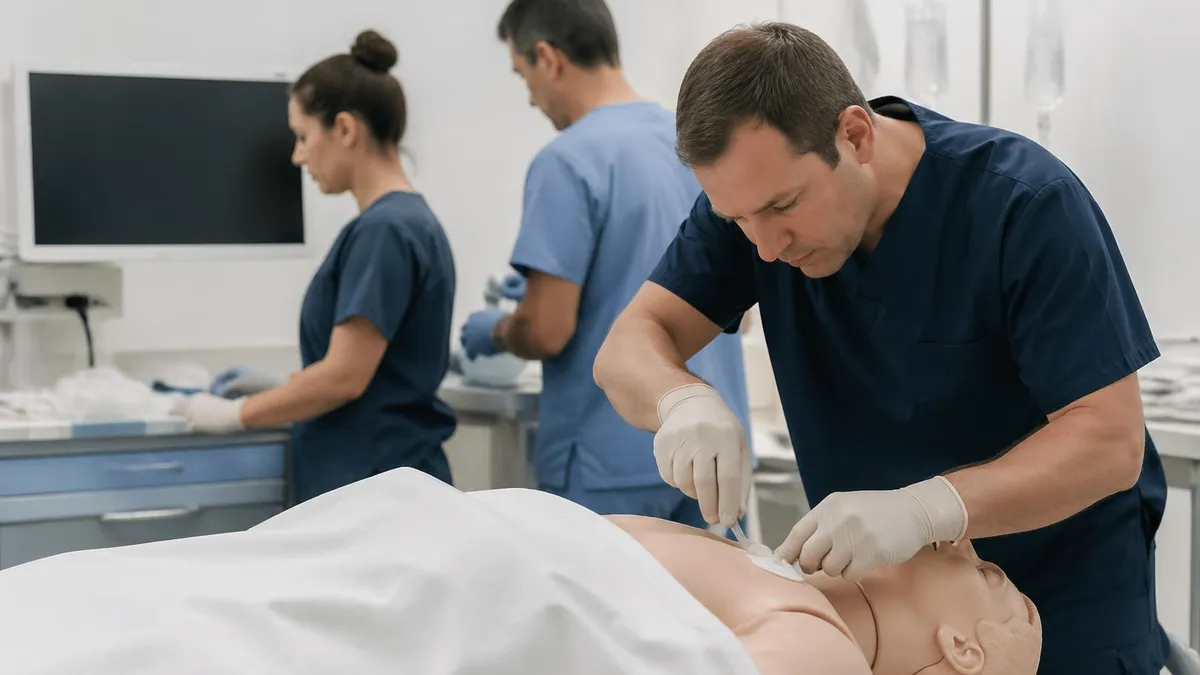
ATLS Certification Guide: Advanced Trauma Life Support Course and Exam

Who Can Take ATLS: Complete Eligibility Requirements and Registration Guide

ATLS Course Online: What You Can and Can't Do Remotely

ATLS Practice Tests: Advanced Trauma Life Support Exam Prep
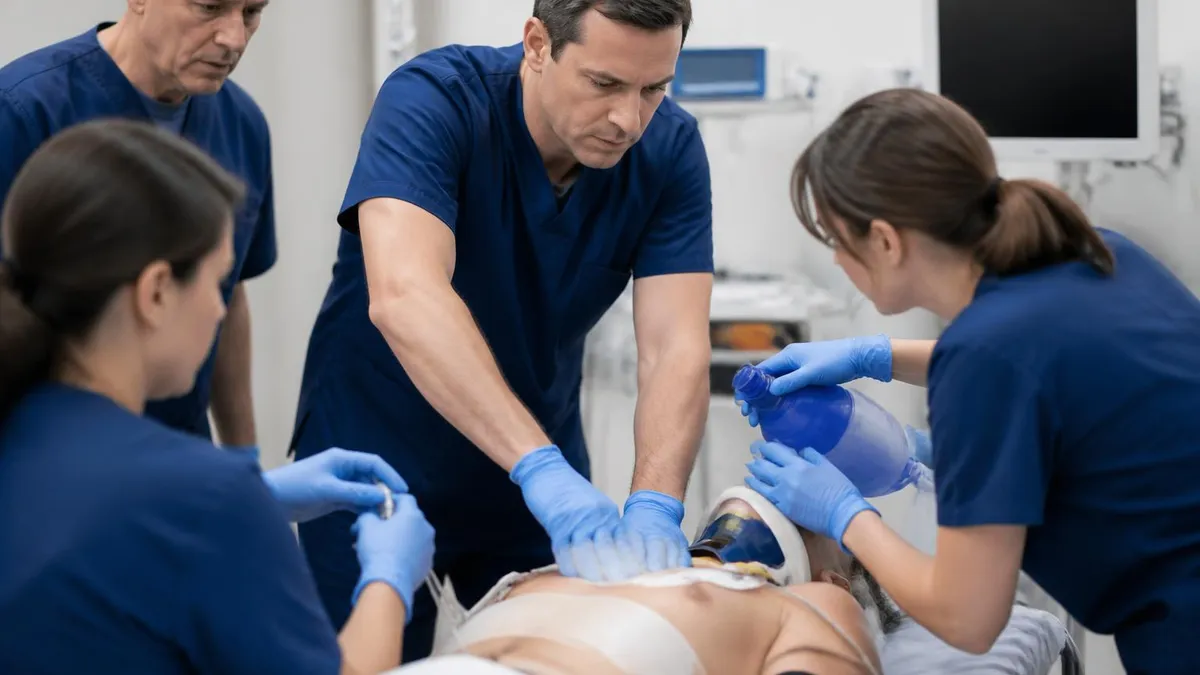
ATLS Training Programs: Course Format, Requirements, and What to Expect
About the Author

Educational Psychologist & Academic Test Preparation Expert
Columbia University Teachers CollegeDr. Lisa Patel holds a Doctorate in Education from Columbia University Teachers College and has spent 17 years researching standardized test design and academic assessment. She has developed preparation programs for SAT, ACT, GRE, LSAT, UCAT, and numerous professional licensing exams, helping students of all backgrounds achieve their target scores.