
Advanced Trauma Life Support (ATLS): Course, Exam, & Cert Guide 2026 September
Complete ATLS guide: ACS course format, 2-day schedule, ABCDE primary survey, $625-$1,200 cost, 80% exam pass mark, 4-year recert, vs ITLS/PHTLS/TNCC. 🟢
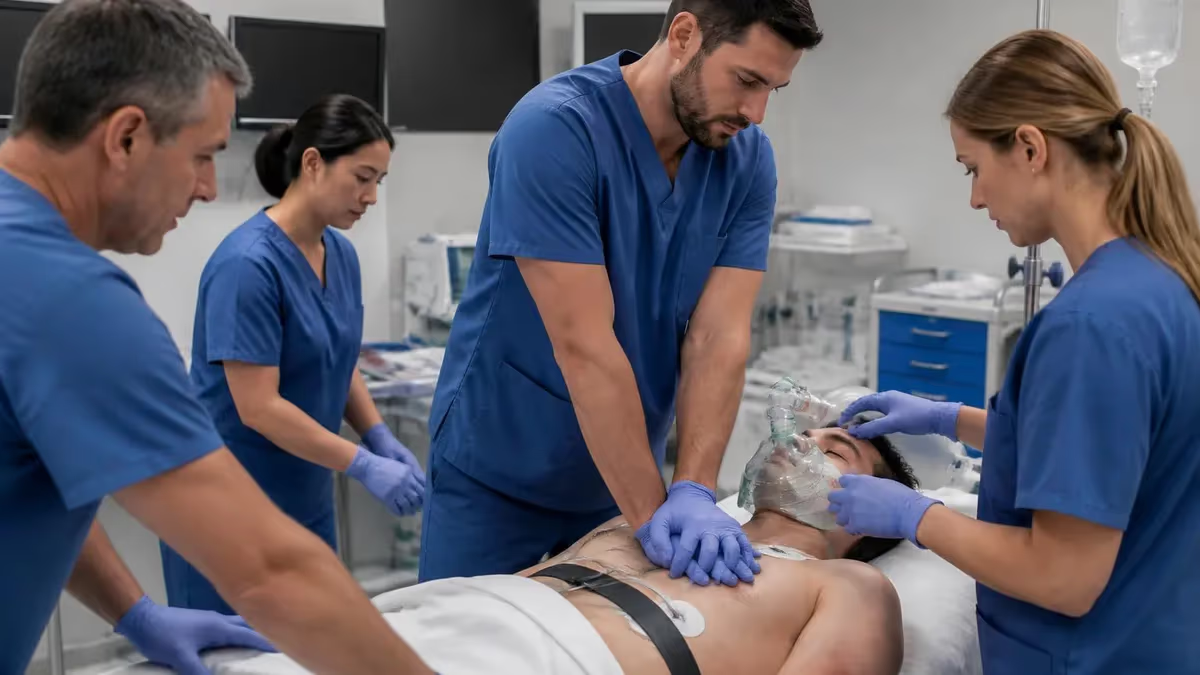
The Advanced Trauma Life Support (ATLS) course is the gold-standard training for physicians who treat injured patients during the first hour after trauma. Developed by the American College of Surgeons (ACS) Committee on Trauma in 1978 after a private-pilot orthopedic surgeon, Dr. James Styner, crashed his plane in rural Nebraska and watched his family receive what he later called "worse care than at the scene of the crash," ATLS has grown into a system taught in more than 80 countries, with over 1.5 million doctors certified to date.
If you are an emergency medicine resident, a general surgery intern starting a trauma rotation, a rural family physician who staffs the only ER for 90 miles, or a military medical officer preparing for deployment, ATLS is almost certainly on your required-training list. It is not a continuing-medical-education box to tick. It is a 2-day, in-person course with an online prework module, a written multiple-choice exam, and a hands-on practical skills station that you must pass to receive the provider card.
This guide walks through everything candidates ask before signing up: who needs ATLS, how the course is structured, what the ABCDE primary survey actually drills into you, the real cost in 2026 (spoiler: more than the brochure suggests), how recertification works, and how ATLS stacks up against ITLS, PHTLS, and TNCC. We finish with study tactics that consistently push pass rates above the program-wide 95% benchmark.
ATLS at a Glance
ATLS is run under the authority of the ACS Committee on Trauma. Each country has a national coordinator, and individual courses are hosted by approved sites, usually academic medical centers, large community hospitals, or military medical commands. The course content is identical worldwide because the manual, slide deck, and skills checklists are tightly controlled by the ACS. What changes between sites is the instructor-to-student ratio (target 1:4), the type of simulation models, and whether cadaver or live-tissue stations are added on top of the standard curriculum.
The current edition is the 10th Edition, released in 2018 and still the official syllabus in 2026. An 11th Edition is in development, but every candidate sitting an exam this year is being tested on 10th Edition material. The manual covers 14 chapters: initial assessment, airway, shock, thoracic trauma, abdominal/pelvic trauma, head trauma, spine trauma, musculoskeletal trauma, thermal injuries, pediatric trauma, geriatric trauma, trauma in pregnancy, transfer to definitive care, and disaster preparedness.
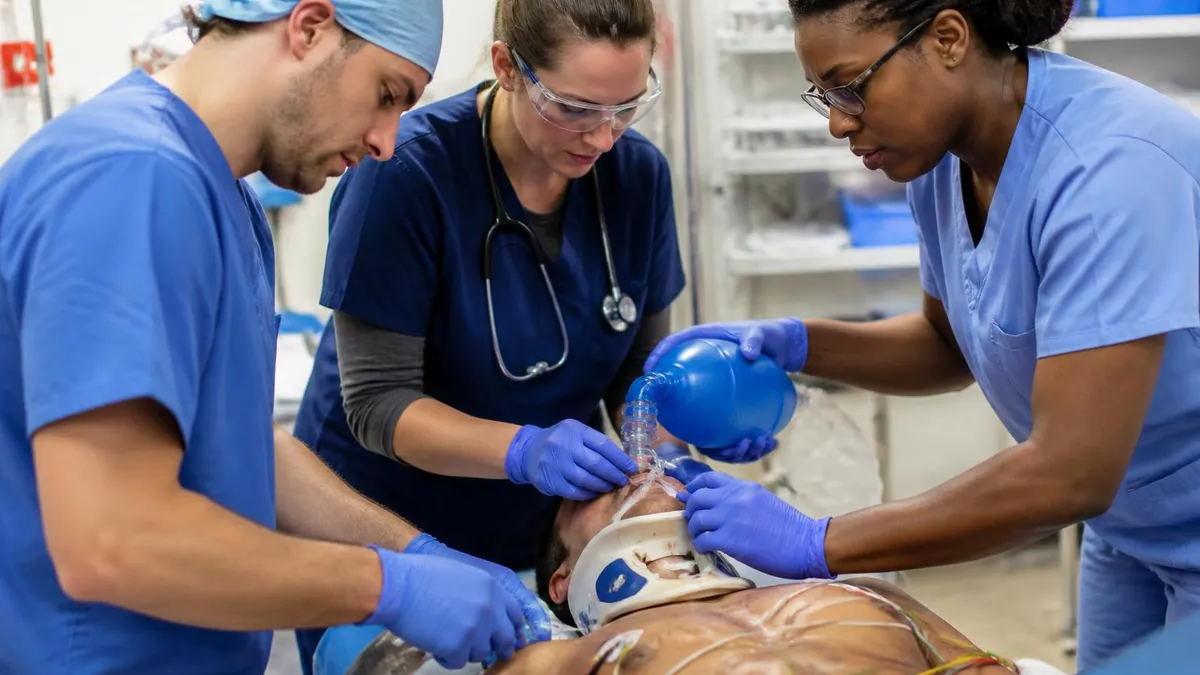
ATLS was created in 1978 after orthopedic surgeon Dr. James Styner crashed his plane in rural Nebraska. His wife died and three of his children were seriously injured. Styner later said the care his family received in the local ER was "worse than at the scene of the crash." Within two years he had partnered with the American College of Surgeons to launch a standardized first-hour trauma curriculum. The course is now taught in over 80 countries and more than 1.5 million physicians have been certified.
The signature mental model of ATLS is the ABCDE primary survey. Every patient gets evaluated and resuscitated in the same order, every time, regardless of how dramatic the most visible injury looks. The order matters because it lists threats to life in the sequence they will kill the patient.
A is Airway with cervical-spine protection. The unconscious trauma patient who cannot protect their airway will die from hypoxia in under four minutes, faster than from any bleeding wound. You assess by asking the patient their name; if they answer in a clear voice, A is intact. If not, you reposition (jaw thrust, not head tilt, because of suspected cervical injury), suction, insert an oropharyngeal or nasopharyngeal airway, and prepare for definitive airway control via endotracheal intubation or a surgical airway.
B is Breathing and ventilation. Expose the chest, look for symmetric rise, palpate for crepitus, auscultate breath sounds, and check oxygen saturation. The immediate killers here are tension pneumothorax (needle decompression at the 5th intercostal space mid-axillary line in the updated 10th Edition, no longer the 2nd intercostal space at the midclavicular line), open pneumothorax (three-sided dressing), and massive hemothorax (chest tube).
C is Circulation with hemorrhage control. Identify and stop external bleeding with direct pressure or a tourniquet, establish two large-bore IVs, draw blood for type and crossmatch, and start balanced resuscitation, ideally with blood products rather than crystalloid in the modern damage-control paradigm.
D is Disability. A rapid neurological exam using the Glasgow Coma Scale, pupil size and reactivity, and motor function in all four limbs.
E is Exposure and environmental control. Fully undress the patient, log-roll to inspect the back, then cover with warm blankets to prevent the lethal triad of hypothermia, acidosis, and coagulopathy.
The ABCDE Primary Survey
Open the airway with a jaw thrust (not head tilt) to protect the cervical spine. Suction, insert an airway adjunct, and prepare for intubation if needed.
Expose the chest, check symmetry, auscultate, and treat tension pneumothorax, open pneumothorax, or massive hemothorax immediately.
Stop external bleeding, place two large-bore IVs, draw blood for crossmatch, and begin balanced resuscitation with blood products.
Rapid neurological exam using the Glasgow Coma Scale, pupils, and motor function in all four limbs.
Fully undress and log-roll the patient, then cover with warm blankets to prevent hypothermia.
ATLS is built around a fixed two-day, in-person course preceded by approximately 8 hours of online prework that you must finish before showing up. The prework includes video lectures, interactive case scenarios, and a pre-test that the course director sees. Skipping the pre-course material is the single most common reason candidates fail the written exam: instructors have repeatedly told the ACS that the day-one pass rate jumps by roughly 15 percentage points when prework is completed thoroughly.
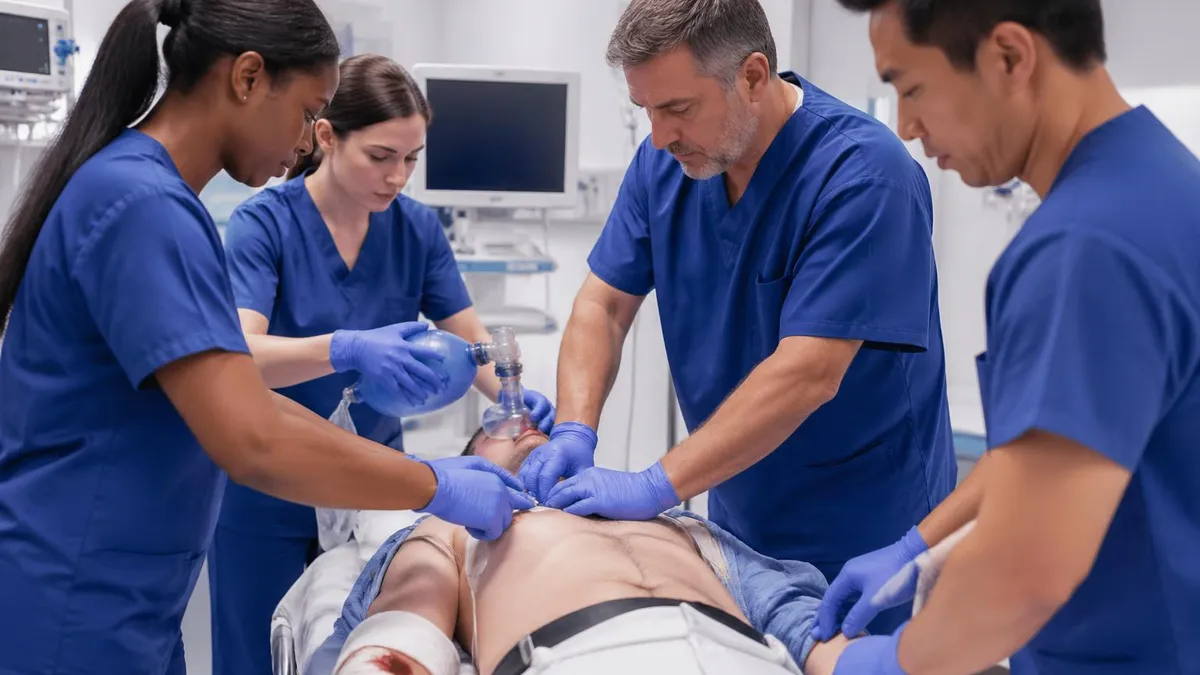
Day one runs from roughly 7 a.m. to 6 p.m. The morning is interactive discussion of the manual chapters, the afternoon is skills stations rotating through airway, surgical airway, chest decompression, FAST ultrasound, and pelvic stabilization. Day two morphs into full patient simulations where teams of four manage a wide-eyed mannequin (or live actor) through a polytrauma scenario while an instructor scores their primary and secondary survey performance. The day closes with the written multiple-choice exam and the practical skills station.
If you are reading this guide more than a month before your course, the highest-yield study path is to (1) buy or borrow the 10th Edition manual now and read two chapters per week, (2) take a free practice quiz every Sunday to identify weak topic areas, (3) attend one trauma morbidity-and-mortality conference at your home institution if you are a resident, and (4) shadow a trauma activation in the ED at least once before the course so the ABCDE rhythm feels familiar rather than foreign on day one.
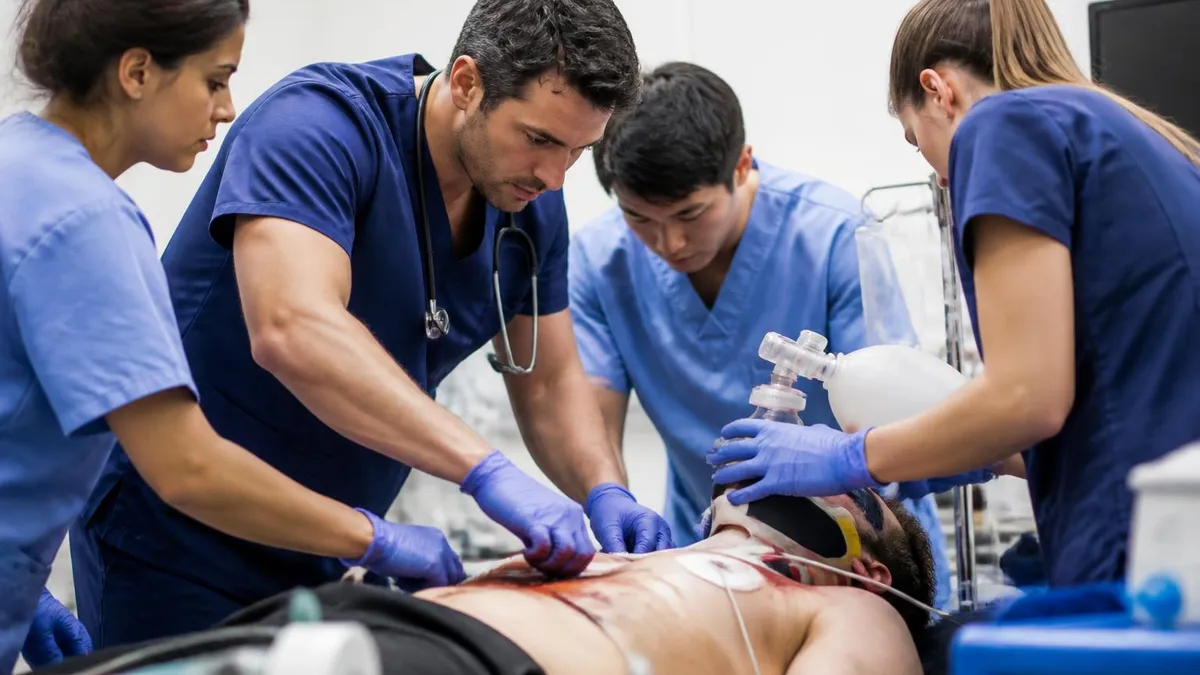
ATLS Course Format Breakdown
Approximately 8 hours of self-paced video lectures, interactive case scenarios, and a pre-test. Must be completed before the course start date. The course director can see your pre-test results, so treat this like a graded module.
The two-station assessment is what trips up about 5% of candidates on their first attempt. The written exam contains 40 multiple-choice questions, drawn from a bank that closely mirrors the chapter review questions in the back of the manual. The passing threshold is 80%, meaning you must answer at least 32 of 40 correctly. There is no penalty for guessing; answer every question. You get 60 minutes.
The practical skills station is performance-based. You are given a brief scenario ("32-year-old male, motorcycle crash, helmeted, GCS 13, hypotensive on arrival"), then you walk through a primary survey on a mannequin while a course instructor scores you against a printed checklist of approximately 25 critical actions. Skipping a single critical action, such as failing to call for blood early in a hypotensive trauma patient, results in a failed station and a required remediation. Candidates who fail one of the two assessments can usually retest the same weekend; failing both means signing up for a future course.
Beyond the formal pass/fail criteria, course directors quietly grade you on team leadership. ATLS is built around the assumption that the trauma team leader (you, in the simulation) calls out actions clearly, assigns roles to teammates, and continually re-evaluates after every intervention. Candidates who silently do everything themselves get flagged, even if they happened to complete the checklist. Practicing "closed-loop communication" ("airway is secure, moving to breathing") before the course makes day two markedly less stressful and protects your skills-station score.
The 10th Edition moved the needle decompression site from the 2nd intercostal space at the midclavicular line to the 5th intercostal space at the mid-axillary line. This is the single most-tested update on the current written exam. Candidates who trained on older editions consistently miss this question, so memorize the new site before the course.
ATLS is required, recommended, or strongly preferred for almost every clinician who might be the first physician to lay hands on a trauma patient.
The most common required-or-recommended groups include trauma surgeons and surgical critical-care fellows (mandatory for board certification renewal at many institutions), emergency medicine attendings and residents (required by most EM residency program directors before independent shifts), general surgery residents (required before trauma rotations at ACS-verified Level I and II centers), orthopedic surgery residents who take trauma call, anesthesiology residents on the trauma service, family medicine and internal medicine physicians who staff rural emergency departments, military medical officers preparing for forward deployment, and flight medicine and HEMS physicians.
Rural and frontier-medicine physicians are an especially important constituency. In a community hospital that sees only a handful of major traumas per year, the ABCDE framework is what prevents skill decay; without ATLS, providers fall back on disorganized improvisation when a critical patient finally arrives. The course is also valuable for international medical graduates preparing for US residency applications, since carrying a current ATLS card is widely viewed as a signal of clinical readiness during interview season.
Nurses, paramedics, and respiratory therapists are not eligible to take ATLS itself, the equivalent courses for them are TNCC (Trauma Nursing Core Course) and PHTLS (Prehospital Trauma Life Support). However, the ACS does run a parallel course called ATCN (Advanced Trauma Care for Nurses) that is taught in parallel with ATLS at the same site so the trauma team can train together.
ATLS Pre-Course Checklist
- ✓Register at the ACS website at least 8 weeks in advance (popular sites fill quickly)
- ✓Purchase or borrow the 10th Edition Student Manual and read it cover to cover
- ✓Complete all online prework modules, including the pre-test
- ✓Memorize the ABCDE primary survey order until it is automatic
- ✓Practice mock scenarios out loud with a study partner
- ✓Shadow one trauma activation in your local ED if possible
- ✓Confirm your hospital or program will reimburse the tuition
- ✓Bring the manual, a notebook, scrubs or comfortable clothes, and ID to the course
Course pricing varies more than candidates expect. The base tuition published by the ACS is around $625-$1,200 in the United States, depending on whether the candidate is a resident, attending, or international student, and whether the host site is a military or academic facility offering a discount. Add the cost of the manual (currently $175 if you do not already own a copy), travel, two hotel nights for non-local candidates, and meals, and the realistic total approaches $1,500-$2,000.
Most residency programs cover the full cost for trainees as part of the educational budget. Attending physicians who need ATLS for credentialing typically have it reimbursed by their hospital. Self-paying physicians, especially international medical graduates trying to match into a US program, should budget the higher figure and look for "ATLS provider course" listings on the ACS website, where prices and waitlists are posted publicly.
International pricing differs significantly. ATLS courses run in the United Kingdom under the Royal College of Surgeons cost roughly £625, in Canada through the Trauma Association of Canada around CAD $900, and in Australia and New Zealand through the Royal Australasian College of Surgeons around AUD $1,400. Military medical commands frequently offer ATLS for free to active-duty personnel, and that subsidized seat is one of the most cost-efficient ways to acquire the certification if you qualify. Waitlists can stretch six months in popular urban sites, so register the moment a course is announced.
Is ATLS Right for You?
- +Universally recognized credential for trauma care in the United States and over 80 countries
- +Required or strongly preferred by most US residency programs and trauma centers
- +Pass rate above 95% for candidates who complete the prework thoroughly
- +Standardized vocabulary that lets multi-disciplinary trauma teams communicate clearly
- +Hands-on practical stations build muscle memory you actually use in the resuscitation bay
- −Total cost can reach $1,500-$2,000 once manual, travel, and lodging are included
- −Two-day in-person format is hard to schedule around clinical duties
- −Recertification required every four years, including a refresher course
- −Not open to nurses, paramedics, or RTs (must take ATCN, TNCC, or PHTLS instead)
- −Online prework is mandatory and time-intensive (approximately 8 hours)
The ATLS provider card is valid for four years. To recertify, candidates take the abbreviated ATLS Refresher Course, which compresses the original two-day curriculum into a single intensive day, focused on simulation, with a shorter written exam at the end. The refresher costs roughly half of the original course and is widely available at the same host sites.
If a provider lets the card expire by more than 90 days, the ACS requires them to take the full two-day course again. There is no honorary or grandfathered status; the certification lapses cleanly on the four-year anniversary. Most hospitals run an internal tracking system through their medical staff office and email reminders 6 months before expiration. Setting your own calendar reminder is wise because losing your ATLS card temporarily can suspend trauma-team privileges.
Trauma education has a small alphabet soup of courses, and candidates frequently ask which one they actually need. ITLS (International Trauma Life Support) is taught primarily to prehospital providers, paramedics, and rural physicians; it overlaps heavily with ATLS but emphasizes austere-environment management. PHTLS (Prehospital Trauma Life Support) is the NAEMT-run analog for EMS providers, focused on field stabilization and rapid transport decisions.
TNCC, run by the Emergency Nurses Association, is the nursing-focused 2-day course. ETM (European Trauma Course) is the European Resuscitation Council answer to ATLS and uses a team-based rather than individual-leader model. For US physicians, ATLS is almost always the right choice because it is the credential hospitals and residency programs ask for by name.
Pass rates for ATLS sit above 95% program-wide, but the strategies separating first-time pass from a retest are predictable. Read the manual cover to cover at least once, do not skim. Pay extra attention to the chapter review questions; the written exam draws heavily from this style. Complete the full online prework before day one, including all interactive cases.
Memorize the order of the primary survey until it is automatic, instructors fail candidates for jumping out of order, not for missing fine details. Practice mock scenarios out loud with a study partner; saying "I am moving to step B, breathing, I expose the chest, look, listen, feel" in front of another human is the closest you get to the actual practical exam environment.
The most common reasons for failing ATLS on the first attempt are surprisingly mundane. Candidates skip prework. Candidates memorize the secondary survey but not the primary survey order. Candidates panic at the practical station and skip a "critical action" such as calling for blood in a hypotensive patient or applying a pelvic binder when the patient has signs of pelvic instability. Candidates do not read the question stem on the written exam carefully, ATLS questions are notorious for hiding the correct answer behind an extra qualifier in the last sentence of the stem.
The fix is simple. Treat the prework like a graded class. Memorize the primary-survey order in writing before the course. Use the printed practical checklist available in the ACS instructor materials as your own study aid. Read every question stem twice on the written exam, especially the long ones.
Taken together, ATLS is more than a certification; it is the shared mental model that lets a trauma surgeon in Boston, a rural family physician in Wyoming, and a military medic in a forward operating base manage the same critical patient using the same vocabulary. That standardization is what saves lives in the first hour.
The certification itself is a 2-day commitment, a single written exam, and a hands-on skills station, but the habit of thinking ABCDE every time you walk into a resuscitation bay is what stays with you for the rest of your career. One last piece of advice from instructors who have watched thousands of candidates pass through: practice talking through scenarios out loud, because instructors score what they hear and see, not what you intend.
ATLS Questions and Answers
About the Author

Educational Psychologist & Academic Test Preparation Expert
Columbia University Teachers CollegeDr. Lisa Patel holds a Doctorate in Education from Columbia University Teachers College and has spent 17 years researching standardized test design and academic assessment. She has developed preparation programs for SAT, ACT, GRE, LSAT, UCAT, and numerous professional licensing exams, helping students of all backgrounds achieve their target scores.