
ACLS Provider Manual: What's Inside the AHA 2026 October Handbook and Where to Get It
🎓 ACLS provider manual guide: what's inside the AHA 2026 October handbook, where to buy it, product code 15-1005, ebook options, and how to study.

What Is the ACLS Provider Manual?
If you're preparing for an ACLS course, you've probably heard that you'll need the ACLS Provider Manual — but what exactly is it, and why does it matter? It's the official textbook published by the American Heart Association (AHA) for healthcare providers who complete ACLS certification. It covers everything from cardiac arrest algorithms to pharmacology to airway management, all aligned with the latest AHA guidelines. Hospitals, nursing schools, and EMS programs treat it as the definitive source for resuscitation protocols in the United States.
The current edition — ISBN 978-1-61-669799-0, AHA product code 15-1005 — reflects the 2020 AHA Guidelines for CPR and Emergency Cardiovascular Care (ECC). Most ACLS training centers include a copy of the manual in your course fee, though some require you to purchase it separately before your class starts. Either way, you'll want it in hand well before test day. Don't wait until the week of your course to crack it open — the manual is dense, and instructors expect you to arrive with a working knowledge of the algorithms before you walk in the door.
Think of the ACLS Provider Book as your roadmap. The algorithms in it aren't just reference material — instructors expect you to know them cold. Pair it with your ACLS cheat sheet for quick-reference summaries while you work through the full manual, and use the ACLS algorithms page to drill the flowcharts until they're second nature. The manual doesn't just list drug doses; it walks you through the decision points that tell you which drug to give, when to give it, and what to do if the patient doesn't respond. That context is what turns memorized facts into clinical judgment.
A quick note on editions: if someone hands you an older copy — say, from 2015 or earlier — it's not the same book. The 2020 update changed the cardiac arrest algorithm, expanded post-cardiac arrest care, and revised the stroke section. Your exam will test you on 2020 guidelines. The manual's product code 15-1005 guarantees you have the right version. If you're buying online and the listing doesn't specify the edition year, check the ISBN before you click purchase.
One thing providers sometimes overlook: the manual isn't just a study tool — it's an ongoing clinical reference. Many ACLS-certified providers keep a copy on their unit or in their locker as a quick reference for drug dosing and algorithm review between certifications. The pharmacology section alone is worth the cost if you ever find yourself mid-resuscitation needing to confirm an amiodarone dose. Real clinical use is built into how the manual was designed — not just exam prep, but bedside decision support for the two years between certifications.
The manual is also widely used as a teaching resource in nursing programs, paramedic training, and medical school emergency medicine rotations. Institutions adopt it because it standardizes the language of resuscitation — the same algorithm steps, the same drug doses, the same systematic approach — so that any certified provider can step into a team and function effectively regardless of where they trained. That standardization is by design, and the manual is the document that makes it possible.

What's Inside the ACLS Provider Manual
Opens with a refresher on Basic Life Support — high-quality CPR, compression depth and rate (at least 2 inches, 100-120/min), rescue breathing ratios, and the chain of survival. If your BLS skills are rusty, this section brings you up to speed before the advanced material begins.
The heart of the manual. Covers the cardiac arrest algorithm (VF/pVT, PEA/asystole), bradycardia, tachycardia (stable vs. unstable), acute coronary syndromes, and stroke. Each algorithm appears as a step-by-step flowchart you can trace and memorize. This is the section most providers study first.
Detailed drug reference for epinephrine, amiodarone, lidocaine, adenosine, atropine, dopamine, and more. Includes adult doses, routes, indications, and timing within each algorithm. Epinephrine (1 mg IV/IO every 3-5 min), amiodarone (300 mg first dose), adenosine (6 mg first, 12 mg repeat) — these are the numbers the exam tests.
The reversible causes of cardiac arrest — Hypovolemia, Hypoxia, Hydrogen ion (acidosis), Hypo/Hyperkalemia, Hypothermia, Tension pneumothorax, Tamponade, Toxins, Thrombosis. The manual explains how to identify and treat each one during a resuscitation. Expect questions on this section in the written exam.
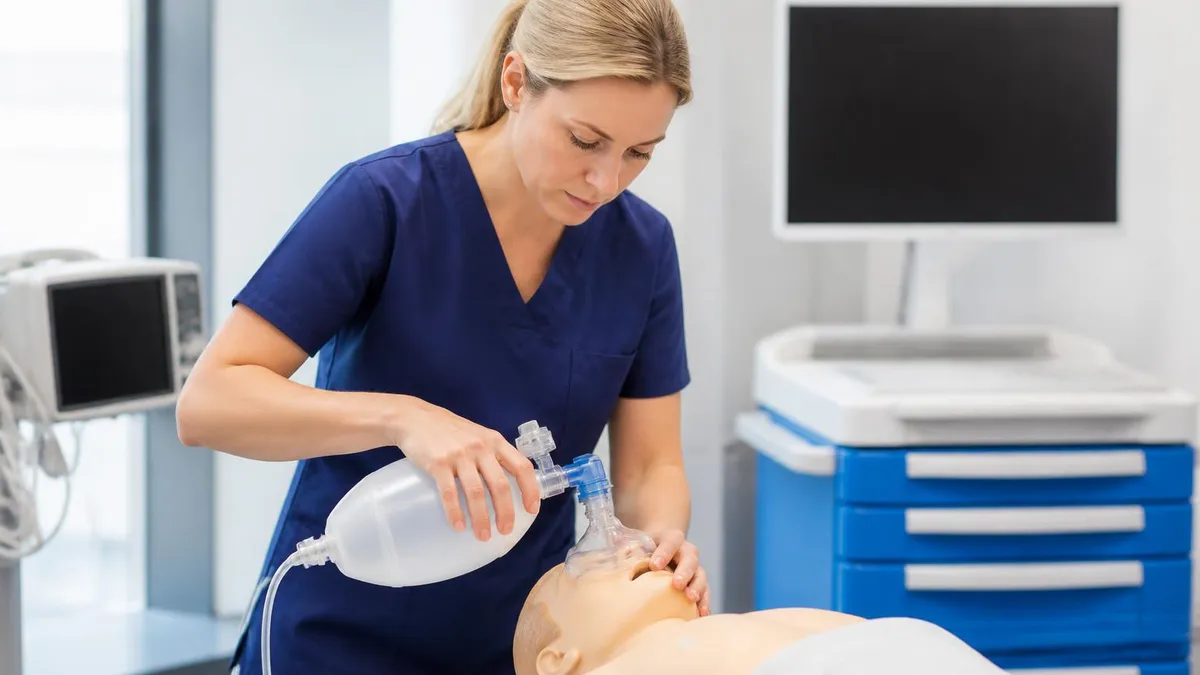
Covers bag-mask ventilation, advanced airway devices (supraglottic airways, endotracheal intubation), capnography for confirmation, and ventilation rates during CPR. Skill station checklists are included so you know exactly what evaluators watch for during your course.
Explains defibrillation, synchronized cardioversion, and transcutaneous pacing — including energy settings, pad placement, and indications for each. Rhythm recognition is woven throughout. If you can't distinguish VF from pVT at a glance, this section is where you fix that.
A dedicated section on what happens after ROSC (return of spontaneous circulation): targeted temperature management (32-36°C), hemodynamic optimization, coronary reperfusion, and neurological assessment. The 2020 edition expanded this section significantly compared to older versions.
Realistic clinical scenarios that mirror the megacode station you'll face in your actual course. Each case study walks through team dynamics, role assignments, and decision-making under pressure. Reading these — even once — builds the mental framework for leading a resuscitation team.
2020 AHA Updates: What Changed and How to Use the Manual
The current ACLS provider manual is the 2020 edition, and it brought meaningful changes from the 2015 version. If you've taken ACLS before and are recertifying, knowing what's different matters — the exam tests you on updated protocols, not old ones. Reviewing the updated manual isn't optional for recertification; it's how you avoid walking in armed with outdated information.
Key changes in the 2020 edition
The cardiac arrest algorithm got the most attention. Vasopressor timing was clarified: epinephrine is still the first-line drug in non-shockable rhythms (PEA/asystole), but the 2020 guidelines emphasize earlier administration rather than waiting through multiple cycles. In shockable rhythms (VF/pVT), epinephrine comes after the third shock — same as before, but the rationale around vasopressor benefit versus harm is more explicitly spelled out. If you took ACLS under the 2015 guidelines, this distinction is one of the most tested changes on current recertification exams.
Post-cardiac arrest care expanded significantly. The 2020 guidelines replaced "therapeutic hypothermia" with targeted temperature management (TTM). The recommended target temperature range shifted to 32-36°C rather than the narrower 32-34°C from older guidelines. Neurological prognostication timelines were also updated, pushing the minimum observation window to 72 hours after rewarming. That directly affects how you'd answer exam questions about neurological prognosis timing.
The aha 2020 acls provider student manual updated its stroke section to align with the expanded window for mechanical thrombectomy — now up to 24 hours in select patients. Acute coronary syndrome content reflects updated door-to-balloon time targets and antiplatelet therapy guidance. The BLS section was revised to reflect the 2020 compression-only CPR guidance for bystanders, which differs from the healthcare provider protocol. Know that difference — it's a common source of confusion on the written exam.
Key ACLS Drug Doses (from the 2020 Manual)
How to study effectively with the manual
Don't try to read the ACLS provider handbook cover to cover in one sitting. It's a reference document — dense by design. Start with the algorithms and work outward. Print out or bookmark each flowchart. For cardiac arrest, trace every branch. Ask yourself: what's the next step if defibrillation fails? When do I give amiodarone vs. lidocaine? What changes if this is PEA instead of VF? These aren't rhetorical questions — they're the exact decision points your instructor will probe during case-based scenarios.
Once you've got the algorithms down, dig into pharmacology. The drug doses in the manual are the ones you'll be tested on. After memorizing the doses, read the H's and T's section carefully — it's a common weak spot on the written exam. Work through each cause: if a patient in cardiac arrest has a history of dialysis, what electrolyte abnormality do you suspect? What treatment do you reach for? The manual answers both — but you have to work through the scenarios, not just skim the list.
Use the ACLS primary assessment content alongside the manual's systematic approach chapters — the two reinforce each other. And when you've worked through a section, test yourself. Running through ACLS practice tests exposes gaps in your knowledge faster than rereading does. Timed practice questions push you to apply what you know under pressure — exactly what you'll face in the course. Don't just read the manual; interrogate it.
The skill station checklists at the end of the manual are often overlooked. They're not just for instructors — they tell you exactly what evaluators watch for during your megacode. Read them. Practice them out loud. The difference between passing and failing the hands-on evaluation often comes down to whether you verbalize your interventions clearly and call out rhythm checks at the right times. "Analyzing rhythm — all clear — shock advised — charging — everyone clear — shock delivered" is a sequence that needs to feel automatic.
The manual gives you the script. Practice turns it into reflex. Plan your study time with at least a week to spare before your course so you have room to revisit weak spots after your first pass through the material.
Print vs. Ebook: Which Version Should You Get?
The print ACLS provider manual runs approximately $40-55 depending on where you buy it. Most providers prefer it for initial study — you can tab sections with sticky notes, write in margins, and flip between algorithms without losing your place on a screen. The print edition (AHA product code 15-1005, ISBN 978-1-61-669799-0) is what most training centers stock, and it's what instructors typically reference during class.
One practical note: the manual is a full-size textbook, not a pocket guide. It doesn't fit in a lab coat pocket. If you want something portable to carry during shifts, pair the print edition with your reference cards — the AHA sells these separately and they're sized for a pocket or badge holder.
If your training center includes the manual in your course fee, confirm which edition you'll receive. Some centers stock older copies. The 2020 edition is the only version aligned with current guidelines — don't study from 2015 material and expect to pass a 2020 exam.
AHA Website (heart.org) — Official source. Guaranteed current 2020 edition. Both print (~$40-55) and ebook (~$30-40) available. Use product code 15-1005 to find it quickly.
Amazon — Widely available, often with Prime shipping. Search the ISBN 978-1-61-669799-0 to confirm you're buying the 2020 edition — third-party sellers sometimes list older versions. Check the edition year before you buy.
Barnes and Noble — Stocks the print edition in-store and online at BarnesAndNoble.com. Call ahead if you need same-day; not every location carries it.
Local AHA Training Centers — Many include the manual in your course registration fee. Ask when you register — if it's included, don't buy a separate copy until you confirm the edition they provide is the 2020 version. The ACLS certification cost breakdown covers what's typically included at different training centers.
Studying With the ACLS Manual: What Works and What Doesn't
- +Algorithms are presented as flowcharts — trace them by hand to build memory
- +Pharmacology section includes doses, routes, and timing in one place
- +Skill station checklists show exactly what evaluators score during megacode
- +Case studies mirror real course scenarios — read them before your class
- +H's and T's section is well-organized and covers all reversible causes
- −Dense text — cover-to-cover reading is not the best study approach
- −No practice questions inside the manual itself — pair it with external quizzes
- −Print edition is full-size — not practical to carry during clinical shifts
- −Ebook DRM ties it to your AHA account — not shareable or printable
- −Older editions (2015) are still sold online — confirm the 2020 edition before buying
Pros and Cons at a Glance
| Pros | Cons |
|---|---|
| Algorithms are presented as flowcharts — trace them by hand to build memory | Dense text — cover-to-cover reading is not the best study approach |
| Pharmacology section includes doses, routes, and timing in one place | No practice questions inside the manual itself — pair it with external quizzes |
| Skill station checklists show exactly what evaluators score during megacode | Print edition is full-size — not practical to carry during clinical shifts |
| Case studies mirror real course scenarios — read them before your class | Ebook DRM ties it to your AHA account — not shareable or printable |

Free PDF, Ebook Options, and Studying Smart
Is there a free PDF of the ACLS provider manual?
This comes up constantly on Reddit and nursing forums: Is there a free ACLS provider manual 2020 PDF? The short answer is no — not a legitimate one. The AHA manual is copyrighted, and any PDF circulating on file-sharing sites is an unauthorized copy. Beyond the legal issues, pirated versions are often incomplete, watermarked from older editions, or missing the updated 2020 algorithms entirely. You don't want to memorize outdated drug doses or deprecated protocols and then fail your exam because you studied the wrong version.
The official ACLS provider manual 2020 ebook is the smart middle ground if you want a digital version. It's available through the AHA's website for around $30-40 — less than the print edition and accessible on any device. If you're studying on a tablet during breaks at work, the ebook format is genuinely more convenient. Search for AHA product code 15-1005 to make sure you're getting the correct 2020 edition, whether in print or digital format. The AHA's reader app is available for iOS and Android, so access isn't limited to a desktop browser.
Some providers look for the ACLS provider manual on Amazon hoping for a better price. You'll find it there, but watch for third-party listings selling older editions from 2015 or earlier. Always check the edition year and the ISBN before buying. The 2020 edition's ISBN is 978-1-61-669799-0 — if the listing doesn't show that number, or if the edition year isn't clearly stated, skip it and buy from the AHA directly. It's worth paying the standard price to know you have the right material.
A word on supplementary materials: the AHA also sells standalone reference cards and pocket guides that complement the manual but don't replace it. These are useful for quick bedside reference after your certification but aren't a substitute for working through the full manual before your course. Think of the manual as your primary study resource and the reference cards as your post-certification clinical tool.
Bottom line: the official manual costs less than most clinical CE courses and gives you far more. It's the primary source for everything your ACLS exam will test you on. Buy it early, study it strategically, and use it as a reference after certification — that's what it was designed for.
How to Study With the ACLS Provider Manual
- ✓Start with the cardiac arrest algorithm — trace both the shockable (VF/pVT) and non-shockable (PEA/asystole) branches before touching anything else
- ✓Memorize key drug doses: epinephrine 1 mg IV/IO every 3-5 min, amiodarone 300 mg first dose / 150 mg second, adenosine 6 mg / 12 mg / 12 mg
- ✓Read the H's and T's section in full — reversible causes are a common written exam weak spot
- ✓Work through the skill station checklists out loud to prepare for the megacode evaluation
- ✓Read at least two case studies before your course to build the mental framework for team leadership
- ✓Use reference cards for portable, fast-lookup access to algorithms during clinical practice after certification
- ✓Pair each manual chapter with targeted practice questions to identify and close knowledge gaps
Getting the most out of the advanced cardiovascular life support provider manual
The advanced cardiovascular life support ACLS provider manual works best as a study companion, not a standalone resource. It was designed to be used alongside hands-on practice, instructor-led scenarios, and self-testing. Here's what actually moves the needle when you sit down to study:
Read the algorithms first, then fill in the pharmacology. The flowcharts give you structure. Once you know that epinephrine comes after the first cycle in PEA/asystole, the dose (1 mg IV/IO every 3-5 minutes) sticks because it has context. Abstract memorization rarely holds under exam pressure — algorithm-anchored memorization does. When you know where a drug fits in the flow, you reach for it without thinking. That's the difference between knowing information and being able to apply it under pressure.
Use the reference cards. The manual includes pocket-sized reference cards at the back — or they're available separately from the AHA. They're legal to use during some portions of your course and built for quick lookup during clinical practice after certification. Get comfortable with the card layout before your class starts. Being able to navigate a reference card quickly is its own skill — don't let the first time you use one under pressure be during your actual megacode evaluation.
Pair the manual with practice questions. After each chapter, find questions that test that specific content. The pharmacology section pairs with drug-dose recall questions. The algorithms section pairs with rhythm recognition and decision-making scenarios. Running through targeted questions reveals gaps that rereading won't. You might read the epinephrine dosing section three times and still blank on the second dose of amiodarone when it appears in a question stem — practice tests make that gap visible before your exam does.
Work through the systematic approach chapters actively. The manual walks through the primary ACLS survey — airway, breathing, circulation, disability, exposure — in detail. Don't just read it; practice verbalizing it out loud. Most providers who struggle with the hands-on portion of their ACLS course do so not because they don't know the content, but because they've never said it out loud. Your instructor is listening for specific phrases. The manual tells you exactly what those phrases are.
Don't underestimate the case studies. Many providers skim them, but they mirror the megacode stations in your actual course. Reading through one case study before you arrive builds the mental schema for leading a resuscitation. That schema kicks in when you're at the head of the bed during your evaluation and your instructor calls out a rhythm change. Your team is looking at you. The case studies are one of the most practical, underused tools in the whole book — and they cost nothing extra to use.
Finally, think beyond the exam. The ACLS provider manual Amazon listings and AHA website both offer the manual as a clinical reference tool, not just a study guide. Once you're certified, keep your copy accessible. Whether it's on your unit's crash cart shelf or in your locker, having the manual nearby gives you a reliable reference for drug doses, algorithm sequencing, and post-arrest care that doesn't depend on your memory — especially valuable in the first few months after certification when you haven't yet worked through a real resuscitation in your facility.
Recertification comes every two years. By then, check for updated guidelines before your renewal course. The AHA periodically revises its guidelines, and the manual editions follow those updates. If you earned ACLS in 2022 or 2023 using the 2020 manual, your next renewal will likely use the same edition unless a major update has been published. Check the AHA website when your renewal window opens — the product code structure stays consistent, making it easy to confirm you have the current version before you buy.
For a fuller set of questions on this topic, see our aha acls algorithms resource.
ACLS Questions and Answers

ACLS Cheat Sheet: Complete 2026 Quick Reference Guide for Algorithms, Drugs, Doses & H's and T's

ACLS Algorithms 2026: Complete Cardiac Arrest, Bradycardia & Tachycardia Guide

ACLS Certification Cost: Complete 2026 Price Guide for Initial Courses, Renewals, Online Options & Hidden Fees

ACLS Primary Assessment: Complete 2026 Guide to the ABCDE Approach, Algorithm Integration & High-Quality Resuscitation
About the Author

Registered Nurse & Healthcare Educator
Johns Hopkins University School of NursingDr. Sarah Mitchell is a board-certified registered nurse with over 15 years of clinical and academic experience. She completed her PhD in Nursing Science at Johns Hopkins University and has taught NCLEX preparation and clinical skills courses for nursing students across the United States. Her research focuses on evidence-based exam preparation strategies for healthcare certification candidates.