
ACLS Cheat Sheet: Complete 2026 October Quick Reference Guide for Algorithms, Drugs, Doses & H's and T's
ACLS cheat sheet covering algorithms, drug doses, H's and T's, and post-arrest care. 📝 Free 2026 October quick reference guide for certification prep and
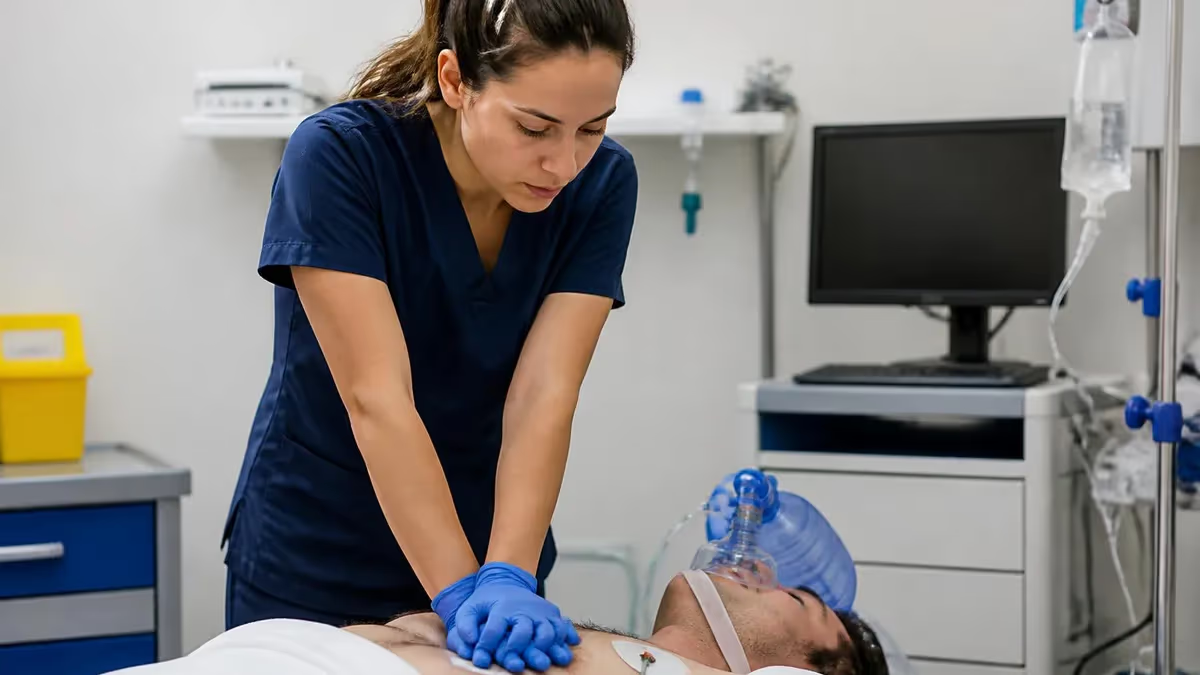
An ACLS cheat sheet is the single most valuable study tool you can carry into your certification exam, megacode simulation, or actual cardiac arrest event. This 2026 quick reference distills every American Heart Association algorithm, drug dose, defibrillation energy level, and reversible cause into a format you can scan in seconds. Whether you are a first-time candidate, a renewing provider, or a clinician who wants confident recall at the bedside, this guide compresses 12 hours of course material into the high-yield essentials that actually appear on the test and in real codes.
The Advanced Cardiovascular Life Support curriculum has expanded significantly since the 2020 AHA update, with the 2026 guidelines emphasizing high-quality CPR metrics, double sequential defibrillation considerations, and refined post-arrest neuroprognostication. Memorizing rhythm strips and drug names is not enough anymore. You must understand sequencing, timing, and the clinical reasoning behind every step. This cheat sheet organizes information the way your brain needs it during a code: by rhythm, then by intervention, then by medication, then by reversible cause.
Most candidates fail the ACLS exam not because they lack medical knowledge, but because they freeze when asked to recall a precise dose under pressure. Epinephrine 1 mg IV every 3 to 5 minutes. Amiodarone 300 mg first dose, 150 mg second. Adenosine 6 mg rapid push, then 12 mg. These numbers must be reflexive. By pairing this written reference with active recall practice and timed simulations, you train your memory to surface the right answer in under three seconds.
The cheat sheet below is structured to mirror the flow of a real resuscitation. It begins with the BLS survey and acls primary assessment, transitions through the cardiac arrest algorithm for ventricular fibrillation, pulseless ventricular tachycardia, asystole, and pulseless electrical activity, then covers bradycardia, tachycardia with and without pulses, acute coronary syndromes, and stroke. Each section ends with the pharmacology you must know cold and the team dynamics principles that separate passing candidates from failing ones.
You will also find rapid-reference tables for the H's and T's, defibrillation energy doses for monophasic and biphasic devices, target end-tidal CO2 values, and the post-cardiac-arrest care bundle including targeted temperature management. Pair this guide with the comprehensive ACLS Study Guide: Complete 2026 Certification Prep with Algorithms, Drugs & Practice Tests for deeper context on each algorithm and the evidence behind every recommendation.
One word of caution before you dive in: a cheat sheet is a memory aid, not a substitute for understanding. The AHA exam includes scenario questions that test whether you know why a specific intervention is appropriate, not just whether you can list the dose. Read the rationale paragraphs, work through the practice questions linked throughout, and complete at least two full megacode simulations before sitting for your skills station. Candidates who do this consistently pass on the first attempt at rates above 95 percent.
Finally, keep this reference accessible in clinical practice. Print it, laminate it, or save it to your phone. Even seasoned providers benefit from a quick glance during the chaos of a real arrest. Cognitive load drops, errors decrease, and team performance improves when the leader has the right numbers visible. That is the entire purpose of this document, and it is built to serve you both on exam day and on the worst day of your patient's life.
ACLS Cheat Sheet by the Numbers

Cardiac Arrest Algorithm — Step-by-Step Quick Reference
Confirm unresponsiveness, check breathing and pulse simultaneously for no more than 10 seconds. Activate the emergency response system, call for the code cart and defibrillator, and begin high-quality CPR immediately at a depth of 2 to 2.4 inches.
Apply pads or paddles as soon as the defibrillator arrives. Identify the rhythm during a brief pulse check pause. Shockable rhythms are ventricular fibrillation and pulseless ventricular tachycardia. Non-shockable rhythms are asystole and pulseless electrical activity.
If VF/pVT, deliver a single shock at 200 J biphasic or 360 J monophasic and resume CPR immediately for two minutes. If asystole or PEA, continue CPR and administer epinephrine 1 mg IV/IO as soon as access is established.
Give epinephrine 1 mg every 3 to 5 minutes throughout the arrest. After the second shock, add amiodarone 300 mg or lidocaine 1 to 1.5 mg/kg for refractory VF/pVT. Place an advanced airway and confirm with waveform capnography.
Systematically search for and treat the H's and T's: hypovolemia, hypoxia, hydrogen ion acidosis, hypo/hyperkalemia, hypothermia, tension pneumothorax, tamponade, toxins, thrombosis pulmonary, and thrombosis coronary. Without reversing the cause, return of spontaneous circulation is unlikely.
The ACLS drug list is shorter than most candidates expect, but mastering the precise indications, doses, and routes for each medication is the difference between a passing megacode and a failed skills station. The core arrest medications are epinephrine, amiodarone, and lidocaine. The core bradycardia medications are atropine, dopamine, and epinephrine infusion. The core tachycardia medications are adenosine, beta blockers, calcium channel blockers, and amiodarone. The core post-arrest medications include norepinephrine and dobutamine for hemodynamic support.
Epinephrine remains the cornerstone of cardiac arrest pharmacology. Administer 1 mg of the 1:10,000 concentration intravenously or intraosseously every 3 to 5 minutes throughout the entire arrest, regardless of the underlying rhythm. The 2026 AHA guidelines continue to emphasize early administration of epinephrine in non-shockable rhythms, ideally within the first minute after recognition. For shockable rhythms, give the first dose of epinephrine after the second shock to avoid interrupting the initial defibrillation strategy.
Amiodarone is the antiarrhythmic of choice for refractory ventricular fibrillation or pulseless ventricular tachycardia. The first dose is 300 mg IV/IO push, followed by a second dose of 150 mg if VF or pVT persists. Lidocaine is an acceptable alternative at 1 to 1.5 mg/kg for the first dose and 0.5 to 0.75 mg/kg for the second. Magnesium sulfate 1 to 2 grams is reserved for torsades de pointes or suspected hypomagnesemia, not routine VF.
For symptomatic bradycardia with a pulse, atropine 1 mg IV is the first-line drug, repeated every 3 to 5 minutes up to a maximum of 3 mg. If atropine is ineffective, transcutaneous pacing is the next step, followed by dopamine infusion at 5 to 20 mcg/kg/min or epinephrine infusion at 2 to 10 mcg/min. The 2026 update doubled the atropine starting dose from the previous 0.5 mg recommendation, simplifying the algorithm and improving response rates.
Tachycardia management depends on stability and rhythm width. For stable narrow-complex tachycardia, attempt vagal maneuvers first, then give adenosine 6 mg rapid IV push followed by a 20 mL saline flush. If unsuccessful, the second dose is 12 mg. For stable wide-complex tachycardia, amiodarone 150 mg over 10 minutes is preferred. Unstable tachycardia at any width requires synchronized cardioversion, with energy doses ranging from 50 to 200 J depending on rhythm. Review the complete ACLS Drugs: Complete 2026 Guide to Medications, Doses, Indications & Algorithm Use for infusion protocols and pediatric adjustments.
Memorization tricks help enormously. The phrase "E-A-L" — Epinephrine, Amiodarone, Lidocaine — captures the cardiac arrest drug sequence. The phrase "A-P-D-E" — Atropine, Pacing, Dopamine, Epinephrine — captures the bradycardia sequence. The phrase "V-A-S-C" — Vagal, Adenosine, Synchronized Cardioversion — captures the stable narrow tachycardia sequence. Anchor these mnemonics to the visual algorithm cards in your AHA provider manual and you will recall them under pressure.
Finally, do not neglect dosing routes. Intravenous access is preferred, but intraosseous is equally acceptable and often faster in arrest. Endotracheal administration of epinephrine, lidocaine, atropine, naloxone, and vasopressin is possible at 2 to 2.5 times the IV dose diluted in 5 to 10 mL of normal saline, though this route has fallen out of favor with the availability of rapid IO devices.
ACLS Practice Test Questions
Prepare for the ACLS Advanced Cardiovascular Life Support Practice exam with our free practice test modules. Each quiz covers key topics to help you pass on your first try.
ACLS Cardiac Rhythms & ECG Interpretation
ACLS Exam Questions covering ACLS Cardiac Rhythms & ECG Interpretation. Master ACLS Test concepts for certification prep.
ACLS Pharmacology & Medications
Free ACLS Practice Test featuring ACLS Pharmacology & Medications. Improve your ACLS Exam score with mock test prep.
ACLS Best Practices & Methodologies
ACLS Mock Exam on Best Practices & Methodologies. ACLS Study Guide questions to pass on your first try.
ACLS Communication & Stakeholder Relations
ACLS Test Prep for Communication & Stakeholder Relations. Practice ACLS Quiz questions and boost your score.
ACLS Core Concepts & Fundamentals
ACLS Questions and Answers on Core Concepts & Fundamentals. Free ACLS practice for exam readiness.
ACLS Data Analysis & Reporting
ACLS Mock Test covering Data Analysis & Reporting. Online ACLS Test practice with instant feedback.
ACLS Documentation & Record Keeping
Free ACLS Quiz on Documentation & Record Keeping. ACLS Exam prep questions with detailed explanations.
ACLS Industry Regulations & Compliance
ACLS Practice Questions for Industry Regulations & Compliance. Build confidence for your ACLS certification exam.
ACLS Leadership & Team Management
ACLS Test Online for Leadership & Team Management. Free practice with instant results and feedback.
ACLS Professional Standards & Ethics
ACLS Study Material on Professional Standards & Ethics. Prepare effectively with real exam-style questions.
ACLS Quality Assurance & Improvement
Free ACLS Test covering Quality Assurance & Improvement. Practice and track your ACLS exam readiness.
ACLS Risk Management & Assessment
ACLS Exam Questions covering Risk Management & Assessment. Master ACLS Test concepts for certification prep.
Defibrillation, Cardioversion & Pacing Energy Quick Reference
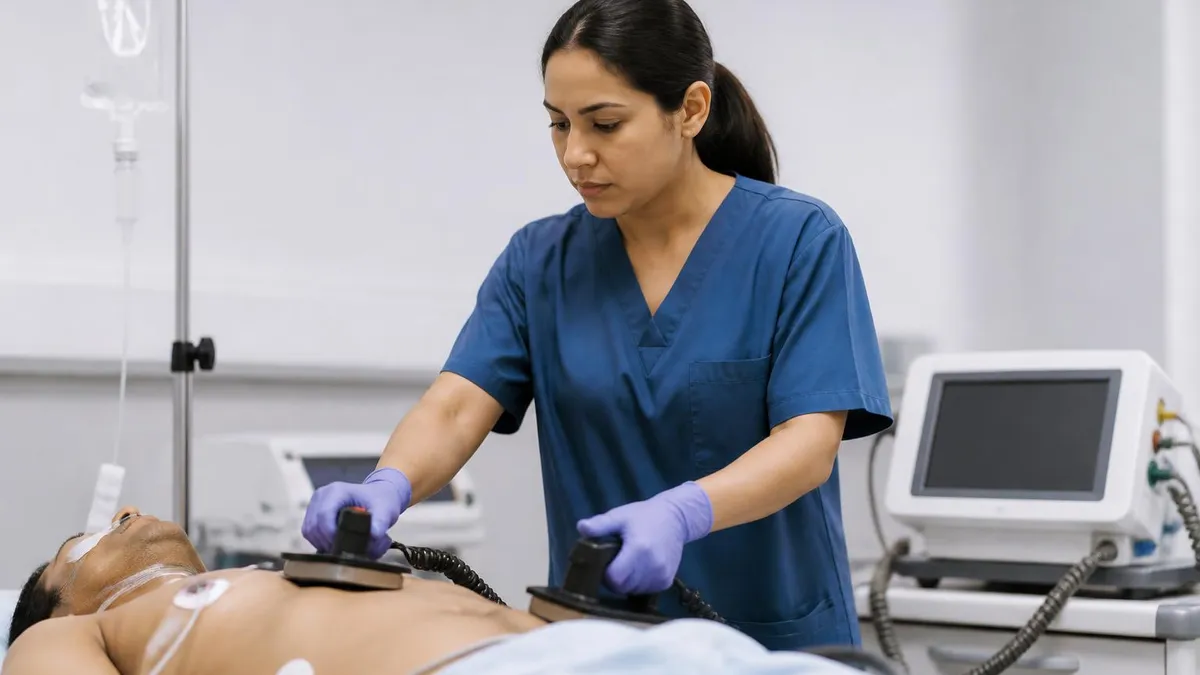
Defibrillation is unsynchronized energy delivery used for pulseless ventricular fibrillation and pulseless ventricular tachycardia. For biphasic defibrillators, follow the manufacturer's recommended dose, typically 120 to 200 J for the first shock and equal or higher energy for subsequent shocks. Most modern devices default to 200 J for adults. For monophasic defibrillators, deliver 360 J for every shock. The 2026 guidelines reinforce single-shock strategy followed by two minutes of CPR before the next rhythm check.
Pad placement matters more than candidates realize. The anterolateral position places one pad to the right of the sternum below the clavicle and the other on the left mid-axillary line at the fifth intercostal space. The anteroposterior position places one pad on the left precordium and the other on the left scapula. Anteroposterior is preferred for atrial fibrillation cardioversion and for patients with implanted devices to avoid pacemaker or ICD damage.
Using a Printed ACLS Cheat Sheet — Strengths and Limitations
- +Reduces cognitive load during high-stress resuscitation events
- +Standardizes drug doses across team members to prevent errors
- +Speeds recall of energy levels and rhythm-specific interventions
- +Helps new providers transition from theory to bedside application
- +Supports just-in-time review immediately before megacode simulations
- +Provides backup when electronic decision support tools are unavailable
- +Reinforces AHA-aligned sequencing for consistent quality of care
- −Cannot replace genuine understanding of pathophysiology and rationale
- −May become outdated when AHA guidelines update every five years
- −Risks over-reliance and atrophy of memorized algorithm flow
- −Cannot address atypical or complex clinical presentations
- −Print copies can be lost, damaged, or unavailable at the bedside
- −Does not substitute for hands-on skills station practice and feedback
Pros and Cons at a Glance
| Pros | Cons |
|---|---|
| Reduces cognitive load during high-stress resuscitation events | Cannot replace genuine understanding of pathophysiology and rationale |
| Standardizes drug doses across team members to prevent errors | May become outdated when AHA guidelines update every five years |
| Speeds recall of energy levels and rhythm-specific interventions | Risks over-reliance and atrophy of memorized algorithm flow |
| Helps new providers transition from theory to bedside application | Cannot address atypical or complex clinical presentations |
| Supports just-in-time review immediately before megacode simulations | Print copies can be lost, damaged, or unavailable at the bedside |
| Provides backup when electronic decision support tools are unavailable | Does not substitute for hands-on skills station practice and feedback |
Code Team Leader Checklist — What to Verify in the First Five Minutes
- ✓Confirm chest compressions are at correct rate of 100 to 120 per minute and depth of 2 to 2.4 inches
- ✓Verify a metronome or audible feedback device is active to maintain consistent rhythm
- ✓Assign a dedicated team member to rotate compressors every two minutes to prevent fatigue
- ✓Establish IV or IO access within 90 seconds and confirm patency with a saline flush
- ✓Attach defibrillator pads and confirm correct anterolateral or anteroposterior placement
- ✓Identify rhythm during the planned pulse check pause, limiting the pause to under 10 seconds
- ✓Administer epinephrine 1 mg IV/IO at the appropriate point in the algorithm
- ✓Place advanced airway when feasible and confirm placement with continuous waveform capnography
- ✓Monitor end-tidal CO2 with a target above 10 mmHg as an indicator of CPR quality
- ✓Verbalize and address each of the H's and T's reversible causes systematically
The Five Numbers That Determine Survival
High-quality CPR is the single greatest predictor of survival from cardiac arrest. Memorize these five numbers: compression rate 100 to 120 per minute, compression depth 2 to 2.4 inches, full chest recoil between compressions, chest compression fraction above 80 percent, and end-tidal CO2 above 10 mmHg. If any one of these falls short, return of spontaneous circulation rates drop dramatically. Coach your team in real time, every cycle, without hesitation.
The bradycardia algorithm acls activates whenever an adult patient has a heart rate below 50 beats per minute with signs of poor perfusion. Signs of instability include acute altered mental status, ischemic chest pain, acute heart failure, hypotension, or other shock indicators. If the patient is asymptomatic, monitor and search for underlying causes such as medication effects, electrolyte abnormalities, or ischemia. If symptomatic, the sequence is atropine first, transcutaneous pacing second, and chronotropic infusions third.
Atropine 1 mg IV push every 3 to 5 minutes to a maximum cumulative dose of 3 mg is the first-line pharmacologic intervention. Atropine is most effective in vagally mediated bradycardia, sinus bradycardia, and first-degree or Mobitz type I second-degree AV block. It is unlikely to work in Mobitz type II or third-degree AV block because the conduction abnormality is below the AV node. In these high-grade blocks, proceed directly to pacing or chronotropic infusions while preparing for transvenous pacing.
Transcutaneous pacing should be initiated promptly when atropine fails or is unlikely to work. Set the rate at 60 to 80 beats per minute and titrate the current upward in 10 mA increments until both electrical and mechanical capture are confirmed. Sedate conscious patients with midazolam, fentanyl, or both because the procedure is painful. Document the threshold current required for capture, then maintain that level plus a small safety margin until definitive pacing is available.
Tachycardia management hinges on three questions in order: is the patient stable or unstable, is the QRS narrow or wide, and is the rhythm regular or irregular. Unstable patients at any QRS width get synchronized cardioversion. Stable narrow regular tachycardia gets vagal maneuvers and adenosine. Stable narrow irregular tachycardia, most commonly atrial fibrillation with rapid ventricular response, gets rate control with beta blockers or calcium channel blockers. Stable wide regular tachycardia gets amiodarone 150 mg over 10 minutes.
Stable wide irregular tachycardia deserves special attention. The differential includes atrial fibrillation with aberrancy, atrial fibrillation in Wolff-Parkinson-White, and polymorphic ventricular tachycardia. Avoid AV nodal blocking agents like adenosine, diltiazem, verapamil, or digoxin if WPW is suspected because they can accelerate conduction down the accessory pathway and precipitate ventricular fibrillation. Procainamide or amiodarone are safer choices. For polymorphic VT with prolonged QT, treat as torsades with magnesium sulfate 1 to 2 grams IV.
Adenosine deserves a precise technique that many providers execute incorrectly. Use a proximal IV site, preferably the antecubital fossa. Connect a three-way stopcock with the adenosine syringe and a 20 mL saline flush. Push the adenosine rapidly over 1 to 2 seconds, then immediately push the saline flush and improve the arm. The drug has a half-life of less than 10 seconds, and any delay in flushing renders the dose ineffective. Warn the patient about transient chest discomfort, flushing, and a sense of impending doom.
Synchronized cardioversion energy doses must be memorized cold. Narrow regular such as SVT or atrial flutter starts at 50 to 100 J. Narrow irregular such as atrial fibrillation starts at 120 to 200 J biphasic. Wide regular such as monomorphic VT with a pulse starts at 100 J. Wide irregular polymorphic VT is treated as ventricular fibrillation with unsynchronized high-energy shocks. Reactivate the synchronize function before every subsequent attempt, since most defibrillators revert to unsync mode automatically after each delivery.

Do not rely on a cheat sheet during your skills station — the AHA examiner will deduct points if you reference printed material during your megacode. Memorize the high-yield content before exam day. Also verify your cheat sheet is dated 2026 or later to reflect the most recent guideline changes, especially regarding double sequential defibrillation, head-up CPR, and post-arrest temperature management targets.
The H's and T's are the systematic checklist for identifying reversible causes of cardiac arrest and pulseless electrical activity in particular. The H's are hypovolemia, hypoxia, hydrogen ion acidosis, hypo and hyperkalemia, and hypothermia. The T's are tension pneumothorax, tamponade cardiac, toxins, thrombosis pulmonary, and thrombosis coronary. During every code, the team leader should verbalize each one and assign treatment as appropriate. Failing to address reversible causes is the most common reason for failed resuscitation.
Hypovolemia is treated with rapid crystalloid infusion, usually 1 to 2 liters of normal saline or lactated Ringer's. Hypoxia is addressed by securing the airway and confirming bilateral breath sounds and oxygenation. Acidosis is managed with adequate ventilation and, in select cases, sodium bicarbonate 1 mEq/kg. Hyperkalemia warrants calcium chloride 1 gram, sodium bicarbonate, insulin and glucose, and albuterol. Hypothermia requires active rewarming with warmed IV fluids, warmed humidified oxygen, and external warming devices.
Tension pneumothorax is treated with immediate needle decompression at the second intercostal space midclavicular line, followed by chest tube placement. Cardiac tamponade requires pericardiocentesis. Toxic exposures may need specific antidotes such as naloxone for opioids, glucagon for beta blocker overdose, or sodium bicarbonate for tricyclic antidepressant toxicity. Pulmonary embolism may justify thrombolytics during ongoing arrest. Coronary thrombosis is addressed with emergent cardiac catheterization once ROSC is achieved.
Post-cardiac arrest care begins the moment return of spontaneous circulation is confirmed. The bundle includes hemodynamic optimization with mean arterial pressure above 65 mmHg, oxygenation targeting SpO2 92 to 98 percent to avoid hyperoxia, ventilation targeting normocapnia with EtCO2 35 to 45 mmHg, and targeted temperature management between 32 and 36 degrees Celsius for at least 24 hours. Twelve-lead ECG should be obtained promptly to identify STEMI, and emergent cath lab activation should occur for ST-elevation or unstable patients regardless of ECG findings.
Neuroprognostication should never occur in the first 72 hours after arrest, especially in patients undergoing temperature management. Multimodal assessment combining clinical examination, EEG, somatosensory evoked potentials, and neuron-specific enolase levels provides the most reliable picture. Premature withdrawal of life-sustaining therapy based on a single early finding is one of the most preventable errors in post-arrest care. Be patient, follow the evidence, and consult neurology and palliative care specialists.
For renewing providers, the 2026 guidelines refined several specific recommendations. Calcium administration during arrest is no longer routinely recommended outside of hyperkalemia or calcium channel blocker toxicity. Sodium bicarbonate is not recommended for routine cardiac arrest. Vasopressin has been removed from the cardiac arrest algorithm as a substitute for epinephrine. Double sequential defibrillation may be considered for refractory ventricular fibrillation after standard measures fail. Review the full ACLS Guidelines 2026: Complete AHA Update on Algorithms, Drugs, CPR Quality & Post-Arrest Care for the complete list of changes.
Stroke management is also part of the ACLS curriculum and worth a quick review. The Cincinnati Prehospital Stroke Scale screens for facial droop, arm drift, and abnormal speech. Time of last known well dictates eligibility for intervention. Patients within 4.5 hours may qualify for IV alteplase or tenecteplase. Patients within 24 hours with large vessel occlusion may qualify for mechanical thrombectomy. Door-to-CT goal is 25 minutes and door-to-needle goal is 60 minutes for thrombolytic-eligible patients.
The week before your ACLS exam should focus on retrieval practice rather than passive review. Open the AHA provider manual to a random algorithm and recite every step aloud without looking. Then check yourself against the page. Repeat this drill for cardiac arrest, bradycardia, tachycardia, acute coronary syndrome, and stroke. Each algorithm should take less than two minutes to verbalize completely. If you cannot do it in that time, you need more reps before sitting for the test.
Pair retrieval practice with timed scenario simulations. Have a study partner read you a clinical vignette, then verbalize your assessment, intervention, and rationale within 60 seconds. Common scenarios include a 64-year-old with crushing chest pain and ST elevation, a 28-year-old with palpitations and a narrow-complex tachycardia, an 80-year-old in symptomatic bradycardia with Mobitz type II block, and a 55-year-old found unresponsive with shockable VF on monitor.
Drug doses should be quizzed in isolation as well. Cover the dose column of your reference card and try to recall epinephrine, amiodarone, lidocaine, adenosine, atropine, magnesium, calcium, and sodium bicarbonate doses from memory. Then test yourself on infusion rates for dopamine, epinephrine, norepinephrine, and dobutamine. Doses you cannot recall in 3 seconds need more focused review. Anchor each dose to a memorable mnemonic or visual cue.
Do not underestimate the team dynamics portion of the exam. The AHA evaluates closed-loop communication, clear role assignment, knowing your limitations, knowledge sharing, constructive intervention, summarizing, and mutual respect. Practice phrases like "Compressor, please switch with Airway," and "Pharmacy, please give 1 milligram of epinephrine IV push," and "Recorder, please time the next dose in 4 minutes." Specific language demonstrates leadership and earns points.
If you are pursuing renewal and looking for nearby options, the ACLS Renewal Near Me: Find Local Recertification Classes, Costs & Online Options in 2026 guide compares blended learning, in-person courses, and fully online formats with cost ranges and accreditation considerations. Online HeartCode courses with in-person skills sessions remain the most flexible option for working clinicians, while traditional one-day courses offer the most efficient path for experienced providers.
On exam day, arrive early, eat a balanced meal, and bring two forms of identification. Take a deep breath before each station and remind yourself that algorithms are designed to be followed step by step. If you blank, restart the BLS survey: check responsiveness, breathing, pulse, activate the response system, begin CPR, attach the monitor. The structured assessment will surface the next step nearly every time. Most candidates who feel uncertain still pass because they fall back on the systematic approach.
Finally, plan how you will use your certification. ACLS is required for emergency department staff, intensive care providers, cardiac catheterization lab personnel, anesthesia providers, rapid response team members, and many advanced practice nursing roles. Add the certification to your resume, online professional profile, and electronic credentialing portal. Set a calendar reminder 90 days before your two-year expiration date to schedule renewal so you avoid a gap in credentials that could affect your scheduling or hospital privileges.
💉 What is the correct epinephrine dose and interval during cardiac arrest?
Give 1 mg IV or IO of the 1:10,000 concentration every 3 to 5 minutes throughout the arrest, regardless of rhythm. For non-shockable rhythms give it as soon as access is established; for shockable rhythms give the first dose after the second shock.
START PHARMACOLOGY PRACTICE TEST⚡ What are the amiodarone doses for refractory VF/pulseless VT?
Amiodarone is 300 mg IV/IO push for the first dose and 150 mg for the second dose, given after the second or third shock. Lidocaine (1 to 1.5 mg/kg, then 0.5 to 0.75 mg/kg) is the accepted alternative antiarrhythmic.
START PHARMACOLOGY PRACTICE TEST💊 What is the maximum cumulative atropine dose for symptomatic bradycardia?
Give atropine 1 mg IV push every 3 to 5 minutes up to a maximum cumulative dose of 3 mg. If atropine fails or is unlikely to work (Mobitz type II, third-degree block), move to transcutaneous pacing or a chronotropic infusion.
START PHARMACOLOGY PRACTICE TEST🔄 How do you correctly administer adenosine for stable narrow-complex tachycardia?
Push 6 mg rapidly through a proximal IV over 1 to 2 seconds, immediately follow with a 20 mL saline flush, and improve the arm. If the rhythm persists, give a second 12 mg dose. Adenosine has a half-life under 10 seconds, so the flush timing matters as much as the dose.
START CARDIAC RHYTHMS PRACTICE TEST⚡ What energy do you use for the first biphasic vs. monophasic defibrillation shock?
Biphasic defibrillators typically deliver 120 to 200 J for the first shock (most default to 200 J); monophasic defibrillators deliver 360 J for every shock. Both use a single-shock strategy followed by two minutes of CPR before the next rhythm check.
START CARDIAC RHYTHMS PRACTICE TEST🎯 How is synchronized cardioversion different from defibrillation?
Synchronized cardioversion delivers energy timed to the R wave to avoid the vulnerable T-wave period, and is used for unstable tachyarrhythmias with a pulse. Defibrillation is unsynchronized and reserved for pulseless VF/VT. Reactivate the sync function before every repeat shock.
START CARDIAC RHYTHMS PRACTICE TEST🔍 What are the H’s and T’s of cardiac arrest?
The H’s are hypovolemia, hypoxia, hydrogen ion acidosis, hypo/hyperkalemia, and hypothermia. The T’s are tension pneumothorax, tamponade, toxins, thrombosis pulmonary, and thrombosis coronary. Verbalize and treat each one systematically during every code.
START CORE CONCEPTS PRACTICE TEST📊 What end-tidal CO2 target indicates good CPR quality?
Target EtCO2 above 10 mmHg during ongoing CPR; a sudden rise often signals return of spontaneous circulation. Persistently low readings below 10 mmHg after 20 minutes of high-quality compressions can indicate a poor prognosis.
START CORE CONCEPTS PRACTICE TEST⏱️ What compression rate and depth define high-quality CPR?
Compress at 100 to 120 per minute to a depth of 2 to 2.4 inches, allowing full chest recoil between compressions. Keep chest compression fraction above 80 percent and rotate compressors every two minutes to prevent fatigue-related quality drop.
START CORE CONCEPTS PRACTICE TEST💊 When is magnesium sulfate indicated during a code?
Give magnesium sulfate 1 to 2 grams IV/IO for torsades de pointes or confirmed/suspected hypomagnesemia only — it is not part of routine VF/pVT treatment. Push it slowly when the patient still has a pulse to avoid hypotension.
START PHARMACOLOGY PRACTICE TESTACLS Questions and Answers
Official Resources
- American Heart Association — ACLS Course: the official AHA course page with current curriculum, format options, and certification details.
- American Heart Association — CPR & ECC Guidelines: the source guidelines behind every algorithm, drug dose, and CPR quality metric on this page.
- AHA Atlas — Find a Class: the official AHA tool to locate an in-person or blended ACLS provider or renewal course near you.
ACLS Study Guide: Complete 2026 Certification Prep with Algorithms, Drugs & Practice Tests

ACLS Guidelines 2026: Complete AHA Update on Algorithms, Drugs, CPR Quality & Post-Arrest Care
ACLS Drugs: Complete 2026 Guide to Medications, Doses, Indications & Algorithm Use

ACLS Renewal Near Me: Find Local Recertification Classes, Costs & Online Options in 2026
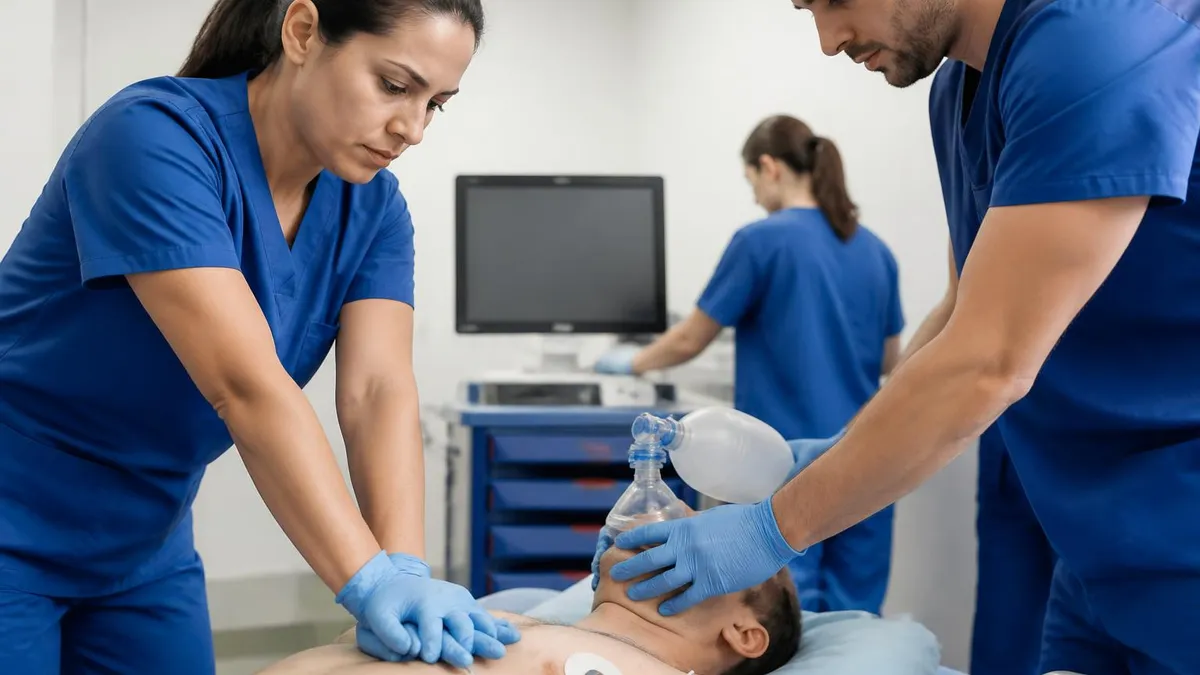
ACLS Certification Cost: Complete 2026 Price Guide for Initial Courses, Renewals, Online Options & Hidden Fees
About the Author

Registered Nurse & Healthcare Educator
Johns Hopkins University School of NursingDr. Sarah Mitchell is a board-certified registered nurse with over 15 years of clinical and academic experience. She completed her PhD in Nursing Science at Johns Hopkins University and has taught NCLEX preparation and clinical skills courses for nursing students across the United States. Her research focuses on evidence-based exam preparation strategies for healthcare certification candidates.