
ServSafe Manual: Complete Study Guide and Certification Prep Hub for 2026
Master the ServSafe manual with our complete 2026 study guide. Practice tests, key topics, and tips to pass your food handlers certification. 📚
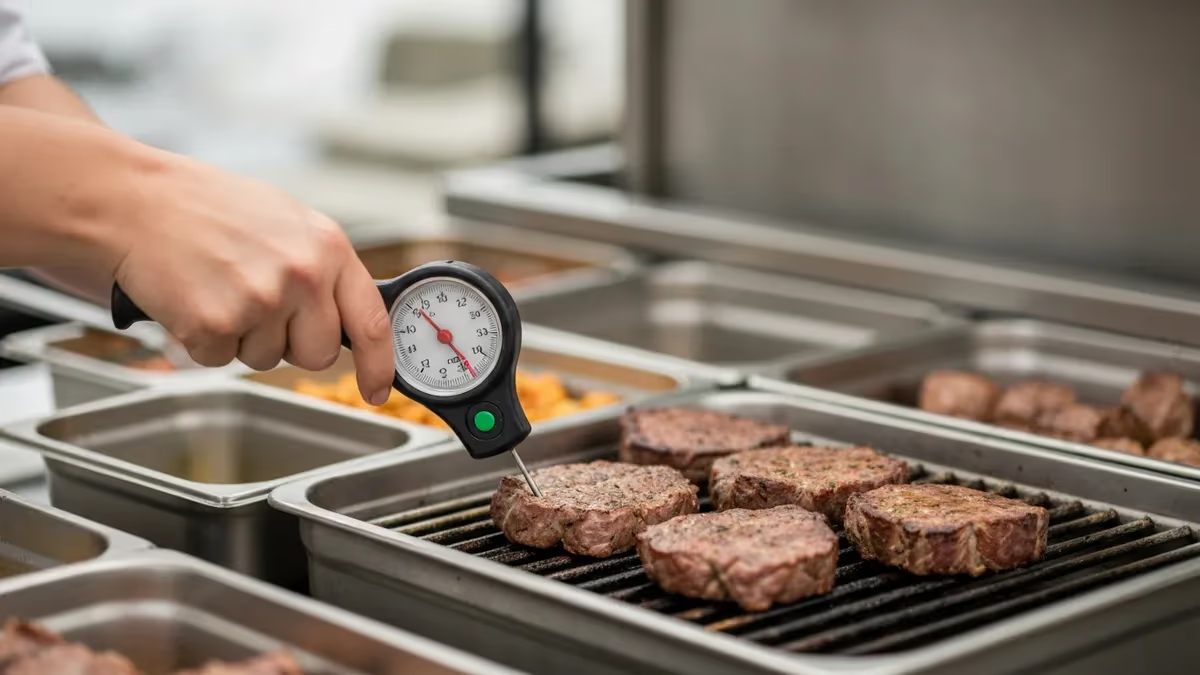
The ServSafe manual is the official textbook published by the National Restaurant Association Educational Foundation (NRAEF) and serves as the authoritative study resource for anyone pursuing food safety certification in the United States. Whether you are preparing for the ServSafe Manager exam, working toward a food handlers card, or refreshing your knowledge for a recertification, the manual provides the foundational science, regulations, and best practices you need to protect public health on the job.
Understanding the full scope of the ServSafe manual is essential because food safety laws in nearly every state require certified food protection managers in commercial kitchens, restaurants, schools, hospitals, and any facility that prepares or serves food to the public. A valid food handlers certificate or manager credential demonstrates to regulators, employers, and customers that your operation meets rigorous hygiene and handling standards. In high-volume environments, even a single lapse can trigger a foodborne illness outbreak affecting dozens or hundreds of guests.
The current edition of the ServSafe manual is regularly updated to reflect the latest FDA Food Code revisions, emerging pathogen research, and changes in food processing technology. Topics range from biological, chemical, and physical hazards all the way through HACCP plan development, employee hygiene policies, and facility design requirements. Each chapter builds on the last, creating a cumulative understanding of how contamination occurs and how systematic controls prevent it at every stage of the food production cycle.
Many candidates underestimate the depth of the ServSafe curriculum. The exam covers more than 90 questions drawn from seven core content domains, and you must score at least 75 percent to earn a passing grade. That threshold means you cannot afford to guess on the material covered in the manual. Dedicated study using the textbook, combined with practice exams and targeted review of weak areas, dramatically improves first-attempt pass rates across all demographic groups and experience levels.
For workers in states like Oregon, Arizona, or Texas, the ServSafe credential often satisfies or overlaps with local licensing requirements for a food handlers permit. Some jurisdictions accept the ServSafe Food Handler certificate as a substitute for the state-issued card, while others require both credentials. Knowing which requirements apply to your specific role, employer, and location is part of the certification journey — and the manual helps you understand the regulatory environment as well as the technical food science.
The servsafe manual chapter on temperature control is one of the most heavily tested sections of the exam, covering the temperature danger zone, cooling procedures, reheating requirements, and the science of pathogen growth rates at different temperatures. Candidates who thoroughly study this section report feeling significantly more confident on exam day, particularly when questions involve calculation-based scenarios about cooling timelines or safe holding temperatures for specific food categories.
This guide is designed to walk you through every major chapter of the ServSafe manual, explain the key concepts in plain language, provide exam-focused study tips, and connect you to free practice tests that mirror the actual exam format. By the time you finish reading, you will have a clear roadmap for preparing systematically, identifying your weakest knowledge areas, and approaching the ServSafe certification exam with the confidence that comes from thorough, structured preparation.
ServSafe Certification by the Numbers

4-Week ServSafe Manual Study Schedule
- ▸Read Chapters 1-2: Why Food Safety Matters and Forms of Contamination
- ▸Read Chapter 3: The Microworld — bacteria, viruses, parasites, fungi
- ▸Complete foodborne illness pathogen practice quizzes
- ▸Create flashcards for the Big 6 pathogens and their symptoms
- ▸Review FDA Food Code definitions and key regulatory terms
- ▸Read Chapters 4-6 covering the complete flow of food through an operation
- ▸Memorize temperature danger zone ranges (41°F–135°F)
- ▸Study cooling and reheating procedures with specific time and temperature requirements
- ▸Practice calculation-based scenarios for cooling timelines
- ▸Complete food preparation standards practice test
- ▸Read Chapters 7-9: Service, Facilities, Cleaning, and Pest Management
- ▸Learn the differences between cleaning and sanitizing and when each applies
- ▸Study chemical sanitizer concentration levels for chlorine, iodine, and quats
- ▸Memorize the steps of the manual warewashing procedure
- ▸Complete cleaning and sanitization practice test online
- ▸Read Chapters 10-11: Food Safety Management Systems and Responsible Alcohol Service
- ▸Build and memorize the seven HACCP principles in order
- ▸Complete a full-length 90-question ServSafe manager practice test under timed conditions
- ▸Review all incorrect answers with manual references
- ▸Complete final review of any weak content areas before exam day
The ServSafe Manager textbook is organized into eleven chapters, each targeting a distinct domain of food safety knowledge that the NRAEF has identified as critical for protecting public health in commercial food service environments. Understanding the purpose and content of each chapter before you begin studying allows you to prioritize your time effectively and recognize how the different domains connect to real-world scenarios you will encounter in your kitchen, restaurant, or food service facility every single day.
Chapter One, "Keeping Food Safe," establishes the regulatory and public health context for everything that follows. This chapter explains why foodborne illnesses are a serious and preventable public health crisis, introduces the three major categories of food hazards (biological, chemical, and physical), and describes the populations most vulnerable to severe foodborne illness outcomes. Understanding who is at risk — young children, pregnant women, elderly individuals, and immunocompromised patients — helps food workers internalize the real-world consequences of safety lapses that might otherwise feel abstract or bureaucratic.
Chapter Two focuses on the forms of contamination in depth, distinguishing between intentional and unintentional contamination events and describing the concept of cross-contamination in detail. This chapter introduces the ALERT framework, which addresses food defense and deliberate tampering. For the exam, you should be able to identify the most common contamination scenarios, explain how physical hazards like bone fragments or glass enter the food supply, and describe the chemical hazards most commonly found in food service environments such as cleaning compounds and pesticides.
Chapters Three through Six form the scientific core of the manual, covering microbiology, foodborne illness pathogens, and the complete flow of food. The microbiology chapter explains the conditions that support bacterial growth — often remembered through the mnemonic FAT TOM (Food, Acidity, Temperature, Time, Oxygen, Moisture). These factors appear repeatedly across exam questions, making thorough understanding of FAT TOM one of the highest-return investments of your study time.
The Big 6 pathogens — Norovirus, Hepatitis A, Salmonella Typhi, Shigella, Shiga toxin-producing E. coli, and Nontyphoidal Salmonella — are particularly important because they are the primary cause of most foodborne illness outbreaks in the United States.
The flow of food chapters walk through purchasing, receiving, storage, preparation, cooking, holding, cooling, reheating, and service, providing minimum internal cooking temperatures and specific time-temperature requirements for every major food category. These are among the most heavily tested sections of the ServSafe exam because they require candidates to recall precise numbers: poultry must reach 165°F for 15 seconds, ground beef 155°F for 17 seconds, whole muscle beef 145°F for 15 seconds, and so on. Practice using temperature tables until these numbers become automatic, as calculation-based exam questions are common and costly if answered incorrectly.
Chapters Seven through Nine cover service, facilities, cleaning, and pest management. The cleaning and sanitization chapter is particularly detailed, distinguishing between the processes of cleaning (removing dirt and food residue) and sanitizing (reducing pathogens to safe levels), and specifying the correct concentration ranges for the three approved chemical sanitizers: chlorine (50-99 ppm), iodine (12.5-25 ppm), and quaternary ammonium compounds (follow manufacturer instructions, typically 200-400 ppm). These numbers appear on the exam, and many candidates lose points by confusing the sanitizer types or their appropriate concentration ranges.
Chapters Ten and Eleven introduce the HACCP (Hazard Analysis Critical Control Points) system and responsible alcohol service. The HACCP chapter is conceptually demanding because it requires candidates to understand all seven principles, recognize how they apply to a real food service operation, and identify critical control points in a given production process. For workers pursuing an RBS certification or bartender license in states that require responsible beverage service training, Chapter Eleven provides foundational knowledge about recognizing intoxication, checking identification, and refusing service legally and professionally. Many states integrate these requirements into their broader food handler licensing frameworks.
ServSafe Manager Practice Test: Key Content Areas
Temperature control is one of the most heavily weighted domains on the ServSafe manager practice test, and for good reason — improper temperature management is responsible for the majority of preventable foodborne illness outbreaks in the United States. Candidates must memorize minimum internal cooking temperatures for all major food categories, the temperature danger zone (41°F to 135°F), and the specific time-and-temperature requirements for cooling food safely from 135°F to 70°F within two hours, and then from 70°F to 41°F or below within an additional four hours.
Beyond memorizing the numbers, you must understand the reasoning behind each requirement and be able to apply that reasoning to novel scenarios. Exam questions frequently present a situation — a large pot of chili placed directly in a walk-in cooler, or a steam table holding soup at 128°F — and ask you to identify the violation and the correct corrective action. Practicing with realistic scenario questions is far more effective than reviewing temperature tables in isolation, because the exam tests application and decision-making, not pure memorization.

ServSafe Manager vs. Food Handler Certificate: Which Do You Need?
- +ServSafe Manager certification is accepted in all 50 states and most US territories as proof of food safety competency
- +The manager credential satisfies most state requirements for Certified Food Protection Manager (CFPM) on staff at all times
- +A five-year validity period means less frequent recertification compared to some state-issued food handlers cards that expire annually
- +The manager exam covers HACCP, food safety management systems, and regulatory knowledge that advances your career beyond entry-level roles
- +ServSafe Manager certification is often a requirement for promotion to kitchen manager, chef, or food service director positions
- +Many culinary schools and community college programs accept ServSafe Manager certification to fulfill food safety course requirements
- −The ServSafe Manager exam is significantly more difficult than a basic food handlers card or permit test, requiring weeks of dedicated study
- −The exam and study materials carry a combined cost of $50-$200 depending on whether you purchase the manual, online course, and proctored exam separately
- −The manager credential requires a proctored exam administered by an approved proctor, adding scheduling complexity compared to online food handler courses
- −Food handler certificates like the Oregon food handlers card or food handlers card Arizona may be required separately even if you hold a ServSafe Manager credential
- −The manual and exam are updated periodically, meaning older editions may not reflect current FDA Food Code requirements and could result in studying outdated material
- −Some states and municipalities have their own mandatory food safety training requirements that ServSafe certification does not fully satisfy without additional local coursework
ServSafe Exam Preparation Checklist
- ✓Purchase or access the current edition of the ServSafe Manager textbook (7th or 8th edition with 2019 FDA Food Code updates)
- ✓Create a four-week study schedule blocking 10-12 hours per week for reading, review, and practice testing
- ✓Memorize the FAT TOM conditions for bacterial growth and explain each factor from memory
- ✓Learn all minimum internal cooking temperatures for poultry (165°F), ground meat (155°F), and whole muscle proteins (145°F)
- ✓Master the temperature danger zone (41°F–135°F) and the two-stage cooling procedure timeline requirements
- ✓Study the Big 6 foodborne illness pathogens including their sources, symptoms, onset times, and control measures
- ✓Review chemical sanitizer types and their correct concentration ranges for chlorine, iodine, and quaternary ammonium compounds
- ✓Learn all seven HACCP principles in order and practice applying them to real food production scenarios
- ✓Complete at least three full-length 90-question ServSafe manager practice tests under timed conditions before exam day
- ✓Review every incorrect practice test answer by locating the explanation in the ServSafe manual chapter it came from
The 75% Rule: What It Really Means for Your Study Strategy
To pass the ServSafe Manager exam you need to answer at least 56 of the 80 scored scored questions correctly — a 75.6% passing threshold. Because 10 of the 90 questions are unscored pilot items, your actual performance on graded content must be even more precise. Candidates who score between 70% and 74% on practice exams should spend at least one additional week reviewing their weakest content domains before scheduling the proctored exam, as the real test typically includes more scenario-based application questions than most free practice resources provide.
State-level food handler certification requirements vary widely across the United States, and understanding your specific jurisdiction's rules is essential before you invest time and money in a particular credential. While ServSafe is a nationally recognized standard, many states have enacted their own food safety training laws that may require a state-specific food handlers card, a state-approved training program, or both a food handler certificate and a separate manager credential on file with your local health department.
In Oregon, the Oregon food handlers card is a state-mandated requirement for virtually all food service workers, not just managers, and must be obtained within 30 days of starting food service employment. Oregon's food handler training is a separate, shorter program from the ServSafe Manager curriculum, covering basic personal hygiene, temperature control, and cross-contamination prevention. While ServSafe training certainly prepares you to pass Oregon's food handler assessment, you still need to complete the official Oregon process and pay the associated fee to receive a card that is legally valid in Oregon food service establishments.
Arizona is another state with its own food handler card requirement. The food handlers card Arizona system requires all food handlers in Maricopa County and most other counties to complete an approved two-hour training course and pass a test.
ServSafe's Food Handler program is one of several approved providers in Arizona, but the key distinction is that the training must be completed through a state-approved provider and the resulting card is valid for only three years before renewal is required. Managers in Arizona who hold the ServSafe Manager credential still need to ensure their operation has a separately credentialed Certified Food Protection Manager on file.
Texas operates a similar dual-track system. Workers pursuing a Texas food handlers license need to complete a two-hour food handler training through a state-approved provider, while food managers in Texas must additionally hold a nationally accredited food protection manager certification such as ServSafe Manager or an equivalent ANSI-accredited credential. The Texas Department of State Health Services maintains a list of approved training providers, and ServSafe appears on that list, making it a straightforward choice for Texas food service professionals who want a credential recognized across all jurisdictions where they might work.
California's requirements are particularly nuanced because the state allows individual counties and cities to set their own food handler training mandates. Los Angeles County, for instance, requires the Los Angeles County Food Handler Card, which must be obtained through the county's own online training system.
Meanwhile, San Diego follows state law requiring a Certified Food Protection Manager rather than a county-specific card for certain facility types. Workers relocating between California counties sometimes discover mid-employment that their existing credentials do not satisfy local requirements, underscoring the importance of verifying current requirements with your local health department before accepting a food service position.
For workers in states with no mandatory food handler training law — and several states still fall into this category — the ServSafe Food Handler or ServSafe Manager credential provides a strong voluntary credential that many employers actively require even when regulators do not. National restaurant chains, hospital food service contractors, school food service programs, and hotel catering operations frequently mandate ServSafe certification as a condition of employment or promotion regardless of state law, because the credential signals a consistent, nationally standardized level of food safety knowledge that managers can rely on when building safety-conscious kitchen teams.
Workers seeking a bartender license or RBS certification for responsible beverage service face an additional layer of state-specific requirements that often run parallel to food handler certification but are administered through separate licensing systems focused on alcohol service rather than food safety.
California's Responsible Beverage Service (RBS) certification, for instance, requires training through a California Department of Alcoholic Beverage Control-approved provider and is separate from any food handler or food manager credential. Understanding which credentials apply to your specific role — food only, alcohol only, or both — is the first step in building an efficient certification strategy that satisfies every applicable legal requirement without duplicating unnecessary training.
ServSafe Manager certifications are valid for five years from the date you pass the proctored exam, but many state health departments require renewal on a different schedule — some as frequently as every three years. Always verify with your local health authority before assuming your federal or NRAEF-issued certification satisfies your current state renewal deadline. An expired credential during a health inspection can result in fines, temporary closure orders, or suspension of your food service permit regardless of how long you have worked in the industry.
Developing an effective test-taking strategy for the ServSafe Manager exam requires understanding how the exam is structured, how questions are written, and which types of errors most commonly cause otherwise well-prepared candidates to miss the 70% passing threshold. The exam consists of 90 questions, of which 80 are scored and 10 are unscored pilot questions being evaluated for future use. You cannot distinguish pilot questions from scored questions during the exam, so treat every question with equal seriousness and do not try to identify or skip questions you suspect might be pilots.
Questions on the ServSafe exam are written at two cognitive levels: recall and application.
Recall questions ask you to identify a fact directly from the manual — for example, "What is the minimum internal cooking temperature for poultry?" Application questions present a scenario and ask you to apply your knowledge to solve a problem — for example, "A cook checks the internal temperature of a whole roasted chicken and reads 158°F. What should the cook do?" Application questions are more challenging and more common on the exam than pure recall questions, which is why studying the manual alone without practicing scenario-based questions leaves many candidates underprepared for the actual test experience.
Time management during the exam is less of a concern than on some other professional certifications, but it is still worth developing a pacing strategy. With a two-hour window for 90 questions, you have approximately 80 seconds per question on average. Read each question stem carefully before looking at the answer choices, because ServSafe question stems often include critical context that changes which answer is correct. Pay attention to words like "first," "most important," "immediately," and "always" or "never" — these qualifiers frequently distinguish the single correct answer from the three plausible distractors.
One of the most effective test-taking strategies for the ServSafe exam is the process of elimination applied to answer choices. ServSafe uses a four-option multiple-choice format, and well-designed distractors are typically partially correct statements that apply to a different context, time period, or food category than the one specified in the question. When you are unsure of the correct answer, eliminate the options that contain a number or detail you know is incorrect, then evaluate the remaining options based on the principles you have studied rather than guessing randomly.
Reviewing your practice test results is as important as taking the practice tests themselves. Every incorrect answer on a practice exam represents either a knowledge gap (you did not learn the content) or a reasoning gap (you knew the content but misapplied it to the scenario). For knowledge gaps, return to the relevant manual chapter and re-read it before testing yourself again with different questions on the same topic.
For reasoning gaps, focus on understanding why the correct answer is correct and why each incorrect answer is wrong — this meta-cognitive exercise strengthens your ability to navigate novel scenarios on the actual exam that may not match the exact wording of any practice question you encountered during preparation.
The night before your ServSafe exam, avoid intensive last-minute cramming, which research consistently shows is less effective than consolidating what you already know through light review and adequate sleep. Instead, spend 30-45 minutes reviewing your flashcards for the most common numerical values — temperatures, time limits, sanitizer concentrations, and pathogen-specific facts — then get at least seven to eight hours of sleep.
Arrive at the testing location at least 15 minutes early, bring the required identification documents specified in your exam registration confirmation, and remember that the ServSafe exam is designed to test practical knowledge that any competent food safety manager should possess — not to trick well-prepared candidates with obscure minutiae from footnotes.
After passing the exam, your ServSafe Manager certification card and certificate will be issued through the NRAEF. Keep digital and physical copies of both documents, as many employers, health inspectors, and licensing authorities may request proof of your current certification during routine audits, inspections, or background checks.
Some states require your employer to maintain a copy of your certification on file at the physical location where you work, separate from any records you keep personally. Familiarize yourself with your specific jurisdiction's record-keeping requirements to ensure your certification is always available for verification on demand without unnecessary delays that could disrupt business operations or create compliance issues during an inspection.
If you want more targeted practice, the servsafe manager practice test pdf page covers the same material with additional questions and explanations.
Practical preparation for the ServSafe exam goes beyond reading the manual and taking practice tests. Experienced food safety educators consistently recommend a multi-modal approach that combines textbook reading with visual learning aids, hands-on practice in your actual work environment, and peer discussion with colleagues who are also preparing for certification. Each of these approaches activates different memory systems and helps you build a more strong, retrievable understanding of complex food safety concepts that may otherwise blur together after weeks of intensive study.
Creating your own study materials is one of the most effective learning strategies available to ServSafe candidates. Rather than passively highlighting text in the manual, try summarizing each chapter in your own words after you finish reading it.
This active recall technique forces your brain to retrieve and reconstruct the information rather than simply recognizing it on the page — a critical distinction because the exam requires retrieval, not recognition. Index cards with specific pathogens on the front and their symptoms, sources, onset times, and control measures on the back are a classic and highly effective study tool for the microbiology chapters of the manual.
Visual learners benefit from creating their own diagrams and flowcharts to represent complex processes like the flow of food, the HACCP decision tree, and the two-stage cooling procedure. Drawing a kitchen floor plan and labeling potential cross-contamination points helps some candidates internalize spatial food safety concepts that are difficult to grasp from text alone. You can also create a simple decision tree for the most common manager decisions covered on the exam: when to restrict versus exclude a sick employee, when to recondition versus discard temperature-abused food, and when to call the regulatory authority.
Study groups, when organized effectively, can significantly accelerate ServSafe preparation by exposing you to questions and scenarios you might not have thought to test yourself on alone. The most effective study groups assign each member to teach a specific chapter to the rest of the group, rather than simply reviewing notes together. Teaching is the highest-level cognitive engagement with material and reveals gaps in understanding that passive review misses entirely. If a study group is not practical for your situation, online forums and community pages for ServSafe candidates provide an informal version of this collaborative learning dynamic.
On exam day, approach the physical testing environment with the same professionalism you bring to a high-stakes food safety inspection. Bring all required identification, arrive early, and follow all proctor instructions exactly as given. If you are taking a computer-based exam through a testing center, familiarize yourself with the navigation interface before the clock starts. Most testing platforms allow you to flag questions for review and return to them before submitting, which is a valuable feature for managing difficult scenario questions that benefit from a second pass after you have answered the remaining questions and settled into the exam rhythm.
After you receive your ServSafe Manager certification, treat it as the beginning of your food safety education rather than the end. The food safety field evolves continuously as new research identifies emerging pathogens, regulatory agencies update the FDA Food Code, and new food production technologies create novel safety challenges.
ServSafe offers continuing education resources, updated editions of the manual, and specialty certifications in areas like allergen awareness and ServSafe Alcohol that allow certified managers to deepen their expertise in specific domains relevant to their operation. Staying current with these developments makes you a more effective food safety leader and a more valuable employee in an industry where knowledge of the latest best practices can mean the difference between a clean inspection and a costly outbreak investigation.
Finally, remember that earning your ServSafe certification is not merely a bureaucratic requirement — it is a tangible demonstration of your commitment to protecting the health and safety of every guest, patient, student, or customer who eats food prepared under your supervision. The knowledge you gain from mastering the ServSafe manual has real-world consequences that extend far beyond any single exam score, and the habits of food safety thinking you develop during your preparation will serve you, your team, and the people you feed for the entirety of your food service career.
ServSafe Questions and Answers

Temperature Danger Zone ServSafe: Preventing Time-Temperature Abuse When Transporting Food

Food Handler Certification: State-by-State Guide for 2026

ServSafe PA: Pennsylvania Food Handler Certification Complete Guide 2026

ServSafe Exam Questions: Complete Study Guide and Certification Prep Hub for 2026

ServSafe Manager Certificate: Complete Study Guide and Certification Prep Hub for 2026
About the Author

Registered Sanitarian & Food Safety Certification Expert
Cornell University College of Agriculture and Life SciencesThomas Wright is a Registered Sanitarian and HACCP-certified food safety professional with a Bachelor of Science in Food Science from Cornell University. He has 17 years of experience in food safety auditing, regulatory compliance, and foodservice management training. Thomas prepares food industry professionals for ServSafe Manager, HACCP certification, and state food handler examinations.