
Pearson ServSafe: Complete Guide to the ServSafe Exam Provider, Food Handlers Card, and Certification Requirements
Learn how Pearson ServSafe works as the official exam provider. Get your food handlers card, manager cert & more. ✅ Requirements by state.
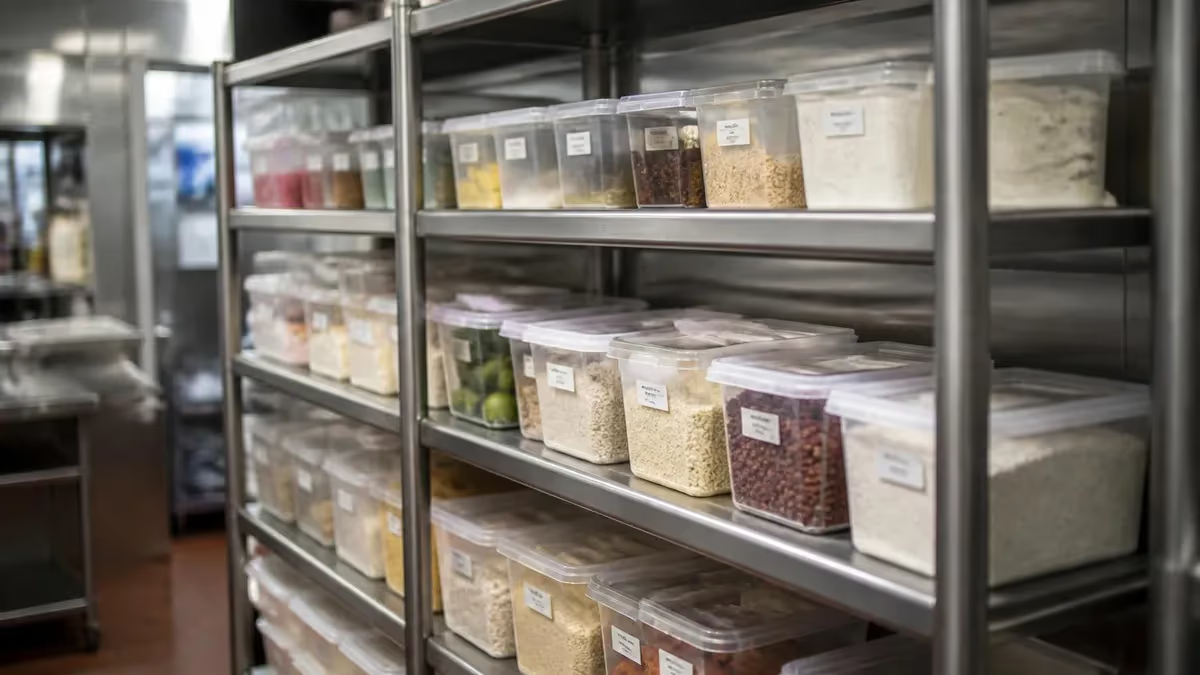
Pearson ServSafe is the backbone of food safety certification in the United States, operating as the exclusive proctoring and exam delivery partner for the National Restaurant Association's ServSafe program. Whether you are pursuing a food handlers card for your first kitchen job or sitting for the ServSafe Manager exam that many state health departments legally require, Pearson's testing infrastructure is the system that validates your score and issues your credential. Understanding how the ServSafe exam provider ecosystem works helps you register faster, choose the right credential, and avoid costly mistakes that could delay your start date at a new employer. Practice with the free ServSafe Certification Practice practice test on PracticeTestGeeks (7 questions with answer explanations).
The relationship between the National Restaurant Association Educational Foundation (NRAEF) and Pearson VUE creates a seamless credentialing pipeline that millions of food service workers navigate every year. Pearson provides online proctoring, in-person testing centers, and the score reporting systems that feed directly into state health department databases. This means that when a health inspector asks to see your food handlers certificate, the credential they are checking often traces back through the Pearson system to the original exam session you completed weeks or months earlier.
One of the most common points of confusion for new food service workers is understanding the difference between the various credentials that fall under the ServSafe umbrella. A food handlers card — sometimes called a food handlers permit or food handlers certificate depending on the state — is generally a shorter, lower-stakes training course aimed at line-level employees.
The ServSafe Manager certification, by contrast, is a proctored examination that requires significantly more preparation, costs more money, and carries greater professional weight. Knowing which credential your employer or local health code actually requires before you spend money on the wrong course is the single most important planning step you can take.
State requirements for food safety credentials vary enormously across the country. If you work in Texas, you will need a texas food handlers license from an approved provider. Oregon workers must hold an oregon food handlers card issued by the Oregon Department of Agriculture or an approved training program.
Arizona food handlers cards have their own approval criteria, and food handlers card arizona searches reveal a state-specific online training market that is separate from the manager-level ServSafe exam. Bartender license requirements in states like California add yet another layer — responsible beverage service certification, sometimes called rbs certification, is distinct from food safety certification and governed by the California Department of Alcoholic Beverage Control.
If you are preparing for the ServSafe Manager exam specifically, one of the best investments you can make is practicing with realistic questions before test day. Taking a servsafe manager practice test under timed conditions exposes the gaps in your knowledge early enough to fix them.
Topics like temperature danger zones, HACCP principles, cross-contamination prevention, and pest control are heavily tested, and encountering those question types for the first time during the real exam — rather than in practice — is a significant disadvantage. The good news is that free and paid practice resources are widely available, and strategically using them can dramatically increase your odds of passing on the first attempt.
Choosing the right servsafe exam provider matters more than many candidates realize. While ServSafe through Pearson is the most widely recognized brand, other ANAB-accredited providers like Learn2Serve operate in the same credentialing space, and some states accept credentials from multiple providers while others mandate a specific program. Before you register and pay for any exam, verify with your local health department or employer HR team that the credential you are pursuing will actually satisfy the legal or policy requirement you are trying to meet. A credential from an unrecognized provider is worthless regardless of how well you scored.
This guide covers everything you need to know about the ServSafe exam provider system: how Pearson delivers the exam, what each credential covers, state-by-state considerations, study strategies, and how to navigate the registration process without wasting time or money. Whether you are a first-time food service worker getting your food handlers certificate or a restaurant manager preparing for the proctored ServSafe Manager exam, the sections below will give you a clear, practical roadmap from registration to credential in hand.
Free ServSafe Certification Practice Study Tools
Interactive ServSafe Certification Practice resources on PracticeTestGeeks, free to start:
- ServSafe Certification Practice flashcards — review key terms and concepts card by card
- ServSafe Certification Practice study guide — topic-by-topic overview of what the exam covers
- ServSafe Certification Practice cheat sheet — one-page printable summary for last-minute review
ServSafe & Food Safety Certification by the Numbers
Key Facts at a Glance
| Item | Value | Details |
|---|---|---|
| Questions on Manager Exam | 90 | 80 scored + 10 unscored |
| Passing Score Required | 70% | 67 of 80 scored questions |
| Exam Time Limit | Not published | For ServSafe Manager |
| Certification Validity | 5 Years | Manager cert renewal cycle |

ServSafe Manager Exam Format
| Section | Questions | Time | Weight | Notes |
|---|---|---|---|---|
| Providing Safe Food | 15 | — | ~19% | FAT TOM, contamination types |
| Forms of Contamination | 12 | — | ~15% | Biological, chemical, physical |
| The Safe Food Handler | 8 | — | ~10% | Handwashing, illness policies |
| The Flow of Food | 16 | — | ~20% | Receiving through service |
| Food Safety Management Systems | 14 | — | ~18% | HACCP, active managerial control |
| Safe Facilities & Pest Management | 15 | — | ~19% | Equipment, cleaning, pests |
| Total | 90 | 2 hours | 100% |
Pearson VUE handles the proctoring and score reporting for the ServSafe Manager certification, making it the most important piece of infrastructure in the ServSafe exam provider system. When you register for a proctored ServSafe Manager exam, you are booking time in Pearson's scheduling system, which connects either to a physical Pearson VUE testing center or to an online proctored session delivered through Pearson's OnVUE platform.
Both options require a valid, government-issued photo ID, a webcam, and a stable internet connection for the online version. The in-person testing centers provide their own equipment but require you to follow strict personal item policies, including no phones, no food, and no notes at your workstation.
The registration process begins at the ServSafe website, where you purchase the exam and select a delivery method. After purchase, you receive a registration confirmation code that you use to book your specific appointment through the Pearson scheduling portal.
This two-step process confuses many first-time candidates, who sometimes purchase an exam but forget to actually schedule the appointment, only to discover weeks later that their eligibility window is closing. Most ServSafe exam eligibility windows are 90 days, so mark your calendar the moment you complete the purchase and book your appointment within 48 hours to guarantee your preferred date and location.
Online proctoring through Pearson's OnVUE system has become significantly more popular since the pandemic, and for good reason — it eliminates travel time, lets you test from home or a private office, and typically offers more appointment flexibility than physical testing centers in rural areas. However, online proctoring is not the right choice for every candidate.
You must have a room where you can close the door, a desk with no papers or secondary monitors, and a computer that meets the OnVUE system requirements. Pearson's proctors monitor your session via webcam and will terminate the exam if they observe violations such as looking off-screen, talking to yourself, or having unauthorized materials visible in your workspace.
Score reporting is immediate for computer-delivered exams. As soon as you complete the final question and submit your exam, the Pearson system generates a score report that tells you whether you passed or failed and shows your performance percentage in each content domain.
This instant feedback is valuable even if you pass — a score of 76% with a weak showing in the food safety management systems domain tells you exactly what to review before your credential expires and you need to recertify. Pearson transmits pass results to the NRAEF, which then issues the official ServSafe Manager certificate and records your credential in the national registry.
Paper-and-pencil exams are still available through ServSafe-registered instructors and proctors who administer sessions at culinary schools, community colleges, restaurant trade events, and employer-sponsored training days. These sessions use pre-printed exam booklets and scantron answer sheets that the proctor mails to ServSafe for scoring. The turnaround time for paper exam results is typically 3-5 business days, which matters if you have a job start date or a health department inspection deadline looming. If timing is tight, always opt for the computer-delivered Pearson exam to get your score the same day.
Understanding how Pearson fits into the broader ServSafe ecosystem also means understanding what it does not cover. Pearson delivers and scores the Manager exam, but the food handlers-level training that millions of line employees complete each year is handled by a separate set of approved providers.
Your employer or local health department may accept ServSafe Food Handler, which is a shorter online course and assessment, or they may require a different state-approved provider entirely. The distinction matters because completing the wrong training means repeating the process — and potentially paying again — before you can legally work certain food service positions in your state.
For workers in states with Responsible Beverage Service mandates, the exam provider landscape adds another dimension. California's RBS certification program, which launched in 2022, requires alcohol sellers and servers to complete training from a California Department of Alcoholic Beverage Control-approved provider and pass a state exam.
ServSafe offers an RBS training course approved for California, but the exam itself is administered through the ABC's own portal, not through Pearson. Similarly, bartender license requirements in other states may involve their own provider networks, making it essential to verify the specific approval chain in your jurisdiction before investing time and money in any training course.
Food Handlers Card, Permit, and Certificate: What Each State Requires
Texas requires all food handlers to obtain a texas food handlers license within 60 days of being hired in a food service role. The training must come from a Texas Department of State Health Services-accredited provider and covers basic food safety topics including proper handwashing, temperature control, cross-contamination prevention, and personal hygiene. The course typically takes 2 hours to complete online, and the resulting food handlers card is valid for 2 years statewide, though some local jurisdictions in Texas have historically maintained their own additional requirements.
ServSafe's Food Handler course is an ANAB-accredited option accepted in Texas, but several other providers such as StateFoodSafety and Learn2Serve (now part of 360training) are also approved. The cost for a Texas food handlers license through any approved provider typically ranges from $10 to $25, making it one of the more affordable compliance requirements in the food service industry. Employers often purchase bulk licenses for new hire cohorts to reduce per-employee costs. Always download and save your certificate PDF immediately after completing the course, as provider portals sometimes require a fee to reprint lost certificates.

ServSafe Through Pearson vs. Alternative Certification Providers
- +Nationally recognized brand — accepted by employers and health departments in all 50 states
- +Pearson's proctoring infrastructure ensures exam integrity, which strengthens credential credibility
- +Immediate score reporting for computer-delivered exams means no waiting period to start work
- +Online proctoring option eliminates travel to a testing center for remote or rural candidates
- +ServSafe Manager certification is valid for 5 years, reducing recertification frequency
- +NRAEF maintains a national credential registry that employers and inspectors can verify
- −Higher cost than many state-specific food handlers programs — Manager exam plus study materials can exceed $200
- −Two-step registration process (purchase then schedule via Pearson) confuses first-time candidates
- −Online proctoring technical requirements and home environment restrictions eliminate some candidates
- −Paper exam scoring takes 3-5 business days, creating delays for candidates with urgent start dates
- −Not all states require the ServSafe Manager credential — paying for it when your state only requires a food handlers card is unnecessary spending
- −Renewal every 5 years requires a full retake of the proctored exam, not just a refresher course
ServSafe Manager Exam Day Checklist
- ✓Confirm your appointment time in the Pearson VUE portal at least 48 hours before the exam.
- ✓Bring two forms of valid ID — a government-issued photo ID is required; a second form such as a credit card with your name is recommended.
- ✓Arrive at the testing center at least 15 minutes early to complete check-in procedures without rushing.
- ✓If testing online, run the Pearson OnVUE system check the night before to confirm your computer meets all technical requirements.
- ✓Clear your testing area of all papers, books, and secondary monitors before an online proctored session begins.
- ✓Avoid consuming a heavy meal immediately before the exam — light nutrition supports sustained concentration over 2 hours.
- ✓Review your weakest content domain scores from practice tests one final time the evening before the exam.
- ✓Know the passing score requirement: you must correctly answer at least 75% of the 80 scored questions (67 correct).
- ✓Plan to spend approximately 75 seconds per question on average — flag difficult questions and return to them after completing the rest.
- ✓After passing, download your score report immediately and save it — your physical certificate arrives by mail within 2-3 weeks.

The 10 Unscored Questions Are Hidden — Treat Every Question as Real
The ServSafe Manager exam includes 10 pretest questions that do not count toward your score, but they are randomly distributed throughout the exam and indistinguishable from scored questions. This means you must approach all 90 questions with equal effort. Candidates who mentally dismiss questions they find unfamiliar risk accidentally skipping scored questions they could have answered correctly with more focus.
Building an effective study plan for the ServSafe Manager exam starts with an honest self-assessment of your existing food safety knowledge. Candidates who have worked in professional kitchens for years often overestimate how much of that practical experience translates directly to the exam's question format. The ServSafe exam is concept-driven and requires you to apply principles — not just recall them.
A seasoned cook who instinctively knows to keep raw chicken below ready-to-eat foods in a refrigerator still needs to articulate the specific temperature thresholds and the regulatory rationale behind that practice in order to answer correctly when the question is framed in an unfamiliar scenario.
The ServSafe Manager Study Guide, available as a standalone purchase or bundled with the exam registration, is the primary study material recommended by the NRAEF. The current edition aligns directly with the exam blueprint, organized into the same content domains that appear on the test.
Reading the entire manual is the baseline, but passive reading is not sufficient for most candidates. Supplement the manual with active recall techniques: after completing each chapter, close the book and try to write down the five most important facts from memory. This retrieval practice builds the kind of durable memory that holds up under exam-day stress.
Practice tests are the single most effective study tool available to ServSafe Manager candidates. The value of a servsafe manager practice test goes beyond memorizing specific answers — the real benefit is pattern recognition. After completing several full-length practice exams, you begin to notice how ServSafe frames temperature questions, how HACCP scenarios are structured, and which answer choices are designed as plausible distractors for candidates who have surface-level knowledge. PracticeTestGeeks.com offers free ServSafe practice questions organized by topic, which is ideal for targeted review of your weakest domains before the real exam.
Temperature control is the highest-stakes topic on the ServSafe Manager exam and deserves disproportionate study time. The temperature danger zone — 41°F to 135°F (5°C to 57°C) — is the foundation, but the exam goes much deeper.
You need to know the minimum internal cooking temperatures for different protein types (165°F for poultry, 155°F for ground beef, 145°F for whole muscle cuts), the maximum time food can spend in the danger zone (4 hours total), the proper cooling procedure (from 135°F to 70°F within 2 hours, then to 41°F or below within the next 4 hours), and the reheating requirements for previously cooled food (165°F within 2 hours). Missing temperature questions is one of the most common reasons candidates fail on their first attempt.
HACCP — Hazard Analysis and Critical Control Points — is a systematic food safety framework that appears extensively on the ServSafe Manager exam. Understanding HACCP requires more than memorizing the seven principles; you need to be able to apply them to realistic operational scenarios.
Practice identifying which step in a food flow represents a critical control point, what the critical limits are for that point, and what corrective action should be taken when a limit is exceeded. ServSafe exam questions often present multi-step scenarios where the wrong answer is plausible if you only understand HACCP superficially, so going deep on this topic pays dividends across multiple question types.
Cross-contamination prevention is another high-frequency topic that trips up candidates who conflate it with general cleanliness. ServSafe tests cross-contamination in the context of allergen management, raw-to-ready-to-eat transfer, and pest activity — three distinct scenarios that require different prevention strategies.
Allergen cross-contact is especially important in modern food service, and recent exam editions have increased the weighting of allergen-related questions to reflect the growing public health importance of the topic. Know the Big Nine allergens recognized by the FDA (milk, eggs, fish, shellfish, tree nuts, peanuts, wheat, soybeans, and sesame), and understand how to communicate allergen information to guests and kitchen staff.
Time management during the exam is a skill that must be practiced deliberately. With 90 questions in 120 minutes, you have an average of 80 seconds per question — comfortable for straightforward recall questions but tight for complex scenario-based problems that require reading a three-sentence setup before evaluating four answer choices.
Practice under timed conditions from the beginning of your prep, not just in the final week. Candidates who practice only in an untimed environment often discover too late that their actual exam pace is too slow, leading to rushed guessing on the final 15-20 questions. Set a timer during every practice session to build the mental stamina and pacing instincts you need on test day.
Most ServSafe exam registrations come with a 90-day eligibility window. If you purchase the exam but fail to schedule and complete it within that window, your registration expires and you will need to repurchase. Pearson VUE does not issue refunds for expired eligibility windows, and the NRAEF policy does not allow extensions except in documented medical or emergency circumstances. Purchase your exam only when you are ready to study and test within three months.
Maintaining your ServSafe Manager credential after you earn it requires planning for the 5-year renewal cycle well before your expiration date arrives. Unlike some professional credentials that allow a shorter renewal course or a continuing education pathway, ServSafe Manager renewal requires passing the full proctored exam again.
There is no shortened renewal exam or grandfathering process for experienced managers — everyone sits for the same 90-question assessment regardless of how many times they have previously passed. This policy ensures consistent standards across the industry but does require active prep even for experienced food safety professionals who may have forgotten specific numerical thresholds from the current edition of the study guide.
The ServSafe curriculum is updated periodically to reflect changes in FDA Food Code guidance, emerging foodborne illness research, and new regulatory requirements at the federal level. When a new edition of the ServSafe Manager program is released, the exam blueprint updates to reflect the new content.
If your renewal falls during a curriculum transition year, make sure you are studying from the current edition of the study guide that aligns with the exam you will be taking. Using an outdated manual from a previous certification cycle is one of the most common and entirely avoidable preparation mistakes that leads to retakes.
State-level requirements add another dimension to the renewal conversation. Some states have mandated renewal intervals that are shorter than the national 5-year ServSafe cycle. California, for example, has historically required food manager certification renewal on a schedule that varies by local jurisdiction, and some California counties require additional local food handler training that supplements rather than replaces the state-recognized manager certification. Always check with your local county environmental health department to confirm the renewal timeline applicable to your specific job and location, because relying solely on the national ServSafe schedule could leave you out of compliance at the state level.
Employers who sponsor ServSafe training for their managers often build renewal tracking into their HR systems, but individual employees are ultimately responsible for their own credential status.
A food manager whose certification lapses during a routine health inspection faces immediate consequences — the establishment may receive a demerit, the manager may be required to step down from food manager responsibilities until recertified, and in some jurisdictions the lapse can trigger a mandatory re-inspection at the employer's expense. Setting a personal calendar reminder 6 months before your ServSafe expiration date gives you enough time to study, schedule, and sit for the renewal exam without pressure.
For food service professionals who want to maximize their career value, the ServSafe ecosystem offers credentials beyond the core Manager certification. ServSafe Alcohol, ServSafe Allergens, and the separate rbs certification programs each address specialized food service contexts. The ServSafe Allergens course is particularly valuable given the increasing regulatory scrutiny around allergen management and the growing prevalence of serious food allergies in the dining public. Completing multiple ServSafe credentials signals to employers and regulators that you are committed to comprehensive food safety — not just checking the minimum compliance box required for your current role.
The digital transformation of the credentialing space also affects how you manage and present your ServSafe credentials to employers. The NRAEF's online verification portal allows employers to confirm the validity of a ServSafe Manager certificate by entering the certificate number and the manager's name.
This verification step has become standard practice at larger restaurant groups and institutional food service operators, where HR teams process high volumes of new hire paperwork. Make sure your certificate information in the NRAEF registry matches your legal name exactly as it appears on your government ID, because name discrepancies can complicate verification and delay your start date at a new job.
Workers who travel between states or work for multi-state restaurant chains may find that their home-state credential is not universally accepted in every state where they are assigned. While ServSafe Manager is the most broadly recognized certification in the country, a small number of states and local jurisdictions have created their own certified food protection manager programs that they prefer over or require in addition to national certifications.
Understanding these nuances is another reason why consulting the official reference — whether the FDA Model Food Code, your state health department's website, or a qualified food safety consultant — is essential before assuming your existing credential covers every situation you will encounter in your food service career.
You can continue preparing with the servsafe manager practice test pdf, which includes answer explanations for every question.
Practical preparation for the ServSafe Manager exam should begin at least 4 to 6 weeks before your scheduled test date. Candidates who try to cram the entire ServSafe curriculum into a weekend rarely perform as well as those who space their study across multiple weeks. The science of learning is clear: distributed practice — studying the same material across multiple shorter sessions separated by rest — produces significantly better long-term retention than massed practice. For a 90-question exam covering six distinct content domains, distributed practice is the only realistic strategy for building the breadth of knowledge the exam demands.
Week one of your study plan should focus on the foundational chapters of the ServSafe Manager Study Guide: providing safe food, forms of contamination, and the safe food handler. These chapters introduce the core vocabulary and conceptual framework that everything else builds upon.
If you do not have a solid understanding of what FAT TOM means — the acronym for the six conditions that support pathogen growth (Food, Acidity, Temperature, Time, Oxygen, Moisture) — then the later chapters on temperature control and HACCP will feel abstract and difficult to retain. Build the foundation first, even if you feel impatient to jump ahead to the more complex material.
Weeks two and three should tackle the flow of food and food safety management systems chapters, which together account for roughly 38% of the exam's scored content. The flow of food section covers everything from purchasing and receiving through storage, preparation, cooking, holding, cooling, reheating, and service.
Each step in the flow has specific temperature requirements, time limits, and monitoring procedures that you must know precisely. The food safety management systems chapter introduces HACCP as a formal management framework and explains how it integrates with active managerial control — the concept that food managers must proactively identify and eliminate risk rather than simply reacting to problems after they occur.
Week four should be dedicated to the safe facilities and pest management chapter and to comprehensive review of the entire curriculum using practice exams. Safe facilities content covers equipment standards, ventilation requirements, water supply safety, waste management, and integrated pest management — topics that are less intuitive for candidates without facility management experience. Spend extra time on pest management specifically, as ServSafe exam questions in this domain are often scenario-based and test whether you understand not just what a pest infestation looks like, but what the correct managerial response is when one is discovered during service hours.
The week before your exam should be pure practice and light review. Complete at least two or three full-length practice exams under timed conditions, then spend the remaining days reviewing the specific questions you answered incorrectly. Do not try to re-read entire chapters at this stage — targeted review of your weak spots is far more efficient.
On the day before the exam, do light review only: flip through your notes, look at key temperature charts, and review the HACCP principles one more time. Avoid heavy studying the night before, as exam-day fatigue from late-night cramming costs more in performance than whatever incremental knowledge you might pick up.
On exam day itself, confidence and calm are as important as content knowledge. Candidates who have prepared systematically and completed multiple timed practice sessions have already done the hard work — the real exam is simply another iteration of what they have already practiced. Read every question stem carefully before looking at the answer choices, because ServSafe frequently uses qualifying language like "most likely," "first," or "best" that changes which of two otherwise correct-looking answers is actually right.
When you encounter a question you are unsure about, use the process of elimination to narrow down the options, make your best-educated choice, flag the question for review, and move on. Never leave a question unanswered — there is no penalty for wrong answers, and a guess has a 25% chance of being correct even with no information.
After the exam, regardless of whether you passed, take time to review your score report before leaving the testing center or closing your browser window. The domain-by-domain performance breakdown tells you exactly where your knowledge held up and where it broke down. If you passed comfortably, the report highlights which areas to prioritize during your 5-year certification period to maintain sharpness.
If you did not pass, the report is your roadmap for retake preparation — focus your additional study hours on the domains where your performance was weakest, rather than reviewing everything equally. Most candidates who retake the ServSafe Manager exam with targeted preparation pass on the second attempt.
Sample ServSafe Certification Practice Practice Questions
Try these questions from our free ServSafe Certification Practice practice tests. The correct answer and an explanation follow each question.
What common challenge do professionals face when applying Food Preparation Standards principles?
- A. Balancing theoretical best practices with practical constraints
- B. Finding the relevant textbook chapter
- C. Obtaining permission to use the principles
- D. The principles are too simple to present any challenge
Answer: A. Balancing theoretical best practices with practical constraints
Professionals commonly face the challenge of adapting theoretical best practices to practical constraints and real-world conditions.
What is the correct order for cleaning food preparation surfaces?
- A. Scrape, wash with detergent, rinse, sanitize, air dry
- B. Sanitize first, then wash
- C. Rinse only without washing
- D. Wipe with a dry cloth only
Answer: A. Scrape, wash with detergent, rinse, sanitize, air dry
The correct order is: scrape/remove food debris, wash with detergent and warm water, rinse with clean water, apply sanitizer, and allow to air dry.
What happens when a food establishment fails a health inspection?
- A. The establishment may receive violations, require reinspection, or face closure depending on severity
- B. Nothing, inspections are advisory only
- C. The owner is immediately arrested
- D. The establishment permanently closes
Answer: A. The establishment may receive violations, require reinspection, or face closure depending on severity
Consequences of failing a health inspection range from written violations requiring correction to mandatory reinspection or temporary closure for serious or imminent health hazards.
How should dry goods be stored in a food establishment?
- A. At least 6 inches off the floor, away from walls, in a cool dry area
- B. Directly on the floor for easy access
- C. In the bathroom for extra space
- D. Outside the building for ventilation
Answer: A. At least 6 inches off the floor, away from walls, in a cool dry area
Dry goods should be stored at least 6 inches off the floor, away from walls, and in a cool, dry area to prevent moisture, pest contamination, and facilitate cleaning.
ServSafe Questions and Answers

Is Learn2Serve the Same as ServSafe? A Complete Comparison for Food Service Workers

Temperature Danger Zone ServSafe: Preventing Time-Temperature Abuse When Transporting Food

ServSafe Certification Practice Test: Complete Prep Guide for Food Handlers and Managers

Respuestas de ServSafe: Guía Completa de Práctica y Certificación para Manipuladores de Alimentos

ServSafe Manual: Complete Study Guide and Certification Prep Hub for 2026
About the Author

Registered Sanitarian & Food Safety Certification Expert
Cornell University College of Agriculture and Life SciencesThomas Wright is a Registered Sanitarian and HACCP-certified food safety professional with a Bachelor of Science in Food Science from Cornell University. He has 17 years of experience in food safety auditing, regulatory compliance, and foodservice management training. Thomas prepares food industry professionals for ServSafe Manager, HACCP certification, and state food handler examinations.