
Safe Serve Questions and Answers: Free Food Safety Practice 2026 September
Free servsafe practice test practice test with questions and answer explanations. ❓ Prepare for the 2026 September exam with instant scoring and study guides.
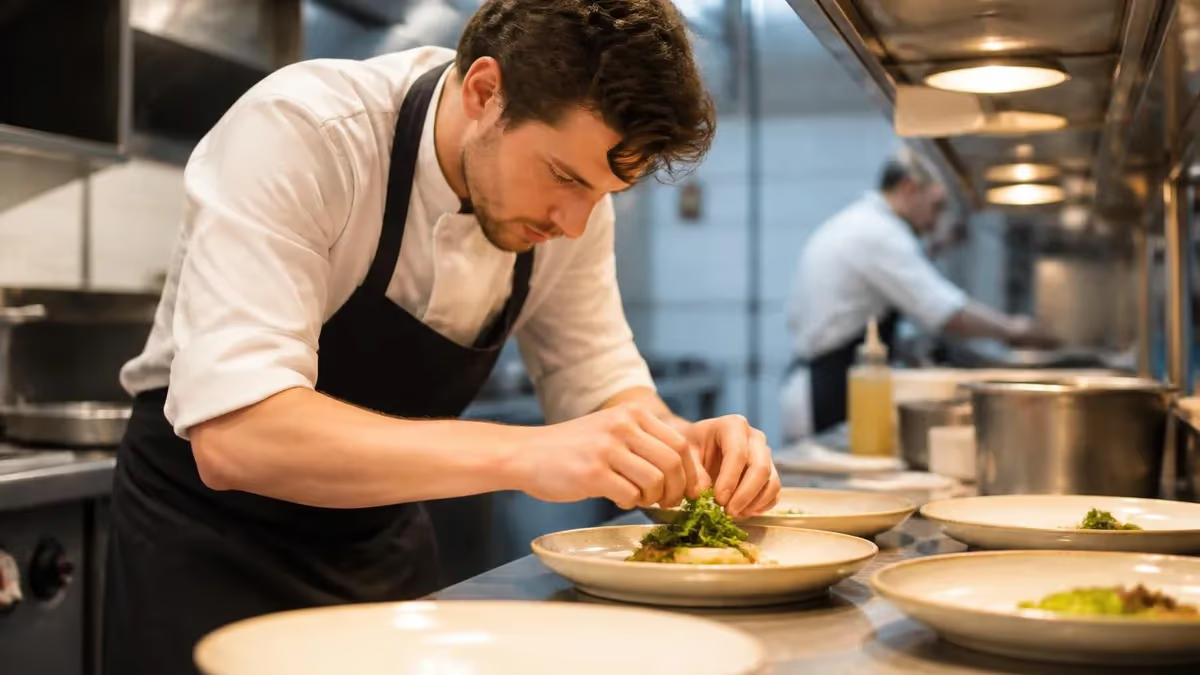
Safe Serve Questions and Answers: Free Food Safety Practice
Safe serve certification — whether you call it ServSafe, food handler, or food safety manager — covers a specific set of topics that show up on every exam. The temperature danger zone. The Big 6 pathogens. FIFO rotation. Personal hygiene rules. Cleaning vs. sanitizing. If you can answer questions on all five, you'll pass.
This guide is different from a 90-question mock test. Instead of simulating the exam, it breaks down the WHY behind each category so you understand what you're answering, not just which letter to pick. You'll retain it better, answer confidently under pressure, and actually apply it on the job.
The ServSafe Food Handler exam has 40 questions. The Manager exam has 90. Both draw from the same core content domains. Master these domains — and the practice questions below — and you're ready for either version.
Want to jump straight into timed practice? Start with a ServSafe practice test to benchmark where you stand right now. Check your weak spots, then come back here to fill the gaps. Most candidates discover they're weak on HACCP or sanitizer concentrations — both covered in detail below.
One more thing: food safety isn't just a test topic. The rules exist because unsafe food handling kills people. Every year, roughly 48 million Americans get sick from foodborne illness — 128,000 are hospitalized and 3,000 die. That context makes the material stick. Memorizing a temperature is easy. Understanding that 41°F to 135°F is literally the range where bacteria can kill customers? That sticks permanently. Let that gravity carry you through the harder sections of this guide.
Temperature Danger Zone: The Most-Tested Topic
41°F to 135°F — that's the range where bacteria grow fastest. Every safe serve exam tests this. Get it tattooed on your brain.
Below 41°F, bacterial growth slows to a crawl. Above 135°F, most pathogens die. Between those numbers? Bacteria can double every 20 minutes under ideal conditions. That's why you don't leave chicken on the counter while you take a break.
The two-hour rule says food can't stay in the danger zone longer than two hours total — and that clock starts the moment food leaves temperature control. On hot days (above 90°F ambient), that window drops to one hour. Many managers don't know the ambient temperature exception. Examiners do.
For temperature danger zone questions, you'll also need to know minimum internal cooking temperatures. Poultry: 165°F for 15 seconds. Ground beef and injected meats: 155°F for 17 seconds. Whole muscle beef and pork: 145°F for 15 seconds. Fish: 145°F for 15 seconds. Vegetables cooked for hot holding: 135°F.
Cooling cooked food is where most operations fail. You've got two hours to drop from 135°F to 70°F — then four more hours to reach 41°F or below. Total cooling window: 6 hours. The most common failure point happens in that first step: a full stockpot of soup loses heat too slowly in a standard walk-in cooler. Divide into shallow pans (2 inches max), use an ice bath, or use a blast chiller. Don't just trust the cooler to do the work.
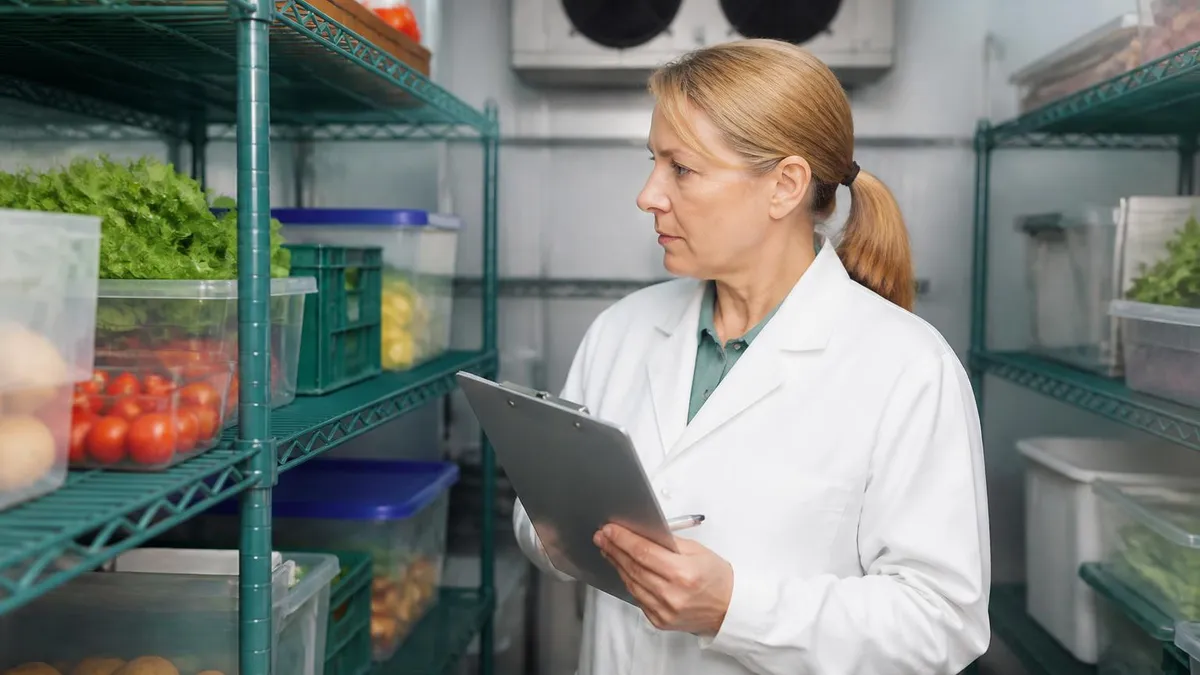
The Big 6 Pathogens — Know Every One
The FDA identifies six pathogens as the most dangerous to public health: Norovirus, Hepatitis A, Salmonella Typhi, Nontyphoidal Salmonella, Shiga toxin-producing E. coli (STEC), and Shigella. These are the only six that require complete employee exclusion from the facility — not just restriction from food handling, but from the building entirely.
Norovirus is the most common cause of foodborne illness in the US. It's highly contagious, survives on surfaces for days, and an infected employee can shed millions of viral particles through normal breathing and movement. One sick food worker caused over 150 illnesses at a catered event. The exam loves Norovirus questions — know it cold.
Hepatitis A spreads fecal-oral, meaning proper handwashing is the primary control. Employees working in childcare or long-term care settings have higher baseline exposure risk. Salmonella Typhi (typhoid) is rare in the US but appears on Manager exams because it's reportable and triggers mandatory exclusion.
For the foodborne illness section, you need the difference between infection, intoxication, and toxin-mediated illness. Infection: you eat live bacteria that grow in your gut (Salmonella). Intoxication: you eat toxins already in the food — the bacteria may be dead, but the toxin remains (Staph aureus, Bacillus cereus). Toxin-mediated: you eat live bacteria that produce toxins after entering your body (E. coli O157:H7). That three-way split appears on Manager exams regularly.
Personal hygiene ties directly to pathogen control. Employees must wash hands for at least 20 seconds with warm water and soap — before entering the kitchen, after using the restroom, after touching raw meat, after sneezing, after touching a cell phone. Not just a rinse. Not just a splash. Twenty seconds with soap. And hand sanitizer doesn't replace handwashing — it only supplements it.
Mandatory Handwashing Moments
- ✓After using the restroom
- ✓After handling raw meat, poultry, or seafood
- ✓After touching your face, hair, or body
- ✓After sneezing or coughing
- ✓After handling garbage or chemicals
- ✓After using a phone or tablet
- ✓When switching between raw and ready-to-eat foods
- ✓After handling money (if also handling food)
FIFO, Cross-Contamination, and Safe Storage
FIFO stands for First In, First Out. Stock rotation basics: older inventory goes in front, newer stock goes behind. Sounds obvious — but restaurants that skip this step end up with expired dairy hidden behind fresh cases, and that's a violation and a lawsuit waiting to happen.
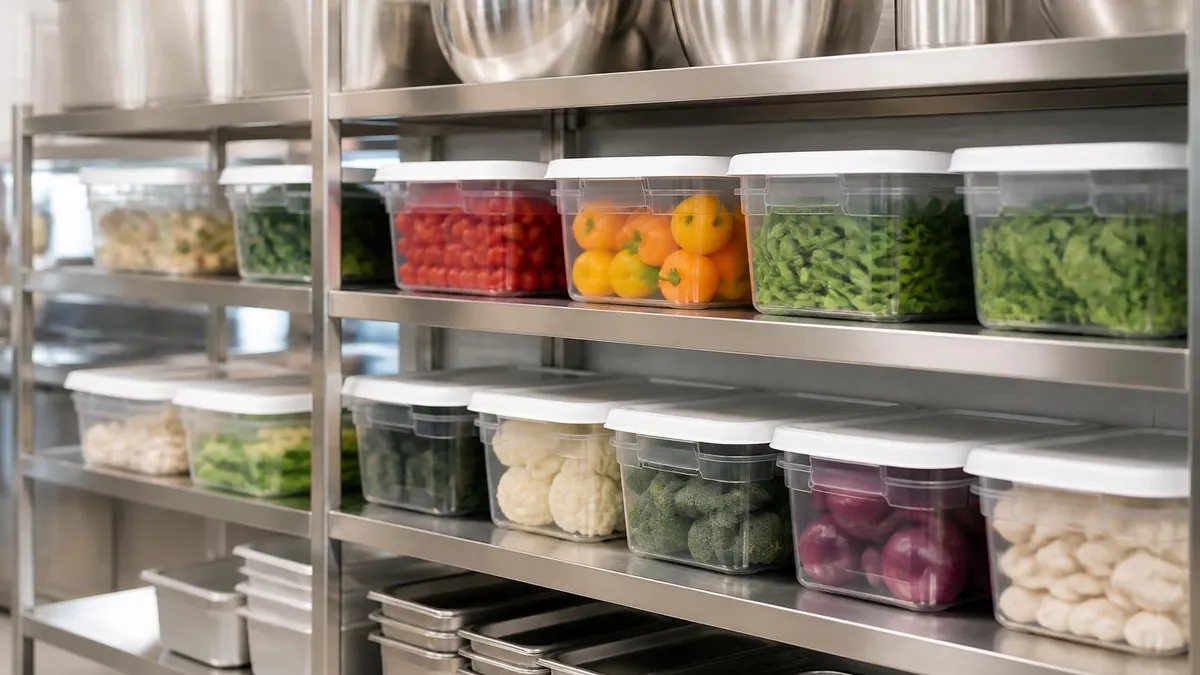
Storage order in a walk-in cooler follows a vertical logic based on minimum cooking temperature. Ready-to-eat foods go on the top shelf (won't be cooked again). Fish goes below. Whole cuts of beef and pork below fish. Ground meat below whole cuts. Poultry sits on the very bottom — lowest shelf, highest cooking temp. If raw chicken drips onto ready-to-eat salad, you've got a cross-contamination event and potentially sick guests.
Cross-contamination also spreads through equipment. A cutting board used for raw chicken, wiped with a cloth towel, then used for lettuce — that's a contamination chain. Color-coded cutting boards (red for meat, green for produce) are a standard control. Separate equipment for allergen management is mandatory at many operations. The exam tests whether you understand the mechanism, not just the rule.
For allergen control, know the Big 9: milk, eggs, fish, shellfish, tree nuts, peanuts, wheat, soybeans, and sesame (added to federal law in 2023). Cross-contact — when an allergen touches food that shouldn't contain it — differs from cross-contamination. Cooking doesn't eliminate it. A peanut allergic reaction doesn't care if the dish was cooked to 165°F. Review the servsafe for full allergen management procedures used in commercial kitchens.
Receiving food correctly is a tested skill. Reject: frozen food showing signs of thaw-refreeze (ice crystals, liquid in package, discoloration), canned goods with swollen lids or dents on the seam, fish with cloudy eyes or strong ammonia odor. Temperature on delivery: refrigerated foods must arrive at 41°F or below, frozen foods must arrive frozen solid with no thaw evidence.
Cleaning vs. Sanitizing: Not Interchangeable
Cleaning removes dirt and food particles. Sanitizing reduces microorganisms to safe levels. You must clean before you sanitize — sanitizer can't penetrate a film of grease or food debris. The exam tests this distinction constantly because many food workers get it backwards.
The 3-sink method: wash in the first sink (detergent + water), rinse in the second (clean water removes soap), sanitize in the third (approved chemical or hot water), then air dry. Never towel dry sanitized surfaces — towels re-contaminate them instantly. Air dry only. That last step is the one people skip most.
Approved chemical sanitizers and their concentrations: chlorine (bleach) at 50–99 ppm, iodine at 12.5–25 ppm, or quaternary ammonium (quat) at 200–400 ppm. These concentrations aren't arbitrary. Too weak and bacteria survive; too strong and it's unsafe on food-contact surfaces. The Manager exam tests ppm ranges — know all three.
Food-contact surfaces must be cleaned and sanitized every four hours during continuous use, or immediately when contaminated. Non-food-contact surfaces (floors, walls, storage shelves) need a regular cleaning schedule — typically daily, or more often in high-traffic areas. Pest prevention starts with removing food and moisture residue from those surfaces consistently.
High-temperature mechanical dishwashers (machines using heat instead of chemicals) must reach 180°F at the dish surface during the final rinse. That's the rack exit temperature — not the internal machine water temp. Verify with a thermometer regularly. Machines running below 180°F aren't sanitizing, even if they look like they are.
Sanitizer Quick Reference
Concentration: 50–99 ppm
Contact time: 7–10 seconds
Water temp: At least 55°F (13°C)
Notes: Most common, cheapest. Degrades quickly in organic matter — test solution every 2 hours. Sensitive to pH. Widely available and recognized by health inspectors.

HACCP: The Manager Exam's Hardest Topic
HACCP stands for Hazard Analysis Critical Control Points. It's a systematic approach to food safety that identifies exactly where things can go wrong and builds controls around those points. Manager-level candidates must know all 7 HACCP principles in order — the exam tests them by number.
Here's the sequence: (1) Conduct a hazard analysis. (2) Identify Critical Control Points (CCPs). (3) Establish critical limits for each CCP. (4) Establish monitoring procedures. (5) Identify corrective actions. (6) Verify the system works. (7) Keep records and documentation.
A Critical Control Point is a step in food production where a control can be applied to prevent, eliminate, or reduce a food safety hazard to an acceptable level. Cooking chicken is a CCP — the critical limit is 165°F for 15 seconds. If a food worker pulls a chicken breast at 159°F, the corrective action is to continue cooking. Not to serve it and hope for the best.
The HACCP principles section often appears as scenario questions on the Manager exam: a delivery truck's refrigeration unit broke down, chicken thighs measured 49°F on arrival — what do you do? Answer: reject the shipment and document the rejection with the date, time, temperature measured, product, and reason for rejection. Corrective actions always require documentation. That's not optional.
HACCP is legally required in many food operations — seafood processing, juice manufacturing, and large-scale meat and poultry operations must have written HACCP plans. ServSafe tests your ability to identify CCPs, set critical limits, and describe what corrective action looks like when a limit is exceeded. Scenario-based questions dominate this section, so practice applying the principles — don't just memorize the definitions.
Two more Manager-level hygiene rules worth knowing: jewelry restrictions prohibit rings, bracelets, and watches during food handling (plain band rings are the only exception). Hair restraints — hats, nets, or caps — are required for all employees working with unpackaged food. Nail polish and artificial nails are prohibited for food handlers unless they're wearing intact single-use gloves. And remember — changing gloves doesn't eliminate handwashing responsibility. Change gloves and wash hands every time the situation calls for it.
Study tip for HACCP: the exam distinguishes between Critical Control Points (CCPs) and control points. A control point is any step where a hazard can be reduced but not eliminated or prevented entirely — washing produce reduces but doesn't eliminate contamination. A CCP eliminates or prevents a hazard to a safe level. That distinction separates correct answers from close-but-wrong ones on Manager exam scenarios.
Food Handler vs. Manager Certification: What's Right for You?
- +Food Handler (easier): 40 questions, 75 min, costs $15–30, valid 3 years — covers frontline worker basics
- +Manager (advanced): 90 questions, 2 hours, costs $35–150, valid 5 years — required for supervisors in most states
- +Food Handler is sufficient for servers, prep cooks, and dishwashers
- +Manager certification is mandatory for food establishment managers in 35+ US states
- +Manager cert unlocks higher pay — food safety managers earn $10–20K more annually than non-certified peers
- −Food Handler doesn't satisfy manager requirements — you'll need to retrain if you get promoted
- −Manager exam is significantly harder — HACCP, regulatory knowledge, corrective action scenarios
- −Most Manager programs require an 8-hour course before you can take the exam
- −If you fail the Manager exam 3 times, you must wait 60 days before retesting
- −Neither certification replaces a local food handler permit — some jurisdictions require both
Safe Serve Practice Questions: Test Your Knowledge
Here are scenario-based questions in the style you'll see on the actual exam — with the answer and the reasoning explained clearly. Read the explanation, not just the answer. Understanding why a rule exists is what lets you handle a question you've never seen before.
Q: A food handler calls in sick with vomiting and diarrhea. What should the manager do? Exclude the employee from the facility entirely. Not just from food handling — from the building. Norovirus and other Big 6 pathogens spread even through incidental contact. The employee can return only after being symptom-free for 24–48 hours (check local jurisdiction rules). Document the exclusion with date and reason.
Q: Leftover clam chowder is stored in a large stockpot at 140°F. Best way to cool it? Divide into shallow pans (no deeper than 2 inches), place pans in ice baths, and stir every 15 minutes. Goal: drop from 135°F to 70°F within 2 hours, then reach 41°F within 4 more hours. A full stockpot in a walk-in won't cool fast enough — it stays in the danger zone for hours.
Q: A can of diced tomatoes has a dent on the seam. Can you use it? No. Seam dents — whether on the side seam or the top/bottom seam — can compromise the can's integrity and allow contamination or gas buildup. A body dent (not on any seam) may be acceptable if the can is otherwise undamaged. When in doubt, reject or discard it. Swollen cans are always rejected: gas-producing bacteria (likely Clostridium botulinum) are the cause.
Q: An employee uses gloves while prepping raw chicken, then starts slicing vegetables without changing gloves. What's wrong? Cross-contamination — the gloves carry raw chicken pathogens directly onto ready-to-eat produce. Gloves must be changed every time you'd otherwise wash your hands. They're a barrier tool, not a get-out-of-handwashing card.
Q: What's the minimum chlorine sanitizer concentration for a 3-sink setup? 50 ppm. Below 50 ppm, chlorine sanitizer isn't effective at reducing pathogens to safe levels. Above 99 ppm, it becomes unsafe for food-contact surfaces and may leave chemical residue. Test strip verification is required — don't guess at concentration by color alone.
These scenario questions represent the style of reasoning the actual exam rewards. The right answer isn't always the one that sounds safest — it's the one that follows the specific ServSafe protocol you'll be tested on. Review each domain, practice with real questions, and you'll be ready.
ServSafe Practice Test Questions
Prepare for the ServSafe - ServSafe Food Safety exam with our free practice test modules. Each quiz covers key topics to help you pass on your first try.
ServSafe Allergens Practice Test
ServSafe Exam Questions covering Allergens Practice Test. Master ServSafe Test concepts for certification prep.
ServSafe Food Handler Practice Test
Free ServSafe Practice Test featuring Food Handler Practice Test. Improve your ServSafe Exam score with mock test prep.
ServSafe - Alcohol Test
ServSafe Mock Exam on - Alcohol Test. ServSafe Study Guide questions to pass on your first try.
ServSafe Alcohol Test - Primary and Advanc...
ServSafe Test Prep for Alcohol Test - Primary and Advanced (2). Practice ServSafe Quiz questions and boost your score.
ServSafe Alcohol Test - Primary and Advanc...
ServSafe Questions and Answers on Alcohol Test - Primary and Advanced (3). Free ServSafe practice for exam readiness.
ServSafe Alcohol Test - Primary and Advanc...
ServSafe Mock Test covering Alcohol Test - Primary and Advanced (4). Online ServSafe Test practice with instant feedback.
ServSafe - Allergens Test
Free ServSafe Quiz on - Allergens Test. ServSafe Exam prep questions with detailed explanations.
ServSafe Facilities, Cleaning & Sanitizing...
ServSafe Practice Questions for Facilities, Cleaning & Sanitizing, and Pest Management Test. Build confidence for your ServSafe certification exam.
ServSafe Management Test
ServSafe Test Online for Management Test. Free practice with instant results and feedback.
ServSafe Management Test #1
ServSafe Study Material on Management Test #1. Prepare effectively with real exam-style questions.
ServSafe Manager Exam 1 (2)
Free ServSafe Test covering Manager Exam 1 (2). Practice and track your ServSafe exam readiness.
ServSafe Manager Exam 1 (3)
ServSafe Exam Questions covering Manager Exam 1 (3). Master ServSafe Test concepts for certification prep.
ServSafe Manager Exam 1 (4)
Free ServSafe Practice Test featuring Manager Exam 1 (4). Improve your ServSafe Exam score with mock test prep.
ServSafe Manager Exam 1 (5)
ServSafe Mock Exam on Manager Exam 1 (5). ServSafe Study Guide questions to pass on your first try.
ServSafe Manager Exam
ServSafe Test Prep for Manager Exam. Practice ServSafe Quiz questions and boost your score.
ServSafe Manager Exam 6
ServSafe Questions and Answers on Manager Exam 6. Free ServSafe practice for exam readiness.
ServSafe Manager Exam 7
ServSafe Mock Test covering Manager Exam 7. Online ServSafe Test practice with instant feedback.
ServSafe Manager Exam 8
Free ServSafe Quiz on Manager Exam 8. ServSafe Exam prep questions with detailed explanations.
ServSafe Manager Practice Exam
ServSafe Practice Questions for Manager Practice Exam. Build confidence for your ServSafe certification exam.
ServSafe Personal Hygiene Test
ServSafe Test Online for Personal Hygiene Test. Free practice with instant results and feedback.
ServSafe Practice Test
ServSafe Study Material on Practice Test. Prepare effectively with real exam-style questions.
ServSafe Practice Test 1
Free ServSafe Test covering Practice Test 1. Practice and track your ServSafe exam readiness.
ServSafe Practice Test 2
ServSafe Exam Questions covering Practice Test 2. Master ServSafe Test concepts for certification prep.
ServSafe Practice Test 3
Free ServSafe Practice Test featuring Practice Test 3. Improve your ServSafe Exam score with mock test prep.
ServSafe Practice Test Allergens
ServSafe Mock Exam on Practice Test Allergens. ServSafe Study Guide questions to pass on your first try.
ServSafe Preparation, Cooking and Serving ...
ServSafe Test Prep for Preparation, Cooking and Serving Test. Practice ServSafe Quiz questions and boost your score.
ServSafe Purchasing, Receiving and Storage...
ServSafe Questions and Answers on Purchasing, Receiving and Storage Test. Free ServSafe practice for exam readiness.
ServSafe Purchasing, Receiving and Storage...
ServSafe Mock Test covering Purchasing, Receiving and Storage Test (2). Online ServSafe Test practice with instant feedback.
ServSafe Purchasing, Receiving and Storage...
Free ServSafe Quiz on Purchasing, Receiving and Storage Test (3). ServSafe Exam prep questions with detailed explanations.
Safe Serve Questions and Answers

About the Author

Registered Sanitarian & Food Safety Certification Expert
Cornell University College of Agriculture and Life SciencesThomas Wright is a Registered Sanitarian and HACCP-certified food safety professional with a Bachelor of Science in Food Science from Cornell University. He has 17 years of experience in food safety auditing, regulatory compliance, and foodservice management training. Thomas prepares food industry professionals for ServSafe Manager, HACCP certification, and state food handler examinations.
Join the Discussion
Connect with other students preparing for this exam. Share tips, ask questions, and get advice from people who have been there.
View discussion (7 replies)