
ServSafe Temperature Guide — Food Safety Temperature Zones 2026
Get ready for your ServSafe Temperature Guide certification. Practice questions with step-by-step answer explanations and instant scoring. ⏳
The Temperature Danger Zone
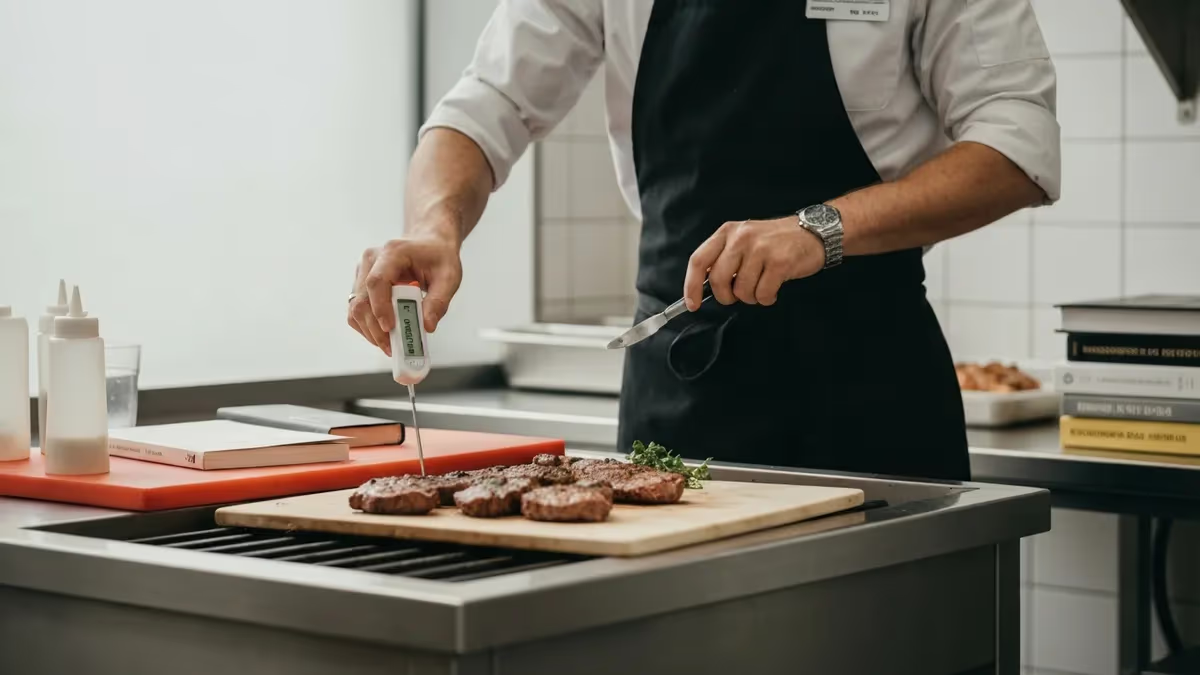
The Temperature Danger Zone is the range between 41°F and 135°F (5°C to 57°C). Within this range, bacteria multiply rapidly — doubling in as little as 20 minutes under ideal conditions. Food held in the danger zone for a cumulative total of more than 4 hours must be discarded. Practice with the free ServSafe practice test on PracticeTestGeeks (1,350+ questions with answer explanations).
The ServSafe exam tests the danger zone extensively. You will see questions that ask you to identify the exact temperature boundaries, calculate how long food has been in the danger zone across multiple exposures, and determine whether food is still safe or must be thrown out. Understanding the danger zone is the foundation of all other temperature knowledge.
Key danger zone facts tested on the ServSafe exam:
- Range: 41°F–135°F (5°C–57°C)
- Bacteria double approximately every 20 minutes in this range
- Food cannot remain in the danger zone for more than 4 cumulative hours
- Time is tracked cumulatively — if food spends 2 hours in danger zone, is chilled, then warms again for 2 more hours, it has reached the 4-hour limit
- TCS (Time/Temperature Control for Safety) foods are at highest risk
TCS foods include: meat, poultry, seafood, cooked starches, cooked vegetables, dairy products, sliced melons, cut tomatoes, cut leafy greens, sprouts, and garlic-in-oil mixtures.
For a broader review of how temperature fits into the full exam, see our ServSafe Study Guide.
- The ServSafe Food Handler assessment has 40 questions and is not proctored. (National Restaurant Association)
- The ServSafe Manager exam has 90 questions, of which 80 are scored and 10 are unscored pilot questions. (National Restaurant Association)
- The ServSafe Food Handler assessment has no time limit; the page estimates most people finish within 90 minutes. (National Restaurant Association)
- The online-proctored ServSafe Manager exam allows 2 hours. (National Restaurant Association)
- The ServSafe Food Handler assessment requires a score of at least 75%, though some jurisdictions may set a different required score. (National Restaurant Association)
- ServSafe Food Handler allows 3 attempts to pass the assessment, and a new course must be purchased after the third failed attempt. (National Restaurant Association)
- The ServSafe Manager exam may be taken twice within 30 days, requires a 60-day wait after three or more attempts, and allows at most four attempts in 12 months. (National Restaurant Association)
- The ServSafe Food Handler certificate is valid for three years. (National Restaurant Association)
- ServSafe Food Handler can often be taken online without a proctor, though some states require a proctor's presence. (National Restaurant Association)
Facts verified Oct 20, 2026 against National Restaurant Association. Dates that have passed are removed automatically.
ServSafe Exam at a Glance
| Item | Detail | Official source |
|---|---|---|
| Number of questions (Food Handler) | 40 questions | National Restaurant Association |
| Number of questions (Manager exam) | 90 questions (80 scored) | National Restaurant Association |
| Time limit (Food Handler) | No time limit (about 90 minutes on average) | National Restaurant Association |
| Time limit (Manager exam) | 2 hours | National Restaurant Association |
| Passing score (Food Handler) | 75% | National Restaurant Association |
| Retake policy (Food Handler) | 3 attempts | National Restaurant Association |
| Retake policy (Manager exam) | 2 attempts in 30 days; 60-day wait after 3+ attempts; max 4 in 12 months | National Restaurant Association |
| Validity (Food Handler) | 3 years | National Restaurant Association |
| Delivery (Food Handler) | Online, non-proctored (some states require a proctor) | National Restaurant Association |
| Delivery (Manager exam) | Online or classroom, with a physically present proctor for classroom exams | National Restaurant Association |
| Eligibility (Manager exam) | No prerequisite listed; check state and local requirements | National Restaurant Association |
| Registration deadline (Manager exam (online proctor)) | Schedule more than 72 h ahead for no extra fee; $8 for 24–72 h; $12 for under 24 h | National Restaurant Association |
| Testing window (Food Handler) | Start within 12 months; course expires 60 days after start | National Restaurant Association |
Facts verified Oct 20, 2026 against National Restaurant Association. Dates that have passed are removed automatically.
Free ServSafe Study Tools
Interactive ServSafe resources on PracticeTestGeeks, free to start:
- ServSafe - Alcohol Test 1 — 49 questions with instant scoring and answer explanations
- ServSafe flashcards — review key terms and concepts card by card
- ServSafe study guide — topic-by-topic overview of what the exam covers
- ServSafe cheat sheet — one-page printable summary for last-minute review
Minimum Internal Cooking Temperatures by Food Type
The ServSafe exam frequently presents scenario questions where you must identify the correct minimum internal cooking temperature for a specific food. Memorize these four temperature tiers:
| Food Type | Minimum Temp | Hold Time |
|---|---|---|
| Poultry (whole birds, ground poultry, stuffing, stuffed meats, casseroles) | 165°F (74°C) | 15 seconds |
| Ground meat & ground fish (hamburgers, ground pork, ground seafood) | 155°F (68°C) | 15 seconds |
| Seafood, steaks, chops, roasts (whole cuts of beef, pork, veal, lamb, fish) | 145°F (63°C) | 15 seconds |
| Pork, beef, veal, lamb roasts (depending on cooking method) | 145°F (63°C) | 4 minutes |
| Commercially processed, ready-to-eat food (hot dogs, pre-cooked items) | 135°F (57°C) | No minimum hold time |
| Fruit, vegetables, grains cooked for hot holding | 135°F (57°C) | No minimum hold time |
Important exam note: The ServSafe exam distinguishes between poultry (always 165°F) and ground meat (155°F). Whole cuts like steaks and chops reach safe temperatures at 145°F. Mixing up these tiers is the most common temperature mistake on the exam.
After cooking, verify the final internal temperature using a calibrated bimetallic stemmed thermometer or digital probe thermometer inserted into the thickest part of the food, away from bone, fat, or gristle.
Review how these temperatures appear in exam questions in our servsafe manager practice test.
ServSafe Temperature Checklist
- ✓Know the Temperature Danger Zone: 41°F–135°F (5°C–57°C)
- ✓Cold holding: TCS food must be 41°F (5°C) or below
- ✓Hot holding: TCS food must be 135°F (57°C) or above
- ✓Poultry minimum cook temp: 165°F (74°C) for 15 seconds
- ✓Ground meat minimum cook temp: 155°F (68°C) for 15 seconds
- ✓Seafood & whole cuts minimum cook temp: 145°F (63°C) for 15 seconds
- ✓2-stage cooling: 135°F → 70°F in 2 hours, then 70°F → 41°F in 4 hours
- ✓Total cooling window: 6 hours maximum (135°F to 41°F)
- ✓Reheating: food must reach 165°F (74°C) within 2 hours
- ✓TCS food in danger zone over 4 cumulative hours must be discarded
- ✓Use a calibrated thermometer — insert into thickest part, away from bone
- ✓Commercially processed ready-to-eat food: heat to 135°F minimum
Reheating Requirements
Food that has been cooked, cooled, and stored must be reheated to a safe temperature before being served hot. ServSafe reheating rules are straightforward but frequently tested:
- Reheating temperature: All TCS food must be reheated to an internal temperature of 165°F (74°C)
- Time limit: Food must reach 165°F within 2 hours
- Method: Use a stove, oven, or microwave — never a steam table or heat lamp (these are for holding, not cooking)
- Steam tables and hot holding equipment are not approved for reheating — they cannot bring food up to temperature fast enough
After reheating to 165°F, food can be placed on steam tables or other hot holding equipment, where it must be maintained at 135°F or above.
For the ServSafe exam, remember: the reheating temperature (165°F) is the same as the minimum cooking temperature for poultry. This makes it easy to remember — when in doubt, 165°F is the safe universal reheating target.
See how reheating fits into the full ServSafe scoring picture in our ServSafe score guide. For a condensed reference of all key temperatures, check our ServSafe cheat sheet. You can also review related content in our servsafe food safety.
ServSafe Temperature Pros and Cons
- +ServSafe has a defined, publicly available content blueprint — candidates know exactly what to prepare for
- +Multiple preparation pathways (self-study, courses, coaching) accommodate different learning styles and schedules
- +A growing ecosystem of study resources means candidates at any budget level can access quality preparation materials
- +Clear score reporting allows candidates to identify specific strengths and weaknesses for targeted remediation
- +Professional recognition associated with strong performance provides tangible career and academic benefits
- −The scope of tested content requires substantial preparation time that competes with existing professional or academic commitments
- −No single resource covers the full content scope — candidates typically need multiple study tools for comprehensive preparation
- −Test anxiety and exam-day performance variability mean preparation effort does not always translate linearly to scores
- −Registration, preparation, and potential retake costs accumulate into a significant financial investment
- −Content and format can change between exam versions, making older preparation materials less reliable
Sample ServSafe Practice Questions
Try these questions from our free ServSafe practice tests. The correct answer and an explanation follow each question.
The Food Safety Modernization Act (FSMA), signed into law in 2011, fundamentally shifted federal food safety policy by emphasizing what approach?
- A. Reacting to foodborne illness outbreaks after they occur
- B. Transferring all inspection authority to state agencies
- C. Preventing food safety problems before they occur
- D. Eliminating HACCP requirements for small operations
Answer: C. Preventing food safety problems before they occur
FSMA represented the most sweeping overhaul of U.S. food safety law in decades, shifting the FDA's focus from responding to outbreaks to proactively preventing contamination throughout the food supply chain.
According to ServSafe, which food is considered a Time/Temperature Control for Safety (TCS) food?
- A. Whole uncut apples
- B. Honey
- C. Cooked rice
- D. Dry crackers
Answer: C. Cooked rice
Cooked rice is a TCS food because it has sufficient moisture and nutrients to support bacterial growth in the danger zone.
Which of the following is a TCS (Time/Temperature Control for Safety) food?
- A. Dry pasta
- B. Whole uncut melons
- C. Sliced tomatoes
- D. Crackers
Answer: C. Sliced tomatoes
Sliced tomatoes are a TCS food because cutting exposes the moist interior, creating an environment that supports bacterial growth.
Which food safety management step is a manager performing when reviewing temperature logs weekly to confirm the HACCP plan is being followed correctly?
- A. Monitoring
- B. Verification
- C. Hazard analysis
- D. Record keeping
Answer: B. Verification
Verification means checking that the HACCP plan is working as intended, such as reviewing monitoring records.
Take the full ServSafe practice test
Many readers pair this guide with the servsafe practice exam with answers to check their readiness before exam day.
ServSafe Temperature Questions and Answers
SERVSAFE Manager 2026: Complete Guide to the Manager Certification Exam
ServSafe Study Guide 2026 — How to Pass the ServSafe Manager Exam
ServSafe Cheat Sheet 2026: Key Facts, Temperatures & Quick Reference
ServSafe Score 2026: Passing Score, Results & What You Need to Know
ServSafe Temperature Danger Zone: Complete Guide 2026
How this page was made: written with AI tools and published by Nathan Beja, founder of Practice Test Geeks, who is responsible for its content. Exam facts are checked against the official sources listed below. Not reviewed by a subject-matter expert. Editorial policy
Sources & references
Exam facts on this page (fees, format, dates, passing scores) are checked against these official sources; the date is our last check. Editorial policy
- servsafe.com — Exam format, score release, fees, time limit, test delivery, passing score, retake policy · verified Oct 2026