
ServSafe HACCP Guide: 7 Principles Explained 2026
Free ServSafe HACCP Guide: 7 Principles practice test with instant feedback and detailed answer explanations. Prepare for your exam. ❓

What Is HACCP?
HACCP stands for Hazard Analysis and Critical Control Points. It is a proactive, science-based food safety system designed to prevent biological, chemical, and physical hazards from causing foodborne illness before they reach the consumer. Unlike reactive inspections, HACCP identifies risks at every step of the flow of food — from receiving and storage through preparation, cooking, holding, cooling, reheating, and serving. Practice with the free ServSafe practice test on PracticeTestGeeks (1,350+ questions with answer explanations).
The FDA and USDA require HACCP plans for many segments of the food industry, including meat and poultry processors, seafood operations, and juice manufacturers. For most food service establishments, applying HACCP principles is best practice and is tested directly on the ServSafe Manager certification exam. If you are studying for ServSafe, you should be able to name all 7 principles in order, give examples of CCPs in a restaurant kitchen, and explain what happens when a critical limit is not met.
Before diving into the principles, it helps to understand the prerequisites. A HACCP plan is only as good as the foundation supporting it. ServSafe teaches that Active Managerial Control and a solid set of Standard Operating Procedures (SOPs) must already be in place. These include personal hygiene policies, approved supplier programs, equipment maintenance, and pest control. Once those foundations are established, you can build an effective HACCP plan. For a full overview of food safety management, see our ServSafe complete guide.
Principle 1 — Conduct a Hazard Analysis
The first principle requires you to identify all potential hazards that could occur at each step in the flow of food. Hazards fall into three categories: biological (bacteria, viruses, parasites), chemical (cleaning agents, pesticides, allergens), and physical (bone fragments, metal shavings, glass). For each menu item, the HACCP team traces every ingredient from receiving to service, asking: what could go wrong here, and is it likely to occur at a level that could harm a guest?
In a commercial kitchen, a hazard analysis for a grilled chicken breast might identify Salmonella contamination during receiving, cross-contamination during prep, and undercooking during grilling as the most significant biological hazards. Chemical hazards might include sanitizer residue if equipment is not properly rinsed. Physical hazards are generally low risk for whole muscle poultry. The output of the hazard analysis is a list of significant hazards that the HACCP plan must control. Employees who handle food with allergen concerns should also review our servsafe as part of the hazard analysis process.
- The ServSafe Food Handler assessment has 40 questions and is not proctored. (National Restaurant Association)
- The ServSafe Manager exam has 90 questions, of which 80 are scored and 10 are unscored pilot questions. (National Restaurant Association)
- The ServSafe Food Handler assessment has no time limit; the page estimates most people finish within 90 minutes. (National Restaurant Association)
- The online-proctored ServSafe Manager exam allows 2 hours. (National Restaurant Association)
- The ServSafe Food Handler assessment requires a score of at least 75%, though some jurisdictions may set a different required score. (National Restaurant Association)
- ServSafe Food Handler allows 3 attempts to pass the assessment, and a new course must be purchased after the third failed attempt. (National Restaurant Association)
- The ServSafe Manager exam may be taken twice within 30 days, requires a 60-day wait after three or more attempts, and allows at most four attempts in 12 months. (National Restaurant Association)
- The ServSafe Food Handler certificate is valid for three years. (National Restaurant Association)
- ServSafe Food Handler can often be taken online without a proctor, though some states require a proctor's presence. (National Restaurant Association)
Facts verified Oct 20, 2026 against National Restaurant Association. Dates that have passed are removed automatically.
ServSafe Exam at a Glance
| Item | Detail | Official source |
|---|---|---|
| Number of questions (Food Handler) | 40 questions | National Restaurant Association |
| Number of questions (Manager exam) | 90 questions (80 scored) | National Restaurant Association |
| Time limit (Food Handler) | No time limit (about 90 minutes on average) | National Restaurant Association |
| Time limit (Manager exam) | 2 hours | National Restaurant Association |
| Passing score (Food Handler) | 75% | National Restaurant Association |
| Retake policy (Food Handler) | 3 attempts | National Restaurant Association |
| Retake policy (Manager exam) | 2 attempts in 30 days; 60-day wait after 3+ attempts; max 4 in 12 months | National Restaurant Association |
| Validity (Food Handler) | 3 years | National Restaurant Association |
| Delivery (Food Handler) | Online, non-proctored (some states require a proctor) | National Restaurant Association |
| Delivery (Manager exam) | Online or classroom, with a physically present proctor for classroom exams | National Restaurant Association |
| Eligibility (Manager exam) | No prerequisite listed; check state and local requirements | National Restaurant Association |
| Registration deadline (Manager exam (online proctor)) | Schedule more than 72 h ahead for no extra fee; $8 for 24–72 h; $12 for under 24 h | National Restaurant Association |
| Testing window (Food Handler) | Start within 12 months; course expires 60 days after start | National Restaurant Association |
Facts verified Oct 20, 2026 against National Restaurant Association. Dates that have passed are removed automatically.
Free ServSafe Study Tools
Interactive ServSafe resources on PracticeTestGeeks, free to start:
- ServSafe - Alcohol Test 1 — 49 questions with instant scoring and answer explanations
- ServSafe flashcards — review key terms and concepts card by card
- ServSafe study guide — topic-by-topic overview of what the exam covers
- ServSafe cheat sheet — one-page printable summary for last-minute review
Principle 2 — Identify Critical Control Points (CCPs)
A Critical Control Point is a step in the food preparation process where a control measure can be applied to prevent, eliminate, or reduce a food safety hazard to an acceptable level. Not every step in the flow of food is a CCP — only those where control is essential and where loss of control would likely result in an unacceptable health risk. A common tool for identifying CCPs is the CCP Decision Tree, a series of yes/no questions about each step and each hazard identified in the hazard analysis.
In a typical restaurant, common CCPs include cooking (temperature kills pathogens), cooling (rapid cooling prevents bacterial growth), and hot holding (maintaining temperature prevents multiplication). Receiving raw shellfish is another common CCP because improper temperature at delivery can render the product unsafe before it ever enters your kitchen. It is important to distinguish a CCP from a prerequisite program — handwashing, for example, is a critical practice but is generally managed through SOPs, not as a formal CCP in the HACCP plan.
Principle 3 — Establish Critical Limits
Critical limits are the measurable standards that must be met at each CCP to keep food safe. They are based on regulatory requirements, scientific data, and expert guidance — not personal judgment. Critical limits must be specific and observable. Temperature and time are the most common critical limits in food service. For example, the critical limit for cooking whole muscle poultry is an internal temperature of 165°F (74°C) for 15 seconds. For ground beef, it is 155°F (68°C) for 15 seconds. For cooling, food must be cooled from 135°F to 70°F within two hours and from 70°F to 41°F within four additional hours.
If a critical limit is not met, the food is not automatically discarded — the corrective action plan (Principle 5) determines the proper response. Critical limits are non-negotiable: they cannot be adjusted based on how busy the kitchen is or personal preference. Managers who hold the ServSafe Food Handler Card must ensure all staff understand the critical limits relevant to their station.
Principle 4 — Establish Monitoring Procedures
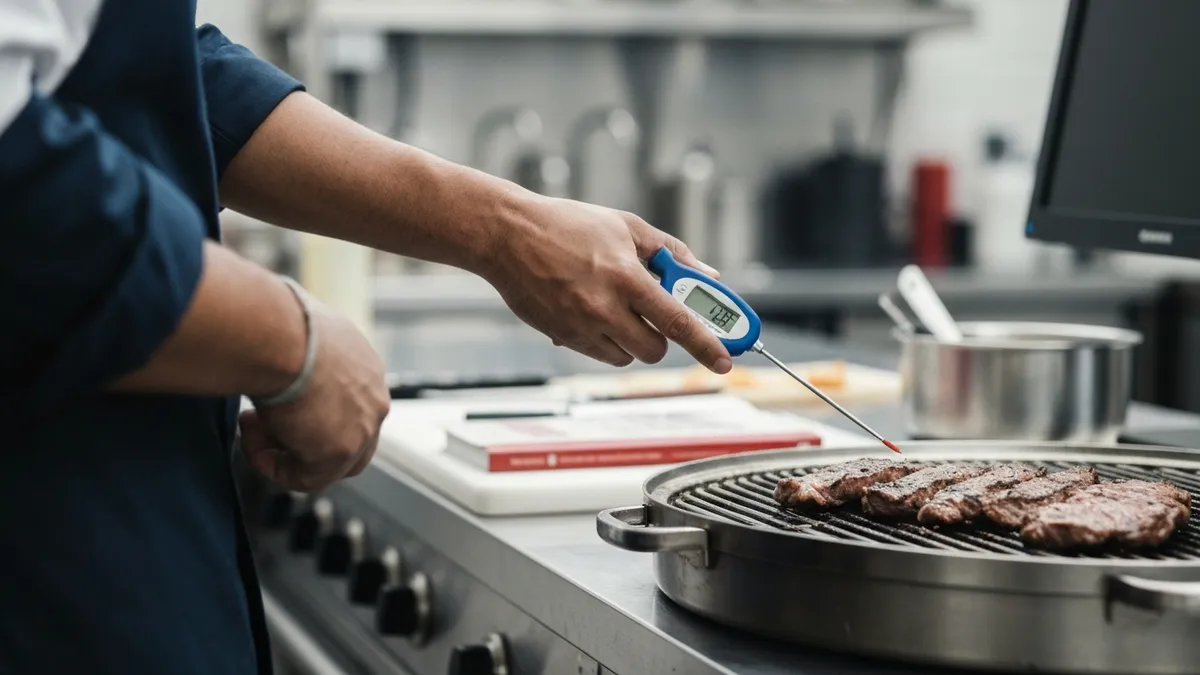
Monitoring is the scheduled observation or measurement of a CCP to ensure it stays within its critical limit. A monitoring procedure defines: what is being measured (e.g., internal temperature), how it is measured (e.g., calibrated bimetallic thermometer), when or how often (e.g., every chicken breast coming off the grill), and who is responsible (e.g., the line cook, verified by the shift supervisor).
Continuous monitoring is preferred where possible — for example, a calibrated probe thermometer built into a walk-in cooler provides constant readings. When continuous monitoring is not possible, the frequency of monitoring should reflect the risk. High-risk CCPs like cooking temperatures should be checked every batch; lower-risk steps like receiving temperatures may be checked on every delivery. Monitoring records must be kept as part of Principle 7 and should be reviewed regularly as part of Principle 6 verification.
Principle 5 — Identify Corrective Actions
When monitoring shows that a critical limit has not been met, a pre-determined corrective action must be taken immediately. Corrective actions serve two purposes: (1) fix the immediate problem with the affected food, and (2) identify and correct the root cause so it does not recur. For food that did not meet a critical limit, options include: continue cooking to reach the correct temperature, reject a shipment that arrived at an unsafe temperature, or discard food that has been in the temperature danger zone too long.
The corrective action must be documented, including what happened, what was done with the affected food, and what steps were taken to prevent recurrence. ServSafe emphasizes that managers must have the authority and knowledge to make corrective action decisions quickly. A line cook who finds that reheated soup only reached 145°F instead of the required 165°F must know to return it to heat immediately — not serve it. For more on how HACCP integrates with your renewal and ongoing training obligations, see our ServSafe renewal guide.
Principle 6 — Establish Verification Procedures
Verification confirms that the HACCP plan is working as intended. Verification activities are different from monitoring: monitoring checks individual CCPs in real time, while verification evaluates the overall system. Verification includes reviewing monitoring records to confirm they are being completed accurately, calibrating thermometers and other measuring equipment on a regular schedule, conducting additional microbiological testing when appropriate, and reviewing the HACCP plan annually or whenever a significant change occurs (new menu item, new supplier, renovation of kitchen space).
Third-party audits, health department inspections, and internal management audits all function as verification activities. The ServSafe exam often tests the distinction between monitoring and verification — know that verification is broader, less frequent, and done by management or a qualified third party.
Principle 7 — Establish Recordkeeping Procedures
The seventh and final HACCP principle requires that all monitoring data, corrective actions, verification activities, and the written HACCP plan itself be documented and retained. Records are the paper trail that proves your system was followed. They also help managers identify trends — for example, if temperature logs show a cooler consistently running at 43°F when the critical limit is 41°F, the trend reveals an equipment problem before a more serious failure occurs.
Required records typically include: the written HACCP plan and hazard analysis, CCP monitoring logs (temperature records, time logs), corrective action reports, equipment calibration records, and employee training documentation. Regulatory agencies can request records during inspections, and incomplete or falsified records can result in serious consequences. Good recordkeeping also supports a culture of accountability and continuous improvement in food safety.
HACCP on the ServSafe Manager Exam
The ServSafe Manager exam dedicates significant attention to HACCP. Expect questions that ask you to identify which step in a scenario represents a CCP, what the appropriate corrective action is when a critical limit is breached, or which of several options correctly describes a verification activity. Common traps include confusing monitoring with verification, misidentifying a step as a CCP when it is better handled by an SOP, or selecting an incorrect critical limit temperature. Use our ServSafe practice test to drill HACCP scenarios until the principles become second nature.
You can continue preparing with the servsafe questions and answers, which includes answer explanations for every question.

HACCP Study Checklist — 8 Things to Know Before the Exam
- ✓Name all 7 HACCP principles in the correct order from memory
- ✓Explain the difference between a Critical Control Point and a prerequisite program (SOP)
- ✓State the critical limit temperatures for poultry (165°F), ground beef (155°F), and whole-muscle meats (145°F)
- ✓Describe the two-stage cooling requirement: 135°F to 70°F in 2 hours, then to 41°F in 4 more hours
- ✓Explain the difference between monitoring (real-time CCP checks) and verification (system-level review)
- ✓Know at least two examples of corrective actions when a critical limit is not met
- ✓List the types of records a HACCP plan requires (temperature logs, corrective action reports, calibration records)
- ✓Practice identifying CCPs in scenario-based questions using the CCP Decision Tree logic
HACCP Pros and Cons
- +HACCP has a defined, publicly available content blueprint — candidates know exactly what to prepare for
- +Multiple preparation pathways (self-study, courses, coaching) accommodate different learning styles and schedules
- +A growing ecosystem of study resources means candidates at any budget level can access quality preparation materials
- +Clear score reporting allows candidates to identify specific strengths and weaknesses for targeted remediation
- +Professional recognition associated with strong performance provides tangible career and academic benefits
- −The scope of tested content requires substantial preparation time that competes with existing professional or academic commitments
- −No single resource covers the full content scope — candidates typically need multiple study tools for comprehensive preparation
- −Test anxiety and exam-day performance variability mean preparation effort does not always translate linearly to scores
- −Registration, preparation, and potential retake costs accumulate into a significant financial investment
- −Content and format can change between exam versions, making older preparation materials less reliable
Pros and Cons at a Glance
| Pros | Cons |
|---|---|
| HACCP has a defined, publicly available content blueprint — candidates know exactly what to prepare for | The scope of tested content requires substantial preparation time that competes with existing professional or academic commitments |
| Multiple preparation pathways (self-study, courses, coaching) accommodate different learning styles and schedules | No single resource covers the full content scope — candidates typically need multiple study tools for comprehensive preparation |
| A growing ecosystem of study resources means candidates at any budget level can access quality preparation materials | Test anxiety and exam-day performance variability mean preparation effort does not always translate linearly to scores |
| Clear score reporting allows candidates to identify specific strengths and weaknesses for targeted remediation | Registration, preparation, and potential retake costs accumulate into a significant financial investment |
| Professional recognition associated with strong performance provides tangible career and academic benefits | Content and format can change between exam versions, making older preparation materials less reliable |
Sample ServSafe Practice Questions
Try these questions from our free ServSafe practice tests. The correct answer and an explanation follow each question.
A food manager reviews HACCP temperature logs every week and confirms the plan is effective. This is an example of which HACCP principle?
- A. Monitoring
- B. Record keeping
- C. Verification
- D. Corrective action
Answer: C. Verification
Verification (Principle 6) involves reviewing records and other activities to confirm that the HACCP plan is working as intended.
Which HACCP principle involves establishing procedures to ensure that the HACCP system is working as intended?
- A. Monitoring
- B. Verification
- C. Record-keeping
- D. Corrective action
Answer: B. Verification
Verification (Principle 6) involves activities confirming the HACCP system is working correctly, such as reviewing records and conducting additional testing.
A HACCP team is conducting a flow diagram review and discovers that cross-contamination is possible when raw beef is stored above ready-to-eat foods. This finding belongs in which HACCP step?
- A. Verification
- B. Hazard analysis
- C. Establishing critical limits
- D. Record keeping
Answer: B. Hazard analysis
The hazard analysis (Principle 1) is where potential hazards at each step of the flow are identified and evaluated for significance.
A manager is setting up a HACCP plan. Which step involves identifying points where control can prevent, eliminate, or reduce a hazard?
- A. Conducting a hazard analysis
- B. Identifying Critical Control Points (CCPs)
- C. Establishing corrective actions
- D. Verifying the system is working
Answer: B. Identifying Critical Control Points (CCPs)
Identifying Critical Control Points (CCPs) is the step where managers pinpoint the specific stages where controls must be applied to ensure food safety.
ServSafe HACCP Questions and Answers



How this page was made: written with AI tools. Exam facts are checked against the official sources listed below. Not reviewed by a subject-matter expert. Editorial policy
Sources & references
Exam facts on this page (fees, format, dates, passing scores) are checked against these official sources; the date is our last check. Editorial policy
- servsafe.com — Exam format, registration deadline, retake policy, time limit, test delivery, eligibility, passing score, test dates, score validity · verified Oct 2026