
Phlebotomy Salary 2026 October: How Much Do Phlebotomists Make in the US?
Phlebotomy salary guide for 2026 October: 💡 average pay, hourly rates, top-paying states, certifications that boost income, and how to earn more as a phlebotomist.
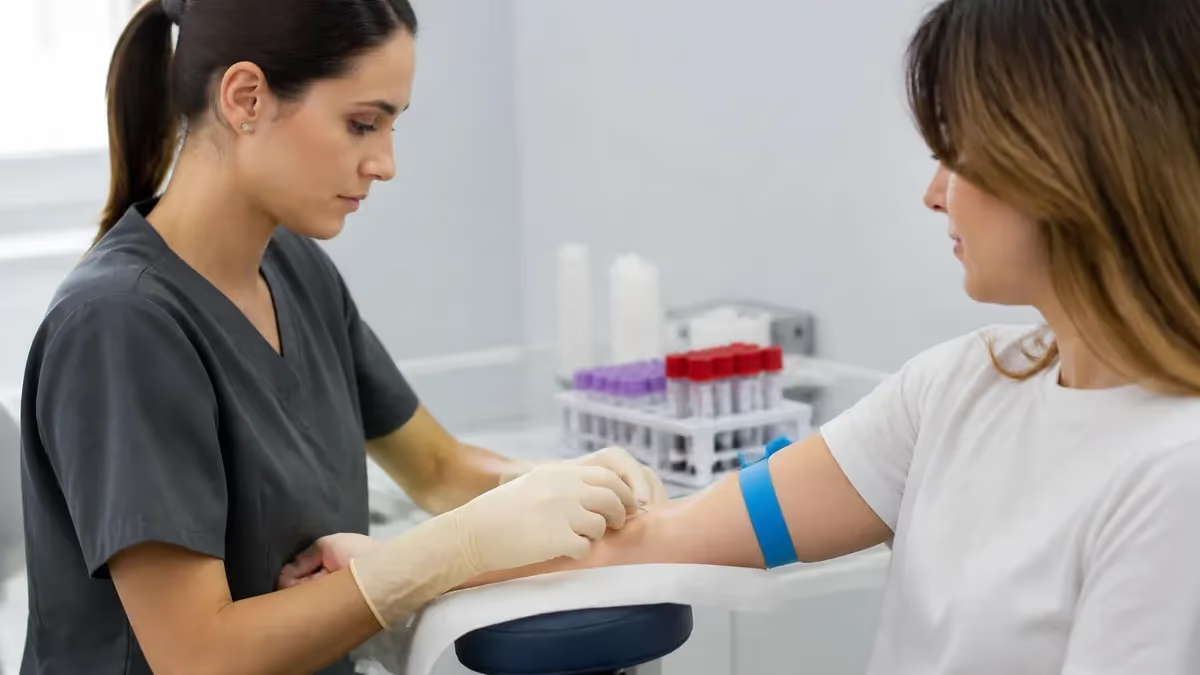
Understanding the real numbers behind a phlebotomy salary is the smartest first step before you sign up for a training program, take a certification exam, or apply for your first hospital draw-station role. The U.S. Bureau of Labor Statistics pegs the median annual wage for phlebotomists at roughly $41,810 as of the latest data release, with hourly rates landing near $20.10. That figure climbs quickly with experience, shift differentials, overtime, and certification — and it varies dramatically by state, employer, and care setting.
This guide gives you a complete picture of what phlebotomists actually earn in 2026, not just a single average. We break down pay by state, by employer type, by years of experience, and by certification level so you can benchmark your offer or plan a realistic career trajectory. Whether you are searching phlebotomy classes near me for the first time or already drawing 80 patients a shift in a busy outpatient lab, the numbers below will give you context.
We also cover the hidden compensation levers most new phlebotomists miss: float pay, on-call differentials, night and weekend premiums, sign-on bonuses, tuition reimbursement, and the increasingly common $1.50 to $4.00 per hour bump for becoming a certified phlebotomy technician. These extras can lift a $19/hour base into the high $20s without changing employers, and we will show you exactly how to negotiate for them.
Job growth is another reason this career attracts career-changers and recent graduates alike. The BLS projects 8% growth for phlebotomists through 2032, faster than the average for all occupations, driven by an aging population, expansion of blood-based diagnostic testing, and the rapid build-out of outpatient draw stations operated by Quest, Labcorp, BioReference, and regional hospital networks. That growth keeps wages competitive and gives new hires real negotiating use.
You will also see how a phlebotomy technician role compares financially to adjacent jobs like medical assistant, EKG tech, and clinical lab assistant. Many phlebotomists eventually layer on a second skill — EKG, point-of-care testing, or specimen processing — to cross the $50,000 threshold without going back to school. We will quantify exactly how much each add-on credential typically adds to your paycheck.
Finally, we tackle the questions readers ask most: Is phlebotomy worth it? Do you need certification to earn the median wage? Can you make six figures? Which states pay the most, and which pay the least once cost of living is factored in? By the end of this article you will have a clear, realistic salary range tied to your geography, experience, and credentials.
Phlebotomy Salary by the Numbers (2026)

Phlebotomy Salary by Employer & Care Setting
Hospital phlebotomists average $21–$26 per hour with strong benefits, shift differentials of $2–$5 for nights and weekends, and pension or 403(b) matching. Trauma centers and academic medical centers typically sit at the top of the range.
National lab giants pay $17–$22 per hour with predictable Monday–Friday schedules, paid certification renewal, and structured promotion ladders. Float and lead phlebotomist roles add $1.50–$3.00 per hour above base.
Clinic and physician office phlebotomists earn $16–$20 per hour with traditional daytime hours and lighter draw volume. Pay is lower but workload is steadier, making these roles popular with parents and second-career hires.
Donor center phlebotomists at Red Cross, Vitalant, CSL Plasma, and Grifols earn $18–$24 per hour plus performance bonuses tied to donor throughput. Many roles include paid travel for mobile blood drives.
Mobile and travel phlebotomists serving home health, insurance exams, and nursing facilities earn $22–$32 per hour or $15–$45 per completed draw, plus mileage. Independent contractors can clear $60,000 with steady routes.
Years of experience drive phlebotomy salary more than almost any other single factor outside geography. A brand-new graduate from a community college program typically starts between $15 and $18 per hour, depending on metro area and whether they hold a national certification at hire. After 12 months on the job, most phlebotomists see a $1.00 to $2.50 bump as they pass their first performance review and demonstrate consistent first-stick success.
By the three-year mark, the typical phlebotomy technician is earning $20 to $24 per hour and qualifies for lead-tech, trainer, or quality-assurance roles that add another $2 to $4 per hour. Lead phlebotomists in hospital systems supervise schedules, audit draw stations for compliance, and onboard new hires — duties that justify a real pay premium and often come with a fixed annual bonus of $500 to $1,500.
Five-to-ten-year veterans regularly clear $25 to $30 per hour, especially if they pick up cross-trained skills in EKG, point-of-care testing, or specimen processing. Veterans in California, Massachusetts, New York, and Washington routinely exceed $33 per hour at large hospital systems with strong unions, and overtime can push annual earnings above $70,000 without leaving the bedside.
The top 10% nationally — typically supervisors, mobile phlebotomy business owners, or specialists in therapeutic phlebotomy — earn $58,720 or more per BLS data, with experienced therapeutic phlebotomy nurses and PAs at hematology clinics earning even more because the role overlaps with clinical decision-making. Working with phlebotomy training specialists who teach CE courses is another path that adds $25 to $60 per hour of teaching time.
Geography multiplies experience. A five-year phlebotomist in rural Mississippi may earn $18 per hour, while the same five-year veteran in San Francisco earns $32. Cost of living closes part of that gap but not all of it — California, Washington, and Massachusetts pay genuinely better after adjusting for housing and taxes for most phlebotomists who do not live in the highest-cost metros within those states.
Education has a smaller effect than experience in this field. An associate degree in medical laboratory technology does not directly raise phlebotomy pay, but it opens doors to MLT roles that start at $50,000+. Many ambitious phlebotomists use one to three years on the bench as a stepping stone toward MLT, nursing, or PA programs while their employer reimburses tuition.
Finally, shift selection matters more than most new hires realize. Choosing the 11 p.m.–7 a.m. shift at a large hospital can add $3 to $7 per hour in differentials and reduce competition for promotions — quietly making night-shift phlebotomists some of the best-paid people in the department.

Phlebotomy Practice Test Questions
Prepare for the Phlebotomy Test exam with our free practice test modules. Each quiz covers key topics to help you pass on your first try.
Phlebotomy American Medical Certification ...
Phlebotomy Exam Questions covering American Medical Certification Association Phlebotomy. Master Phlebotomy Test concepts for certification prep.
Phlebotomy American Medical Technologists ...
Free Phlebotomy Practice Test featuring American Medical Technologists Phlebotomy. Improve your Phlebotomy Exam score with mock test prep.
Phlebotomy American Society for Clinical P...
Phlebotomy Mock Exam on American Society for Clinical Pathology Phlebotomy. Phlebotomy Study Guide questions to pass on your first try.
Phlebotomy Association of Phlebotomy Techn...
Phlebotomy Test Prep for Association of Phlebotomy Technicians. Practice Phlebotomy Quiz questions and boost your score.
Phlebotomy National Center for Competency ...
Phlebotomy Questions and Answers on National Center for Competency Testing Phlebotomy. Free Phlebotomy practice for exam readiness.
Phlebotomy National Healthcareer Associati...
Phlebotomy Mock Test covering National Healthcareer Association Phlebotomy. Online Phlebotomy Test practice with instant feedback.
Phlebotomy Order of Draw and Additives
Free Phlebotomy Quiz on Order of Draw and Additives. Phlebotomy Exam prep questions with detailed explanations.
Phlebotomy Legal and Ethics
Phlebotomy Practice Questions for Phlebotomy Legal and Ethics. Build confidence for your Phlebotomy certification exam.
Phlebotomy Safety and Infection Control
Phlebotomy Test Online for Safety and Infection Control. Free practice with instant results and feedback.
Phlebotomy Special Collection Procedures
Phlebotomy Study Material on Special Collection Procedures. Prepare effectively with real exam-style questions.
Phlebotomy Specimen Processing and Handling
Free Phlebotomy Test covering Specimen Processing and Handling. Practice and track your Phlebotomy exam readiness.
Phlebotomy Test Arterial Blood Gas Collection
Phlebotomy Exam Questions covering Test Arterial Blood Gas Collection. Master Phlebotomy Test concepts for certification prep.
Phlebotomy Test Capillary and Dermal Puncture
Free Phlebotomy Practice Test featuring Test Capillary and Dermal Puncture. Improve your Phlebotomy Exam score with mock test prep.
Phlebotomy Test Pediatric Blood Collection
Phlebotomy Mock Exam on Test Pediatric Blood Collection. Phlebotomy Study Guide questions to pass on your first try.
Phlebotomy Test Phlebotomy Anatomy and Phy...
Phlebotomy Test Prep for Test Phlebotomy Anatomy and Physiology. Practice Phlebotomy Quiz questions and boost your score.
Phlebotomy Test Phlebotomy Exam Simulation
Phlebotomy Questions and Answers on Test Phlebotomy Exam Simulation. Free Phlebotomy practice for exam readiness.
Phlebotomy Test Phlebotomy Patient Identif...
Phlebotomy Mock Test covering Test Phlebotomy Patient Identification and Communication. Online Phlebotomy Test practice with instant feedback.
Phlebotomy Test Point of Care Testing
Free Phlebotomy Quiz on Test Point of Care Testing. Phlebotomy Exam prep questions with detailed explanations.
Top-Paying States, Cities & Order of Draw Phlebotomy Specialists
California leads the country with an average phlebotomy salary near $50,210, driven by mandatory state certification (CPT-1 and CPT-2), strong unions, and high cost of living. Washington follows at roughly $47,260, then New York at $45,930, Massachusetts at $44,710, and Oregon at $43,580. Hawaii, Alaska, and Connecticut round out the top tier.
These states share three traits that lift wages: stricter licensure that limits supply, large hospital systems with collective bargaining, and a high concentration of academic medical centers. If you are willing to relocate, even a 200-mile move from a low-paying state to a neighboring high-paying state can add $6,000 to $12,000 to your annual income.
Is a Phlebotomy Career Worth the Salary? Pros & Cons
- +Short, affordable training — most programs run 4 to 8 months and cost $700 to $2,500
- +Strong 8% job growth projected through 2032, faster than average
- +Predictable hourly pay with overtime, night, and weekend differentials available
- +Clear pay bumps for certification (CPT, RPT, PBT) ranging from $1.50 to $4.00 per hour
- +Excellent stepping stone toward nursing, MLT, PA, and physician careers
- +Tuition reimbursement is common at hospital employers (often $3,000 to $5,250 annually)
- +Demand exists in every U.S. metro — easy to relocate without losing seniority
- −Entry-level pay below $18/hour in many rural and southern markets
- −Physical demands: standing 6 to 10 hours, repetitive motion, and exposure risk
- −Emotional load from anxious patients, difficult sticks, and pediatric draws
- −Salary growth plateaus around year 5 without adding skills or moving to lead roles
- −Mandatory state licensure in CA, WA, NV, and LA adds upfront cost
- −Weekend, holiday, and night-shift coverage is the norm, not the exception
- −Six-figure earnings require business ownership, travel contracts, or career change
Pros and Cons at a Glance
| Pros | Cons |
|---|---|
| Predictable hourly pay with overtime, night, and weekend differentials available | Emotional load from anxious patients, difficult sticks, and pediatric draws |
| Excellent stepping stone toward nursing, MLT, PA, and physician careers | Mandatory state licensure in CA, WA, NV, and LA adds upfront cost |
| Demand exists in every U.S. metro — easy to relocate without losing seniority | Weekend, holiday, and night-shift coverage is the norm, not the exception |

10 Proven Ways to Boost Your Phlebotomy Salary
- ✓Earn a nationally recognized certification (ASCP PBT, NHA CPT, AMT RPT, or NCCT NCPT)
- ✓Add a second credential like EKG technician or point-of-care testing specialist
- ✓Volunteer for night shift or weekend coverage to capture $2–$7/hour differentials
- ✓Relocate to a top-paying state (CA, WA, NY, MA, OR) if you are flexible
- ✓Pursue lead phlebotomist or trainer roles after 18–24 months on the job
- ✓Negotiate sign-on bonuses of $500–$3,000 — they are common but rarely offered first
- ✓Use employer tuition reimbursement to begin an MLT or nursing pathway
- ✓Track your stick success rate and bring numbers to performance reviews
- ✓Build a mobile phlebotomy side business serving home health and insurance exams
- ✓Renew certifications on time — lapses can cost you the certification pay differential
Certification pays for itself within 2 to 4 months
A typical $1.50 per hour certification differential equals roughly $3,120 extra per year for a full-time phlebotomist. With ASCP, NHA, and AMT exam fees ranging from $115 to $200, your certification literally pays for itself within the first two to four months. Skipping certification to save the exam fee is the single most expensive mistake new phlebotomists make.
Certification is the highest-ROI investment a phlebotomist can make, and the data backs it up clearly. The four credentials most employers recognize are ASCP PBT (Phlebotomy Technician), NHA CPT (Certified Phlebotomy Technician), AMT RPT (Registered Phlebotomy Technician), and NCCT NCPT. All four are nationally portable, and any of them satisfies the certification line on most hospital and reference-lab job descriptions.
ASCP PBT carries the strongest reputation in hospital labs, particularly academic medical centers and pathology departments, because ASCP also certifies the medical laboratory technicians and scientists those same departments employ. Pass rates run around 78–82%, and the exam covers 80 questions over two hours. Many employers will reimburse the $135 exam fee after you pass, making it nearly free to obtain.
NHA CPT is the most popular credential for graduates of community college and proprietary school programs, with more than 100,000 active CPTs nationally. The exam is widely available at PSI test centers and pairs well with the NHA CCMA (medical assistant) credential if you plan to cross-train. Many of the country's phlebotomy salary leaders in outpatient settings hold both CPT and CCMA.
AMT RPT and NCCT NCPT round out the major options and are accepted nearly everywhere. AMT is preferred at certain large health-system employers in the Midwest and South, while NCCT is common in physician office and clinic settings. California, Washington, Nevada, and Louisiana add a state license requirement on top of national certification — California's CPT-1 and CPT-2 in particular drive the state's high average wages by limiting the labor pool.
Beyond the entry-level credentials, the ASCP DPT (Donor Phlebotomy Technician) is the niche credential for blood-donation-center work, and it can add another dollar or two per hour at Red Cross, Vitalant, and OneBlood. Phlebotomists who add point-of-care testing (POCT) and EKG certifications often jump into hybrid "patient care tech" roles that pay $22 to $28 per hour even in lower-cost markets.
Re-certification is required every one to two years and typically costs $60 to $100 plus continuing education hours. The CE requirements are modest — usually 10 to 12 contact hours per cycle — and many employers either reimburse them or provide them free. Letting a certification lapse is one of the most expensive accidental pay cuts in healthcare, so set a calendar reminder 90 days before your renewal date.
Finally, if you ever plan to move into a supervisory, education, or compliance role, holding two credentials (for example ASCP PBT plus NHA CPT) signals commitment and broadens your eligibility for roles posted under different credential requirements. The combined cost is under $300 and the long-term ROI is enormous.
Many entry-level postings advertise "up to $25/hour" — that figure usually represents a senior lead phlebotomist at the top of the pay band, not a new hire. Always ask the recruiter for the specific starting wage for a non-certified vs. certified candidate, and request the shift differential schedule in writing before signing. Verbal promises rarely survive HR onboarding.
Negotiating your first phlebotomy offer feels uncomfortable, but employers expect it and most have built-in flexibility on starting wage, sign-on bonus, shift assignment, and PTO accrual. The biggest mistake new hires make is accepting the first verbal offer without asking three simple questions: What is the certified pay differential? Is there a sign-on bonus for this shift? And how much PTO do I accrue in year one?
Hospital systems and large reference labs publish internal pay bands, and HR departments have authority to move new hires up one or two steps within those bands if you bring certifications, prior healthcare experience, or a competing offer. A printed competing offer from another local employer is the single most effective negotiating tool — it raises your starting wage 3% to 8% in most cases without changing anything else about the role.
Shift selection is your second lever. Nights, weekends, and 12-hour shifts carry the largest differentials, and they are usually the hardest shifts to staff. New hires who volunteer for the 7 p.m.–7 a.m. weekend rotation often earn the equivalent of a senior phlebotomist's wage during their first year. If you have life flexibility, this is the fastest path to a real paycheck.
Sign-on bonuses ranging from $500 to $5,000 have become standard at hospitals struggling to staff inpatient draw teams. They are almost never advertised on the job posting, but recruiters can authorize them if you ask. Make sure the bonus contract specifies whether it is paid up front or after 90 days, and what happens if you leave within 12 months — most require repayment if you leave early.
Beyond cash compensation, do not overlook tuition reimbursement, which can be worth $3,000 to $5,250 per year tax-advantaged. If you intend to bridge into nursing, MLT, or PA school, choose the employer with the strongest reimbursement program even if the hourly wage is $0.50 lower. The lifetime ROI of free tuition dwarfs a small hourly difference. Many people first looking for phlebotomy certification near me end up choosing their first job based on this single benefit.
PTO, retirement matching, and continuing education stipends are the final lever. Hospital employers typically offer 15 to 20 days of PTO in year one, 401(k) or 403(b) matching of 3% to 6%, and a CE stipend of $200 to $500 annually. Reference labs usually offer less PTO but stronger structured advancement. Choose the package that matches your life stage, not just the biggest hourly number.
When you receive an offer, ask for 48 hours to review it. Use that window to compare bands, talk to current employees on Glassdoor or Reddit's r/phlebotomy, and prepare your counter. A polite, specific counter — "Based on my CPT certification and the local market, would you be able to start me at $19.50?" — succeeds far more often than new hires expect.
Once you understand what is phlebotomy at a clinical level and have your certification in hand, the practical question becomes: how do you actually find the highest-paying phlebotomy jobs in your area? Start with the four employer categories most new graduates overlook: large reference labs (Quest, Labcorp, BioReference, Sonic), blood donation networks (Red Cross, Vitalant, OneBlood, CSL Plasma), travel/mobile staffing agencies, and Veterans Affairs hospitals. The VA in particular pays at or above market and offers federal benefits that often exceed private-sector packages.
Local hospital systems are usually the first place new phlebotomists apply, and they remain a strong choice — but they are also the most competitive entry point because every recent graduate applies there. Reference labs hire larger cohorts on a rolling basis and often pay for your certification renewal, making them a smart first job even if hourly pay is a dollar lower. After 12 to 24 months, lateral moves to hospitals become easy.
Mobile and travel phlebotomy deserves special attention because it can dramatically raise effective hourly earnings without requiring a degree. Companies like ExamOne, Superior Mobile Health, and Phlebotek pay per completed visit, and a well-organized mobile phlebotomist running a tight route can clear $30 to $40 per hour after expenses. The trade-off is no benefits and the need to manage your own taxes, mileage, and supplies.
For self-employed phlebotomists, building a small mobile business serving home health agencies, hospice, life insurance companies, and personal-injury attorneys is a realistic path to $70,000–$90,000 annually. Startup costs are minimal — phlebotomy chair, draw kits, biohazard transport, liability insurance, and an LLC. The biggest barrier is contracting with reference labs to process specimens, which usually requires a CLIA-waived courier agreement.
Tracking your performance is the single most underrated career move. Document your monthly draw count, first-stick success rate, patient complaint count, and any compliance audits you participate in. Bring these numbers to every performance review and to every external interview. Phlebotomists who can quantify their work command premium offers because hiring managers can immediately picture the productivity gain.
Continuing education matters even when not required. ASCP, NHA, and AMT all offer free or low-cost CE on niche topics — pediatric draws, geriatric venipuncture, difficult-stick patients, point-of-care testing — that directly justify higher pay and broaden your employability. Twelve hours per year is enough to keep certifications active and resume polished.
Finally, build a small professional network now. Join your state phlebotomy association, follow ASCP and NHA on LinkedIn, and connect with three or four local phlebotomy educators. Most of the highest-paying phlebotomy openings — especially at academic medical centers and specialty hematology clinics — are filled through referrals before the posting even goes public. The phlebotomists earning the top 10% of wages are almost always people who built relationships, not just resumes.
Sample Phlebotomy Practice Questions
Try these questions from our free Phlebotomy practice tests. The correct answer and an explanation follow each question.
Which hepatitis virus is primarily transmitted through the fecal-oral route and poses the least occupational risk to phlebotomists?
- A. Hepatitis B
- B. Hepatitis C
- C. Hepatitis D
- D. Hepatitis A
Answer: D. Hepatitis A
Hepatitis A is transmitted via the fecal-oral route, not blood, so it poses minimal occupational risk during routine phlebotomy.
Which federal law primarily governs the privacy and confidentiality of patient health information that phlebotomists must uphold?
- A. HIPAA (Health Insurance Portability and Accountability Act)
- B. OSHA Bloodborne Pathogens Standard
- C. CLIA (Clinical Laboratory Improvement Amendments)
- D. ADA (Americans with Disabilities Act)
Answer: A. HIPAA (Health Insurance Portability and Accountability Act)
HIPAA's Privacy Rule establishes national standards for protecting patients' medical records and personal health information.
Which of the following is a requirement to be eligible for the NCCT Phlebotomy Technician exam?
- A. Bachelor’s degree in a medical field
- B. Completion of a phlebotomy training program or relevant work experience
- C. State licensure as a laboratory technician
- D. Two years of supervisory experience in a clinical lab
Answer: B. Completion of a phlebotomy training program or relevant work experience
To be eligible for the NCCT Phlebotomy Technician exam, candidates must demonstrate foundational knowledge and practical skills. This is typically achieved through the completion of a recognized phlebotomy training program or by possessing relevant work experience in the field. These requirements ensure that applicants have a solid understanding of phlebotomy procedures and patient care before attempting certification.
The 'syncope' complication during phlebotomy is MOST often caused by:
- A. Allergic reaction to the antiseptic
- B. A vasovagal response triggered by anxiety, pain, or the sight of blood
- C. Hyperventilation from the patient's breathing
- D. Blood loss from the venipuncture exceeding safe limits
Answer: B. A vasovagal response triggered by anxiety, pain, or the sight of blood
Vasovagal syncope (fainting) during phlebotomy results from vagal nerve activation that slows the heart and drops blood pressure, most commonly triggered by anxiety, pain, or blood sight.
Phlebotomy Questions and Answers
About the Author

Registered Nurse & Healthcare Educator
Johns Hopkins University School of NursingDr. Sarah Mitchell is a board-certified registered nurse with over 15 years of clinical and academic experience. She completed her PhD in Nursing Science at Johns Hopkins University and has taught NCLEX preparation and clinical skills courses for nursing students across the United States. Her research focuses on evidence-based exam preparation strategies for healthcare certification candidates.