
OSHA 30 Hour Training: Complete Guide to Requirements, Topics, and Career Benefits
📗 Everything you need to know about OSHA 30 hour training: who needs it, what topics are covered, how long it takes, and how it advances your career.
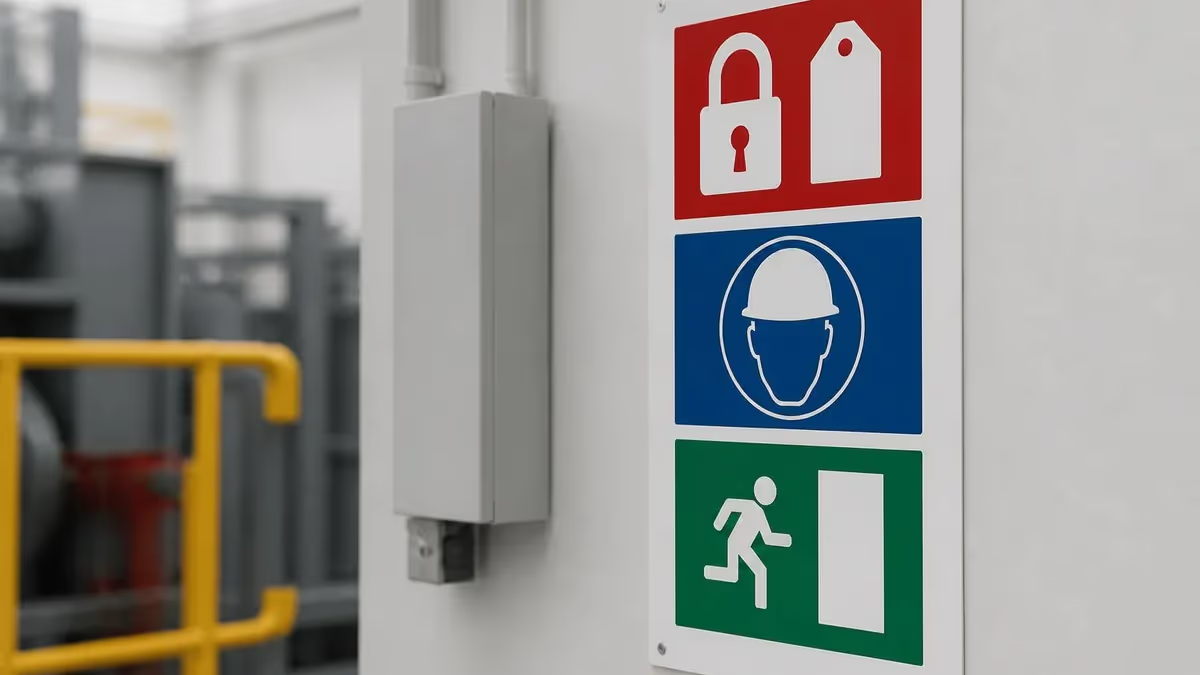
The osha 30 hour training program is one of the most widely recognized safety credentials in the United States, designed for workers in construction, general industry, and maritime environments who want to take on greater safety responsibilities in the workplace. Developed and authorized by the Occupational Safety and Health Administration, this voluntary training course delivers a comprehensive foundation in hazard recognition, OSHA standards, workers' rights, and employer obligations. Whether you are a foreman, supervisor, safety coordinator, or simply someone committed to building a safer job site, the OSHA 30-hour card signals that you have invested in serious safety education.
Unlike the OSHA 10-hour course, which serves as an introductory overview for entry-level workers, the OSHA 30-hour program goes significantly deeper into each topic area. Participants spend more time analyzing real workplace scenarios, understanding regulatory requirements in detail, and learning how to apply OSHA standards in practical situations. The extra twenty hours of instruction are not just filler — they represent a meaningful upgrade in how thoroughly a worker or supervisor understands the federal rules that govern job site safety across America's construction and industrial sectors.
The demand for OSHA 30-hour cardholders has grown substantially over the past decade. Many states, cities, and municipalities now require workers on publicly funded projects to hold a valid OSHA 30-hour card as a condition of employment on those sites. New York City, for example, mandates the credential for certain construction workers under Local Law 196. Massachusetts, Nevada, and several other states have passed similar legislation, and private general contractors increasingly write the requirement into subcontractor agreements regardless of public funding status.
From a career development standpoint, the OSHA 30-hour credential opens doors that the 10-hour card cannot. Workers who hold it are more competitive for lead worker, foreman, and safety officer positions. Employers who invest in this training for their teams also benefit directly — companies with well-trained supervisory staff report fewer recordable incidents, lower workers' compensation premiums, and smoother OSHA inspections. The credential communicates to clients and general contractors that a company takes its safety culture seriously, which can be a decisive factor when bidding on projects.
The training is delivered exclusively through OSHA-Authorized Outreach Trainers — instructors who have completed rigorous training themselves and who must renew their authorization periodically to stay current with regulatory updates. These trainers offer courses in multiple formats: traditional in-person classroom sessions, blended learning models, and fully online courses for eligible industries. Each delivery method must cover the same required topic areas and meet the minimum hour requirements established by OSHA's Outreach Training Program guidelines, ensuring consistent quality regardless of how you complete the course.
Completing OSHA 30-hour training does not make you an OSHA compliance officer or a licensed safety professional, and it is important to understand that distinction from the outset. The credential demonstrates awareness and foundational competency — it is an educational achievement, not a certification that grants enforcement authority. However, it is frequently the first step workers take before pursuing advanced designations such as the OSHA 500 or OSHA 510 trainer certification, the Certified Safety Professional (CSP), or the Associate Safety Professional (ASP) credential offered by the Board of Certified Safety Professionals.
This guide covers everything you need to know about the OSHA 30-hour program: the core topic areas, format options, cost, how long the card remains valid, and what steps to take once you have completed the course. Whether you are deciding whether the training is right for you, or you are already registered and want to know what to expect, you will find detailed, accurate, and practical information throughout this article to help you make the most of your safety education investment.
OSHA 30 Hour Training by the Numbers
Key Facts at a Glance
| Item | Value | Details |
|---|---|---|
| Total Training Hours | 30 hrs | Minimum required by OSHA |
| Card Validity Period | 5 yrs | Renewal required after expiration |
| Typical Course Cost | $150–$300 | Varies by format and provider |

OSHA 30 Hour Course Structure and Format
Traditional instructor-led sessions held over multiple days. Allows direct interaction with the trainer, group discussions, and hands-on demonstrations. Ideal for workers who learn best in structured environments with immediate feedback and peer engagement.
Available for general industry track only. Participants complete modules on their own schedule using an OSHA-authorized online platform. Construction track online courses must include a live virtual component to meet OSHA Outreach requirements.
Combines online pre-work with live instructor sessions. Workers complete reading and video modules before class, then spend class time on deeper discussions and scenario-based exercises. Reduces total in-person days while maintaining engagement quality.
Many large general contractors and safety-conscious employers bring authorized trainers on-site to train entire crews at once. Group rates reduce per-person cost and scheduling is built around the project calendar for minimal downtime.
The OSHA 30-hour curriculum for the construction industry is divided into required and elective topic areas. Every authorized trainer must cover the required topics in full, while elective content can be tailored to the specific hazards most relevant to the audience. Required topics include introduction to OSHA, managing safety and health, OSHA focus four hazards (falls, struck-by, caught-in/between, and electrocution), personal protective equipment, and health hazards in construction. These subjects are not optional because they represent the categories responsible for the overwhelming majority of construction fatalities in the United States each year.
Falls remain the leading cause of construction worker deaths, accounting for roughly one-third of all fatalities in the industry annually according to Bureau of Labor Statistics data. The OSHA 30-hour curriculum dedicates significant time to fall protection systems: guardrail systems, safety net systems, personal fall arrest systems, and the hierarchy of controls that governs how employers choose which protections to implement. Participants learn to identify unprotected edges, floor holes, wall openings, and leading edge work situations — and they study the specific OSHA standards in 29 CFR 1926 Subpart M that govern fall protection requirements.
Struck-by hazards are the second leading cause of construction deaths, and the OSHA 30-hour curriculum addresses them in detail. Workers learn to recognize struck-by hazards from vehicles, falling objects, flying objects, and swinging or rolling objects. They study traffic control plans, the importance of high-visibility apparel, and how crane and rigging operations must be managed to prevent load drops. Understanding the difference between a struck-by hazard and a caught-in/between hazard is also covered, as the two are sometimes confused but require different preventive controls.
Electrical hazards receive substantial coverage in the 30-hour course, reflecting the fact that electrocution is consistently one of the top four causes of construction fatalities. Participants learn the basic principles of electrical safety, how to identify overhead power line hazards, grounding requirements, lockout/tagout procedures, and the proper use of ground fault circuit interrupters (GFCIs) on construction sites. The course also covers arc flash hazards and the personal protective equipment required when working near energized electrical equipment, topics that are increasingly relevant as electrical infrastructure projects expand across the country.
Health hazards in construction represent a growing area of OSHA enforcement focus, and the 30-hour curriculum reflects this priority. Topics include silica dust exposure and the requirements of OSHA's respirable crystalline silica standard (29 CFR 1926.1153), which became fully enforceable in 2018. Lead exposure, asbestos awareness, noise-induced hearing loss, heat-related illness prevention, and chemical hazard communication under the Hazard Communication Standard are also covered. These are issues that do not cause immediate acute injuries the way fall hazards do, but their long-term health consequences for workers are severe and well-documented.
Scaffolding is another required topic in the construction track, given how frequently scaffolding-related fatalities occur. The OSHA 30-hour course covers the different types of scaffolding systems — supported scaffolds, suspended scaffolds, and aerial lifts — and the specific requirements for each. Participants learn about scaffold capacity ratings, planking requirements, fall protection on scaffolds, and the role of the competent person in scaffold erection, movement, and dismantling. Scaffold access and the prohibition on using cross-bracing as a means of access are among the specific regulatory details covered.
Excavation and trenching hazards are addressed with particular urgency because trench collapses can be instantly fatal and are entirely preventable with proper precautions. The course covers soil classification, the four protective systems OSHA recognizes (sloping, benching, shoring, and trench boxes), and the critical role of the competent person in identifying soil conditions and approving protective systems. Workers learn that even shallow trenches can collapse without warning and that OSHA's excavation standard in 29 CFR 1926 Subpart P does not allow workers to enter an unprotected trench that is five feet or more in depth.
OSHA Practice Test Questions
Prepare for the OSHA - Safety Certificate exam with our free practice test modules. Each quiz covers key topics to help you pass on your first try.
OSHA Basic OSHA Practice
OSHA Exam Questions covering Basic OSHA Practice. Master OSHA Test concepts for certification prep.
OSHA Confined Space Entry
Free OSHA Practice Test featuring Confined Space Entry. Improve your OSHA Exam score with mock test prep.
OSHA Fall Protection
OSHA Mock Exam on Fall Protection. OSHA Study Guide questions to pass on your first try.
OSHA - Safety Certificate Electrical Safet...
OSHA Mock Test covering - Safety Certificate Electrical Safety Standards. Online OSHA Test practice with instant feedback.
OSHA - Safety Certificate Emergency Action...
Free OSHA Quiz on - Safety Certificate Emergency Action and Fire Plans. OSHA Exam prep questions with detailed explanations.
OSHA - Safety Certificate Hazard Communica...
OSHA Practice Questions for - Safety Certificate Hazard Communication Standard. Build confidence for your OSHA certification exam.
OSHA - Safety Certificate Introduction to ...
OSHA Test Online for - Safety Certificate Introduction to OSHA. Free practice with instant results and feedback.
OSHA - Safety Certificate Lockout/Tagout P...
OSHA Study Material on - Safety Certificate Lockout/Tagout Procedures. Prepare effectively with real exam-style questions.
OSHA - Safety Certificate Machine Guarding...
Free OSHA Test covering - Safety Certificate Machine Guarding Requirements. Practice and track your OSHA exam readiness.
OSHA - Safety Certificate OSHA Recordkeepi...
OSHA Exam Questions covering - Safety Certificate OSHA Recordkeeping and Reporting. Master OSHA Test concepts for certification prep.
Construction vs. General Industry vs. Maritime: Choosing Your OSHA 30 Hour Track
The construction industry track, governed by 29 CFR 1926, is the most commonly completed version of the OSHA 30-hour course. It is designed for supervisors, foremen, lead workers, and safety personnel working on building construction, renovation, demolition, and civil infrastructure projects. The curriculum focuses on the unique hazards of construction environments, including fall protection, scaffolding, trenching, cranes and rigging, and electrical safety on job sites where conditions change daily and multiple trades work in close proximity.
State and local mandates for the construction track have grown rapidly since 2015. New York, New Jersey, Nevada, Connecticut, and Missouri have all enacted legislation or regulations requiring OSHA 30-hour cards for workers on certain public projects. Many private owners and general contractors have added similar requirements to their own contracts, meaning that holding a valid construction OSHA 30-hour card is increasingly a prerequisite for career advancement in commercial and industrial construction across the country.

OSHA 30 Hour Training: Benefits and Limitations to Consider
- +Nationally recognized credential accepted by employers, general contractors, and government agencies across all 50 states
- +Opens eligibility for supervisory, lead worker, and safety coordinator roles that require demonstrated safety training
- +Meets state and local legislative mandates on publicly funded construction projects in New York, Nevada, and other states
- +Reduces personal liability exposure for supervisors who can document formal safety training in the event of an incident investigation
- +Available in multiple formats including in-person, online (general industry), and blended learning to fit varied schedules
- +Provides a strong foundation for pursuing advanced credentials such as OSHA 500, OSHA 510, CSP, or ASP designations
- −Does not grant enforcement authority or qualify the holder to conduct formal OSHA compliance inspections
- −Card expires after five years and must be renewed through additional training to remain current and valid
- −Course quality varies significantly between authorized trainers — not all providers deliver equally engaging or thorough instruction
- −Online construction track courses must include a live component, making fully self-paced completion unavailable for that industry sector
- −Cost of $150–$300 plus potential lost wages during training days can be a barrier for independent workers without employer sponsorship
- −Does not replace task-specific competency training required by OSHA for activities like confined space entry, crane operation, or scaffold erection
How to Choose the Right OSHA 30 Hour Provider
- ✓Verify the trainer or training organization appears on OSHA's official Outreach Training Program authorized trainer list before registering.
- ✓Confirm the course covers your specific industry track — construction, general industry, or maritime — and not a generic version.
- ✓Check that the provider issues completion cards directly through OSHA's Outreach Training Program within two weeks of course completion.
- ✓Review the course schedule to ensure it meets the minimum 30-hour requirement spread appropriately across sessions, not compressed into a single marathon day.
- ✓Confirm the trainer's current authorization status, since OSHA can suspend or revoke trainer authorization for non-compliance.
- ✓Ask whether the course includes interactive components — group exercises, case studies, and hazard identification activities — rather than pure lecture.
- ✓For online courses, verify the platform is OSHA-authorized and clearly states whether it meets your state's legislative requirements for the card.
- ✓Compare total costs including any materials fees, card issuance fees, and whether the provider charges extra for replacement cards.
- ✓Read recent reviews or ask for employer references to gauge instruction quality and whether the trainer is engaged and knowledgeable.
- ✓Confirm the provider's process for issuing DOL wallet cards and whether physical cards or digital verification is accepted by your employer.
Your OSHA Card Is Issued by the Department of Labor, Not the Training Provider
The wallet-sized completion card you receive after finishing OSHA 30-hour training is issued by the U.S. Department of Labor through OSHA's Outreach Training Program — not by the training company. This means the card carries federal credibility regardless of which authorized trainer delivered your course. Always ensure your provider submits your completion data to OSHA's system promptly, as card issuance can take several weeks after course completion and employers may need verification before you begin work on a job site.
The career impact of holding an OSHA 30-hour card is difficult to overstate in industries where safety compliance directly affects contract awards and project financing. Many large general contractors in commercial construction have written OSHA 30-hour requirements into their subcontractor qualification criteria, meaning that companies bidding on these projects must demonstrate that their supervisory personnel hold valid cards. Workers who can present a current OSHA 30-hour card at the start of a new project often move through the site orientation and credentialing process significantly faster than those who cannot.
In terms of earnings, workers with supervisory safety credentials consistently earn more than their peers without comparable training. According to data compiled by the Center for Construction Research and Training (CPWR), workers in lead and supervisory roles on union and commercial construction projects earn between 15 and 30 percent more per hour than journeyperson-level workers in similar trades. The OSHA 30-hour card is not the only factor driving that differential, but it is a widely recognized marker of leadership readiness that employers and hiring managers associate with higher-responsibility roles and the compensation that accompanies them.
For workers in general industry and manufacturing, the career pathway opened by the OSHA 30-hour credential often leads toward Environmental Health and Safety (EHS) coordinator and manager roles. These positions are in high demand as OSHA enforcement activity has increased and as companies face growing pressure from insurers, investors, and customers to demonstrate strong safety management systems. EHS managers with field-level training backgrounds — including OSHA 30-hour completion — are particularly valued because they combine regulatory knowledge with practical workplace experience that purely academic safety professionals may lack.
Safety-conscious employers also cite reduced workers' compensation costs as a measurable financial benefit of investing in OSHA 30-hour training for their supervisory teams. Studies conducted by the National Safety Council and various industry associations consistently show that companies with more extensively trained supervisory workforces experience lower incident rates. Because workers' compensation experience modification factors (EMRs) are directly tied to a company's incident history, lower incident rates translate to lower insurance premiums — a financial return that can substantially exceed the cost of training programs over a multi-year period.
The OSHA 30-hour credential also provides important legal protection for individual supervisors and managers. When an OSHA inspection follows a workplace incident, investigators examine whether supervisors had adequate training to recognize and correct the hazard that caused the injury. A supervisor who holds a current OSHA 30-hour card and can document that they received training on the specific hazard type involved is in a significantly stronger position than one without formal safety training. While the card does not confer immunity, it demonstrates due diligence in a way that courts and administrative law judges consistently view favorably.
Apprenticeship programs affiliated with the Building and Construction Trades Council and other major trade organizations increasingly incorporate OSHA 30-hour training into their curriculum for journeymen completing their apprenticeship or advancing into foreman certification programs. This integration reflects the industry's recognition that safety leadership is an essential component of professional competency, not an optional add-on. Workers who complete their OSHA 30-hour training as part of an apprenticeship program are building a professional foundation that will serve them throughout their entire careers in the trades.
International comparisons further underscore the value of the OSHA 30-hour credential within the U.S. labor market. American construction and industrial safety standards, while imperfect, are considerably more stringent than those in many other countries, and the OSHA Outreach Training Program is a significant mechanism through which those standards are transmitted to workers at the point of hazard. Workers who complete the OSHA 30-hour program are not just earning a card — they are joining a safety culture that measurably reduces the likelihood of serious injury and death on job sites across the country.

OSHA Outreach completion cards issued under the current program guidelines are valid for five years from the date of completion. After that period, the card is no longer considered current by many employers and state agencies, and renewal requires completing another 30-hour course — there is no abbreviated renewal option. If you work in a jurisdiction with legislative mandates, an expired card can result in removal from the job site until you complete new training. Mark your expiration date on your calendar well in advance to avoid disruptions to your employment.
Once you have earned your OSHA 30-hour card, the most productive next step depends on your specific career goals. For workers who aspire to become OSHA-authorized trainers themselves, the pathway begins with the OSHA 500 course (Trainer Course in Occupational Safety and Health Standards for the Construction Industry) or the OSHA 502 update course for existing trainers. The OSHA 500 is a week-long course that qualifies graduates to deliver OSHA 10-hour and 30-hour training to others, effectively allowing them to build their own training business or serve as an in-house trainer for a large employer.
Workers interested in formal safety management credentials should research the Associate Safety Professional (ASP) and Certified Safety Professional (CSP) designations offered by the Board of Certified Safety Professionals. These credentials require documented work experience in addition to passing a rigorous examination, but the OSHA 30-hour card contributes to the professional development portfolio that supports the application. The CSP in particular is widely recognized as the gold standard credential for safety management professionals and commands a significant salary premium in most industries.
For construction workers in specialized trades, completing OSHA 30-hour training often pairs well with task-specific competency training that OSHA requires separately. Competent person training for scaffolding, trenching, or fall protection, for example, goes beyond awareness to establish that the individual has the authority and knowledge to identify hazards and take corrective action immediately. These task-specific competencies, combined with the broad awareness provided by the OSHA 30-hour course, create a well-rounded safety professional capable of managing complex job site conditions effectively.
Employers who sponsor their supervisory workers through OSHA 30-hour training often pair the investment with a formal safety management system implementation, such as OSHA's Injury and Illness Prevention Program (I2P2) framework or an ISO 45001 occupational health and safety management system. These systems provide the organizational structure within which trained supervisors can apply what they have learned, ensuring that the investment in individual training translates into measurable improvements in workplace safety performance metrics across the entire organization.
State-plan states — those that operate their own OSHA-approved safety programs rather than falling under federal OSHA jurisdiction — may have additional requirements or programs that complement OSHA 30-hour training. California's Division of Occupational Safety and Health (Cal/OSHA), for example, operates independently of federal OSHA and has developed its own injury prevention and safety standards in some areas. Workers in state-plan states should verify whether their OSHA 30-hour card satisfies state-specific requirements or whether supplemental training is recommended for full compliance with local regulations.
The ongoing evolution of construction technology is also creating new areas where OSHA 30-hour-trained workers can build additional expertise. Drone operations, augmented reality safety inspection tools, wearable safety monitoring devices, and Building Information Modeling (BIM) for safety planning are all areas where construction safety professionals with strong foundational OSHA knowledge are increasingly valuable. The OSHA 30-hour credential gives workers the regulatory grounding to understand why these technologies matter and how they connect to the standards that govern workplace safety across all sectors of the U.S. economy.
Regardless of the specific career path you choose after completing OSHA 30-hour training, the credential represents a meaningful and lasting investment in your professional development. The knowledge you gain — about hazard recognition, regulatory requirements, workers' rights, and the hierarchy of controls — will inform every safety decision you make throughout your career. In a field where the stakes are measured in human lives, that knowledge has value that no salary figure can fully capture, and it is the foundation upon which every effective safety professional continues to build throughout their working life.
Preparing for your OSHA 30-hour course is different from studying for a formal examination, but going in with a solid baseline knowledge of OSHA's structure and key standards will help you get significantly more out of the training.
Before your first session, spend a few hours reviewing the basic structure of the Occupational Safety and Health Act of 1970, understanding the difference between standards, directives, and enforcement memoranda, and familiarizing yourself with the numbering system OSHA uses to organize its regulations in Title 29 of the Code of Federal Regulations. This background will make it much easier to follow along when trainers reference specific CFR section numbers during instruction.
One of the most effective ways to prepare is to take practice quizzes that cover OSHA's focus four hazards and basic regulatory concepts. This is not because the 30-hour course includes a graded examination — it does not in most cases — but because active recall of safety concepts before training accelerates learning during the course itself.
When a trainer explains fall protection requirements and you already have a mental framework for what fall protection involves, the new details you are learning get anchored to existing knowledge rather than floating in isolation. This principle of prior knowledge activation is well-established in adult learning research and directly applicable to professional safety training.
During the course itself, engage as actively as possible with the hazard identification exercises and scenario-based discussions. The OSHA 30-hour curriculum is specifically designed to move beyond passive listening, and the most effective trainers spend a significant portion of class time walking participants through real job site photographs, accident reconstruction cases, and regulatory compliance scenarios.
When you identify a hazard in a training exercise, explain your reasoning out loud — this forces you to articulate not just what the hazard is, but why it violates a specific OSHA standard and what corrective measures are required. That kind of active reasoning is what you will need on an actual job site.
Take comprehensive notes during the course, particularly during any discussions of specific CFR section numbers and the conditions under which particular standards apply. The OSHA 30-hour course covers a large amount of regulatory material, and while you will not be expected to memorize every specific numerical threshold, having a personal reference document you can consult when questions arise on a job site is enormously practical. Note the difference between OSHA-required practices and OSHA-recommended best practices, since the two have different enforcement consequences and employers sometimes conflate them.
After completing the course, build a habit of reviewing OSHA's website for updated standards, new enforcement memoranda, and changes to compliance directives in your industry. OSHA's regulatory environment is not static — the agency issues new standards, revises existing ones, and publishes updated guidance documents on a regular basis. Workers who rely exclusively on what they learned in a five-year-old training course risk operating with outdated knowledge of requirements that may have changed substantially. Subscribing to OSHA's email newsletter and following industry safety associations can help you stay current between formal training updates.
Create a personal network of other safety-conscious professionals after completing your training. Fellow OSHA 30-hour graduates, authorized trainers, EHS managers, and safety consultants are valuable sources of practical guidance when you encounter novel hazard situations or regulatory questions on the job. Industry associations like the American Society of Safety Professionals (ASSP), the National Safety Council, and trade-specific organizations all offer networking opportunities, continuing education resources, and access to expert guidance that can help you apply your OSHA 30-hour knowledge more effectively throughout your career.
Finally, use your credential to actively improve safety culture in your workplace. The OSHA 30-hour card signals to employers and colleagues that you have made a serious investment in safety knowledge, but the real value is realized only when that knowledge drives visible behavioral change on the job site or in the plant.
Conduct pre-task safety briefings, participate in job hazard analyses, speak up when you observe unsafe conditions, and mentor less experienced workers in the hazard recognition principles you have learned. Safety culture is built one conversation, one decision, and one corrective action at a time — and workers who have completed OSHA 30-hour training are uniquely equipped to lead that effort at every level of the organization.
Sample OSHA Safety Certificate Practice Questions
Try these questions from our free OSHA Safety Certificate practice tests. The correct answer and an explanation follow each question.
A landscaping company has hired several new workers who will be operating noisy equipment like lawnmowers and leaf blowers, requiring the use of hearing protection. Which of the following is NOT a required topic for the employer to cover in PPE training for these employees?
- A. How to properly fit and wear the earplugs/earmuffs.
- B. The limitations of the hearing protection.
- C. The specific decibel reduction rating of each brand of equipment.
- D. The proper care, maintenance, and disposal of the hearing protection.
Answer: C. The specific decibel reduction rating of each brand of equipment.
According to OSHA 29 CFR 1910.132(f), employee training must cover when PPE is necessary, what PPE is necessary, how to properly use it, the limitations of the PPE, and its proper care and maintenance. While understanding that the PPE is adequate for the noise level is important, training on the specific decibel rating of every brand is not a mandated training element, but rather part of the employer's hazard assessment and PPE selection process.
When must the employer verify that PPE training occurred?
- A. Verbally only
- B. Through a written certification of training
- C. By posting a sign
- D. Verification is not required
Answer: B. Through a written certification of training
OSHA requires a written certification identifying the employee trained and the date of training.
How often must portable fire extinguishers be visually inspected under OSHA regulations?
- A. Weekly
- B. Monthly
- C. Quarterly
- D. Annually
Answer: B. Monthly
OSHA requires that portable fire extinguishers be visually inspected at least monthly.
At what point of operation must machine guards be in place according to OSHA 29 CFR 1910.212?
- A. Only during startup
- B. Only when maintenance is being performed
- C. Whenever the machine is in operation and an employee could contact moving parts
- D. Only during the first shift of the day
Answer: C. Whenever the machine is in operation and an employee could contact moving parts
OSHA requires guards to be in place at all times when the machine is operating and workers could be exposed to moving parts.
OSHA Questions and Answers

OSHA TRIR Calculator: Formula, Calculation Steps, and Industry Benchmarks

OSHA Approved Hard Hats: Complete 2026 Guide to ANSI Z89.1 Compliance, Types, and Workplace Requirements

OSHA 300 Form: Complete Guide to the Log of Work-Related Injuries and Illnesses

Cal/OSHA Form 300: Complete 2026 Guide to California's Workplace Injury and Illness Recordkeeping Requirements

OSHA 510: Course Content, Path to Trainer, and Realistic Path
How this page was made: written with AI tools and published by Nathan Beja, founder of Practice Test Geeks, who is responsible for its content. Exam facts are checked against the official sources listed below. Not reviewed by a subject-matter expert. Editorial policy
Sources & references
Exam facts on this page (fees, format, dates, passing scores) are checked against these official sources; the date is our last check. Editorial policy
- osha.gov — Test delivery, eligibility, fees, passing score, renewal, retake policy, score release, score validity · verified Oct 2026