
NFPA 1971: Complete Guide to the Standard on Protective Ensembles for Structural and Proximity Fire Fighting
Everything you need to know about NFPA 1971 — the standard covering protective gear requirements for structural and proximity firefighting. ✏️
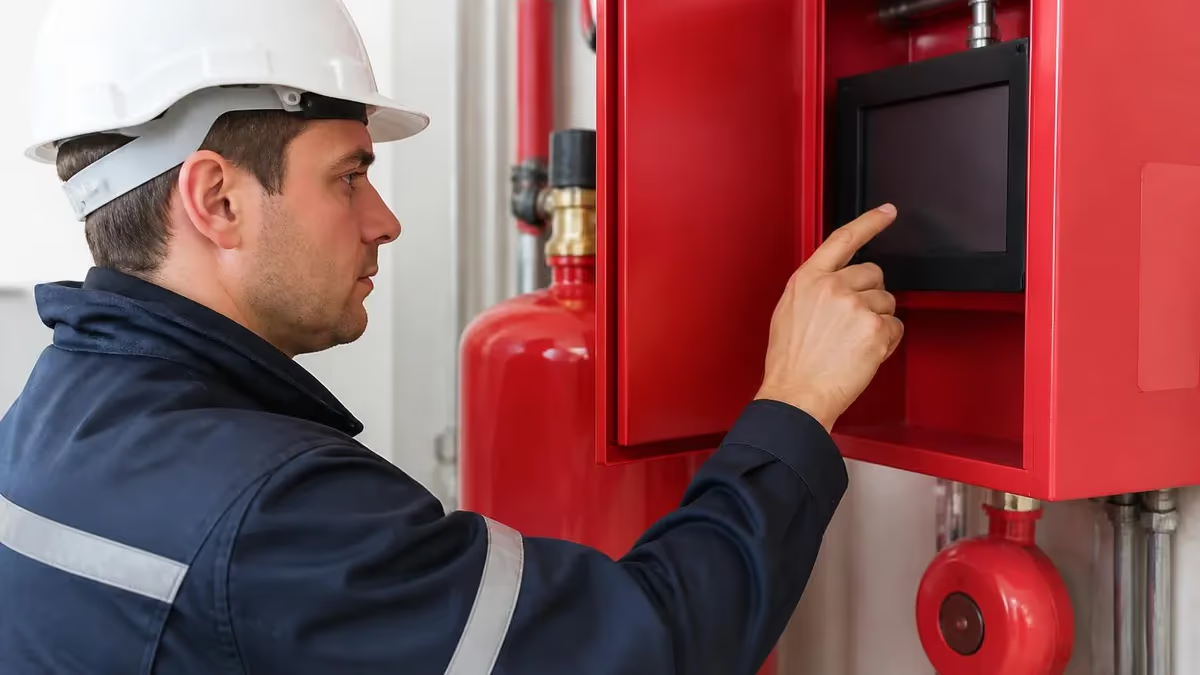
NFPA 1971 is the foundational standard published by the National Fire Protection Association that establishes minimum design, performance, testing, and certification requirements for protective ensembles worn by firefighters during structural and proximity fire fighting operations. First adopted in 1975, this standard has evolved significantly over the decades to reflect advances in materials science, lessons learned from line-of-duty deaths, and the ever-changing threat landscape that modern firefighters face inside burning structures. If you work in fire service or study for certification exams, understanding NFPA 1971 is non-negotiable. Practice with the free NFPA - National Fire Protection Association practice test on PracticeTestGeeks (100+ questions with answer explanations).
The standard covers the complete structural firefighting ensemble, which is composed of multiple protective elements working together as a coordinated system. These elements include the coat and trousers (commonly called turnout gear or bunker gear), the helmet, the gloves, the footwear, and the interface components that connect each element to prevent gaps in coverage. Each component must independently pass a rigorous battery of tests before it can be certified, and the manufacturer must demonstrate that the entire ensemble functions as an integrated system capable of protecting against the thermal, mechanical, and environmental hazards found in structural fire fighting scenarios.
One of the most important concepts embedded in NFPA 1971 is the three-layer construction requirement for the coat and trousers. The outer shell provides physical strength and initial flame resistance, the moisture barrier prevents water and liquids from saturating the thermal barrier, and the thermal liner traps dead-air space to insulate the wearer from conducted, convective, and radiant heat. This layered architecture is a direct response to decades of research showing that single-layer or two-layer garments simply cannot provide adequate protection across the full range of thermal conditions encountered during structure fires.
Proximity fire fighting, also addressed within NFPA 1971, involves operations near high-heat sources such as aircraft rescue and fire fighting (ARFF) scenarios, refinery fires, and industrial incidents where radiant heat loads far exceed those found in typical residential structure fires. Protective ensembles designed for proximity operations incorporate aluminized outer shells that reflect radiant heat rather than absorbing it. The reflective performance requirements for proximity gear are considerably more stringent than for structural gear, and the two categories must never be confused or interchanged on the fireground.
Certification under NFPA 1971 requires independent third-party testing by an organization accredited specifically for this purpose. Manufacturers cannot self-certify their products; instead, they must submit garments and components to accredited labs that conduct standardized tests on representative samples. The certification label sewn into compliant gear must display the NFPA 1971 edition year to which the product was tested, the manufacturer's name, the model designation, and the date of manufacture. Fire departments are responsible for verifying that purchased gear carries a current and valid certification label before placing items into service.
Understanding the certification cycle is critical for fire department quartermasters and safety officers. NFPA 1971 is revised on a roughly five-year cycle, and each new edition may introduce updated test protocols, revised performance thresholds, or entirely new requirements based on emerging research. Gear certified to an older edition does not automatically become non-compliant when a new edition is published, but departments should understand that newer editions typically represent improvements in protective performance. Knowing the edition year on your gear helps you benchmark it against current best practices and informs retirement planning decisions.
For firefighters preparing to advance their careers, a thorough grasp of protective ensemble standards intersects directly with officer-level certification requirements. Resources such as nfpa 1971 officer qualification standards build on an expectation that candidates already understand the protective equipment standards their crews rely on every shift. Whether you are studying for a written certification exam, preparing for a promotional interview, or simply trying to keep your crew safer, mastering the content of NFPA 1971 is time well invested.
Free NFPA - National Fire Protection Association Study Tools
Interactive NFPA - National Fire Protection Association resources on PracticeTestGeeks, free to start:
- Free NFPA Life Safety Questions and Answers — 11 questions with instant scoring and answer explanations
- NFPA - National Fire Protection Association flashcards — review key terms and concepts card by card
- NFPA - National Fire Protection Association study guide — topic-by-topic overview of what the exam covers
- NFPA - National Fire Protection Association cheat sheet — one-page printable summary for last-minute review
NFPA 1971 by the Numbers
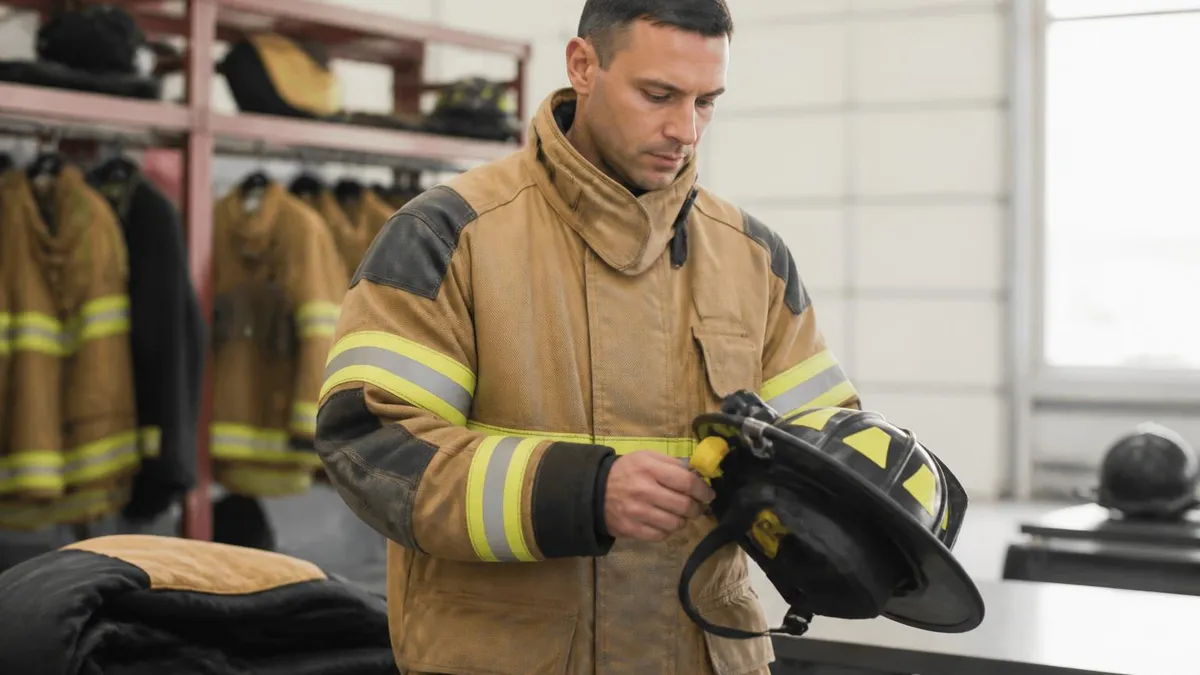
Key Components of a Compliant NFPA 1971 Ensemble
The primary garment elements, constructed with a mandatory three-layer system — outer shell, moisture barrier, and thermal liner — certified to meet heat and flame resistance, tear strength, seam strength, and liquid penetration resistance benchmarks defined in the standard.
Must provide impact resistance, electrical insulation, heat and flame resistance, and faceshield or goggle eye protection. The suspension system and retention strap are also tested to ensure the helmet remains secured during fireground operations and falls.
Required to meet grip, dexterity, cut resistance, thermal insulation, and liquid penetration resistance standards. Firefighters must be able to perform essential tasks while wearing gloves, so dexterity testing is a critical evaluation criterion under NFPA 1971.
Structural fire fighting boots must pass tests for puncture resistance, heat resistance, electrical hazard protection, and liquid penetration resistance. The boot upper, sole, and any interface components between boot and trouser must all meet the standard's requirements.
Wristlets, collar liners, and hood systems that bridge the gaps between major ensemble elements. These components prevent hot gases, flames, and steam from penetrating at the junctions between gloves, coat sleeves, helmet, and trousers, which are historically high-injury zones.
The testing requirements built into NFPA 1971 are among the most comprehensive in any occupational safety standard. Performance tests are divided into categories that address thermal protection, physical integrity, and environmental resistance. Thermal tests include the Thermal Protective Performance (TPP) test, the Total Heat Loss (THL) test, the Radiant Protective Performance (RPP) test for proximity gear, and flame resistance tests for each individual layer. Physical integrity tests assess tensile strength, tear resistance, puncture resistance, and seam strength across the coat, trousers, and other components.
The TPP test is arguably the most widely cited performance metric in the structural fire fighting garment industry. In this test, a calibrated heat source delivers a combined radiant and convective heat flux of 2.0 cal/cm² per second to the outer surface of a mounted fabric sample.
A copper calorimeter sensor behind the sample measures the rate of heat transfer, and the test result is expressed as the TPP value — the time in seconds multiplied by the incident heat flux at which the sensor predicts a second-degree burn. A higher TPP value indicates better thermal insulation. NFPA 1971 establishes a minimum TPP value, but many manufacturers target significantly higher values to provide additional protection margin.
The Total Heat Loss (THL) test was added to NFPA 1971 to address a critical insight from firefighter physiology research: a garment that provides excellent thermal insulation also traps metabolic heat generated by the wearer's body. This trapped heat can lead to heat stress, heat exhaustion, and in extreme cases heat stroke — all significant threats to firefighter health and operational effectiveness. THL measures how well a fabric system allows body heat and moisture vapor to escape outward, and the standard imposes a minimum THL value to ensure that highly protective garments are also reasonably breathable and heat-stress-aware in design.
Liquid penetration resistance testing evaluates the moisture barrier layer's ability to prevent water, blood, and other liquids from soaking through to the thermal liner and the wearer's skin. Firefighters routinely work in environments saturated with water from hose streams, and the moisture barrier must maintain its integrity across thousands of laundering cycles and years of operational use. NFPA 1971 requires that moisture barriers be tested after accelerated aging protocols designed to simulate real-world wear, not just fresh out of the factory packaging.
Contamination resistance is a growing area of emphasis in recent NFPA 1971 editions, driven by research documenting improved cancer rates among firefighters. Fireground smoke contains polycyclic aromatic hydrocarbons (PAHs), volatile organic compounds (VOCs), heavy metals, and other toxic substances that can penetrate outer shell fabrics and deposit on the moisture barrier or thermal liner surfaces. While NFPA 1971 does not yet mandate garments that fully prevent chemical penetration from all carcinogens encountered on the fireground, the standard has progressively tightened requirements around chemical resistance, and industry discussions about adding cancer-reduction performance metrics are ongoing.
Label and documentation requirements are a frequently overlooked but critical part of NFPA 1971 compliance. Each certified garment must carry a permanently attached label that includes the edition year, manufacturer identification, model designation, size, and date of manufacture. The standard also requires manufacturers to provide a product information package that explains care, maintenance, and limitations of the garment. Fire departments should retain these documents and make them available to the firefighters who wear the gear, as well as to safety officers and quartermasters responsible for the department's PPE management program.
Third-party certification organizations play a gatekeeping role in the NFPA 1971 ecosystem. Bodies such as Underwriters Laboratories (UL) and similar accredited testing organizations evaluate manufacturer submissions against the standard's test protocols and, when products pass, authorize the use of a certification mark. This mark — along with the label information — is the department's assurance that the product was independently verified to meet minimum performance thresholds. Fire departments should routinely check that the certification marks on gear they are purchasing correspond to the current or most recently superseded edition of NFPA 1971 and that the certifying body remains accredited.
NFPA Practice Test Questions
Prepare for the NFPA - National Fire Protection Association exam with our free practice test modules. Each quiz covers key topics to help you pass on your first try.
NFPA Life Safety
NFPA Exam Questions covering Life Safety. Master NFPA Test concepts for certification prep.
NFPA 10 Portable Fire Extinguishers
NFPA Mock Exam on NFPA 10 Portable Fire Extinguishers. NFPA Study Guide questions to pass on your first try.
NFPA 13 Sprinkler Systems
NFPA Test Prep for NFPA 13 Sprinkler Systems. Practice NFPA Quiz questions and boost your score.
NFPA 1 Fire Code General Requirements
NFPA Questions and Answers on NFPA 1 Fire Code General Requirements. Free NFPA practice for exam readiness.
NFPA 25 Water-Based Fire Protection Inspec...
NFPA Mock Test covering NFPA 25 Water-Based Fire Protection Inspection. Online NFPA Test practice with instant feedback.
Structural vs. Proximity vs. CBRN Protective Gear Under NFPA 1971
Structural fire fighting ensembles are designed for interior attack and overhaul operations inside burning buildings. The standard mandates that structural gear withstand a flame impingement test, pass the TPP test at minimum values, and maintain physical integrity under the mechanical stresses of forcible entry, ladder climbing, and victim rescue. The outer shell fabrics most commonly used include aramid blends (Nomex, Kevlar) and PBI Gold composites, chosen for their high limiting oxygen index and low heat release rate upon ignition.
Structural gear is not appropriate for fighting aircraft fires, refinery incidents, or any scenario where radiant heat loads exceed those anticipated in ordinary combustible fires. Departments that respond to both structural and high-heat industrial incidents must maintain separate ensembles for each hazard category and train firefighters to select the correct gear for each incident type. Mixing structural and proximity components within a single ensemble is prohibited under NFPA 1971 and can create dangerous gaps in protection at the interfaces between the two gear types.
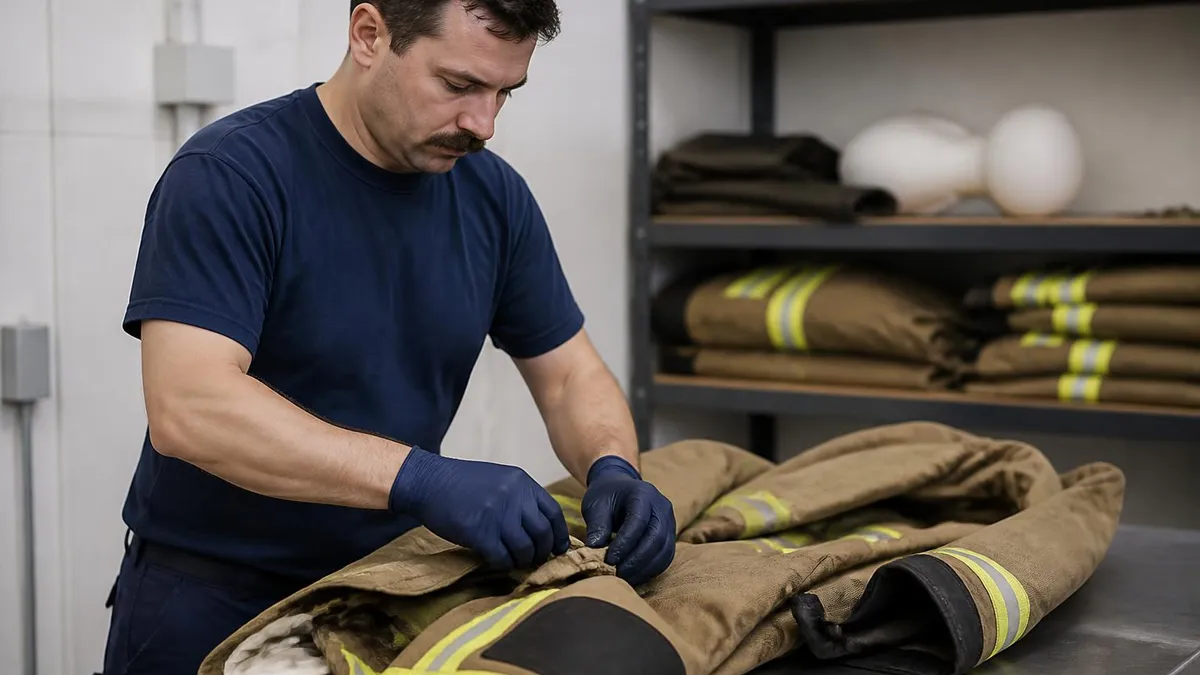
Benefits and Limitations of NFPA 1971 Certification Requirements
- +Establishes a nationally consistent minimum performance baseline that all certified gear must meet regardless of manufacturer or price point
- +Requires independent third-party testing, eliminating conflicts of interest that arise when manufacturers self-certify their own products
- +Covers the complete ensemble as a system rather than evaluating individual components in isolation, reducing protection gaps at interfaces
- +Regular revision cycle (approximately every five years) incorporates new research on firefighter health, including emerging cancer risk data
- +TPP and THL test requirements balance thermal protection with heat stress reduction, addressing both burn injury and physiological risk
- +Certification labels provide fire departments with traceability information needed for PPE management, inspection, and retirement programs
- −Minimum performance thresholds represent the floor, not the ceiling — some certified products barely exceed minimums and offer limited safety margin
- −The five-year revision cycle means current editions may lag behind the latest fire behavior research and carcinogen penetration data
- −Certification testing is conducted on new, unworn samples that may not accurately represent the protection level of gear after years of field use
- −Standard does not currently mandate quantitative carcinogen penetration limits, leaving a known cancer risk pathway inadequately addressed
- −Compliance verification burden falls largely on fire departments, which may lack the technical expertise or resources to audit gear documentation thoroughly
- −Proximity and structural gear requirements are in the same document but serve very different hazard profiles, which can create confusion for smaller departments with limited specialty exposure
Pros and Cons at a Glance
| Pros | Cons |
|---|---|
| Establishes a nationally consistent minimum performance baseline that all certified gear must meet regardless of manufacturer or price point | Minimum performance thresholds represent the floor, not the ceiling — some certified products barely exceed minimums and offer limited safety margin |
| Requires independent third-party testing, eliminating conflicts of interest that arise when manufacturers self-certify their own products | The five-year revision cycle means current editions may lag behind the latest fire behavior research and carcinogen penetration data |
| Covers the complete ensemble as a system rather than evaluating individual components in isolation, reducing protection gaps at interfaces | Certification testing is conducted on new, unworn samples that may not accurately represent the protection level of gear after years of field use |
| Regular revision cycle (approximately every five years) incorporates new research on firefighter health, including emerging cancer risk data | Standard does not currently mandate quantitative carcinogen penetration limits, leaving a known cancer risk pathway inadequately addressed |
| TPP and THL test requirements balance thermal protection with heat stress reduction, addressing both burn injury and physiological risk | Compliance verification burden falls largely on fire departments, which may lack the technical expertise or resources to audit gear documentation thoroughly |
| Certification labels provide fire departments with traceability information needed for PPE management, inspection, and retirement programs | Proximity and structural gear requirements are in the same document but serve very different hazard profiles, which can create confusion for smaller departments with limited specialty exposure |
NFPA 1971 Compliance Checklist for Fire Departments
- ✓Verify that all newly purchased protective ensembles carry a valid certification label referencing the current or most recently superseded NFPA 1971 edition.
- ✓Confirm the certifying organization shown on the label is currently accredited for NFPA 1971 testing at the time of purchase.
- ✓Record the manufacture date from each certification label and enter it into your department's PPE management database upon receipt.
- ✓Obtain and retain the manufacturer's product information package for each ensemble model in service, including care and limitations documentation.
- ✓Conduct a routine inspection of all interface components — wristlets, hood, collar — at every Advanced Inspection cycle as required by NFPA 1851.
- ✓Separate structural and proximity ensembles in storage and training records to prevent inadvertent mixing of components between the two certification categories.
- ✓Document all repairs, contamination events, and exposure incidents for each ensemble to support retirement decisions based on cumulative service history.
- ✓Ensure replacement components (gloves, hoods, helmets) are certified to the same NFPA 1971 edition as the base ensemble to maintain system-level compliance.
- ✓Train all firefighters to recognize valid NFPA 1971 certification labels and to report any gear that appears uncertified or has a missing, damaged, or illegible label.
- ✓Review each new NFPA 1971 edition upon publication and update department PPE specifications and procurement contracts accordingly.
Higher TPP Does Not Always Mean Safer Gear
A garment with an extremely high Thermal Protective Performance (TPP) value traps so much heat that the wearer's own metabolic output cannot escape, dramatically increasing heat stress risk during interior operations. NFPA 1971's Total Heat Loss (THL) requirement exists precisely to prevent manufacturers from chasing TPP numbers at the expense of physiological safety — both values matter, and compliant gear must balance protection against burnover with the ability to manage body heat during sustained work.
The edition history of NFPA 1971 tells the story of the American fire service's evolving understanding of what kills and injures firefighters on the job. The original 1975 edition focused primarily on flame resistance and basic thermal protection for the coat and trousers. Subsequent editions in the 1980s and 1990s progressively added requirements for helmets, gloves, and footwear as investigators documented burn injuries occurring through inadequately protected extremities. The 2000 edition was a landmark revision that introduced the three-element ensemble concept and formally integrated moisture barrier and thermal liner performance into the certification framework.
The 2007 edition brought significant changes to hood and interface requirements, motivated by epidemiological data showing disproportionate rates of head and neck burns even among firefighters wearing otherwise compliant structural gear. Research conducted in collaboration with fire service organizations and academic burn centers found that hoods made from single-layer knit fabrics performed significantly worse than thicker, multi-layer hood constructions, particularly during flashover survival scenarios. The 2007 revisions raised minimum hood performance thresholds and added requirements for compatibility testing between hoods and SCBA facepieces.
The 2013 and 2018 editions addressed contamination and decontamination issues with increasing urgency as the firefighter cancer crisis became impossible to ignore. Several state-level studies published in the early 2010s confirmed that firefighters face statistically improved risks for multiple cancer types, including mesothelioma, non-Hodgkin lymphoma, and bladder, prostate, and testicular cancers. While NFPA 1971 alone cannot solve the contamination problem — that effort spans multiple NFPA standards including NFPA 1851 on selection, care, and maintenance — the 2013 and 2018 editions added provisions addressing gross decontamination procedures and documentation of contamination events as part of the PPE management chain.
The most recent editions have also grappled with the challenge of measuring and mitigating dermal absorption of fireground contaminants through gear fabrics. Research has demonstrated that certain carcinogenic compounds present in fire smoke, including naphthalene and benzo(a)pyrene, can permeate even intact moisture barrier fabrics over time, particularly when the barrier is compressed against the wearer's body during physical exertion. This finding has sparked debate within the NFPA technical committee about whether future editions should include quantitative permeation resistance test requirements, potentially requiring the development of entirely new test methods to measure compound-specific penetration rates under realistic use conditions.
Moisture barrier durability has been a persistent concern across multiple edition cycles. Early moisture barrier constructions using expanded polytetrafluoroethylene (ePTFE) membranes offered excellent liquid penetration resistance when new but were found to delaminate or develop pinholes after repeated laundering and thermal cycling. Modern moisture barriers use more strong laminate constructions and are required by NFPA 1971 to maintain their performance after accelerated aging protocols, but field experience has shown that even durable barriers can fail prematurely when exposed to petroleum-based contaminants that degrade the membrane's molecular structure over time.
Technical committee composition under NFPA's consensus-based standards development process includes representatives from fire departments, manufacturers, testing laboratories, academia, and labor organizations including the International Association of Fire Fighters (IAFF). This diverse representation ensures that NFPA 1971 reflects multiple perspectives — from the research scientist who measures TPP on a bench-top apparatus to the career firefighter who must wear the resulting gear for twelve-hour shifts in urban high-rise operations. Public comment periods allow any interested party to submit proposed changes or objections, making the standard one of the most openly developed technical documents in occupational safety.
Understanding how NFPA 1971 has evolved helps fire departments make more informed decisions about gear retirement and replacement. A department whose structural gear was certified to the 2007 edition should understand precisely which performance improvements were added in the 2013 and 2018 editions and factor those improvements into budget planning conversations.
While older certified gear does not become illegal when a new edition is published, procurement planning that accounts for the safety improvements encoded in newer editions demonstrates a commitment to firefighter health that goes beyond bare legal compliance — and that commitment is reflected in reduced injury rates and improved firefighter longevity.
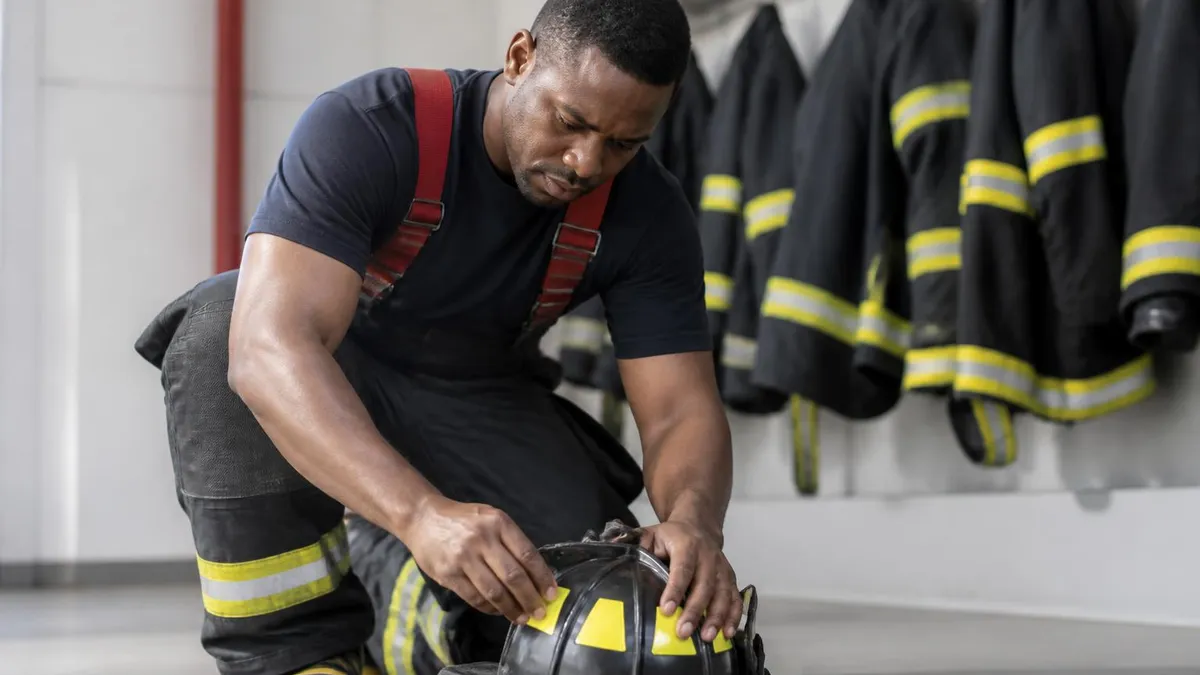
NFPA 1971 explicitly prohibits combining components certified to the structural ensemble category with components certified to the proximity ensemble category within the same ensemble worn by a firefighter. Mixing categories creates uncertified interfaces that have not been evaluated for the heat flux levels encountered in either operational scenario. Fire departments must maintain separate, fully compliant ensembles for structural and proximity operations and train personnel to select the correct gear type before any incident response.
Inspection and maintenance requirements for gear certified under NFPA 1971 are governed primarily by NFPA 1851, the companion standard on selection, care, and maintenance of protective ensembles. While NFPA 1971 establishes what certified gear must be able to do when new, NFPA 1851 prescribes how departments must manage gear throughout its service life to maintain as much of that initial protection as possible. The two standards work together as an integrated PPE management system, and compliance with one without the other leaves significant safety gaps in the department's overall protective ensemble program.
NFPA 1851 defines three inspection levels for structural ensembles: the Routine Inspection performed by the wearer after each use, the Advanced Inspection performed by a trained inspection program manager on a regular schedule, and the Verification Inspection performed by an ISO/IEC 17020-accredited inspection organization. Each level involves progressively more detailed evaluation of the outer shell, moisture barrier, thermal liner, hardware, seams, trim, labels, and interface components. Items that fail any inspection level must be removed from service immediately and either repaired by a verified repair organization or retired from the inventory.
Retirement criteria under NFPA 1851 include both time-based and condition-based triggers. The time-based criterion specifies that structural gear must be retired no later than ten years from the date of manufacture as recorded on the NFPA 1971 certification label. This ten-year maximum service life reflects the cumulative degradation of protective materials from repeated thermal exposures, laundering cycles, UV exposure, and mechanical wear that ultimately compromises the ensemble's ability to meet the performance thresholds it was originally certified against. Some departments adopt more aggressive retirement schedules based on operational tempo, contamination history, or budget cycles that allow more frequent gear replacement.
Condition-based retirement is triggered whenever an inspection identifies damage, contamination, or degradation that cannot be corrected by cleaning or compliant repair. Common condition-based retirement triggers include delamination of the moisture barrier laminate, outer shell fabric that has been weakened by chemical or thermal exposure to below minimum tensile strength values, reflective trim that has separated or degraded below the visibility threshold, and hardware that has been permanently deformed or corroded to the point where it can no longer perform its intended function.
Field soiling from petroleum products, biological fluids, or other contaminants that cannot be fully removed by NFPA 1851 compliant cleaning procedures is also a retirement trigger because residual contamination can degrade protective materials and create a dermal exposure risk for the wearer.
Cleaning and decontamination procedures specified in NFPA 1851 are directly informed by the material performance requirements in NFPA 1971. Because some cleaning agents, particularly those containing chlorine bleach or quaternary ammonium compounds, can degrade aramid fibers and moisture barrier laminates, NFPA 1851 restricts the types of cleaning products that may be used on certified gear.
Departments must follow manufacturer-provided care instructions, which in turn must be developed in accordance with NFPA 1851's framework. Gear that has been cleaned with non-approved agents may not maintain its NFPA 1971 certified performance levels, effectively removing the department's assurance that the gear will protect as expected during a thermal exposure event.
Repair of NFPA 1971 certified gear is restricted to organizations that have been verified by an independent accredited organization as meeting the requirements specified in NFPA 1851. A verified repair organization must use replacement materials certified to the same NFPA 1971 edition as the original garment, follow established repair protocols, and maintain documentation of all repairs performed.
Field repairs — such as stitching made in a fire station using standard thread or fabric — do not constitute compliant repair under NFPA 1851 and may actually invalidate the gear's certification status by introducing unverified materials or techniques into the ensemble's construction. Departments should contract with a verified repair organization for all non-routine repairs and document those repairs in the gear's permanent service record.
The holistic relationship between NFPA 1971 and NFPA 1851 illustrates a broader principle in fire service safety: standards are most effective when they are implemented as complete systems rather than isolated rules. A fire department that purchases gear certified to the latest edition of NFPA 1971 but fails to implement NFPA 1851's inspection and maintenance requirements will see that protective performance erode rapidly over the gear's service life.
Conversely, a department with a rigorous NFPA 1851 program that is still operating gear certified to editions from two revision cycles ago may be managing obsolete performance thresholds that leave firefighters underprotected relative to current best practices. The goal is always both: current certification standards and rigorous lifecycle management applied together to deliver consistent, documented protection across every shift.
Firefighters and fire officers who want to deepen their practical understanding of NFPA 1971 should begin by obtaining a copy of the current edition directly from the NFPA website, where it is available for free read-only access online. Reading the actual standard — rather than relying on summaries or training materials — exposes you to the precise language of requirements, definitions, and exceptions that determine compliance in real procurement and inspection decisions. Pay particular attention to Chapter 1 (scope and purpose), Chapter 3 (definitions), and the applicable performance requirements chapters for the ensemble elements most relevant to your operational context.
Attending NFPA's annual conference or fire service-specific training programs that address PPE management is another high-value investment for fire officers. These events provide access to technical committee members, researchers, and manufacturers who can explain the rationale behind specific requirements and share emerging data that may influence future editions. Networking at these events often surfaces practical insights — such as which outer shell fabrics are showing unexpected durability issues in humid climates, or which moisture barrier constructions are performing best after repeated decontamination cycles — that are not yet reflected in published standards documents.
Fire department safety officers should build relationships with the independent inspection and testing organizations in their region. Third-party inspection organizations accredited under ISO/IEC 17020 can provide verification inspections that independently assess whether your department's gear still meets NFPA 1971 performance thresholds after years of service. These verification inspections, conducted on representative samples of in-service gear, can detect degradation that is not visible through routine or advanced inspection alone — giving the safety officer objective data to support retirement decisions and budget requests to replace aging inventory.
Procurement planning for NFPA 1971 compliant gear benefits from a total cost of ownership perspective rather than a unit-price-focused approach. A garment that costs twenty percent more per unit but carries a higher TPP value, a higher THL value, and a more durable moisture barrier construction may well be the more economical choice when retirement rates, injury costs, and firefighter health outcomes are factored into the analysis.
Fire chiefs who can present procurement decisions in total cost of ownership terms — supported by data from NFPA 1971 certification records and NFPA 1851 service records — are better positioned to secure budget approval for higher-quality protective gear that delivers superior protection throughout its service life.
Manufacturer technical representatives are an underutilized resource for fire departments navigating NFPA 1971 compliance. Most major structural gear manufacturers employ field representatives who can visit departments, review existing gear inventories, identify items approaching retirement, and provide education on care and maintenance best practices for specific product lines. These visits are typically provided at no charge as part of the manufacturer's customer support commitment, and the insights gained can be invaluable for quartermasters managing large fleets of gear across diverse operational assignments, weather conditions, and exposure histories.
Labor-management collaboration on PPE issues has produced measurable improvements in firefighter protective gear quality at many departments. The International Association of Fire Fighters (IAFF) has published extensive guidance on NFPA 1971 compliance, firefighter cancer risk reduction, and PPE management best practices that local union representatives can bring to joint safety committee discussions. When firefighters have a direct voice in the PPE procurement and management process, departments tend to achieve better compliance with inspection schedules, faster reporting of gear damage, and higher rates of voluntary decontamination after fire exposures — all of which extend gear service life and protect firefighter health.
Ultimately, NFPA 1971 is not just a technical standard for gear manufacturers — it is the document that defines the minimum level of protection the American fire service has agreed is acceptable for the men and women who enter burning structures.
Every firefighter deserves to understand the standard that governs their protective ensemble, and every fire officer has a professional obligation to ensure that their department's gear selection, procurement, inspection, maintenance, and retirement practices honor the intent of that standard. Staying current with NFPA 1971 and its companion documents is one of the most direct ways a fire officer can demonstrate genuine commitment to crew safety rather than mere regulatory compliance.
Sample NFPA - National Fire Protection Association Practice Questions
Try these questions from our free NFPA - National Fire Protection Association practice tests. The correct answer and an explanation follow each question.
Under NFPA 30, what bonding and grounding requirement applies when transferring Class I flammable liquids from one container to another?
- A. No bonding required for containers under 5 gallons
- B. Containers must be bonded together and grounded to prevent static sparks
- C. Only the receiving container needs grounding
- D. Bonding is required only for metal containers
Answer: B. Containers must be bonded together and grounded to prevent static sparks
NFPA 30 requires that both containers be bonded to each other and that the system be grounded to prevent static electricity discharge during transfer.
According to NFPA 30, what is required for flammable liquid dispensing areas to prevent static ignition?
- A. All metal equipment must be painted with conductive paint
- B. Conductive flooring must be used throughout
- C. The dispensing nozzle must be bonded to the container before dispensing
- D. Rubber gloves must be worn by all personnel
Answer: C. The dispensing nozzle must be bonded to the container before dispensing
NFPA 30 requires the dispensing nozzle to be bonded to the receiving container prior to opening the dispensing valve to prevent static sparks.
According to NFPA 30, what is the maximum quantity of Class I and Class II liquids that may be stored in a single cabinet without special permits?
- A. 30 gallons
- B. 60 gallons
- C. 120 gallons
- D. 240 gallons
Answer: B. 60 gallons
NFPA 30 limits flammable liquid storage cabinets to a maximum of 60 gallons of Class I and Class II liquids combined.
Under NFPA 30, which type of vent pipe is required on an above-ground atmospheric storage tank containing Class I liquids?
- A. Open vent pipe only
- B. Flame arrester or pressure-vacuum vent
- C. Pressure relief valve set at 15 psi
- D. Check valve vent
Answer: B. Flame arrester or pressure-vacuum vent
NFPA 30 requires above-ground atmospheric tanks storing Class I liquids to be equipped with a flame arrester or pressure-vacuum vent to prevent ignition of vapors.
Take the full NFPA - National Fire Protection Association practice test
NFPA Questions and Answers
NFPA 1021: Complete Guide to the Standard for Fire Officer Professional Qualifications
NFPA 921 Explained: The Complete Guide to the Guide for Fire and Explosion Investigations

NFPA 24: Complete Guide to the Standard for Private Fire Service Mains and Their Appurtenances
NFPA 704 Diamond: Complete Guide to Hazard Identification Ratings

NFPA 1582: Complete Guide to the Standard on Medical Requirements for Firefighters
How this page was made: written with AI tools and published by Nathan Beja, founder of Practice Test Geeks, who is responsible for its content. We have not yet matched this exam's facts to an official source, so confirm fees, dates and rules with the exam body. Not reviewed by a subject-matter expert. Editorial policy