
NFPA 24: Complete Guide to the Standard for Private Fire Service Mains and Their Appurtenances
🧠 NFPA 24 explained: private fire service mains, hydrants, valves, installation, testing, and inspection requirements for fire protection water supply.

NFPA 24 is the Standard for the Installation of Private Fire Service Mains and Their Appurtenances, and it governs how water is delivered from a public source or private supply to the inlet side of fire protection systems on private property. Anyone working with sprinklers, standpipes, fire hydrants, or fire pumps needs to understand how nfpa 24 shapes the design, installation, testing, and maintenance of every pipe, valve, and fitting buried between the street and the building.
The standard exists because a fire sprinkler system is only as reliable as the water main feeding it. If a private main fails, leaks at a joint, gets crushed by a dump truck, or freezes during a January cold snap, every downstream system becomes useless at the exact moment lives are on the line. NFPA 24 sets the rules that prevent those failures, addressing pipe materials, depth of bury, thrust restraint, valves, hydrants, backflow prevention, and acceptance testing in one consolidated document.
NFPA 24 is published by the National Fire Protection Association and is updated on a three-year cycle, with the most recent editions in 2019, 2022, and 2025. It is referenced directly by NFPA 13, NFPA 14, NFPA 20, and NFPA 25, meaning a sprinkler designer, standpipe installer, fire pump contractor, or inspector cannot do competent work without understanding it. State and local jurisdictions adopt NFPA 24 through their fire code, typically through the International Fire Code or NFPA 1, making compliance a legal obligation, not a suggestion.
The scope of NFPA 24 begins at the connection to the public water supply or other water source and ends at the system riser, fire department connection, hydrant, or monitor nozzle. It covers underground piping, exterior aboveground piping that is part of the supply, post indicator valves, hydrants, meters where required, and the bracing and restraint that keep buried pipes from blowing apart under pressure surges.
One of the most important concepts in NFPA 24 is the idea that a private fire service main is a dedicated piece of fire protection infrastructure. It is not a domestic water line that happens to feed a sprinkler. It must be sized, supervised, and protected as a life safety system, which means flushing requirements are stricter, materials are more limited, and inspection frequencies are more demanding than for ordinary plumbing.
This guide walks through the structure of NFPA 24, the components it regulates, installation and acceptance testing requirements, ongoing inspection obligations under NFPA 25, common field violations, and the way the standard interacts with the broader suite of nfpa codes and standards pdf. Whether you are a contractor pulling permits, an AHJ reviewing plans, a building owner managing risk, or a candidate preparing for a fire protection examination, the material below is structured to give you a working command of the standard.
By the end, you should understand why a thrust block matters, why a 200 psi hydrostatic test is the universal benchmark, why flushing velocities are not negotiable, and why even a perfectly designed sprinkler system can fail inspection because of something buried six feet below the parking lot.
NFPA 24 by the Numbers
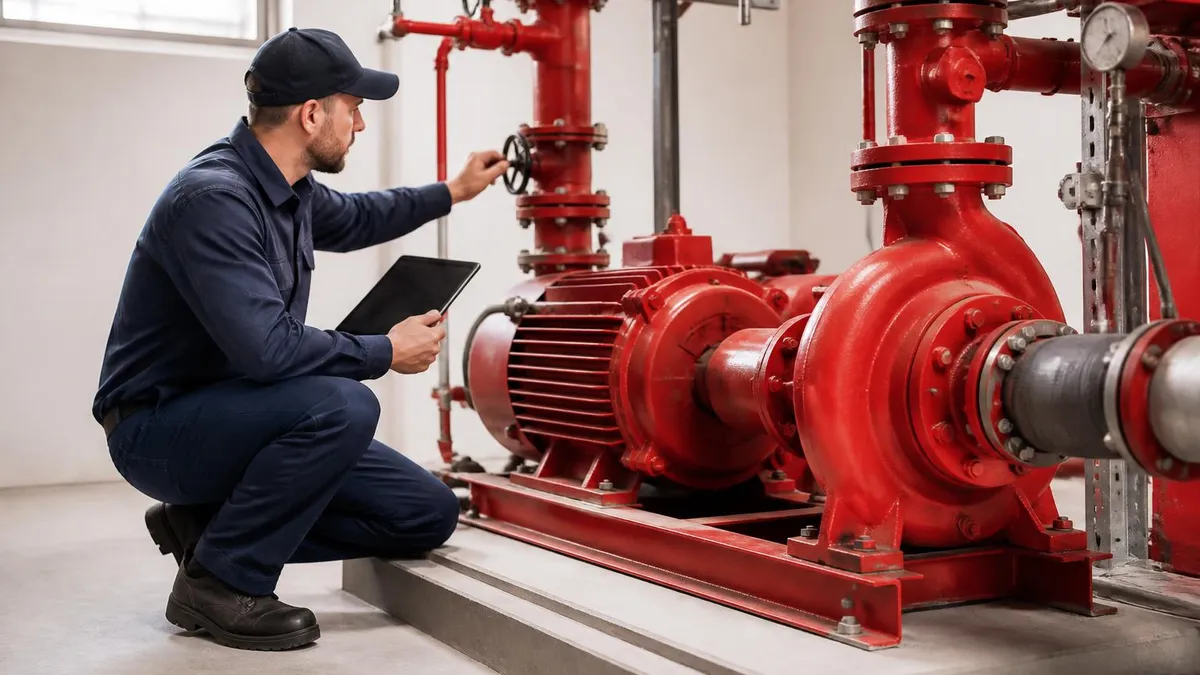
Core Components Regulated by NFPA 24
Cast iron, ductile iron, HDPE, PVC, steel, brass, copper, and concrete pressure pipe are addressed with specific listing, depth, and bedding requirements throughout the buried run of any private fire main.
Public and private hydrants, monitor nozzles, hose houses, and wall hydrants must meet spacing, drainage, marking, and accessibility rules that ensure firefighters can deploy water within seconds of arrival.
Post indicator valves, OS&Y valves, butterfly valves, and curb boxes all require listing, identification, accessibility, and either electronic or visual supervision to confirm they remain in the open position.
Every change in direction, every tee, cap, plug, and reducer must be restrained with thrust blocks, mechanical joint restraints, or rodding to prevent joint separation under operating and surge pressures.
FDCs that tie into the private main fall under NFPA 24 for piping arrangement, check valve placement, drainage, and identification, ensuring responding crews can boost pressure into the system.
Material selection drives much of the field work on a private fire service main, and NFPA 24 is very specific about what is acceptable. Ductile iron pipe with cement mortar lining remains the most common choice for new construction because of its strength, corrosion resistance, and long service life. HDPE has become increasingly popular due to its flexibility, fused joints, and ability to handle ground movement, while PVC is widely used where soil conditions are favorable and pressures are moderate.
Whatever material is selected, the pipe and all fittings must be listed for fire protection service. A pipe sold for irrigation or municipal water service is not automatically acceptable. The listing confirms the material has been tested for the pressures, surge conditions, and chemical exposures expected in a buried fire main, and inspectors will check shipping tickets and stenciling on the pipe to verify compliance before backfill.
Depth of cover is another non-negotiable parameter. NFPA 24 requires a minimum of 2.5 feet of cover in most regions, with additional depth required wherever the frost line goes deeper. In northern climates, that can mean five or six feet of bury, which dramatically changes excavation cost and trench safety planning. Pipes installed under driveways, parking lots, and roadways may also need protective sleeves or concrete encasement to handle vehicle loads.
Bedding matters as much as depth. The pipe must rest on a uniformly graded material free of rocks, frozen lumps, and debris that could puncture or point-load the pipe. Haunching, the material placed in the lower quadrants of the pipe, gives the pipe lateral support and prevents deflection when the trench is backfilled. Sloppy bedding is a leading cause of joint failure five or ten years after installation, long after the original crew is gone.
Thrust restraint is one of the most misunderstood elements of NFPA 24. Every time water changes direction in a pressurized pipe, it tries to push the fitting in the opposite direction. A 90 degree elbow on an eight-inch main at 175 psi can generate more than 7,000 pounds of thrust. If that force is not resisted by a properly sized concrete thrust block or by mechanical joint restraints rated for the application, the joint will eventually separate, often catastrophically.
Backflow prevention is required wherever the private fire main connects to a potable supply, and the device must be listed for fire protection service, not just plumbing service. A double check assembly is typical for systems without antifreeze or chemical additives, while a reduced pressure zone assembly is required when contamination risk is higher. The friction loss of these devices must be accounted for in the hydraulic calculations the sprinkler designer prepares under NFPA 13.
Coordination with other trades is essential. A private fire main often crosses paths with sanitary sewer, storm drainage, gas, electrical, and telecommunication utilities, and the separation distances in NFPA 24 must be honored to prevent contamination and physical damage. Reviewing the utility plan before trenching begins prevents costly relocations and the kind of last-minute fittings that turn into long-term leak sources.
NFPA Practice Test Questions
Prepare for the NFPA - National Fire Protection Association exam with our free practice test modules. Each quiz covers key topics to help you pass on your first try.
NFPA Life Safety
NFPA Exam Questions covering Life Safety. Master NFPA Test concepts for certification prep.
NFPA 10 Portable Fire Extinguishers
NFPA Mock Exam on NFPA 10 Portable Fire Extinguishers. NFPA Study Guide questions to pass on your first try.
NFPA 13 Sprinkler Systems
NFPA Test Prep for NFPA 13 Sprinkler Systems. Practice NFPA Quiz questions and boost your score.
NFPA 1 Fire Code General Requirements
NFPA Questions and Answers on NFPA 1 Fire Code General Requirements. Free NFPA practice for exam readiness.
NFPA 25 Water-Based Fire Protection Inspec...
NFPA Mock Test covering NFPA 25 Water-Based Fire Protection Inspection. Online NFPA Test practice with instant feedback.
Hydrants, Valves, and Fire Department Connections Under NFPA 24
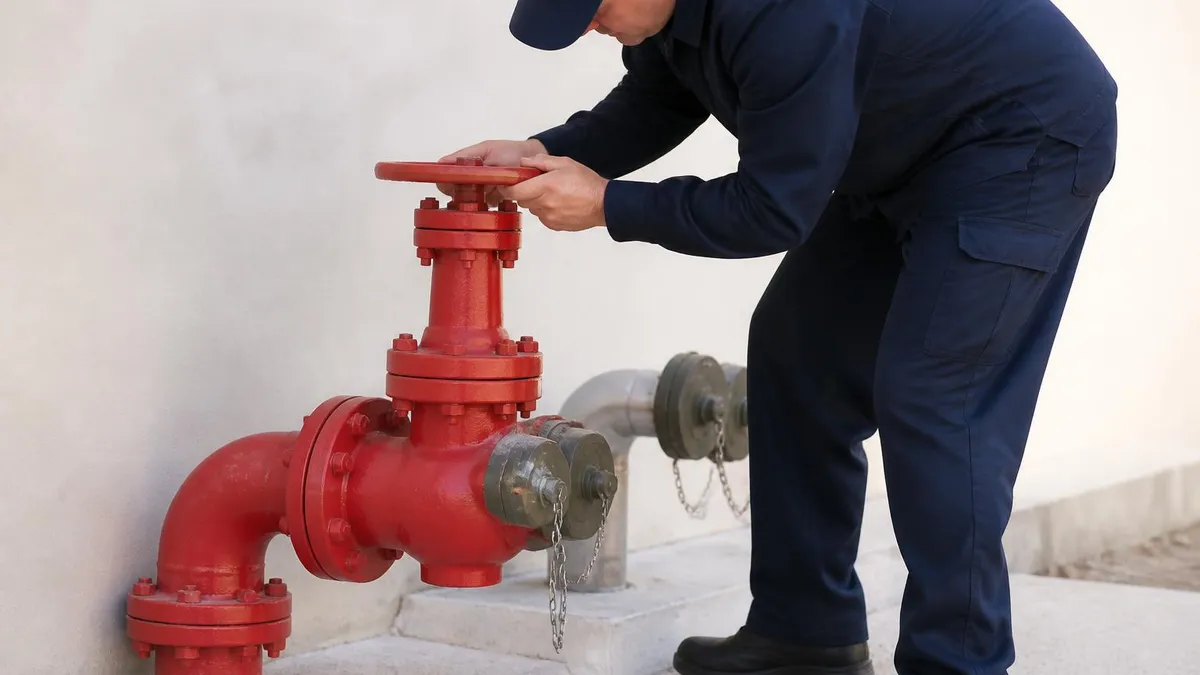
NFPA 24 requires private hydrants to be listed, color-coded according to their flow capacity, and spaced to provide effective coverage of the protected property. The standard pulls heavily from NFPA 291 for flow testing and color coding, with light blue indicating flows above 1,500 gpm and red indicating flows below 500 gpm at 20 psi residual pressure.
Each hydrant must drain after use to prevent freeze damage, and the drain must not connect to a sanitary sewer or storm drain. Bollards or other physical protection are required wherever vehicles could strike the hydrant, and clearance around the operating nut and outlets must remain unobstructed by landscaping, fencing, or accumulated snow for the life of the installation.
Advantages and Drawbacks of a Private Fire Service Main
- +Dedicated water supply independent of domestic plumbing demand
- +Larger pipe sizes allow higher hydraulic capacity for sprinklers and hydrants
- +On-site hydrants reduce fire department setup time and hose lays
- +Owner controls supervision, testing schedule, and maintenance quality
- +Insurance credits often available for documented NFPA 24 compliance
- +Lower friction loss than a tap shared with a building service line
- −Significant capital cost for excavation, piping, and restoration
- −Requires ongoing inspection and testing under NFPA 25
- −Backflow prevention adds friction loss and annual testing burden
- −Soil conditions can force expensive material upgrades or extra depth
- −Coordination with multiple utilities complicates trenching
- −Permitting and AHJ approval can extend project schedules by months
Pros and Cons at a Glance
| Pros | Cons |
|---|---|
| Dedicated water supply independent of domestic plumbing demand | Significant capital cost for excavation, piping, and restoration |
| Larger pipe sizes allow higher hydraulic capacity for sprinklers and hydrants | Backflow prevention adds friction loss and annual testing burden |
| On-site hydrants reduce fire department setup time and hose lays | Soil conditions can force expensive material upgrades or extra depth |
| Owner controls supervision, testing schedule, and maintenance quality | Coordination with multiple utilities complicates trenching |
| Lower friction loss than a tap shared with a building service line | Permitting and AHJ approval can extend project schedules by months |
NFPA 24 Acceptance Testing Checklist
- ✓Verify all pipe and fittings are listed for fire protection service before backfill.
- ✓Document trench depth, bedding, and haunching with photos at each pipe segment.
- ✓Install and inspect thrust blocks or mechanical restraints at every direction change.
- ✓Flush the system at a minimum velocity of 10 feet per second to clear debris.
- ✓Perform a 200 psi hydrostatic test for two hours with no allowable leakage.
- ✓Confirm backflow preventer is installed in the correct orientation and tested.
- ✓Verify post indicator valves operate fully open and target windows are visible.
- ✓Test electrical supervision on all control valves with the alarm panel.
- ✓Flow test each hydrant and record static, residual, and flow pressures.
- ✓Submit contractor's material and test certificate to the AHJ before placing in service.
Debris in a new main can disable an entire sprinkler system
Rocks, sand, wood chips, and even abandoned tools left in a buried pipe can travel into a riser and lodge in sprinkler heads, alarm valves, or fire pump impellers. NFPA 24 requires flushing at 10 fps because that velocity reliably moves debris larger than what can pass through downstream equipment. Skipping or short-cutting the flush invites failures that may not surface until the first real fire.
Once a private fire service main is accepted and placed in service, it falls under NFPA 25, the Standard for the Inspection, Testing, and Maintenance of Water-Based nfpa codes and standards pdf. NFPA 24 governs the design and installation phase, but NFPA 25 takes over for the rest of the system's life, and the two standards work as a matched pair. Understanding the handoff prevents the gaps that often appear when contractors leave the site and ownership transitions to facility staff.
The most common ongoing requirement is the annual flow test of hydrants. Each private hydrant must be operated, flushed, lubricated, and inspected for damage or corrosion. Static and residual pressures should be recorded and compared against the original acceptance test to detect supply degradation, valve closures, or scale buildup inside the main. A drop in flow capacity of more than ten percent warrants investigation.
Control valves are inspected weekly when not supervised and monthly when supervised. The inspector verifies the valve is in the correct position, the chain or lock is intact, no leakage is present at the stem, and any tamper switch responds correctly. Documentation of these inspections is what separates a defensible compliance program from a paper exercise, and AHJs increasingly demand digital records during routine fire inspections.
Backflow preventers require annual testing by a certified backflow tester, often a separate trade from the fire sprinkler contractor. The forward flow test must demonstrate that the system can still meet its hydraulic demand with the backflow device installed, not just that the device itself functions. This is a frequent source of failures because a marginal water supply that passed the original acceptance test may no longer meet demand a decade later.
Internal inspection of underground piping is required every five years, accomplished by flushing a sample of the main at full flow and examining the discharged water for sediment, scale, or biological growth. If significant material is found, additional flushing or a full main inspection may be required. This is one of the most commonly missed NFPA 25 requirements, often because the building owner does not realize buried pipe needs periodic attention.
Hydrant maintenance includes verifying that operating nuts turn freely, drains function, caps are in place, and outlet threads are not damaged. Lubrication of the operating mechanism extends service life dramatically, and replacement of worn gaskets prevents leakage that wastes water and erodes the soil around the hydrant base. Cold weather inspections should confirm that hydrants drain completely to prevent freeze damage in winter.
Documentation closes the loop on every inspection. The owner is responsible for maintaining records of all testing, inspection, and maintenance activities, and those records must be available for review by the AHJ and the insurance carrier. Many jurisdictions now require electronic submission of inspection reports, and failure to file on time can result in citations, increased insurance premiums, and impaired status notices that the fire department tracks closely.

NFPA loss data consistently shows that a shut control valve is the single most common reason a sprinkler system fails to control a fire. NFPA 24 requires supervision and identification of every valve in the private main, and any work that involves closing a valve must include an impairment procedure with notification to the AHJ, the alarm company, and the insurance carrier before the valve is touched.
Common violations of NFPA 24 tend to cluster in a few predictable areas, and recognizing them early saves enormous rework cost. The first is inadequate thrust restraint. Field crews sometimes substitute oversized backfill compaction for engineered thrust blocks or restrained joints, especially when schedules are tight and concrete deliveries are inconvenient. The result is a joint that holds during the hydrostatic test but separates a year later under a routine pressure surge.
The second frequent violation is unlisted material. A purchasing agent buys ductile iron pipe from a supplier who normally serves municipal water projects, and the pipe arrives without the proper stenciling for fire service. The inspector catches it on site, work stops, and the project loses two weeks waiting for replacement material. Verifying the listing before placing the order prevents this kind of avoidable delay.
Improper depth of cover is another regular finding. A contractor working in unfamiliar territory may install pipe at the depth required in the previous jurisdiction, only to discover that the local frost line requires another two feet of bury. Re-trenching is expensive and time-consuming, and in some cases the existing pipe must be removed entirely because it was not rated for the deeper installation.
Missing or incorrect supervision on control valves comes up repeatedly in annual inspections. A post indicator valve is installed properly, but the tamper switch is never wired to the fire alarm panel, or the switch is wired but never tested. The AHJ writes the violation, and the building owner faces both the cost of the corrective work and the embarrassment of a deficiency that should have been caught during commissioning.
Fire department connection problems include missing caps, incorrect thread types, blocked sight lines, and obstructions that prevent apparatus access. Landscaping grows over time, and an FDC that was clearly visible at acceptance may be hidden behind a hedge five years later. NFPA 25 inspectors are now trained to flag these issues, but proactive owners trim landscaping and verify signage on every annual walk-through.
Coordination with the related NFPA 13D Explained: Complete Guide to Sprinkler Systems in One- and Two-Family Dwellings and Manufactured Homes standard occasionally creates confusion, since residential sprinkler supplies are typically sized and installed differently than commercial private mains. NFPA 24 applies to private fire service mains regardless of occupancy, but the practical implementation differs significantly between a 200,000 square foot warehouse and a residential subdivision served by a small underground loop.
Finally, lack of as-built documentation is a recurring problem. A main is installed, tested, accepted, and then buried. Five years later, a different contractor needs to tie in a new sprinkler riser and has no idea where the existing main runs or what depth to expect. Accurate as-builts saved to the owner's permanent records prevent excavation accidents, broken pipes, and the cascading impairments that follow.
For anyone preparing to apply NFPA 24 on a project or to test on the standard for a certification exam, a few practical habits make the difference between competence and confusion. First, always work from the edition that has been formally adopted in your jurisdiction. The 2025 edition may be the current published version, but if the local fire code still references 2019, that is the document you must comply with, and the differences between editions can be significant.
Second, read the standard with the annex material included. Annex A provides explanatory text for nearly every requirement, and it is where the rationale, examples, and engineering judgment live. The body of the standard tells you what to do, but the annex often tells you why, and that context is essential when an unusual field condition forces a judgment call between two acceptable approaches.
Third, build relationships with the AHJ early. A fifteen minute conversation with the fire marshal during design can prevent weeks of redesign during permit review. Most AHJs appreciate proactive contact and will share their interpretation of debated requirements, their preferred submittal format, and the specific issues that have caused problems on recent projects in their jurisdiction.
Fourth, document everything. Photographs of trench bottoms, restraint details, hydrostatic test gauges, and flushing discharge are worth far more than written records alone. When a question arises three years later about whether a particular fitting was properly restrained, a date-stamped photo settles the matter immediately. Cloud-based documentation systems make this easy and affordable.
Fifth, treat the acceptance test as a final exam, not a formality. A successful 200 psi hydrostatic test with zero loss for two hours proves the joints are tight, the fittings are properly installed, and the materials can handle service pressure plus margin. A test that limps through with marginal results is a warning sign that the system will not age well, and the time to fix problems is before backfill, not after.
Sixth, integrate NFPA 24 knowledge with the related standards. A complete fire protection professional understands how the private main feeds into NFPA 13 sprinklers, NFPA 14 standpipes, NFPA 20 fire pumps, and NFPA 25 ongoing inspection. Reading the standards in isolation produces narrow specialists who miss interactions; reading them as a system produces designers and inspectors who catch issues other people miss.
Finally, stay current on revisions. The three-year cycle introduces meaningful changes in nearly every edition, sometimes tightening requirements and occasionally relaxing them based on field experience and research. Subscribing to NFPA's free public access to standards and attending the local chapter meetings of organizations like the AFSA or NFSA keeps your knowledge sharp and your certifications current.
Sample NFPA - National Fire Protection Association Practice Questions
Try these questions from our free NFPA - National Fire Protection Association practice tests. The correct answer and an explanation follow each question.
Under NFPA 72, what minimum standby battery capacity is required for a fire alarm control unit?
- A. 4 hours alarm + 4 hours standby
- B. 24 hours standby + 5 minutes alarm
- C. 4 hours standby + 15 minutes alarm
- D. 60 minutes alarm only
Answer: B. 24 hours standby + 5 minutes alarm
NFPA 72 requires fire alarm control units to have battery backup for 24 hours in standby followed by 5 minutes in full alarm.
Under NFPA 10, what action is required when a fire extinguisher pressure gauge reads in the red (overcharged or undercharged) zone?
- A. Tag and continue in service for 30 days
- B. Remove from service and recharge or replace
- C. Add pressure if undercharged only
- D. Submit a report to the AHJ
Answer: B. Remove from service and recharge or replace
NFPA 10 requires that extinguishers with gauges outside the operable (green) range be removed from service and recharged or replaced.
According to NFPA 10, what information must appear on the tag attached to a fire extinguisher after annual maintenance?
- A. Manufacturer's date of manufacture only
- B. Date of service, servicing company, and technician initials or ID
- C. Owner name and address
- D. Next recharge due date only
Answer: B. Date of service, servicing company, and technician initials or ID
NFPA 10 requires the maintenance tag to show the date of service, the name of the servicing organization, and the technician's identification.
Under NFPA 10, what is the maximum travel distance to a Class A fire extinguisher in a light hazard occupancy?
- A. 50 feet
- B. 75 feet
- C. 100 feet
- D. 150 feet
Answer: B. 75 feet
NFPA 10 requires that Class A extinguishers in light hazard occupancies be placed so that travel distance does not exceed 75 feet.
Take the full NFPA - National Fire Protection Association practice test
NFPA Questions and Answers

NFPA 1582: Complete Guide to the Standard on Medical Requirements for Firefighters

NFPA 1001 Explained: Firefighter Professional Qualifications Standard Guide

NFPA 1901: Complete Guide to the Standard for Automotive Fire Apparatus
NFPA 13D Explained: Complete Guide to Sprinkler Systems in One- and Two-Family Dwellings and Manufactured Homes

NFPA 70E: Electrical Safety Standard Guide for the Workplace
About the Author

Certified Safety Professional & OSHA Compliance Expert
Indiana University of Pennsylvania Safety SciencesDr. William Foster holds a PhD in Safety Science from Indiana University of Pennsylvania and is a Certified Safety Professional (CSP) and Certified Hazardous Materials Manager. With 20 years of occupational health and safety management experience across construction, manufacturing, and chemical industries, he coaches safety professionals through OSHA certification, CSP, CHST, and safety management licensing programs.
Join the Discussion
Connect with other students preparing for this exam. Share tips, ask questions, and get advice from people who have been there.
View discussion (8 replies)