
MRI Technician Salary: How Much Do MRI Techs Make in 2026 September?
MRI technician salary data for 2026 September: 🟢 average pay, hourly wages, state-by-state breakdown, shift differentials, bonuses, and how to earn more.
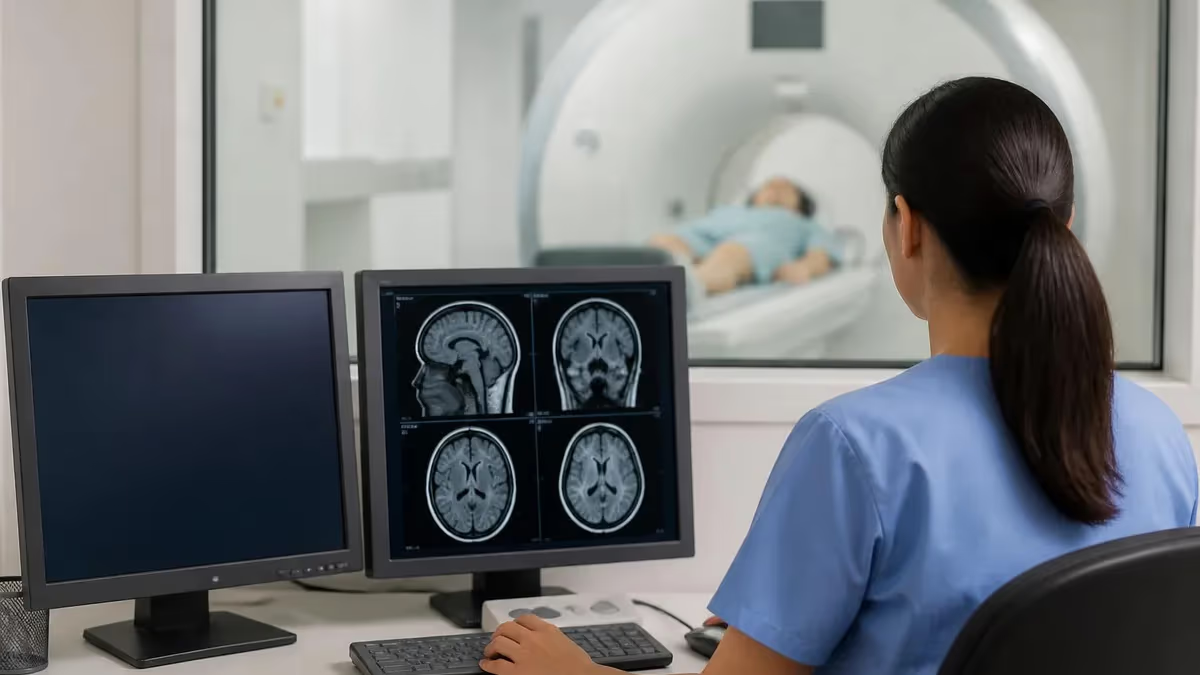
The mri technician salary in the United States has climbed steadily over the past five years, driven by an aging population, rising demand for advanced imaging, and a persistent shortage of credentialed technologists. As of early 2026, the national average sits at roughly $86,400 per year, with experienced specialists in metropolitan markets routinely clearing six figures. That figure represents base pay before shift differentials, overtime, on-call stipends, and sign-on bonuses, which can push total compensation considerably higher in competitive hospital systems.
Compensation varies more than most prospective students realize. A new graduate working a day shift at a rural outpatient clinic might start near $60,000, while a senior technologist running 3T cardiac protocols overnight at a Level I trauma center in California can earn $130,000 or more. Geography, modality experience, certifications, employer type, and willingness to work nights or weekends all swing the dial. Understanding these variables before you commit to a program helps you choose the right credential path.
This guide breaks down what MRI technologists actually earn in 2026, how pay differs by state, employer, shift, and experience level, and what realistic career moves can lift your income over time. We pull from Bureau of Labor Statistics data, hospital pay-grade disclosures, recent job postings, and union contracts to give you concrete numbers rather than vague ranges. If you are still exploring training options, you may want to read our companion guide on how to become an MRI technician alongside this article.
We will also address the questions that career-changers ask most often: How does MRI pay compare to CT, X-ray, and ultrasound? Is it worth pursuing advanced registries like MRSO or VIR-specific credentials? Do travel positions really pay $3,000 a week, and what are the trade-offs? Are night-shift differentials enough to justify the lifestyle hit? Each of these decisions has a measurable dollar impact, and we will quantify them with current market data.
One critical caveat before diving in: salary surveys lag the market by 12 to 18 months. The numbers you see on legacy career sites often reflect 2023 or 2024 pay rates, which understate current offers by 8 to 15 percent in many regions. Throughout this article, we cite the most recent BLS Occupational Employment Statistics release, ARRT credential survey data, and live job board snapshots taken in the first quarter of 2026 to keep the figures fresh and actionable.
Finally, salary is only one piece of the total-rewards picture. Hospital-based MRI technologists typically receive employer-paid health insurance, retirement matching of 4 to 8 percent, paid time off accruing at 15 to 25 days annually, tuition reimbursement, and continuing education stipends. Adding these benefits, total compensation often runs 25 to 35 percent above base salary. We will quantify that bundle later so you can compare offers apples-to-apples rather than chasing the highest hourly rate.
Whether you are weighing whether to enroll in an MRI program, negotiating a first offer, or considering a switch from another modality, the figures in this guide will help you anchor expectations. Pay attention to the state and employer breakdowns, because national averages obscure as much as they reveal. A $75,000 offer in Birmingham buys a very different lifestyle than the same number in Boston, and the strongest negotiating position comes from knowing exactly where your local market sits.
MRI Technician Salary by the Numbers (2026)
MRI Technician Salary by Experience Level
New graduates with ARRT(R)(MR) or ARMRIT credentials typically earn $58,000 to $72,000 nationally. Outpatient clinics start lower; hospital systems offer sign-on bonuses of $5,000 to $15,000 plus relocation assistance to close the gap.
With 3T experience and a second registry, mid-career techs earn $78,000 to $98,000. This is the sweet spot for negotiating shift bids, weekend differentials, and lead-tech responsibilities that add 5 to 10 percent to base pay.
Senior technologists running cardiac, breast, or interventional MRI protocols command $95,000 to $118,000. Many step into protocol-development, applications specialist, or clinical educator roles that blend bedside work with higher-paid hybrid duties.
Lead MRI techs and modality supervisors earn $110,000 to $135,000 in base pay, often with administrative-on-call stipends. Multi-site supervisors at large health systems can reach $150,000 when bonus structures and call pay are included.
Travel contractors and per-diem PRN techs convert lifestyle flexibility into cash. Weekly travel packages of $2,400 to $3,500 (taxable plus stipends) are common in 2026, while PRN hourly rates of $58 to $78 reward those who can self-schedule.
Geography is the single biggest predictor of mri technician pay, often outweighing experience level. California leads the nation with an average wage of approximately $108,000, followed by Hawaii at $103,000, Washington at $99,000, and Massachusetts at $96,500. The Mountain West and Pacific Northwest pay well because credentialed technologists are scarce and the cost of living is high; major academic medical centers in Seattle, Portland, and Denver routinely post openings above $100,000 even for technologists with fewer than five years of experience.
The Northeast corridor pays competitively but unevenly. New York City and Boston metros average $94,000 to $98,000, but pay drops sharply outside city limits — upstate New York averages around $78,000 and central Pennsylvania closer to $74,000. New Jersey is an outlier, with strong union contracts at hospital systems like RWJBarnabas pushing experienced techs above $105,000 once differentials are factored in.
The Southeast offers lower headline numbers but extremely favorable cost-of-living ratios. Florida averages $76,000, Georgia $74,000, Tennessee $71,000, and the Carolinas hover near $72,000. After adjusting for state income tax (zero in Florida and Tennessee) and housing costs, take-home purchasing power in these markets often rivals or exceeds higher-paying coastal cities. Atlanta and the Research Triangle in particular have seen wage compression close as health systems compete for travelers and permanent staff.
The Midwest sits in the middle. Illinois ($86,000), Minnesota ($88,000), and Michigan ($79,000) anchor the higher end, with Chicago-area academic centers pushing past $95,000 for experienced 3T technologists. Rural Iowa, Nebraska, and Kansas average $66,000 to $72,000 but increasingly offer aggressive sign-on bonuses and student-loan repayment programs to attract candidates away from coastal markets.
Texas deserves its own paragraph. Despite no state income tax, base wages in Texas average just $77,000, with Houston and Dallas at $82,000 and rural West Texas closer to $65,000. However, Texas hospital systems compensate with strong overtime cultures, generous PRN rates of $62 to $70 per hour, and rapid promotion tracks at expanding facilities like Houston Methodist and Baylor Scott & White. Many techs use Texas as a base while taking out-of-state travel assignments through agencies headquartered in Dallas and Austin.
The lowest-paying markets are concentrated in the rural South and parts of Appalachia, where averages fall to $58,000 to $66,000. Mississippi, West Virginia, Arkansas, and parts of Alabama and Kentucky struggle to retain technologists, which paradoxically creates opportunity: critical-access hospitals in these regions now offer state-funded loan repayment of $20,000 to $50,000 over three to five years for techs who commit to underserved areas. For details on what these technologists actually do day-to-day before chasing a market, review our overview of what MRI can detect and its diagnostic capabilities.
One final geographic note: cost-of-living adjustments matter enormously. A $108,000 California salary sounds dominant until you account for housing, state income tax of up to 13.3 percent, and 9 to 10 percent sales tax. Compare that to Tennessee, where a $74,000 salary stretches further thanks to no state income tax and median home prices roughly 60 percent below California averages. Use a take-home calculator before deciding that the highest-listed state actually maximizes your savings rate.
MRI Practice Test Questions
Prepare for the MRI - Magnetic Resonance Imaging exam with our free practice test modules. Each quiz covers key topics to help you pass on your first try.
MRI Knowledge
MRI Exam Questions covering Knowledge. Master MRI Test concepts for certification prep.
MRI Physics
Free MRI Practice Test featuring Physics. Improve your MRI Exam score with mock test prep.
MRI Anatomy and Pathology
MRI Test Prep for MRI Anatomy and Pathology. Practice MRI Quiz questions and boost your score.
MRI Anatomy and Positioning
MRI Questions and Answers on MRI Anatomy and Positioning. Free MRI practice for exam readiness.
MRI Contrast Agents
Free MRI Quiz on MRI Contrast Agents. MRI Exam prep questions with detailed explanations.
MRI Patient Care and Positioning
MRI Practice Questions for MRI Patient Care and Positioning. Build confidence for your MRI certification exam.
MRI Technician Salary by Employer Type
Large hospital systems remain the highest-paying employers for staff MRI technologists, particularly academic medical centers and Level I trauma centers. Base wages average $84,000 to $102,000, with night, weekend, and call differentials adding $8,000 to $18,000 annually. Union-represented facilities in California, Oregon, Washington, Minnesota, and parts of the Northeast typically push total compensation 10 to 15 percent above non-union peers thanks to step-grade pay scales.
Hospital roles also bundle the strongest benefits: employer-paid medical premiums, retirement matches of 5 to 8 percent, defined-benefit pensions at some legacy systems, generous PTO, and tuition reimbursement up to $5,250 annually. The trade-off is shift volatility — overnight call, holiday rotations, and stat trauma scans are inescapable. If lifestyle stability matters more than maximum income, evaluate outpatient settings instead.

Is an MRI Technologist Career Worth the Salary?
- +Median pay above $86,000 with strong upward trajectory and 6%+ five-year wage growth
- +Two-year associate degree pathway means low debt relative to income potential
- +Stable, recession-resistant demand driven by aging population and rising imaging utilization
- +Multiple specialization tracks (cardiac, breast, MSK, neuro) that lift pay 10 to 20 percent
- +Travel and PRN options provide flexible six-figure earning paths without long-term commitment
- +Strong benefits packages add 25 to 35 percent to base salary in hospital settings
- +No prescribing authority, no patient discharge decisions — lower medical-legal exposure than nursing
- −Physical demands include lifting patients, long standing shifts, and repetitive coil placement
- −Night, weekend, and on-call rotations are difficult to avoid in hospital settings
- −Geographic pay disparity means relocation may be necessary to maximize earnings
- −Continuing education requirements (24 CE credits every two years) add ongoing cost and time
- −Strong magnetic field hazards require constant vigilance — quench and projectile risks are real
- −Career ceiling without management or applications specialist transitions tops out near $135,000
- −Outpatient roles can feel repetitive — many techs cycle through the same handful of protocols daily
Checklist: How to Maximize Your MRI Technician Salary
- ✓Earn ARRT(R)(MR) primary registry rather than the post-primary pathway when possible
- ✓Add a second advanced registry such as cardiac MR, breast MR, or vascular interventional
- ✓Pursue MRSO (Magnetic Resonance Safety Officer) certification — adds $5,000 to $10,000
- ✓Document 3T scanner experience explicitly on your resume; many job postings require it
- ✓Target academic medical centers and Level I trauma centers for top base wages
- ✓Negotiate shift differentials in writing before signing — they often exceed 15 percent
- ✓Build at least 12 months of experience before chasing travel contracts to qualify for premium rates
- ✓Track your scan volume; productivity metrics support raise requests in private-equity-owned centers
- ✓Relocate to a high-paying metro if your local market caps below the national median
- ✓Move into lead-tech, applications specialist, or clinical educator roles by year five
A second registry beats five extra years of experience
Industry compensation surveys consistently show that adding a second ARRT post-primary registry (cardiac, breast, or vascular interventional) raises base pay by $9,000 to $14,000 — more than what most technologists gain from five additional years of general MRI tenure. If you are early in your career and want to maximize earning velocity, invest your CE hours in a specialty track rather than waiting on automatic step raises.
Shift differentials, on-call pay, and overtime are where many MRI technologists quietly add $12,000 to $25,000 to their base salary every year. Understanding these add-ons is essential to evaluating offers honestly, because two facilities advertising the same hourly rate can deliver wildly different annual totals once schedule variables are factored in. Most hospital systems publish their differential structures in employee handbooks or union contracts; ask to see the schedule in writing before you accept any position.
Evening shift differentials (typically defined as shifts starting between 3 PM and 11 PM) average 8 to 12 percent of base hourly wage in 2026, up from 5 to 8 percent pre-pandemic. Night shifts (11 PM to 7 AM) command 15 to 22 percent, with some California and Pacific Northwest systems paying 25 percent or more. A technologist earning $42 per hour base could clear $51 per hour on nights, which over a full year of 36-hour weeks generates more than $17,000 in additional gross pay beyond straight time.
Weekend differentials stack on top of shift differentials at most facilities. Saturday and Sunday rates typically add another 10 to 15 percent, and some union contracts pay double-time on the seventh consecutive day worked. Weekend-only positions, sometimes called Baylor shifts, pay 36 hours of work as 40 hours and remain a popular option for parents or students balancing other commitments. These positions are competitive — incumbents rarely leave them — so be patient about bidding in.
On-call pay is often misunderstood. Most facilities pay $4 to $8 per hour to be on call (carrying a pager from home), then pay full hourly wage plus 1.5x or 2x premium when called in. A typical hospital MRI tech taking one week of call per month can add $6,000 to $12,000 annually depending on call-in frequency. Trauma centers and stroke-certified hospitals generate more call-ins, which raises both stress and compensation. Verify how many call-ins are typical before assuming the pager pay is easy money.
Overtime culture varies dramatically by facility. Some hospital systems aggressively manage labor costs and rarely approve overtime, while others rely on it structurally to cover chronic understaffing. Federal law requires 1.5x pay above 40 hours weekly for non-exempt employees, and a few states (California, Alaska, Nevada) add daily overtime after eight hours. Voluntary overtime at premium pay can quickly add $15,000+ annually, but watch for burnout — chronic 50+ hour weeks degrade safety performance and increase injury risk.
Holiday pay structures range from a flat 1.5x to a generous 2.5x rate plus a banked PTO day. Working Christmas, Thanksgiving, New Year's, and the Fourth of July can add $3,000 to $6,000 to annual pay for technologists willing to volunteer. Some facilities also offer pickup bonuses of $200 to $500 per shift when they cannot fill open holes — these unscheduled premiums have become increasingly common as staffing shortages persist into 2026.
Finally, certification and education premiums often show up as line items separate from base pay. Advanced registry differentials of $1 to $3 per hour, charge-nurse equivalents for lead-tech responsibilities, and preceptor pay for training new staff each add up. When comparing offers, build a complete compensation spreadsheet that lists base, every differential you realistically expect to capture, expected overtime, employer retirement match, and the dollar value of health insurance and PTO. The lowest base rate sometimes wins on a total-comp basis.
Many hospital systems use step-grade scales that cap out after 10 to 15 years of service, leaving senior technologists earning only marginally more than mid-career peers. If your facility has obvious wage compression, you may need to switch employers, move into a hybrid clinical-educator role, or pursue a credential that triggers a new pay band. Loyalty rarely beats market-rate negotiation after the first decade.
Credentials are the single most controllable lever you have for raising your salary. Every additional ARRT post-primary registry, vendor-specific certification, and safety credential opens new bands of pay and new types of positions. Below we walk through the certifications that produce the clearest financial return on investment in 2026, ranked roughly by impact-per-hour-of-study.
The foundation is ARRT(R)(MR) or ARMRIT, the primary registry credentials that qualify you to scan independently. ARRT(R)(MR) requires graduating from a JRCERT-accredited program, while ARMRIT offers a broader pathway for non-radiography backgrounds. Both are widely accepted, though ARRT is preferred by larger hospital systems and academic centers. Without one of these, you simply cannot work as a credentialed MRI technologist, so this is table stakes rather than a pay differentiator.
Beyond the primary, the highest-ROI second registry is cardiac MR. Cardiac protocols require specialized knowledge of ECG gating, parametric mapping (T1, T2, ECV), late gadolinium enhancement, and dynamic contrast timing. Cardiac MR technologists routinely earn $10,000 to $18,000 above general MRI peers and are in chronic short supply, particularly at academic centers and dedicated cardiovascular institutes. The ARRT post-primary registry requires documented clinical hours and a structured exam, but study materials are abundant and pass rates exceed 80 percent.
Breast MR is the second-highest-return specialty. As breast MRI screening guidelines have expanded to include high-risk and dense-breast populations, demand for dedicated breast imaging technologists has surged. Pay premiums of $7,000 to $14,000 are common, and many positions are day-shift-only at outpatient women's imaging centers, eliminating overnight call. The credential pathway mirrors cardiac MR — clinical experience plus a focused exam — and complements careers in radiology specialty groups beautifully.
MRSO (Magnetic Resonance Safety Officer) certification through the American Board of Magnetic Resonance Safety is increasingly required at large facilities. MRSO holders coordinate Zone 4 access, screen patients with implants, and lead quench drills. Many systems pay an MRSO differential of $2 to $5 per hour or a flat annual stipend of $4,000 to $8,000. The exam is challenging but the credential is portable and signals leadership readiness. To round out your clinical knowledge while studying, refresh your understanding of common MRI findings across brain, spine, and joints.
Vendor-specific certifications from Siemens, GE, Philips, and Canon do not always show up in pay bands, but they sharply increase your value to specific employers. A Siemens-certified technologist at a Siemens-heavy health system is more productive on day one and often negotiates a higher starting offer. Applications specialist roles at the vendors themselves pay $110,000 to $150,000 with a company car and travel — a viable exit path for technologists tired of patient-facing work.
Finally, do not overlook adjacent credentials like CT (ARRT CT post-primary) and mammography. Dual-modality technologists are extremely valuable at smaller facilities where staffing flexibility is critical. While CT and mammography do not necessarily pay more than MRI per hour, they expand the universe of jobs you can take and protect your income against modality-specific downturns. Many career technologists hold three registries by year ten, which keeps both their schedule and their negotiating leverage strong.
If you have read this far, you already understand that MRI technologist pay is more variable than headline averages suggest. The practical question is what to do next. Below are concrete tactics organized by career stage, drawn from negotiation patterns we see successful technologists actually use. Pick the ones that match your current situation and execute them within the next 30 to 90 days; the cost of inaction is measured in thousands of dollars per year of delay.
If you are still in school or pre-registry, prioritize clinical placements at high-volume hospitals with 3T scanners and diverse caseloads. Clinical sites matter more than program prestige — a student who rotates through cardiac, MSK, and neuro at an academic center starts negotiations 12 to 18 months ahead of one who rotated only at an outpatient orthopedic clinic. Volunteer for early-morning and weekend cases to maximize hands-on time, and start studying for ARRT registry six months before graduation rather than after.
If you are a new graduate evaluating offers, do not accept the first number. Even entry-level positions have negotiation room, especially in 2026 when staffing shortages persist. Counter-offer with a specific dollar figure backed by a comparable posting from a competing facility. Ask about sign-on bonuses (commonly $5,000 to $15,000), relocation assistance, tuition reimbursement, and CE allowance. If the base is fixed by HR, push for shift assignment guarantees or a six-month review with a defined raise tied to performance metrics.
If you are in years three to seven, the highest-leverage move is adding a second registry. Map out the CE hours required, build a study plan over six to nine months, and notify your manager that you are pursuing the credential. Many hospitals will reimburse exam fees and approve study time as professional development. When the credential is in hand, schedule a formal compensation review — bring market data showing the differential, and be prepared to interview elsewhere if your current employer will not match.
If you have plateaued at the senior staff level, consider non-bedside hybrid roles. Applications specialists at scanner vendors, clinical educators at imaging schools, MRI safety consultants, and PACS or workflow specialists at health-IT companies all draw heavily from experienced technologists and pay $100,000 to $150,000. These roles trade scan-room time for travel or screen time, which suits some personalities and not others. Test the waters by presenting at a regional conference or precepting students before fully committing.
For technologists considering travel work, the calculation is more nuanced than agency recruiters will admit. Run the numbers carefully: subtract self-paid health insurance, retirement contributions you will lose, gap weeks between contracts, and license/CE costs across multiple states. Travel pays well for technologists with strong financial discipline who can save aggressively during contract weeks. It does not pay well for those who lifestyle-creep into the higher take-home and miss employer retirement matching for years on end.
Finally, do not neglect the soft side of compensation. Strong relationships with referring physicians, radiologists, and operations leadership translate into preferred shift bids, first access to overtime, lead-tech opportunities, and internal-mobility into specialty teams. Technologists who are easy to work with, reliably accurate, and proactive about patient communication consistently out-earn technically equivalent peers who are harder to manage. Salary is a function of credentials, geography, and shift selection, but careers are built on reputation.
MRI Questions and Answers
About the Author

Medical Laboratory Scientist & Clinical Certification Expert
Johns Hopkins UniversityDr. Sandra Kim holds a PhD in Clinical Laboratory Science from Johns Hopkins University and is certified as a Medical Technologist (MT) and Medical Laboratory Scientist (MLS) through ASCP. With 16 years of clinical laboratory experience spanning hematology, microbiology, and molecular diagnostics, she prepares candidates for ASCP board exams, MLT, MLS, and specialist certification tests.
Join the Discussion
Connect with other students preparing for this exam. Share tips, ask questions, and get advice from people who have been there.
View discussion (8 replies)