
How to Become an MRI Technician: Schools, Certification, Salary 2026 October
How to become an MRI technician in 2026 October: 🎓 accredited schools, ARRT registry path, clinical hours, salary by state, and the exact steps to land your
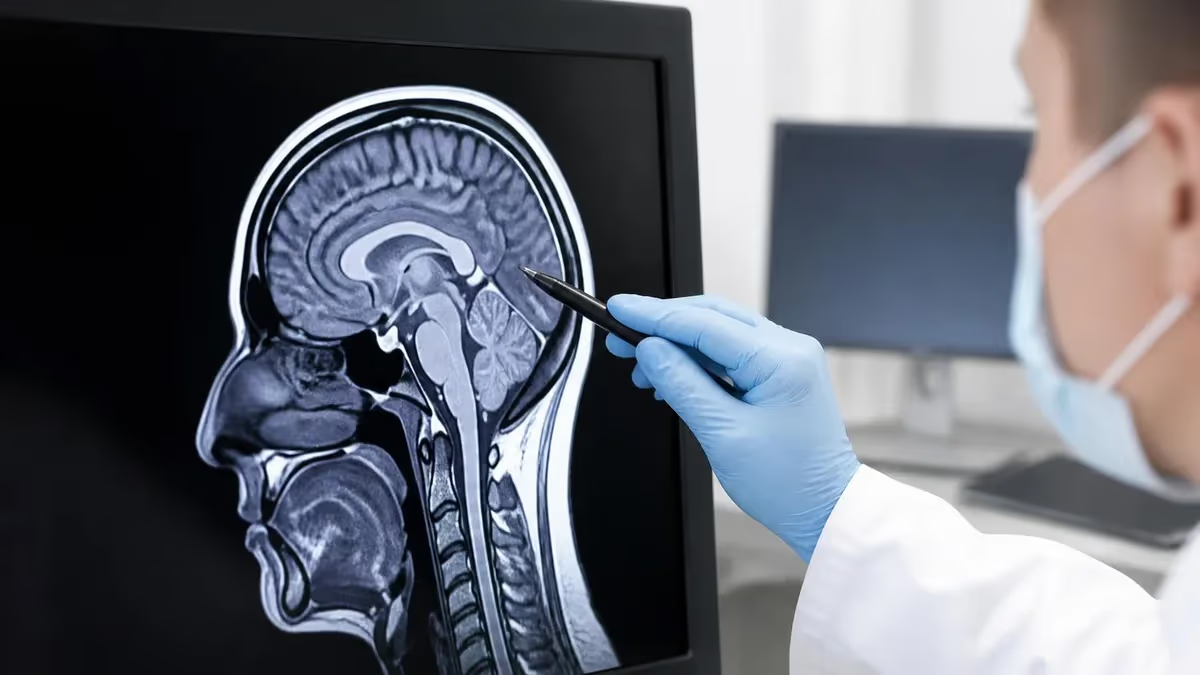
Becoming an MRI technician is one of the most direct ways to enter advanced medical imaging without spending eight years in school. You can be scanning patients in a hospital within two to four years of starting your training, earning a salary that lands well above the national median, and working in an environment where every shift looks different. The path is shorter than nursing, less crowded than ultrasound, and pays better than general radiography in most markets.
That said, the route is not a straight line. The MRI registry exam administered by the American Registry of Radiologic Technologists requires either a primary credential in radiography or a structured post-primary pathway. Schools vary in length, cost, and clinical reputation. Some states layer in licensure rules that the rest of the country ignores. And the clinical hours requirement means you cannot skip the hands-on apprenticeship phase, no matter how strong your test-taking skills are.
This guide lays out every step in order. Education prerequisites first, then primary certification, then the MRI-specific clinical training, then the registry exam itself, then licensure if your state requires it, then job hunting. We will also cover salary ranges by region, the realistic career ceiling, continuing education obligations, and the specific exam prep that gets first-time candidates across the 75-percent passing threshold. Read it once end to end so you understand the full picture, then come back to the sections that apply to your current step.
MRI Technician Career at a Glance
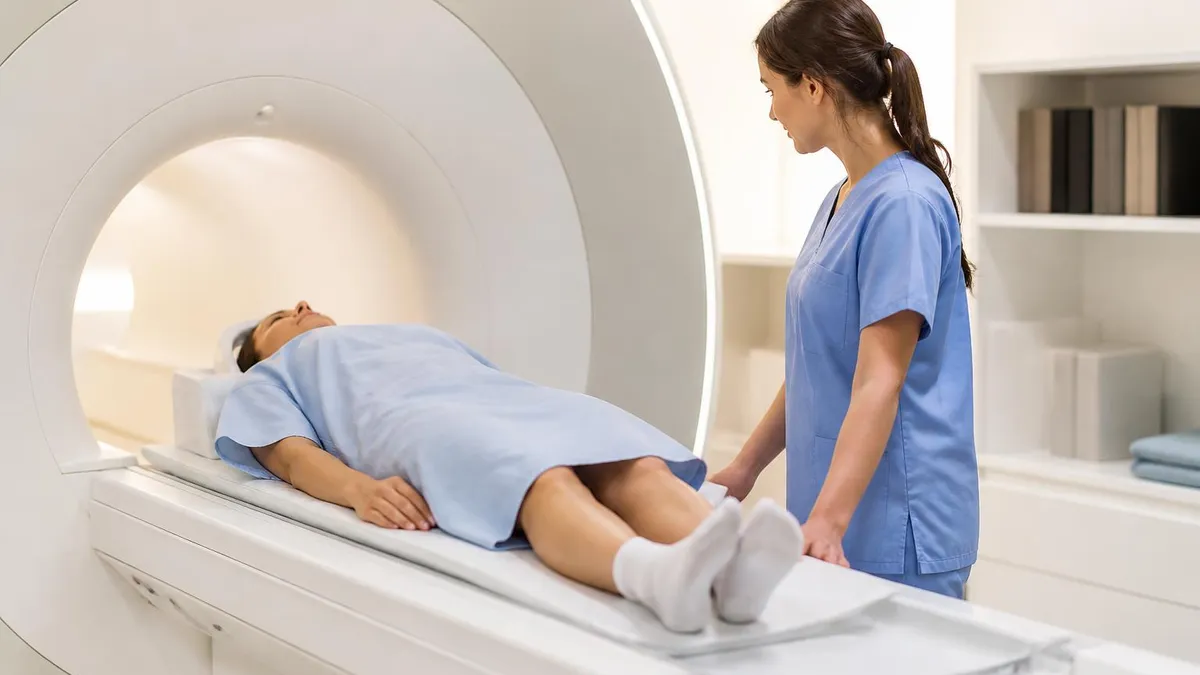
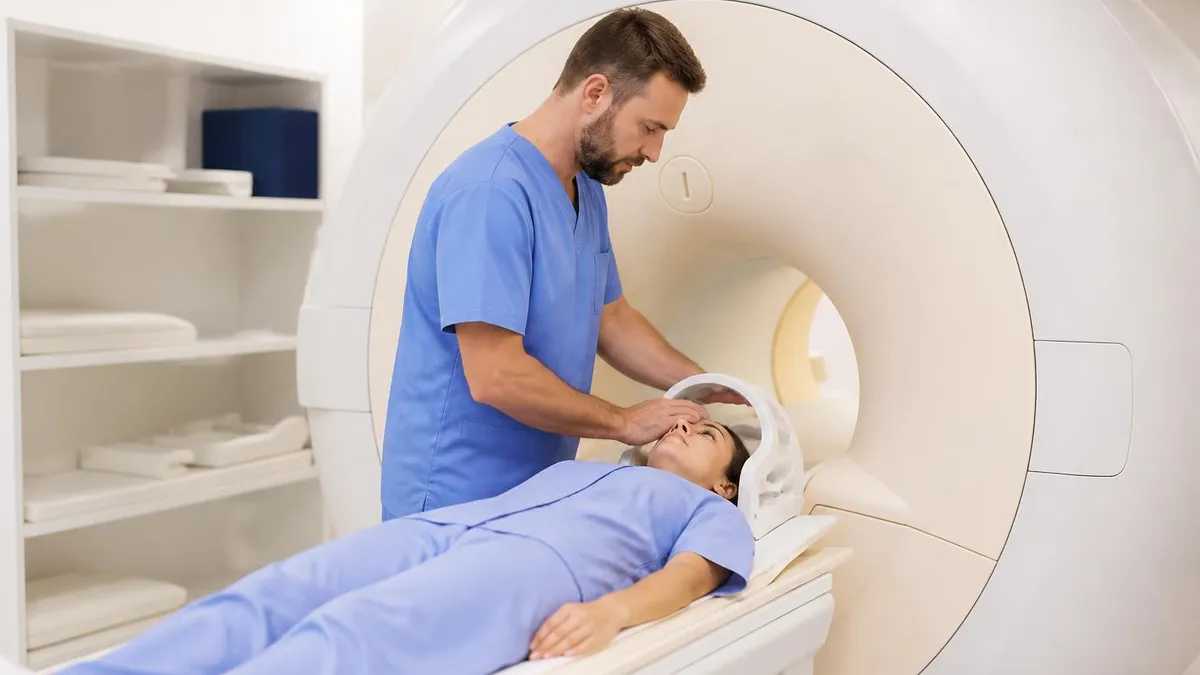
Before you commit to the training path, get clear on what the job actually looks like day to day. An MRI technician runs the scanner, positions patients, places receiver coils, monitors safety during the scan, and communicates with the radiologist about protocol adjustments. You will spend about 60 percent of your shift on patient care - explaining the procedure, screening for metal, calming the claustrophobic, helping older patients on and off the table - and the other 40 percent at the console adjusting sequences and reviewing image quality.
Most techs work in hospitals, outpatient imaging centers, or specialty clinics. Hospital roles include on-call rotations for emergency studies. Outpatient centers tend to run scheduled hours, usually 8 to 5, sometimes with extended evening shifts. Mobile MRI services move scanners between rural hospitals on a trailer, which suits techs who like variety and do not mind some driving. Travel MRI tech contracts pay premium rates - often double the local market - and run 13 weeks at a time for those willing to relocate.
The physical demands are real but manageable. You will lift and reposition patients, push gurneys, and stand for hours. Repetitive stress in the wrists and lower back is common over a long career. Most techs retire from active scanning by their early 60s, sometimes transitioning into education, applications support for scanner manufacturers, or imaging informatics roles that pay similarly and reduce physical wear.
Key Insight
Among the imaging specialties, MRI consistently pays more than CT, plain radiography, or mammography. The reason is a chronic shortage of credentialed MRI techs combined with the capital intensity of the scanners themselves - a hospital that spent three million dollars on a 3T magnet wants the room booked twelve hours a day, and that requires staff. If you are picking between radiography subspecialties for the salary, MRI is usually the right choice. The downside is the registry exam is widely considered the toughest of the post-primary credentials, with denser physics content than CT or mammography boards.
Two routes lead to MRI registry eligibility. The traditional path starts with an associate degree in radiologic technology from a JRCERT-accredited program, takes the ARRT radiography registry, then pursues MRI as a post-primary specialty. This route takes about three to four years total - two for the associate degree, six to twelve months for MRI-specific clinical hours, then the registry exam. Most working MRI techs took this route because it gives you a fallback credential and broadens the kinds of jobs you can apply for.
The direct MRI path skips radiography. A handful of programs offer a one-to-two-year MRI-specific certificate or associate degree that prepares graduates to sit directly for the MRI registry without first being radiographers. These programs are less common but exist at community colleges and some allied health schools. Graduates can scan but cannot perform CT, X-ray, fluoroscopy, or interventional procedures without additional training. If you are absolutely certain MRI is your only interest, the direct path saves a year. If you might want flexibility, the radiography-first path is more durable.
Either way, your program must be accredited by JRCERT or the equivalent for ARRT to honor the clinical hours. Verify accreditation before you enroll. The school's website usually says so on the program page, and you can cross-check at jrcert.org. Programs that lack accreditation may still be legitimate but their hours will not count toward registry eligibility, which makes the time and tuition essentially wasted.
Stages of the MRI Technician Career Path
High school diploma or GED, basic anatomy and physiology coursework, college algebra, and often introductory physics. Some programs require CNA experience or healthcare volunteer hours.
Two-year associate degree in radiologic technology (most common) or one-to-two year MRI-specific program. Includes didactic coursework plus 1,800 to 2,400 clinical hours.
Pass ARRT Radiography registry if going post-primary route. The exam tests image production, radiation protection, patient care, and procedures across 200 questions in 3.5 hours.
Complete 1,250 documented MRI clinical hours under a credentialed technologist. Many techs accumulate these while working as a radiographer in a hospital that has an MRI department.
Pass the ARRT MRI registry exam - 200 questions, 3.5 hours, covers physics, safety, procedures, image production, and patient care. Passing score is 75 percent scaled.
About 35 states require state license on top of ARRT registration. Application typically requires proof of ARRT credential and a state-specific fee. A few states have additional jurisprudence exams.
How do you pick a program? Start with three filters: accreditation, location, and clinical site quality. Accreditation is non-negotiable as discussed. Location matters more than you might think because you will spend hundreds of hours at clinical sites affiliated with your school. If those sites are forty minutes away, that is forty minutes each way for months on end. Clinical site quality determines what kind of cases you see during training. A school affiliated with a Level I trauma center exposes you to far more variety than one tied only to an outpatient orthopedic clinic.
Tuition for an associate-degree radiography program at a public community college runs $8,000 to $20,000 total. Private programs and for-profit schools charge two to four times that for arguably similar credentials. Look at the published first-time ARRT pass rate for graduates - JRCERT publishes this data publicly. Pass rates above 85 percent on first attempt signal a program that drills exam content well. Pass rates below 70 percent are a red flag regardless of how slick the recruiting brochure looks.
Ask current students about the politics. Some programs are notorious for kicking students out at the slightest grade dip, which artificially inflates pass rates because only the strongest test takers reach graduation. Others coddle students through coursework but leave them unprepared for the registry. The sweet spot is a program that holds high standards but supports struggling students with tutoring and remediation rather than dismissal.
What the ARRT MRI Registry Covers
Screening for contraindications, IV access for contrast, monitoring during the scan, handling claustrophobia, communicating with patients across language barriers, infection control, and emergency response including code blue and contrast reactions. About 30 questions on the exam.
The MRI registry exam is computer-based, administered at Pearson VUE testing centers across the country. You schedule it after your application paperwork clears - typically four to six weeks after submitting clinical hour documentation. The fee is $225 as of 2026, with a $200 retake fee if you do not pass the first time. Most candidates pass on the first attempt, but the failure rate is high enough that programs build in remediation strategies for graduates who do not.
The 200 questions are multiple choice, single best answer. You have 3.5 hours to complete them, which works out to about 63 seconds per question. That sounds tight but most candidates finish with time to review flagged questions. The interface allows you to mark items for return, change answers, and use an on-screen calculator for the handful of math problems. There is no penalty for guessing, so every blank should be filled in before time expires.
Scoring works on a scaled system rather than raw percentage. You need a scaled score of 75 to pass, which corresponds roughly to 65 to 70 percent raw depending on how difficult that particular form of the exam was. The ARRT does not release the exact conversion. Results post to your ARRT account within ten to fifteen business days, although most candidates see results within a week. Pass and you can immediately use the credential. Fail and you can re-test after 90 days, up to three total attempts in a three-year window before you must repeat clinical hours.
Weak physics foundation is the number one failure cause. Candidates who breezed through their program by memorizing protocols without understanding spin dynamics, K-space, and gradient physics consistently underperform on the data acquisition and physical principles sections, which combined are 35 percent of the exam. Second cause: underestimating safety content. The 20 percent safety weighting catches candidates by surprise. Third: not doing enough practice questions. Plan for at least 1,500 practice questions over your study period, ideally across multiple question banks so you do not just memorize one publisher wording.
The Bureau of Labor Statistics tracks MRI technologists separately from general radiographers. As of the most recent data, the median annual salary for MRI technologists in the United States is $83,740. The lowest ten percent earn around $61,000 and the top ten percent clear $107,000. Geography drives most of the variation. California, Massachusetts, Washington State, Hawaii, and the New York metro consistently pay top quartile. The Deep South, rural Midwest, and Mountain West pay below median, though cost of living usually compensates.
Setting matters too. Outpatient imaging centers tend to pay slightly less than hospitals but offer predictable hours. Hospitals pay more but include on-call rotations and night shifts. Travel MRI tech contracts are the most lucrative option - weekly take-home of $2,000 to $3,000 after housing is common on 13-week assignments, especially in shortage markets. The trade-off is constant relocation and the loss of long-term benefits like pension vesting and health insurance continuity.
Specialty credentials add to base pay. Adding a CT registry makes you eligible for combined CT/MRI roles that often pay 10 to 15 percent more than single-modality positions. A breast MRI focus opens opportunities at high-volume cancer centers. Cardiac MRI subspecialization is rarer and pays well at academic medical centers running advanced cardiac protocols. The more body parts and modalities you can credibly scan, the more use you have in salary negotiations and shift bidding.
Your Step-by-Step Action Plan
- ✓Verify program accreditation through JRCERT before enrolling
- ✓Apply to multiple programs - acceptance rates can be competitive
- ✓Complete prerequisite anatomy, physiology, algebra, and physics coursework
- ✓Maintain at least a 3.0 GPA throughout your associate degree program
- ✓Document every clinical hour and procedure type accurately during training
- ✓Sit for the ARRT Radiography registry within 6 months of graduation
- ✓Apply for entry-level radiographer position at a facility with an MRI department
- ✓Cross-train into MRI through your hospital while logging 1,250 MRI hours
- ✓Submit ARRT post-primary application with documented MRI clinical hours
- ✓Study 8 to 12 weeks for the MRI registry using physics-heavy review materials
- ✓Schedule and pass the MRI registry exam at a Pearson VUE testing center
- ✓Apply for state license if your state requires it (check ARRT state list)
- ✓Apply for MRI tech positions or negotiate transfer within your current facility
- ✓Maintain 24 continuing education credits per two-year ARRT renewal cycle
State licensure is where many new techs get tripped up. The ARRT credential is the national standard, but about 35 states require an additional state license to actually scan patients within their borders. California, Texas, New York, Florida, and Illinois all require state licensure on top of ARRT. A handful of states - Idaho, Missouri, Wyoming, and a few others - have no state license requirement and rely entirely on the ARRT credential. Find out where your target market falls before assuming the ARRT alone is enough.
The application process for state licensure varies but typically involves submitting your ARRT verification, a state-specific application, fingerprints for a background check, and an application fee that ranges from $50 to $250. Most states process applications within four to eight weeks. A few states - notably California - require an additional jurisprudence exam that tests state-specific imaging regulations. The fail rate on these state add-ons is low but you should not assume you can walk in cold and pass.
Continuing education is a lifelong commitment in this field. The ARRT requires 24 hours of continuing education every two years to keep your registration active. The hours must come from approved sources - 30 osha training online in-person workshops, journal articles with attached CE credit, manufacturer training sessions, or attendance at professional conferences like RSNA or ISMRM. Failure to log enough hours results in administrative status until you make them up, which can suspend your ability to practice in licensed states.
Your hospital or imaging center typically pays for or subsidizes continuing education. Some employers run in-house CE programs that earn credit for staff while delivering training on new equipment. Others reimburse for outside courses up to an annual cap. Negotiate this benefit during job offers - $1,500 a year in CE reimbursement is reasonable to ask for and saves you out-of-pocket expense for the lifetime of the role.
Pros and Cons of an MRI Tech Career
- +Strong median salary above $83,000 with top quartile clearing $100,000
- +Stable demand driven by aging population and chronic shortage of credentialed techs
- +Training takes 2 to 4 years - far shorter than nursing or physician pathways
- +No ionizing radiation exposure unlike X-ray or CT work
- +Travel contracts allow rapid income growth and geographic flexibility
- +Multiple specialty paths to deepen expertise and increase compensation
- +Hospital benefits packages typically include strong health, retirement, and tuition aid
- −Registry exam is the toughest of the radiology post-primary credentials
- −Long shifts on your feet contribute to musculoskeletal wear over time
- −On-call hospital schedules disrupt sleep and personal life
- −Patient interactions include difficult cases, claustrophobia, and pediatric anxiety
- −Continuing education obligations require 12 hours per year for life
- −State licensure adds cost and paperwork in about 35 states
- −Career ceiling without further education - moving up usually means leaving scanning
Pros and Cons at a Glance
| Pros | Cons |
|---|---|
| Stable demand driven by aging population and chronic shortage of credentialed techs | Registry exam is the toughest of the radiology post-primary credentials |
| No ionizing radiation exposure unlike X-ray or CT work | Long shifts on your feet contribute to musculoskeletal wear over time |
| Travel contracts allow rapid income growth and geographic flexibility | On-call hospital schedules disrupt sleep and personal life |
| Multiple specialty paths to deepen expertise and increase compensation | Patient interactions include difficult cases, claustrophobia, and pediatric anxiety |
| Hospital benefits packages typically include strong health, retirement, and tuition aid | Career ceiling without further education - moving up usually means leaving scanning |
Once you have a few years of MRI experience under your belt, the career options expand considerably. The most common specialization paths are cardiac MRI, breast MRI, neuro MRI, and musculoskeletal MRI. Cardiac MRI techs work at academic centers and large heart hospitals where complex protocols like late gadolinium enhancement, T1 mapping, and stress perfusion imaging are routine. The learning curve is steep but the work is intellectually rich and the pay reflects it.
Lead technologist or chief MRI tech roles add management responsibility - scheduling, protocol development, equipment quality assurance, and supervising junior staff. These positions usually require five-plus years of clinical experience and often a bachelor's degree in health administration or a related field. The pay premium over staff tech is modest, in the range of 10 to 20 percent, but the role provides a stepping stone to imaging informatics, applications specialist work for scanner vendors, or imaging department leadership.
Applications specialist positions with scanner manufacturers - GE, Siemens, Philips, Canon - pay well and involve traveling to install new scanners, train hospital staff on protocols, and troubleshoot equipment. These jobs require strong clinical knowledge, good communication skills, and willingness to spend half the year on the road. Compensation often clears $130,000 once you factor in bonus structure and equity, though the lifestyle is not for everyone. Some applications specialists transition into product management roles at the manufacturer, which removes the travel while keeping the salary.
Education and research roles round out the advancement options. Teaching at a radiography or MRI program requires a bachelor's degree and several years of clinical experience but provides a more predictable schedule and the satisfaction of training the next generation. Research MRI work at academic medical centers supports physician investigators running clinical trials and developing new imaging methods - the pay is similar to staff clinical work but the environment is more intellectually stimulating and the patients are usually consented research subjects rather than acutely ill.
If you want to keep climbing without leaving imaging entirely, a master's degree in medical imaging or a related discipline qualifies you for senior administrative roles. Some techs go on to PhD programs in medical physics or biomedical engineering, especially those who fell in love with the physics side of MRI during their registry prep. The path from technologist to medical physicist is long - typically eight years of additional training - but the salary jump at the end is substantial, often doubling staff tech compensation.
MRI Questions and Answers
The path from high school graduate to credentialed MRI technician is well-mapped, and thousands of people travel it successfully every year. The variables that make the biggest difference are program quality, clinical site exposure, and how seriously you take registry prep. Pick an accredited program with strong pass rates, get into clinical sites that see varied case mix, and budget two to three months of focused study for the registry. Do those three things and your odds of landing a $70,000-plus job within three to four years are excellent.
If you are still in the research phase, take time to shadow a working MRI tech for a shift or two. Most imaging departments will allow shadowing if you contact the chief technologist and offer a flexible schedule. Watch what the job actually looks like before you commit to the training. Some prospective students drop out of programs within the first semester because the reality of patient interactions, long shifts, and exposure to acute illness does not match what they imagined. Better to discover that on a shadow shift than after $15,000 in tuition.
For those ready to commit, start the application process now. Community college programs often have one-year wait lists for high-demand allied health tracks. Apply to three or four schools, take the prerequisite courses while you wait for acceptance, and use the time to read introductory radiography textbooks.
The first semester goes smoother for students who showed up already familiar with basic anatomy, exposure technique, and patient care concepts. Once you are accepted and enrolled, the path becomes a matter of execution rather than uncertainty. Show up, do the work, document your hours, study smart for the exam, and you will be running a scanner before the decade is out.
If you are already a radiographer thinking about adding MRI, the calculation is simpler. Talk to your imaging department director about cross-training opportunities, start logging hours in the MRI suite during slow X-ray shifts, and pick a registry review course that fits your schedule. Most facilities support staff who want to add credentials because it expands the department scheduling flexibility. Within twelve to eighteen months of starting the conversation, you can be sitting for the MRI registry and bumping your salary by ten to twenty percent on the same payroll.
About the Author

Medical Laboratory Scientist & Clinical Certification Expert
Johns Hopkins UniversityDr. Sandra Kim holds a PhD in Clinical Laboratory Science from Johns Hopkins University and is certified as a Medical Technologist (MT) and Medical Laboratory Scientist (MLS) through ASCP. With 16 years of clinical laboratory experience spanning hematology, microbiology, and molecular diagnostics, she prepares candidates for ASCP board exams, MLT, MLS, and specialist certification tests.
Join the Discussion
Connect with other students preparing for this exam. Share tips, ask questions, and get advice from people who have been there.
View discussion (8 replies)