
MRI History: From Nuclear Resonance to Modern Scanners 2026 October
📗 MRI history explained: how Bloch, Damadian, Lauterbur and Mansfield turned nuclear resonance into the scanner used in hospitals today.
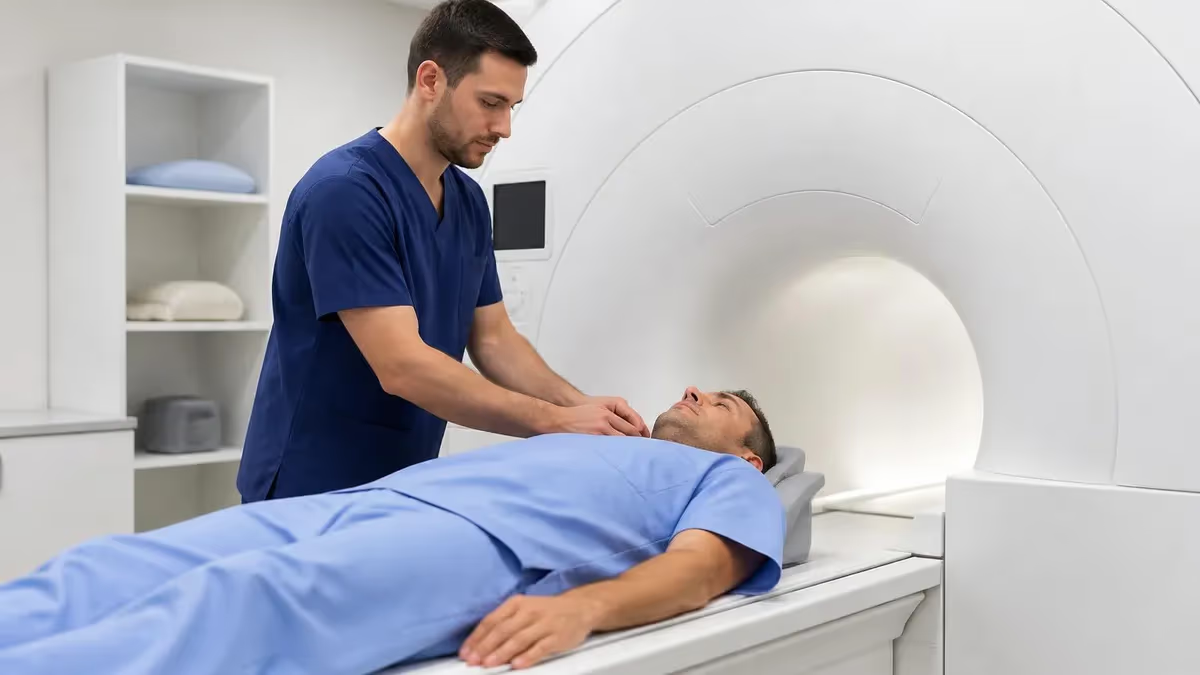
The mri history story does not start with a hospital. It starts inside two physics labs on opposite ends of the United States, with two researchers who had no idea their work would ever be aimed at a human body. Felix Bloch at Stanford and Edward Purcell at Harvard were chasing a quiet puzzle in 1946: could you measure the spin of an atomic nucleus without smashing the sample apart?
They both said yes. Independently. Within months of each other.
That discovery, nuclear magnetic resonance, earned them the 1952 Nobel Prize in Physics. It also lit a slow fuse. The fuse would burn for the next twenty-five years before anyone pointed the technique at a living patient.
This guide walks the whole arc. Who discovered the physics, who built the first scanner, who took home the prizes, and which dates show up most often on registry exams. Expect a few names, a few patents, and one rather public falling-out near the end. If you are studying for a radiology or technologist exam, the section near the bottom condenses the timeline into a memorizable list.
The underlying physics, nuclear magnetic resonance, was discovered in 1946 by Felix Bloch and Edward Purcell, who shared the 1952 Nobel Prize in Physics. The first MRI image of a living human body was acquired by Raymond Damadian on 3 July 1977 using a homemade scanner called Indomitable. The first commercial MRI scanner shipped in 1980; the FDA approved clinical use in the United States in 1984.
For most of the 1950s and 1960s, NMR stayed in chemistry departments. It became the workhorse tool for figuring out the structure of new molecules: ring this signal, that signal, count the protons, read the spectrum. Useful science. Quiet science. No hospitals, no patients, no scanners.
Then in 1971 a physician named Raymond Damadian published a short paper in Science with a long, strange title: "Tumor Detection by Nuclear Magnetic Resonance." He had taken rat tissue, dropped it inside an NMR coil, and noticed something nobody else seemed to be talking about. Cancerous tissue produced different relaxation times than healthy tissue. The signal looked different.
Damadian was thirty-five years old. He believed he had just stumbled onto a way to scan a whole human being for tumors without cutting them open. Most of his peers thought he had gone slightly mad.
MRI History by the Numbers
The next leap came two years later, in 1973, from a chemist at Stony Brook named Paul Lauterbur. He was, by his own account, eating a hamburger in a Big Boy restaurant when the idea hit. If you added a magnetic gradient across the sample, then the resonance frequency of each tiny region would be slightly different. You could decode the signal back into a spatial map. An image. Not a number on a chart. A picture.
He scribbled the math on a napkin and went home to test it. The first published image, a few months later, showed two water-filled glass tubes inside a beaker. Crude. Blurry. But unmistakably the first MRI image ever made.
It depends on what you count. Bloch and Purcell discovered the physics. Damadian showed cancer changed the signal and built the first whole-body scanner. Lauterbur introduced gradients so the signal could become an image. Mansfield turned imaging into a clinical-speed technique with echo-planar imaging. If a question asks who developed the mri machine, the safest answer for an exam is "Damadian, Lauterbur and Mansfield together, building on the 1946 NMR work of Bloch and Purcell."
While Lauterbur was getting the picture, Sir Peter Mansfield was working in Nottingham on the same problem from a completely different angle. Mansfield came at it like a mathematician. He worked out how to slice the body into thin planes using carefully shaped gradient pulses, then how to read out a whole plane in a single shot using a method he called echo-planar imaging.
Echo-planar imaging, or EPI, was wild for the early seventies. It meant you could, in principle, freeze motion. Catch a beating heart. Catch a thought.
Mansfield's first human image, of a finger, came in 1977. It looks comically primitive next to a modern scan. It was also the moment the field stopped being a thought experiment.
The Four People Who Built MRI
Stanford and Harvard, 1946. Independently discovered nuclear magnetic resonance. Shared the 1952 Nobel Prize in Physics.
- ▸1946 NMR discovery
- ▸1952 Nobel Prize
- ▸Pure physics, no clinical intent
Brooklyn physician. Showed tumors had different relaxation times in 1971. Built the first whole-body scanner, Indomitable, in 1977. Founded FONAR. Snubbed by the 2003 Nobel Committee.
- ▸1971 tumor paper
- ▸1977 Indomitable scan
- ▸FONAR patent fights
Chemist at Stony Brook. In 1973 introduced magnetic gradients so the NMR signal could be decoded into a spatial image. Shared the 2003 Nobel in Medicine.
- ▸1973 gradient idea
- ▸First MRI image (2 water tubes)
- ▸2003 Nobel laureate
Mathematician and physicist at Nottingham. Developed echo-planar imaging and slice-selection techniques between 1973 and 1977. Shared the 2003 Nobel with Lauterbur.
- ▸Echo-planar imaging
- ▸1977 finger scan
- ▸2003 Nobel laureate
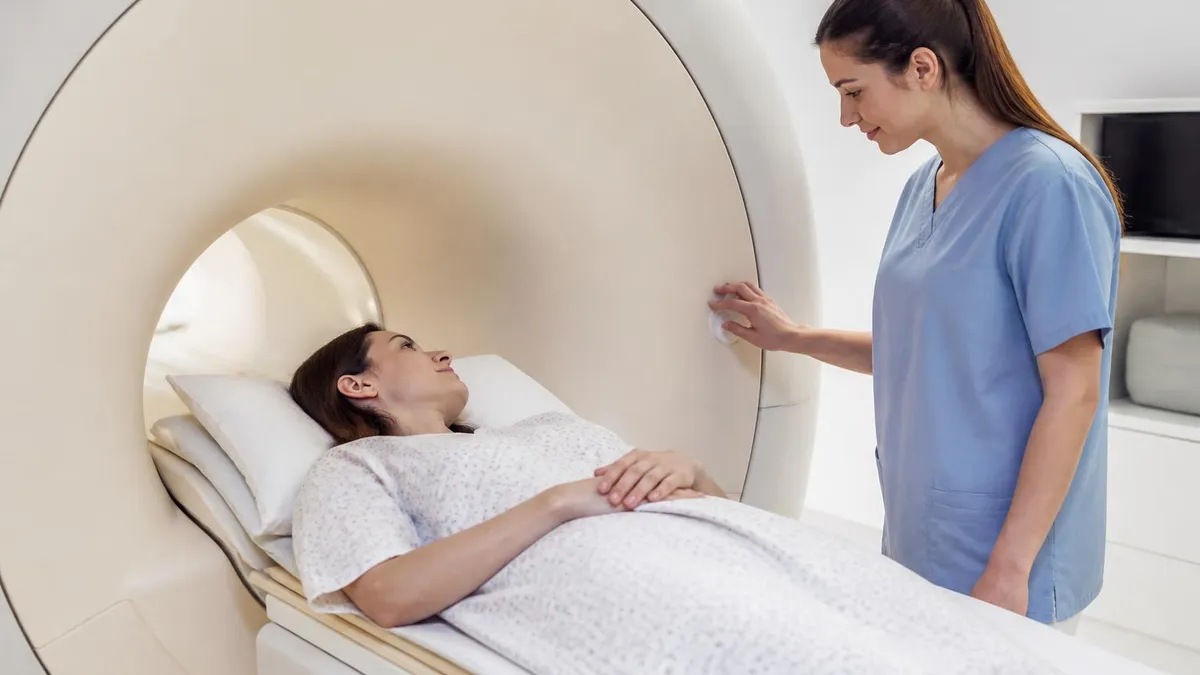
1977 was a busy year. On 3 July of that year, in a borrowed lab in Brooklyn, Damadian and two graduate students wedged themselves into a homemade machine they had nicknamed Indomitable. It was a five-foot-tall cylinder wrapped in superconducting wire, cooled with liquid helium, and it took them almost five hours to acquire a single cross-section through Damadian's chest cavity.
The picture, when it finally appeared, showed his heart, his lungs, his chest wall. The first whole-body human MRI scan in history.
Damadian filed for the foundational patent under his company FONAR. He spent the next twenty years in court defending it against General Electric and other manufacturers. He won. Repeatedly. The man was extremely good at lawsuits.
MRI History Timeline by Decade
Pure-physics era. Bloch and Purcell publish independently in 1946. NMR becomes the workhorse tool of chemistry through the 1950s and 1960s, used to figure out molecular structure rather than human anatomy. No patients, no scanners, no hospitals.
If you are wondering when did mri come out as a clinical product, the answer is the early 1980s. The first commercial scanner shipped in 1980. The first FDA approval for clinical use in the United States came in 1984. Hospitals, mostly large research centers at first, started installing 0.15 to 0.5 Tesla magnets. Scan times were still long. Image quality was poor by modern standards. But the gap between sci-fi and standard of care had finally closed.
For a sense of scale, the first scanner could barely resolve a brain hemorrhage. A modern 3T MRI picks out individual brain stem nuclei a millimeter wide.
Hospitals adopted the technology in waves. Academic centers came first, then large urban tertiary hospitals, then community hospitals through the late 1980s, then outpatient imaging centers in the early 1990s. Insurance reimbursement followed roughly the same curve. By 1990, the United States had installed somewhere north of two thousand scanners. By 2000, the count had passed six thousand.
And the conversation about who got credit for which piece of the technology was, by then, very much underway.
1992 was the next pivot. A Japanese-American physicist named Seiji Ogawa was working at Bell Labs when he noticed that the MRI signal in the brain changed slightly when neurons fired. Active brain regions used more oxygen, which changed the magnetic susceptibility of the blood, which changed the signal. He called it BOLD contrast, blood-oxygen-level-dependent imaging.
That single observation gave us functional MRI, the technique that maps brain activity in real time. Suddenly neuroscience had a non-invasive window into thinking, seeing, remembering, lying, loving. Whole subfields of psychology, linguistics, and pain research grew up around it in a decade.
Then came the Nobel of 2003. On 6 October the Karolinska Institute announced that the Nobel Prize in Physiology or Medicine would go jointly to Paul Lauterbur and Peter Mansfield for their work on MRI. Damadian was not included.
He was furious. He took out full-page ads in The New York Times, The Washington Post, and The Los Angeles Times with the headline "The Shameful Wrong That Must Be Righted." He argued, with some justification, that he had filed the first patent, scanned the first human body, and even coined the original term. The Nobel Committee never publicly explained the snub. They almost never do. Most historians of medicine now agree the dispute will outlive everyone involved.
The post-Nobel years are mostly engineering. 1.5T became the workhorse field strength of the 1990s and 2000s. 3T machines, twice as strong, rolled out in the early 2000s and are now standard for neuro and musculoskeletal work. The first 7T human scanner was installed in 1999 at the University of Minnesota; today there are more than ninety of them worldwide and at least one 11.7T system in France for research.
Open MRI machines arrived in the late 1990s for claustrophobic and bariatric patients. Wide-bore designs followed. Faster sequences, like compressed sensing and parallel imaging, took a typical knee study from forty-five minutes down to ten or twelve.
Contrast agents matured along the way. Gadolinium chelates entered clinical practice in the late 1980s and became standard for many neuro, cardiac, and oncologic studies. More recently, macrocyclic gadolinium agents have largely replaced linear ones for safety reasons. Manganese-based and iron-oxide agents are circling the market for niche applications.
Coil technology kept pace. Multi-channel phased-array coils, dozens of receivers wrapped around the patient, let modern scanners read the body in parallel rather than one channel at a time. That is part of why a brain scan that took an hour in 1985 now finishes in eight or nine minutes.
High-Yield MRI History Facts for Exams
- ✓1891: Nikola Tesla publishes early work on high-frequency oscillating fields. Often cited as a precursor in trivia questions, though not true magnetic-resonance work.
- ✓1946: Felix Bloch (Stanford) and Edward Purcell (Harvard) independently discover nuclear magnetic resonance in liquids and solids.
- ✓1952: Bloch and Purcell share the Nobel Prize in Physics for the NMR discovery, which had quietly become the workhorse tool of analytical chemistry.
- ✓1971: Raymond Damadian publishes "Tumor Detection by Nuclear Magnetic Resonance" in Science, the first paper to suggest NMR could distinguish cancerous from healthy tissue.
- ✓1972: Damadian files the foundational FONAR patent, US 3,789,832, granted in 1974.
- ✓1973: Paul Lauterbur introduces magnetic gradients in Nature and publishes the first MRI image — two water-filled glass tubes inside a beaker.
- ✓1973–77: Sir Peter Mansfield develops slice selection and echo-planar imaging (EPI) at Nottingham.
- ✓3 July 1977: Damadian and graduate students Lawrence Minkoff and Michael Goldsmith acquire the first whole-body human scan using a homemade scanner called Indomitable.
- ✓1980: The first commercial MRI scanner is delivered, beginning the slow rollout into hospital radiology departments.
- ✓1984: FDA approves MRI for clinical use in the United States.
- ✓1992: Seiji Ogawa describes BOLD contrast at Bell Labs, launching functional MRI (fMRI).
- ✓1997: Damadian wins a 128 million dollar patent infringement verdict against General Electric.
- ✓1999: First 7T human scanner installed at the University of Minnesota.
- ✓2003: Lauterbur and Mansfield share the Nobel in Physiology or Medicine. Damadian is omitted and protests in newspaper ads.
- ✓2010s: Compressed sensing, parallel imaging, and deep-learning reconstruction cut typical scan times by half or more.
- ✓FONAR: Damadian's company, founded in 1978 to commercialize his original whole-body MRI patent and still operating today.
The most recent chapter is artificial intelligence. Reconstruction algorithms now take heavily under-sampled raw data, the kind you would have thrown out twenty years ago, and rebuild it into a clean image in seconds. Vendors call it deep-learning reconstruction. Radiologists mostly call it "the thing that gave us our afternoons back."
Combined with new contrast agents and dedicated cardiac mri cpt code protocols, the technique is now used in roughly forty million scans every year in the United States alone.
From two physics lab benches in 1946 to forty million scans a year. It is, by almost any measure, one of the fastest translations from pure physics to bedside medicine in the history of medicine.
And the technology has not stopped moving. Portable, low-field bedside scanners arrived in the late 2010s. Helium-free magnets, using closed-cycle cryocoolers and far smaller helium reservoirs, are now shipping. Image-guided MR therapy combines a scanner with a focused-ultrasound device to ablate tumors without surgery. The arc is still bending.
Why was the mri invented in the first place? The honest answer is that nobody set out to invent it. Bloch and Purcell were chasing a quantum-mechanical curiosity. Damadian was trying to detect cancer. Lauterbur was trying to map molecular structure. Mansfield was trying to image solids. Each of them solved a different problem, and only in retrospect does the chain look obvious.
That is usually how big technologies arrive. Not from a single laboratory drawing a single straight line, but from a tangle of unrelated projects suddenly clicking together when one stubborn physician decides that the rats might just be the start.
What MRI Changed in Medicine
- +Non-ionizing: no X-ray dose to the patient, unlike CT or plain film.
- +Superb soft-tissue contrast for brain, spine, joints, and pelvic organs.
- +Functional imaging (fMRI) opened a non-invasive window into brain activity.
- +Cardiac MRI now resolves scar tissue, perfusion defects, and ejection fraction in one study.
- +Repeat scans are safe across pregnancy follow-up, oncology, and pediatric care.
- −Capital cost: a single 3T scanner can run two to three million dollars before siting.
- −Long acquisition times for some protocols, although AI reconstruction is closing the gap.
- −Patients with certain implants, pacemakers, or metallic foreign bodies need careful screening.
- −Claustrophobic patients may require sedation or an open-bore system.
- −Liquid-helium supply remains a real-world supply-chain pressure point.
Pros and Cons at a Glance
| Pros | Cons |
|---|---|
| Non-ionizing: no X-ray dose to the patient, unlike CT or plain film. | Long acquisition times for some protocols, although AI reconstruction is closing the gap. |
| Superb soft-tissue contrast for brain, spine, joints, and pelvic organs. | Patients with certain implants, pacemakers, or metallic foreign bodies need careful screening. |
| Functional imaging (fMRI) opened a non-invasive window into brain activity. | Claustrophobic patients may require sedation or an open-bore system. |
| Cardiac MRI now resolves scar tissue, perfusion defects, and ejection fraction in one study. | Liquid-helium supply remains a real-world supply-chain pressure point. |
For learners preparing for an exam in radiologic technology, the timeline matters less than the personalities. Examiners love asking who did what, in what year, and which prize they won. If you can keep Bloch and Purcell tied to 1946, Damadian to the 1971 tumor paper and the 1977 Indomitable scan, Lauterbur to the 1973 gradient idea, Mansfield to echo-planar imaging, and the joint Lauterbur-Mansfield Nobel to 2003, you have most of the high-yield trivia covered.
And if a question mentions FONAR, the answer is Damadian.
Beyond the personalities, registry exams love a handful of physics fundamentals you should be able to recite cold. The hydrogen nucleus, a single proton, is the workhorse signal source because of its abundance in tissue water and fat. Larmor frequency at 1.5T is roughly 64 MHz; at 3T it doubles to about 128 MHz. T1 and T2 are the two relaxation times Damadian was measuring back in 1971.
And while we are name-dropping vocabulary: gradient, echo, sequence, k-space, and Fourier transform. Five words. Memorize what each one means before you sit a registry exam and you have already cleared a quarter of the physics section.
One last loose end: how was the mri invented technically? Three pieces had to come together. A strong, stable magnetic field, supplied by a superconducting magnet cooled in liquid helium. Radio-frequency pulses, tuned to the precession frequency of hydrogen, to flip the protons out of alignment. And gradient coils, Lauterbur's contribution, to encode position into frequency so the returning signal could be mapped back into a picture. Wrap it in shielding, add a computer to do the Fourier transform, and you have a scanner.
Take any of those three pieces away, and the technique collapses back into a chemistry-lab curiosity.
The patent fights also deserve a footnote. Damadian's original FONAR patent, US 3,789,832, was filed in 1972 and granted in 1974. He spent the next two decades suing larger manufacturers for infringement, and won a 128 million dollar judgment against General Electric in 1997. GE settled. So did most of the rest of the industry, one after another. It is one of the largest medical-device patent payouts on record.
If you want to follow the thread further, the same physics that let Lauterbur image two water tubes now lets cardiologists see scar tissue, neurologists see microbleeds, and oncologists watch tumors shrink under treatment week by week. Each clinical sub-specialty has its own protocol library. Each protocol is, in a sense, a small descendant of that 1973 napkin sketch. Modern MRI equipment still runs on the same three pillars Damadian, Lauterbur, and Mansfield assembled.
It is worth remembering how unusual that lineage is. Many medical technologies arrive through gradual refinement, generation after generation of incremental tweaks. MRI is the opposite. The foundational ideas all landed in a single decade, the 1970s, and the field has spent the fifty years since polishing those ideas rather than replacing them.
The terminology lines up the same way. When a tech today says "T1 weighted" or "spin echo" or "slice select," they are using language Damadian, Lauterbur, and Mansfield were already arguing about during the Carter administration.
That is the short version of mri history. Eighty years from a quiet 1946 paper on nuclear precession to a worldwide installed base of more than sixty thousand scanners. Three Nobel Prizes touched the field, one of which is still argued about. Two patent fights, dozens of clinical sub-specialties, and one rather opinionated Brooklyn physician who never quite let the snub go. Not a bad arc for a technique that started life as nobody's idea of a hospital tool.
If you want a single sentence to take with you: MRI is what happened when 1946 nuclear physics, 1971 oncology curiosity, and 1973 mathematical imagination all collided inside one decade. And then a great many engineers spent the next fifty years making the result fast enough, quiet enough, and cheap enough to put on a hospital floor.
Sample MRI - Magnetic Resonance Imaging Practice Questions
Try these questions from our free MRI - Magnetic Resonance Imaging practice tests. The correct answer and an explanation follow each question.
The magnetic field's intensity is varied from head to foot by this gradient coil.
- A. Z
- B. X
- C. Y
Answer: A. Z
In most MRI systems, the main magnetic field (B0) is oriented along the Z-axis, which typically runs from the patient's head to foot. The Z-gradient coil is specifically designed to create a linear variation in the magnetic field strength along this Z-axis. This allows for precise slice selection and spatial encoding in the head-to-foot dimension.
The magnetic field's intensity is changed by this gradient coil from right to left.
- A. Z
- B. X
- C. Y
Answer: B. X
In a standard MRI coordinate system, the X-axis typically corresponds to the right-to-left (or left-to-right) direction across the patient. The X-gradient coil is engineered to produce a linear change in the magnetic field strength along this X-axis. This gradient is primarily used for spatial encoding, particularly for frequency encoding, in the right-to-left dimension.
Pulsatile flow artifact from a vessel typically appears as ghost images displaced in which direction?
- A. Slice-selection direction
- B. Frequency-encoding direction
- C. Phase-encoding direction
- D. Both frequency and phase directions equally
Answer: C. Phase-encoding direction
Pulsatile flow ghosts appear in the phase-encoding direction because pulsatile variations in spin phase occur between TR intervals during phase-encode data collection.
Magnets formed of ferrous material found naturally or from blocks or slabs.
- A. Selenoid
- B. Reistive
- C. Permanent
- D. Superconducting
Answer: C. Permanent
Permanent magnets are created from naturally occurring ferromagnetic materials or specially treated blocks of ferrous material. These magnets retain their magnetism without requiring an external power source. They produce a constant magnetic field and are typically utilized in low-field MRI systems, offering a simpler and less costly design.
Take the full MRI - Magnetic Resonance Imaging practice test
MRI Questions and Answers
About the Author

Medical Laboratory Scientist & Clinical Certification Expert
Johns Hopkins UniversityDr. Sandra Kim holds a PhD in Clinical Laboratory Science from Johns Hopkins University and is certified as a Medical Technologist (MT) and Medical Laboratory Scientist (MLS) through ASCP. With 16 years of clinical laboratory experience spanning hematology, microbiology, and molecular diagnostics, she prepares candidates for ASCP board exams, MLT, MLS, and specialist certification tests.
Join the Discussion
Connect with other students preparing for this exam. Share tips, ask questions, and get advice from people who have been there.
View discussion (8 replies)