
MRI Diffusion: How DWI and ADC Maps Reveal Tissue Microstructure 2026 September
🗨️ MRI diffusion explained: how DWI, ADC maps, and b-values reveal stroke, tumors, and tissue microstructure. Physics, protocols, and clinical pearls.
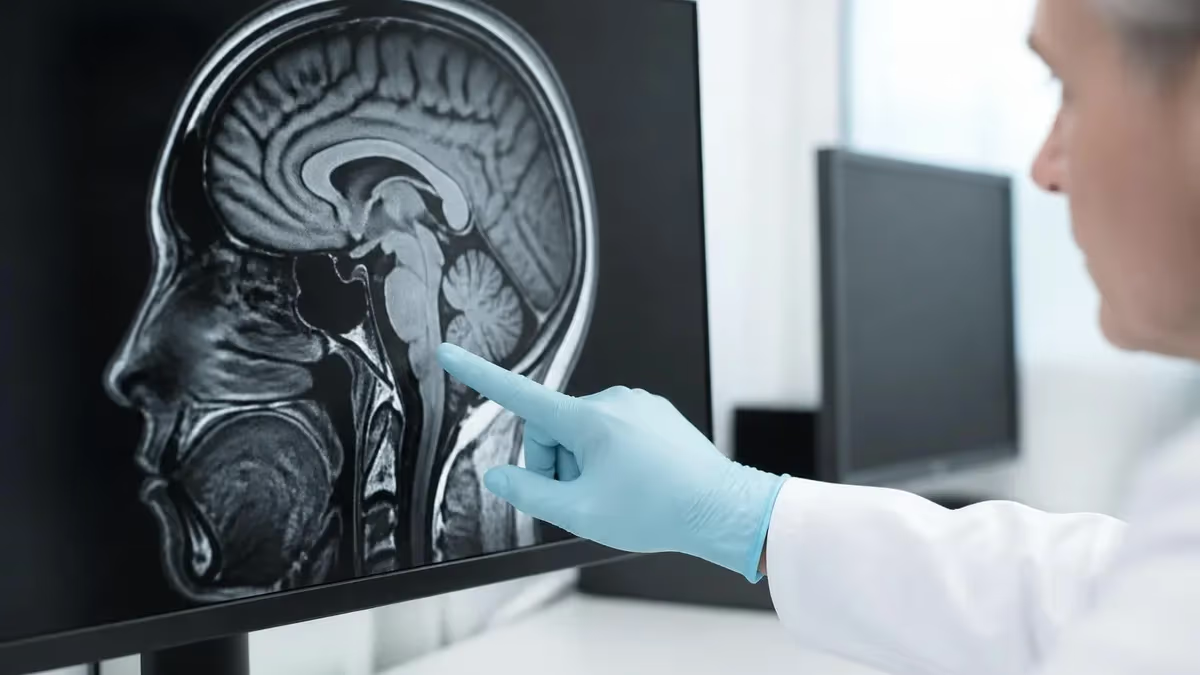
MRI diffusion imaging is one of the most powerful tools in dwi mri, transforming a routine brain or body scan into a window on cellular microstructure. By measuring the random Brownian motion of water molecules within tissue, mri diffusion sequences detect changes that conventional T1 and T2 imaging cannot see, sometimes within minutes of onset. The technique underlies acute stroke triage, tumor characterization, abscess detection, and a growing list of body and musculoskeletal applications that depend on contrast between freely diffusing and restricted water.
At its core, diffusion-weighted imaging (DWI) uses a pair of strong gradient pulses on either side of a 180-degree refocusing pulse. Stationary water molecules experience equal and opposite phase shifts and rephase fully, producing bright signal. Mobile molecules diffuse between the pulses, accumulate net phase, and lose signal. The result is a map where restricted tissues, such as densely packed tumor cells or cytotoxic edema, appear bright while freely diffusing fluids like cerebrospinal fluid appear dark.
The strength of diffusion weighting is controlled by the b-value, expressed in seconds per square millimeter. A b=0 image is essentially a T2-weighted echo-planar acquisition, while b=1000 s/mm² is the workhorse for brain stroke imaging. Higher b-values like 2000 or 3000 are increasingly used for prostate, breast, and oncologic body imaging to improve lesion conspicuity, though they come with signal-to-noise penalties and longer scan times that must be balanced against diagnostic yield.
The apparent diffusion coefficient, or ADC, is the quantitative companion to the qualitative DWI image. By acquiring two or more b-values and fitting an exponential decay curve, the scanner calculates an ADC value for every voxel and displays it as a grayscale map. Dark voxels on ADC indicate restricted diffusion, while bright voxels indicate free diffusion. Reading DWI without ADC is one of the most common rookie mistakes, because T2 shine-through can mimic restriction on the high b-value image alone.
Clinically, mri diffusion has rewritten the workflow for suspected stroke. Within the first six hours, when CT may still be normal and T2 changes are subtle, DWI shows the infarct core as a bright lesion with corresponding dark ADC. This positive-DWI, dark-ADC pattern is so reliable that thrombolysis and thrombectomy decisions are routinely made on diffusion findings alone. Beyond stroke, diffusion separates pyogenic abscess from necrotic tumor, epidermoid from arachnoid cyst, and hypercellular lymphoma from less aggressive lesions.
Beyond standard DWI, advanced techniques such as diffusion tensor imaging (DTI), diffusion kurtosis imaging (DKI), and intravoxel incoherent motion (IVIM) extract additional microstructural information. DTI maps white matter tracts using fractional anisotropy and is the foundation of presurgical fiber tractography. IVIM separates true diffusion from perfusion-related microcirculation, which is useful in liver and renal lesion characterization. Each of these methods builds on the same gradient principle but extracts a different piece of the diffusion signal.
Whether you are preparing for a registry exam, refreshing protocol knowledge, or studying the history of MRI and how diffusion fits into the broader timeline, this guide walks through the physics, acquisition choices, artifact pitfalls, and clinical interpretation patterns that every technologist and trainee should master before standing at the console or the reading workstation.
MRI Diffusion by the Numbers
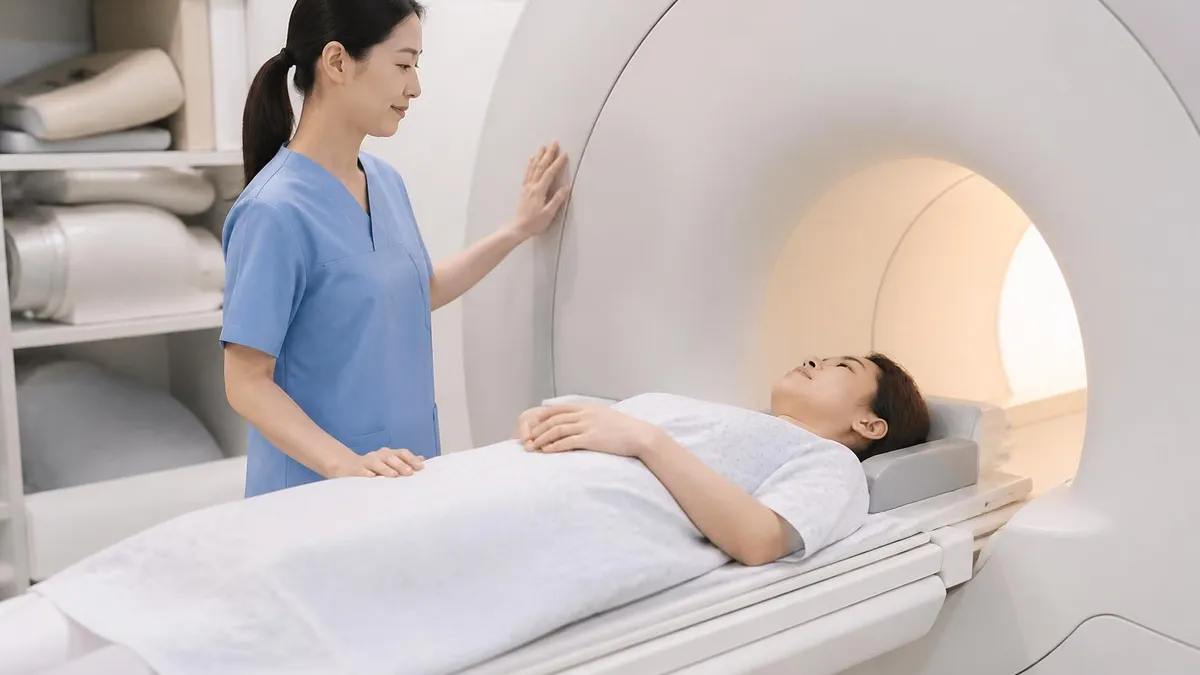
Diffusion Physics & Sequence Design
The foundational pulse sequence places two equal diffusion gradients around a 180° refocusing pulse. Stationary spins rephase perfectly; moving water loses signal proportional to displacement, producing the diffusion contrast.
Single-shot EPI readout captures the entire k-space after one excitation, freezing motion in roughly 100 ms per slice. Speed is essential because diffusion gradients amplify any bulk motion into catastrophic artifact.
b = γ²G²δ²(Δ−δ/3), where G is gradient amplitude, δ is gradient duration, and Δ is the separation. Higher gradients or longer durations increase b and diffusion weighting.
S = S₀·e^(−b·ADC). Two b-values let the scanner solve for ADC per voxel. The exponential decay means small ADC differences produce visible signal changes on high-b images.
Strong, fast-switching gradients (40–80 mT/m on modern systems) shorten echo time, boost SNR, and enable higher b-values. Hardware limits ultimately determine achievable diffusion weighting and resolution.
Reading mri diffusion correctly means always interpreting DWI and ADC side by side. The DWI image at high b-value (typically b=1000) shows restricted diffusion as bright signal, but a portion of that brightness comes from underlying T2 weighting that EPI carries with it. This residual T2 contribution is called T2 shine-through, and it is the single most common reason diffusion is misread. Cerebrospinal fluid, vasogenic edema, and chronic infarcts can all appear deceptively bright on DWI alone.
The ADC map resolves the ambiguity. True restricted diffusion produces a dark voxel on ADC; T2 shine-through produces a bright or normal ADC. The textbook acute stroke signature is therefore bright on DWI and dark on ADC, an arrangement sometimes summarized as the diffusion-ADC mismatch. If both DWI and ADC are bright, you are looking at facilitated diffusion or T2 shine-through, not restriction, and the differential shifts toward edema, encephalomalacia, or a non-cellular fluid collection.
Temporal evolution matters as much as signal direction. Hyperacute and acute infarcts (0–7 days) show classic bright DWI and dark ADC. Around day 7 to 14, ADC begins to pseudonormalize as cytotoxic edema resolves and vasogenic edema replaces it, so ADC rises back toward normal while DWI may still look bright from T2 shine-through. By weeks three and beyond, both DWI and ADC reflect tissue loss and gliosis, often appearing as facilitated diffusion with bright ADC and variable DWI signal.
Beyond stroke, the same DWI-ADC logic applies to oncology. Hypercellular tumors such as lymphoma, medulloblastoma, and high-grade glioma show restricted diffusion because tightly packed cells reduce the extracellular space available to water. Necrotic centers, by contrast, contain free fluid and show facilitated diffusion. The combination helps grade tumors, guide biopsy to the most cellular component, and distinguish recurrence from radiation necrosis on follow-up studies.
Infection imaging benefits enormously from diffusion. Pyogenic brain abscesses contain viscous pus dense with inflammatory cells, proteins, and bacteria, producing markedly restricted diffusion in the central cavity. Necrotic tumors that mimic abscesses on T1 post-contrast almost always show facilitated central diffusion. This single finding can redirect management from neurosurgical resection to drainage and antibiotics, illustrating why diffusion is now routine on every brain MRI protocol.
Cholesteatoma, epidermoid, and arachnoid cyst represent another classic diffusion triad. Cholesteatoma in the middle ear and epidermoid in the cerebellopontine angle both show bright DWI and dark ADC because their keratin contents trap water in tortuous extracellular paths. Arachnoid cysts contain free CSF and follow it on every sequence, including diffusion. Without DWI, epidermoid and arachnoid cyst look identical on routine sequences, making mri diffusion the deciding factor.
Diffusion is also indispensable when contrast is contraindicated. Patients with severe renal impairment, gadolinium allergy, or pregnancy still get high-yield imaging because diffusion requires no injection. For a deeper comparison of injected versus non-contrast workflows, see MRI with and without contrast, which covers when diffusion alone is sufficient and when complementary post-contrast imaging is still required.
MRI Practice Test Questions
Prepare for the MRI - Magnetic Resonance Imaging exam with our free practice test modules. Each quiz covers key topics to help you pass on your first try.
MRI Knowledge
MRI Exam Questions covering Knowledge. Master MRI Test concepts for certification prep.
MRI Physics
Free MRI Practice Test featuring Physics. Improve your MRI Exam score with mock test prep.
MRI Anatomy and Pathology
MRI Test Prep for MRI Anatomy and Pathology. Practice MRI Quiz questions and boost your score.
MRI Anatomy and Positioning
MRI Questions and Answers on MRI Anatomy and Positioning. Free MRI practice for exam readiness.
MRI Contrast Agents
Free MRI Quiz on MRI Contrast Agents. MRI Exam prep questions with detailed explanations.
MRI Patient Care and Positioning
MRI Practice Questions for MRI Patient Care and Positioning. Build confidence for your MRI certification exam.
b-Values, Protocols, and Parameters
The standard brain DWI protocol uses single-shot EPI with b-values of 0 and 1000 s/mm², acquired in three orthogonal directions and combined into an isotropic trace image. TR is typically 4000–8000 ms, TE is minimized at 70–90 ms, and slice thickness ranges from 4 to 5 mm. Total acquisition runs about 30 to 60 seconds for whole-brain coverage on a 1.5T system.
Higher field strengths and stronger gradients allow shorter TE, better SNR, and optional high b-values around 2000–3000 for improved gray-white contrast and small infarct detection. Many centers now add a high-b DWI series to standard stroke protocols, particularly when scanning patients in extended thrombectomy windows where small cortical and brainstem infarcts change treatment decisions.
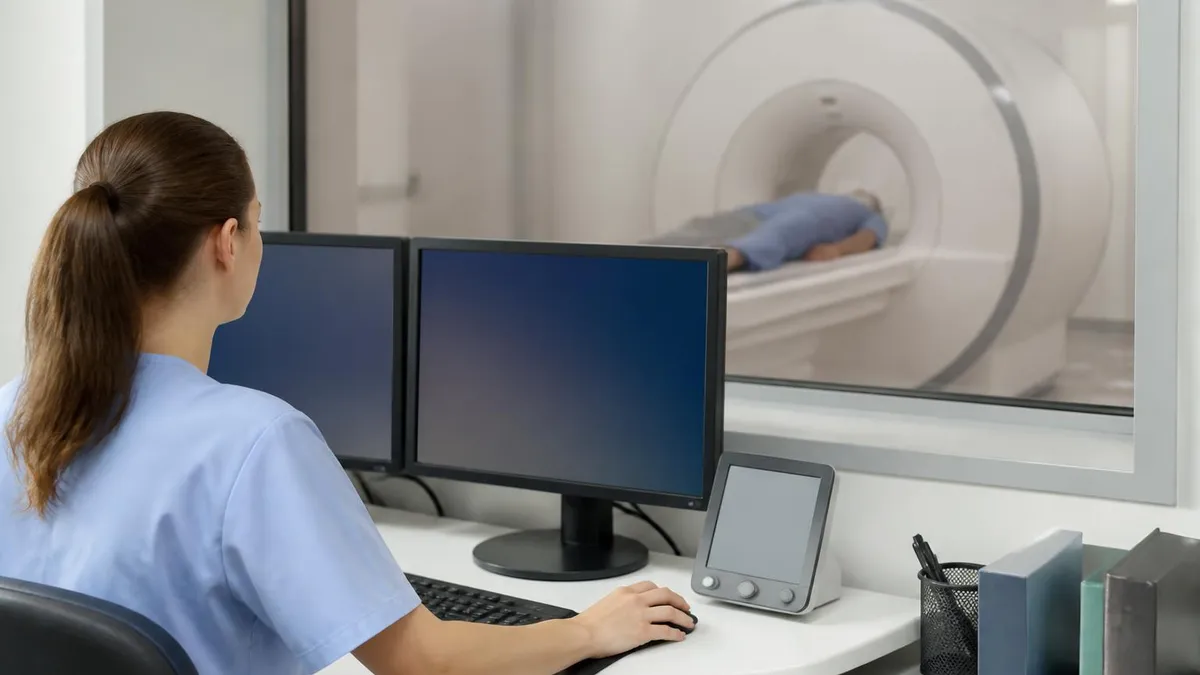
Strengths and Limitations of MRI Diffusion
- +Detects acute stroke within minutes of symptom onset, well before CT or conventional MRI changes
- +Requires no intravenous contrast, making it safe for renal failure and gadolinium allergy
- +Provides quantitative ADC values that support objective lesion characterization and follow-up
- +Distinguishes abscess from necrotic tumor with one short sequence
- +Differentiates epidermoid from arachnoid cyst when other sequences are equivocal
- +Adds only 30 to 60 seconds to most brain protocols and is universally available
- −Echo-planar readout is highly susceptible to susceptibility artifact near sinuses, skull base, and metal
- −Limited spatial resolution compared with structural T1 and T2 sequences
- −T2 shine-through can mimic restriction if ADC is not reviewed alongside DWI
- −Eddy currents and gradient nonlinearity can distort high b-value images
- −Patient motion produces severe signal dropout because diffusion gradients amplify any bulk motion
- −Quantitative ADC varies between vendors, field strengths, and protocols, complicating cross-site comparison
Pre-Scan MRI Diffusion Quality Checklist
- ✓Verify patient screening, especially for implants that may distort EPI near metal
- ✓Position the head in the coil with attention to symmetric placement to minimize geometric distortion
- ✓Use auto-shimming and confirm a homogeneous field before launching the diffusion series
- ✓Select b-values appropriate for the body part: 1000 for brain, 1400–2000 for prostate, 800 for liver
- ✓Acquire diffusion in at least three orthogonal directions and reconstruct an isotropic trace image
- ✓Always generate the ADC map automatically and confirm it appears in PACS alongside DWI
- ✓Apply fat saturation in body imaging to prevent chemical-shift artifact in the EPI readout
- ✓Use parallel imaging (SENSE, GRAPPA, ASSET) to shorten echo train and reduce distortion
- ✓Coach the patient to remain motionless; even slight motion devastates diffusion images
- ✓Inspect images at the console for signal dropout, ghosting, or shim failure before releasing the patient
Never read DWI without the ADC map
The single most common diffusion error is interpreting a bright DWI lesion as restricted diffusion without checking the ADC. True restriction is bright on DWI and dark on ADC. If ADC is bright or normal, the DWI signal reflects T2 shine-through, not restricted diffusion. Build the habit of toggling between the two series on every read.
Diffusion sequences are wonderfully informative but uniquely fragile. The strong gradients that generate diffusion contrast also amplify bulk motion, susceptibility differences, and eddy currents into visible artifacts. Recognizing these patterns is essential for both technologists at the console and radiologists at the reading workstation, because an artifact mistaken for restriction can trigger unnecessary workup, while true pathology hidden by distortion can be missed entirely.
Susceptibility artifact is the dominant nemesis of EPI-based DWI. Air-tissue interfaces near the frontal sinuses, mastoids, skull base, and orbits produce local field inhomogeneity that distorts the EPI readout into characteristic geometric warping and signal pile-up. Dental hardware, surgical clips, and spinal instrumentation worsen the effect dramatically. Strategies to mitigate include reduced field-of-view DWI, readout-segmented EPI (RESOLVE), and increased parallel imaging factors that shorten the echo train.
Eddy currents arise when the rapidly switched diffusion gradients induce currents in nearby conductive structures, including the scanner cryostat itself. The result is a residual magnetic field that shifts and shears images differently for each diffusion direction, producing misregistration on the trace image and a blurry ADC map. Modern systems use bipolar diffusion gradients, twice-refocused spin echoes, or on-line eddy-current correction to suppress this artifact.
Motion is the third major culprit. Because diffusion gradients encode displacement, even sub-millimeter motion during the gradient pair causes phase errors that destroy signal. Whole-brain shots can show one or more dark slices when the patient swallows, sighs, or twitches. Cardiac pulsation produces ghosting in posterior fossa and brainstem images. Coaching, padding, and choosing a respiratory-triggered or navigator-gated sequence for body imaging are the standard countermeasures.
Chemical-shift and fat-related artifacts are particularly important in body diffusion. EPI has very low bandwidth in the phase-encoding direction, so the 3.5 ppm fat-water shift smears fat across many pixels unless suppressed. SPAIR, STIR, or robust fat-saturation pulses are essential in spine, breast, and abdominal DWI. Failed fat suppression usually means non-diagnostic images, not just cosmetic flaws, because the bright fat can mimic or obscure restricted diffusion in adjacent organs.
Cross-vendor and cross-field-strength variability presents a quieter but equally important problem. ADC values measured on a 1.5T GE system are not numerically identical to those measured on a 3T Siemens or Philips system, because gradient performance, eddy-current correction, and pulse sequence implementation differ. Programs running quantitative ADC for treatment response should validate site-specific normal ranges and avoid drawing conclusions from raw cross-platform comparisons.
Finally, troubleshooting starts at the console, not the reading room. Technologists should scan through the DWI series before releasing the patient, looking for slice dropout, geometric warping, missing ADC reconstructions, or wrong b-value selection. A 60-second repeat at the time of the original visit is infinitely preferable to recalling the patient for a non-diagnostic study or, worse, missing an acute infarct because the diffusion run failed silently.
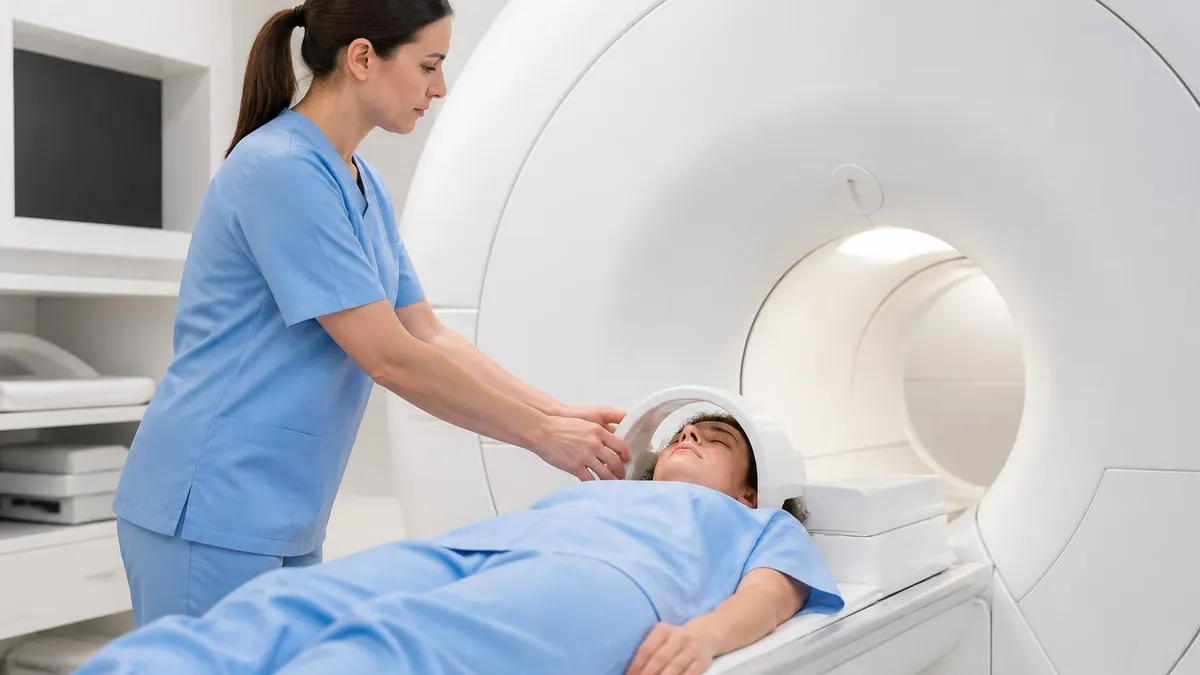
Susceptibility distortion near dental work, surgical clips, or spinal hardware can produce bright signal on DWI that mimics restricted diffusion. Always cross-reference with the ADC map and the structural T2 series. If a lesion sits exactly where metal artifact predicts geometric warping, treat the finding as artifact until proven otherwise on a non-EPI sequence such as PROPELLER or RESOLVE DWI.
Advanced diffusion techniques push beyond the simple two-b-value model and extract richer microstructural information. Diffusion tensor imaging samples six or more directions to model the three-dimensional ellipsoid of water motion in each voxel. The major eigenvector points along the dominant fiber direction, fractional anisotropy quantifies how directional the motion is, and tractography algorithms link voxels with similar orientations into continuous fiber bundles for presurgical planning and white-matter research.
Diffusion kurtosis imaging acknowledges that real tissue diffusion is not perfectly Gaussian. By acquiring three or more b-values, kurtosis quantifies how strongly the signal decay deviates from a simple exponential. Higher kurtosis values reflect more complex microstructure, with applications in tumor grading, stroke microstructural injury, and Alzheimer-related neurodegeneration. The trade-off is longer scan times and additional susceptibility to noise at high b-values.
Intravoxel incoherent motion modeling separates the diffusion signal into two components: true molecular diffusion and pseudo-diffusion arising from microcirculatory blood flow in capillaries. Using a series of low and high b-values, the IVIM model produces estimates of perfusion fraction, pseudo-diffusion coefficient, and true diffusion. Liver fibrosis grading, renal lesion characterization, and head-and-neck oncology have all explored IVIM as a contrast-free alternative to dynamic contrast mri-enhanced MRI.
Whole-body diffusion-weighted imaging with background body signal suppression (DWIBS) takes the technique to the entire torso. Multiple stations are acquired with free breathing, fat saturation, and inverted display so that hypercellular lesions appear as dark spots against a suppressed background. Lymphoma staging, myeloma screening, prostate cancer mri surveillance, and pediatric oncology have all adopted DWIBS as a radiation-free alternative or complement to PET-CT.
For breast and mri of prostate ultra-high b-values (1500–2500 s/mm²) have become routine because they maximize contrast between tumor and background fibroglandular or transition-zone tissue. Calculated high-b images, where the scanner extrapolates a synthetic high b-value from acquired lower b-values, deliver similar conspicuity with better SNR than direct acquisition. Both approaches now feed into PI-RADS and BI-RADS scoring in cancer detection pipelines.
Functional and connectivity research lean heavily on advanced diffusion. Tractography reveals corticospinal, optic, and arcuate fiber pathways, supporting neurosurgical planning around tumors and epilepsy foci. Connectomics combines diffusion-derived structural networks with functional MRI to map brain organization. Although many of these applications remain research-grade, they are increasingly part of clinical pre-surgical packages at academic centers, particularly for awake craniotomies near language and motor cortex.
Finally, diffusion is now central to almost every modern MRI protocol, not just neuroimaging. For a broader look at the abbreviation conventions and how diffusion appears in reports and order sets, see MRI medical abbreviation, which clarifies how DWI, ADC, DTI, and DWIBS show up in clinical documentation and how to communicate them clearly across the care team.
Practical preparation for diffusion imaging starts the moment a patient is scheduled. Technologists should review the indication, target body part, and history of prior surgery or implants that may distort the EPI readout. A stroke alert patient gets the abbreviated 5-minute protocol with DWI first; an oncology follow-up may need DWIBS with high b-values; a presurgical case may require a full DTI acquisition. Matching the protocol to the question prevents wasted scan time and inconclusive reads.
Patient communication is a quiet but decisive factor. Diffusion sequences are short but unforgiving of motion, so coaching patients to remain still, breathe steadily, and avoid swallowing during the run pays dividends. For body diffusion, practice breath-holds or respiratory-triggered acquisitions at the start of the exam so the patient understands the cadence. A two-minute conversation before scan-time often saves a five-minute repeat later.
Console-side quality control is non-negotiable. Before releasing a patient, scroll through the DWI series for signal dropout, geometric distortion, or missing slices. Confirm the ADC map reconstructed automatically. Spot-check the b-value metadata so that a hospital workflow does not accidentally save a b=500 series when the protocol called for b=1000. These checks take 30 to 60 seconds and prevent the dreaded scenario of discovering a non-diagnostic diffusion run after the patient has gone home.
For trainees aiming at the registry, build a mental algorithm for every bright DWI lesion: check the ADC, check the b=0 image, consider T2 shine-through, then localize. If the ADC is dark, restricted diffusion is real; if bright, it is T2 effect; if equivocal, look at the conventional sequences and clinical history. Most registry questions revolve around this exact workflow, often built around classic cases like acute stroke, abscess, epidermoid, and lymphoma.
When reporting, use precise language. Phrases like restricted diffusion, facilitated diffusion, T2 shine-through, and pseudonormalization carry specific meanings, and referring clinicians depend on them to time interventions. A clear note that an infarct is in the acute phase based on bright DWI and dark ADC, or that pseudonormalization is consistent with subacute timing, guides downstream management for thrombolysis windows, secondary prevention, and rehabilitation planning.
For outpatient and freestanding facilities, protocol governance matters as much as scan execution. Periodically benchmark ADC values against phantom standards and published normal ranges. If you work across multiple sites or vendors, document the inevitable cross-platform differences so that quantitative follow-up does not falsely flag interval change. Many modern MRI imaging centers now publish their diffusion protocols as part of accreditation and quality dashboards.
Finally, keep learning. Diffusion is one of the most rapidly evolving areas in MRI, from synthetic MRI to deep-learning reconstruction that reduces scan times by 30 to 50 percent without sacrificing image quality. Subscribe to a society newsletter, attend one diffusion-focused webinar each quarter, and run sample protocols on volunteers when new sequence packages roll out. The technologists and radiologists who stay current with diffusion are the ones who shape the next decade of stroke, oncology, and neuroscience imaging.
MRI Questions and Answers
The History of MRI: From Discovery to Modern Medicine
MRI With and Without Contrast: How It Works, What to Expect
MRI Medical Abbreviation: What MRI Stands For and Why It Matters
MRI Imaging Centers: Complete Guide to Independent Outpatient MRI Facilities
St Jude Pacemaker MRI Compatibility List: A Complete Safety and Scanning Guide
About the Author

Medical Laboratory Scientist & Clinical Certification Expert
Johns Hopkins UniversityDr. Sandra Kim holds a PhD in Clinical Laboratory Science from Johns Hopkins University and is certified as a Medical Technologist (MT) and Medical Laboratory Scientist (MLS) through ASCP. With 16 years of clinical laboratory experience spanning hematology, microbiology, and molecular diagnostics, she prepares candidates for ASCP board exams, MLT, MLS, and specialist certification tests.
Join the Discussion
Connect with other students preparing for this exam. Share tips, ask questions, and get advice from people who have been there.
View discussion (8 replies)