
MRI Cost by Location: Open MRI Machine Prices, Pelvic MRI CPT Codes, and Finding Open Bore MRI Locations
🎯 MRI cost Brisbane and US city prices compared: open MRI machine rates, pelvic MRI CPT codes, and tips to find open bore MRI locations near you.
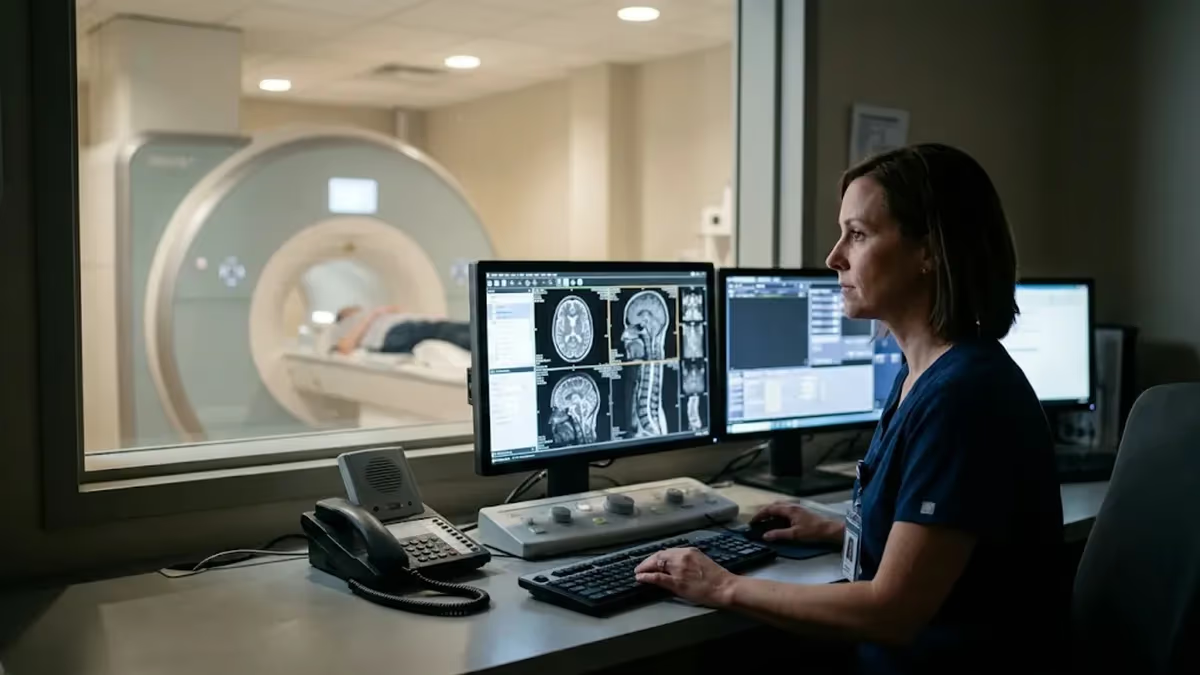
Searching for MRI cost Brisbane can be confusing for American readers, because the name points to two very different places: Brisbane, Australia, and the small city of Brisbane, California, just south of San Francisco. Either way, the real question is the same. Why does one MRI scan cost a few hundred dollars in one place and several thousand in another? This guide explains how geography, facility type, and scanner design shape the price, and what you can do about it. Practice with the free MRI - Magnetic Resonance Imaging practice test on PracticeTestGeeks (11 questions with answer explanations).
In the United States, the same brain, knee, or pelvic MRI can carry wildly different price tags depending on whether you book at a hospital outpatient department or a freestanding imaging center. Published cash prices frequently run from about $400 to more than $3,500 for a single study. Insurance contracts add another layer, since your allowed amount, deductible, and coinsurance determine what you actually owe. Understanding these moving parts helps you compare quotes before you schedule.
Location matters because imaging prices are negotiated locally. Urban markets with several competing centers tend to price lower than rural areas where a single hospital owns the only scanner. Real estate costs, local wages for technologists and radiologists, and regional insurer leverage all feed into the final number. If you want a broader view of how scan types compare on price and purpose, see our overview of mri cost by location and imaging choices alongside CT.
Scanner design is the second big variable. An open MRI machine uses a more spacious layout, with a wide gap or open sides instead of a long, narrow tunnel. Patients who feel claustrophobic, who are larger-bodied, or who need a family member nearby often prefer it. Because older open systems run at lower field strength, some centers price them lower, while newer wide-bore 1.5T and 3T scanners can cost about the same as a conventional exam.
Billing codes also drive price. Every MRI is reported with a CPT code that identifies the body region and whether contrast is used. For example, a pelvic MRI CPT code of 72195, 72196, or 72197 covers pelvic imaging without contrast, with contrast, or both. Insurers and imaging centers set fees by code, so asking for the exact code before your appointment is the single most reliable way to get an apples-to-apples price quote.
Throughout this article you will find real price ranges, a step-by-step method for comparing quotes, and practical advice on finding open bore MRI locations near you. We also cover how to search for the closest open MRI to your location, what to ask about radiologist reading fees, and how to avoid surprise bills. Treat the numbers here as typical ranges, because your actual price depends on your plan, your city, and the facility you choose.
A note on the Australian side of the search: in Brisbane, Queensland, a private MRI often costs somewhere in the hundreds of Australian dollars out of pocket, depending on the scan, the referral, and Medicare rebate eligibility. US patients rarely see that kind of predictability. We use the contrast later to show why shopping around, asking for cash-pay rates, and comparing facility types matter so much to American patients paying for imaging.
Free MRI - Magnetic Resonance Imaging Study Tools
Interactive MRI - Magnetic Resonance Imaging resources on PracticeTestGeeks, free to start:
- Free MRI Knowledge Questions and Answers — 11 questions with instant scoring and answer explanations
- MRI - Magnetic Resonance Imaging flashcards — review key terms and concepts card by card
- MRI - Magnetic Resonance Imaging study guide — topic-by-topic overview of what the exam covers
- MRI - Magnetic Resonance Imaging cheat sheet — one-page printable summary for last-minute review
MRI Costs by the Numbers
What Drives MRI Cost by Location
Hospital outpatient departments add facility fees that freestanding imaging centers do not. The same knee MRI may cost $2,500 at a hospital and $450 at an independent center nearby. Choosing the site type often saves more than choosing the city.
Cities with many competing imaging chains tend to offer lower self-pay prices and discounts. Rural areas with one scanner often keep prices high because patients have few alternatives within a reasonable driving distance.
An open MRI machine, a 70 cm wide-bore system, and a standard closed tunnel each carry different operating costs and field strengths. Open systems can be cheaper per scan, but image quality and scan time vary.
Price follows the billing code. A pelvic MRI without contrast, with contrast, or both uses codes 72195, 72196, or 72197, and each step up adds cost for contrast, extra sequences, and a longer radiologist read.
Your deductible, coinsurance, and network determine what you pay. A low cash price can beat a high negotiated rate if your deductible is unmet, so always request both numbers before scheduling.
Open Bore MRI Locations and Price Differences Across US Cities
Where you live changes the price, but where you book changes it more. A hospital outpatient department typically bills a facility fee on top of the professional fee, which is why an identical knee MRI might cost $2,500 at the hospital and $450 at a freestanding center two miles away. Before comparing cities, compare facility types. In many markets, switching sites saves more money than moving across the country ever could.
Regional patterns still exist. High-cost coastal metros such as New York, Boston, San Francisco, and Los Angeles often show higher billed charges, yet they also have dense competition from independent imaging chains that offer discounted self-pay rates. Smaller markets in the Midwest and South may have lower wages but fewer scanners, so a hospital monopoly can keep prices elevated. The cheapest option is rarely determined by state alone; it depends on local competition.
Consider a practical example. A patient in a mid-sized Texas city might be quoted $1,900 for a lumbar spine MRI without contrast at a hospital, $650 at a freestanding center, and $425 through a cash-pay marketplace. Same body region, same CPT code, and often the same radiologist group reading the images. The difference comes from contracts, overhead, and how the bill is structured. That spread is why price shopping is worthwhile for scheduled, non-emergency scans.
Open scanners add another geographic wrinkle. Open bore MRI locations are less common than conventional tunnel systems, especially outside large metro areas. In some regions, only one or two centers within a hundred miles offer a true open or wide-bore system. Limited supply can raise prices or lengthen wait times. In other cities, several chains advertise open MRI as a differentiator and discount it to attract patients who would otherwise avoid scanning altogether.
Searching for the closest open MRI to your location works best with a layered approach. Start with your insurer's provider directory and filter for imaging centers. Then call each site and ask whether the scanner is a true open system, a wide-bore 70 cm closed system, or a standard 60 cm tunnel. Marketing language varies, and some centers call wide-bore machines open. Confirm the field strength and the maximum patient weight before booking.
Insurance geography matters too. Your plan may only cover in-network facilities, and a center that looks cheap in cash may be pricier through insurance if you have not met your deductible. Conversely, if your deductible is high, the cash price may beat your negotiated rate. Ask the imaging center for both numbers. Some will let you pay cash and still submit the receipt toward your deductible, though plans differ on whether that counts.
Travel can be cost-effective for pricey scans. Driving an hour to a freestanding center in a neighboring county can save over a thousand dollars on an abdominal or pelvic MRI. Weigh gas, time off work, and the need for sedation or a companion. For urgent problems or anything involving anesthesia, convenience and safety should come first, but for scheduled imaging a short trip often pays for itself many times over.
Open MRI Machine vs Wide-Bore vs Closed MRI: Cost and Comfort
An open MRI machine replaces the long cylinder with two flat magnets above and below the patient, leaving the sides open. Field strengths commonly range from about 0.2 to 1.2 tesla. Patients who are claustrophobic, children, and people with larger bodies often tolerate the exam far better. Many centers price open exams between roughly $400 and $1,200 in cash, though prices vary by region, body part, and contrast use.
The tradeoff is image quality and speed. Lower-field open systems usually need longer scan times, so motion blur becomes a risk for anyone who cannot stay still. They can be less ideal for small structures, such as fine brain detail, small joints, or detailed pelvic and gynecologic studies. Ask your ordering provider whether an open system is adequate for your clinical question before choosing it purely for comfort.
Is an Open MRI Machine Worth the Price?
- +Much less claustrophobia than a narrow tunnel
- +Better fit for larger-bodied patients and children
- +A family member or caregiver can often stay nearby
- +Often priced lower at freestanding centers
- +Fewer patients need sedation, which lowers risk and cost
- +Good option for many spine, knee, and shoulder studies
- −Lower field strength can reduce image detail
- −Longer scan times increase motion artifact risk
- −Fewer open bore MRI locations, so travel may be needed
- −Not ideal for fine brain, cardiac, or small pelvic detail
- −Marketing terms vary, so some open machines are really wide-bore
- −Insurers may not cover a repeat scan if quality is poor
Pros and Cons at a Glance
| Pros | Cons |
|---|---|
| Much less claustrophobia than a narrow tunnel | Lower field strength can reduce image detail |
| Better fit for larger-bodied patients and children | Longer scan times increase motion artifact risk |
| A family member or caregiver can often stay nearby | Fewer open bore MRI locations, so travel may be needed |
| Often priced lower at freestanding centers | Not ideal for fine brain, cardiac, or small pelvic detail |
| Fewer patients need sedation, which lowers risk and cost | Marketing terms vary, so some open machines are really wide-bore |
| Good option for many spine, knee, and shoulder studies | Insurers may not cover a repeat scan if quality is poor |
Checklist: Find the Closest Open MRI to Your Location
- ✓Get the exact CPT code and body region from your ordering provider.
- ✓Search your insurer's directory for in-network imaging centers.
- ✓Search open bore MRI locations by city and ZIP code.
- ✓Call each site and ask if the scanner is open, wide-bore, or closed.
- ✓Confirm the field strength, such as 0.3T, 1.5T, or 3T.
- ✓Ask about the maximum patient weight and opening size.
- ✓Request both the cash price and the insurance estimate.
- ✓Ask whether the radiologist's reading fee is included.
- ✓Confirm any prior authorization is approved for the same code.
- ✓Request your images and report on a portal or disc.
Ask for the CPT code first
A price quote is only meaningful when it names the CPT code, the facility, and whether the radiologist's read is included. Quotes for 72195, 72196, and 72197 can differ by hundreds of dollars at the same center, so match codes before comparing locations.
Pelvic MRI CPT Code and MRI Pelvis W/WO GYN CPT Explained
Pelvic MRI billing follows a small family of codes. CPT 72195 is MRI of the pelvis without contrast, 72196 is with contrast, and 72197 is without contrast followed by contrast, which radiologists describe as without and with. When a gynecologist orders an MRI pelvis w wo gyn CPT study to evaluate fibroids, endometriosis, or an ovarian mass, 72197 is the code most often used. The code you receive largely determines your price.
Why does the contrast choice matter financially? A scan without contrast is the cheapest, a scan with contrast adds the cost of the gadolinium agent and its administration, and a combined without-and-with exam adds both sets of sequences, extra table time, and a longer radiologist read. In practice, cash prices for 72197 are commonly several hundred dollars above 72195 at the same center. Hospital pricing can widen that gap further, so confirm the exact code on your order.
Here is a worked example. Suppose a freestanding center in Ohio lists 72195 at $525, 72196 at $750, and 72197 at $925. A hospital in the same city might bill $1,800, $2,400, and $3,100. If your gynecologist orders 72197 and you have a $3,000 deductible, you could owe the full allowed amount before coverage begins. Choosing the freestanding site saves about $2,000 without changing the clinical information in the images.
Related codes can appear on the same bill. Some centers separately bill the radiologist's professional component with modifier 26 and the facility technical component with modifier TC. Pelvic MRI is also distinct from abdominal codes such as 74181 to 74183. If your order says pelvis but the doctor really wants abdomen and pelvis, you will be billed under more than one code, so clarify the scope of the study with the ordering office in advance.
Prior authorization is common for pelvic MRI. Insurers often require documentation of symptoms, earlier ultrasound results, or failed conservative treatment before approving the scan. Your ordering office submits the request using the CPT code and a diagnosis code. If the imaging center performs a different code than the one approved, for example by adding contrast, the claim can be denied. Always confirm that the approved code and the scheduled code match before the day of your exam.
Medicare and Medicaid pay set fee schedule amounts that are generally well below commercial rates. For many beneficiaries, the Medicare-allowed amount for a pelvic MRI is in the range of a few hundred dollars, and the patient share is 20 percent after the Part B deductible. Commercial plans negotiate their own rates, which is why the same code can have dozens of different allowed amounts in one city. The Medicare Physician Fee Schedule lookup tool offers a useful benchmark.
Uninsured patients have leverage here. Under federal price transparency rules, hospitals must publish standard charges, including cash prices, for shoppable services such as MRI. Many freestanding centers also post flat self-pay fees for each CPT code. Print the published price, call to confirm it, and ask whether a prompt-pay discount applies. A few minutes of comparison can easily reduce a pelvic MRI bill by half or more, even before any negotiation.
If the scan performed does not match the CPT code your insurer approved, the claim can be denied and you may be billed in full. Confirm the code, the facility, and the radiologist's network status before your appointment, and get the quote in writing.
How the MRI Cost Brisbane Patients Pay Compares With US Prices
It is instructive to compare US prices with Brisbane, Australia. Australia's Medicare Benefits Schedule covers many MRI scans when a doctor refers the patient, and eligibility depends on the scan type, the referring practitioner, and the patient's circumstances. As a result, some patients pay little or nothing at certain clinics and a modest gap fee at others. The MRI cost Brisbane patients face is therefore far more predictable than what Americans see on a typical hospital bill.
For scans that are not eligible for rebates, a Brisbane private clinic may charge from a few hundred to roughly one thousand Australian dollars, depending on body region and contrast. Converted to US dollars, that is often lower than a typical American hospital price and comparable to US freestanding centers. These figures are indicative only, and exchange rates move. They are useful mainly as a reminder that quality imaging can be delivered at lower prices than many US hospitals charge.
Why the difference? Australia uses a government fee schedule and regulated rebates, which limits how far prices can drift. The US relies on negotiated rates between insurers and providers, where list prices, called chargemasters, can be several times the amount insurers actually pay. Americans who pay cash are often quoted the inflated rack rate unless they ask for a discount. The lesson is that bargaining and transparency matter far more in the US system than abroad.
Medical tourism is a tempting idea, but it rarely makes sense for a single MRI. Airfare, lodging, and the need for follow-up with your own doctors usually outweigh any savings, and imaging performed abroad must be transferred and reread. A better use of the comparison is as a benchmark. If a US facility quotes ten times the Brisbane price for an identical scan, you have solid grounds to ask for a lower self-pay rate or look elsewhere.
Within the US, the Brisbane, California angle is a reminder that Bay Area pricing is its own market. Peninsula residents can compare hospital systems with independent centers in San Mateo, South San Francisco, and Daly City. Prices there can swing from a few hundred dollars to several thousand dollars for the same code. Apply the same method anywhere: identify the CPT code, call multiple sites, ask for cash and insurance prices, and check whether the radiologist's read is included.
Some employers and health plans now offer reference-based pricing or navigation services that steer members to lower-cost imaging centers, sometimes with a zero-dollar copay for using them. Check your benefits portal or call member services and ask whether such a program exists. Third-party marketplaces also list prepaid MRI prices that include the radiologist read. These platforms are particularly helpful for high-deductible plans, because the prepaid price is often lower than the insurer's allowed amount.
Finally, factor in downstream costs. An inexpensive scan that is repeated because of poor image quality is not a bargain. A center that delivers images by portal or disc and uses board-certified radiologists, ideally with subspecialty training in the body region, offers better value than a bare-bones deal. When comparing prices across locations, weigh scanner type, technologist experience, report turnaround time, and how easily your treating physician can obtain the images afterward.
Practical Tips to Lower Your MRI Bill Before You Book
Start with your ordering provider. Ask whether the scan is truly necessary now, whether an ultrasound or X-ray could answer the question first, and whether the study can be done without contrast. Never skip recommended imaging purely for cost, but a short conversation can eliminate redundant studies. If your doctor's office has a preferred imaging center, ask why, and whether they will send the order elsewhere if you find a cheaper in-network site.
Gather three quotes. Call at least one hospital, one freestanding center, and one cash-pay marketplace, and give each the same CPT code, such as 72195 or 72197, along with your insurance details. Write down the quoted price, whether the radiologist read is included, and the date of the call. Having numbers on paper gives you leverage when you ask for a courtesy discount, and it protects you if the final bill differs.
Use your insurance wisely. If you have not met a high deductible, paying cash at a discount center may cost less than running the claim through your plan. If you are close to meeting the deductible or the out-of-pocket maximum, the in-network price might be better. Ask the billing office to estimate your portion, and remember that health savings accounts and flexible spending accounts can be used for imaging costs with pre-tax dollars.
Prepare for the scan itself so you only pay once. Remove metal, tell staff about implants, pacemakers, and tattoos, and arrive early for paperwork. If you are claustrophobic, discuss an open MRI machine or a wide-bore scanner, or ask your physician about a mild sedative with a driver arranged in advance. Motion is the most common cause of repeated sequences, so practicing steady breathing at home helps considerably.
Request your images and report. Many centers provide a patient portal link or disc at no charge, and having a copy avoids repeat scans if you change providers. If your insurer denies the claim, ask for the denial reason in writing. Common fixes include a corrected CPT code, a prior authorization, or a letter of medical necessity from your doctor. Appeals succeed more often than many patients expect, particularly when the paperwork is complete and consistent.
Review the bill carefully when it arrives. Compare the CPT codes to what you were quoted, check that you were not billed twice for contrast, and make sure the facility and the radiologist are in your network. Under the No Surprises Act, many out-of-network charges at in-network facilities are restricted. If something looks wrong, call the billing office before paying and ask for an itemized statement that lists each code and charge.
If the balance remains high, negotiate. Ask for financial assistance screening, a prompt-pay discount, or a zero-interest payment plan. Nonprofit hospitals are required to maintain financial assistance policies, and many patients qualify without realizing it. Persistence pays off, and polite, documented requests are usually successful. With the right preparation, you can find the closest open MRI to your location, choose the right scanner, and pay a fair price for the exam you need.
Sample MRI - Magnetic Resonance Imaging Practice Questions
Try these questions from our free MRI - Magnetic Resonance Imaging practice tests. The correct answer and an explanation follow each question.
A T1 hyperintense (bright) lesion in the brain is most consistent with which finding?
- A. Acute infarct
- B. Pure fluid-filled cyst
- C. Subacute blood or fat-containing lesion
- D. Vasogenic edema
Answer: C. Subacute blood or fat-containing lesion
T1 hyperintensity in the brain is classically associated with subacute hemorrhage (methemoglobin), fat, protein-rich fluid, or melanin.
When imaging the lumbar spine, which position best opens the intervertebral foramina and reduces lumbar lordosis for improved visualization?
- A. Prone with legs extended
- B. Supine with legs elevated on a cushion (knees and hips flexed)
- C. Lateral decubitus
- D. Prone with pillow under abdomen
Answer: B. Supine with legs elevated on a cushion (knees and hips flexed)
Flexing the hips and knees while supine flattens lumbar lordosis, opens intervertebral foramina, and improves disc and nerve root visualization.
Multiple sclerosis (MS) plaques in the brain are classically found in which location on MRI?
- A. Basal ganglia bilaterally
- B. Periventricular white matter, corpus callosum, and juxtacortical regions
- C. Gray matter of the cortex only
- D. Cerebellum exclusively
Answer: B. Periventricular white matter, corpus callosum, and juxtacortical regions
MS demyelinating plaques characteristically occur in periventricular white matter, corpus callosum (Dawson fingers), juxtacortical, and infratentorial regions.
What minimum distance from the MRI magnet bore is generally recommended to keep unsecured ferromagnetic oxygen cylinders?
- A. 1 meter
- B. 3 meters
- C. 5 meters
- D. Distance depends on field strength and cylinder size
Answer: D. Distance depends on field strength and cylinder size
The safe exclusion zone for ferromagnetic oxygen cylinders depends on both the scanner's field strength and the cylinder size, so no single fixed distance applies universally.
Take the full MRI - Magnetic Resonance Imaging practice test
MRI Questions and Answers

CT vs MRI Imaging: How They Differ, When Each Is Used, and What to Expect

MRI Prep: Complete Patient Guide to Preparing for Your MRI Scan

Travel MRI Tech 2026: Salary, Requirements & ARRT MRI Exam
Dangers of MRI Machines: Safety Risks, Side Effects, Pelvic MRI CPT Codes, and Open Bore Options
GE 1.5 MRI Machines: Models, Pelvic MRI CPT Codes, and Open Bore Options
Written and edited by Nathan Beja, founder of Practice Test Geeks, with AI assistance. Exam facts are checked against the official sources linked below. Editorial policy
Sources & references
Exam facts on this page (fees, format, dates, passing scores) are checked against these official sources; the date is our last check. Editorial policy
- assets-us-01.kc-usercontent.com — Renewal, score validity, eligibility, exam format, retake policy, test dates, time limit · verified Nov 2026
- arrt.org — Fees, passing score, score release, exam information · verified Nov 2026
- home.pearsonvue.com — Test delivery · verified Nov 2026