
Medtronic Device MRI Compatibility — Complete Guide (2026 October)
🧠 Medtronic MRI compatibility — SureScan pacemakers, ICDs, baclofen pumps, DBS, SCS. MR Conditional models, scan limits, model lookup.
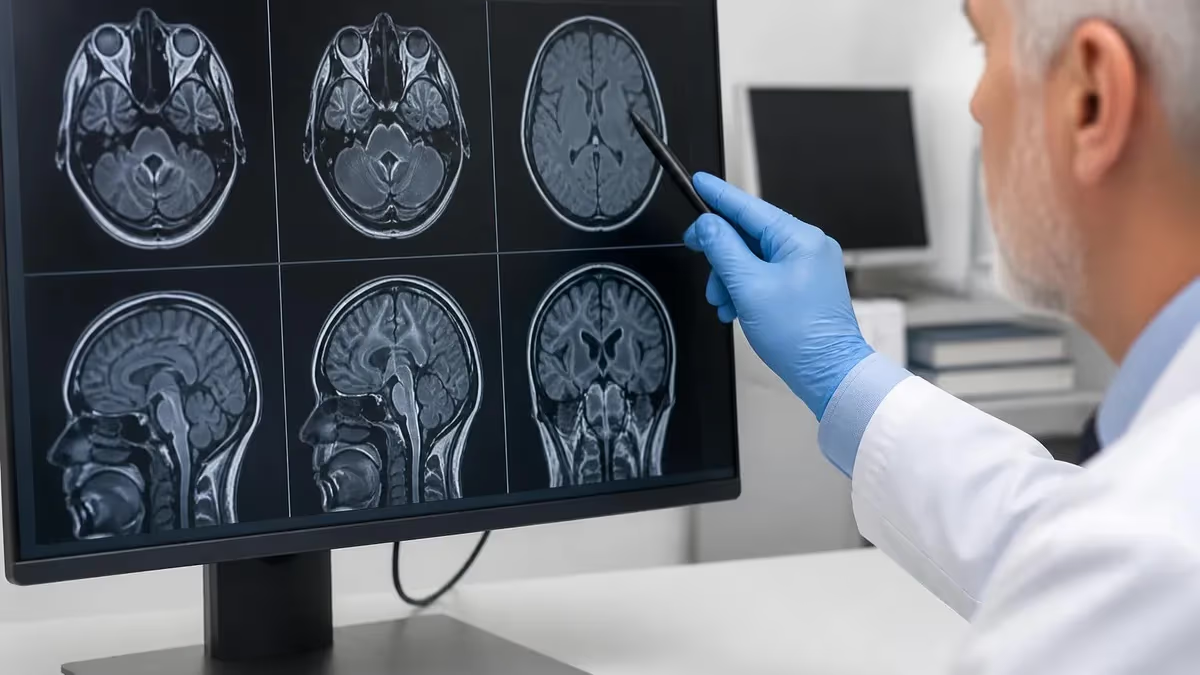
Medtronic MRI Compatibility — Key Numbers
Medtronic Device MRI Compatibility — Complete Guide (2026)
Your patient has a Medtronic pacemaker implanted in 2014 and needs a lumbar MRI tomorrow. Scan? Refuse? It depends entirely on the model number stamped on the patient ID card — and getting that lookup wrong can kill someone.
This guide walks through every major Medtronic implantable device and where it sits on the FDA MRI compatibility ladder. Pacemakers, ICDs, CRT devices, baclofen pumps, sacral nerve stimulators, deep brain stimulators, spinal cord stimulators — each family has both MR Conditional models and older units that remain absolutely unsafe near a magnet. The line between them is the model number. Not the device type. The exact model.
Short answer first. Medtronic's SureScan product line — branded with the SureScan label — is MR Conditional at 1.5 Tesla. Pre-SureScan devices implanted before roughly 2011 are MR Unsafe and require alternatives like CT, ultrasound, or nuclear imaging. The Reveal LINQ cardiac monitor and the newer Percept PC deep brain stimulator added 3T capability. Everything else stays at 1.5T or below. Always verify the model on the patient ID card against the current Medtronic MRI technical manual before scanning.
FDA MRI Compatibility Categories Explained
The FDA classifies every implantable device into one of three buckets. Knowing which bucket your patient sits in is the entire decision tree.
MR Safe means the device poses no known hazard in any MRI environment. Pure plastic, glass, or non-magnetic materials. Almost no Medtronic active implant qualifies — these are leadless monitors, dental implants, certain orthopedic hardware. Don't assume any Medtronic active electronic device is MR Safe. They aren't.
Then there's MR Conditional. The device is safe to scan but only under specified conditions — field strength, gradient slew rate, specific absorption rate (SAR), patient positioning, scan duration, and programming mode. Get any condition wrong and the scan becomes unsafe. Most modern Medtronic devices live here. The conditions are in the Medtronic MRI technical manual for that specific model — not a generic document.
Last category. MR Unsafe means the device cannot enter the MRI environment under any circumstance. Implanted ferromagnetic components, susceptibility to magnetic torque, or risk of programming corruption from the gradient fields. Almost all pre-2011 Medtronic active implants fall here. If your patient has an older pacemaker, ICD, or stimulator and no documentation showing MR Conditional status, treat the device as MR Unsafe by default. Document that decision in the chart, then route the patient to MRI vs CT scan alternatives — usually CT with contrast or nuclear scintigraphy depending on the indication.
One more category that's worth knowing about because it confuses radiology techs. Some older Medtronic literature uses the term "MRI compatible" — that's the obsolete pre-2005 wording and it doesn't map cleanly to the current three-category FDA system. If you see "MRI compatible" on a patient ID card from 2003 or earlier, do not assume it means MR Safe or MR Conditional by today's standards. Look up the exact model in the current technical manual or call the Medtronic MRI Resource Center at 1-800-Medtronic for a definitive answer.
How Medtronic Earned MR Conditional Status — The Engineering Recipe
- ✓Redesigned pacing leads with reduced ferromagnetic content and smaller cross-section to lower RF heating at the lead tip
- ✓Redesigned generator can with internal filtering circuits that suppress induced currents from gradient field switching
- ✓Added a programmer-driven MRI mode that suspends pacing, defibrillation, or stimulation therapy during the scan
- ✓Validated the complete lead-plus-generator system at 1.5T (and 3T for Reveal LINQ) under defined SAR and gradient limits
- ✓Created patient ID cards with model-specific MRI compatibility status to standardize verification at every imaging center
- ✓Established the 24/7 Medtronic MRI Resource Center hotline (1-800-Medtronic) for clinical decision support
- ✓Required mismatched lead-generator combos (older lead + new SureScan generator) to be treated as MR Unsafe by default
How Medtronic's MRI Approval Story Evolved
Worth knowing the historical arc. Before 2011, every Medtronic active cardiac implant was MR Unsafe by default. Patients carried laminated wallet cards saying "DO NOT MRI." That meant millions of pacemaker patients with shoulder injuries, back pain, or suspected strokes had to settle for CT — losing the soft-tissue contrast that only MRI delivers. The Revo MRI launch in 2011 was a watershed for cardiac patients.
Since then, almost every Medtronic device family has added a SureScan-branded successor. The pattern follows three steps. Engineers redesign the lead to reduce RF heating. They redesign the generator can to filter induced currents from gradient fields. They add a programmer-driven MRI mode that suspends pacing or therapy delivery during the scan.
Put those three pieces together and you've got an MR Conditional system. Skip any one of them, and the device stays MR Unsafe — which is exactly why a pre-SureScan generator paired with a new SureScan lead doesn't count as MR Conditional. The whole system has to be qualified together.
Why Lead Compatibility Matters as Much as the Generator
This is the part radiology techs miss most often. The MR Conditional approval applies to a specific generator paired with specific leads. Mix and match isn't allowed. A patient might come in with a 2018 Advisa MRI generator implanted on top of 2005 pacing leads from a previous device — and the entire system loses MR Conditional status because the older leads weren't tested or approved for the magnetic environment.
How to check? The patient ID card lists the generator model and serial. Implant records — usually in the cardiology chart or the device interrogation report — list lead models and serial numbers. Cross-reference both. SureScan-compatible leads have specific model designations (5076 for atrial, 4076 for ventricular, etc.). Mismatched leads mean MR Unsafe by default. Pull the operative report if there's any doubt.
One more wrinkle worth knowing. Patients sometimes have abandoned leads from previous device implants — leads cut and capped but left in the chest from a prior pacemaker that was upgraded. Those abandoned leads are not always SureScan-rated even if the current active leads are. Most centers consider any abandoned non-SureScan lead a relative contraindication to MRI, though some experienced centers do scan under modified protocols. The conservative default — treat any unclear lead history as MR Unsafe until proven otherwise via the operative reports and the current Medtronic technical manual.
SureScan Pacemakers — MR Conditional at 1.5T
The original. Approved by the FDA in February 2011 as the first pacemaker labeled MR Conditional in the United States. Models RVDR01 and RVSR01. Dual-chamber and single-chamber options. Approved for 1.5T scans, full-body, with specific gradient and SAR limits documented in the Medtronic MRI technical manual.
Pre-scan programming is mandatory. Switch the device to MRI mode via the Medtronic CareLink programmer before the patient enters the scanner. After the scan, switch back to therapy mode within 30 minutes. Skip either step and the pacemaker behaves unpredictably — either pacing inappropriately during the scan or failing to resume normal therapy after.
ICD and CRT Devices — SureScan Family
Single and dual-chamber ICD models. MR Conditional 1.5T full-body. Requires pre-scan programming to MRI mode via Medtronic programmer. Tachy therapies temporarily suspended during MRI mode — patients with frequent VT/VF need clinical judgment on scan timing.
Combination ICD with atrial fibrillation detection. MR Conditional 1.5T. Same pre-scan mode-switch workflow. The AF detection algorithm pauses during MRI mode — that's expected. Document baseline AF burden in the chart before the scan so post-scan comparison is meaningful.
CRT-D (defibrillator) and CRT-P (pacemaker) options for biventricular pacing in heart failure. Both MR Conditional 1.5T full-body. Triple-lead system needs programmer mode-switch like all SureScan devices. Confirm all three leads are SureScan-compatible — mismatched older lead with new generator changes the safety profile.
Maximo, Marquis, Virtuoso, Concerto — older ICD models from before 2015 carrying no MR Conditional approval. Treat as MR Unsafe. Lead heating during a scan can cause myocardial damage at the lead tip. Route patients to CT or nuclear cardiac imaging instead.
Pre-Scan Verification Steps — Every Medtronic Patient
- ✓Locate the patient's Medtronic device ID card — model name, model number, serial number all visible
- ✓Cross-reference the model against the current Medtronic MRI technical manual at medtronic.com/mri
- ✓Confirm MR Conditional status — note the field strength limit (1.5T or 3T) and any SAR/gradient restrictions
- ✓Verify all leads are SureScan-compatible — mismatched old lead with new generator is not approved
- ✓Schedule the Medtronic CareLink programmer to be available 30 minutes before scan
- ✓Switch device to MRI mode via programmer just before patient enters the scanner
- ✓Confirm with radiologist that scan parameters fit within the device's conditional limits
- ✓After scan completion, switch device back to normal therapy mode within 30 minutes
- ✓Document mode-switch times, scan parameters, and post-scan device interrogation in the chart
- ✓Schedule follow-up device interrogation within 30 days to confirm normal function
Reveal LINQ Insertable Cardiac Monitor
The Reveal LINQ sits in a different category from active therapy devices. It's a small subcutaneous monitor — no leads, no pacing, just recording. That smaller footprint and lead-free design gave the FDA confidence to approve it for both 1.5T and 3T scans. Most Medtronic devices stop at 1.5T. LINQ is the exception.
Pre-scan programming is still required but the workflow is simpler. The CareLink programmer puts the LINQ into MRI mode, which suspends arrhythmia detection during the scan. Post-scan, the device returns to monitoring mode automatically when removed from the magnetic field. No 30-minute window panic like with pacemakers. Worth noting if you see a patient with a LINQ and a pacemaker — the pacemaker dictates the scan limit, not the LINQ.
One caveat about LINQ data after a scan. Some patients show transient artifact in stored ECG strips for several hours post-scan. That's the gradient field interaction, not actual arrhythmia. Compare against the patient's baseline rhythm before flagging anything as new. Detailed interpretation comes from cardiac MRI specialists who routinely review these monitors alongside scan results.
SynchroMed II and Solara Baclofen Pumps
The Medtronic SynchroMed II intrathecal drug delivery pump and the newer Solara pump are both MR Conditional at 1.5T. They deliver baclofen, morphine, ziconotide, or other agents directly to the intrathecal space for spasticity or chronic pain. The pump itself is metal — titanium housing, ferromagnetic components — but the FDA approved 1.5T scans with specific gradient and SAR limits.
The scan halts pump function temporarily — that's expected and built into the safety design. Baclofen withdrawal can be life-threatening, so any scan over 90 minutes near the pump requires backup oral baclofen on hand. The pump auto-resumes within 60 minutes of leaving the scanner. Verify resumption by interrogating with the Medtronic programmer post-scan and checking the displayed infusion rate matches the prescribed rate.
SynchroMed II model B35200 is one of the specific models that ships with detailed scan-protocol documentation. The Solara pump (newer) adds remote programming and longer battery life but follows the same 1.5T conditional rules. Pre-2010 SynchroMed EL and earlier intrathecal pumps are MR Unsafe — those need to come out before any MRI, which is rare but does happen in patients with declining therapy needs.
One scenario that comes up often. A patient on intrathecal baclofen needs an urgent lumbar MRI for new neurologic symptoms. The pump is right there in the abdomen. You can scan — the L-spine MRI sits well within the SynchroMed II conditional parameters — but be aware that abdominal-located devices may show local artifact on adjacent images. The radiologist should know the device is present before reading the study, otherwise the artifact gets misread as pathology. Send the device model and serial along with the order.
InterStim and DBS — Generation Decides Everything
MR Unsafe. Implanted for urinary urge incontinence, urinary retention, and fecal incontinence. Lead-stimulator combo has too much ferromagnetic content. Risks lead displacement and tissue heating in the magnetic field. No scans allowed under any circumstance.
MR Conditional at 1.5T full-body. Launched 2020. Smaller form factor and updated lead design unlocked the conditional approval. Same SureScan-style workflow: pre-scan mode switch via programmer, scan within documented parameters, post-scan mode-switch back to therapy.
MR Conditional only under extremely restrictive conditions — head transmit coil only, specific SAR limits, no body-coil scans. Most centers treat as effectively MR Unsafe outside dedicated DBS-experienced MR programs. Refer such patients to specialty centers.
MR Conditional at 1.5T full-body with relatively standard SAR and gradient limits — much closer to SureScan pacemaker rules. Launched 2020. Records local field potentials, giving neurologists real-time data on therapy effectiveness alongside imaging.
InterStim Bladder Stimulator — The Generation Gap
InterStim is where things get tricky. The original InterStim and InterStim II — implanted for urinary urge incontinence, urinary retention, and fecal incontinence — are MR Unsafe. No scans allowed. Period. The lead-stimulator combo has too much ferromagnetic content and risks lead displacement and tissue heating in the magnetic field.
The newer InterStim Micro, launched in 2020, is MR Conditional at 1.5T full-body. Same SureScan-style workflow — pre-scan mode switch via programmer, scan within documented parameters, post-scan mode-switch back to therapy. The smaller form factor and updated lead design unlocked the conditional approval.
How to tell which version your patient has? The patient ID card lists the model. InterStim Model 3023 is the original. Model 97800 is the InterStim Micro. Don't guess. The decision tree is binary — original = no MRI, Micro = MRI Conditional at 1.5T. Refer to the Medtronic bladder stimulator MRI safety documentation at medtronic.com/mri for the current Micro technical manual.
Deep Brain Stimulation — Activa vs Percept
Medtronic dominates the DBS market with implants for Parkinson's, essential tremor, dystonia, and treatment-resistant OCD. The MRI compatibility line falls between two generations.
The older Activa PC and Activa SC systems were MR Conditional only under extremely restrictive conditions — head transmit coil only, specific SAR limits, no body-coil scans. In practice, most centers treated them as MR Unsafe outside of dedicated DBS-experienced MR centers because the conditions were so restrictive.
The newer Percept PC launched in 2020 changed everything. Percept PC is MR Conditional at 1.5T full-body with relatively standard SAR and gradient limits — much closer to SureScan pacemaker rules. Plus Percept records local field potentials, giving neurologists real-time data on therapy effectiveness. If your patient has Percept, MRI is broadly accessible. If they have an Activa generation, route them through a center experienced with restrictive DBS MRI protocols.
Worth knowing about the upgrade pathway. Some Parkinson's patients with Activa devices are now mid-battery — and the question of whether to replace early with a Percept comes up. The MRI access advantage is real. Patients who need repeat brain imaging (atypical parkinsonism workup, ruling out vascular contributions to tremor) benefit substantially from the broader Percept conditional approval. Discuss with the implanting neurosurgeon and the neurologist before the next planned generator replacement.
Spinal Cord Stimulators — Vanta and Intellis
Medtronic's spinal cord stimulators target chronic back pain, leg pain, and complex regional pain syndrome. Current MR Conditional models include Vanta (primary cell, non-rechargeable) and Intellis (rechargeable). Both approved for 1.5T full-body MRI with SureScan-style conditions.
The workflow mirrors pacemakers. Switch the device to MRI mode via the patient's handheld programmer or the clinician programmer. Scan within documented gradient and SAR limits. Post-scan, return the device to therapy mode. Some patients with Intellis can self-switch with their handheld controller, but the conservative approach has a clinician verify mode in both directions when possible.
Older SCS systems — RestoreSensor, RestoreUltra, PrimeAdvanced — are MR Unsafe or have such restrictive conditional limits that most centers default to no-scan. Verify the exact model. For chronic pain patients needing repeat imaging, the upgrade conversation to Vanta or Intellis becomes clinically relevant — not just a feature upgrade, but a meaningful safety win.
Medtronic Model Number Lookup — Where to Verify
The single most important pre-scan step is verifying the model number against current Medtronic MRI documentation. Three reliable sources.
First — medtronic.com/mri. The main Medtronic MRI Resource Center. Search by device family, then drill into specific model numbers. Each model page includes the technical manual PDF with scan conditions, SAR limits, gradient slew rates, and patient-positioning rules. Bookmark the page — it's updated whenever a new product launches.
Second — mrisurescan.com. Medtronic's dedicated site for SureScan family devices. Faster lookup for cardiac rhythm devices specifically. Includes interactive decision trees for radiology techs and nurses.
Third — the 24/7 Medtronic clinical hotline at 1-800-Medtronic (1-800-633-8766). Staff include cardiac and neurology specialists who can confirm MR Conditional status for any model and walk through scan conditions in real time. Use it for urgent cases when paper documentation isn't immediately available or when scan parameters seem to fall outside published limits.
The Pre-Scan Workflow — End to End
Real-world workflow looks like this. Patient arrives. Radiology tech asks about implanted devices. Patient produces the Medtronic ID card. Tech reads off the model number. Charge nurse or MRI safety officer cross-references against the current technical manual or calls Medtronic if anything is unclear. CareLink programmer arrives — usually carried in by a Medtronic field rep or stored at MRI-experienced centers permanently. Mode switch happens just before the patient enters the scanner.
Scan runs. The MRI tech watches the device behavior on telemetry where possible — some SureScan generators support real-time monitoring during the scan. Post-scan, the patient sits up, the rep or clinician re-runs the programmer, and the device flips back to therapy mode. Final interrogation captures battery status, lead impedances, and any sensor flags. Anything abnormal triggers immediate cardiology or neurology consult.
The whole sequence adds about 30 minutes to a standard MRI appointment. That overhead is non-negotiable. Skipping the pre-scan mode switch or the post-scan therapy resumption converts an MR Conditional scan into something materially riskier. Make the workflow muscle memory at any MRI center that scans cardiac or neuro device patients regularly. The MRI safety protocol at your institution should explicitly include Medtronic-specific steps, not just a generic implant questionnaire.
Many readers pair this guide with the open mri near me to check their readiness before exam day.
Many readers pair this guide with the mri abdomen and pelvis cpt code to check their readiness before exam day.
Scanning a Medtronic Patient — Trade-offs to Know
- +Diagnostic MRI now available for cardiac, neuro, and spine indications previously off-limits
- +Full-body 1.5T scans approved for all current SureScan, Vanta, Intellis, Percept, InterStim Micro
- +Reveal LINQ approved at both 1.5T and 3T for high-resolution brain and musculoskeletal imaging
- +Patient ID card system standardizes verification across hospitals and outpatient centers
- +Medtronic 24/7 hotline covers ambiguous cases or urgent clinical decisions
- −Pre-scan programmer requirement adds 30 minutes and needs trained personnel on site
- −Pre-SureScan devices (2011 and earlier) remain MR Unsafe with no upgrade path short of explant
- −3T scans are off-limits for most cardiac SureScan devices — limits high-resolution neuro imaging
- −Activa-generation DBS limited to head-coil-only or no-scan protocols at most centers
- −Mismatched lead-generator combinations void MR Conditional status — full system swap needed
Medtronic MR Conditional Milestones
2011 — Revo MRI
2013 — Advisa MRI
2014 — Reveal LINQ
2015 — Evera MRI ICD
2020 — Percept PC DBS
2020 — InterStim Micro
Field Strength Approval by Device Family
Sample MRI - Magnetic Resonance Imaging Practice Questions
Try these questions from our free MRI - Magnetic Resonance Imaging practice tests. The correct answer and an explanation follow each question.
A technologist who holds an RT(MR)(ARRT) credential and allows it to lapse must complete which process to reinstate it?
- A. Retake the full MRI registry examination
- B. Apply for reinstatement and fulfill CE requirements
- C. Resubmit all original application materials and retake the exam
- D. Complete only a practical competency evaluation
Answer: B. Apply for reinstatement and fulfill CE requirements
ARRT allows lapsed credential holders to reinstate by applying for reinstatement and meeting outstanding CE obligations.
What is the term for the MRI safety classification that indicates a device has been tested and found safe under specified conditions?
- A. MR Safe
- B. MR Conditional
- C. MR Unsafe
- D. MR Compatible
Answer: B. MR Conditional
MR Conditional means the device poses no known hazards when used within the specific conditions (field strength, SAR, gradient limits) stated by the manufacturer.
The quantity of determines the receiver bandwidth.
- A. Frequency samples in the matrix
- B. Phase changes within the matrix
Answer: A. Frequency samples in the matrix
The receiver bandwidth in MRI is directly determined by the number of frequency samples (pixels) in the frequency encoding direction. A higher number of samples requires a wider bandwidth to accurately capture the range of frequencies present in the signal within the acquisition time. This ensures proper spatial resolution and minimizes aliasing artifacts in the resulting image.
For pituitary gland MRI, which plane is considered the primary imaging plane?
- A. Axial
- B. Sagittal
- C. Coronal
- D. Oblique axial
Answer: C. Coronal
Coronal thin-slice images are the primary plane for pituitary imaging because they best demonstrate lateral extension, cavernous sinus invasion, and microadenomas.
Take the full MRI - Magnetic Resonance Imaging practice test
MRI Questions and Answers
Related MRI Safety Guides
MRI Safety 2026: Complete Guide to MRI Protocols and Hazards
MRI Scan Guide 2026: Types, Preparation & What to Expect
MRI With Contrast: When It's Needed and What to Expect
MRI Machine: How It Works, Types, Field Strengths, and What to Expect
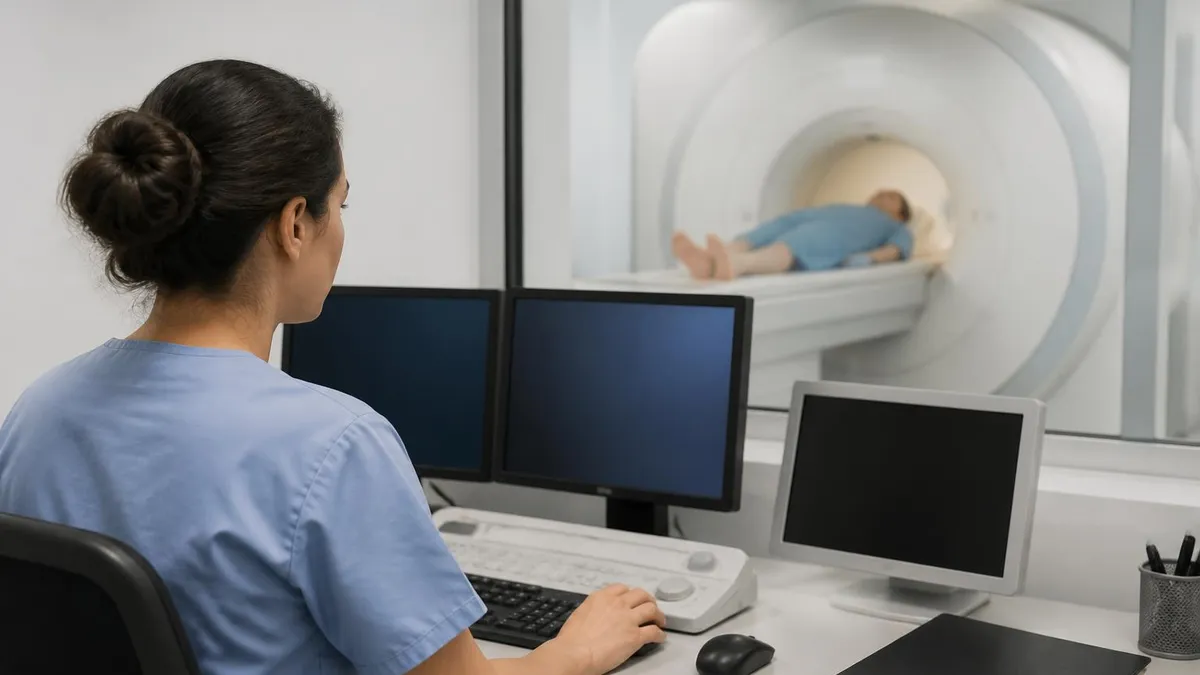
Cardiac MRI: Complete Guide for Patients and MRI Technologists
About the Author

Medical Laboratory Scientist & Clinical Certification Expert
Johns Hopkins UniversityDr. Sandra Kim holds a PhD in Clinical Laboratory Science from Johns Hopkins University and is certified as a Medical Technologist (MT) and Medical Laboratory Scientist (MLS) through ASCP. With 16 years of clinical laboratory experience spanning hematology, microbiology, and molecular diagnostics, she prepares candidates for ASCP board exams, MLT, MLS, and specialist certification tests.
Join the Discussion
Connect with other students preparing for this exam. Share tips, ask questions, and get advice from people who have been there.
View discussion (8 replies)