
CPT Code for MRI Brain W WO Contrast: Complete 2026 Coding Guide
🗨️ Master CPT code for MRI brain w wo contrast (70553) plus codes for spine, joint, abdomen MRI. Billing, modifiers, reimbursement and documentation tips.
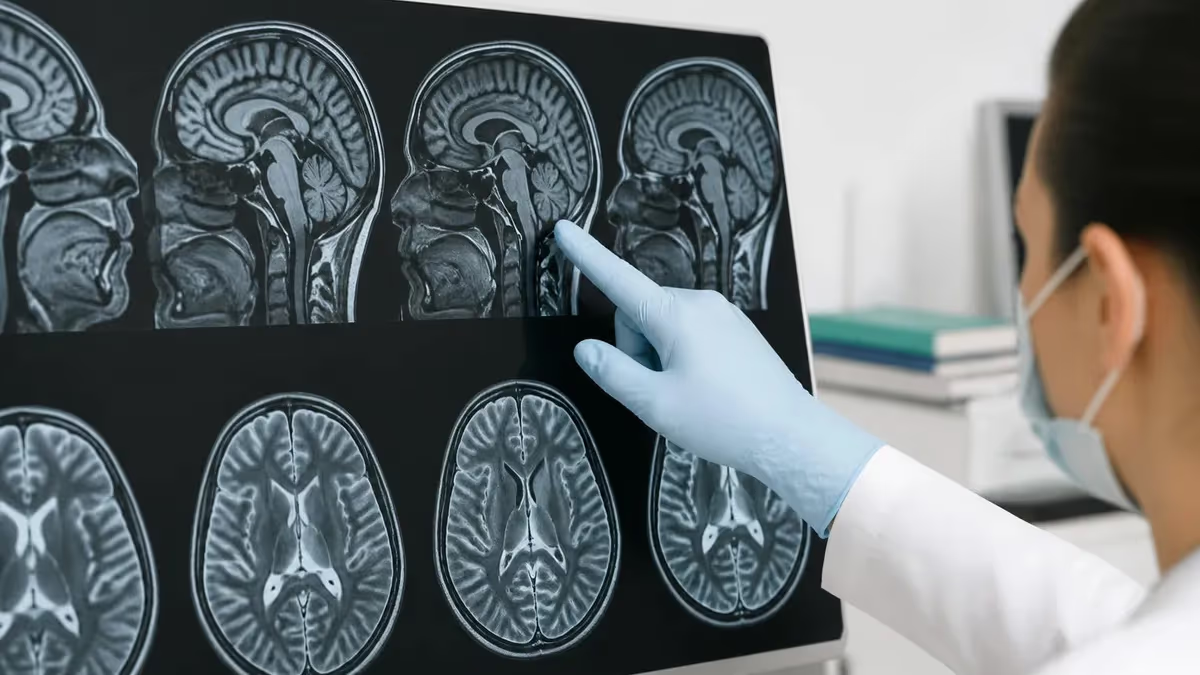
The cpt code for mri brain w wo contrast is 70553, and it is one of the most frequently billed neuroradiology procedures in the United States. This single five-digit code captures a complete brain MRI study performed first without intravenous gadolinium and then repeated after contrast administration. Understanding this code, its sibling codes, and the documentation rules that surround it is essential for radiologic technologists, coders, billers, and front-office staff who keep imaging revenue flowing accurately and compliantly. Practice with the free MRI - Magnetic Resonance Imaging practice test on PracticeTestGeeks (200+ questions with answer explanations).
Current Procedural Terminology codes are maintained by the American Medical Association and updated each January. For MRI, the 707xx and 705xx code families cover everything from a unilateral knee study to a complex cardiac morphology examination with stress. Selecting the wrong code by even one digit can shift reimbursement by hundreds of dollars, trigger an audit, or leave the patient with an unexpected balance bill, so precision matters at every step of the workflow.
Brain MRI codes break into three options based on contrast use: 70551 (without contrast), 70552 (with contrast only), and 70553 (without and with contrast). The combined 70553 study is the workhorse for evaluating tumors, infection, demyelinating disease, and post-surgical surveillance because it lets the radiologist compare native tissue signal against enhancement patterns after gadolinium reaches abnormal vasculature or a disrupted blood-brain barrier.
Coders cannot simply default to 70553 because it pays more. Medical necessity must be supported in the order, the clinical history, and the final report. CMS, commercial payers, and radiology benefit managers like eviCore and AIM apply appropriateness criteria from the American College of Radiology, and many require prior authorization before a contrast study is scheduled. A weak indication can convert a paid claim into a denial within days.
This guide walks through the cpt code for mri across every major body region, explains modifier usage, breaks down reimbursement under the Medicare Physician Fee Schedule and Hospital Outpatient Prospective Payment System, and gives concrete documentation checklists. Whether you are a new MRI technologist learning to match orders to protocols or a seasoned biller chasing a denied 70553, you will find practical answers backed by current AMA and CMS guidance.
We will also touch on adjacent topics that affect coding decisions, including bundled angiography codes, the difference between MR spectroscopy and standard sequencing, and how to handle limited or repeat studies. By the end you should be confident selecting the correct CPT, applying the right modifiers, and supporting the claim with documentation that survives both prepayment review and post-payment audit. For a refresher on what radiologists look for on these studies, see our overview of common MRI findings.
Coding is not a static skill. The 2026 CPT cycle added clarifications around MR elastography reporting and revised parenthetical instructions for combined MRA and MRV studies, so even experienced coders should plan an annual refresh. Treat this article as a working reference, bookmark the official AMA CPT manual, and verify payer policies whenever a code crosses your desk for the first time.
MRI: upcoming dates and official changes
- Aug 17, 2026: ARRT launched a separate entry-level Imaging Assistant, Magnetic Resonance (I.A.) credential. A reduced $75 fee applied to applications made Aug. 17–Oct. 14, 2026, for testing Oct. 15–Nov. 30, 2026. Later applicants pay $225 and can test on or after Jan. 1, 2027.[4]
- The ARRT MRI exam for postprimary-pathway candidates has 220 questions: 200 scored and 20 unscored pilot items.[1]
- The ARRT MRI exam for primary-pathway candidates has 230 questions: 200 scored and 30 unscored pilot items.[2]
- Postprimary-pathway candidates get 210 minutes for the ARRT MRI exam, inside a 230-minute (3 hours, 50 minutes) appointment.[1]
- Primary-pathway candidates get 230 minutes for the ARRT MRI exam, inside a 250-minute (4 hours, 10 minutes) appointment that also covers the tutorial, the NDA and a survey.[2]
- To pass the ARRT MRI exam you need a total scaled score of 75 on ARRT's 1–99 scale. This is not a percentage.[3]
- The ARRT MRI exam through the postprimary pathway costs $225, or $450 for candidates whose supporting credential is from NMTCB or ARDMS.[4]
- The ARRT MRI certification exam costs $225 to apply for through the primary eligibility pathway.[4]
- ARRT MRI candidates have three attempts to pass the exam, all within three years of the date their first exam window opens.[2]
- ARRT MRI certification and registration lasts 10 years, even with annual renewal. After that, holders must complete Continuing Qualifications Requirements (CQR).[5]
Numbers in brackets link to the official sources listed under Sources & last verified. Dates that have passed are removed automatically.
MRI Exam at a Glance
| Item | Detail | Source · Verified |
|---|---|---|
| Number of questions (Postprimary pathway) | 220 questions (200 scored + 20 unscored pilot)[1] | assets-us-01.kc-usercontent.com · Oct 15, 2026 |
| Number of questions (Primary pathway) | 230 questions (200 scored + 30 unscored pilot)[2] | assets-us-01.kc-usercontent.com · Oct 15, 2026 |
| Time limit (Postprimary pathway) | 210 minutes test time (230-minute appointment)[1] | assets-us-01.kc-usercontent.com · Oct 15, 2026 |
| Time limit (Primary pathway) | 230 minutes test time (250-minute appointment)[2] | assets-us-01.kc-usercontent.com · Oct 15, 2026 |
| Passing score | Scaled score of 75 (scale 1–99)[3] | The American Registry of Radiologic Technologists · Oct 15, 2026 |
| Exam fee (Postprimary pathway) | $225 application fee ($450 with an NMTCB or ARDMS supporting credential)[4] | The American Registry of Radiologic Technologists · Oct 15, 2026 |
| Exam fee (Primary pathway) | $225 application fee[4] | The American Registry of Radiologic Technologists · Oct 15, 2026 |
| Retake policy | 3 attempts within 3 years of the first exam window[2] | assets-us-01.kc-usercontent.com · Oct 15, 2026 |
| Validity | 10 years, then Continuing Qualifications Requirements (CQR)[5] | assets-us-01.kc-usercontent.com · Oct 15, 2026 |
| Renewal | Annual renewal, $65/year; 24 CE credits every 2 years[5] | assets-us-01.kc-usercontent.com · Oct 15, 2026 |
| Delivery | Computer-based at Pearson VUE test centers[2] | assets-us-01.kc-usercontent.com · Oct 15, 2026 |
| Eligibility (Postprimary pathway) | Supporting ARRT credential (or NMTCB/ARDMS) + structured education + clinical experience[1] | assets-us-01.kc-usercontent.com · Oct 15, 2026 |
| Eligibility (Primary pathway) | ARRT-recognized MRI program + associate degree or higher + ethics[2] | assets-us-01.kc-usercontent.com · Oct 15, 2026 |
| Score release | Preliminary score at the test center; official results in about 10 business days[3] | The American Registry of Radiologic Technologists · Oct 15, 2026 |
| Testing window | One-year (365-day) exam window per application[2] | assets-us-01.kc-usercontent.com · Oct 15, 2026 |
Free MRI - Magnetic Resonance Imaging Study Tools
Interactive MRI - Magnetic Resonance Imaging resources on PracticeTestGeeks, free to start:
- Free MRI Knowledge Questions and Answers — 11 questions with instant scoring and answer explanations
- MRI - Magnetic Resonance Imaging flashcards — review key terms and concepts card by card
- MRI - Magnetic Resonance Imaging study guide — topic-by-topic overview of what the exam covers
- MRI - Magnetic Resonance Imaging cheat sheet — one-page printable summary for last-minute review
MRI CPT Codes by the Numbers
Brain MRI CPT Code Breakdown
Used for stroke protocols, headache workups, and routine screening when contrast is contraindicated or unnecessary. Includes T1, T2, FLAIR, and diffusion-weighted sequences. National Medicare payment averages approximately $241 globally in 2026.
Rarely ordered as a stand-alone study but used in specific follow-up scenarios where pre-contrast imaging is not clinically needed. Requires gadolinium administration and documentation of dose, agent, and injection site for compliant billing.
The workhorse for tumor, infection, MS, and post-operative imaging. Includes pre-contrast sequences plus post-contrast T1 imaging. National Medicare global payment is approximately $418, making accurate documentation critical for revenue integrity.
Functional brain MRI for pre-surgical mapping. 70554 includes physician administration of testing; 70555 reports the technical component when testing is administered by another provider. Both require specialized BOLD imaging hardware and analysis.
Category III add-on code reported alongside the primary brain MRI when single or multi-voxel spectroscopy is performed. Always check payer policy because Category III codes frequently carry contractor pricing or non-coverage determinations.
Spine MRI uses three primary code families organized by anatomic region: cervical (72141, 72142, 72156), thoracic (72146, 72147, 72157), and lumbar (72148, 72149, 72158). Within each family, the first code is without contrast, the second is with contrast, and the third is the combined without-and-with study. This parallel structure mirrors the brain coding logic and makes spine coding relatively predictable once a coder understands the pattern.
The most commonly billed spine code is 72148, lumbar MRI without contrast, used for low back pain, radiculopathy, and disc herniation evaluation. Contrast is reserved for patients with prior surgery (to distinguish recurrent disc from post-operative scar), suspected infection, suspected metastatic disease, or known multiple sclerosis with cord involvement. Ordering contrast routinely on lumbar studies is a common denial trigger because it fails ACR appropriateness criteria for uncomplicated back pain.
Joint MRI codes follow a different convention. Upper extremity joints (shoulder, elbow, wrist) use 73218 through 73225, while lower extremity joints (hip, knee, ankle) use 73718 through 73725. Each region distinguishes between joint MRI and non-joint upper or lower extremity MRI, which catches many new coders by surprise. A knee study is coded 73721 without contrast, but a calf soft tissue study is 73718, even though both scan the lower extremity.
MR arthrogram studies require careful coding because they involve two distinct procedures: the joint injection and the MRI itself. The injection is reported with the appropriate arthrography code (such as 23350 for shoulder), the radiologic supervision is reported with the relevant S&I code, and the MRI is then reported with the with-contrast joint code. Bundling these incorrectly is a frequent source of denials and underpayments in musculoskeletal imaging.
Abdominal and pelvic MRI codes (74181, 74182, 74183 for abdomen; 72195, 72196, 72197 for pelvis) cover liver, kidney, adrenal, prostate, and gynecologic indications. Specialized studies like MR enterography for inflammatory bowel disease still use the standard abdomen codes but require oral contrast and specific bowel preparation. The CPT code does not change based on the imaging protocol; only the without/with/both designation drives code selection in this family. Our breakdown of what MRI can detect explains why these protocols matter clinically.
chest mri cpt code codes (71550, 71551, 71552) are less commonly used because CT remains the primary modality for thoracic imaging. They appear most often for brachial plexus evaluation, chest wall masses, and cardiac studies that do not meet the criteria for the dedicated cardiac MRI codes (75557 through 75565). Pediatric oncology surveillance for thoracic neuroblastoma is another scenario where chest MRI codes apply, particularly when ionizing radiation must be avoided.
MR angiography has its own code series that varies by anatomic region: 70544-70546 for head, 70547-70549 for neck, 71555 for chest, 72198 for pelvis, 73225 for upper extremity, 73725 for lower extremity, and 74185 for abdomen. The third digit pattern in the head and neck series follows the without/with/both convention, but the body MRA codes generally bundle contrast administration into a single code, so coders cannot bill a separate with-contrast option.
MRI Practice Test Questions
Prepare for the MRI - Magnetic Resonance Imaging exam with our free practice test modules. Each quiz covers key topics to help you pass on your first try.
MRI Knowledge
MRI Exam Questions covering Knowledge. Master MRI Test concepts for certification prep.
MRI Physics
Free MRI Practice Test featuring Physics. Improve your MRI Exam score with mock test prep.
MRI Anatomy and Pathology
MRI Test Prep for MRI Anatomy and Pathology. Practice MRI Quiz questions and boost your score.
MRI Anatomy and Positioning
MRI Questions and Answers on MRI Anatomy and Positioning. Free MRI practice for exam readiness.
MRI Contrast Agents
Free MRI Quiz on MRI Contrast Agents. MRI Exam prep questions with detailed explanations.
MRI Patient Care and Positioning
MRI Practice Questions for MRI Patient Care and Positioning. Build confidence for your MRI certification exam.
Contrast Decision Logic for MRI CPT Codes
Without-contrast studies are appropriate when the clinical question can be answered using native tissue contrast alone. Examples include acute stroke imaging where diffusion-weighted imaging identifies infarct, lumbar spine MRI for uncomplicated radiculopathy, and routine knee MRI for meniscal or ligament injury. These studies use codes ending in 1 within each family (70551, 72141, 72148, 73721).
Skipping contrast saves roughly 15 to 20 minutes of scanner time, eliminates IV access, and avoids gadolinium exposure in patients with poor renal function. However, the trade-off is reduced sensitivity for small enhancing lesions, vascular abnormalities, and active inflammation. Choosing without-contrast incorrectly when contrast was indicated forces a repeat study and creates documentation complications that may require an addendum or amended order.
Using Combined Without-and-With MRI Codes: Pros and Cons
- +Captures comprehensive pre and post contrast comparison
- +Higher reimbursement appropriately reflects radiologist work
- +Reduces need for callbacks or repeat imaging studies
- +Detects subtle enhancing lesions and active inflammation
- +Supports complete tumor staging and surveillance
- +Aligns with ACR appropriateness for many cancer protocols
- −Requires medical necessity documentation for contrast
- −Increases scan time and patient throughput pressure
- −Risks denial when ordered without proper indication
- −Demands prior authorization with most commercial payers
- −Higher gadolinium exposure for the patient
- −More complex protocol with greater operator skill required
Pros and Cons at a Glance
| Pros | Cons |
|---|---|
| Captures comprehensive pre and post contrast comparison | Requires medical necessity documentation for contrast |
| Higher reimbursement appropriately reflects radiologist work | Increases scan time and patient throughput pressure |
| Reduces need for callbacks or repeat imaging studies | Risks denial when ordered without proper indication |
| Detects subtle enhancing lesions and active inflammation | Demands prior authorization with most commercial payers |
| Supports complete tumor staging and surveillance | Higher gadolinium exposure for the patient |
| Aligns with ACR appropriateness for many cancer protocols | More complex protocol with greater operator skill required |
MRI CPT Code Documentation Checklist
- ✓Order specifies anatomic region and contrast preference
- ✓Clinical indication supports medical necessity per ACR criteria
- ✓Patient consent obtained and documented for contrast administration
- ✓Renal function verified before gadolinium when required
- ✓Technologist worksheet records all sequences performed
- ✓Contrast agent name, dose, lot number, and route documented
- ✓Report header lists CPT-matching study description
- ✓Radiologist explicitly addresses pre and post contrast findings
- ✓Modifiers TC, 26, or 52 applied when appropriate
- ✓Final signed report dated within payer timeliness rules
The 25-Word Rule for Defending 70553
If your radiology report cannot describe the medical necessity for contrast in 25 words or fewer, your 70553 claim is at audit risk. Build a clinical history macro that captures indication, prior findings, and contrast rationale before signing.
Reimbursement for MRI CPT codes depends on the setting, the payer, and whether the technical component, professional component, or both are billed. Under the Medicare Physician Fee Schedule, a global 70553 in a non-facility setting pays approximately $418 in 2026, while a facility-based interpretation only (modifier 26) pays approximately $89. The technical component (modifier TC), which covers scanner time, technologist labor, contrast, and supplies, accounts for the difference and is typically billed by the hospital or imaging center.
Hospital outpatient billing uses the OPPS APC system rather than the MPFS. mri brain with and without contrast cpt falls into APC 5523 (Level 3 imaging without contrast) or APC 5524 depending on contrast use, and the 2026 national payment rate runs roughly $526 for the facility component. Inpatient MRI is bundled into the DRG payment and is not separately reimbursable, which is why scheduling outpatient is often financially preferable when clinical timing permits.
Modifiers shape payment in ways that surprise new billers. Modifier 26 reports only the professional interpretation, modifier TC reports only the technical service, and the absence of either signals a global bill. Modifier 52 indicates a reduced service when, for example, contrast was attempted but failed, requiring a clear narrative in the report. Modifier 59 separates distinct procedural services and is heavily scrutinized by Medicare, so use it only when NCCI edits clearly support unbundling.
Commercial payers diverge from Medicare in several important ways. Many require prior authorization through eviCore, Carelon (formerly AIM), or HealthHelp, particularly for contrast studies and advanced MRA. Some payers contract with regional rates that exceed Medicare by 60 to 120 percent, while others negotiate downward. Workers compensation and auto liability claims often follow state fee schedules that differ from both Medicare and commercial benchmarks, so revenue cycle teams must maintain payer-specific code mappings.
Bundling rules under the National Correct Coding Initiative prevent certain code combinations from being billed together. For example, MR angiography of the head (70544) cannot generally be billed on the same day as brain MRI without modifier 59 plus documented separate indication. MR spectroscopy add-on codes have similar restrictions. Coders should run every multi-code claim through a current NCCI edit checker before submission to avoid predictable denials.
Radiology benefit manager prior authorization is the single biggest pre-claim hurdle in 2026. RBMs evaluate orders against ACR Appropriateness Criteria and may downgrade a requested 70553 to a 70551 if the indication does not support contrast. When a downgrade occurs, the ordering physician can request a peer-to-peer review, but the deadline is usually 24 to 72 hours, so front-office staff must triage authorization status daily to keep the schedule from clogging with denied authorizations.
Patient cost share is another consideration that affects collections. A high-deductible plan member may owe the full allowed amount for a 70553, which can exceed $2,000 in some markets, while a Medicare patient typically owes 20 percent of the MPFS allowed charge after meeting the Part B deductible. Transparent financial counseling before the scan reduces bad debt and improves patient satisfaction, especially for self-pay scheduling.
Billing 70544 (MRA head) on the same day as 70553 (brain MRI w/wo contrast) without modifier 59 and documented distinct indication will trigger an automatic NCCI denial. Always run multi-code MRI claims through a current edit checker before submission.
Real-world coding scenarios illustrate how the rules apply at the desk level. Consider a 52-year-old patient with new-onset seizures referred for brain MRI with and without contrast. The order specifies 70553, the technologist performs T1, T2, FLAIR, DWI, susceptibility-weighted imaging, and post-gadolinium T1 in three planes. The radiologist describes a 1.4 cm enhancing lesion in the right frontal lobe consistent with metastasis. Coding 70553 is correct, supported by indication, sequences, and findings.
Now consider a contrast complication: the same patient develops urticaria after 2 mL of gadobutrol, the injection is stopped, and the radiologist completes only the pre-contrast sequences. The correct billing approach is 70551 (without contrast) with a clear report addendum explaining the reaction. Some coders incorrectly bill 70553 with modifier 52, but most payers prefer the without-contrast code in this scenario because no diagnostic post-contrast images were obtained.
A repeat-study scenario shows how modifiers protect revenue. A patient completes a 70553 brain study, but motion artifact ruins the post-contrast sequences. The radiologist requests a return visit the next day to repeat only the post-contrast portion. The repeat is reported with 70552 (with contrast only) and modifier 76 (repeat procedure by same physician) on the second claim. Without modifier 76, the payer will reject the same-anatomy second claim as a duplicate. For technologists curious about the broader workflow, our guide on how to become an MRI technician covers the clinical training behind these decisions.
Limited or focused studies introduce another nuance. A patient with a known pituitary microadenoma returns for a dedicated sella study rather than a full brain MRI. Some coders bill this as 70553, but the cleaner approach is 70553 with modifier 52 (reduced services) or, if the protocol is truly limited to one anatomic region, the appropriate limited study code. Always match the billed code to the actual sequences and anatomic coverage documented in the report.
Pediatric MRI under anesthesia adds anesthesia codes (00170 for diagnostic procedures involving the head) plus modifier P3 or higher based on ASA classification. The MRI code itself does not change, but the anesthesia provider bills separately, and coordination between radiology and anesthesia billing teams prevents duplicate claims for the same time block. Use Place of Service code 22 or 19 correctly to align facility-based pediatric anesthesia with the global radiology service.
Audit defense begins with the order. A vague indication like "headache, rule out abnormality" rarely survives RBM review or post-payment audit. Coders should educate referring physicians to use specific language: "new-onset headache with focal neurologic deficit" or "surveillance of treated glioblastoma with prior enhancement at six months." The order, the radiologist history, and the report impression should tell a consistent clinical story that supports the billed code and any contrast use.
Finally, keep an annual cadence of CPT updates, ACR Appropriateness Criteria revisions, and payer policy bulletins on the team calendar. The 2026 cycle alone introduced revised parentheticals for combined MRA and MRV studies and clarified MR elastography reporting. Missing these updates is the most common cause of avoidable denials, so subscribe to AMA CPT Assistant, MLN Matters, and your top three payers' policy update feeds. Treat coding accuracy as an ongoing skill, not a one-time training event.
Practical tips separate efficient coding teams from those constantly chasing denials. Build a code crosswalk spreadsheet that maps common ordering language to the correct CPT, including anatomic synonyms and contrast triggers. When a referring practice writes "MRI of the lower back with dye," the front-office scheduler should know instantly that the appropriate code is 72158 (lumbar with and without contrast) and that prior authorization is almost certainly required.
Train technologists to verify the order against the protocol before the patient enters the magnet. A surprising percentage of mismatched claims trace back to a tech who performed the protocol matching their habit rather than the written order. A 30-second pause at the console to confirm anatomic region, contrast indication, and special sequences (like spectroscopy or perfusion) eliminates most downstream coding rework and prevents costly repeat scans.
Use structured report templates with discrete fields for indication, technique, contrast details, and findings. Voice recognition systems with template enforcement catch missing elements before the radiologist signs the report. The technique section should always list every sequence performed and explicitly mention contrast agent, dose, and post-contrast imaging when applicable. Auditors look for these statements first, and missing them invites recoupment.
Establish a daily denial review huddle for radiology coders. A 15-minute morning standup reviewing yesterday's MRI denials surfaces patterns quickly: a particular payer downgrading 70553 to 70551, a specific referring office submitting weak indications, or a technologist consistently mismatching protocols. Patterns become coaching opportunities, and coaching prevents repeat denials. Solo coders should at least keep a weekly denial log with root-cause categories.
Invest in a current NCCI edit tool and a payer-specific medical policy library. The free CMS NCCI edit files are sufficient for Medicare, but commercial payers maintain their own bundling rules and downcoding policies that the public CMS files do not reflect. Subscriptions to coding references from AAPC or AHIMA, combined with direct access to payer portals, give coders the ammunition they need to appeal incorrect denials confidently.
Develop a clean appeal letter library. Most denied MRI claims fall into five or six categories: medical necessity, contrast indication, bundling, modifier missing, and prior authorization. A pre-built letter for each category with placeholders for patient name, date of service, and clinical history accelerates appeal turnaround from days to hours. Track appeal success rates by denial type to know which fights are worth taking and which need a different strategy.
Finally, measure what matters. Key performance indicators for MRI coding include first-pass denial rate, days in accounts receivable for radiology, modifier accuracy rate, and post-audit recoupment rate. A first-pass denial rate under 5 percent and a modifier accuracy above 97 percent are realistic targets for a well-run radiology revenue cycle team. Share these metrics monthly with technologists, radiologists, and referring practices to keep everyone invested in coding excellence and clean claim submission.
🧠 What is the CPT code for a brain MRI without contrast?
CPT 70551 reports a brain MRI performed without intravenous contrast. It covers T1, T2, FLAIR, and diffusion-weighted sequences and is the standard choice for stroke workups and routine headache imaging.
START MRI KNOWLEDGE PRACTICE TEST💉 What does the "70552 cpt code" mean in brain MRI billing?
CPT 70552 reports a brain MRI with contrast only, without a pre-contrast series. It is uncommon and mainly used for short-interval surveillance of a known enhancing lesion, such as a pituitary microadenoma, when a prior study already supplies the baseline.
START MRI REGISTRY PRACTICE TEST🏥 Why is 70553 the "brain mri cpt code" used most for tumors and infection?
CPT 70553 combines a pre-contrast and post-contrast brain MRI in one study, letting the radiologist compare native tissue signal against gadolinium enhancement. That comparison is essential for tumor staging, infection, demyelinating disease, and post-surgical surveillance.
START MRI KNOWLEDGE PRACTICE TEST💰 How much does Medicare pay for CPT 70553 in 2026?
The 2026 Medicare Physician Fee Schedule pays approximately $418 globally for CPT 70553 in a non-facility setting. The professional-only component (modifier 26) pays roughly $89, with the technical component (modifier TC) covering the remainder.
START MRI PHYSICS PRACTICE TEST📋 What is the "mri brain with contrast cpt code" for a combined study?
When a brain MRI is performed both without and with contrast, the correct code is 70553, not 70552. 70552 only applies when no pre-contrast sequences were performed and interpreted.
START MRI KNOWLEDGE PRACTICE TEST🚫 What is the "mri brain without contrast cpt code" used for stroke imaging?
CPT 70551 is the code for brain MRI without contrast, commonly used in acute stroke protocols where diffusion-weighted imaging identifies infarct without needing gadolinium.
START MRI KNOWLEDGE PRACTICE TEST📄 Who maintains CPT codes and how often are they updated?
The American Medical Association maintains and updates Current Procedural Terminology codes annually, with changes effective each January 1. The 2026 cycle revised parentheticals for combined MRA and MRV studies and clarified MR elastography reporting.
START MRI ANATOMY PRACTICE TEST✅ What documentation supports a clean 70553 claim?
A clean claim needs an order specifying anatomic region and contrast, a clinical indication supporting medical necessity, prior authorization when required, technologist documentation of every sequence, contrast agent name/dose/route, and a signed report addressing both pre- and post-contrast findings.
START MRI PATIENT CARE PRACTICE TEST🔍 Does the 70553 brain MRI CPT code require prior authorization?
Most commercial payers and many Medicare Advantage plans require prior authorization for CPT 70553, usually through a radiology benefit manager such as eviCore, Carelon, or HealthHelp. Traditional Medicare generally does not require prior authorization for this code.
START MRI SAFETY PRACTICE TEST🧪 What is the "70551 cpt code" family pattern for other body regions?
Most MRI CPT families follow the brain pattern: the first code is without contrast, the second is with contrast only, and the third is without-and-with. Lumbar spine follows this as 72148, 72149, and 72158.
START MRI ANATOMY PRACTICE TESTSample MRI - Magnetic Resonance Imaging Practice Questions
Try these questions from our free MRI - Magnetic Resonance Imaging practice tests. The correct answer and an explanation follow each question.
For a contrast-enhanced MRA of the aorta, the bolus tracking technique monitors contrast arrival in which vessel to trigger the 3D acquisition?
- A. Superior mesenteric artery
- B. Abdominal aorta or descending thoracic aorta at the level of interest
- C. Right atrium
- D. Femoral artery
Answer: B. Abdominal aorta or descending thoracic aorta at the level of interest
A monitoring slice is placed at the aorta at the target level; when the contrast bolus arrives (signal threshold), the 3D acquisition is automatically triggered.
Which MRI technique uses magnetically labeled water protons as an endogenous tracer to measure cerebral blood flow without contrast injection?
- A. Dynamic Contrast Enhanced (DCE) MRI
- B. Arterial Spin Labeling (ASL)
- C. Dynamic Susceptibility Contrast (DSC) MRI
- D. Blood Oxygen Level Dependent (BOLD) fMRI
Answer: B. Arterial Spin Labeling (ASL)
ASL uses RF inversion of arterial water protons proximal to the imaging plane as a flow tracer, enabling non-invasive perfusion measurement.
Which of the following parameters most directly controls T1 contrast in a spin echo sequence?
- A. Repetition time (TR)
- B. Echo time (TE)
- C. Flip angle in gradient echo
- D. Bandwidth
Answer: A. Repetition time (TR)
TR determines how much longitudinal relaxation occurs between excitations; a short TR emphasizes T1 differences because tissues with shorter T1 recover faster.
Which MRI technique is used to assess brain perfusion by tracking the first pass of a gadolinium bolus?
- A. Arterial Spin Labeling (ASL)
- B. Dynamic Susceptibility Contrast (DSC) perfusion
- C. Diffusion Tensor Imaging (DTI)
- D. Magnetic Resonance Spectroscopy (MRS)
Answer: B. Dynamic Susceptibility Contrast (DSC) perfusion
DSC perfusion MRI uses rapid T2*-weighted sequences to measure signal drop as gadolinium transits through the brain capillaries.
Take the full MRI - Magnetic Resonance Imaging practice test
MRI Questions and Answers
Official Resources
- American Medical Association – CPT: the official source for Current Procedural Terminology code definitions, annual updates, and CPT Assistant guidance that governs how codes like 70551, 70552, and 70553 are defined and revised each January.
- CMS Physician Fee Schedule Look-Up Tool: the government source for verifying current Medicare Physician Fee Schedule payment rates, including global, professional (modifier 26), and technical (modifier TC) amounts for any MRI CPT code.
- American College of Radiology – Appropriateness Criteria: the evidence-based guidelines payers and radiology benefit managers use to decide whether a contrast MRI is medically necessary before authorizing a study.
Sources & last verified
- assets-us-01.kc-usercontent.com — number of questions, time limit, eligibility (official source). “MRI Scored Items 200 Pilot Items 20 Total Items 220 Test Time 210 min” Verified Oct 15, 2026.
- assets-us-01.kc-usercontent.com — number of questions, time limit, retake policy, delivery (official source). “MRI Scored Items 200 Pilot Items 30 Total Items 230 Test Time 230 min” Verified Oct 15, 2026.
- The American Registry of Radiologic Technologists — passing score, score release (official source). “Our exam scoring scale ranges from 1 to 99, and you’ll need a total score of 75 to pass the exam.” Verified Oct 15, 2026.
- The American Registry of Radiologic Technologists — exam fee, other (official source). “Postprimary (M, CT, MR, BD, CI, VI, VS, BS, R.R.A.): $225 Postprimary (CT, MR, BD, or VS—using NMTCB as supporting category): $450 Postprimary (MR, VS,…” Verified Oct 15, 2026.
- assets-us-01.kc-usercontent.com — validity, renewal (official source). “ARRT certification and registration—even with annual renewal—is limited to 10 years.” Verified Oct 15, 2026.
How we verify: editorial & fact-checking policy. Report an error: contact us.
How this page was made: written with AI tools and published by Nathan Beja, founder of Practice Test Geeks, who is responsible for its content. Exam facts are checked against the official sources listed below. Not reviewed by a subject-matter expert. Editorial policy
Sources & references
Exam facts on this page (fees, format, dates, passing scores) are checked against these official sources; the date is our last check. Editorial policy
- arrt.org — Passing score, score release, fees, exam information · verified Oct 2026
- assets-us-01.kc-usercontent.com — Renewal, score validity, test delivery, eligibility, exam format, test dates, time limit · verified Oct 2026