
Cost of MRI: Price Ranges, Insurance and How to Save 2026 September
Cost of MRI guide — price ranges by body part, hospital vs freestanding, insurance coverage, cash prices, prior authorization and ways to save. 🏆
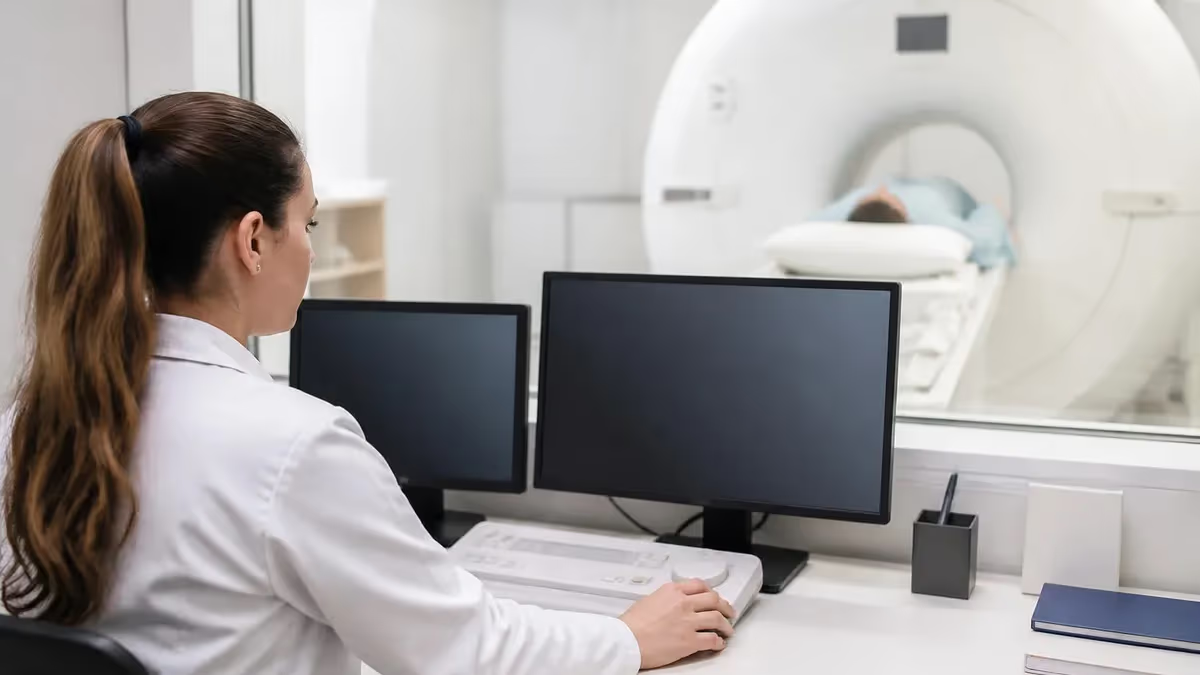
The cost of an MRI in the United States in 2026 varies wildly across facilities, geographies and clinical contexts. The same brain MRI that costs $400 cash at a freestanding outpatient imaging center can cost $3,500 at a hospital-based outpatient department across the street, with the image quality essentially identical at both. The price spread is one of the widest in American medicine and one of the few situations where actively shopping around saves substantial money — often more than $1,000 per scan for sophisticated patients willing to make a few phone calls.
The factors driving MRI cost are well-defined. Facility type is the biggest single factor — hospital outpatient departments charge two to three times what freestanding imaging centers charge for identical scans. Geography matters substantially with major coastal cities running 30% to 60% above the national average and rural areas running 20% to 30% below. Body part affects price modestly because larger or more complex anatomies require longer scan times. Adding contrast adds $200 to $400. Adding vascular sequences (MRA or MRV) adds another $200 to $500.
Insurance coverage shapes what you actually pay out of pocket dramatically. With insurance and a low deductible, your out-of-pocket cost may be a small copay even on a $3,000 hospital MRI. With insurance and a high deductible (common in modern plans), you may pay the full negotiated rate until the deductible is met. Without insurance, the cash price at a freestanding center is often dramatically lower than the listed insurance rate at the same facility, because cash patients avoid the administrative overhead of insurance billing.
This guide explains the cost of MRI in detail — typical price ranges by body part and facility type, the factors that drive price differences, how insurance handles MRI billing, the prior authorization process required by most payers, the cash and self-pay options that can save substantial money, and several specific strategies for reducing your out-of-pocket cost. Whether you have insurance or not, the key is to understand what drives price and where you have leverage.
Cost of MRI in 30 seconds
Brain MRI without contrast: $400 to $3,500. Spine MRI: $400 to $3,500. Knee MRI: $400 to $2,500. Abdomen or pelvis MRI: $500 to $4,000. Cost depends primarily on facility type — hospital outpatient runs 2-3x freestanding imaging center prices. Adding contrast adds $200-$400. Insurance typically covers 80% after deductible. Shopping cash prices at three local facilities saves $1,000+ on a typical scan.
The cost difference between hospital outpatient departments and freestanding imaging centers is the single biggest variable to understand. A hospital outpatient MRI department charges what is called the hospital outpatient prospective payment system rate plus facility overhead — substantially higher than what freestanding centers charge. The image quality is typically equivalent because both facility types use the same major-brand MRI machines (Siemens, GE, Philips, Canon). The price difference reflects different cost structures, not different technology.
Freestanding imaging centers operate on lower overhead. They specialize in imaging, run efficiently with smaller staffs and avoid the cost-allocation methods that drive hospital outpatient pricing. A network like RadNet, SimonMed, Akumin, or many regional freestanding center operators typically charges 30% to 60% of what a hospital charges for the same scan. The trade-off is that freestanding centers are not co-located with the rest of the medical care infrastructure — for an outpatient MRI ordered by an outside doctor, this rarely matters.
For inpatients (admitted to a hospital), the MRI is part of the hospital stay billing rather than a separate outpatient charge, and the cost calculation works differently. For most insured patients, inpatient MRI cost is bundled into the overall hospital bill with the patient's deductible and copay applying to the total stay rather than the individual scan. The shopping-around strategy applies to outpatient MRIs you can choose where to have done — not to scans performed during an inpatient stay.
Geographic variation is substantial within the U.S. New York City, San Francisco, Los Angeles, Boston, Washington DC and Miami are the most expensive markets, with MRI prices 30% to 60% above the national average. The Midwest, South and rural areas run 20% to 30% below the average. Patients in expensive markets sometimes save money by traveling to nearby smaller cities for outpatient imaging. The savings on a $3,000 scan can easily justify a 50-mile drive.
Factors driving MRI cost
Hospital outpatient departments charge 2 to 3 times what freestanding imaging centers charge for the same scan. The image quality is typically equivalent because both facility types use the same major-brand MRI machines. Choosing the right facility type is the single highest-leverage decision in controlling MRI cost.
Major coastal cities run 30% to 60% above the national average. Midwest, South and rural areas run 20% to 30% below. The same scan can vary by a factor of 2 between an expensive market and a value market in the U.S. Some patients save substantial money by traveling 50 to 100 miles for outpatient imaging.
Brain, spine and joint MRIs cluster in the lower price range ($400 to $3,500 typically). Abdominal, pelvic and cardiac MRIs run higher ($500 to $4,500) because they require longer scan times and often involve contrast. Whole-body screening MRI runs $1,500 to $4,500 at facilities offering it as an elective service.
Adding gadolinium contrast adds $200 to $400 to the base scan cost. Vascular sequences (MRA or MRV) add another $200 to $500. Some scans require contrast for diagnostic accuracy; others do not. If your doctor's order is flexible, ask whether the non-contrast version answers the clinical question — sometimes it does.
Insurance coverage for MRI nearly always requires prior authorization, which the ordering doctor's office obtains by submitting clinical documentation justifying the scan to your insurance company. The clinical criteria typically include documented symptoms with appropriate duration, failure of conservative treatment in non-emergent cases, the presence of red-flag findings, or a specific clinical scenario where MRI changes management within the next month. Without prior authorization, the patient may be responsible for the full cost.
The prior authorization process typically takes 3 to 7 business days. Some payers have faster paths for urgent cases. Some scans (cancer staging follow-up, post-surgical evaluation, suspected acute conditions like multiple sclerosis flares) get streamlined approval. Other scans (long-standing back pain, headaches without red flags) face stricter review and may be denied initially, requiring appeal with additional documentation. Always confirm prior authorization is in place before showing up for the scan; do not assume.
For insured patients, the actual out-of-pocket cost depends on the plan's deductible, coinsurance and out-of-pocket maximum. With a $1,500 deductible already met for the year, your share of a $3,000 hospital MRI might be 20% coinsurance ($600) up to your plan's annual out-of-pocket maximum. With a $5,000 deductible not yet met, you may pay the full negotiated rate of perhaps $1,800 (the insurance-negotiated price, lower than the chargemaster but still substantial). The math depends on where you are in the deductible cycle.
For uninsured patients, the cash price at freestanding centers is often dramatically lower than the chargemaster. Many freestanding imaging centers explicitly market cash-pay prices on their websites — $400 for a brain MRI without contrast, $600 with contrast, $500 for a knee MRI. The cash price is often less than the insurance-negotiated rate at the same facility, because cash patients avoid the administrative overhead of insurance billing and the risk of contested claims.
Typical MRI cost by body part
Brain MRI without contrast: $400 to $3,500. With contrast: $600 to $4,000. With MRA (vascular): add $200 to $500. Most common indication is headache, stroke, dementia or MS workup. Single most-performed MRI nationally. Wide price spread between hospital outpatient and freestanding centers makes shopping around especially valuable for this scan.
Saving money on MRI requires deliberate shopping. The three concrete steps that produce the biggest savings are: call three freestanding imaging centers within a 30-mile radius and ask the cash price for your specific scan; check whether your insurance carrier has steered you to a preferred network of imaging providers with discounted rates; and ask your ordering doctor whether the non-contrast version of the scan answers the clinical question, since adding contrast adds $200 to $400 even when not strictly required.
Cost transparency tools have improved dramatically since the 2021 federal price transparency rule took effect. Hospital websites are now required to publish their negotiated rates with each insurance company plus the cash price for each procedure. Tools like Healthcare Bluebook, MDsave, GoodRx (for imaging in addition to drugs), New Choice Health and Imaging Direct help patients compare prices across local facilities. The transparency is imperfect but substantially better than it was 5 years ago.
For uninsured or high-deductible patients, MDsave and similar marketplace platforms negotiate cash prices at participating providers and sell vouchers at fixed prices. A brain MRI voucher through MDsave at a participating freestanding center may cost $375 to $700 — substantially less than the same scan billed conventionally even with insurance. The voucher process is simple: pay online, receive an authorization code, schedule directly with the facility, present the code at check-in. No insurance billing complications.
For patients facing a major out-of-pocket cost, healthcare financing options include third-party medical credit cards (CareCredit is the largest), payment plans negotiated directly with the facility, and sliding-scale options at hospital systems for low-income patients. CareCredit offers promotional financing periods (typically 6, 12 or 24 months interest-free for amounts above $200) but charges high deferred interest if not paid in full by the end of the promotional period. Read the terms carefully before using.

The federal No Surprises Act, in effect since January 2022, protects insured patients from balance billing for emergency services and out-of-network charges at in-network facilities. For MRI specifically, this means an in-network facility cannot bill you for unexpectedly higher amounts because the radiologist who read the images was out-of-network. Patients facing surprise bills should dispute through the federal independent dispute resolution process. Most disputes are resolved in favor of patients.
Medicare coverage of MRI follows specific rules. Medicare Part B covers medically necessary outpatient MRIs at 80% after the annual deductible ($240 in 2026). The patient is responsible for the remaining 20% coinsurance. Medicare-approved freestanding imaging centers and hospital outpatient departments both bill Medicare directly; the patient pays only the coinsurance and any unmet deductible. Medicare does not require prior authorization for most MRIs but does require medical necessity documentation that the ordering doctor's office handles.
Medicare Advantage plans (Part C) cover MRIs through commercial insurance carriers operating under Medicare contract. Coverage rules vary by plan but most require prior authorization for advanced imaging. The patient's out-of-pocket cost depends on the specific plan's structure — copays, coinsurance and out-of-pocket maximums vary widely. Always check your specific Medicare Advantage plan's MRI coverage rules before scheduling.
Medicaid coverage of MRI varies substantially by state. Some states cover MRI fully with no patient cost-sharing for Medicaid recipients. Others have small copays. Some require prior authorization with specific clinical criteria. Most state Medicaid programs cover medically necessary MRIs but the bureaucratic burden of getting prior authorization can delay scans by weeks. Patients should engage their ordering doctor's office actively to push prior authorization through.
For Health Savings Account (HSA) and Flexible Spending Account (FSA) holders, MRI costs are fully eligible expenses. Pay with the HSA or FSA debit card or pay out of pocket and submit for reimbursement. The HSA path produces a triple tax advantage — pre-tax contributions, tax-free growth and tax-free withdrawals for qualified medical expenses. Patients with high-deductible plans can use HSAs to convert otherwise after-tax MRI costs into pre-tax expenses, saving 20% to 35% on the effective cost.
How to save on MRI cost checklist
- ✓Call three freestanding imaging centers for cash prices
- ✓Check your insurance's preferred imaging provider network
- ✓Ask doctor whether non-contrast version answers the clinical question
- ✓Compare hospital outpatient vs freestanding center pricing
- ✓Use Healthcare Bluebook, MDsave or GoodRx for price comparison
- ✓Confirm prior authorization is in place before scheduling
- ✓For uninsured patients, ask about cash discount
- ✓Use HSA or FSA funds for tax advantage if available
- ✓Consider traveling to a nearby lower-cost market if savings justify
The chargemaster price (the facility's listed retail price) is rarely what anyone actually pays. Insurance companies negotiate rates substantially below chargemaster — typically 30% to 60% of the listed price for major payers. Cash patients sometimes pay even less than the insurance-negotiated rate because they avoid administrative overhead. Always ask the facility for the actual price you would pay, whether you are using insurance or paying cash. The chargemaster number is largely irrelevant to actual patient costs.
For complicated billing situations, the facility's billing office is usually willing to work with you on payment plans or reduced rates if you ask early. A $2,500 bill that would otherwise become a collection action often gets reduced to $1,500 with a 30-day payment plan, simply because collecting from patients who cannot pay is expensive and uncertain for facilities. The leverage is greatest before the bill is sent to collections; after that point, the facility has already discounted the receivable to a third-party collector.
For employees with employer-sponsored insurance, ask HR whether the company has a navigator service or imaging steerage program. Many large employers contract with vendors (Castlight, Healthcare Bluebook, RBP plans) that direct employees to lower-cost imaging providers and may even pay bonuses for choosing the lower-cost option. The bonus can offset some of the patient's cost-sharing entirely. Smaller employers may have similar programs that are not actively marketed; ask explicitly.
For patients in narrow-network plans or HMOs, the choice of facility may be limited to in-network providers. Check the network directory carefully for freestanding imaging centers in addition to hospital outpatient departments — many HMO networks include lower-cost freestanding options that the doctor's referral may not explicitly steer toward. The patient's right to choose the in-network facility for the scan often produces meaningful savings within the constraint of network requirements.
Medical tourism for MRI is a real if niche option. Some patients in expensive U.S. markets travel to Mexico, Costa Rica or other countries with established medical tourism infrastructure for high-cost imaging. A brain MRI that costs $3,000 at a U.S. hospital may cost $300 to $500 at a reputable facility in Tijuana or San Jose. The cost includes travel logistics. Domestic medical tourism (traveling to a lower-cost U.S. market) is more common and easier to arrange — driving 100 miles to a freestanding imaging center can save $1,500 plus.
For repeat MRI surveillance (cancer follow-up, multiple sclerosis monitoring, post-surgical evaluation), the cumulative cost across multiple scans per year can be substantial. Building a relationship with a single lower-cost provider for repeat imaging produces better continuity of care and predictable cost. Some imaging centers offer surveillance pricing for multi-scan packages — a series of four scans over two years at a discount versus four separate one-off prices.
MRI cost quick reference
Where to compare MRI prices
Free price comparison tool aggregating self-reported and negotiated rates by procedure and ZIP code. Provides a fair price reference and shows how local providers compare. Useful for getting a baseline before calling facilities directly. Coverage varies by region; major metropolitan areas have the most data.
Marketplace selling pre-paid medical procedure vouchers including MRI. Negotiates fixed prices at participating freestanding centers. Pay online, receive authorization code, schedule directly with facility. Often substantially less than the conventional billing path even with insurance. Useful for high-deductible patients and uninsured patients.
Federal price transparency rule requires hospitals to publish negotiated rates with each major insurance company plus the cash price for each procedure. Hospital websites have varying degrees of usability; the data is there but not always easy to find. Helpful for confirming what your specific insurance pays at a specific facility.
After any prior insurance-paid MRI, review the Explanation of Benefits (EOB) to see what your insurer paid versus what you were billed. The EOB shows the negotiated rate and your share. Patterns over time reveal which facilities your insurance has best negotiated rates with — useful for choosing facilities for future scans.
For patients with pre-existing relationships with specific imaging centers (familiarity with the staff, prior images on file for comparison), the value of continuity sometimes justifies paying somewhat more. Comparison MRIs are clinically valuable, and centers with your prior images can produce them quickly without record requests. The continuity premium is real but usually under 20%; if a familiar facility costs 50% more than a new one, the continuity advantage rarely justifies the difference.
For ongoing MRI surveillance protocols (cancer survivors, MS patients, post-surgical follow-up), establishing the cost-effective long-term provider early in the surveillance journey produces meaningful savings over multiple years. Five MRIs at $1,500 each over a surveillance period costs $7,500; five MRIs at $500 each costs $2,500. The $5,000 savings over a multi-year surveillance period is meaningful for most household budgets and is essentially a one-time decision about where to go.
For patients who recently received an unexpectedly high MRI bill, the practical first step is to contact the facility billing office and ask for an itemized bill. Errors are common — duplicate charges, services billed but not delivered, contrast charged when the scan was non-contrast. Identifying and disputing errors often produces meaningful reductions before any negotiation begins. The itemized bill is also the foundation for any insurance appeal if the claim was processed incorrectly.
MRI: Pros and Cons
- +MRI credential is recognized by employers and industry professionals
- +Higher earning potential compared to non-credentialed peers
- +Expanded career opportunities and professional advancement
- +Structured learning path builds comprehensive knowledge
- +Professional development that stays current with industry standards
- −Preparation requires significant time and study commitment
- −Associated costs for exams, materials, and renewal fees
- −Continuing education needed to maintain credentials
- −Competition for advanced positions can be challenging
- −Requirements and standards may vary by state or region
MRI Questions and Answers
About the Author

Medical Laboratory Scientist & Clinical Certification Expert
Johns Hopkins UniversityDr. Sandra Kim holds a PhD in Clinical Laboratory Science from Johns Hopkins University and is certified as a Medical Technologist (MT) and Medical Laboratory Scientist (MLS) through ASCP. With 16 years of clinical laboratory experience spanning hematology, microbiology, and molecular diagnostics, she prepares candidates for ASCP board exams, MLT, MLS, and specialist certification tests.
Join the Discussion
Connect with other students preparing for this exam. Share tips, ask questions, and get advice from people who have been there.
View discussion (8 replies)