
What to Expect at MEPS for Army: Your Complete Processing Guide 2026 October
What do you do at MEPS for Army? 🎯 Full walkthrough of medical exams, ASVAB, background checks & oath. Know exactly what to expect.

If you are preparing to join the United States Army, understanding what do you do at MEPS for Army processing is one of the most important steps you can take before you ever set foot in the building. MEPS — the Military Entrance Processing Station — is the federally operated facility where every military applicant goes through a standardized series of evaluations that determine whether they are physically, mentally, and morally qualified to serve.
For Army applicants specifically, the day at MEPS is long, structured, and consequential, often lasting anywhere from 8 to 14 hours depending on the station and the applicant's individual circumstances.
The MEPS process is not a single test. It is a comprehensive pipeline that includes the Armed Services Vocational Aptitude Battery (ASVAB) for those who have not already completed it, a thorough physical examination that covers everything from vision and hearing to orthopedic flexibility and blood pressure, a urinalysis for drug screening, a background and moral character review, and finally, if everything is approved, the moment every recruit looks forward to — the Oath of Enlistment.
Understanding what does meps stand for and what each stage involves can dramatically reduce anxiety and help you show up prepared on your processing day.
Many recruits make the mistake of walking into MEPS without knowing what to expect, leading to confusion, delays, or even disqualification for easily avoidable reasons. For example, something as simple as wearing underwire in a bra, bringing a prohibited personal item, or failing to disclose a medical history can derail your entire processing day. The Army's relationship with MEPS is non-negotiable — there is no alternative route to enlistment, and every single soldier, regardless of their future MOS or enlistment bonus, must clear this same checkpoint.
MEPS facilities are jointly operated by the Department of Defense and staffed with military medical officers, civilian examiners, and administrative personnel who handle thousands of applicants each month. There are 65 MEPS locations across the United States, and most Army applicants are assigned to the MEPS nearest their home or recruiting station. Applicants typically travel the evening before their processing day and stay at a government-contracted hotel — also called a MEPS hotel or Lodging — so they can report to the station by 5:30 to 6:00 AM the following morning.
Preparation is everything when it comes to MEPS. From getting adequate sleep the night before, to eating a light breakfast, to arriving with the correct documentation, to knowing exactly which medical disclosures you must make, the recruits who have the smoothest processing days are almost always the ones who did their homework in advance. This guide will walk you through every stage of Army MEPS processing in detail, so you can walk in with confidence and walk out with your enlistment papers signed.
Throughout this article, we will cover the timeline of a typical MEPS day, the specific medical standards the Army uses to evaluate recruits, the ASVAB score requirements for Army enlistment, common disqualifiers and how waivers work, and practical tips from recruits and veterans who have been through the process. Whether this is your first visit to MEPS or you are returning after a disqualification, this guide has everything you need to succeed.
It is also worth noting that MEPS standards are set by federal regulations, meaning that what happens at MEPS in Atlanta is substantively the same as what happens at MEPS in Los Angeles or Chicago. That consistency is intentional — it ensures a fair, uniform evaluation process for every person who seeks to serve, regardless of geography or recruiting office.
MEPS by the Numbers

MEPS Day Timeline: Hour by Hour
5:30–6:00 AM — Check-In
6:30–8:00 AM — ASVAB Testing
8:00–12:00 PM — Medical Examination
12:00–1:00 PM — Lunch Break
1:00–3:00 PM — Background Review & Job Selection
3:00–4:30 PM — Oath of Enlistment
The medical examination at MEPS is the cornerstone of the entire processing day, and for Army applicants, it is also the phase where the greatest number of initial disqualifications occur. The exam follows Department of Defense Instruction 6130.03, which establishes medical standards for military service across all branches. Army-specific standards are then layered on top of those baseline requirements, meaning that a condition that might qualify you for the Navy could still disqualify you for certain Army roles. Understanding this hierarchy is critical before you walk through the MEPS door.
Your medical day begins with a review of your medical history forms, which you will have pre-filled with your recruiter. These forms ask about everything from childhood illnesses and surgeries to mental health treatment, prescription medications, and prior injuries. Honesty on these forms is not just morally required — it is legally required. Providing false information on a federal military enlistment document is a felony. More practically, undisclosed conditions discovered later in your service career can result in discharge under other-than-honorable conditions, which carries lifelong consequences for benefits and employment.
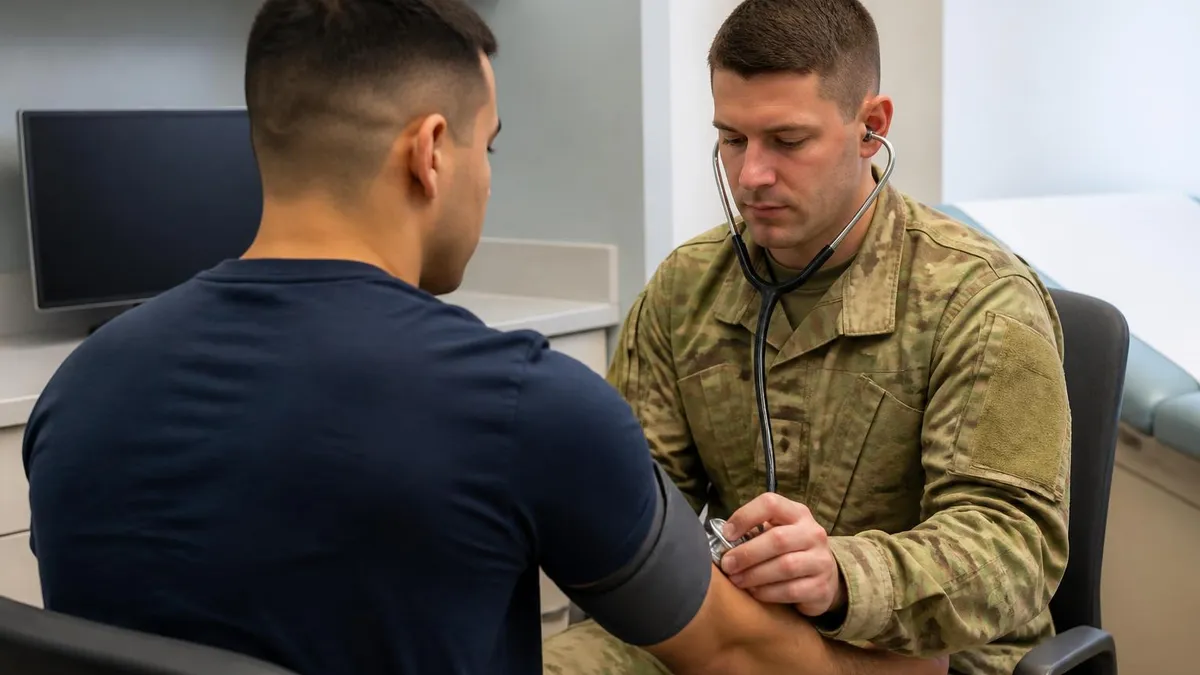
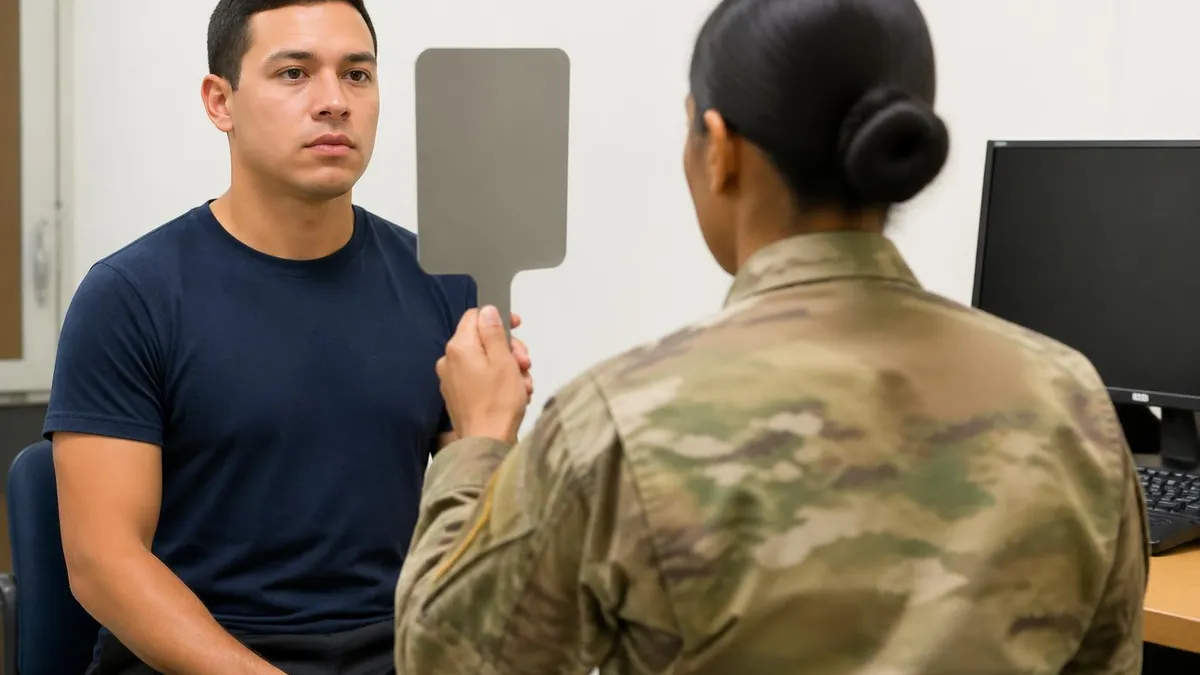
The physical stations at MEPS include a vision screening that tests for visual acuity, color vision, and depth perception; a hearing test conducted in a soundproofed booth; a blood pressure and pulse check; a blood draw for a complete blood count and infectious disease screening; and a urinalysis that serves simultaneously as a drug test and a metabolic panel.
Each of these screenings has specific pass/fail thresholds established by regulation. For example, Army recruits must have uncorrected vision no worse than 20/200 in either eye, correctable to 20/20 with lenses, and must pass a red-green color vision test for most combat and technical MOSs.
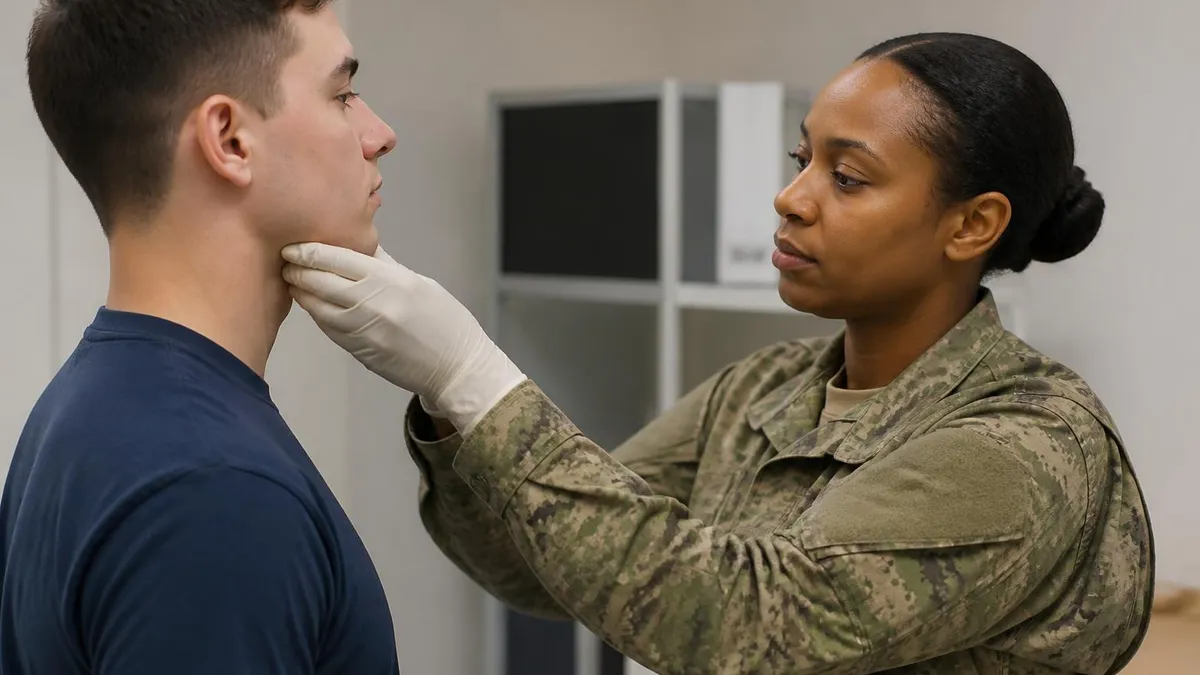
The orthopedic screening is one of the most comprehensive parts of the physical. A MEPS medical technician will walk you through a series of movements — squats, lunges, the "duck walk," arm circles, and range-of-motion tests for your neck and back. These movements are designed to detect hidden musculoskeletal issues including joint instability, limited range of motion, and chronic pain conditions that could be worsened by the physical demands of Army service. Applicants with a history of knee surgery, torn ligaments, or spinal issues will face additional scrutiny at this station.
Height and weight standards at MEPS reflect the Army's own Body Composition standards. If you are outside the acceptable weight range for your height, you will be measured for body fat using the Army's tape test method — circumference measurements at the neck and waist for males, and neck, waist, and hips for females.
Failure to meet body composition standards does not automatically disqualify you on the spot, but it flags you for additional review and may delay your processing. Your recruiter should help you address this before your MEPS date. Applicants from tampa meps and many other stations report that the weight check is often the first screening of the morning, so knowing your numbers in advance is essential.
After the individual station screenings, you will meet with a MEPS physician — either a uniformed military doctor or a contracted civilian physician — for a comprehensive review of your findings and medical history. This is your opportunity to ask questions and to clarify any conditions on your forms. The physician will make a preliminary determination of qualified, temporarily disqualified, or permanently disqualified. Temporary disqualifications often result from conditions that can be resolved with documentation, such as providing surgical records, specialist letters, or proof of resolved treatment.
Mental health history is a particularly sensitive area of the MEPS medical examination. The Army has specific policies regarding a history of depression, anxiety disorders, ADHD, and other psychological conditions. In many cases, a history of treatment does not automatically disqualify you — what matters is the nature of the condition, the duration and type of treatment, and whether it has been resolved.
If you had a childhood ADHD diagnosis but have not required medication or treatment for several years and have functioned normally, a waiver may be available. Being prepared to discuss your mental health history honestly and with supporting documentation is the most effective strategy.
MEPS ASVAB, Background Check & Moral Screening
The Armed Services Vocational Aptitude Battery is a multi-section aptitude test that measures your capabilities across nine domains including general science, arithmetic reasoning, word knowledge, paragraph comprehension, mathematics knowledge, electronics information, auto and shop information, mechanical comprehension, and assembling objects. Your AFQT score — derived from four of those subtests — determines basic enlistment eligibility. The Army requires a minimum AFQT score of 31 for high school graduates and 50 for GED holders. However, most Army jobs require significantly higher line scores in specific categories, so maximizing your ASVAB performance expands your MOS options considerably.
The CAT-ASVAB administered at MEPS is computer-adaptive, meaning the difficulty of each question adjusts based on your previous answers. This format typically results in a shorter test than the paper version while maintaining accuracy. You cannot skip questions or go back to change answers on the CAT-ASVAB. Most applicants complete the full battery in two to three hours. Scores are typically available within minutes on the computer and are reviewed immediately by your MEPS guidance counselor to assess your job eligibility during the afternoon MOS selection session.

Advantages and Challenges of the MEPS Process
- +Comprehensive medical screening catches conditions early, protecting recruits from service-related injury aggravation
- +Standardized national process ensures every Army recruit is evaluated fairly regardless of location
- +ASVAB scores taken at MEPS are valid for two years and can be used for multiple branch applications
- +MOS selection at MEPS happens with full knowledge of your scores, giving you real negotiating information
- +The Oath of Enlistment at MEPS is a formal, memorable milestone that marks the true beginning of service
- +MEPS lodging and meals are provided at government expense, reducing financial burden on applicants
- −Processing days are extremely long — often 10 or more hours of waiting, testing, and examinations
- −Minor undisclosed medical conditions can cause delays or disqualification even when they pose no real risk
- −Limited privacy during physical examinations can be uncomfortable for many applicants
- −MOS job availability at the moment of signing may not include your first-choice career field
- −Temporary disqualifications require additional documentation that can delay enlistment by weeks or months
- −Anxiety about the unknown process causes many recruits unnecessary stress that could be reduced with better preparation
Pros and Cons at a Glance
| Pros | Cons |
|---|---|
| Comprehensive medical screening catches conditions early, protecting recruits from service-related injury aggravation | Minor undisclosed medical conditions can cause delays or disqualification even when they pose no real risk |
| Standardized national process ensures every Army recruit is evaluated fairly regardless of location | Limited privacy during physical examinations can be uncomfortable for many applicants |
| ASVAB scores taken at MEPS are valid for two years and can be used for multiple branch applications | MOS job availability at the moment of signing may not include your first-choice career field |
| MOS selection at MEPS happens with full knowledge of your scores, giving you real negotiating information | Temporary disqualifications require additional documentation that can delay enlistment by weeks or months |
| The Oath of Enlistment at MEPS is a formal, memorable milestone that marks the true beginning of service | Anxiety about the unknown process causes many recruits unnecessary stress that could be reduced with better preparation |
MEPS Day Preparation Checklist for Army Applicants
- ✓Bring your original Social Security card and government-issued photo ID or birth certificate
- ✓Wear comfortable, loose-fitting clothing — avoid underwire, metal accessories, and tight shoes
- ✓Get at least 8 hours of sleep the night before and avoid alcohol for at least 48 hours
- ✓Eat a light, healthy breakfast — avoid caffeine-heavy drinks that could improve your blood pressure reading
- ✓Disclose ALL medical history accurately on your forms, including childhood conditions and prescription medications
- ✓Know your ASVAB score if you have already tested, or arrive ready to test on your MEPS day
- ✓Bring any medical records, surgical documentation, or specialist letters your recruiter advised you to carry
- ✓Review your criminal history and ensure all disclosures on your background forms are complete and honest
- ✓Confirm your MEPS hotel check-in time and government transportation pickup schedule with your recruiter
- ✓Leave all electronics, valuables, and prohibited items at home or secured in your hotel room before reporting
Disclosure Always Beats Concealment
The single most common reason recruits are delayed or flagged at MEPS is failure to disclose medical or legal history. MEPS examiners are not adversaries — their job is to assess fitness, not to reject you. Honest disclosure paired with supporting documentation almost always results in a faster, smoother processing day than information discovered during examination without prior disclosure. When in doubt, tell your recruiter first and let them help you navigate the documentation process.
Disqualifiers at MEPS fall into two broad categories: permanent disqualifiers, which cannot be waived regardless of circumstances, and temporary or waiverable disqualifiers, which may be overcome with documentation, additional evaluation, or command-level review. Understanding which category your condition falls into — before you ever arrive at MEPS — is one of the most valuable pieces of preparation you can do. Your recruiter should be your first point of contact for this assessment, but you can also review Department of Defense Instruction 6130.03 directly, which is publicly available and lists the medical standards for military service in granular detail.
Permanent medical disqualifiers for Army enlistment include conditions such as a history of schizophrenia or psychotic disorders, severe scoliosis with a curvature greater than 30 degrees, insulin-dependent diabetes mellitus, active tuberculosis, HIV-positive status under current regulations, and missing limbs or digits that impair functional performance. These conditions represent absolute bars to military service and no waiver process exists that can overcome them. If you have one of these conditions, your recruiter should counsel you accordingly before your MEPS date to avoid wasting your time and the government's resources.
Waiverable conditions represent a much larger category, and this is where many recruits find hope after an initial disqualification. Common waiverable conditions include a history of asthma with no symptoms after age 13, prior knee surgery with documented full recovery, a history of depression or anxiety with successful treatment and period of stability, certain vision deficiencies correctable by surgery such as PRK or LASIK, and prior drug use that does not meet the threshold for permanent disqualification. The waiver process begins with your recruiter, who submits a waiver request to the appropriate Army authority along with supporting documentation.
The Army grants waivers based on a holistic review that considers the nature and severity of the condition, the recency of any treatment or incident, the specific MOS being requested, and the Army's overall accession needs at the time of the request. This means that waiver approval rates can vary depending on whether the Army is in a high-recruitment or low-recruitment cycle.
During periods of high demand for soldiers, waiver approval rates tend to be more favorable. Applicants who have been disqualified should work with their recruiter to build the strongest possible waiver package, including letters from treating physicians, test results demonstrating resolved conditions, and personal statements.
The dallas meps dallas tx station, like all MEPS, processes waiver paperwork through the Army Recruiting Command's medical review office. Turnaround times for waiver decisions can range from a few weeks to several months depending on the complexity of the case and the documentation submitted. Applicants should be patient and proactive — following up with their recruiter regularly and providing any additional documentation requested promptly. Delays in the waiver process are almost always caused by missing or incomplete documentation, not by the underlying condition itself.
Body composition waivers deserve special mention because they are among the most common issues MEPS applicants face. If you arrive at MEPS overweight by Army standards, you will not be immediately disqualified — but you may be sent home with a requirement to return once you meet the standards. Your recruiter can help you develop a fitness and nutrition plan to meet the standards before your rescheduled MEPS date. Some MEPS stations conduct a "pre-MEPS" physical with your recruiter to catch these issues in advance, giving you time to correct them before the official processing day.
Legal disqualifiers follow a similar framework. Felony convictions, particularly those involving violence, firearms, or controlled substances, are the hardest to waive and sometimes represent permanent bars. Misdemeanor convictions, minor in possession of alcohol, and marijuana use below a certain threshold are routinely waived for otherwise qualified applicants. The key in every case is honest, complete disclosure backed by court documentation. Your recruiter needs certified copies of all charging documents, dispositions, and sentencing orders to build a complete waiver package.

Many recruits assume a prior medical condition or legal issue automatically disqualifies them from Army service and never speak to a recruiter. This is a common and costly mistake. The list of waiverable conditions is extensive, and MEPS examiners make determinations on a case-by-case basis. Always consult with an Army recruiter before concluding that you cannot enlist — your situation may be more common and more manageable than you realize.
The Oath of Enlistment is the culminating event of your MEPS day, and for most recruits it is one of the most emotionally significant moments of their early military journey. After all medical screening is completed, all background reviews are approved, and all enlistment contracts are signed, eligible applicants are gathered in a designated room — typically a small auditorium or formal meeting space — where a uniformed military officer administers the oath.
In some MEPS facilities, family members who have traveled to the station are permitted to witness the ceremony, which typically lasts less than ten minutes but carries enormous symbolic weight.
The oath itself is established by federal statute at 10 U.S.C. § 502 and reads as follows: "I, (name), do solemnly swear (or affirm) that I will support and defend the Constitution of the United States against all enemies, foreign and domestic; that I will bear true faith and allegiance to the same; and that I will obey the orders of the President of the United States and the orders of the officers appointed over me, according to regulations and the Uniform Code of Military Justice.
So help me God." These words are not a formality — they are a legally binding contract between the recruit and the United States government, enforceable under the Uniform Code of Military Justice.
If you are enlisting through the Delayed Entry Program (DEP), you will take the oath at MEPS on your initial visit and then report back to MEPS on your ship date — the day you depart for Basic Combat Training — to complete a secondary verification physical and take the oath a second time before boarding your government transportation.
The DEP period can last anywhere from a few days to up to a year, depending on training seat availability for your MOS and the Army's recruitment pipeline. During the DEP period, you remain a civilian but are subject to DEP regulations including physical fitness standards and conduct requirements.
Understanding fort jackson meps columbia sc and other station-specific procedures helps applicants appreciate how the oath ceremony can vary slightly in formality and setting from station to station, though the words and legal significance are identical. Some MEPS locations have invested in more formal ceremonial spaces with flags, staging areas, and photography opportunities; others conduct the oath in a more utilitarian setting. Regardless of the physical environment, the commitment you make in that room is the same.
After the oath, you will receive copies of your signed enlistment contract, your DD Form 4 (Enlistment/Reenlistment Document), and any other processing paperwork. Keep these documents in a safe place — they will be referenced throughout your military career and are particularly important during in-processing at Basic Combat Training. Your recruiter will also maintain copies and will typically arrange your transportation to Basic or coordinate your return home if you are in the DEP. The MEPS staff will provide a final briefing on what to expect at your reporting date.
For recruits heading directly to Basic Combat Training from MEPS — sometimes called "ship day" applicants — the transition is immediate and often emotionally intense. You may go directly from the oath ceremony to government transportation to the airport or bus station. Packing light is advised; most personal items are not permitted at Basic Combat Training and will need to be mailed home. Your recruiter should provide a specific packing list approved for your training installation. First impressions at Basic start the moment you board that transportation, so arriving composed, respectful, and mentally prepared sets the right tone.
The Army uses MEPS data — your medical profile, ASVAB scores, and background clearance level — throughout your career, not just at the point of enlistment. Your PULHES medical profile established at MEPS determines which assignments and training schools you are eligible for.
Your ASVAB scores may be used to assess your suitability for reclassification into a new MOS if your career path changes. And your moral character record, though it begins before MEPS, is a foundation that influences your eligibility for advanced positions and security clearances. Treat your MEPS day as the first chapter of a long military record, not just a one-time hurdle.
Practical preparation for MEPS goes well beyond paperwork and medical records. The recruits who have the smoothest MEPS days share a common set of habits and mindsets that are worth adopting well in advance of your appointment. Start by conducting a thorough self-assessment of your health history using your own medical records. If you do not have copies of records for past surgeries, hospitalizations, or mental health treatment, request them from the relevant providers now — these requests can take weeks, and arriving at MEPS without documentation for a disclosed condition is one of the most common sources of delays.
Physical fitness preparation for MEPS is distinct from fitness preparation for Basic Combat Training. At MEPS, you are not being evaluated on how fast you can run or how many push-ups you can do — you are being evaluated on your structural health, body composition, and absence of disqualifying conditions.
That said, being in good physical shape helps in several indirect ways: it keeps your weight and body fat in range, it ensures your blood pressure and resting heart rate are within normal limits, and it means your orthopedic stations will show full, unrestricted range of motion. Start maintaining a consistent fitness routine at least eight to twelve weeks before your MEPS date.
Sleep is non-negotiable in the days before MEPS. Chronic sleep deprivation can temporarily improve blood pressure, impair cognitive performance on the ASVAB, and exacerbate anxiety to a degree that interferes with your performance throughout the day. Aim for seven to nine hours of sleep each night in the week leading up to your MEPS appointment, and make a special effort to sleep well the night at the MEPS hotel. Some recruits report difficulty sleeping due to nerves; a relaxation routine including light stretching and avoiding screens for an hour before bed can significantly improve sleep quality.
Diet in the 24 to 48 hours before MEPS also matters more than most recruits realize. Avoid high-sodium foods that can temporarily improve blood pressure. Avoid alcohol entirely for at least 48 hours, as it shows up in your system and can also raise your blood pressure and heart rate.
Drink plenty of water — you will need to provide a urine sample for the drug screen, and being well-hydrated ensures you can produce the sample promptly without delays. Eat a light, nutritious breakfast the morning of MEPS. Skipping breakfast to avoid feeling sick during the physical is a common mistake — low blood sugar can make you dizzy during the orthopedic screening, which involves physical movement and balance challenges.
Clothing choice for MEPS day sounds trivial but genuinely matters. Wear slip-on shoes or shoes you can remove quickly — you will take them off at multiple stations. Avoid belts with metal buckles, underwire bras, and clothing with excessive metal hardware, as these slow down the screening process at stations that use metal detection.
Wear comfortable, modest clothing that you can move freely in — the orthopedic screening will require you to squat, bend, and perform range-of-motion movements. Avoid overly casual clothing like shorts or tank tops; while there is no formal dress code, dressing respectably reflects well on your character and sets a professional tone.
Mental preparation may be the most underrated aspect of MEPS readiness. Many recruits arrive already anxious, and the long waits between stations, the clinical environment, and the high-stakes nature of the evaluation can amplify that anxiety. Having a realistic mental model of the day — which this article provides — dramatically reduces anxiety by replacing the unknown with the known. Practice grounding techniques if you are prone to anxiety: deep breathing, mindfulness, or simply reminding yourself that the vast majority of applicants who walk into MEPS in good health and with honest paperwork walk out cleared for service.
Finally, have a plan for the afternoon MOS selection session. Review Army job requirements and ASVAB line score thresholds before your MEPS day so you arrive informed. If you have a preferred MOS, know what line scores it requires and confirm whether your scores meet those thresholds.
If you are open to options, research a range of MOSs across categories — infantry, intelligence, signal, medical, logistics — so you can make an informed choice during your counseling session. The recruits who feel most satisfied with their Army enlistment contracts are usually those who came to MEPS with clear preferences and the knowledge to advocate for the jobs that fit their goals.
Sample MEPS - Military Entrance Processing Stations Practice Questions
Try these questions from our free MEPS - Military Entrance Processing Stations practice tests. The correct answer and an explanation follow each question.
Which composite score does the Army use for intelligence and information technology jobs?
- A. Skilled Technical (ST)
- B. General Technical (GT)
- C. Electronics (EL)
- D. Clerical (CL)
Answer: A. Skilled Technical (ST)
The Army's Skilled Technical (ST) composite is used for intelligence, information technology, and many technical MOS fields.
If an Army applicant wants to become a 35M (Human Intelligence Collector), which line score is most critical?
- A. Mechanical Maintenance (MM)
- B. Skilled Technical (ST)
- C. Clerical (CL)
- D. Field Artillery (FA)
Answer: B. Skilled Technical (ST)
The 35M MOS (Human Intelligence Collector) requires a minimum Skilled Technical (ST) score of 101.
When a job counselor at MEPS discusses 'Option 40' with an Army recruit, what is being offered?
- A. A contract option to attempt Ranger Assessment and Selection Program (RASP) after basic training
- B. A guaranteed assignment to Fort Bragg upon completion of AIT
- C. An enlistment bonus for airborne school attendance
- D. A waiver for minor criminal offenses in exchange for service
Answer: A. A contract option to attempt Ranger Assessment and Selection Program (RASP) after basic training
Option 40 is an Army enlistment option that guarantees the recruit an opportunity to try out for the 75th Ranger Regiment by attending RASP after airborne school.
During the waiver process, who ultimately approves a moral waiver for enlistment into the Army?
- A. The MEPS commander
- B. The recruiting battalion commander or higher authority
- C. The Secretary of the Army
- D. The individual recruiter who submitted the application
Answer: B. The recruiting battalion commander or higher authority
Moral waivers in the Army are typically approved at the recruiting battalion commander level, though serious offenses may require higher authority.
Take the full MEPS - Military Entrance Processing Stations practice test
MEPS Questions and Answers

MEPS Drug Test: How Long MEPS Takes & What to Expect
Fort Dix MEPS Fort Dix NJ: Complete Processing Guide
MEPS San Antonio: Your Complete Guide to Fort Sam Houston Processing
MEPS Meaning: What Is a Military Entrance Processing Station?

MEPS Disqualifiers: Complete Guide to Military Entrance Processing Standards
About the Author

Retired Military Officer & Armed Forces Test Preparation Specialist
United States Army War CollegeColonel Steven Harris (Ret.) served 28 years in the US Army, earning a Master of Arts in Military Science from the Army War College and a Bachelor of Science in Criminal Justice. He has coached thousands of military enlistment and officer candidate program applicants through the ASVAB, AFQT, AFCT, OAR, and officer selection assessment processes across all military branches.
Join the Discussion
Connect with other students preparing for this exam. Share tips, ask questions, and get advice from people who have been there.
View discussion (8 replies)