
Lying at MEPS: Consequences, Risks, and What You Must Know Before Processing
Thinking about lying at MEPS? 🎯 Learn the real consequences — discharge, federal charges, and lifetime bans — before you make a career-ending mistake.

The question of how to lie at MEPS crosses the mind of many applicants who worry that a past medical issue, prior arrest, or undisclosed drug use might derail their military dreams. Understanding meps what is it and exactly what happens at the Military Entrance Processing Station is the first step every recruit must take — because MEPS is far more rigorous than most people expect, and the consequences of dishonesty there are severe, permanent, and often federal in nature.
MEPS, which stands for Military Entrance Processing Station, is the gateway through which virtually every person who enlists in the United States Armed Forces must pass. During your MEPS visit, trained examiners, physicians, and investigators gather comprehensive background information, conduct physical evaluations, administer aptitude tests, and verify every piece of information you provide on your enlistment paperwork. The process is designed with redundancy and cross-referencing built in, meaning that a lie told in one portion of processing is very likely to be caught when compared against data collected in another.
Federal law treats fraudulent enlistment as a serious crime. Under 18 U.S.C. § 1001, making false statements to a federal government agency — including MEPS examiners — is punishable by up to five years in federal prison. Beyond the criminal exposure, applicants who lie and are subsequently caught face administrative discharge under less-than-honorable conditions, repayment of any signing bonuses received, and a permanent bar from future military service in any branch. These are not hypothetical risks; they are outcomes that occur every single year across all service branches.
The background investigation conducted at MEPS is more thorough than most applicants realize. Examiners access criminal databases, medical records (when authorized), driving history, credit reports, and Social Security records. They compare your answers against those databases in real time. Military recruiters, who sometimes encourage applicants to minimize or omit disqualifying information, can also face serious consequences for coaching applicants to lie — so the pressure to shade the truth can come from unexpected directions, making it even more important that you understand the rules clearly before you walk through the MEPS door.
This article will walk you through every dimension of the lying-at-MEPS issue: what examiners actually check, what gets discovered and when, how fraudulent enlistment charges work, what happens if a lie surfaces after you've already shipped to basic training, and what legal pathways exist for applicants with genuine disqualifying histories. We cover the waiver process, the moral waiver process, and why honest disclosure almost always produces better outcomes than concealment — even when the truth is uncomfortable.
Whether you are a first-time applicant nervous about a sealed juvenile record, a prior-service member hoping to re-enlist after a period of instability, or a parent trying to counsel a young person considering military service, this guide provides the factual, unvarnished information you need. The military needs quality recruits, and the system is specifically designed to find honest people who can be trusted with weapons, classified information, and the lives of their fellow service members. Honesty is not just a moral virtue at MEPS — it is the foundation of a sustainable military career.
By the time you finish reading, you will understand precisely why attempting to deceive MEPS examiners is one of the worst decisions a prospective service member can make, and you will know the legitimate channels available for addressing the issues that might tempt someone to lie in the first place. Knowledge is your most powerful tool at MEPS — use it wisely.
MEPS Lying Consequences by the Numbers

What MEPS Verifies at Each Stage of Processing
Pre-Screening and Records Request
Medical History Questionnaire (DD Form 2807)
Physical Examination
Drug and Alcohol Screening
Background Investigation and Records Check
Final Interview and Oath
The types of lies told at MEPS fall into several distinct categories, each carrying its own profile of risk and consequence. The most common category involves medical history omissions — applicants who fail to disclose asthma, ADHD diagnoses, prior mental health treatment, surgeries, or prescription medication histories. The temptation here is understandable: many of these conditions are potentially disqualifying, and applicants fear that honest disclosure will end their military career before it begins. What they fail to calculate is that omitting a treated medical condition is detectible through pharmacy benefit records, insurance claims histories, and the physical examination itself.
Criminal history concealment is the second major category of MEPS fraud. This includes failing to disclose arrests that did not result in conviction, misdemeanor guilty pleas, deferred adjudication sentences, traffic offenses above a certain severity threshold, and juvenile adjudications. Many applicants mistakenly believe that an expunged record or a case that was dismissed does not need to be disclosed. MEPS specifically asks about arrests and charges regardless of outcome, and failure to disclose them — even when the legal proceeding was resolved favorably — constitutes a false statement on federal paperwork.
Drug use concealment is the third category and the one most reliably caught during the MEPS visit itself. If you deny any drug use and your urinalysis returns positive, you have simultaneously committed a disqualifying act and provided documented evidence of a false statement. Even for drug use that falls outside the detection window of a standard urinalysis — meaning use that occurred months or years before your MEPS visit — examiners are trained to probe for inconsistencies between stated drug history and physical presentation. Certain patterns of past drug abuse leave long-term physiological markers that experienced MEPS physicians recognize.
Financial fraud, including concealment of prior bankruptcies, defaulted student loans, or significant unpaid judgments, is particularly relevant for applicants seeking security clearances. The higher the clearance level required for your desired military occupational specialty, the more thoroughly your financial background will be scrutinized.
Applicants who lie about financial history during MEPS and are later subjected to a full security clearance investigation face the compounding problem of having the lie documented in a federal investigation file, which is far more damaging to long-term clearance eligibility than the original financial issue would have been. For applicants at locations like dallas meps dallas tx, the same federal databases are accessed regardless of which MEPS location you process through.
Prior military service concealment — including prior discharges, administrative separations, or time served in a different branch — is another category of fraud that MEPS catches with high reliability. Every prior service member's records are stored in the Defense Manpower Data Center (DMDC), which MEPS examiners query as a standard part of processing. Claiming to be a first-time enlistee when you have prior service is caught in virtually every case, often before the applicant even sits down with an examiner.
Dependency fraud — failing to disclose dependents, marriages, or financial obligations — affects both your legal qualification to enlist and the benefits package you receive. Married applicants who claim to be single, or applicants with children who conceal those dependents, may receive incorrect housing allowances and family separation pays. When audited, these overpayments must be repaid in full, and the original concealment can support a fraudulent enlistment finding even if the underlying conduct was not the primary issue under review.
The consequences in each category are proportional to the severity of the omission and the point at which it is discovered. An omission caught during initial processing typically results in disqualification and potential re-application with a waiver. An omission discovered after enlistment — especially after a signing bonus has been paid or after security clearance processing has begun — almost always results in the most severe administrative and criminal consequences available under the Uniform Code of Military Justice and federal civilian law.
How MEPS Military Investigators Catch Lies
MEPS examiners have real-time access to a network of federal and state databases that most applicants are entirely unaware of. These include the National Crime Information Center, the FBI's Interstate Identification Index, the Defense Manpower Data Center, the Social Security Administration's records, and — for applicants requiring security clearances — the Consolidated Adjudication Facility's prior investigation files. Each database cross-references your self-reported information against independently maintained records, creating a multi-layer verification net that catches omissions with high consistency.
State-level databases add another layer of verification that catches locally managed records that do not always flow into federal systems immediately. Many applicants assume that a state-level charge or a county court civil judgment is invisible to federal examiners — this assumption is wrong. MEPS maintains liaison relationships with state law enforcement agencies and has procedures for querying local records when an applicant's stated history raises inconsistencies. The combination of federal and state database access means that the information blackout zone applicants imagine is much smaller than they believe.

Honest Disclosure vs. Concealment: Comparing Your Options
- +Eligible for waiver consideration for most disqualifying conditions when disclosed honestly
- +Preserves your legal standing — no criminal exposure for false federal statements
- +Allows your military career to be built on a foundation that withstands later investigation
- +Recruiters can advocate for you more effectively with full, accurate information
- +Security clearance adjudicators consistently treat honest disclosure more favorably than discovered concealment
- +Avoids the compounding damage of a lie being caught after bonuses have been paid or clearances granted
- −Some conditions may require a lengthy waiver process that delays your enlistment timeline
- −Certain disqualifying factors — particularly serious felonies — have very limited waiver pathways
- −Honest disclosure of drug use history may restrict available military occupational specialties
- −Mental health history disclosure can trigger additional evaluation requirements and processing delays
- −Financial history issues may limit clearance eligibility for intelligence or special operations roles
- −Juvenile record disclosure, even for minor offenses, adds paperwork and processing complexity
Pros and Cons at a Glance
| Pros | Cons |
|---|---|
| Eligible for waiver consideration for most disqualifying conditions when disclosed honestly | Some conditions may require a lengthy waiver process that delays your enlistment timeline |
| Preserves your legal standing — no criminal exposure for false federal statements | Certain disqualifying factors — particularly serious felonies — have very limited waiver pathways |
| Allows your military career to be built on a foundation that withstands later investigation | Honest disclosure of drug use history may restrict available military occupational specialties |
| Recruiters can advocate for you more effectively with full, accurate information | Mental health history disclosure can trigger additional evaluation requirements and processing delays |
| Security clearance adjudicators consistently treat honest disclosure more favorably than discovered concealment | Financial history issues may limit clearance eligibility for intelligence or special operations roles |
| Avoids the compounding damage of a lie being caught after bonuses have been paid or clearances granted | Juvenile record disclosure, even for minor offenses, adds paperwork and processing complexity |
Honest Disclosure Checklist Before Your MEPS Appointment
- ✓Gather all medical records, including diagnoses, surgeries, hospitalizations, and prescription histories from the past 10 years.
- ✓Write a complete list of every court contact — arrests, citations, charges, and convictions — regardless of final outcome or record status.
- ✓Document all prior drug use honestly, including substances, frequency, and dates of last use, for your recruiter review.
- ✓Obtain your driving record from your state DMV and review it for violations you may have forgotten.
- ✓Pull your credit report and note any bankruptcies, judgments, defaults, or collections accounts.
- ✓Review your social media accounts and identify any publicly visible posts that might contradict your enlistment paperwork.
- ✓Ask your recruiter specifically about waiver eligibility for any disqualifying conditions you identify — do not assume a condition is automatically disqualifying.
- ✓Bring documentation supporting the resolution of any past issues — court dismissal orders, medical clearance letters, or treatment completion certificates.
- ✓Review the DD Form 2807 instructions carefully and ask your recruiter to clarify any questions you have about what must be reported.
- ✓Confirm with your recruiter that all information you have disclosed has been accurately reflected in your submission package before your MEPS appointment date.
Waivers Exist Precisely Because Honest Disclosure Is Expected
The military waiver system was designed for applicants with disqualifying histories who disclose those histories honestly. Every year, thousands of recruits receive waivers for medical conditions, prior legal issues, and past drug use — because they told the truth. The waiver pathway closes permanently the moment you choose concealment over disclosure, and the criminal pathway opens in its place.
Fraudulent enlistment is a specific federal offense defined under 10 U.S.C. § 884 (Article 84 of the Uniform Code of Military Justice) as well as under federal civilian criminal statutes. An applicant commits fraudulent enlistment when they procure their own enlistment by knowingly making a false representation or deliberate concealment about any fact that would have been disqualifying.
The critical legal element is that the concealed fact must be one that, if known, would have prevented enlistment — meaning not every omission rises to the level of a criminal act, but the standard is applied broadly and encompasses most conditions that appear on MEPS screening criteria.
The consequences of a fraudulent enlistment finding depend significantly on when the fraud is discovered. If discovered before the Oath of Enlistment, the applicant is simply disqualified — no military service begins, and while administrative documentation is created, criminal prosecution is relatively uncommon unless the concealment was particularly egregious. If discovered after the oath but before shipping to basic training, the enlistment contract can be voided and the applicant separated with a characterization that reflects the fraudulent circumstances. This separation characterization is permanent and visible to future employers conducting background checks.
The most severe consequences attach when fraudulent enlistment is discovered after the service member has shipped to training or has been serving on active duty for a period of time. At this point, the service member is subject to court-martial proceedings under the UCMJ.
Article 84 court-martial convictions can result in a dishonorable discharge, forfeiture of all pay and allowances, reduction to the lowest enlisted pay grade, and confinement. The dishonorable discharge is the military equivalent of a felony conviction and carries virtually all of the same collateral consequences under civilian law — loss of voting rights, firearm prohibition, and ineligibility for most federal employment.
Signing bonuses present a particular legal vulnerability for applicants who lie at MEPS. When a service member receives a signing bonus as part of an enlistment contract and that enlistment is later found to be fraudulent, the government's position is that the contract was void from its inception — meaning the service member received money under false pretenses.
Repayment demand letters are standard, and failure to repay can support additional criminal charges under civilian fraud statutes independent of the UCMJ proceedings. Service members who have already spent their signing bonuses face the compounding financial and legal problem of owing tens of thousands of dollars in repayment while simultaneously facing criminal prosecution.
Security clearance implications extend the damage of MEPS fraud well beyond the immediate military career. The Defense Security Service maintains permanent records of fraudulent enlistment findings, and these records are accessed in every future security clearance adjudication, including applications made years or decades later in civilian federal employment.
The adjudicative guidelines for security clearances treat deliberate falsification of background investigation paperwork as among the most serious derogatory factors considered — more serious, in many cases, than the underlying disqualifying condition that prompted the original lie. A person who honestly disclosed a prior marijuana conviction and received a waiver is in a far stronger clearance position than a person who concealed it and was later discovered.
For service members who discover after enlistment that they made an inadvertent omission — meaning they genuinely forgot to disclose something rather than deliberately concealing it — there is a voluntary disclosure procedure. Service members who come forward voluntarily before an omission is discovered through independent investigation are generally treated significantly more favorably than those who are discovered.
The distinction between voluntary disclosure and discovered concealment is one of the most important factors in determining both the criminal and administrative outcomes. If you realize you omitted something important from your MEPS paperwork, speak to your JAG officer immediately rather than hoping the issue never surfaces.
The investigative timeline matters too. MEPS fraud that surfaces during an initial security clearance investigation — which typically occurs within the first year of service for most military occupational specialties — is treated differently than fraud discovered five or ten years into a service member's career. Early discovery before substantial service investment allows the military to void the contract relatively cleanly.
Late discovery, particularly after a service member has been promoted, has served with distinction, or has deployed in support of combat operations, creates significant administrative complexity and occasionally results in more lenient outcomes — but this variability should never be relied upon as a planning assumption.

The Department of Justice has prosecuted fraudulent enlistment cases resulting in federal prison sentences. These cases are referred by military investigators when concealment was deliberate, systematic, or involved particularly serious disqualifying conditions such as prior felony convictions, foreign national ties, or controlled substance distribution histories. Do not assume the criminal consequences are theoretical — they are documented outcomes that occur in cases brought each year.
Understanding the legitimate pathways available for applicants with disqualifying histories is essential context for anyone tempted to lie at MEPS. The waiver system exists precisely because the military recognizes that a person's past does not always define their potential as a service member. Medical waivers, moral waivers, and dependency waivers each provide structured pathways for applicants to disclose disqualifying information honestly and still pursue military service — often with strong advocacy from their recruiter and the successful completion of additional evaluation requirements.
Applicants at processing centers like fort jackson meps columbia sc and those at other locations nationwide go through the same waiver process, because the waiver decision authority rests with each service branch's accession commands rather than with individual MEPS locations.
Medical waivers cover an enormous range of conditions. Asthma that has been well-controlled and symptom-free for a specified period, corrected vision that now falls within standards, prior mental health treatment that has been successfully completed, and orthopedic conditions that have fully healed are all commonly waived.
The key factors in medical waiver approval are: the severity of the original condition, the completeness of treatment and resolution, the time elapsed since last symptoms or treatment, and the specific physical demands of the military occupational specialty being sought. Applicants who proactively gather comprehensive medical documentation supporting resolution of their condition are significantly more likely to receive favorable waiver decisions than those who disclose without supporting records.
Moral waivers — the term used for waivers related to criminal history — cover a range of prior legal issues from minor misdemeanors to certain low-level felony convictions. Each service branch maintains its own moral waiver criteria, and these criteria are updated periodically based on recruiting environment and force quality goals.
During periods of high recruiting demand, moral waiver standards tend to be more permissive; during periods of recruiting surplus, standards tighten. Working with your recruiter to understand the current waiver climate for your specific branch and your specific offense history is the most reliable way to assess your options. Your recruiter has current information about waiver approval rates that no online source can provide.
The drug use waiver process is one of the most commonly needed and most commonly granted waiver pathways. Experimental or limited past marijuana use — particularly use that occurred before state legalization changes that have shifted social norms — is frequently waivable for most military branches. More extensive drug use histories, including use of harder controlled substances, require more thorough documentation of cessation and are subject to stricter review.
The critical factor is not the past use itself but rather the elapsed time, the frequency and duration of past use, and evidence of current abstinence and stability. Honest disclosure, supported by documentation, gives the waiver reviewer the information needed to make a favorable decision.
Financial waivers address credit history issues, prior bankruptcies, and unresolved financial obligations. These are particularly important for applicants seeking military occupational specialties that require security clearances, because financial vulnerability is considered a potential counter-intelligence risk. However, financial waivers and clearance adjudication regularly account for mitigating circumstances — job loss, medical emergencies, divorce, and youthful financial mistakes that have since been addressed. Applicants who can demonstrate a pattern of financial recovery and current responsibility are much better positioned than those with ongoing unresolved debts and no evident effort toward resolution.
The dependency waiver process covers applicants who have children, who are married, or who have other financial dependents that exceed the branch-specific limits for initial enlistment. Some branches restrict enlistment for single parents with custody of minor children; others permit it with waiver approval.
The key to a successful dependency waiver is demonstrating that an appropriate care plan is in place, that custody arrangements are legally documented, and that your dependent responsibilities will not conflict with the demands of military training and deployment. Recruiters with experience processing dependency waivers can guide you through the documentation requirements specific to your situation and branch.
Finally, prior service waivers provide a pathway for veterans who were previously separated under conditions that might otherwise bar re-enlistment. General discharge characterizations, some administrative separations, and certain patterns of prior service misconduct can be waived for re-enlistment when the applicant demonstrates sufficient personal growth, stability, and motivation. Dishonorable discharges and Bad Conduct discharges are not waivable under any current authority, but for less severe separation characterizations, the waiver pathway is real and is used regularly by prior service applicants who turn their military careers around after an initial period of difficulty.
Practical preparation for your MEPS appointment begins weeks before you walk through the door. The single most important thing you can do in the weeks before your scheduled MEPS visit is to sit down with your recruiter and go through your complete personal history — medical, legal, financial, and personal — with absolute candor.
Your recruiter has seen thousands of applicants and is far more knowledgeable about what is and is not disqualifying than you are. Give your recruiter the information they need to advocate for you effectively, and let them guide you through what needs to be disclosed and how to present it in the most favorable accurate light.
Gather your medical records before your appointment rather than relying on memory during the DD Form 2807 completion process. Medical history questions cover your entire lifetime, and most people have conditions, procedures, and medications in their history that they have forgotten about. Prescription drug histories in particular are difficult to recall accurately from memory, and pharmacy benefit records showing medications you genuinely forgot about look identical to records showing medications you deliberately omitted.
Contact your primary care physician, any specialists you have seen, and any hospitals where you have been treated, and request summaries of your care. This documentation serves two purposes: it ensures your disclosure is complete, and it provides supporting medical evidence if a waiver is needed.
Review your driving record through your state's DMV portal. Many applicants are surprised by what their official driving record contains — minor violations from years ago that were handled through traffic school or that resulted in small fines can appear as official violations that must be disclosed. The MEPS threshold for traffic offense disclosure varies by violation type and severity, and your recruiter can clarify which violations require disclosure. Providing an accurate driving record is both a legal obligation and a quality-of-life protection, since discovered omissions in driving history are among the more embarrassing and avoidable causes of processing complications.
Run a credit report from all three major bureaus before your appointment. For applicants pursuing security clearance eligibility, this is particularly important. Financial information that surfaces in a clearance investigation but was not disclosed during MEPS creates the appearance of deliberate concealment even when the applicant simply did not think to mention it. Knowing what is in your financial history gives you the opportunity to disclose it proactively and, where possible, to begin addressing outstanding obligations before your processing date. Demonstrating active efforts to resolve financial issues carries significant positive weight in both waiver reviews and clearance adjudications.
The night before your MEPS appointment, prepare physically as well as administratively. Get a full night's sleep — fatigue affects cognitive performance on the ASVAB aptitude testing that is a central component of MEPS processing. Bring all required identification documents, your Social Security card, and any documentation supporting your disclosed medical, legal, or financial history. Dress comfortably in loose-fitting clothing appropriate for a physical examination. Do not bring restricted items — cell phones are typically restricted in certain MEPS areas, and bringing prohibited items creates unnecessary complications on a day when your goal is to process smoothly.
During the MEPS appointment itself, answer every question asked by examiners, physicians, and administrative staff completely and truthfully. If you are unsure whether a condition needs to be disclosed, disclose it and let the examiner make the determination. The cost of an unnecessary disclosure is minimal — a brief follow-up question or a note in your file.
The cost of a necessary disclosure that is omitted is potentially career-ending. When in doubt, err strongly on the side of transparency. This applies equally to verbal questions asked during the physical examination and to written questions on forms — both constitute sworn federal statements.
If you are asked to return for a follow-up appointment, additional testing, or medical evaluation, treat this as a normal part of the process rather than a sign of impending disqualification. Many applicants require follow-up evaluation for conditions that are ultimately waivable, and the follow-up process exists to gather complete information before a final determination is made. Maintain consistent honesty throughout every stage of the follow-up process, because examiners conducting follow-up evaluations are specifically looking for whether your statements remain consistent with your original disclosures. Consistency is a marker of truthfulness that examiners are trained to assess.
Sample MEPS - Military Entrance Processing Stations Practice Questions
Try these questions from our free MEPS - Military Entrance Processing Stations practice tests. The correct answer and an explanation follow each question.
How long must an applicant typically wait before reapplying after a security clearance denial?
- A. 30 days
- B. 6 months
- C. 1 year
- D. There is no mandatory waiting period; they may appeal immediately
Answer: C. 1 year
Applicants whose clearance is denied or revoked must generally wait 1 year before reapplying, though they have appeal rights through the Defense Office of Hearings and Appeals (DOHA).
What is the maximum time an enlistee may remain in the Delayed Entry Program before they must ship to basic training?
- A. 6 months
- B. 12 months
- C. 18 months
- D. 24 months
Answer: B. 12 months
Department of Defense policy generally limits DEP membership to 365 days (12 months), after which the enlistee must ship or be discharged.
A recruit signs a contract for a specific MOS but later wants to change it before shipping to basic training. What typically must happen?
- A. The contract must be voided and a new enlistment contract signed
- B. The recruiter can verbally authorize the change without new paperwork
- C. The recruit must wait until after basic training to request a change
- D. Only the commanding general can approve MOS changes
Answer: A. The contract must be voided and a new enlistment contract signed
Changing an MOS after signing requires voiding the original contract and executing a new DD Form 4 reflecting the updated job assignment.
During the moral screening interview at MEPS, an applicant is caught lying about a prior arrest. What is the most likely consequence?
- A. They receive a written warning and continue processing
- B. They may be permanently barred from military service for fraudulent enlistment
- C. The arrest is forgiven since they eventually told the truth
- D. Processing is paused for 30 days then resumed
Answer: B. They may be permanently barred from military service for fraudulent enlistment
Fraudulent enlistment, including lying during the MEPS process, is a federal offense and can result in permanent disqualification from military service.
Take the full MEPS - Military Entrance Processing Stations practice test
MEPS Questions and Answers

El Paso MEPS: Complete Guide to Military Entrance Processing in El Paso, Texas
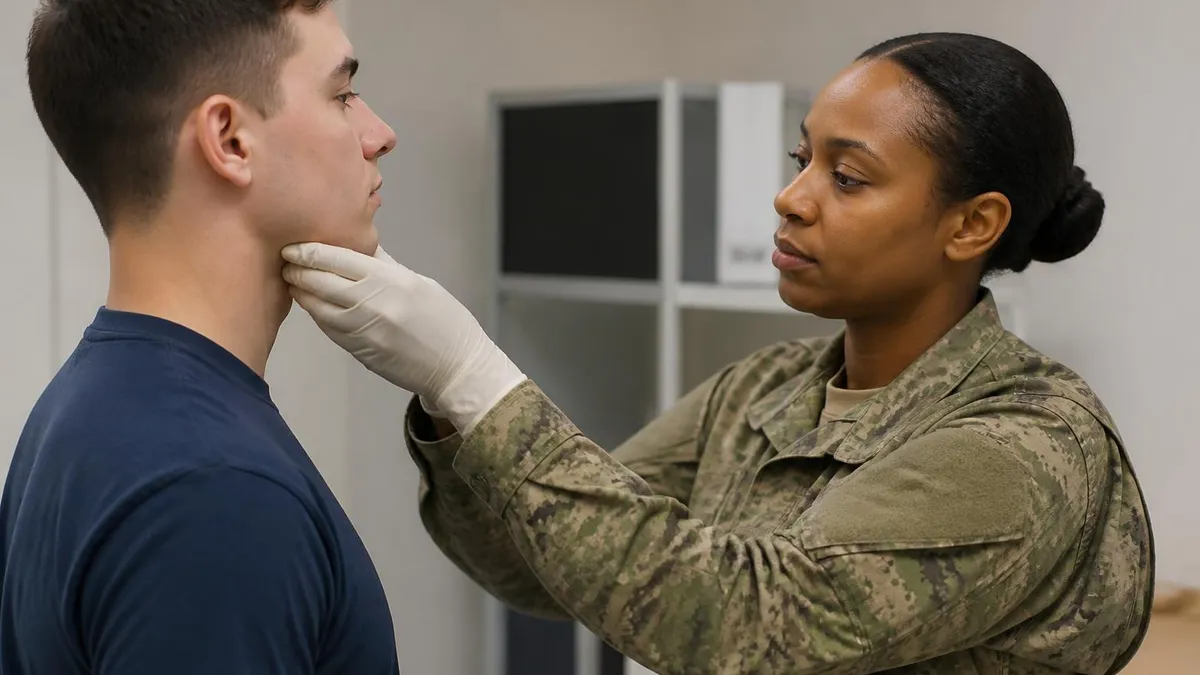
MEPS San Antonio: Your Complete Guide to Fort Sam Houston Processing

MEPS Verification Test: What It Is and How to Prepare

Military Entrance Processing Stations (MEPS)

MEPS Waiver Process: How Long Does It Take MEPS to Approve a Waiver
About the Author

Retired Military Officer & Armed Forces Test Preparation Specialist
United States Army War CollegeColonel Steven Harris (Ret.) served 28 years in the US Army, earning a Master of Arts in Military Science from the Army War College and a Bachelor of Science in Criminal Justice. He has coached thousands of military enlistment and officer candidate program applicants through the ASVAB, AFQT, AFCT, OAR, and officer selection assessment processes across all military branches.
Join the Discussion
Connect with other students preparing for this exam. Share tips, ask questions, and get advice from people who have been there.
View discussion (8 replies)