
HVAC Technician Jobs Near Me: How to Find, Land, and Grow in Local HVAC Careers
🆕 Searching HVAC technician jobs near me? See local pay, hiring employers, certifications, and how to land your first or next HVAC role fast.
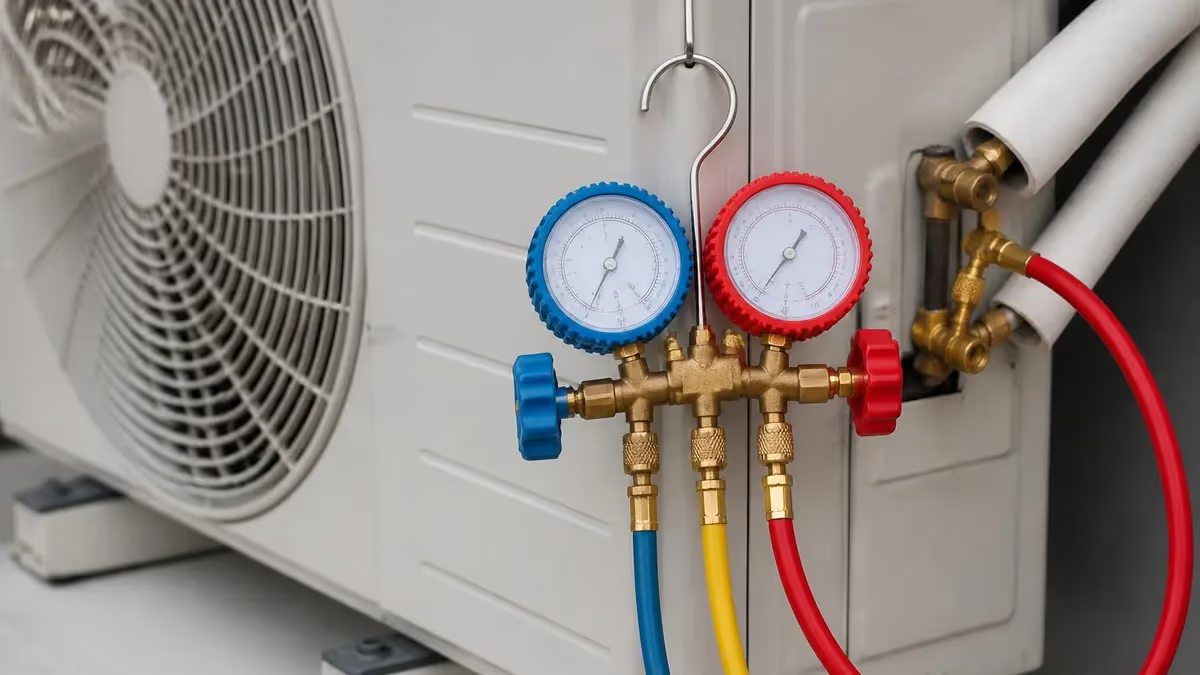
If you've been typing hvac technician jobs near me into search engines, you're already part of one of the strongest skilled-trades job markets in the country. The Bureau of Labor Statistics projects roughly 9% growth for heating, ventilation, and air conditioning technicians through 2033, which is faster than the average across all occupations. That growth is happening in every metro area, not just hot southern cities. Local demand is driven by aging boilers, heat pump retrofits, new construction, and stricter efficiency rules pushing homeowners and businesses toward upgrades.
What that means for you is simple: there is almost certainly a contractor within twenty miles of your home who needs an extra pair of trained hands. Residential hvac service co, commercial mechanical contractors, school districts, hospitals, data centers, and grocery chains all hire HVAC techs locally because the work cannot be outsourced. A condenser does not get fixed over Zoom. Local presence, a clean driving record, and reliable communication are often valued just as much as deep technical knowledge.
The challenge is figuring out which local listings are worth your time, which employers train apprentices, which expect you to walk in fully certified, and where the pay actually lives. Job boards lump everything together, from $17-per-hour install helpers to $42-per-hour commercial refrigeration specialists with sign-on bonuses. Without context, it is hard to know what to apply to first and what to skip.
This guide walks through the entire local job-hunt process from a practical, ground-level view. You will learn how to evaluate listings, which credentials matter most to local hiring managers, what salary you can realistically expect in your region, how to interview well, and how to move from helper to lead tech in three to five years. You will also see how to prepare for the licensing exam many states now require before you can pull permits on residential systems.
If you are brand new to the trade, do not be intimidated by job descriptions that read like a manufacturer spec sheet. Most local employers are willing to train motivated candidates who arrive on time, can lift seventy-five pounds, and pass a drug screen. If you already have EPA 608 certification and a year or two of field time, the conversation shifts immediately to pay, vehicles, and on-call rotation. Either way, knowing the landscape gives you use.
Before applying, take a few minutes to map the employer types in your area. Residential service firms, new-construction installers, commercial mechanical contractors, and facilities departments all behave differently when it comes to hours, overtime, and growth. Understanding those differences early helps you avoid taking a job that pays well for six months and then burns you out. Local HVAC is a marathon trade, and the best techs choose employers strategically, not just whoever called back first.
This article is built for that strategic approach. You will see real salary ranges, sample interview questions, a hiring checklist, common mistakes that get applications tossed, and a clear timeline from first phone call to first paycheck. Use the table of contents to jump to the section you need, but if you are new, read straight through — every section feeds the next.
HVAC Technician Jobs Near You by the Numbers

Local HVAC Job Market Snapshot
Repair and maintenance on home furnaces, air conditioners, heat pumps, and mini-splits. Highest call volume in summer and winter peaks. Strong tipping culture and rapid promotion for techs who communicate well with homeowners.
Rough-in ductwork, set equipment, and start up systems on new builds. Slower in winter in cold climates, steadier in the Sun Belt. Fewer customer interactions, more physical labor, and predictable daytime hours.
Rooftop units, chillers, VAV boxes, and exhaust systems for offices, schools, and retail. Higher pay ceilings, more controls work, and often union shops with structured raises and pension plans.
Walk-in coolers, ice machines, and supermarket racks. Niche but lucrative; refrigeration techs frequently earn $35–$50 per hour with on-call premiums. Requires deeper EPA and electrical knowledge than general HVAC.
In-house techs for hospitals, universities, military bases, and city buildings. Slightly lower base pay but excellent benefits, pensions, and consistent forty-hour weeks. Great fit for techs prioritizing stability over overtime.
Finding quality HVAC jobs near you is part search strategy, part networking. Indeed, ZipRecruiter, and Glassdoor host the largest pool of postings, but the best openings often never reach those sites. Local contractors fill many positions through word-of-mouth, supply-house referrals, and trade-school placement offices long before a listing goes public. If you want first pick of the high-paying seats, you need to be visible in the places hiring managers actually look when they need someone tomorrow.
Start with the supply houses. Walk into your local Ferguson, Johnstone, or RE Michel branch in the morning when techs are picking up parts. Counter staff hear constantly about who is hiring, who just quit, and which shops treat people well. Ask politely, leave a one-page resume with the counter manager, and check back every two weeks. This single tactic outperforms most online applications because you are pre-vetted by someone the owner already trusts.
Next, target manufacturer dealer locators. Carrier, Trane, Lennox, Daikin, and Mitsubishi all list certified dealers in your zip code. Those dealers are required to maintain trained staff, which means they hire continuously. Make a spreadsheet of every dealer within thirty miles, find the owner or service manager on LinkedIn, and send a short, specific message. Mention your EPA card number, any NATE certifications, and your willingness to start as a helper if needed.
Job boards still matter, but use them smartly. Filter by posting date — anything older than fourteen days is usually stale or a poorly written evergreen ad. Read reviews on Indeed and Glassdoor before applying, paying attention to comments about on-call rotation, truck stock, and how disputes get resolved. If three different reviews mention unpaid drive time or missing overtime, believe them. Local reputation is sticky in the trades, and a bad shop will not magically improve when you arrive.
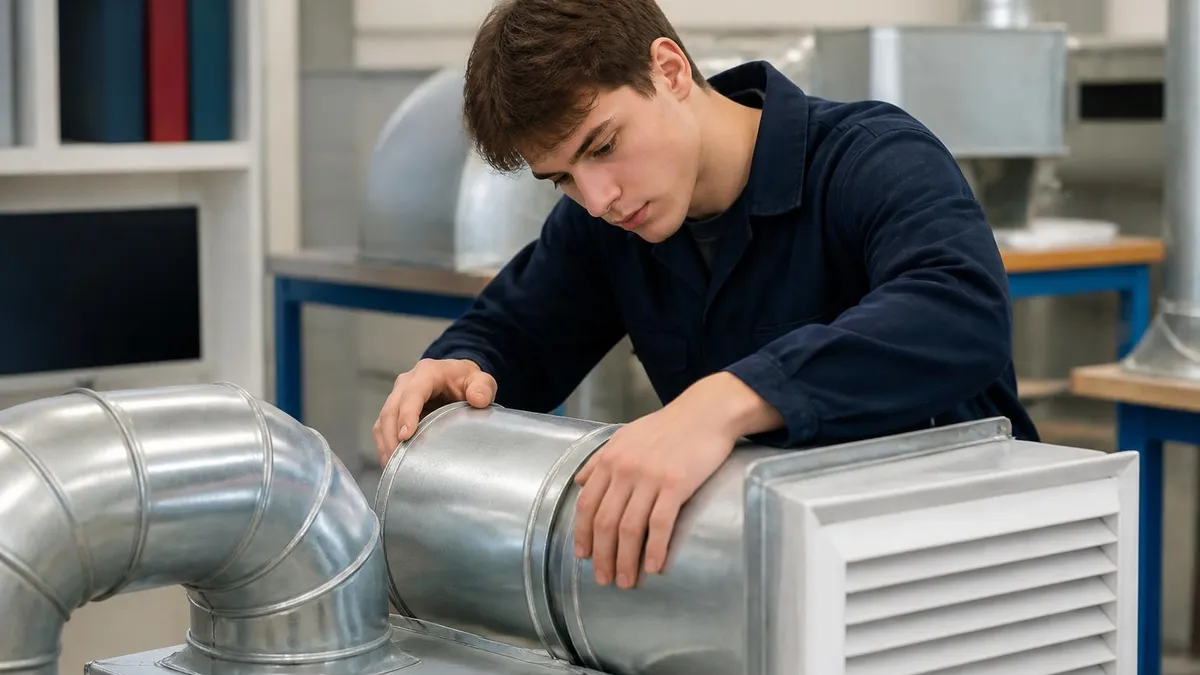
Trade school placement offices are another underused channel. Even if you graduated years ago, most programs maintain employer relationships and will forward your resume to alumni-friendly shops. Community colleges with HVAC programs often host quarterly career fairs that are open to the public. Show up in clean work clothes, bring printed resumes, and treat each conversation as a mini-interview. Hiring managers remember candidates who present themselves professionally in person. For a primer on what local employers expect mechanically, review fundamentals like sizing and sealing covered in HVAC Duct Installation: Materials, Sizing, Sealing and Best Practice.
Finally, use union halls if you are in a metro area with a strong Local 638, 73, or similar. UA-affiliated apprenticeships pay you to learn, include healthcare from day one, and graduate journeymen at industry-leading wages. Competition is fierce — some halls accept fewer than 5% of applicants — but the package is hard to beat. If union is not your path, consider open-shop apprenticeships through ABC or local merit-shop councils, which offer similar structure with different politics.
Whichever channel you use, treat the job search itself like a job. Block two hours each morning, apply to five carefully chosen openings, and follow up on every application after three business days. Volume matters less than fit, and a focused approach typically lands offers within four to six weeks even in slower markets. Random spray-and-pray applications rarely produce results in trades, where employers want to feel like you specifically chose them.
HVAC Practice Test Questions
Prepare for the HVAC - Heating Ventilation and Air Conditioning exam with our free practice test modules. Each quiz covers key topics to help you pass on your first try.
HVAC Air Conditioning
HVAC Exam Questions covering Air Conditioning. Master HVAC Test concepts for certification prep.
HVAC Code Compliance
Free HVAC Practice Test featuring Code Compliance. Improve your HVAC Exam score with mock test prep.
HVAC Electrical Controls
HVAC Test Prep for Electrical Controls. Practice HVAC Quiz questions and boost your score.
HVAC Energy Efficiency
HVAC Questions and Answers on Energy Efficiency. Free HVAC practice for exam readiness.
HVAC Heating Systems
HVAC Mock Test covering Heating Systems. Online HVAC Test practice with instant feedback.
HVAC Load Calculations
Free HVAC Quiz on HVAC Load Calculations. HVAC Exam prep questions with detailed explanations.
HVAC Tools and Equipment
HVAC Practice Questions for HVAC Tools and Equipment. Build confidence for your HVAC certification exam.
HVAC Refrigeration
HVAC Test Online for Refrigeration. Free practice with instant results and feedback.
HVAC Safety Practices
HVAC Study Material on Safety Practices. Prepare effectively with real exam-style questions.
HVAC System Design
Free HVAC Test covering System Design. Practice and track your HVAC exam readiness.
HVAC Thermodynamics
HVAC Exam Questions covering Thermodynamics. Master HVAC Test concepts for certification prep.
Local HVAC Employer Types Explained
Residential service companies generate revenue from breakdowns, tune-ups, and replacements at single-family homes. Expect a service van assigned to you, a tablet for invoicing, and a flat-rate price book. Most shops in this category run on a dispatch system where you handle four to seven calls per day. Pay typically combines an hourly base plus spiff bonuses for selling memberships, IAQ accessories, and replacement systems.
The upside is variety, customer interaction, and fast promotion if you communicate well. The downside is summer burnout — sixty-hour weeks during a July heat wave are normal. Companies of fifteen to fifty trucks tend to offer the best balance of structure and growth. Avoid one-truck operations unless you want to learn the business side, and be cautious of mega-corporations that grade techs purely on closed-ticket revenue.
Pros and Cons of Local HVAC Technician Work
- +Strong, recession-resistant local demand in every metro area
- +Median pay above many bachelor's-degree careers without student debt
- +Clear advancement path from helper to lead tech to service manager
- +Daily problem-solving variety — no two service calls are identical
- +Take-home service van and tools provided by most reputable shops
- +Portable skills you can use anywhere in the country
- +Overtime and on-call premiums regularly boost income 20–40%
- −Physical demands include attic and crawlspace work in extreme temperatures
- −Summer and winter peaks bring long weeks and weekend call-outs
- −Refrigerant exposure and electrical hazards require constant safety discipline
- −Customer-facing role means handling complaints and high-pressure sales expectations
- −On-call rotations can disrupt family time and sleep schedules
- −Tool investment grows over time — expect $2,000 to $5,000 in personal tools
- −Some shops underpay drive time, training hours, or shop meetings
Pros and Cons at a Glance
| Pros | Cons |
|---|---|
| Strong, recession-resistant local demand in every metro area | Physical demands include attic and crawlspace work in extreme temperatures |
| Median pay above many bachelor's-degree careers without student debt | Summer and winter peaks bring long weeks and weekend call-outs |
| Clear advancement path from helper to lead tech to service manager | Refrigerant exposure and electrical hazards require constant safety discipline |
| Daily problem-solving variety — no two service calls are identical | Customer-facing role means handling complaints and high-pressure sales expectations |
| Take-home service van and tools provided by most reputable shops | On-call rotations can disrupt family time and sleep schedules |
| Portable skills you can use anywhere in the country | Some shops underpay drive time, training hours, or shop meetings |
Local HVAC Job Application Checklist
- ✓Update your resume with EPA 608 number, certification type, and issue date
- ✓List every manufacturer school or factory training you have completed
- ✓Get a copy of your motor vehicle record — most shops pull one before offers
- ✓Renew or obtain OSHA 10 or OSHA 30 card; many commercial shops require it
- ✓Add NATE, R-410A, or HVAC Excellence certifications if you hold them
- ✓Prepare three professional references including at least one former supervisor
- ✓Buy or borrow professional work boots, navy or khaki work pants, and clean shirts
- ✓Research the company on Indeed, Glassdoor, and BBB before your interview
- ✓Bring printed resumes, EPA card, driver's license, and any tool list to interviews
- ✓Be ready to take a hands-on test — wiring a contactor or pumping down a system
Show up early, dress like a tech, and ask about training
Service managers consistently say the single biggest predictor of a great hire is how the candidate shows up to the interview. Arrive fifteen minutes early in clean work clothes — not a suit. Ask specifically about ride-along periods, manufacturer training reimbursement, and the path from helper to running your own van. Candidates who frame questions around growth almost always get offers over candidates focused only on starting pay.
Pay for local HVAC technicians varies more by market and employer type than by raw experience. A second-year installer in Houston might pull $26 per hour with truck and tools, while a fifteen-year journeyman in rural Iowa caps out at $32. According to BLS, the national median is around $57,300 per year, but the top decile clears $89,000, and refrigeration specialists in metros like New York, San Francisco, and Boston regularly earn six figures with overtime included. Knowing your local band before interviewing protects you from accepting below-market offers.
To establish your local band, pull data from three sources. First, BLS Occupational Employment Statistics break out HVAC wages by metro area — search "OEWS 49-9021" plus your city. Second, salary aggregators like Payscale and Built In show self-reported numbers; weight these less but use them as a sanity check. Third, ask techs at supply houses directly. Most are willing to share ballpark wages, especially after you buy them a coffee at the counter.
Compensation also includes far more than hourly rate. A take-home service van saves $400 to $700 per month in personal vehicle costs and tax-free mileage. Company-paid health insurance for a family is worth $12,000 to $20,000 annually. Tool allowances of $500 to $1,500 per year and uniform programs add another few thousand. Shops that contribute 4% to a 401(k) are providing real wealth-building support that hourly comparisons miss entirely. Always evaluate the full package before deciding.
Overtime and on-call deserve special attention. A typical residential service tech works 45 to 55 hours during peak season and 35 to 40 in shoulder months. At time-and-a-half, the overtime can add $15,000 to $25,000 per year. On-call pay structures vary — some shops pay a flat $150 per week to carry the phone plus full hourly for any call-outs, while others pay only when you actually run a call. Always ask for the specific on-call policy in writing before accepting.
Sign-on bonuses returned in a big way after 2022 and remain common in tight markets. Expect $1,500 to $7,500 for experienced techs, usually paid in installments over six to twelve months to encourage retention. Negotiate these openly — most contractors have budget for them even when the posting does not mention one. If a shop refuses any bonus, ask for a hiring tool allowance or a guaranteed first-year raise instead. Everything is negotiable when demand is high.
Benefits beyond pay matter more as you build a career. Look for paid manufacturer training, NATE certification reimbursement, and tuition assistance for community college courses. Some employers cover the cost of state journeyman or contractor license exams, which can save you thousands when you decide to step up. If you are evaluating offers, read about credentials and continuing education by reviewing the role of a thorough HVAC Inspection: What's Included and Why It Matters to understand the diagnostic skills good shops prioritize during reviews.
Finally, do not ignore retirement and long-term financial benefits. A 4% 401(k) match on a $60,000 salary is $2,400 per year compounding for forty years — over $400,000 in retirement value at average market returns. Union pensions remain among the most valuable benefits in the trades, often paying $3,000 to $6,000 per month in retirement after a full career. Two equal hourly rates can produce vastly different lifetime earnings depending on retirement structure, so think long-term.

Be cautious of listings that promise "unlimited income potential" with no base wage — this usually means commission-only with thin parts margins. Avoid shops that require you to buy your own van, pay for your own gas, or supply specialty tools like recovery machines and refrigerant scales. Reputable employers cover these costs as the price of doing business. If an interview skips talking about training, safety culture, or how disputes get resolved, treat it as a serious warning sign.
The career path in local HVAC follows a fairly predictable arc, but how fast you move through it depends entirely on initiative. A motivated helper can reach lead installer in two years and run a service truck independently by year four. A passive employee can spend a decade as an assistant. The biggest accelerator is voluntary learning — reading equipment manuals at lunch, watching manufacturer training videos at night, and asking to shadow senior techs on complex calls. Owners notice this behavior immediately.
Year one is usually spent as an install helper or apprentice. You carry equipment, hand tools, run wire, braze fittings under supervision, and learn the rhythm of a job site. Pay ranges from $16 to $22 per hour depending on region. The goal of this year is not high pay — it is to absorb fundamentals, earn EPA 608 certification, and prove you show up reliably. Many shops will pay for your EPA test and study materials if you ask.
By year two and three, you should be moving into service or running a small install van under loose supervision. Pay typically jumps to $24 to $30 per hour. This is the stretch where you decide whether you are a residential, commercial, or refrigeration person. Each path requires different deep skills, and trying to be elite at all three is unrealistic. Specializing pays better and protects you against burnout from constant context switching between vastly different equipment.
Year four through seven is journeyman territory. You run calls independently, troubleshoot complex problems, train newer techs, and start to consider state licensure if your state requires one. Hourly rates climb to $30 to $42 depending on market. Some techs at this stage take on lead installer or service supervisor roles, trading a slight hourly bump for predictable hours and bonus structures tied to crew performance. Others stick to the truck because they prefer the autonomy of field work.
Beyond seven years, your options expand significantly. Senior techs become service managers, install supervisors, comfort advisors, controls specialists, or trainers. Compensation ranges from $75,000 for a small-shop service manager to over $150,000 for a commercial controls expert with PE-stamp design responsibility. The smart move at this stage is to keep collecting credentials — BPI, NATE Senior Efficiency Analyst, manufacturer master tech, and state contractor license. Each one widens your options and protects your earning power.
Many techs eventually start their own businesses. The capital requirements are modest — a used van, basic tools, insurance, and licensing — and a solo operation can generate $150,000 in first-year revenue with disciplined marketing. If you go this route, study utility rebate programs and tax incentives carefully, including the Tax Credit for Installing New HVAC: 2026-2026 Rules, because passing those savings to customers is a major competitive advantage. Many independent contractors run successful one-truck operations for decades without ever hiring an employee.
Whatever path you choose, the local HVAC trade rewards consistency, curiosity, and customer respect more than raw talent. Techs who treat every homeowner like family, document their work thoroughly, and keep learning new equipment will always have offers waiting. The trade has very few ceilings for people willing to keep growing — and the demand is only increasing as buildings get smarter, refrigerants change, and electrification accelerates the shift toward heat pumps and integrated controls in every market in the country.
Once you have an interview scheduled, preparation is what separates offer letters from polite rejections. Local hiring managers run interviews very differently from corporate office jobs. Expect a casual conversation in the shop or break room, a tour of the warehouse, and almost always a hands-on technical evaluation. Show up with your EPA card, driver's license, and any certifications already organized in a folder — fumbling through your phone to find a screenshot is a small but real turn-off for managers who value organization on a service call.
Practice the most common technical questions before you go. You will be asked to explain superheat and subcooling in plain English, walk through how you would diagnose a unit that is short-cycling, and describe what you would check first on a no-cool call. You do not need textbook-perfect answers — managers are looking for logical thinking and safe practices. Saying "I would first verify thermostat call and check for tripped breakers before climbing on the roof" beats a complex monologue full of jargon.
The hands-on test usually lasts fifteen to thirty minutes. You might be asked to wire a basic contactor and capacitor on a bench, identify components inside a furnace, or pump down a system on a training rig. Move deliberately, talk through what you are doing, and verify with a meter before energizing anything. Managers watch for safety habits as much as speed. A candidate who slows down to lock out a disconnect impresses more than one who rushes and skips the step.
Have intelligent questions ready. Ask about typical daily call volume, the ratio of maintenance to repair work, on-call rotation length, and how raises are structured. Ask who trains new hires and what manufacturer schools the shop sends techs to each year. Ask about the truck — make, model year, parts stock, and whether you can take it home. These questions signal that you are evaluating fit, not just begging for any job. Strong candidates always interview the employer too.
Salary negotiation is where many techs leave money on the table. When asked your rate, do not say a number first. Reply with, "Based on my certifications and experience, I am targeting the upper end of what your role typically pays — what range did you have in mind?" If they push, give a range $2 above your minimum acceptable hourly rate. Local employers expect negotiation, and accepting the first number often signals inexperience. A polite back-and-forth almost always lands you a higher final offer.
After the interview, send a short follow-up email within twenty-four hours. Thank them, reference one specific thing you learned about the shop, and reiterate your interest. Most candidates skip this step entirely, which means a two-paragraph email puts you ahead of the pack. If you have not heard back after five business days, call once. Persistence within reason is appreciated; pestering is not. One polite check-in is the right amount of follow-through for a trade hiring process.
Finally, prepare for the start date with intention. Show up the first day with your basic hand tools, a clean lunch box, a thermos, and a notepad. Watch carefully for the first two weeks, take notes constantly, and ask questions during breaks rather than mid-job. Build relationships with the parts manager, dispatcher, and senior techs early — these are the people who will quietly help or quietly sabotage your first ninety days. Local HVAC is relationship work, and your first month sets the tone for everything that follows.
Sample HVAC Practice Questions
Try these questions from our free HVAC practice tests. The correct answer and an explanation follow each question.
Under NFPA 70E electrical safety standards relevant to HVAC, what is the minimum approach boundary for unqualified persons near exposed energized parts at 120V?
- A. Restricted approach boundary
- B. Limited approach boundary
- C. Arc flash boundary
- D. Prohibited boundary
Answer: B. Limited approach boundary
NFPA 70E defines the Limited Approach Boundary as the distance unqualified persons must stay from exposed energized conductors to avoid electrical shock hazard.
In HVAC system design, 'diversity factor' is applied to:
- A. Reduce the total calculated peak load when all zones are unlikely to peak simultaneously
- B. Increase equipment sizing to account for future loads
- C. Adjust for climate uncertainty in ASHRAE design temperatures
- D. Account for part-load efficiency degradation
Answer: A. Reduce the total calculated peak load when all zones are unlikely to peak simultaneously
A diversity factor reduces the sum of individual zone peak loads to reflect that zones rarely all peak at the same time, allowing smaller central plant equipment.
What condition results when a building's HVAC system creates a negative pressure differential relative to the outdoors?
- A. Stack effect reversal
- B. Backdrafting of combustion appliances
- C. Increased filtration efficiency
- D. Reduced volatile organic compound levels
Answer: B. Backdrafting of combustion appliances
Negative building pressure can cause combustion gases from furnaces or water heaters to be drawn back into the living space instead of exhausted outside.
A technician reads 22 psi static pressure at the boiler on a cold system. After firing the boiler, pressure rises to 28 psi. This indicates:
- A. A system leak is developing
- B. Normal system operation with thermal expansion
- C. The pressure relief valve is about to open
- D. The expansion tank has lost its pre-charge
Answer: B. Normal system operation with thermal expansion
A 6 psi rise from cold fill pressure to operating pressure as water heats is typical and indicates normal thermal expansion being managed by a properly functioning expansion tank.
HVAC Questions and Answers
About the Author

NATE Certified HVAC Technician & Licensing Exam Trainer
Universal Technical InstituteMike Johnson is a NATE-certified HVAC technician and EPA 608 universal-certified refrigerant handler with a Bachelor of Science in HVAC/R Technology. He has 19 years of commercial and residential HVAC installation and service experience and specializes in preparing technicians for NATE certification, EPA 608, A2L refrigerant safety, and state HVAC contractor licensing examinations.