HVAC Manifold Gauges: The Complete Technician's Guide to Reading, Using, and Maintaining Refrigerant Manifold Gauge Sets
📚 HVAC manifold gauges explained — learn to read pressures, charge refrigerant, diagnose faults, and pick the right gauge set for your tool kit.
HVAC manifold gauges are the most important diagnostic instrument a refrigeration or air conditioning technician carries. Whether you are charging a residential split system, recovering refrigerant from a rooftop unit, or troubleshooting a walk-in cooler that will not hold suction pressure, the manifold gauge set is the window into what is happening inside the sealed refrigerant circuit. Mastering this tool separates apprentices from journeymen and is a skill tested on nearly every HVAC certification exam in the United States.
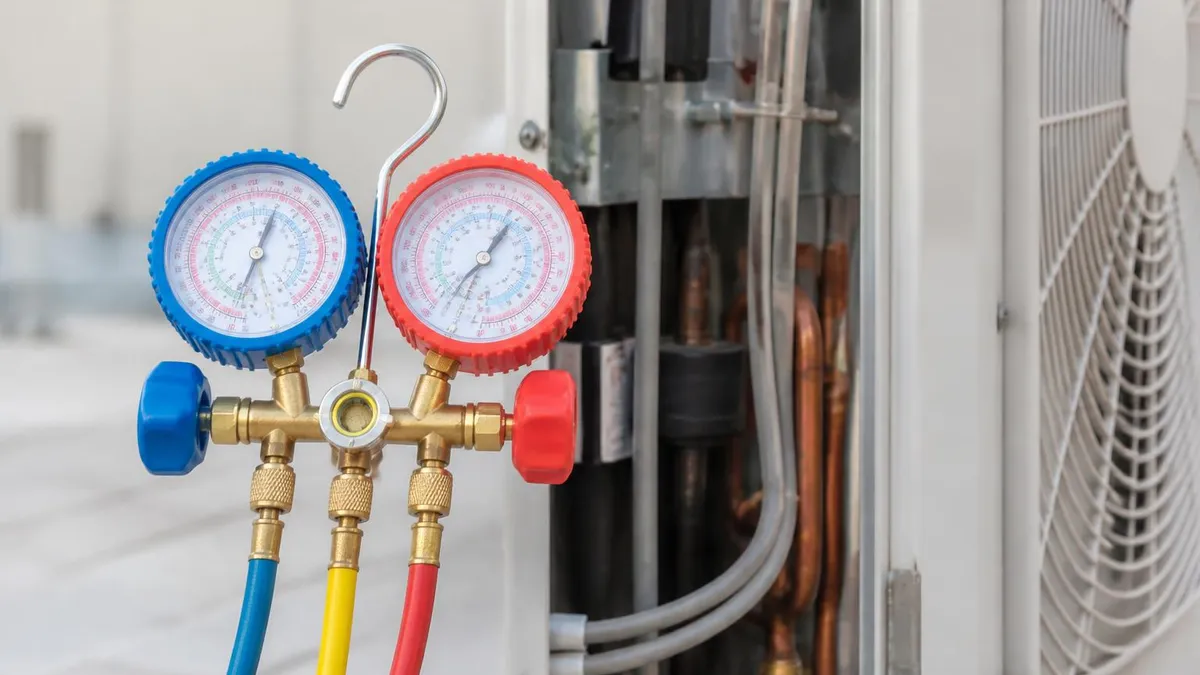
A manifold gauge set, sometimes called a charging manifold or refrigerant manifold, consists of two or four gauges mounted on a manifold body with hand valves that control the flow of refrigerant through color-coded hoses. The blue low-side gauge reads suction pressure, the red high-side gauge reads discharge pressure, and the yellow center hose connects to a refrigerant cylinder, vacuum pump, or recovery machine. This three-port arrangement is the foundation of nearly every hvac scheduling software procedure.
Modern technicians choose between analog gauges with bourdon-tube movements and hvac digital gaugess with electronic pressure transducers. Analog sets are inexpensive, durable, and easy to read at a glance, while digital sets calculate superheat and subcooling automatically, log data via Bluetooth, and handle dozens of refrigerants without changing the scale ring. Both have a place in a professional tool bag, and understanding the trade-offs helps you invest in the right equipment for the work you do most often.
This guide explains how manifold gauges work, how to interpret the numbers on the dial, and how to use them safely with R-410A, R-22, R-32, R-454B, and the newer A2L refrigerants now appearing on residential equipment. We will cover evacuation, charging by superheat and subcooling, leak detection, and the calibration habits that keep your readings trustworthy year after year. If you also handle airflow diagnostics, pair this skill with our broader HVAC Solutions: The Complete Guide to Heating, Cooling, and Indoor Air Quality Systems for Homes and Buildings reference for context.
Beyond the basics, we will examine common field mistakes that ruin compressors and waste refrigerant. Cross-contamination, hose loss, micron creep during evacuation, and improper purging are responsible for an enormous share of repeat callbacks in residential service. Each of these errors stems from misunderstanding what the gauges are actually telling you, and each can be prevented by following a disciplined procedure.
The economics matter too. A quality four-valve digital manifold set runs $400 to $900, while a basic two-valve analog set costs under $80. The right choice depends on how often you work, what refrigerants you encounter, and whether you need data logging for warranty documentation or commercial commissioning reports. We will walk through the buying decision later in this guide.
By the end of this article you will know how to attach gauges correctly, take meaningful pressure readings, charge a system to manufacturer specification, and recognize the warning signs of refrigerant overcharge, undercharge, restricted metering devices, and failing compressors. The same knowledge appears on the EPA 608 certification exam and on state HVAC journeyman tests, so the time you invest here pays off in both fieldwork and credentials.
HVAC Manifold Gauges by the Numbers

Anatomy of a Manifold Gauge Set
Compound gauge reading both vacuum (in inches of mercury) and pressure up to about 250 psig. Connects to the suction service port and shows evaporator-side conditions.
Pressure-only gauge reading up to 500 psig or higher on R-410A sets. Connects to the discharge or liquid line service port and reflects condenser performance.
Aluminum or brass block housing two or four hand valves. Valves isolate hoses for charging, recovery, and evacuation without disconnecting from the system.
Utility port connecting to refrigerant tanks, vacuum pumps, or recovery machines. Modern sets include a self-sealing quick-connect to prevent refrigerant loss.
Optional clear window in the manifold body letting the technician observe liquid refrigerant flow during charging, useful for confirming a full liquid column.
Reading hvac digital gauges accurately starts with knowing what each dial is telling you. The outer scale on both gauges is calibrated in pounds per square inch gauge (psig), meaning pressure above atmospheric. The inner scales are color-coded for specific refrigerants and display the saturation temperature that corresponds to that pressure for the chosen fluid. When the system is running, the saturation temperature on the low side approximates evaporator temperature and on the high side approximates condenser temperature.
Before connecting anything to the unit, inspect your hoses for cracks, check that the depressors inside the fittings move freely, and confirm the gauges read zero with the valves open to atmosphere. A gauge that reads two psig at rest will read two psig high on every job until you recalibrate it, leading to chronic undercharging. Many digital manifolds zero themselves automatically when powered on at ambient conditions.
Always purge your hoses before opening the manifold valves to the system. With the tank connected to the yellow hose and pressurized refrigerant in the line, briefly crack each manifold valve to push air out of the blue and red hoses. Air left in the lines contaminates the charge with non-condensables, which raises head pressure and can void compressor warranties. This single step prevents countless callbacks.
When taking readings, let the system stabilize for ten to fifteen minutes after startup. Pressures swing wildly during the first few minutes as oil migrates, refrigerant redistributes, and the indoor coil approaches design temperature. Recording numbers too early gives a snapshot of a system in transition rather than steady-state operation, which is what manufacturer charging charts assume. For airflow-related diagnostics that affect those readings, consult our HVAC Duct Calculator: The Complete Guide to Sizing Ductwork for Airflow, Static Pressure, and System Efficiency guide as undersized returns will skew your low-side pressure.
Pressure-temperature relationships are at the heart of refrigeration diagnostics. On R-410A, a 118 psig low side equals roughly 40°F saturation temperature. If your suction line is 50°F at that pressure, you have ten degrees of superheat. Memorize a few anchor points for each refrigerant you handle, and you will diagnose problems faster than colleagues who reach for a chart every time.
Watch for needle flutter on hvac tools and gauges. A jumpy low-side needle often indicates a flooded suction caused by liquid refrigerant returning to the compressor, a serious condition that destroys valves and pistons. A high-side needle bouncing rhythmically may indicate compressor valve damage or pulsating discharge from a failing reed plate. Digital sets dampen these signals electronically, so analog gauges sometimes catch mechanical problems sooner.
Finally, train yourself to read both gauges simultaneously and think about the ratio. Compression ratio equals absolute discharge pressure divided by absolute suction pressure. Healthy residential ratios run roughly 2.5 to 4.0 on cooling-mode systems. Ratios above 5 stress the compressor; ratios below 2 suggest a low charge, a stuck reversing valve, or an internal compressor bypass. The relationship between the two numbers tells you more than either pressure alone.
HVAC Practice Test Questions
Prepare for the HVAC - Heating Ventilation and Air Conditioning exam with our free practice test modules. Each quiz covers key topics to help you pass on your first try.
HVAC Air Conditioning
HVAC Exam Questions covering Air Conditioning. Master HVAC Test concepts for certification prep.
HVAC Code Compliance
Free HVAC Practice Test featuring Code Compliance. Improve your HVAC Exam score with mock test prep.
HVAC Electrical Controls
HVAC Test Prep for Electrical Controls. Practice HVAC Quiz questions and boost your score.
HVAC Energy Efficiency
HVAC Questions and Answers on Energy Efficiency. Free HVAC practice for exam readiness.
HVAC Heating Systems
HVAC Mock Test covering Heating Systems. Online HVAC Test practice with instant feedback.
HVAC Load Calculations
Free HVAC Quiz on HVAC Load Calculations. HVAC Exam prep questions with detailed explanations.
HVAC Tools and Equipment
HVAC Practice Questions for HVAC Tools and Equipment. Build confidence for your HVAC certification exam.
HVAC Refrigeration
HVAC Test Online for Refrigeration. Free practice with instant results and feedback.
HVAC Safety Practices
HVAC Study Material on Safety Practices. Prepare effectively with real exam-style questions.
HVAC System Design
Free HVAC Test covering System Design. Practice and track your HVAC exam readiness.
HVAC Thermodynamics
HVAC Exam Questions covering Thermodynamics. Master HVAC Test concepts for certification prep.
Refrigerant-Specific Manifold Gauge Procedures
R-410A operates at roughly 50 to 70 percent higher pressures than the R-22 it replaced. A typical cooling-mode high side runs 350 to 425 psig with low side at 115 to 135 psig. You must use a gauge set rated for at least 800 psig on the high side, and hoses must carry the same rating. Older R-22 manifolds will burst and cause injury if used on R-410A.
Always charge R-410A as a liquid into the suction side through a metering device, or directly into the liquid line on a system that is off. The blend is a near-azeotrope but still benefits from liquid charging to prevent fractionation. Invert the tank so liquid flows from the dip tube, throttle the manifold valve carefully, and monitor superheat or subcooling against the manufacturer charging chart.
Digital vs Analog Manifold Gauges
- +Digital manifolds calculate superheat and subcooling automatically
- +Built-in libraries handle 80+ refrigerants without scale changes
- +Bluetooth logging documents commissioning data for warranty claims
- +Pressure transducers resist mechanical shock better than bourdon tubes
- +Backlit displays improve visibility in attics and crawl spaces
- +Auto-zeroing eliminates calibration drift on most days
- +Some models integrate with vacuum gauges for one-screen evacuation
- −Premium digital sets cost five to ten times more than analog
- −Batteries die at inconvenient times during long service calls
- −Software updates and firmware bugs can disable units in the field
- −Electronics fail in extreme heat or sustained vibration in trucks
- −Analog needles still catch needle flutter that smooths out on digital
- −Repair parts and gaskets are easier to source for analog sets
- −Some inspectors and instructors still require analog for testing
Manifold Gauge Charging and Service Checklist
- ✓Verify gauge calibration reads zero at atmospheric pressure before connecting
- ✓Inspect hoses for cracks, kinks, and worn depressor pins
- ✓Confirm the manifold is rated for the refrigerant pressure on this system
- ✓Purge hoses with refrigerant vapor to remove air before opening to the system
- ✓Connect blue hose to suction service port and red hose to liquid line port
- ✓Allow the system to run at least 10–15 minutes before recording readings
- ✓Measure ambient outdoor temperature and indoor wet bulb for charging chart
- ✓Calculate superheat for fixed-orifice systems and subcooling for TXV systems
- ✓Adjust charge in small increments and recheck after stabilization each time
- ✓Document final pressures, superheat, subcooling, and refrigerant weight added
Always pull below 500 microns and confirm with a decay test
A proper evacuation removes moisture and non-condensables that destroy compressors. Pull the system below 500 microns, then isolate the vacuum pump and watch the gauge for five minutes. If the reading rises above 1000 microns, you either have a leak or remaining moisture — repeat the evacuation before charging.
Manifold gauges shine brightest during troubleshooting, because the combination of high-side and low-side pressures fingerprints almost every common refrigeration fault. Once you know the signatures, you can walk up to a struggling system, attach gauges, and identify the failure mode within a few minutes. This pattern recognition is the core skill tested on EPA 608 Type II and Universal certification exams, and it is what separates a parts-changer from a true diagnostician.
The most common pattern, low suction and low head pressure, points to undercharge or a restricted liquid line. Look at the evaporator: if the coil is iced near the inlet only, you have a restriction such as a clogged hvac filter drier. If the entire coil is starved and superheat is sky-high, the system is short on refrigerant. Always confirm with a leak search before adding refrigerant, because charging a leaking system is both illegal under EPA Section 608 and a guarantee of a callback.
High suction and low head pressure usually indicate a failing compressor. The valves inside the compressor have worn, allowing refrigerant to bypass internally rather than being pumped to the condenser. Confirm by measuring compression ratio: if it falls below two, the compressor is the suspect. A current draw far below nameplate amperage at design conditions reinforces the diagnosis. Replacement, not recharging, is the cure.
High head pressure with normal or high suction often means an overcharge, a dirty condenser coil, or a failing condenser fan motor. Walk around the outdoor unit, feel for hot spots, and listen for the fan speed. A coil packed with cottonwood seed is a five-minute fix that customers blame on the contractor every spring. Always rinse condensers before assuming a refrigerant issue exists.
Low suction with high head pressure is the classic metering device restriction. Either the TXV is stuck closed, the screen at the inlet is clogged, or the bulb has lost its charge. Replace the TXV or clean the screen, evacuate properly, and recharge by weight whenever possible. Field charging by superheat alone can mask a partially restricted metering device because pressures look reasonable at certain ambients.
Pay attention to time-based patterns too. A system that runs fine for fifteen minutes then trips on high pressure usually has a noncondensable problem from poor purging or a failing condenser fan that quits when its windings heat up. A unit that pulls down properly then loses capacity overnight may be undersized rather than malfunctioning. Gauges tell you the symptom; the technician decides whether the cause is mechanical, electrical, or design-related.
Document every diagnosis with photos of the gauges. Modern smartphones make this trivial, and a clear record of pressures protects you when a homeowner calls back disputing the work. For commercial accounts, log results to your digital manifold app and email the customer a report at the end of the call. Professional documentation justifies higher labor rates and reduces warranty disputes with manufacturers.
EPA Section 608 prohibits venting refrigerants to atmosphere during service, maintenance, or disposal. Fines can reach $44,539 per day per violation. Always recover refrigerant with EPA-certified equipment, document weights, and use evacuation procedures that minimize loss when disconnecting hoses. Self-sealing quick-connects on modern manifolds dramatically reduce inadvertent venting.
Choosing the right manifold gauge set comes down to four factors: the refrigerants you work with, the volume of jobs you complete weekly, the level of documentation your customers expect, and how rough your work environment is. A residential service technician handling ten calls a day in an unconditioned van faces different demands than a controls commissioning agent working in clean mechanical rooms. There is no single best manifold; there is a best manifold for your work pattern.
For new technicians, a quality four-valve analog set with a 60-inch hose package costs around $150 and will outlast multiple jobs if you maintain it. Yellow Jacket, Ritchie, JB Industries, and Mastercool dominate the U.S. market and offer rebuild kits for valves and seals. Avoid the cheapest no-name imports — the gauges are often inaccurate out of the box, and replacement parts simply do not exist. If you are still selecting other tools too, our HVAC Vents: The Complete Homeowner's Guide to Types, Sizing, Placement, and Airflow Optimization guide pairs well for understanding airflow context.
Experienced techs working commercial or refrigeration accounts should invest in a digital manifold with at least four ports, a wireless vacuum gauge, and refrigerant library updates pushed via app. Testo 550s, Fieldpiece SMAN, and Yellow Jacket Mantooth are the dominant choices, ranging from $400 to $1200 for complete kits with hoses and case. The time saved on superheat and subcooling calculations alone pays back the investment within a few months of full-time use.
Maintenance is straightforward but essential. Store hoses with the ends capped to keep dust and moisture out of the depressor seats. Replace gasket inserts annually or any time you notice slow leaks at the connections. Recalibrate analog gauges yearly against a known reference; many supply houses offer this service free for customers. Digital manifolds need battery checks and occasional firmware updates that fix bugs and add support for new refrigerants like R-454B.
Avoid common storage mistakes that destroy gauge accuracy. Leaving a manifold in a hot truck without venting tank connections can stress the bourdon tubes. Dropping a digital unit onto concrete will eventually break solder joints inside the transducer module. Use a padded case, route hoses to prevent kinking, and replace the rubber bumpers on analog gauges when they crack. Small habits multiply into years of additional service life.
Calibration deserves special attention. A bourdon-tube gauge that reads three psig at atmosphere will tell you the system is undercharged on every cooling call, leading you to add refrigerant that does not belong there. Overcharging crushes compressors and raises head pressures dangerously. Buy a deadweight tester or compare against a freshly calibrated reference set every spring before the busy season. Cross-check your digital units the same way.
Finally, train yourself to use the gauges as confirmation, not as the sole source of truth. Visual inspection of coils, temperature measurement at line sets, amperage readings, and airflow checks together paint a complete picture. The gauge tells you about refrigerant; the rest of your tools tell you why the refrigerant is behaving that way. Combining all four data streams is what makes a true expert troubleshooter.
Putting manifold gauge skills into daily practice requires building a personal routine that you can repeat on every service call. Consistency matters more than speed; technicians who skip steps to save five minutes end up returning for callbacks that cost hours. Develop your sequence — connect, purge, run, stabilize, read, calculate, adjust, document — and follow it on every system, every time, regardless of how routine the job feels.
When charging by superheat on a fixed-orifice system, measure both the outdoor dry bulb and the indoor wet bulb temperatures. Cross-reference the target superheat on the manufacturer chart, then adjust the charge until your measured superheat matches within two degrees. Allow ten minutes between adjustments because the system takes time to respond. Adding refrigerant in small bursts and waiting beats dumping in a pound and watching the gauges overshoot.
When charging by subcooling on a TXV system, the procedure is simpler but no less precise. Most manufacturers specify subcooling between eight and twelve degrees at the liquid line. Measure liquid line temperature with a clamp thermocouple, compare against the saturation temperature for your high-side pressure, and adjust. The TXV controls superheat automatically, so subcooling becomes your charge indicator. Trust the chart even when the suction pressure looks unusual.
Practice your evacuation procedure deliberately. Connect a vacuum-rated hose to a quality two-stage pump, use a micron gauge on a tee separate from the pump, and pull below 500 microns. Isolate the pump and watch for decay. A reading that climbs and stabilizes around atmospheric pressure indicates a leak. A reading that climbs and stabilizes around 1500 to 2000 microns usually indicates trapped moisture and demands a longer evacuation. Documenting micron readings builds your professional credibility.
Recovery is the other half of refrigerant management. Use an EPA-certified recovery machine, recovery cylinder rated for the refrigerant, and a calibrated scale. Pull the system down to the required level — currently 0 psig or below for most refrigerants on small appliances — and document the recovered weight on the service ticket. Recovered refrigerant must be either recharged into the same system, sent for reclamation, or properly destroyed. Mixing recovered refrigerants in a single cylinder contaminates the batch and disqualifies it for reclamation.
Build relationships with your local supply house and ask them to demonstrate new manifold features as they arrive. Manufacturers run free training sessions throughout the year, often with free lunch and free product samples. Two hours at a counter day teaches you tricks that take months to discover on your own. Ask specifically about A2L refrigerant handling, because the next few years will see widespread transition away from R-410A in residential equipment.
Above all, treat your gauges as the precision instruments they are. A manifold set is the most-handled tool in your kit, and the easiest to abuse. Clean it after every refrigerant-loss situation, recalibrate at least annually, and replace hoses before they fail. Gauge investment is not a one-time purchase; it is an ongoing commitment to accuracy. Your customers, your warranty record, and your professional reputation all depend on the numbers you read off those dials.
HVAC Questions and Answers
HVAC Solutions: The Complete Guide to Heating, Cooling, and Indoor Air Quality Systems for Homes and Buildings

HVAC Vents: The Complete Homeowner's Guide to Types, Sizing, Placement, and Airflow Optimization

HVAC Duct Calculator: The Complete Guide to Sizing Ductwork for Airflow, Static Pressure, and System Efficiency
Certified HVAC Contractors: How to Find, Vet, and Hire the Right Professional for Your Home or Business