
Home Inspector School: Complete 2026 Guide to Training Programs, Costs, Licensing & Career Launch
Home inspector school guide: ✍🏼 best programs, tuition costs, licensing requirements by state, salary outlook, and how to launch your inspection career
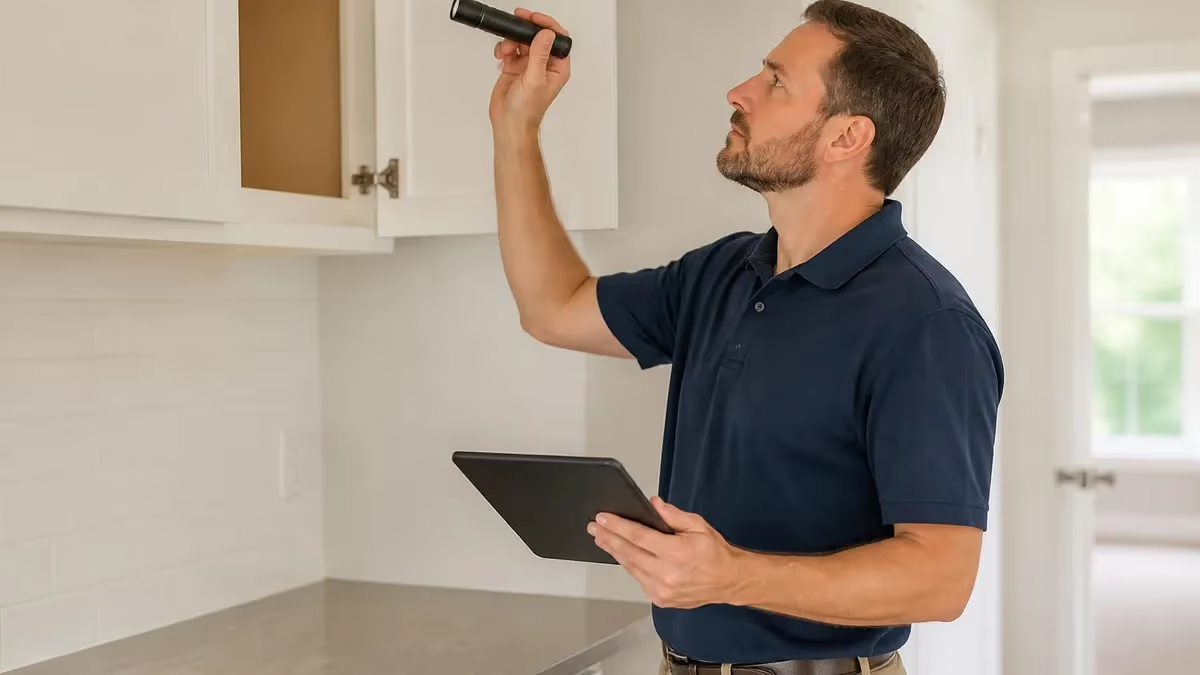
Choosing the right home inspector school is the single most important decision you will make at the start of your inspection career, because the quality of your training shapes how fast you pass your state exam, how confidently you walk through your first paid inspection, and how quickly your phone starts ringing from agents who type home inspectors near me into Google searches every weekend. A good program gives you classroom instruction, ride-along field hours, report-writing software practice, and exam prep all bundled together.
The home inspector school landscape in 2026 looks very different from even five years ago. Hybrid online-plus-field programs now dominate the market, with schools like InterNACHI, ICA, ATI, AHIT, and Kaplan competing for new students with self-paced video modules, virtual mock inspections, and proctored final exams. Tuition typically ranges from free (InterNACHI for members) up to roughly $1,500 for premium hybrid programs that include exam vouchers, business templates, and report software trials.
Before you spend a dollar, you need to verify what your state actually requires. Roughly 33 states regulate home inspectors with formal licensing, and each one publishes a list of approved pre-licensing courses you must complete before sitting for the National Home Inspector Examination (NHIE) or a state-specific exam. Picking a school that is not approved in your state is the most expensive mistake new inspectors make, because those classroom hours simply will not count toward your license application.
Beyond the legal requirements, the right school should teach you to actually inspect a house. That means hours on real roofs, in real crawlspaces, looking at real electrical panels with double-tapped breakers, federal Pacific bus bars, and aluminum branch wiring. Classroom theory matters, but the inspectors who build six-figure businesses are the ones who logged 40 to 100 supervised field inspections during school, not the ones who only watched videos on a laptop.
Cost is obviously a factor, but it should not be the only one. A $400 online-only course that gets you licensed in a non-regulated state may be a fine starting point, while an inspector planning to work in Texas, Illinois, North Carolina, or New York will likely need a longer state-approved program with proctored hours. Think of school tuition as the cheapest part of your business launch — your software, marketing, errors and omissions insurance, and tools will easily cost three to five times more.
This guide walks you through every angle of home inspector school selection in 2026: program lengths, accreditation, tuition ranges, what is actually taught in the curriculum, how field training works, the role of associations like InterNACHI and ASHI, exam prep strategies, post-graduation licensing steps, salary expectations, and the business skills that schools rarely teach but you absolutely need. We will also cover the regional differences for Chicago, Minneapolis, Texas, and Florida markets where pricing, competition, and consumer expectations vary dramatically.
Whether you are a contractor pivoting from the trades, a retired military veteran using GI Bill benefits, or a second-career professional drawn to the flexibility of self-employment, the path through home inspector school is one of the shortest routes into a respected, hands-on profession. With focused effort, most students go from enrollment to first paid inspection in three to six months, and to a sustainable full-time income within eighteen months.
Home Inspector School by the Numbers

Types of Home Inspector Schools and Programs
Video modules and digital textbooks you complete on your own schedule. Best for self-disciplined learners in non-regulated states. Typical cost $400–$700, completion in 4–8 weeks.
Combines online theory with 1–4 weekends of in-person ride-alongs, mock inspections, and roof walks. Standard format in licensed states. Cost ranges $900–$1,500.
Traditional in-person instruction over 2–4 weeks of full-day classes. Strong for hands-on learners and networking, but limited geographic availability. Cost $1,200–$2,200.
InterNACHI and ASHI offer training included with membership. InterNACHI is free with $499/year membership; ASHI School runs $1,295 standalone with exam prep.
Some states like Illinois allow logged supervised inspections with a licensed mentor in place of part of formal coursework. Slower but earns income during training.
State licensing rules are the foundation of every home inspector school decision, and they vary more than most newcomers expect. Texas, for example, requires 154 classroom hours plus a substantive examination component and at least 25 supervised inspections before a Real Estate Inspector can advance to Professional Inspector status. North Carolina demands 120 hours of pre-licensing education plus passing the NHIE and the state-specific exam, while Florida requires only 120 hours and a state exam with no field-hour mandate.
On the other end of the spectrum, states like Colorado, Georgia, Idaho, Kansas, Michigan, Minnesota, Missouri, Nebraska, Ohio, Utah, Vermont, and Wyoming currently have no statewide home inspector licensing law at all. In these states, inspectors can technically open for business after completing any reputable training program, but most still pursue InterNACHI or ASHI certification because real estate brokers, lenders, and savvy consumers expect it. Insurance carriers also typically demand documented training before issuing E&O coverage.
If you are researching how to become a home inspector in Illinois, the requirements are particularly structured: 60 hours of classroom training from an approved school, 40 hours of field training including parallel inspections under a licensed inspector, and passing both the National Home Inspector Examination and the Illinois state portion. Chicago and the surrounding suburbs alone employ more than 800 licensed inspectors, making it one of the most competitive metro markets in the country.
New York requires 140 hours split between classroom and field, plus the NHIE. California oddly has no state licensing for home inspectors, only a statutory standard of practice in the Business and Professions Code, but the California Real Estate Inspection Association (CREIA) and ASHI certifications functionally serve as the de-facto credential. This patchwork makes it essential to confirm requirements with your state Department of Professional Regulation, not just trust a school's marketing claims.
Reciprocity between states is limited and inconsistent. An inspector licensed in Texas cannot simply transfer that credential to North Carolina or Florida — each state generally requires its own application, exam, and sometimes additional coursework. If you plan to work near a state border or eventually relocate, factor this into your school choice by picking a program approved in multiple states or one that offers state-specific add-on modules at low or no cost.
Continuing education (CE) requirements also start the moment you are licensed. Most states demand between 14 and 24 CE hours annually or biennially, often including specific topics like radon, mold, energy auditing, or report writing updates. Your school should offer accredited CE courses on an ongoing basis so you can satisfy renewal requirements without scrambling to find providers later in your career.
Finally, federal protections like the GI Bill, VA training benefits, and Workforce Innovation and Opportunity Act (WIOA) funding can cover much or all of your tuition at approved schools. AHIT, ICA, and Kaplan are commonly listed on state Eligible Training Provider Lists. Veterans should always verify VA approval before enrolling, as benefit eligibility is school-specific and can cut your out-of-pocket cost to zero for the right program.

Home Inspector Practice Test Questions
Prepare for the Home Inspector Test exam with our free practice test modules. Each quiz covers key topics to help you pass on your first try.
Home Inspector MCQ
Home Inspector Exam Questions covering MCQ. Master Home Inspector Test concepts for certification prep.
Home Inspector Test
Free Home Inspector Practice Test featuring Test. Improve your Home Inspector Exam score with mock test prep.
Home Inspector Trivia
Home Inspector Mock Exam on Trivia. Home Inspector Study Guide questions to pass on your first try.
Home Inspector Home Online Inspector Test
Home Inspector Test Prep for Home Online Inspector Test. Practice Home Inspector Quiz questions and boost your score.
Home Inspector Top Rated Home Inspector
Home Inspector Questions and Answers on Top Rated Home Inspector. Free Home Inspector practice for exam readiness.
Home Inspector Ultimate Home Inspector
Home Inspector Mock Test covering Ultimate Home Inspector. Online Home Inspector Test practice with instant feedback.
Home Inspector Electrical System Safety Ha...
Free Home Inspector Quiz on Electrical System Safety Hazards. Home Inspector Exam prep questions with detailed explanations.
Home Inspector Forced-Air Furnace Inspection
Home Inspector Practice Questions for Forced-Air Furnace Inspection. Build confidence for your Home Inspector certification exam.
Home Inspector Plumbing DWV Systems
Home Inspector Test Online for Plumbing DWV Systems. Free practice with instant results and feedback.
Home Inspector Roofing Systems and Materials
Home Inspector Study Material on Roofing Systems and Materials. Prepare effectively with real exam-style questions.
Home Inspector Structural Framing Defects
Free Home Inspector Test covering Structural Framing Defects. Practice and track your Home Inspector exam readiness.
What You'll Learn: Curriculum Overview for Home Inspector Certification
Core curriculum at every reputable home inspector school covers the major building systems: roofing, exterior cladding, structural framing, foundations, plumbing supply and waste, electrical service and distribution, heating and cooling, insulation, ventilation, and interior finishes. You learn to identify common defects like sagging ridge beams, efflorescence on basement walls, double-tapped breakers, reverse-polarity outlets, and improperly vented bathroom fans that drain moisture into attics.
Instructors walk you through the Standards of Practice (SoP) published by InterNACHI, ASHI, or your state, which define the minimum scope of every inspection. You learn what you must inspect, what you may exclude, and how to phrase findings so they are factual, defensible, and useful to buyers and agents without crossing into engineering opinions or code enforcement.
Should You Attend Home Inspector School? Pros and Cons
- +Fast entry into a licensed profession — typically 3 to 6 months from enrollment to first paid inspection
- +Relatively low tuition compared to trade schools or college degrees, usually under $1,500 all-in
- +Strong income potential with experienced inspectors earning $75,000 to $120,000 per year
- +Schedule flexibility — most inspectors work 4 days per week and skip evenings and Sundays
- +GI Bill, VA, and WIOA funding cover tuition at many approved schools
- +Career-long demand because every real estate transaction typically involves an inspection
- +Builds transferable skills in construction, electrical, plumbing, and HVAC diagnostics
- −Physically demanding work involving ladders, crawlspaces, attics, and roofs in all weather
- −High liability exposure requires ongoing E&O and general liability insurance premiums
- −Income is inconsistent during the first 12 to 18 months while you build agent referrals
- −Marketing and business operations are not taught in most schools and must be self-learned
- −Seasonal slowdowns in northern markets reduce winter inspection volume significantly
- −Licensing rules vary by state and continuing education is required annually
- −Competitive metro markets like Chicago and Dallas can have 800+ active inspectors
Pros and Cons at a Glance
| Pros | Cons |
|---|---|
| GI Bill, VA, and WIOA funding cover tuition at many approved schools | Physically demanding work involving ladders, crawlspaces, attics, and roofs in all weather |
| Career-long demand because every real estate transaction typically involves an inspection | High liability exposure requires ongoing E&O and general liability insurance premiums |
| Builds transferable skills in construction, electrical, plumbing, and HVAC diagnostics | Marketing and business operations are not taught in most schools and must be self-learned |

Home Inspector School Selection Checklist
- ✓Confirm the school is approved by your state's licensing board for pre-licensing credit
- ✓Verify the program includes supervised field inspections, not just video walkthroughs
- ✓Check that exam prep for the National Home Inspector Examination is included or available
- ✓Ask whether report-writing software trials or licenses are bundled with tuition
- ✓Confirm GI Bill, VA, or WIOA eligibility if you qualify for funded training
- ✓Read independent reviews on Reddit, InspectorPro forums, and Google before enrolling
- ✓Verify the school offers continuing education credits you will need after licensing
- ✓Request a syllabus and total instructional hours in writing before paying tuition
- ✓Ask about job placement assistance, mentor networks, and graduate referral programs
- ✓Compare total cost including exam fees, background check, and insurance referrals
Field hours predict success more than tuition price
InspectorPro Insurance claims data consistently shows that inspectors who completed 40 or more supervised field inspections during training file roughly 40% fewer E&O claims in their first three years. When comparing two schools, the one with more hands-on hours is almost always the better long-term investment, even if tuition is several hundred dollars higher.
Income expectations are the single biggest reason most people enroll in home inspector school, and the numbers are genuinely encouraging when you understand the full picture. Looking at home inspector salary data from the Bureau of Labor Statistics, ZipRecruiter, and Indeed, the national median for full-time inspectors in 2026 sits between $62,000 and $68,000, with the top 25% earning more than $90,000 and seasoned multi-inspector firm owners clearing $150,000 to $250,000.
Per-inspection pricing varies dramatically by region. In Minneapolis-Saint Paul, recent Reddit threads in r/TwinCities and r/RealEstate show home inspections averaging $450 to $650 for a 2,000 square foot single-family home, with radon testing adding $150 and sewer scopes another $200 to $300. Chicago inspectors typically charge $350 to $550 for the same property, while Houston and Dallas inspectors charge $375 to $475 because of higher market competition and lower median home prices.
Inspection volume is the other variable. A solo inspector running a tight schedule can comfortably complete 350 to 500 inspections per year, working four to five days per week. At an average ticket of $450, that produces gross revenue of $157,000 to $225,000 before expenses. Subtract insurance, software, fuel, marketing, continuing education, and self-employment taxes, and realistic take-home falls between $85,000 and $140,000 for an established solo inspector.
New inspectors should expect a slower ramp. Year one typically produces 80 to 150 inspections as you build agent relationships, refine your marketing, and earn online reviews. Most full-time first-year inspectors gross between $35,000 and $60,000. By year three, the inspectors who consistently market themselves and deliver excellent reports usually break into the $90,000-plus range and stay there for the duration of their career.
Add-on services dramatically improve profitability. Radon testing, mold sampling, sewer scope inspections, thermal imaging, wood-destroying insect inspections, well water testing, and pre-listing inspections each add $100 to $400 per appointment with minimal additional time. Inspectors who offer four or more ancillary services typically earn 30% to 50% more per inspection slot than those who only perform standard buyer inspections.
Geographic arbitrage also matters. Inspectors in high-cost coastal markets like San Francisco, Boston, and Seattle command $700 to $1,200 per inspection, while inspectors in rural Kentucky or West Virginia may struggle to charge more than $300. If you have flexibility in where you live and work, choosing a market with strong real estate volume and inspector-friendly pricing norms can double your effective hourly rate.
Finally, equity matters. Many successful inspectors transition into multi-inspector firms by year five or year seven, hiring associate inspectors at a 60/40 or 50/50 revenue split. A firm with three full-time inspectors plus the owner-operator can produce $500,000 to $800,000 in annual revenue, with the owner clearing $200,000 or more once systems, marketing, and dispatch are running smoothly. School is just the first step on a long earning curve.
Many new inspectors buy E&O insurance but forget general liability, leaving themselves exposed to claims like broken windows, damaged HVAC equipment, or pet escapes during inspections. Cheap general liability for home inspectors typically costs $400 to $700 per year and is non-negotiable for working with most real estate brokerages and franchise relocation networks.
Comparing the top home inspector schools head-to-head clarifies which program fits your situation. InterNACHI (International Association of Certified Home Inspectors) is the largest training and certification body globally, with free online coursework included in its $499 annual membership. Their House of Horrors training facility in Boulder offers in-person hands-on training, and their library includes more than 1,000 hours of video content. InterNACHI is ideal for self-motivated learners in non-licensed states or those seeking certification on top of state-required coursework.
AHIT (American Home Inspectors Training) is the most widely state-approved school in the country, offering hybrid programs ranging from $1,095 to $1,495 with classroom, online, and field options in 30+ states. AHIT bundles exam prep, report-writing software trials, business templates, and post-graduation mentor access. Graduates frequently cite AHIT's job-placement and lead-generation programs as a deciding factor compared to less business-focused competitors.
ICA School (Inspection Certification Associates) offers a $695 fully online program with lifetime course access and unlimited NHIE exam attempts through their prep system. ICA is popular for second-career professionals, contractors, and inspectors in unregulated states. The program is heavy on video but light on field training, so most ICA graduates supplement with InterNACHI's free field guides or paid ride-alongs from local mentors.
Kaplan Real Estate Education provides state-approved pre-licensing for inspectors in Texas, North Carolina, New York, and several other regulated states. Kaplan pricing runs $800 to $1,400 and includes proctored exams, live virtual instructors, and continuing education libraries. Their reputation for exam pass rates is strong, particularly in Texas where the TREC exam has a tougher pass rate than the standard NHIE.
ATI Training Center and PHII (Professional Home Inspection Institute) round out the top tier for more affordable hybrid options. ATI focuses on practical, defect-recognition skills and includes an exam pass guarantee. PHII offers a $429 online-only course that is suitable for unregulated states but should be supplemented with field training before opening a business. Both are popular choices for budget-conscious students who plan to add hands-on learning informally.
For Chicago-area students specifically, the Illinois Department of Financial and Professional Regulation maintains a list of approved schools — McKissock, AHIT, and ATI Training all appear on that list and are good starting points if you are evaluating how much do home inspectors make in the Illinois market. Local in-person classes in Naperville, Lombard, and the western suburbs make field training logistically easier.
Whatever school you choose, demand transparency. Ask for the exact instructional hour count, the field-inspection count, the included software trials, the exam voucher policy, and the refund window. Reputable schools answer these questions in writing without hesitation. A program that hides details or pressures you to enroll before answering is one to avoid, no matter how attractive the marketing video looks on YouTube.
Once you have enrolled in school, the strategies you use to study and practice determine how quickly you pass the NHIE and how prepared you feel walking into your first inspection. Start by building a consistent study routine of 10 to 15 hours per week. Treat school like a part-time job: block calendar time, mute notifications, and work through one module per session rather than skipping between topics. Consistency beats marathon weekend cramming every time.
Pair every chapter you read with hands-on observation. If you are studying electrical systems, spend an hour the same week looking inside the panel of your own home, identifying breaker types, grounding electrodes, and service entrance configurations. If you are studying roofing, walk your neighborhood and identify shingle types, flashing details, and ventilation patterns. This dual-track learning builds visual pattern recognition that pure reading cannot.
Use practice quizzes constantly. Most schools include a question bank, but you should also use free third-party question pools to expose yourself to different phrasing and trick options. Aim for 80% or higher on three consecutive practice exams before scheduling your real NHIE. The exam is computer-based, 200 questions, with a four-hour time limit, and a scaled score of 500 is required to pass.
Build relationships during school. Your classmates and instructors are the foundation of your future referral network. Many ride-along partners become mentors who let you tag along on real inspections after graduation. Join your local InterNACHI or ASHI chapter while still in school — chapter meetings are usually free for students and put you in front of inspectors who often refer overflow work to trusted newcomers.
Start your business setup in parallel with your final weeks of school. Register your LLC, secure your EIN, open a business bank account, purchase E&O and general liability insurance, build a basic website, claim your Google Business Profile, and design a simple report template. Inspectors who wait until after passing the exam to handle this paperwork typically lose four to six weeks of potential earnings during their first quarter in business.
Invest in good tools from day one. A quality inspection ladder, GFCI tester, voltage detector, moisture meter, infrared thermometer, gas leak detector, and headlamp should cost $600 to $1,000 combined. Skip the impulse to buy budget tools — failed equipment in front of a client is embarrassing and costs you future referrals. Most professional inspectors upgrade to thermal imaging cameras within their first year, adding $400 to $800 of equipment investment.
Finally, plan for marketing before you need it. Build a relationship with five to ten real estate agents during school by offering free pre-listing walkthroughs of their personal properties or hosting an educational lunch-and-learn at their brokerage. These early relationships generate your first 20 to 40 paid inspections in the months after licensing, providing the cash flow and review velocity you need to escape the slow first quarter that traps many new inspectors.
Sample Home Inspector Test Practice Questions
Try these questions from our free Home Inspector Test practice tests. The correct answer and an explanation follow each question.
A home inspector is evaluating the attic of a 1,800-square-foot house. According to the standard International Residential Code (IRC) 1/150 rule, what is the minimum required net free ventilating area (NFVA)?
- A. 6 square feet
- B. 10 square feet
- C. 12 square feet
- D. 15 square feet
Answer: C. 12 square feet
The standard IRC rule for attic ventilation is 1 square foot of net free ventilating area for every 150 square feet of attic floor space. Therefore, for an 1,800-square-foot attic, the calculation is 1800 / 150 = 12 square feet of NFVA.
A home inspector identifies a Built-Up Roofing (BUR) system on a commercial flat roof. When properly installed and maintained with multiple plies, what is the typical life expectancy of this type of roofing system?
- A. 5-10 years
- B. 10-15 years
- C. 20-30 years
- D. 40-50 years
Answer: C. 20-30 years
A properly installed and maintained Built-Up Roofing (BUR) system, which consists of multiple layers of bitumen and reinforcing fabrics, typically has a life expectancy of 20 to 30 years. The number of layers (plies) directly impacts its longevity.
When inspecting a two-story home, the inspector finds that a second-floor bath drain connects directly to the vent stack above the first-floor drain connection. What is this arrangement called?
- A. Wet venting
- B. Wet tapping
- C. Back venting
- D. Yoke venting
Answer: A. Wet venting
Wet venting is when a single pipe serves as both a drain and a vent, which is permitted under specific code conditions for certain fixture combinations.
A home inspector finds that a second-floor bedroom was added above a garage, but the garage door header appears to be a single 2x10. What is the likely concern?
- A. A single 2x10 is typically undersized to carry the additional live and dead loads from the floor above
- B. The header material is incorrect; only engineered lumber is allowed over garage openings
- C. The concern is fire separation between the garage and living space, not structural
- D. A single 2x10 header is standard and adequate for any garage door opening
Answer: A. A single 2x10 is typically undersized to carry the additional live and dead loads from the floor above
A wide garage opening with an added floor above requires a much larger header or beam to carry the additional loads without excessive deflection.
Home Inspector Questions and Answers
Certified Home Inspector: Complete Guide to Training, Certification, Salary & Career Path in 2026
Local Home Inspectors: Complete Guide to Finding, Hiring, and Working With Trusted Inspection Pros Near You
National Home Inspector Exam: Complete 2026 Study Guide, Pass Rates, Cost & Certification Prep
Home Inspector Pro Review 2026: Pricing, Features & Top Alternatives
Free National Home Inspector Questions and Answers
About the Author

Licensed Real Estate Broker & Licensing Exam Specialist
University of Wisconsin School of BusinessSandra Taylor is a Graduate Realtor Institute (GRI) and Accredited Buyer's Representative (ABR) designee with an MBA in Real Estate from the University of Wisconsin School of Business. She has 18 years of residential and commercial real estate brokerage experience and coaches real estate license candidates through state salesperson and broker pre-license examinations across multiple states.