
How to Become a Home Inspector: Step-by-Step Career Guide 2026 October
✍🏼 How to become a home inspector in 2026 October: state licensing, training hours, NHIE exam, insurance, costs ($500-$3500), timeline (3-6 months), salary.
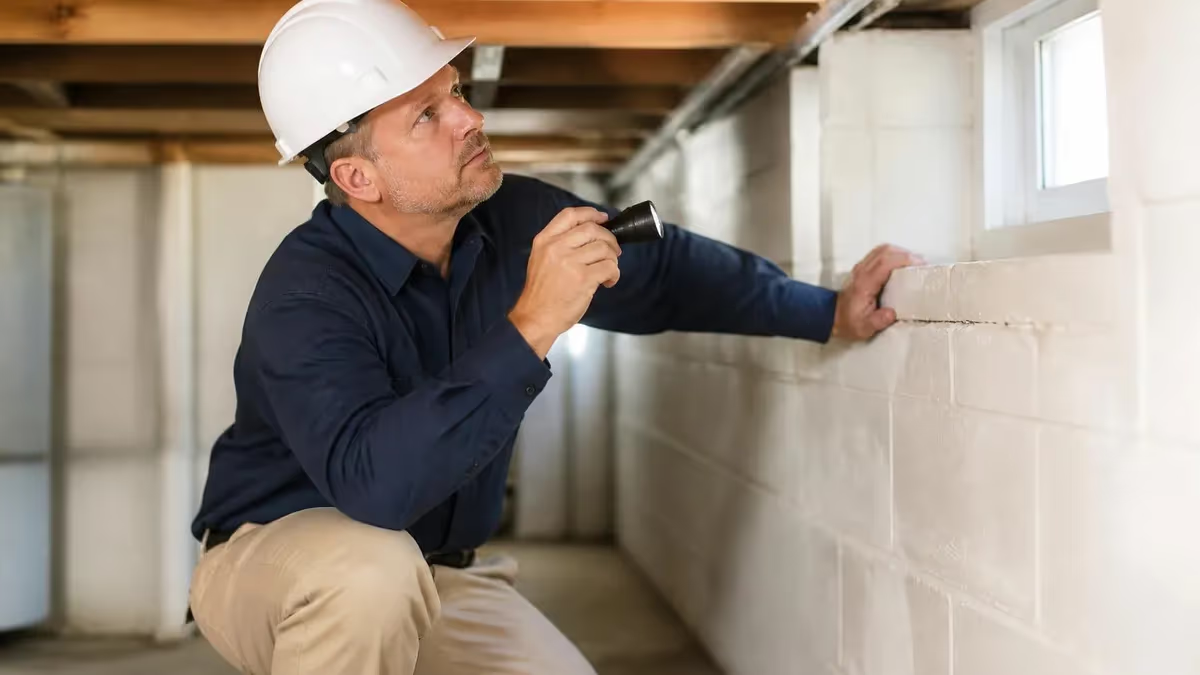
How to Become a Home Inspector: A Complete 2026 Career Guide
If you have an eye for detail, enjoy hands-on work, and want a flexible career with real earning power, learning how to become a home inspector is one of the most accessible paths into the real estate inspection industry. Home inspectors evaluate residential properties for buyers, sellers, and lenders — checking structural integrity, electrical systems, plumbing, HVAC, roofing, and dozens of other components that affect safety and value.
The career rewards people who like solving puzzles. Every house is different, every defect tells a story, and your written reports directly help families make six-figure decisions. The barrier to entry is moderate: most states require 60 to 120 hours of pre-licensing education, supervised field inspections, and a passing score on a national exam — but no four-year degree is needed.
This guide walks through the full pathway: prerequisites, state-by-state licensing rules, training hours, the National Home Inspector Examination (NHIE), insurance requirements, costs, realistic timelines, and the salary range you can expect. We compare franchise opportunities like Pillar to Post and AmeriSpec against starting your own independent firm, and explain which path fits which personality.
You'll learn the specific steps to take this month, next month, and in your first year of practice. Practice exam tools matter too — many candidates use the official home inspector test resources to prepare for state and national licensing exams. Free question banks like our home inspector practice test pdf help cement the knowledge before exam day.
Demand for qualified home inspectors stays strong because every residential real estate transaction involves a buyer who wants peace of mind, a lender who wants risk assessment, and a seller who needs deal certainty. Roughly 4 to 5 million U.S. homes change hands each year and 80% of them receive a professional inspection — that floor demand alone supports a vibrant inspector workforce of about 30,000 active inspectors nationwide. Aging housing stock and rising insurance scrutiny continue to push inspection demand upward year after year.
Basic Prerequisites: Who Can Become a Home Inspector?
Most states have low barriers to entry. The baseline requirements across the U.S. are: at least 18 years of age, a high school diploma or GED, and no disqualifying criminal background. Some states (Texas, Louisiana, North Carolina) run a background check before issuing a license — felony convictions involving fraud, theft, or violence can disqualify applicants for 5 to 10 years.
No college degree is required in any U.S. state. However, a background in construction, engineering, architecture, electrical work, plumbing, or general contracting gives you a major head start. Roughly 40% of new home inspectors come from one of these trades. The rest learn the technical material from scratch through approved coursework.
Physical requirements matter too. Inspectors crawl through attics, climb on roofs, squeeze into crawl spaces, and lift inspection equipment. You should be able to climb a ladder safely, work in confined spaces, and walk a typical 2,000-square-foot home for 2 to 4 hours without breaks.
Step 1: Research Your State's Licensing Requirements
Home inspector licensing in the United States is split. Roughly 28 states require a state-issued license, while the rest (including Colorado, Georgia, Idaho, Kansas, Maine, Minnesota, Missouri, Nebraska, Utah, Wyoming, and a few others) operate without state licensing. In unlicensed states, professional certification through ASHI, InterNACHI, or NAHI substitutes for state credentials and is what real estate agents look for.
Licensed states fall into three tiers. Tier 1 (strict): Texas, North Carolina, Florida, Louisiana, and New York require formal pre-licensing classes, field training, exam, fingerprinting, and ongoing continuing education. Tier 2 (moderate): California, Virginia, Illinois, Pennsylvania, Maryland, Massachusetts require coursework and exam but lighter field-training rules. Tier 3 (registration-only): a few states require only that you register your business and carry insurance — no exam.
Start by visiting your state's Department of Real Estate, Department of Licensing, or Board of Home Inspectors website. Search for "home inspector license + [your state]" and download the official application packet. This single document tells you the exact hours, exam, fees, and renewal cycle you'll need to follow.

What This Career Actually Looks Like
A typical home inspector performs 200 to 500 inspections per year, charging $300 to $600 per inspection (higher in coastal markets). Most inspections take 2-4 hours on-site plus 1-2 hours writing the report. Weekends and same-week turnaround are normal — real estate contracts have tight inspection contingency windows. Expect to drive 50-150 miles a day. After 12-18 months in business, established inspectors often turn down work or hire helpers.
The 8-Step Pathway to Becoming a Licensed Home Inspector
Step 1: Research State Rules
Step 2: Pre-Licensing Education
Step 3: Field Training & Ride-Alongs
Step 4: Pass the State or NHIE Exam
Step 5: Obtain Insurance
Step 6: Apply for State License
Step 7: Join a Professional Org
Step 8: Build Your Business
Step 2: Complete Pre-Licensing Education (60-120 Hours)
Pre-licensing coursework is where you learn the technical fundamentals — the difference between aluminum and copper wiring, how to spot a failing TPR valve on a water heater, what efflorescence on a basement wall means, and dozens of other diagnostic skills. Most states require 60 to 120 hours of approved coursework. Texas requires 154 hours, the highest in the country. New York requires 140. California requires no formal hours but does require InterNACHI or ASHI certification.
You can complete coursework three ways. Online self-paced (InterNACHI, ATI Training, AHIT, Kaplan): $400-$900, finish in 4-12 weeks. Online instructor-led (live Zoom): $700-$1,200, follows a fixed 8-week schedule. In-person at community college or trade school: $1,000-$2,500, runs 12-16 weeks evenings. Online self-paced is most popular — 70% of new inspectors use it.
Make sure your course is approved by your state board before you pay. Each state publishes an approved-providers list. InterNACHI courses are accepted by every licensed state. ASHI courses are accepted by all but a few. Generic Udemy or YouTube courses do NOT count toward licensing hours, no matter how good they are.
Step 3: Complete Field Training and Supervised Ride-Alongs
Classroom learning teaches the theory; field training teaches the eye. About 18 licensed states require supervised field training as a separate requirement on top of coursework. Texas requires 30 inspections under a sponsor before you can sit for the exam. Louisiana requires 50. New York and Virginia each require 40. Some states accept "parallel inspections" — observing then performing alongside a mentor on the same property — others require independent completion.
Finding a sponsor mentor is the biggest practical challenge in your training. Established inspectors charge $50-$200 per ride-along, or trade ride-alongs in exchange for marketing help. Local InterNACHI chapters often run mentor-matching events. Some pre-licensing schools (Kaplan, AHIT) bundle a fixed number of supervised inspections into their tuition.
During ride-alongs, you'll learn the workflow: pre-inspection client call, on-site sequencing (roof first or last? exterior or interior?), photo discipline, defect categorization (safety vs. major vs. maintenance), and how to deliver findings without scaring buyers out of a deal. The soft skills matter as much as the technical ones.
Step 4: Pass the National Home Inspector Examination (NHIE)
The NHIE is the gold-standard national exam used by 30+ states. It's 200 multiple-choice questions covering 8 content domains: structural systems, exterior, roofing, plumbing, electrical, HVAC, interiors, insulation/ventilation. You have 4 hours. Passing score is scaled but roughly 73% correct. Cost: $225. About 65% of first-time test-takers pass.
A handful of states use proprietary exams instead. Texas uses the TREC Texas Real Estate Inspector Exam (110 questions, $145). California uses an InterNACHI online exam. North Carolina runs its own state-specific exam. Wherever you live, your state board's website lists exactly which exam you need.
Preparation matters. Most candidates spend 60-100 hours studying after coursework completes. Use a question bank with at least 1,000 practice questions — patterns repeat across categories. Free resources like our home inspector test walkthrough and the downloadable home inspector practice test pdf cover the major NHIE domains. Plan to take 2-3 full-length practice tests before scheduling the real exam — you should consistently score above 80% before booking your seat.
In states requiring supervised inspections (Texas, Louisiana, New York, Virginia, North Carolina), you cannot complete licensing without a sponsoring licensed inspector. Mentors are scarce in some metro markets — call 15-25 inspectors via the state license lookup BEFORE enrolling in coursework. Some students finish 150 hours of classes only to wait 6 months for a sponsor slot. Lock in your sponsor first, then start coursework.
Step 5: Get Errors & Omissions Plus General Liability Insurance
Insurance is non-negotiable. Errors & Omissions (E&O) protects you if a buyer sues claiming you missed a defect — say a cracked heat exchanger you noted as "functional." General Liability covers physical injury or property damage during an inspection like a slip and fall or broken tile. Both policies bundled cost $1,000-$2,000 annually. Top providers: InspectorPro, OREP, Allen Insurance, and ASHI-endorsed plans through Lockton Affinity.
Newer inspectors often underestimate the lawsuit exposure. The most common claim is a buyer alleging you missed an obvious defect within 90 days of closing — leaky roof, faulty water heater, cracked foundation. Even when the inspector is right and the defect was disclosed in the report, defending the claim costs $5,000-$25,000 in legal fees. E&O pays those defense costs. Without it, one nuisance lawsuit wipes out a year of profit.
Choose a provider that offers "per-claim" defense outside the policy limit rather than "defense within limits." The latter eats your coverage cap on lawyer fees before any settlement is paid. Pay annually instead of monthly to save 8-15%. Lock in multi-year discounts where available — InspectorPro and OREP both offer 5-7% off for 3-year prepay.
Coverage limits matter. Minimum: $100K per occurrence / $300K aggregate is the entry tier. Recommended: $300K / $1M for inspectors doing 200+ inspections a year. Some states like Florida mandate specific minimums. Your client real estate agents will ask for a Certificate of Insurance (COI) before referring you — many won't refer uninsured inspectors at all.
Step 6: Submit Your State License Application
Once coursework, field training, exam, and insurance are done, file your application. Most states use an online portal. Documents typically required: government ID, proof of coursework completion, exam score report, insurance COI, fingerprint card or background check authorization, application fee ($50-$300), and a passport-size photo. Processing takes 2-6 weeks. A few states like Texas and North Carolina take 8-12 weeks during peak season.
If your state requires sponsoring inspector sign-off for the apprenticeship hours, plan ahead — your sponsor must mail or upload a signed verification form. Get that paperwork rolling 2-3 weeks before your other docs are ready to avoid delays at the finish line.

Cost Breakdown to Get Licensed
- Online self-paced: $400 - $900
- Online instructor-led: $700 - $1,200
- In-person: $1,000 - $2,500
- NHIE national exam: $225
- State-specific exam: $100 - $200
- Re-take (if needed): $100 - $225
- State license fee: $50 - $300
- Fingerprinting: $30 - $80
- Background check: $25 - $50
- E&O + General Liability: $1,000 - $2,000
- Bond (some states): $100 - $500
- Auto endorsement: $100 - $200
- Ladder, flashlight, meters: $500 - $1,000
- Thermal camera (optional): $500 - $3,000
- Report software (annual): $300 - $700
- Website + branding: $300 - $1,500
- LLC formation: $50 - $500
- Initial marketing: $500 - $2,000
Home Inspector Career at a Glance
How to Become a Home Inspector — By State
Texas Real Estate Commission (TREC) regulates inspectors. Requirements: 154 hours of approved coursework, 30 inspections under a sponsoring inspector, pass the TREC exam (110 questions, 73% to pass), $145 exam fee, $150 license fee, financial bond plus E&O insurance. Total time: 4-6 months. Continuing education: 32 hours every 2 years. Texas is the strictest in the country — but also has high inspector pay ($75K-$110K median).

Steps 7-8: Join a Professional Org and Build Your Business
Joining a professional organization signals credibility to real estate agents and home buyers. The three biggest are ASHI (American Society of Home Inspectors), InterNACHI (International Association of Certified Home Inspectors), and NAHI. ASHI ($529/year) emphasizes a strict Standards of Practice and Code of Ethics. Many veteran agents see ASHI as the prestige tier.
InterNACHI ($499/year) has the largest membership at over 30,000 inspectors, the deepest free education library, and a money-back guarantee program that backs your work to consumers. NAHI is smaller but well-respected in the Midwest. You can join two simultaneously to maximize referral marketing reach across overlapping agent networks.
Building the business is where many new inspectors stumble. The skill of inspection is only half the job — the other half is marketing. Start with a Google Business Profile, professional logo, mobile-friendly website featuring sample reports, client testimonials, and an online booking calendar. Photograph yourself doing inspections in branded shirts — agents share visual content readily on social channels.
The most valuable referral channel is real estate agents. Buyers ask agents "who should I use?" 90% of the time. Visit 30-50 local agents in your first 90 days. Bring printed business cards, a sample inspection report, and a one-page comparison sheet showing your turnaround time and service area. Successful inspectors host "lunch and learn" sessions at real estate brokerages — sponsoring pizza for 20 agents pays back within 2-3 referrals.
Online presence amplifies offline networking. Capture every client email. Send a branded follow-up 7 days post-inspection with a thank-you, a downloadable maintenance checklist, and one polite review request. Ask first for the Google review (most valuable for local SEO), then for the Facebook recommendation. Inspectors who reach 50+ Google reviews in year one consistently fill their calendar without paid ads.
Software tools cut administrative drag. HomeGauge, Spectora, and InspectIt all generate professional, photo-rich PDF reports in 60 minutes versus the 4-6 hours a homemade Word template takes. Spectora costs $89/month but includes scheduling, payments, agreements, agent-pages, and reporting. The time savings alone pay for the subscription within your second inspection of the month.
Realistic Salary Expectations and Career Outlook
Bureau of Labor Statistics data lists home inspector median pay at $70,200 in 2024. The 10th percentile earns $42,000; the 90th percentile earns $114,000. Top earners in Southern California, Florida, the Northeast corridor, Denver, and Austin clear $130,000 to $180,000 working 50-hour weeks with 1-2 helpers. Independent inspectors keep more revenue per inspection after subtracting insurance, marketing, software, and vehicle costs.
Franchise inspectors trade some revenue for built-in lead flow. The trade-off depends on personality: independent operators willing to grind sales calls and SEO content for 12-18 months out-earn franchise owners by year three. Those who prefer to focus on the technical inspection and skip the marketing grind often net more from a franchise model despite the royalty.
The market follows real estate cycles. In hot markets, 25-35 inspections per month per inspector is normal. In slow markets, that drops to 8-15. Smart inspectors diversify by adding ancillary services: radon testing adds about $150 per inspection, termite or wood-destroying organism inspections add $100-$200, mold sampling, sewer scope, pool/spa inspection, and drone roof inspection each boost revenue per appointment 40-80%.
Long-term career growth means specialization or scaling. Specialize: become a commercial inspector charging $800-$5,000 per inspection, a code-compliance consultant, an expert witness for real estate litigation, or a multi-family/condo specialist. Scale: hire and train associate inspectors, branch into property management consulting, or franchise your own operation in 3-5 years. Both paths can reach $200K+ household income within 5-7 years.
Demand fundamentals look healthy. Even when home sales slow, refinance inspections, pre-listing inspections, insurance inspections (especially in Florida and Gulf states for wind/4-point coverage), and warranty 11-month inspections create year-round work. Aging housing stock in the Midwest and Northeast continues to need pre-purchase analysis. Inspectors who survive year one almost always pass $100K by year three.
Franchise vs Independent Home Inspector
- +Franchise: instant brand recognition with agents and buyers
- +Franchise: marketing systems, lead generation, and call center built in
- +Franchise: proven training programs and ongoing mentorship
- +Franchise: discounted insurance, equipment, and report software
- +Franchise: clear playbook reduces year-one mistakes
- −Independent: keeps 100% of inspection revenue (no royalty fees of 6-9%)
- −Independent: total brand and pricing control
- −Independent: lower startup ($500-$3,500 vs $25K-$60K franchise fee)
- −Independent: choose your service area and hours without territory restrictions
- −Independent: easier to add specialty services and sub-brands
Pros and Cons at a Glance
| Pros | Cons |
|---|---|
| Franchise: instant brand recognition with agents and buyers | Independent: total brand and pricing control |
| Franchise: marketing systems, lead generation, and call center built in | Independent: choose your service area and hours without territory restrictions |
| Franchise: proven training programs and ongoing mentorship | Independent: easier to add specialty services and sub-brands |
Your First 30 Days Checklist
- ✓[object Object]
- ✓[object Object]
- ✓[object Object]
- ✓[object Object]
- ✓[object Object]
- ✓[object Object]
- ✓[object Object]
- ✓[object Object]
Almost every licensed state mandates ongoing Continuing Education (CE). Typical: 14-32 hours every 2 years. Subjects must align with your state's approved-topic list — usually code updates, ethics, structural pathology, energy systems. InterNACHI offers free CE that satisfies 30+ states; ASHI charges around $179 for an annual all-access pass. Skipping CE causes license suspension and re-application fees that exceed $400.
Home Inspector Practice Test Questions
Prepare for the Home Inspector Test exam with our free practice test modules. Each quiz covers key topics to help you pass on your first try.
Home Inspector MCQ
Home Inspector Exam Questions covering MCQ. Master Home Inspector Test concepts for certification prep.
Home Inspector Test
Free Home Inspector Practice Test featuring Test. Improve your Home Inspector Exam score with mock test prep.
Home Inspector Trivia
Home Inspector Mock Exam on Trivia. Home Inspector Study Guide questions to pass on your first try.
Home Inspector Home Online Inspector Test
Home Inspector Test Prep for Home Online Inspector Test. Practice Home Inspector Quiz questions and boost your score.
Home Inspector Top Rated Home Inspector
Home Inspector Questions and Answers on Top Rated Home Inspector. Free Home Inspector practice for exam readiness.
Home Inspector Ultimate Home Inspector
Home Inspector Mock Test covering Ultimate Home Inspector. Online Home Inspector Test practice with instant feedback.
Home Inspector Electrical System Safety Ha...
Free Home Inspector Quiz on Electrical System Safety Hazards. Home Inspector Exam prep questions with detailed explanations.
Home Inspector Forced-Air Furnace Inspection
Home Inspector Practice Questions for Forced-Air Furnace Inspection. Build confidence for your Home Inspector certification exam.
Home Inspector Plumbing DWV Systems
Home Inspector Test Online for Plumbing DWV Systems. Free practice with instant results and feedback.
Home Inspector Roofing Systems and Materials
Home Inspector Study Material on Roofing Systems and Materials. Prepare effectively with real exam-style questions.
Home Inspector Structural Framing Defects
Free Home Inspector Test covering Structural Framing Defects. Practice and track your Home Inspector exam readiness.
Home Inspector Questions and Answers
Related Resources
Home Inspector Test 2026

Home Inspector Practice Test PDF (Free Printable 2026)
Local Home Inspectors: Complete Guide to Finding, Hiring, and Working With Trusted Inspection Pros Near You
National Home Inspector Exam: Complete 2026 Study Guide, Pass Rates, Cost & Certification Prep
Home Inspector Pro Review 2026: Pricing, Features & Top Alternatives
About the Author

Licensed Real Estate Broker & Licensing Exam Specialist
University of Wisconsin School of BusinessSandra Taylor is a Graduate Realtor Institute (GRI) and Accredited Buyer's Representative (ABR) designee with an MBA in Real Estate from the University of Wisconsin School of Business. She has 18 years of residential and commercial real estate brokerage experience and coaches real estate license candidates through state salesperson and broker pre-license examinations across multiple states.