
Home Inspector Near Me: How to Hire a Quality Local Inspector (2026 October)
Hire the right home inspector near me. Where to find them, 📝 what to ask, red flags, costs ($300-$700+) and what's covered. Step-by-step buyer's guide.
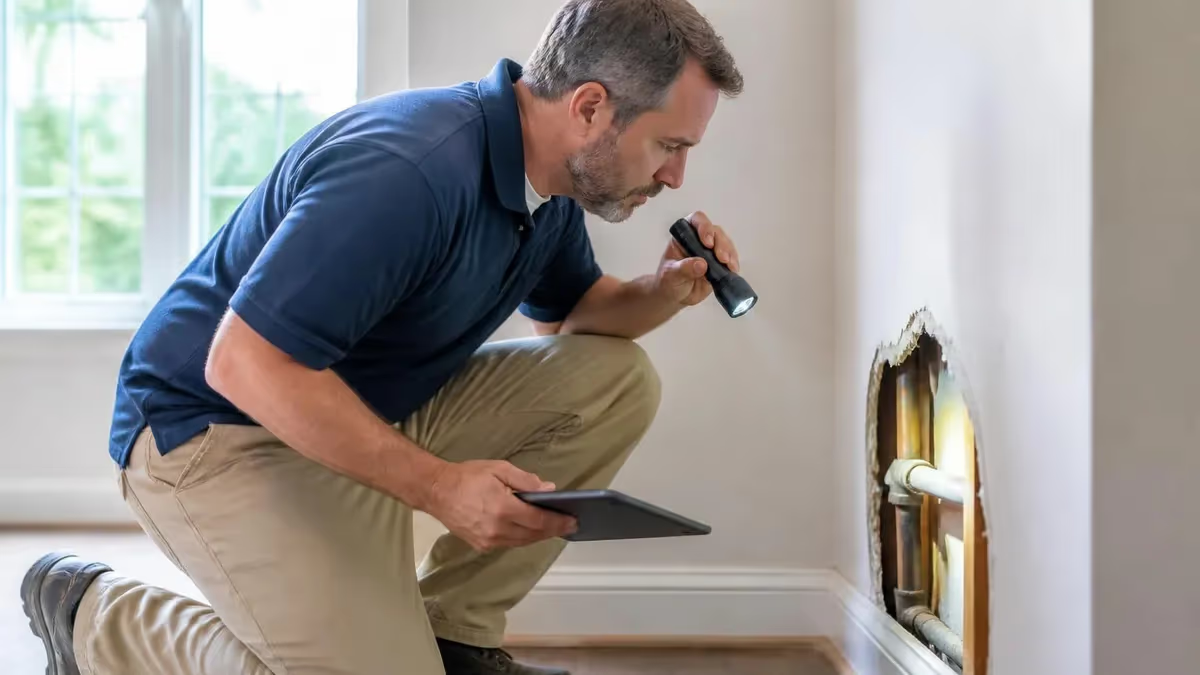
Hiring a Home Inspector Near You
A quality home inspector near me search should focus on three things: state license verified at your state board, professional certification (ASHI Certified Inspector or InterNACHI Certified Master Inspector), and E&O plus general liability insurance of at least $300K. Expect to pay $300 to $700 for a standard inspection on a 1,500 to 2,500 square foot home, with larger homes running $500 to $1,200. Inspections take 2 to 4 hours, and you should always attend.
The biggest mistake buyers make is choosing the cheapest inspector their agent suggests. Your inspector represents you, not the agent or the seller. Use independent referrals from neighbors or friends, then cross-check with ASHI.org Find My Inspector or InterNACHI.org Find an Inspector. Verify the license, request a sample report, and confirm insurance coverage before signing anything.
Home Inspector Near Me: How to Hire a Quality Local Inspector
Searching for a home inspector near me usually happens fast. You signed a purchase agreement, your buyer's inspection contingency clock just started, and you have 7 to 14 days to find someone you trust to walk through what might be the largest purchase of your life. Most buyers spend more time picking a dishwasher than choosing the inspector who will tell them whether the foundation is cracked or the electrical panel is a fire hazard.
This guide walks through exactly how to find, vet, and hire a quality local home inspector. We cover where to search, what credentials matter, the eight questions to ask before you sign, the five red flags that should make you walk away, and what a fair price looks like in 2026. Whether you are buying your first home, selling and want a pre-listing inspection, or you own a home and want an annual maintenance check, the process is the same.
A home inspection is not just a closing checkbox. It is your one chance to walk through the property with a trained professional before the keys change hands. A good inspector will spend 2 to 4 hours on a typical home and produce a 20 to 50 page report with color photos, severity ratings, and a summary section. A weak inspector will be in and out in 90 minutes and email you a generic PDF. Knowing the difference saves you thousands.
If you are curious what inspectors actually study before they pass their state board exam, our home inspector test resource explains the certification process and exam content. Buyers who understand what the inspector is checking ask better questions on inspection day and catch issues the inspector might overlook.
Below we cover when to hire an inspector, where to find a good one, what to look for on the credentials side, the questions to ask, red flags, fair pricing, what is and is not covered, and how to use the report to negotiate. The goal is simple: by the end of this guide you should be able to vet any home inspector in your area in under 30 minutes.
One last framing point before we dive in. The home inspection is the only step in the buying process where the professional you hire works solely for you. The agent has a commission tied to closing. The lender has a loan officer with origination targets. The title company has the seller as a co-client.
The inspector is the one independent voice in the room. That makes choosing the right inspector arguably more important than choosing the right lender or agent — yet most buyers spend 10 times longer comparing mortgage rates than vetting their inspector. Flip that ratio and you will catch things that save you tens of thousands.

Your Quick-Reference Hiring Guide
The best home inspectors near me rarely advertise heavily — they get most work through referrals. Start with the official directories: ASHI.org "Find My Inspector" lets you search by ZIP code and filters for ASHI Certified Inspectors (ACI). InterNACHI.org/find shows Certified Professional Inspectors (CPI) and Certified Master Inspectors (CMI). Both directories show license numbers, certifications, contact details, and ratings.
Beyond directories, ask three sources: a neighbor who recently bought (most reliable), your real estate attorney (no kickback motive), and your real estate agent (useful but verify — agents may steer to inspectors who do not kill deals). Avoid Yelp and Angi as primary sources; use them only to cross-check reviews on inspectors you already shortlisted.
When Do You Actually Need a Home Inspector?
The most common trigger is a real estate purchase. Almost every U.S. residential purchase contract includes a buyer's inspection contingency lasting 7 to 14 days from the date of contract acceptance. During this window, you hire an inspector, review the report, and decide whether to proceed, request repairs, ask for credits, or walk away with your earnest money intact. Miss the deadline and you waive the contingency, which can mean losing your earnest money if you later try to back out.
Sellers also hire inspectors. A pre-listing inspection costs the same as a buyer's inspection but gives you control. You learn about issues before listing, can choose to repair or disclose, and reduce the risk of renegotiation after the buyer's inspection. Sellers who do this typically close faster and at higher net prices.
Existing homeowners benefit from annual or biennial maintenance inspections, especially on older homes. A 4-year-old roof, a 12-year-old HVAC, or a 25-year-old electrical panel each have different risk profiles. A maintenance inspection catches small problems before they become $15,000 emergencies. Many inspectors offer a discounted "maintenance inspection" rate of $250 to $400 for repeat clients.
Finally, after major weather events — hurricanes, severe hail, wildfire smoke, earthquake — a targeted inspection focused on the relevant systems (roof, structure, HVAC, exterior) can document damage for insurance claims. Some inspectors specialize in storm and insurance work.
Where to Find a Quality Local Home Inspector
Start with the two national certification bodies. ASHI.org runs the "Find My Inspector" search; ASHI inspectors must pass the National Home Inspector Examination and maintain continuing education. InterNACHI.org has the largest directory with the most rigorous continuing education requirement — InterNACHI Certified Master Inspectors (CMI) have completed 1,000+ paid inspections plus advanced coursework.
Ask your real estate agent for three names — not one. Cross-reference the names against the directories above. If your agent only gives you one name and pushes hard for that pick, treat it as a warning sign. Some agents have informal arrangements with "deal-friendly" inspectors who downplay issues to keep transactions moving. Your inspector should work for you, not the deal.
The best referrals come from people who have no financial stake: a neighbor who closed in the last 6 months, a coworker who renovated, or a contractor friend. Ask what they liked, what they would change, and whether the report was actually useful.
If you are looking specifically in the Chicago metropolitan area, we have a dedicated guide covering Illinois state licensing and top firms — see our breakdown of chicago area home inspectors. The same vetting principles apply to any market.
One overlooked source: county recorder and small claims court records. In some metros, you can search for lawsuits naming home inspectors as defendants. Inspectors with multiple lawsuits in the past 5 years are worth avoiding. This sounds extreme but takes 10 minutes online and has saved buyers from hiring people with documented track records of missing major defects. Treat it as a final filter on your shortlist of two or three candidates.
8 Pre-Hiring Questions to Ask Every Home Inspector
- ✓Are you licensed in this state? What is your license number? (Verify on your state's licensing board website before hiring.)
- ✓What certifications do you hold? Look for ASHI Certified Inspector (ACI), InterNACHI CPI, or InterNACHI Certified Master Inspector (CMI).
- ✓How many years have you been inspecting and how many inspections have you completed? Aim for 5+ years and 500+ inspections.
- ✓Am I allowed to be present for the entire inspection? If the answer is no or 'only at the end,' hang up.
- ✓Will you walk the roof if it is safe, and will you enter the crawl space and attic? Both are non-negotiable.
- ✓What insurance do you carry and what are the limits? Minimum: $300K E&O plus general liability.
- ✓Can you email me a sample report from a recent inspection? Quality reports have 20+ pages, color photos, and severity ratings.
- ✓How long after the inspection until I get the written report? 24 to 48 hours is standard; 5+ days is too slow.
5 Red Flags When Hiring a Home Inspector
- Why it matters: 28 states require home inspector licensing. In licensed states, an unlicensed inspector is operating illegally and you have no recourse.
- What to do: Verify license on your state board lookup before hiring. Walk away if the number does not match.
- Why it matters: Without E&O and general liability, you cannot recover damages if the inspector misses a serious defect.
- What to do: Request the insurance certificate directly. Confirm $300K+ E&O and $1M general liability.
- Why it matters: A weak report = a weak inspection. Quality inspectors are proud of their reports and share them freely.
- What to do: If the sample is under 15 pages, lacks photos, or has no severity ratings, choose someone else.
- Why it matters: Attending is how you learn the home. Inspectors who restrict attendance are usually hiding rushed work.
- What to do: Insist on full attendance from start to finish. If they push back, hire someone else.
- Why it matters: Many states prohibit inspectors from referring contractors due to kickback risk. It biases findings toward more repairs.
- What to do: If the inspector pushes a specific HVAC company or roofer, ask why. Get independent contractor quotes.

What Credentials Actually Matter
Two layers matter: state license and professional certification. State license is the legal floor — 28 states require home inspectors to be licensed, registered, or certified by a state body. In those states, an unlicensed inspector is operating illegally and any contract is unenforceable. Always verify the license number directly on your state's licensing board website, not just on the inspector's business card.
Professional certification is the quality floor. ASHI (American Society of Home Inspectors) requires passing the National Home Inspector Exam (NHIE), completing 250 paid inspections, and ongoing continuing education. ASHI Certified Inspector (ACI) is the gold standard for residential work. InterNACHI (International Association of Certified Home Inspectors) is the largest body; its Certified Master Inspector (CMI) designation requires 1,000 paid inspections plus continuing education and is widely respected.
Experience matters more than people think. An inspector with 5 years and 1,500 inspections has seen problems a 1-year inspector with 80 inspections has never encountered. Pattern recognition — knowing that a hairline crack in a specific location indicates foundation settlement — comes from volume, not coursework.
Insurance is the final layer. Errors and Omissions (E&O) insurance covers you if the inspector misses a major defect. General liability covers physical damage to the property during the inspection. Minimums: $300K E&O, $1M general liability. Get the certificate of insurance in writing before paying. Inspectors who shrug at insurance questions are often uninsured.
What the Inspection Day Looks Like
Plan to spend 2 to 4 hours on-site. Arrive 15 minutes early to meet the inspector and walk the exterior with them. Bring a notepad, a flashlight, and comfortable clothes — you may be climbing into the attic or crawl space. Wear shoes you do not mind getting dirty.
The inspection follows a standard sequence: exterior first (siding, grading, drainage, roof from ground), roof walk if safe, attic, then through the interior room by room (electrical, plumbing fixtures, windows, doors), HVAC, basement or crawl space, and finally the appliances and water heater. Good inspectors narrate as they go and explain what they are seeing. Take notes; the report will arrive later, but in-the-moment observations help you decide which repairs to prioritize.
You will receive the full written report 24 to 48 hours after inspection. Read it the same day. Quality reports include color photos, severity ratings (safety hazard, major defect, minor defect, maintenance item), and a summary section listing the top issues. Use the summary to drive your negotiation strategy.
Want to test your own knowledge of what inspectors check? Take our home inspector practice test — the same content covered in state board exams. It is a useful way for buyers to learn the language inspectors use in reports.
Negotiating With the Inspection Report
Once you have the report, you have four options: request repairs, request a credit at closing, request a price reduction, or walk away (if your contingency is still active). Most buyers combine the first two. The repair-vs-credit decision depends on your timeline and trust in the seller's contractor choices. Credits give you control; repairs save you the hassle.
Lead with safety hazards (electrical, gas, structural). These are non-negotiable in most markets. Move to major defects (roof at end of life, HVAC failure, water intrusion). Skip cosmetic items — asking for paint touch-ups will hurt your credibility on the bigger asks. A typical credible ask is 3 to 6 items totaling $3,000 to $15,000 on a median-priced home.
If the seller refuses, you have two paths. First, get independent contractor quotes for the items and re-present with hard numbers. Second, decide if the deal is still worth it at the original price. If your contingency is still active and the seller will not budge, walking away with your earnest money intact is a legitimate option. A good inspector enables this decision; a bad one leaves you guessing.
Home Inspection Cost Breakdown (2026)
Home Inspection Stats Every Buyer Should Know
Independent Inspector vs Franchise Chain
- +Independent inspectors are often more experienced (many own their business after 10+ years in trades)
- +Independents typically spend more time on-site (3-4 hours vs 2-2.5 hours at franchises)
- +Reports tend to be more detailed and customized to the specific home
- +Direct relationship — you call the inspector, not a dispatch line
- +Often more flexible scheduling and faster report turnaround (24 hours)
- +Pricing is often more competitive in major metros
- −Quality varies more — vetting is essential since there is no brand-level QA
- −Smaller or no marketing presence makes them harder to discover
- −Limited specialty add-ons (may need separate vendors for radon, sewer scope)
- −Less standardized report formats — some are still PDF text-only
- −No corporate backstop if there is a dispute over a missed defect
- −Insurance limits may be lower than franchise minimums
Pros and Cons at a Glance
| Pros | Cons |
|---|---|
| Reports tend to be more detailed and customized to the specific home | Quality varies more — vetting is essential since there is no brand-level QA |
| Direct relationship — you call the inspector, not a dispatch line | Smaller or no marketing presence makes them harder to discover |
| Pricing is often more competitive in major metros | Limited specialty add-ons (may need separate vendors for radon, sewer scope) |

National Franchise Chains: The Big Five
If you prefer a brand name, the U.S. market is dominated by five franchise networks. Pillar to Post has 500+ franchises across North America and is the largest. WIN Home Inspection operates 175+ locations and emphasizes detailed digital reports. AmeriSpec has 200+ U.S. and Canadian locations and is part of the ServiceMaster family. HouseMaster runs 250+ locations and is known for warranty-backed inspections. BPG (Building Pro Group) covers commercial and residential with 70+ offices.
The franchise advantage is consistency: report templates, training standards, and corporate insurance. The disadvantage is that franchise quality is only as good as the individual franchisee. A Pillar to Post in one city may be excellent; the same brand in the next city may be mediocre. Vet the specific franchisee using the same checklist as you would for an independent.
A practical approach: ask the franchise to assign their most experienced inspector to your appointment, not the newest hire. Franchises rotate work among their inspectors, and you can specifically request a senior person.
What If the Seller Refuses to Negotiate?
This is more common than buyers expect, especially in seller's markets. If the seller refuses to repair or credit, you have three real options. First, escalate with documentation: get two independent contractor quotes for the major items and present them as evidence of the real cost. Sellers often capitulate when they see hard numbers from licensed contractors.
Second, negotiate scope: drop the smaller items and focus on the two or three largest. Sellers will sometimes agree to handle the roof or HVAC if the rest is dropped. Third, walk away. If your contingency is still active and the deal-breakers are confirmed, walking is a legitimate move. You will lose the inspection fee but keep your earnest money.
Many buyers find a fourth path: re-shop the loan. If the appraisal comes in low, you have additional negotiation use independent of the inspection. Combine an appraisal contingency with the inspection contingency and you have two parallel paths to renegotiate the price.
Specialty Inspectors You May Also Need
A general home inspector is the starting point, but some properties need more. Older homes (pre-1978) should add a lead paint test if children will live there. Homes in EPA Radon Zone 1 should always include radon testing. Homes 40+ years old benefit from a sewer scope. Homes with private wells need water quality testing. Homes with septic systems need a separate septic inspection ($200-$500).
Coastal properties need a wind mitigation inspection — required for insurance discounts in Florida, Texas, and the Gulf Coast. Homes with pools or spas need a separate pool/spa inspection. Homes with oil tanks (above-ground or buried) need an oil tank scan and possibly environmental testing.
For aspiring inspectors curious about the career path on the other side of this equation, our guide to how to become a home inspector covers state licensing, training schools, and the certification timeline. The earnings side is covered in our home inspector salary deep dive, and full training options are in our home inspector courses comparison.
Bottom line: a home inspector near you is easy to find but hard to vet well. Spend an hour on the front end checking license, certifications, insurance, and a sample report and you will save days of frustration and potentially thousands in undisclosed repairs. The inspection is the one moment in the buying process where a small investment yields the largest return.
A final practical note on timing. Schedule the inspection for the third or fourth day of your contingency window, not the last day. You want at least 3 to 5 days of buffer after the report arrives to gather contractor quotes, negotiate, and respond formally. Buyers who book on day 13 of a 14-day window leave themselves no room to negotiate — they either accept whatever the seller offers or walk. Booking early is the single easiest way to strengthen your negotiating position without spending an extra dollar.
And remember: the inspector's job is to find problems, not to grade the house pass-fail. Every home has issues — even brand new construction. A report listing 15 to 25 items is normal. A report listing 3 items is a red flag (the inspector was rushed or unqualified). A report listing 50 items is also a red flag (every minor scratch is being padded in). Look for proportionate, photo-backed findings with severity ratings, and you have your answer on whether you hired the right person.
Your Inspection Day Timeline (Hour by Hour)
30 min before
Hour 1: Exterior + Roof
Hour 2: Attic + Interior
Hour 3: Systems + Basement
Hour 4: Wrap-up Walkthrough
24-48 hours after
Home Inspector Questions and Answers
Related Home Inspector Resources
Home Inspector Test 2026
How to Become a Home Inspector: Step-by-Step Career Guide
Home Inspector Salary: Real Earnings by State, City & Experience (2026)
Home Inspector Courses: Best Schools, Costs & State Requirements (2026)
Chicago Area Home Inspectors: Hire or Become One in Illinois

Home Inspector Practice Test PDF (Free Printable 2026)
About the Author

Licensed Real Estate Broker & Licensing Exam Specialist
University of Wisconsin School of BusinessSandra Taylor is a Graduate Realtor Institute (GRI) and Accredited Buyer's Representative (ABR) designee with an MBA in Real Estate from the University of Wisconsin School of Business. She has 18 years of residential and commercial real estate brokerage experience and coaches real estate license candidates through state salesperson and broker pre-license examinations across multiple states.