
Ham Radio License Online: The Complete Guide to Getting Licensed in 2026
Ham radio license online guide: requirements, exam prep, costs, and how to get your Technician license fast in 2026. 💡
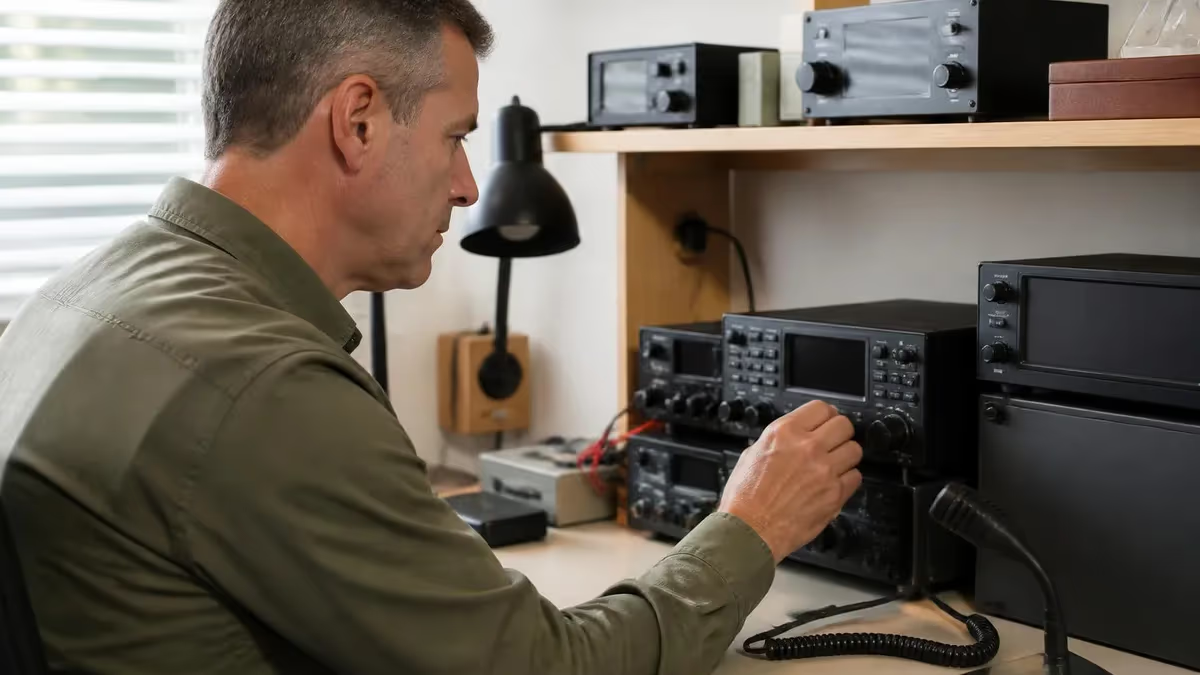
Getting your ham radio license online has never been easier than it is in 2026, and the entire path from complete beginner to FCC-licensed operator can now be completed in a matter of weeks. The Technician class license is the entry point into amateur radio, granting you privileges on a wide range of VHF and UHF bands plus limited HF access. With online study tools, remote video exam sessions, and a streamlined FCC system, you no longer need to attend in-person classes to earn your callsign. Practice with the free Ham Radio Technician practice test on PracticeTestGeeks (450+ questions with answer explanations).
The first thing to understand is that there is no fully automatic ham radio license issued by simply clicking a button. You must still pass a 35-question multiple-choice exam administered by Volunteer Examiners. The good news is that both the study process and the exam itself can be handled remotely. Dozens of VE teams now offer video-proctored remote testing sessions, meaning you can sit the exam from your kitchen table using a webcam, a second device, and a quiet room free of notes.
A ham radio license is a federal credential issued by the FCC, and it is valid for ten years before renewal. Unlike a driver's license, there is no road test, no minimum age, and no citizenship requirement. Children as young as eight have passed the Technician exam. The 35 questions are drawn from a published pool of around 400 questions, so every single possible question and answer is available to study in advance. This transparency is exactly what makes self-study so reliable and effective for newcomers.
Before you buy any gear, it helps to know that a local ham radio outlet can walk you through starter radios once you have your callsign in hand. Many new operators rush to buy expensive equipment before they pass, only to discover their needs change after they understand the hobby better. We recommend earning the license first, then investing in a radio that matches the bands and activities you actually want to pursue, whether that is local repeaters, emergency communication, or satellite work.
This guide walks you through every step of the process: understanding the license classes, registering for an FCC Registration Number, studying the question pool efficiently, finding and booking a remote or in-person exam session, passing the test, and receiving your official callsign. We will also cover realistic costs, timelines, and the most common mistakes new applicants make, so you can sidestep them entirely and get on the air faster than you might expect.
Amateur radio remains one of the most rewarding technical hobbies in the world, blending electronics, geography, public service, and global friendship. Whether you want to chat with neighbors, prepare for emergencies when cell networks fail, or bounce signals off the moon, it all starts with that first Technician license. By the end of this article you will have a clear, actionable plan to get licensed online and join the more than 750,000 active amateur radio operators across the United States.
Free Ham Radio Technician Test Study Tools
Interactive Ham Radio Technician Test resources on PracticeTestGeeks, free to start:
- Free Ham Radio Technician Amateur Questions and Answers — 16 questions with instant scoring and answer explanations
- Ham Radio Technician Test flashcards — review key terms and concepts card by card
- Ham Radio Technician Test study guide — topic-by-topic overview of what the exam covers
- Ham Radio Technician Test cheat sheet — one-page printable summary for last-minute review
Ham Radio Licensing by the Numbers
Ham Radio Technician Test: upcoming dates and official changes
- Jul 1, 2026: The revised 2026–2030 Technician Class question pool became mandatory for Ham Radio Technician examinations on July 1, 2026. (Federal Communications Commission (FCC); examinations administered by Volunteer Examiner Coordinators, including ARRL VE)
Facts verified Oct 18, 2026 against Federal Communications Commission (FCC); examinations administered by Volunteer Examiner Coordinators, including ARRL VE. Dates that have passed are removed automatically.
- The Ham Radio Technician examination contains 35 multiple-choice questions. (Federal Communications Commission (FCC); examinations administered by Volunteer Examiner Coordinators, including ARRL VE)
- Passing the Ham Radio Technician examination requires at least 26 correct answers out of 35 questions. (Federal Communications Commission (FCC); examinations administered by Volunteer Examiner Coordinators, including ARRL VE)
- A new Ham Radio Technician license application costs $35 payable to the FCC, separately from the administering VEC's examination fee. (Federal Communications Commission (FCC); examinations administered by Volunteer Examiner Coordinators, including ARRL VE)
- Retaking a failed Ham Radio Technician examination element at an ARRL VEC session requires an additional examination fee. (Federal Communications Commission (FCC); examinations administered by Volunteer Examiner Coordinators, including ARRL VE)
- A Ham Radio Technician examination retake cannot reuse the same question set previously administered to that examinee. (Federal Communications Commission (FCC); examinations administered by Volunteer Examiner Coordinators, including ARRL VE)
- The FCC Ham Radio Technician license is normally granted for a 10-year term. (Federal Communications Commission (FCC); examinations administered by Volunteer Examiner Coordinators, including ARRL VE)
- An expired Ham Radio Technician license may be renewed during a two-year filing grace period, but operating privileges cease until renewal. (Federal Communications Commission (FCC); examinations administered by Volunteer Examiner Coordinators, including ARRL VE)
- The Ham Radio Technician examination can be taken in person or online. (Federal Communications Commission (FCC); examinations administered by Volunteer Examiner Coordinators, including ARRL VE)
- Anyone who qualifies by examination may apply for a Ham Radio Technician license except a representative of a foreign government. (Federal Communications Commission (FCC); examinations administered by Volunteer Examiner Coordinators, including ARRL VE)
Facts verified Oct 18, 2026 against Federal Communications Commission (FCC); examinations administered by Volunteer Examiner Coordinators, including ARRL VE. Dates that have passed are removed automatically.
Ham Radio Technician Test Exam at a Glance
Facts verified Oct 18, 2026 against Federal Communications Commission (FCC); examinations administered by Volunteer Examiner Coordinators, including ARRL VE. Dates that have passed are removed automatically.
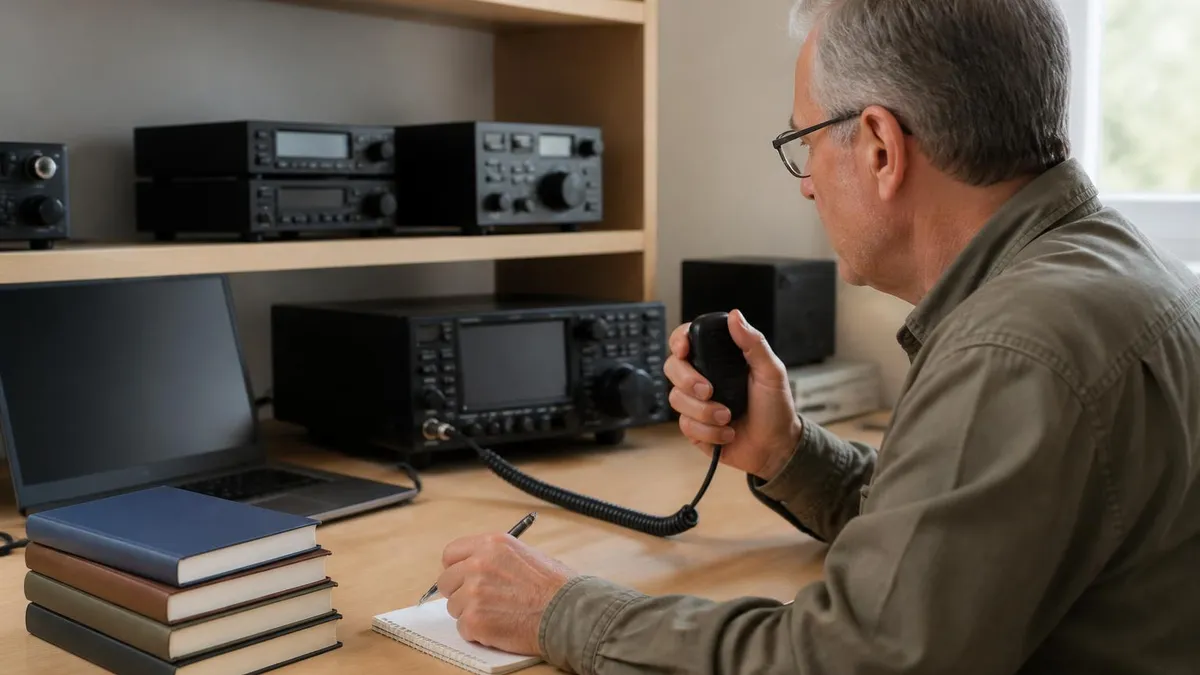
The Three Amateur Radio License Classes
The entry-level license most new hams earn first. Grants all amateur VHF and UHF privileges above 30 MHz plus limited HF voice and data on the 10-meter band. A single 35-question exam is required to qualify.
The middle tier that opens up the majority of the high-frequency HF bands for worldwide communication. Requires passing a second 35-question exam after earning Technician privileges. Most serious long-distance DX operators hold this license.
The highest license class with full access to every amateur frequency allocation. Requires a challenging 50-question exam covering advanced theory, regulations, and operating practices. Grants exclusive sub-band privileges prized by contesters and DXers.
Since 2007 the FCC removed all Morse code testing requirements from every license class. Today you can earn any amateur license, including Extra, with written multiple-choice exams only. Code remains a popular optional operating mode.
The Technician ham radio license test consists of 35 multiple-choice questions drawn from a public question pool, and you need to answer at least 26 correctly to pass, which works out to roughly 74 percent. Each question has four possible answers, and the exact wording of every question and its correct answer is published years in advance. This means there are no surprises on exam day; everything you might be asked is something you can study beforehand using free or low-cost resources.
The current Technician question pool contains around 400 questions organized into ten subelements covering FCC rules, operating procedures, radio and electronic fundamentals, antennas, propagation, safety, and station setup. The Volunteer Examiner system, coordinated by groups like the ARRL and W5YI, randomly selects questions from each subelement so your exam fairly samples the entire body of knowledge. Because the pool is finite and published, diligent study almost guarantees a pass on your first attempt.
Most candidates pass the Technician exam after two to four weeks of casual study, spending perhaps thirty minutes to an hour per day. The key is repetition with practice exams rather than memorizing a textbook cover to cover. Taking a ham radio license test practice run repeatedly until you consistently score above 85 percent is the single most reliable predictor of passing the first time. The questions you miss most often reveal exactly where you need to focus your effort.
The exam is administered by a team of at least three accredited Volunteer Examiners, all of whom hold General class or higher licenses. These volunteers donate their time to grow the hobby, and they grade your exam on the spot. If you pass, they submit your results electronically to the FCC, often the same day. Remote video sessions follow the same rules, with examiners watching through your webcam to ensure you take the test honestly and without any outside help.
One detail that trips up newcomers is the math. While there is some basic Ohm's law and frequency-wavelength arithmetic, the calculations are simple and a basic four-function calculator is permitted. You do not need to be an engineer or have a science background to pass. The vast majority of formulas you need are limited to a handful of relationships, and many practice platforms let you flag the calculation questions so you can focus on the conceptual material first.
Cost is modest and predictable. The FCC charges a $35 application fee for new and renewed licenses, payable after you pass. The VE team typically charges a separate exam session fee of around $15, though some clubs offer free or discounted sessions for students and youth. Altogether, earning your Technician license usually costs between $40 and $60 total, including a study guide if you choose to buy one rather than relying entirely on free online materials.
After passing, your information is processed through the FCC Universal Licensing System, and your brand-new callsign typically appears in the public database within one to three business days. Once that callsign is issued, you are legally permitted to transmit on the air. Many new hams keep their phone open to the FCC ULS website on exam day, eagerly refreshing the page until their unique callsign appears and they can make their very first on-air contact.
Ham Radio Bands, Frequencies, and Equipment Basics
As a Technician, your most-used ham radio bands are 2 meters (144-148 MHz) and 70 centimeters (420-450 MHz), the workhorses of local repeater and simplex communication. These VHF and UHF allocations are ideal for handheld radios and mobile rigs, reaching across a city or county through repeaters. You also gain access to 6 meters, often called the magic band for its surprise long-distance openings during good conditions.
Technicians additionally receive limited high-frequency privileges, most notably voice on a slice of the 10-meter band and digital and CW segments on 80, 40, 15, and 10 meters. These HF ham radio frequencies allow occasional worldwide contacts when propagation cooperates. While General and Extra licenses unlock far more HF spectrum, the Technician allocations are more than enough to learn propagation firsthand and get a real taste of long-distance work.
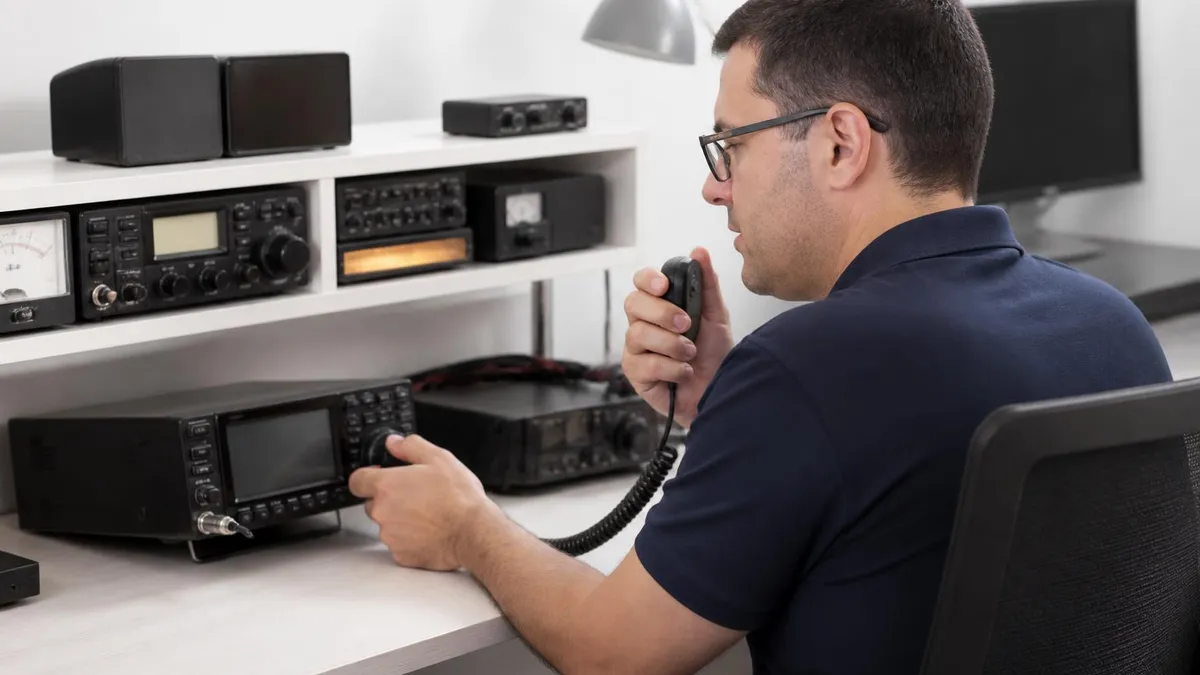
Should You Study and Test for Your License Online?
- +Study entirely on your own schedule from any device, anywhere
- +Remote video exam sessions eliminate travel to a test location
- +Free practice tests mirror the exact published question pool
- +Results are submitted to the FCC the same day in most cases
- +No classroom enrollment, tuition, or fixed semester required
- +Self-paced review lets fast learners finish in under two weeks
- +Accessible for rural candidates far from any in-person VE team
- −Remote sessions require a webcam, second device, and stable internet
- −No instructor is present to answer questions in real time
- −Self-discipline is needed to stay on a consistent study schedule
- −Hands-on equipment learning is harder without a mentor nearby
- −Identity and environment checks can feel intrusive on camera
- −Technical glitches can occasionally delay a remote exam session
Your Ham Radio License Online Checklist
- ✓Register for an FCC Registration Number (FRN) at the CORES website
- ✓Download the current Technician question pool for free reference
- ✓Choose a study method: app, online course, or printed study guide
- ✓Take practice exams daily until you score 85 percent or higher
- ✓Review the FCC rules and RF safety subelements carefully
- ✓Find a remote or in-person VE exam session near you or online
- ✓Book your session and confirm tech requirements for remote testing
- ✓Gather your ID, FRN, and a calculator before the exam begins
- ✓Pass the 35-question exam with at least 26 correct answers
- ✓Pay the $35 FCC fee promptly when the email link arrives
- ✓Watch the FCC ULS database for your new callsign to appear
- ✓Make your first on-air contact once your callsign is issued
Score 85% on practice exams before booking
The single best predictor of passing on your first try is consistently scoring 85 percent or higher on full-length practice exams. Do not schedule your real session until you hit that mark three sessions in a row. This small buffer above the 74 percent passing threshold absorbs exam-day nerves and the random question selection.
Choosing between online and in-person study comes down to your learning style, schedule, and access to local resources. Online self-study using free question-pool apps and practice exams is by far the most popular route today, and it costs almost nothing. You drill questions in short daily sessions, track your weak subelements, and watch your scores climb. This approach works especially well for motivated adults and teens who are comfortable learning independently without a fixed classroom structure or schedule.
In-person classes, often run by local radio clubs over a weekend or a few weeknights, offer a different advantage: human mentorship. An experienced ham, called an Elmer in the hobby, can explain confusing concepts, demonstrate real equipment, and answer questions on the spot. Many clubs pair a one-day cram class with a same-day exam session, letting you walk in unlicensed and walk out having passed. For hands-on learners, this immersion can be more effective than solo screen time.
When it comes to the exam itself, you now have two delivery options. Traditional in-person sessions happen at clubs, hamfests, libraries, and community centers, where a VE team proctors a room of candidates. Remote video sessions, which exploded in popularity after 2020, let you test from home while examiners observe through your webcam. Both are equally valid; the FCC treats a remotely administered exam identically to one taken in a physical room, and your resulting license is no different.
Remote testing does carry specific technical requirements you must prepare for. You typically need a computer with a working webcam, a second camera device such as a smartphone positioned to show your hands and workspace, a quiet private room, and a reliable internet connection. Examiners will ask you to pan the camera around the room to confirm there are no notes or hidden devices. Failing to meet these requirements is the most common reason a remote session gets postponed, so read the instructions carefully.
Cost differences between the two paths are minimal. Online study materials range from completely free to about $30 for a premium course or printed manual. Exam session fees are similar whether remote or in-person, generally $15 or less, plus the universal $35 FCC fee. Some organizations waive the session fee entirely for first-time youth candidates, making the hobby remarkably accessible compared to other licensed pursuits that demand expensive formal coursework and lengthy certification programs.
For those who want to explore equipment while studying, visiting a local ham radio outlet in person lets you hold radios, compare antennas, and ask staff questions before you commit to a purchase. Even if you buy online later, handling gear firsthand builds intuition that pure screen study cannot provide. Store staff are often licensed hams themselves and happy to point newcomers toward sensible starter setups that will not be outgrown too quickly.
Ultimately, the best approach for most people is a hybrid: study online at your own pace using free practice exams, lean on a local club or online forum when you hit a confusing topic, and choose whichever exam format is most convenient. There is no penalty for retaking the exam if you fail, and many VE teams let you attempt the next question set the same day. The flexibility of the modern system means almost anyone willing to invest a few weeks can succeed.
Readers who want more detail usually continue with ham radio license online.
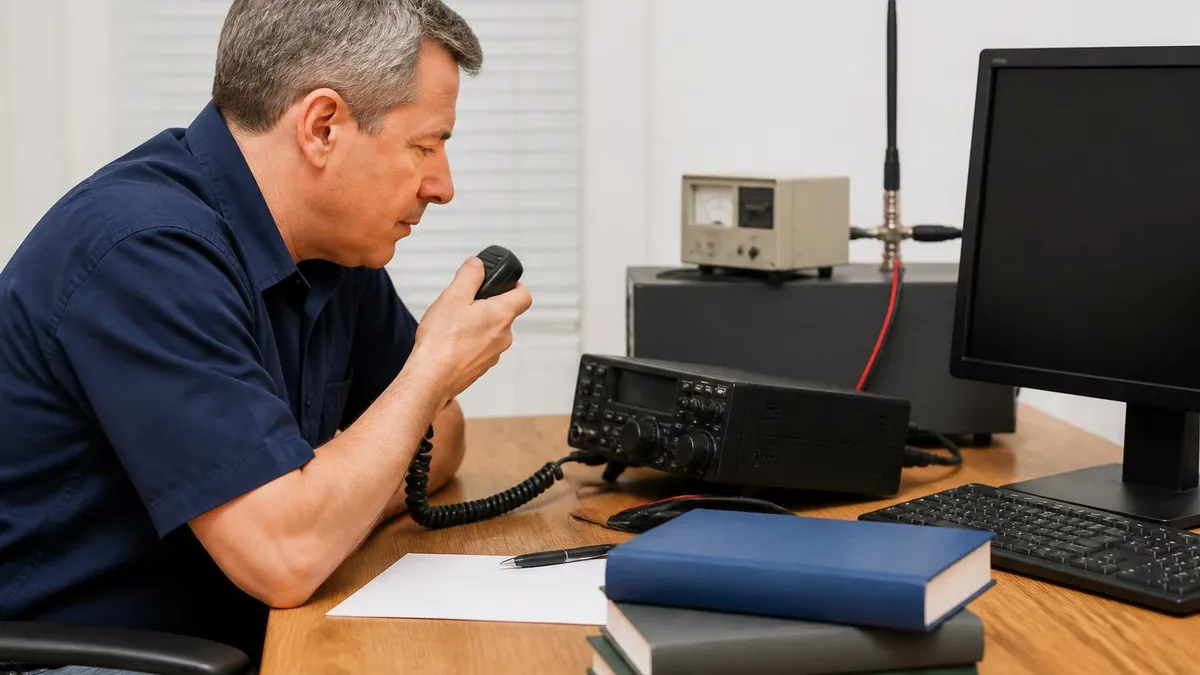
You must obtain an FCC Registration Number (FRN) from the CORES system before your exam, not after. VE teams now require your FRN at check-in to submit results, and using a Social Security Number instead is no longer accepted. Register for your free FRN a few days ahead to avoid a stressful last-minute scramble on exam day.
Exam day itself is far less intimidating than most candidates expect. Whether you test in person or remotely, arrive early, bring a government-issued photo ID, your FRN, a pencil, and a basic calculator. For remote sessions, log in fifteen minutes early to resolve any camera or connection issues before the official start. Take a deep breath; remember that you have already seen every possible question during your practice, so nothing on the screen should be truly unfamiliar when it appears.
Read each question carefully and watch for negative phrasing like which is not that can flip the correct answer. If you are unsure, eliminate the obviously wrong choices first to improve your odds, then make your best selection. There is no penalty for guessing, so never leave a question blank. Flag tough questions and return to them after answering the easy ones, which builds confidence and often jogs your memory for the harder items you skipped earlier.
The math questions catch some people off guard, but they are limited and formulaic. Ohm's law relationships, simple power calculations, and frequency-to-wavelength conversions cover nearly all of them. Practice these a handful of times until the pattern is automatic. Knowing how to compute wavelength helps you understand antenna length too, which is one reason antenna fundamentals and trivia like did ed gein talk to ilse on a ham radio curiosity often draw people deeper into the hobby's history.
Once you pass, the VE team gives you a Certificate of Successful Completion of Examination, or CSCE, as proof. They submit your results electronically, and within a few business days the FCC issues your callsign. You will receive an email with a link to pay the $35 fee, and you must pay promptly or your license will not be granted. Set a reminder so you do not let that important email slip past unnoticed in a busy inbox.
The moment your callsign appears in the FCC ULS database, you are legally on the air. Many new hams program a local repeater into a handheld they bought in advance and make a nervous first call. Do not worry about sounding perfect; the amateur community is famously welcoming to newcomers, and experienced operators love helping a fresh callsign make their first contact. That first conversation is a milestone you will remember for years to come.
From there, the hobby opens wide. You might pursue your General class license for worldwide HF privileges, join an emergency communication group, experiment with digital modes like FT8 or DMR, or chase satellites and even the International Space Station. Local clubs offer field days, contests, and mentorship that turn a solo license into a lifelong community. The Technician license is not the finish line; it is the on-ramp to a deep and endlessly varied technical pastime.
Finally, keep your license active by renewing before the ten-year expiration, which the FCC now allows for free. Update your address in the ULS if you move, since the FCC sends important notices to your registered location. Renewal does not require retaking any exam as long as you act before your grace period ends. With that simple maintenance, your callsign can stay with you for life, becoming part of your identity within the worldwide fraternity of amateur radio operators.
Now that you understand the full path, let us turn to practical preparation tips that consistently separate first-time passers from those who stumble. The most effective study habit is short, frequent sessions rather than marathon cramming. Twenty to thirty focused minutes each day for two or three weeks beats an exhausting all-nighter. Spaced repetition cements the material in long-term memory, so by exam day the answers feel automatic rather than freshly memorized and easily forgotten under pressure.
Use a quality practice-exam platform that pulls directly from the current published question pool and tracks which subelements you miss most. When you answer incorrectly, do not just note the right choice; read the brief explanation and understand why your selection was wrong. This conceptual grounding helps you handle the random subset of questions that appears on your actual exam, since you cannot predict exactly which 35 of the 400-plus questions you will face on test day.
Prioritize the subelements with the most questions. FCC rules and regulations, operating procedures, and station setup carry significant weight, while a few subelements contribute only a handful of questions each. Knowing the distribution lets you allocate study time efficiently rather than spending equal effort on every topic. Many candidates over-study electronics theory out of anxiety while under-preparing the rules questions that are actually easier points to bank reliably.
Do not neglect the RF safety and electrical safety questions. These are straightforward and almost free points if you simply read them once, yet stressed candidates sometimes skip them assuming they are intuitive. The same applies to questions about good amateur operating practice and band-plan courtesy. These commonsense items are gifts from the question pool; make sure you have reviewed all of them so you do not lose easy marks to simple carelessness.
If your scores plateau below the passing line, identify your two or three weakest subelements and drill only those for a few days. Targeted remediation produces faster gains than re-reviewing material you already know well. Many platforms let you generate a custom quiz from a single subelement, which is perfect for this kind of surgical practice. Once those weak areas climb, return to full-length mixed exams to confirm your overall readiness before booking the real session.
Reviewing the actual ham radio bands and their frequency limits is worth a dedicated session, because band-edge and privilege questions appear reliably and reward simple memorization. Make a one-page cheat sheet of your Technician privileges by band, study it until it sticks, and you will pick up several guaranteed points. Understanding where you are allowed to transmit is also genuinely useful knowledge once you are licensed and active on the air.
On the night before your exam, do a final full-length practice run, get a good sleep, and avoid frantic last-minute cramming that only breeds anxiety. Trust the preparation you have done. Lay out your ID, FRN, calculator, and pencil so the morning is calm. Confidence built on weeks of consistent practice is your best asset, and the published, finite nature of the question pool means a well-prepared candidate has every advantage on test day itself.
Sample Ham Radio Technician Test Practice Questions
Try these questions from our free Ham Radio Technician Test practice tests. The correct answer and an explanation follow each question.
What is the correct term for an amateur radio operator who is licensed but not yet holding General or Amateur Extra privileges?
- A. Technician
- B. Novice
- C. Conditional
- D. Limited
Answer: A. Technician
Technician is the entry-level FCC amateur radio license class currently in use, granting VHF/UHF privileges and limited HF access.
What is the term for the person named on an amateur radio license who is responsible for the proper operation of the station?
- A. Station manager
- B. Control operator
- C. Trustee
- D. Station licensee
Answer: D. Station licensee
The station licensee is the individual named on the license and is ultimately responsible for proper station operation.
What information is included on an amateur radio license grant in the FCC ULS database?
- A. Call sign, operator class, and expiration date only
- B. Call sign, operator class, expiration date, and licensee's mailing address
- C. Call sign and a photo ID of the licensee
- D. Only the call sign — all other data is private
Answer: B. Call sign, operator class, expiration date, and licensee's mailing address
The ULS record includes the call sign, license class, expiration date, and licensee name and mailing address, all of which are public.
What is the minimum age requirement to obtain an amateur radio license in the United States?
- A. 13 years old
- B. 16 years old
- C. 18 years old
- D. There is no minimum age requirement
Answer: D. There is no minimum age requirement
The FCC imposes no minimum age requirement for an amateur radio license; anyone who passes the exam may be licensed.
Take the full Ham Radio Technician Test practice test
Ham Radio Technician Questions and Answers
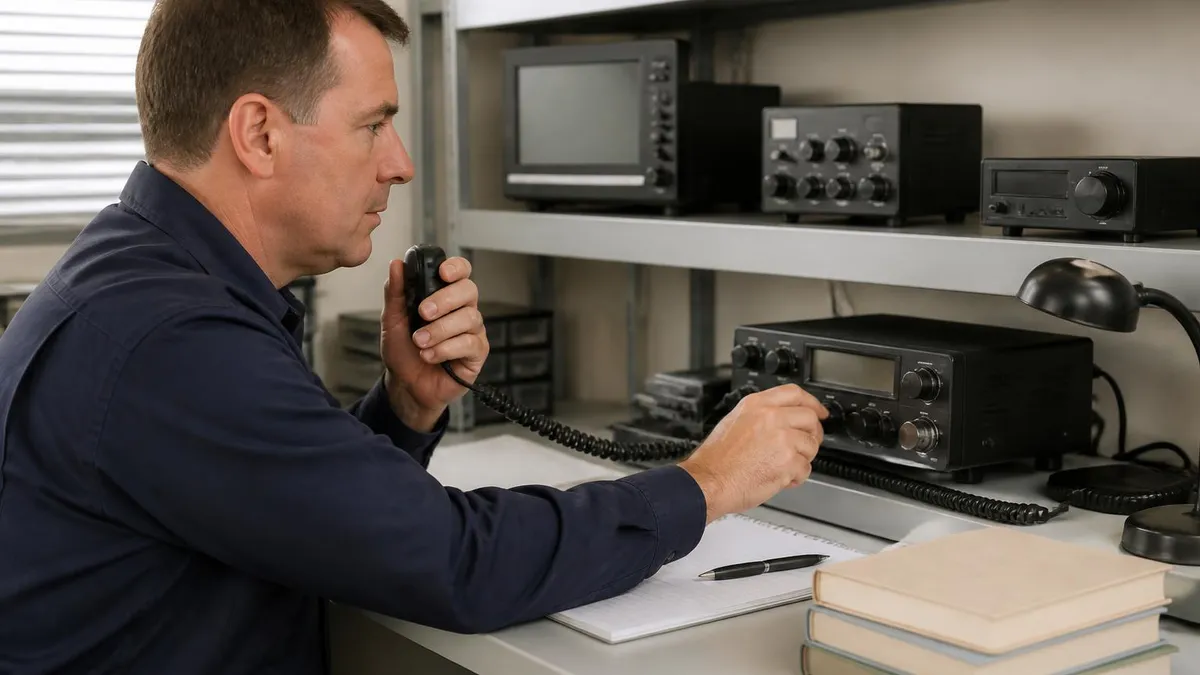
Ham Radio Stores: Where to Buy Ham Radio Equipment, Gear, and Get Your License
Ham Radio Clubs Near Me: How to Find Local Amateur Radio Groups in 2026
Ham Radio License Practice Test: Free Technician Exam Prep & Question Pool
Ham Radio Antenna Guide: Types, Towers, Portable, and Satellite Antennas
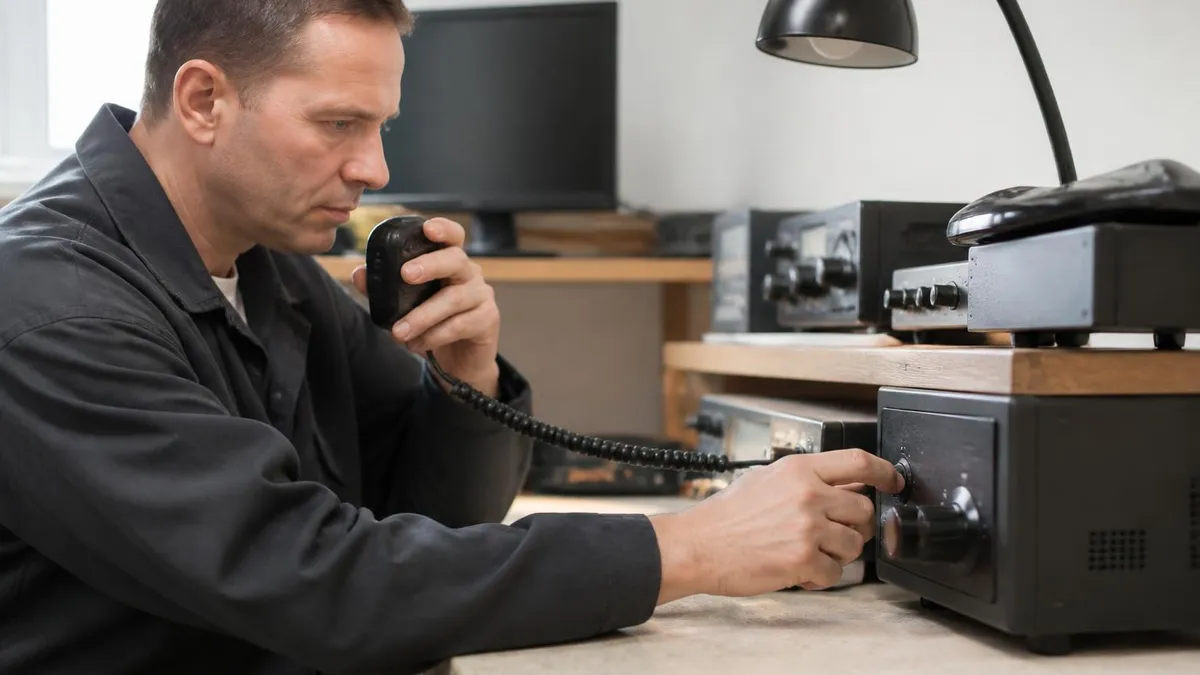
Ham Radio Handheld: Complete Guide to HT Selection, Programming, and Technician License Use
How this page was made: written with AI tools. Exam facts are checked against the official sources listed below. Not reviewed by a subject-matter expert. Editorial policy
Sources & references
Exam facts on this page (fees, format, dates, passing scores) are checked against these official sources; the date is our last check. Editorial policy
- arrl.org — Eligibility, passing score, renewal, retake policy, score release, score validity, test delivery, test dates, fees, retake fee · verified Oct 2026
- home.arrl.org — Exam format · verified Oct 2026