
HAM Radio Kits — Complete Guide (2026 October)
Ham radio kits buying guide for 2026 October: QRP Labs QCX-mini, Elecraft KX2, antenna kits, NanoVNA, hotspots, soldering tools and where to buy. 🧠
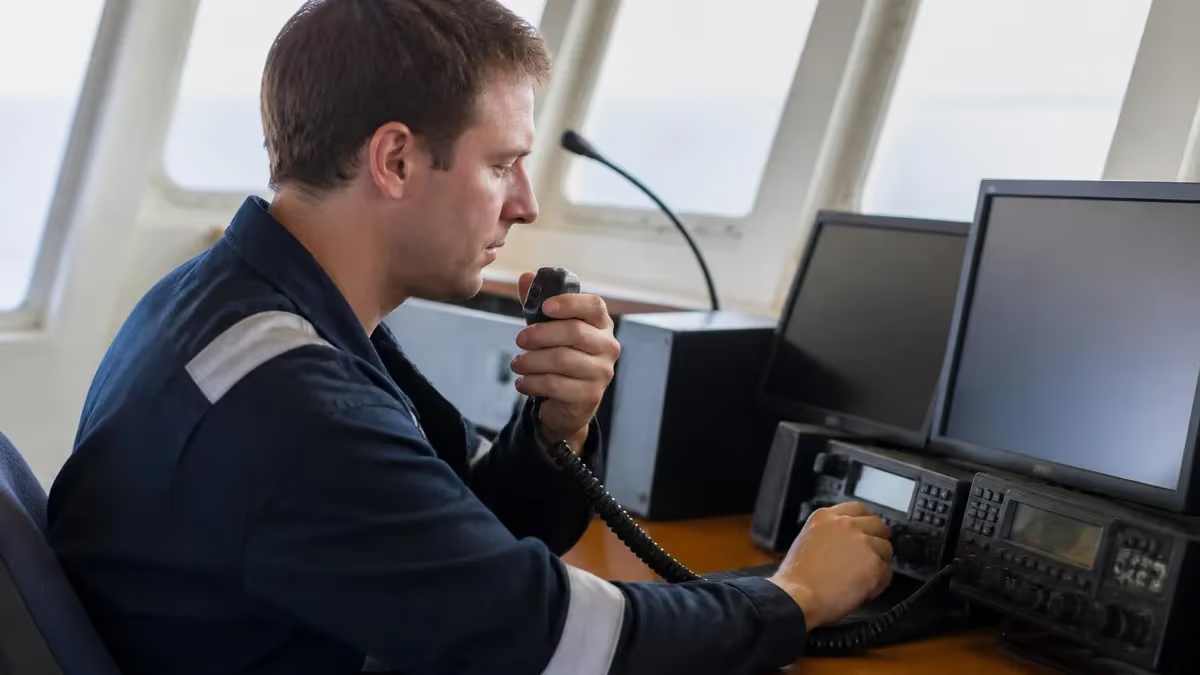
Ham Radio Kits — Complete Guide (2026)
Ham radio kits sit at the heart of the hobby. They're how thousands of operators learn what's actually happening inside the box — the toroids, the mixers, the crystal filters — instead of just turning the knob on a finished rig. If you've passed your Technician exam (or you're studying), a kit is the fastest route to building real skills and walking away with a working radio you understand end-to-end.
Here's the honest answer on cost: a basic QRP CW transceiver kit lands around $55–$150. Mid-range mono-band kits with SSB run $300–$700. Full-featured portable rigs like the Elecraft KX2 climb into the $1,300+ range. Antenna kits start under $40. None of that includes the soldering iron, multimeter, and the patience you'll need on assembly night.
The market in 2026 is healthier than it's been in a decade. ham radio equipment manufacturers like QRP Labs, Elecraft, and Hendricks QRP Kits ship constantly. Heathkit — yes, that Heathkit — is back with limited runs of the AT-1 transmitter. Plus there's a whole world of microcontroller-driven projects on the Raspberry Pi and Arduino that didn't exist when your Elmer was licensed.
What follows breaks down kits by skill level, plus the antenna kits, test gear, and digital tools that round out a modern station. By the end you'll know which kit to start with, what tools you actually need, and where to buy without overpaying.
One more thing before we dive in. If you haven't passed your exam yet, take a ham radio practice test first. You'll get more out of building a kit when you understand the theory behind what you're soldering together.
Beginner-friendly QRP transceiver kits, intermediate SSB rigs, advanced HF stations, antenna kits, NanoVNA test gear, Pi-Star digital hotspots, Arduino/Raspberry Pi projects, soldering tool recommendations, and trusted vendors. Plus realistic price ranges and skill prerequisites for each category.
Kit Categories at a Glance
- Price Range: $55–$150
- Example: QRP Labs QCX-mini
- Skill Needed: Basic soldering
- Build Time: 8–14 hours
- Price Range: $300–$700
- Example: Elecraft K1, KX2 add-ons
- Skill Needed: SMD experience helpful
- Build Time: 20–35 hours
- Price Range: $2,000–$4,500
- Example: Elecraft K3S
- Skill Needed: Strong electronics background
- Build Time: 40–80 hours
- Price Range: $40–$400
- Example: DX Engineering, MFJ EFHW
- Skill Needed: Minimal — winding & soldering
- Build Time: 2–6 hours
Beginner QRP Transceiver Kits
Start small. The QRP Labs QCX-mini is the kit that's pulled more newcomers into homebrew than any other in the last five years. It's a 5-watt CW transceiver for a single band — you pick 80, 60, 40, 30, 20, or 17 meters when you order — and it costs around $55 plus an enclosure. The instructions are excellent. Hans Summers at QRP Labs has rewritten them based on a decade of build reports, so the gotchas are flagged.
What Makes the QCX-Mini a Good First Build
Through-hole components. Clear PCB silkscreen. A test point at every critical stage so you can troubleshoot with a basic multimeter. The microcontroller handles tuning, keying, and CW decode — which means once it's working, you can use it to copy code as you study for General. That's two skills built from one kit.
Other beginner-friendly options worth a look: the Pacific Antenna SS-30 (a 30-meter superhet, ~$80), the K1EL Winkeyer kits for CW practice, and the Hendricks PFR-3B (a discontinued classic, but used kits show up on QRZ regularly). For sideband on a budget, the uBitx v6 from HF Signals lands at around $150 for a multi-band 10-watt rig — though it's more challenging to align.
Tools You'll Need for a First QRP Kit
A temperature-controlled soldering iron in the 40-60W range. Hakko, Weller, and the Pinecil V2 (about $30) are all fine. You'll also want decent solder — 60/40 leaded works best for beginners, despite RoHS preferences. Add a magnifier, side cutters, needle-nose pliers, and a digital multimeter. Total tool spend if you're starting from zero: $80–$120.
One warning. Don't buy a $15 iron from a marketplace site. It'll overshoot temperature, ruin pads, and frustrate you out of the hobby. Spend the $30 on the Pinecil and you'll never look back. Many local ham radio clubs run build-along nights where you can borrow proper tools before committing.
Beginner Kit Prices (2026)
Intermediate Kits: Elecraft Country
Once the QCX is humming, Elecraft is the next stop. The Elecraft K1 is a 4-band CW transceiver kit — discontinued but available used — that gave a generation of builders their first taste of a polished rig. The K1's successor is effectively the KX2 with optional internal kits, but the KX2 itself ships assembled. So the K1 used market and Pacific Antenna fill the gap.
The Elecraft KX2 Path
The KX2 is the rig most serious portable operators end up with. It's $1,300 assembled, but Elecraft sells the internal ATU, battery, and microphone as add-on installation kits. The ATU kit alone is a satisfying 4-hour project. If you want kit-builder satisfaction without 40 hours, this is the sweet spot.
Step further and you're looking at the Elecraft K3S. The K3S in kit form requires real electronics chops — alignment, calibration with a signal generator, a quiet day at the bench. Plan 40-80 hours. The reward is a contest-grade station you assembled yourself.
Mono-Band Mid-Tier Options
Heathkit's reborn AT-1 transmitter kit ($499) is a faithful 1953 reproduction. A 50-watt CW-only transmitter on 80/40/20/15/10m. Pair with a receiver for a vintage station. It uses tubes — add safety reading before plugging in.
The (tr)uSDX from DL2MAN is a five-band 5W SSB/CW kit at $90. Tiny, clever, pocket-sized. Build reports vary — the SMD parts are small — so it's ambitious second-build territory.
Compare Mid-Tier Kits
Bands: 4 (typically 80/40/30/20m). Power: 5W. Mode: CW only. Build time: 25–35 hours. Used price: $400–$650. Excellent documentation; many builders consider this the gold standard for first-time intermediate kits.

Advanced Kits: K3S, Big Power, Big Bench Time
The Elecraft K3S is the apex of consumer ham kit building. Around $4,500 fully loaded. It's a 100-watt all-mode HF + 6m transceiver with software-defined IF, dual receivers, and contest-grade selectivity. The kit version requires you to assemble several modules, install IF roofing filters, and run a guided alignment. Plan two weekends.
What You're Buying Into
The K3S kit isn't about saving money. It's about earning the right to call it yours. You'll know which filter is in slot two. You'll know what the noise blanker board looks like. When something fails in five years, you'll already know how to take the case apart.
Big Linear Amplifier Kits
Beyond the K3S sit legal-limit kits. Expert Linears and OM Power offer partial-kit options where you install meters, RF modules, and final assembly yourself. Not a starter project. But for a Class Extra operator, building your own 1.5kW amp is a milestone.
Even at this level, the ham radio license test only certifies you to operate. It doesn't certify you to design or modify gear. Always work with someone experienced when you're learning around lethal voltages.
HF Antenna Tuners
Don't sleep on tuner kits. The Elecraft T1 is a 20-watt autotuner kit at $169 that pairs with QRP rigs. The MFJ-901B manual tuner kit covers 1.8–30 MHz at 200W for $90. Building one teaches matching networks and balun construction.
Advanced Kit Comparison
- Power: 100W (200W with KPA500)
- Modes: SSB, CW, AM, FM, Data
- Coverage: 160m–6m
- Kit Price: ~$3,500 base
- Output: 500W
- Type: Solid-state amp kit
- Bands: 160m–6m
- Kit Price: ~$2,200
- Power Handling: 20W
- Match Range: 5:1 (typical)
- Power Source: Internal 9V battery
- Kit Price: $169
Antenna Kits Worth Building
An antenna is where most newcomers waste money. They buy a flashy commercial vertical, mount it badly, and wonder why the noise floor sits at S7. The truth is simple. A $60 end-fed half-wave kit at 30 feet outperforms a $400 vertical at 6 feet for most HF work. Antenna kits are cheap, fast, and they teach you the physics that matters.
End-Fed Half-Wave (EFHW)
The MFJ-1982HP is a 49:1 transformer EFHW kit at around $80. Add wire (about $30) and you've got a multi-band antenna that works on 80/40/20/15/10m with a tuner. Build time: under three hours. The transformer is the heart of it — wind it carefully on an FT240-43 core, count your turns, and the rest is just cutting wire to length.
Dipole Kits
The classic 40m dipole is probably the most-built antenna in ham radio. DX Engineering sells a balun-and-insulator kit for about $45 that includes everything except the wire. Half-wave on 40m is 66 feet end-to-end. Get it 30+ feet up and you'll work the world on 100 watts.
Vertical and Mobile Antenna Kits
For mobile, Hamstick-style monoband whips ship as kits — you assemble the matching coil and adjust the resonance. The Wolf River Coils SB-1000 portable vertical is a popular kit/parts combo for park activations. For base verticals, the DX Engineering DXE-MBVE-5A is a 5-band vertical kit with detailed instructions and quality stainless hardware.
One final note on antennas. Always check the ham radio bands you'll actually use before buying a multi-band antenna kit. A Technician working VHF/UHF doesn't need an 80-meter EFHW. Match the antenna to your license class and your goals.
Antenna Kit Build Checklist
- ✓Measure twice, cut once — wire is forgiving, holes in your roof aren't
- ✓Use stainless hardware on every outdoor connection
- ✓Apply Penetrox or equivalent to every coax connector
- ✓Drip loop before the coax enters the shack
- ✓Bond all grounds to a single point near the entry
- ✓Test SWR on every band before transmitting at full power
- ✓Photograph every step — helps when troubleshooting six months later
- ✓Wrap connector unions with self-fusing tape, not electrical tape
Test Equipment Kits: NanoVNA Changed Everything
For decades, antenna analyzers cost $400+. Then the NanoVNA showed up at $50, and the hobby changed overnight. A NanoVNA-H4 (the larger-screen variant) runs about $70-90 and measures SWR, impedance, Smith charts, and time-domain reflectometry across HF and VHF. It's not a true lab-grade VNA, but it'll find a bad PL-259 in 30 seconds and confirm your dipole is tuned where you think it is.
Other Test Gear Worth Having
A simple SWR/power meter (LP-100A or the cheaper MFJ-849, both available in kit form) lives between rig and antenna for daily use. An RTL-SDR dongle ($30) plugs into a laptop and turns into a wideband panadapter — useful for finding empty frequencies and monitoring local repeaters. For audio interfacing with digital modes, the SignaLink USB kit (~$150 with cable for your specific radio) is the standard.
The Multimeter Question
You don't need a Fluke 87V to build kits. A $30 Aneng AN8008 or the open-source DT830 do everything most builders need: continuity, voltage, current, basic capacitance. Spend the savings on a better soldering iron. The one piece of test gear worth splurging on — if you're serious — is a 100MHz oscilloscope. Used Tektronix TDS210 units run $150-250 and let you actually see what's happening in RF stages.

Test Gear Cost vs Value
Digital Hotspots, Pi-Star, and Arduino Projects
Digital ham radio (DMR, D-STAR, YSF, P25, NXDN) opened up worldwide connectivity without an HF rig — and most of it runs through small Raspberry Pi-based hotspots. A complete Pi-Star MMDVM hotspot kit costs about $130: a Raspberry Pi Zero W ($15), an MMDVM hat ($45), a small case ($10), an SD card with Pi-Star image (free, you download it), and a duplex board if you want simultaneous TX/RX ($60 extra).
Why Build a Hotspot Yourself
Commercial duplex hotspots from OpenSpot or Jumbospot run $200-400 assembled. Building one teaches you Linux basics, MMDVM configuration, and how networked digital protocols actually route. When something breaks at 9pm before a net, you can fix it yourself instead of waiting for vendor support.
Arduino and Raspberry Pi Ham Projects
The hobby has exploded with microcontroller-driven projects. Some standouts: the K3NG keyer (Arduino-based CW keyer with memory, contesting features), the WSPR-tx kit from QRP Labs ($30, transmits WSPR beacons across HF), and the various Si5351-based VFO kits that let you build your own variable-frequency oscillator for under $20.
Shortwave Receiver Kits
Even if you're not licensed yet, shortwave receiver kits are a great entry point. The Tecsun PL-330 isn't a kit, but the Elecraft K2 (used kit market only now) and various regen receiver kits from QRP Labs and Heathkit reissues let you build a working SWL station for under $200. Useful for understanding the difference covered in ham radio license theory between AM, SSB, and CW reception.
Building vs Buying Pre-Assembled
- +You understand every circuit in your radio
- +Easier to troubleshoot when something fails
- +Significant cost savings on high-end gear
- +Earned satisfaction — the radio is genuinely yours
- +Builds soldering and RF skills that transfer everywhere
- +Active builder communities for support (Groups.io, QRZ forums)
- −Time investment — assembled rigs work out of the box
- −Tools and test gear add to total cost
- −Mistakes during alignment can damage components
- −Some kits require SMD soldering (small surface-mount parts)
- −No warranty on builder error
- −Documentation quality varies widely between vendors
Skills You'll Build (and Need to Build)
Soldering is the obvious one. But kit building teaches more than that — and the skills compound. After three or four kits, you'll read schematics fluently, troubleshoot from symptoms backward to cause, and understand impedance matching in a way no textbook delivered. That's the real value, and it's why old-timers push newcomers toward kits even when an assembled rig is cheaper after time-cost.
Soldering: Get It Right Early
Bad solder joints cause 80% of kit failures. The fix is boring: clean iron tip, fresh solder, correct temperature (around 700°F for 60/40), and patience. Heat the joint, feed solder to the joint (not to the iron), let it flow, remove solder, remove iron. Two seconds per joint, max. If you're holding the iron there for five seconds, your temperature is too low.
Troubleshooting: The Skill That Pays Off Forever
Every kit will fail to work on first power-up at least once. Maybe a cold joint. Maybe a backwards diode. Maybe a wrong toroid winding count. The skill is splitting the radio into stages and testing each one — RF input, mixer, IF, audio output — until you find where signal stops. This is the same skill that lets you fix a broken commercial radio later.
Reading Schematics Fluently
By kit three, schematics stop looking like spaghetti. You'll recognize a Pi-network low-pass filter. You'll spot an oscillator stage immediately. This fluency makes online builder forums actually useful — when someone says "check Q3 bias," you'll know what they mean without translating.
For Technicians studying General theory, kit building accelerates the learning curve dramatically. The bands, modes, and circuits you read about become real things you've touched. Build one decent kit and your ham radio license study guide sessions will click faster.
Your First-Year Kit Building Path
Month 1: Practice Soldering
Month 2: First QRP Kit
Month 3: Build an Antenna
Month 4-6: Test Gear
Month 7-9: Hotspot or Hat Kit
Month 10-12: Intermediate Transceiver
Where to Buy Ham Radio Kits
The vendor list shrinks every year as boutique designers retire, but the ones still shipping are excellent. Stick to known sellers — counterfeit components are a real problem on general marketplace sites, and a fake transistor will fail in a way that's impossible to diagnose unless you know to suspect it.
Top Kit Vendors in 2026
QRP Labs (Hans Summers) — UK-based, ships worldwide, the QCX-mini and various WSPR/QRP kits. Documentation is the gold standard in the hobby. Hendricks QRP Kits (now operated under Pacific Antenna) — classic kits including the SS-30, BLT antenna tuner, and several CW transceivers. Elecraft — Watsonville, California; the K1, K3S, T1 ATU, and various transverter kits. Heathkit reborn — limited runs of classic kits including the AT-1. They sell out fast.
Online Stores
For tools and components: Mouser and Digi-Key for everything. DX Engineering for antenna parts, RF connectors, and grounding hardware. ham radio store chains like HRO carry Elecraft kits and some Heathkit reissues. eBay and QRZ Swapmeet for used kits — be cautious, ask for build photos before buying.
Don't Buy Counterfeit Parts
That bargain Mini-Circuits transformer on a general marketplace? Probably a knockoff. The Toshiba 2SC2078 you found for $0.50 each? Usually a re-marked weaker transistor. Stick to Mouser, Digi-Key, Newark, or DigiKey when sourcing replacement parts. The 30% markup over marketplace prices is the cost of working components.
One Last Tip
Join your local club and ask before buying. Every region has someone who's built every kit on the market and will tell you straight: what's currently shipping, what's worth the price, and what to avoid. That conversation will save you $200 and three months of frustration. The hobby still runs on Elmer relationships — use them.
Ham Radio Questions and Answers
About the Author

Educational Psychologist & Academic Test Preparation Expert
Columbia University Teachers CollegeDr. Lisa Patel holds a Doctorate in Education from Columbia University Teachers College and has spent 17 years researching standardized test design and academic assessment. She has developed preparation programs for SAT, ACT, GRE, LSAT, UCAT, and numerous professional licensing exams, helping students of all backgrounds achieve their target scores.
Join the Discussion
Connect with other students preparing for this exam. Share tips, ask questions, and get advice from people who have been there.
View discussion (8 replies)