
HAM Radio Bands: Complete US Amateur Radio Band Reference 2026 October
📚 Ham radio bands explained: all 27 US amateur radio bands from 160m to microwave, propagation, license privileges, and best uses for new hams.
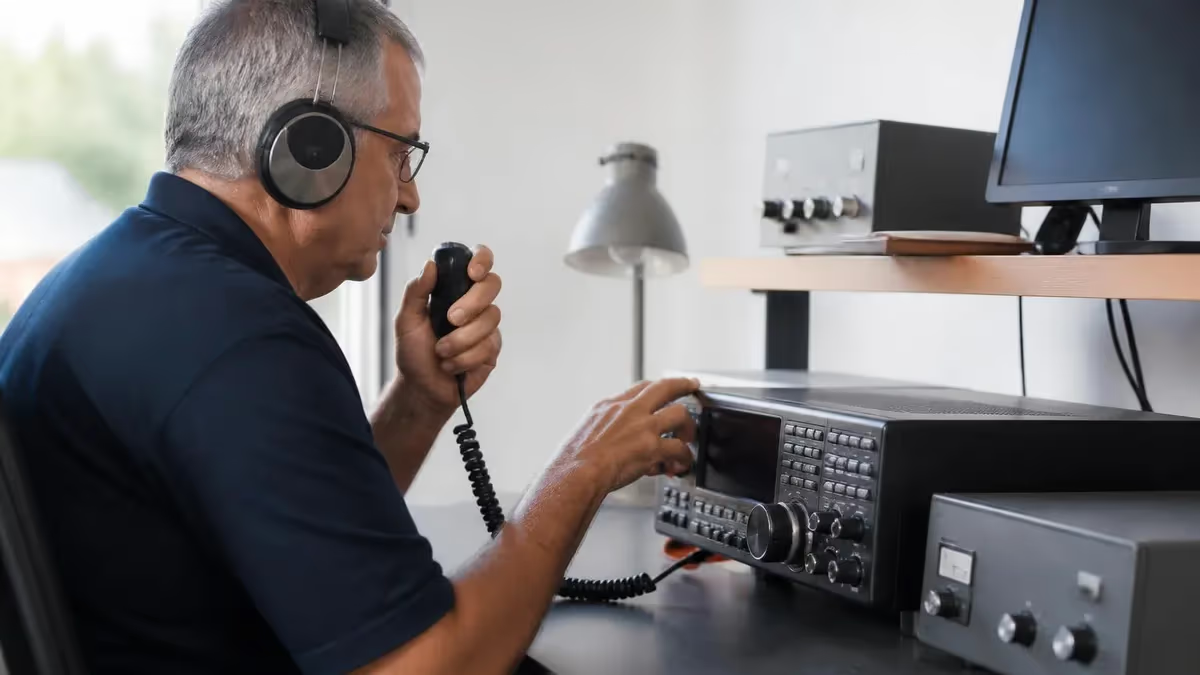
Ham radio bands are slices of the radio spectrum that the FCC sets aside for licensed amateur operators in the United States. Each band has its own personality. Some carry signals across the planet at midnight on a 100-foot wire. Others barely reach across town from a handheld radio. Knowing which band does what is the single biggest skill that separates a confused new ham from somebody who actually makes contacts.
You'll hear bands referred to two ways: by wavelength (like 2-meter, 40-meter, or 70-centimeter) and by frequency in megahertz (like 144 MHz or 7 MHz). Both refer to the same thing. The wavelength names are older and stickier, and almost every ham uses them in casual talk. If you're studying for the ham radio technician test, you'll need to know both labels cold.
The FCC governs all of this under Part 97 of its rules. Allocations are coordinated internationally through the ITU and locally through the IARU, so a ham band in Tucson is mostly a ham band in Tokyo too — though small differences in segments and modes exist between regions. The US sits in ITU Region 2, which gives American operators some slightly different sub-band edges than hams in Europe or Asia.
Why does any of this matter to you on day one? Because the band you pick decides everything else. It tells you how big your antenna needs to be, what time of day you'll be on the air, whether you can talk across the room or across the ocean, and what kind of radio you'll spend your money on. Match the band to the mission, and your station works. Mismatch it, and you'll sit there wondering why nobody answers your calls.

US Ham Radio Bands at a Glance
Here's the short version: low frequencies (long wavelengths) travel far but need huge antennas. High frequencies (short wavelengths) need tiny antennas but mostly stay local. The middle bands play tricks with the ionosphere and can do either depending on the sun. That's the entire propagation story in three sentences, and the rest of this article unpacks it band by band. For a full numerical reference of every segment by mode, see this ham radio frequencies list.
One more piece of vocabulary before you dive in. When hams say a band is open, they mean signals are propagating well enough to make contacts. When they say a band is dead, signals aren't reaching anywhere useful. Open and dead change by the minute on some bands. On 20m during a solar peak, the band stays open almost around the clock. On 6m, a band can be dead all morning and red-hot by lunch.
You'll also hear the words sub-band, segment, and watering hole. A sub-band is a slice of a band reserved (by FCC rule or band plan) for one mode or license class. A segment is a smaller chunk of activity inside a sub-band. A watering hole is the spot where everyone gathers for a specific activity — like 14.074 MHz for FT8 on 20m, or 28.400 MHz for 10m DX SSB. Once you know the watering holes, you know where everybody hangs out.
Bands by Category: HF, VHF/UHF, and Conditions
HF stands for high frequency, 3 to 30 MHz. These are the bands that talk to the world by bouncing signals off the ionosphere. There are nine of them in the US ham allocation.
- 160m (1.8-2.0 MHz) — nicknamed Top Band, mostly nighttime, gigantic antennas, contest favorite.
- 80m (3.5-4.0 MHz) — regional ragchews and nightly nets after dark.
- 40m (7.0-7.3 MHz) — workhorse band; open day and night, regional plus some DX.
- 30m (10.1-10.15 MHz) — WARC band, CW and data only, no contests allowed.
- 20m (14.0-14.35 MHz) — the most popular HF band on Earth, worldwide DX almost any hour.
- 17m (18.068-18.168 MHz) — quiet WARC band, friendly DX.
- 15m (21.0-21.45 MHz) — 24-hour DX when the sun cooperates.
- 12m (24.89-24.99 MHz) — WARC band, no contests, opens during solar peaks.
- 10m (28.0-29.7 MHz) — magic during solar max; FM repeaters live above 29 MHz.
Technician class licensees get a narrow toehold on 10m phone (28.3-28.5 MHz) and 10m CW, plus CW privileges on chunks of 80m, 40m, and 15m. Everything else above is General class and up.
If you want to actually use any of these bands, you need an FCC ham radio license. There are three classes today: Technician, General, and Amateur Extra. Each one unlocks more spectrum. Technician is the entry door, and it's the license most US hams hold. General is the gateway to worldwide HF DX. Extra adds the premium DX sub-bands and a few exclusive segments where the rare ones hang out.
The Technician license used to be called a starter ticket, and a lot of hams still think of it that way. But that label sells it short. With a Tech license, you have full access to every VHF and UHF band, which means satellites, ISS contacts, EME on 70cm, the entire 6m band, FM repeaters across every town in America, and weak-signal SSB on 2m and 70cm. You can stay a Technician for life and never run out of new things to try.
That said, almost every Tech eventually wants HF. The lure of working a station in Australia from a wire in your backyard is too strong. That's where General comes in. The General class exam covers more theory and a bit more rules, but the payoff is roughly four megahertz of HF spectrum across nine bands. Most General licensees never feel the urge to push further. The few who do are usually contesters, DX chasers, or theory geeks who want every last kilohertz the FCC gives amateurs.

Band Privileges by License Class
- Full Privileges: All VHF and UHF bands (6m, 2m, 1.25m, 70cm, 33cm, 23cm, microwave)
- HF Phone: 28.300-28.500 MHz on 10m (SSB voice)
- HF CW: Portions of 80m, 40m, 15m, and 10m
- Best Starting Bands: 2m and 70cm FM repeaters
- Full Privileges: All Technician privileges plus most of HF
- HF Access: Sub-bands on 160m, 80m, 40m, 30m, 20m, 17m, 15m, 12m, 10m
- Modes Unlocked: HF SSB, CW, FT8, RTTY, AM, image
- Step Up From Tech: Adds about 4 MHz of HF spectrum
- Full Privileges: Every US amateur band and segment, with no holes
- Exclusive Spectrum: Bottom CW segments and top SSB DX sub-bands
- Common Use: Serious DXing, contesting, and rare-band chasing
- Test Difficulty: Hardest of the three, 50 questions on tougher theory
So which band should you actually pick up the mic on? It depends on what you want to do. Want to chat with somebody across town from the car? 2m FM. Want to talk to Australia from your back porch? 20m SSB. Want a quiet evening on a band with friendly DX? 17m. The match between band and goal is what makes ham radio click.
Let's get more practical. Suppose you live in suburban Phoenix and your goal is talking to other hams across the metro for emergency preparedness. The clear answer is 2 meters with a 70cm secondary. Buy a dual-band mobile rig, throw a quarter-wave magnet-mount on the car roof, program in every local repeater within 30 miles, and you're set. Total cost: under $300. That station will work reliably day or night with no propagation drama.
Now suppose your goal is bouncing signals to Europe from the same Phoenix backyard. You'll want HF, which means General class. The 20m band is your first stop — a 33-foot dipole at 30 feet off the ground talks to Europe most afternoons. Add 100 watts and you'll have a pile of EU stations answering your CQ during good conditions. Same operator, same town, totally different gear. The band is the variable.
If your goal is something more exotic — bouncing signals off the moon, working the International Space Station as it passes overhead, or chasing rare island DXpeditions — you're picking specialty bands. EME usually lives on 2m, 70cm, or 23cm. ISS works on 2m FM. Rare DX gathers on 17m, 12m, and the bottom 25 kHz of each HF band where the Extra-class DX hounds prowl.
HF vs VHF/UHF: Choosing Where to Start
- +VHF/UHF needs small antennas — a 2m HT fits in your pocket
- +Technician class gets full VHF/UHF privileges with no upgrade
- +FM repeaters on 2m and 70cm give instant local coverage
- +Cheap gear: $30 handhelds work fine for learning
- +Predictable propagation — line-of-sight, no waiting on the sun
- +Satellites, digital voice, and packet all live up here
- −HF antennas are large — an 80m dipole is 130 feet of wire
- −HF requires General class for most useful segments
- −HF propagation depends on the solar cycle and time of day
- −HF gear is pricier — a decent 100W rig runs $700 to $2,000
- −Worldwide contacts and DX hunting really live on HF
- −HF nets and contests are the heart of amateur radio tradition
Pros and Cons at a Glance
| Pros | Cons |
|---|---|
| Technician class gets full VHF/UHF privileges with no upgrade | HF requires General class for most useful segments |
| Predictable propagation — line-of-sight, no waiting on the sun | HF propagation depends on the solar cycle and time of day |
| Satellites, digital voice, and packet all live up here | Worldwide contacts and DX hunting really live on HF |
One thing trips up almost every new ham: the difference between an FCC allocation and a band plan. The FCC tells you which frequencies you can transmit on with your license class. Band plans are voluntary agreements (mostly by ARRL and the operator community) that subdivide a band by mode so SSB stations aren't sitting on top of CW operators. Band plans aren't law, but ignoring them gets you yelled at fast.
Common subdivisions: CW lives at the bottom of the band, then digital and data, then SSB phone, with FM at the top of HF and the top of VHF/UHF allocations. Repeaters cluster in specific sub-bands. Calling frequencies (like 146.520 MHz on 2m) are where everyone meets to find a clear simplex channel.
Here's how band plans play out in real operating. On 40m, the CW operators camp from 7.000 to 7.125 MHz. The digital crowd, especially FT8, settles around 7.074 MHz. SSB voice runs from about 7.125 MHz up to 7.300 MHz, with the lower portion reserved for Extra class. AM enthusiasts gather around 7.290 MHz. Try to run FM on 40m and you'll be tomato-pelted off the band — 40m is a CW and SSB and digital band, period.
On 2 meters, the band plan is even more structured. Weak-signal SSB and CW live at the bottom around 144.100 to 144.300 MHz. Above that you find satellite uplinks and downlinks. FM simplex lives from 146.400 to 146.580 MHz. Repeater outputs cluster from 146.610 to 147.390 MHz. Mess up your simplex versus repeater knowledge and you'll transmit on a repeater's input frequency without realizing it. Studying band plans saves you embarrassment.

Best Bands for a Brand-New Ham
- ✓2m FM (144-148 MHz) — buy a $30 HT, find a local repeater, you're on the air today
- ✓70cm FM (420-450 MHz) — same vibe as 2m, often paired in dual-band radios
- ✓2m simplex on 146.520 MHz — the national calling frequency for direct contacts
- ✓10m SSB (28.3-28.5 MHz) — Technicians can use it; great during solar peaks
- ✓6m FM/SSB — the magic band; cheap to get on and full of surprises in summer
- ✓Avoid 160m and microwave at first — antennas and gear are expensive distractions
If you only ever operate on one band, make it 2 meters. The 144-148 MHz allocation has more daily activity than any other ham band in America. Almost every town has at least one 2m FM repeater. Emergency nets, weather spotter nets, ARES, RACES, and Skywarn all run on 2m. A $30 handheld talkie gets you on the air, and a $150 mobile rig in the car turns your commute into a community.
Once you have your ham radio license, your first transmission will almost certainly be on 2m. It's the band where you'll learn proper procedure, meet your local ham community, and discover whether this hobby is going to take over your weekends. Spoiler: it probably will.
How to Pick a Band for Any Contact
Step 1: Decide How Far You Need to Reach
Step 2: Check the Time of Day
Step 3: Check Solar and Geomagnetic Conditions
Step 4: Match the Band to Your Antenna
Step 5: Pick the Right Mode and Sub-Band
Your antenna is the other half of the band-selection puzzle. Lower bands need bigger antennas, period. A full-size 80m dipole stretches about 130 feet end to end. A 40m dipole runs around 65 feet. By 10m, you're at 16 feet, and a 2m antenna is the rubber duck on your handheld. Compromise antennas like shortened verticals, magnetic loops, and end-fed wires work, but they trade efficiency for size. If you're planning your station, this ham radio antenna setup guide walks through trade-offs for every band.
Antenna height matters as much as length. A dipole at 30 feet performs noticeably better than the same dipole at 10 feet, especially on lower bands. The general rule: try to get your antenna at least a quarter-wavelength off the ground. On 20m that's about 16 feet. On 40m it's 33 feet. On 80m it's 65 feet, which is why most suburban hams settle for compromise heights and lower performance.
Don't ignore feedline either. Coax loss climbs steeply with frequency. RG-58 is fine for a short 2m run but bleeds power across 100 feet to a 70cm yagi. For long UHF runs, hams use LMR-400 or hardline. For HF, RG-8X is the sensible choice. Ladder line beats coax on HF if you can route it cleanly. The wrong feedline erases the gain of a good antenna and leaves you wondering why your band sounds dead.
Ground systems matter too, especially on lower HF bands. Verticals on 40m and 80m perform poorly without radial fields. A serious 80m vertical sits on top of 30 to 60 buried wires, each a quarter-wave long. Skipping the radials turns a $400 vertical into a $400 paperweight. Dipoles don't need ground systems, which is why they're the go-to first antenna for almost every new HF operator. Simple, cheap, and they work the world.
Antenna Length Needed by Band (Half-Wave Dipole)
- 160m dipole: About 250 feet end to end (huge yard required)
- 80m dipole: About 130 feet end to end
- 40m dipole: About 65 feet end to end
- Tip: Most hams use traps, loading coils, or end-feds to fit smaller lots
- 30m dipole: About 46 feet end to end
- 20m dipole: About 33 feet end to end
- 17m dipole: About 26 feet end to end
- Best: 20m fits in a typical backyard and works the world
- 6m dipole: About 9.5 feet end to end
- 2m vertical: About 39 inches tall
- 70cm vertical: About 13 inches tall
- Why It Matters: Pocket-sized antennas mean HTs and mobile rigs are realistic
Modes matter as much as bands. CW (Morse code) still has its sub-bands and a loyal following. SSB voice is king on HF for both ragchewing and DX. FM owns VHF and UHF repeaters. FT8, the dominant digital mode, runs on every HF band and has crowded waterfalls 24/7. AM is rare but lives on at the bottom of 75m and on parts of 10m. SSTV, ATV, packet, APRS, D-STAR, DMR, and Yaesu System Fusion all have their corners. Each band hosts a different mix.
FT8 deserves a special mention. Released in 2017, it dominates digital activity on every HF band today. It uses short 15-second transmissions, decodes signals well below the noise floor, and lets a 5-watt station with a wire antenna work the world. The watering holes are well known: 14.074 MHz on 20m, 7.074 MHz on 40m, 28.074 MHz on 10m, and a few others. If you tune to those frequencies any hour of any day, you'll see decoded callsigns flowing past.
Voice modes pick their bands by tradition. SSB rules HF because it's spectrum-efficient and works well at low power. FM rules VHF/UHF because the wider bandwidth pairs well with the strong line-of-sight signals up there. Trying to use FM on 20m would waste bandwidth and confuse everybody. Trying to use SSB on a 2m repeater wouldn't work because the repeater is FM-only. The mode you choose follows from the band, more often than not.
Digital voice modes — D-STAR, DMR, and Yaesu System Fusion — live almost entirely on VHF/UHF FM allocations. They run on 2m and 70cm repeaters specifically built for digital. Each system has its own ecosystem of reflectors, talkgroups, and Internet linking. You can't mix D-STAR with DMR over the air, but both connect through gateways to networks that stretch around the world. Digital voice is one of the fastest-growing areas of ham radio in 2026.
30m, 17m, and 12m are WARC bands. They were added to the amateur service at the 1979 World Administrative Radio Conference. By gentlemen's agreement among ARRL and IARU member societies, no contests are run on these three bands. That makes them the friendliest spots for casual DX chasing and ragchew when the rest of the spectrum is jammed with a contest weekend.
30m is also CW and data only — no voice — by FCC rule, not just band plan. Many hams treat WARC bands as their refuge from chaos. If you're new to HF and walk into a contest weekend, retreat to 17m and you'll find calm and friendly operators.
Solar Cycle 25 peaked between 2024 and 2026. That's the best news US hams have had in over a decade. The high bands — 10m, 12m, 15m, and 17m — have been wide open for worldwide DX for hours at a time. Even modest 100-watt stations with wire antennas can work all continents during good openings. By 2028 or 2029, conditions will quiet down and 80m and 40m will take over as the workhorses again.
If you're studying for the ham radio license test right now and plan to upgrade to General, do it soon. You've got a few more years of golden HF conditions before the cycle bottoms out and the high bands go quiet again.
What does a solar peak actually feel like at the radio? On a typical afternoon during 2025 and 2026, 10 meters has been alive with European, South American, and even Pacific stations. You can flip on a $500 entry-level HF rig, throw out a CQ on 28.400 MHz, and have a Spanish operator answer within a minute. Try the same thing during solar minimum and you'll listen to static for an hour. The difference is staggering — and historically reliable across every 11-year cycle since record-keeping began.
Smart operators plan their HF goals around the cycle. If you want to work all 100+ DXCC entities for the basic DX Century Club award, the high bands during a solar peak make it almost easy. Wait until the cycle bottoms out and you'll grind through the same goal on 40m and 80m with much bigger antennas needed. The lesson: when the sun cooperates, get on the air. When it doesn't, settle into the lower bands and learn patience.
The bottom line on US ham radio bands is this: 27 allocations from 1.8 MHz up into millimeter wave, each one with a flavor of its own. Technician gets you VHF/UHF and a taste of HF. General opens most of HF. Extra unlocks every last hertz the FCC gives amateurs. Beginners start on 2m FM repeaters because the gear is cheap and the learning curve is gentle. Advanced operators chase DX on 20m or bounce signals off the moon on 1296 MHz.
One practical tip before you go shopping for a radio: think hard about the band before the radio. Too many new hams buy a $1,500 all-mode HF rig and then discover the only band they can legally use is 10m. They end up frustrated with the rig collecting dust between solar peaks. A better path for most Technicians is a $200 dual-band 2m/70cm mobile rig first, plus a $30 handheld for portable work. Get experience, get on the air, then upgrade to General and add an HF rig later.
The same logic applies to antennas. Buy for the band, not for the spec sheet. A simple 40m dipole strung between two trees outperforms most commercial multi-band verticals on its design band. A modest 2m yagi on a 20-foot pole opens repeaters 60 miles away that a rooftop vertical struggles to reach. Match the antenna to the band you actually plan to use, and your station will outperform stations costing twice as much.
Whatever your interest in amateur radio, there's a band waiting. Pick one, learn it well, and the rest of the spectrum opens up over time. Most hams find one or two favorite bands they call home and a few others they visit for special occasions. The fun is in the exploring, not in trying to operate everything at once.
Sample HAM - Radio Extra Class Test Practice Questions
Try these questions from our free HAM - Radio Extra Class Test practice tests. The correct answer and an explanation follow each question.
Which amateur band is sometimes called the 'WARC bands' along with 17 and 12 meters?
- A. 160 meters
- B. 30 meters
- C. 6 meters
- D. 2 meters
Answer: B. 30 meters
The 30-meter (10 MHz), 17-meter (18 MHz), and 12-meter (24 MHz) bands are collectively called WARC bands, allocated at the 1979 World Administrative Radio Conference.
What document serves as the primary reference for FCC rules governing amateur radio in the United States?
- A. The ARRL Handbook
- B. Title 47 CFR Part 97
- C. The ITU Radio Regulations
- D. The National Electrical Code
Answer: B. Title 47 CFR Part 97
Title 47 of the Code of Federal Regulations, Part 97, contains all FCC rules governing the Amateur Radio Service in the US.
What is the purpose of a 'CQ' call on the amateur radio bands?
- A. To call a specific station
- B. To request emergency assistance
- C. To announce a general call inviting any station to respond
- D. To indicate the frequency is in use
Answer: C. To announce a general call inviting any station to respond
CQ is a general call to any and all stations, inviting anyone who hears the transmission to respond and establish contact.
A radio amateur is attempting a long-distance contact on a lower HF band (e.g., 80 meters) and notices a significant signal enhancement for a short period around sunrise and sunset, but only when the path is aligned with the terminator. What is this mode of propagation called?
- A. Sporadic E-skip
- B. Gray-line propagation
- C. Transequatorial propagation
- D. Backscatter
Answer: B. Gray-line propagation
Gray-line propagation occurs along the terminator, the line separating daylight and darkness on Earth. During this time, the D-layer, which absorbs lower-frequency HF signals, rapidly disappears or has not yet formed, while the F-layer remains ionized and capable of refracting signals. This combination of low absorption and available refraction creates a brief window for excellent long-distance communication, especially on the lower HF bands.
Ham Radio Bands Questions and Answers
About the Author

Educational Psychologist & Academic Test Preparation Expert
Columbia University Teachers CollegeDr. Lisa Patel holds a Doctorate in Education from Columbia University Teachers College and has spent 17 years researching standardized test design and academic assessment. She has developed preparation programs for SAT, ACT, GRE, LSAT, UCAT, and numerous professional licensing exams, helping students of all backgrounds achieve their target scores.
Join the Discussion
Connect with other students preparing for this exam. Share tips, ask questions, and get advice from people who have been there.
View discussion (8 replies)