
The Chinese Gaokao System: How China's Most Competitive Exam Works 2026 October
Learn how the Chinese gaokao system works — subjects, scoring, format & prep tips. 🎯 Everything US students need to understand this high-stakes exam.
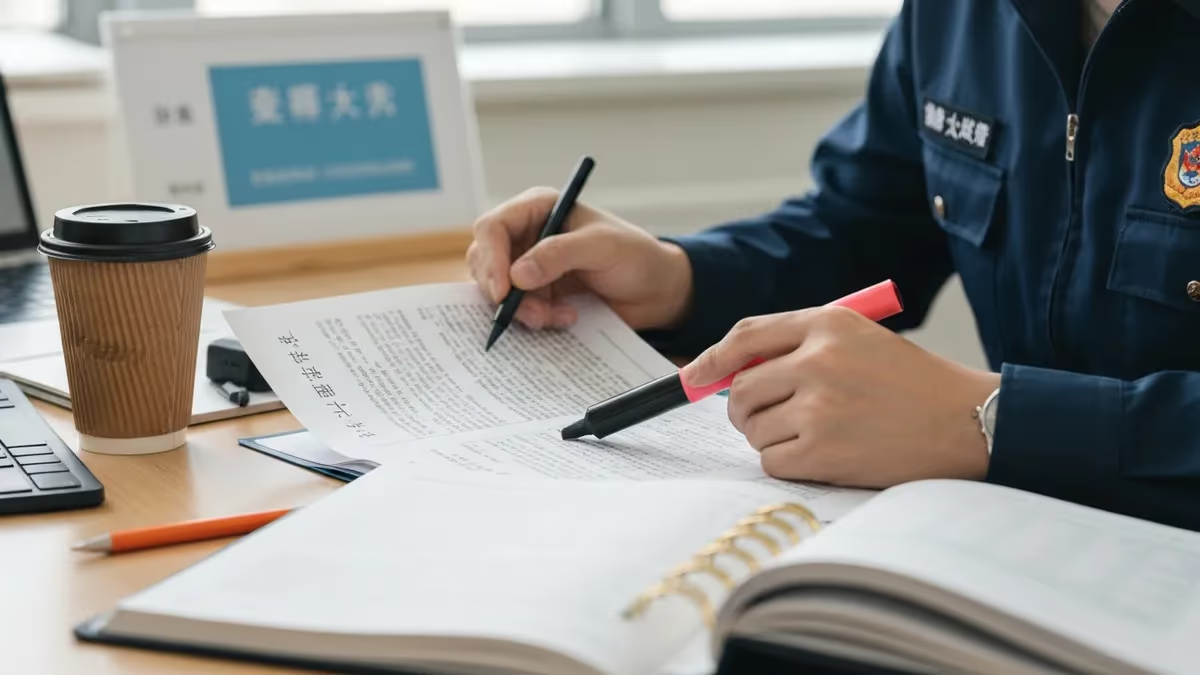
The Chinese gaokao system is one of the most consequential academic examinations in the world, shaping the futures of roughly 13 million students every year. Short for Putong Gaodeng Xuexiao Zhaosheng Quanguo Tongyi Kaoshi — China's National College Entrance Examination — the gaokao functions as a single high-stakes gateway to higher education.
A student's performance on this two-day test largely determines which university they can attend, what field they will study, and, in many respects, the arc of their professional life. Understanding how this system operates is increasingly important for American educators, students interested in comparative education, and anyone looking to understand China's academic landscape.
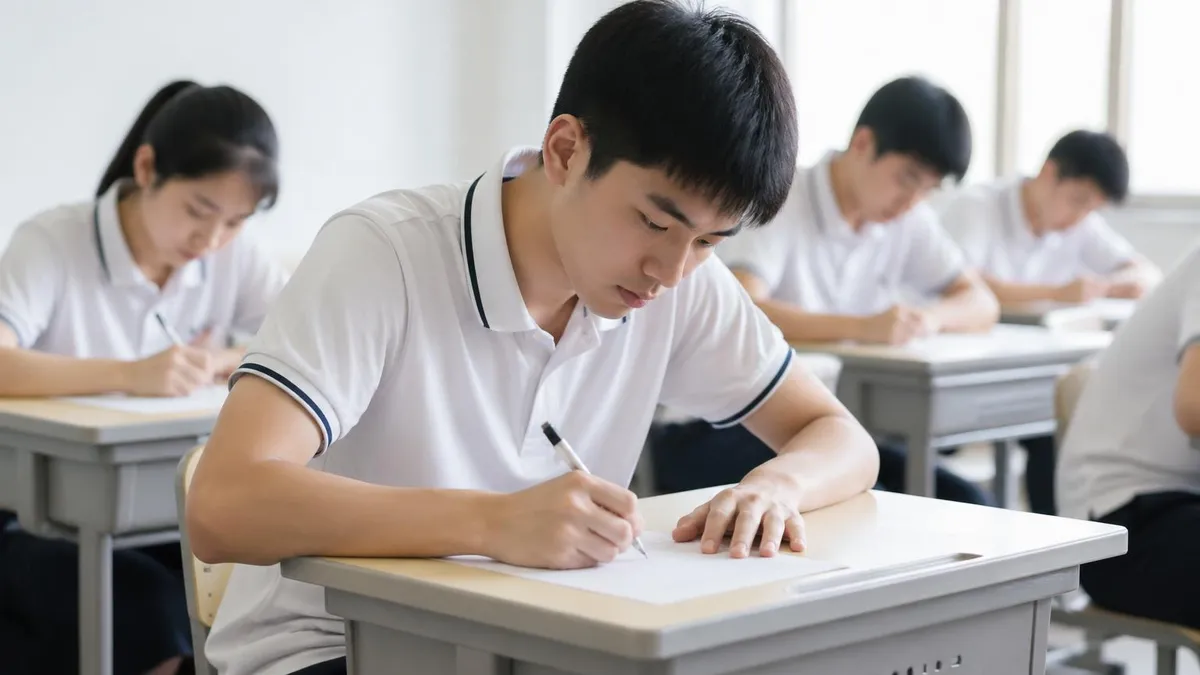
At its core, the gaokao examination is a standardized test administered nationwide every June, typically on the 7th and 8th. Unlike the SAT or ACT in the United States, the gaokao is not one component of a broader application — it is essentially the entire application. Universities assign admission spots almost exclusively based on gaokao scores, supplemented in some cases by provincial quotas that account for China's enormous regional population differences. The weight placed on a single exam creates both extraordinary motivation and enormous pressure among Chinese high schoolers and their families.
The structure of the gaokao has evolved significantly since the examination was reinstated in 1977 after the Cultural Revolution. Today, the exam tests students on a core set of compulsory subjects — Chinese language, mathematics, and a foreign language (usually English) — plus additional elective subjects chosen from a science or humanities track. Recent reforms introduced by several Chinese provinces, including Shanghai and Zhejiang, allow students to select three elective subjects from a broader menu, offering more flexibility while maintaining the exam's high-stakes character.
Scoring on the gaokao is straightforward in concept but fiercely competitive in practice. The full exam totals 750 points across all subjects, with Chinese, mathematics, and the foreign language each worth 150 points. The remaining 300 points come from the chosen elective subjects, each typically worth 100 points. Students do not simply need a passing score — they need a score that places them competitively within their province, because university admissions quotas are allocated on a province-by-province basis. A score that earns admission to a top university in one province might fall short in another with higher competition.
For American students and educators encountering gaokao exam questions for the first time, the difficulty level is striking. Gaokao math questions, for instance, routinely involve multi-step calculus problems, geometric proofs, and combinatorics that go well beyond what most U.S. high school curricula require. The Chinese language section demands deep knowledge of classical literature, modern writing conventions, and essay composition. The English section tests reading comprehension, cloze passages, and written expression at a level that rivals many college placement tests in the West.
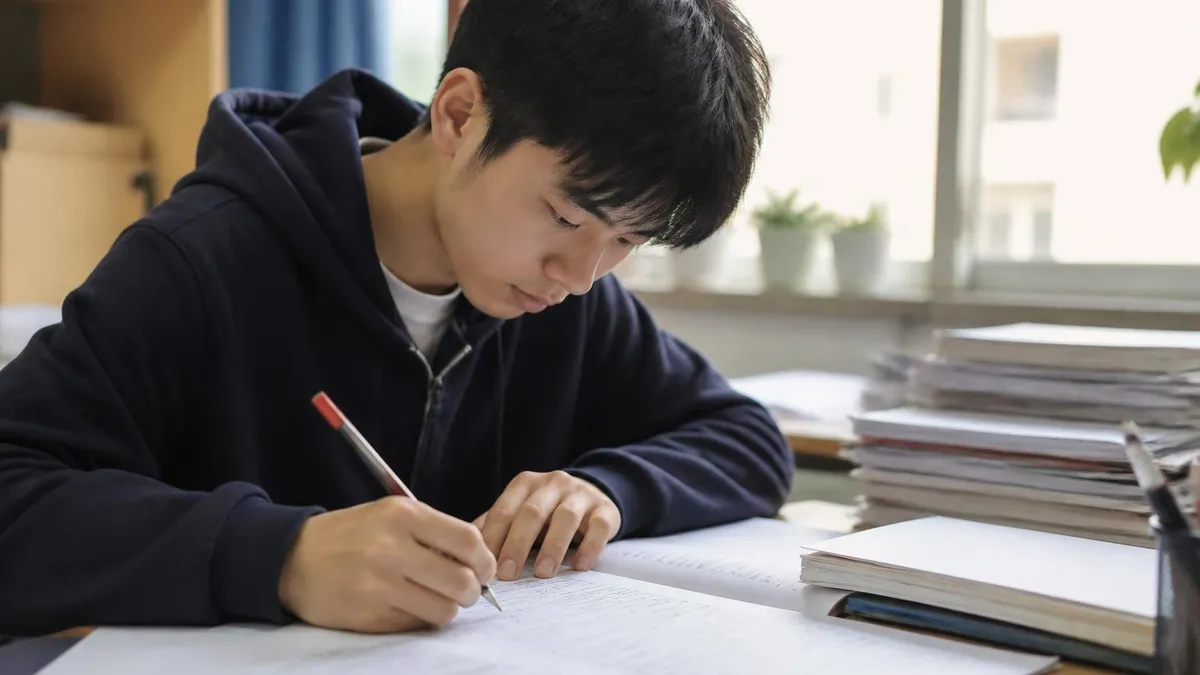
Preparation for the gaokao is itself a massive undertaking. Most Chinese students spend the three years of senior high school — known as gaokao prep years — intensively studying for the exam. Supplemental tutoring, weekend cram schools, and 12-to-14-hour study days in the final months before the exam are common. The pressure is immense: families may reorganize their entire domestic routines during gaokao season to minimize noise and stress for the student. This cultural intensity around the exam reflects the deeply held belief in China that education is the primary engine of social mobility.
For those outside China who want to test their knowledge or prepare for competitive exams that draw on similar academic rigor, exploring authentic gaokao exam questions offers a genuinely challenging and educational experience. Whether you are a high school student seeking advanced practice, a university student curious about Chinese academic standards, or an educator designing challenging curricula, engaging with actual gaokao content reveals the depth and seriousness of China's national educational system in a way that no summary alone can convey.
The Gaokao by the Numbers
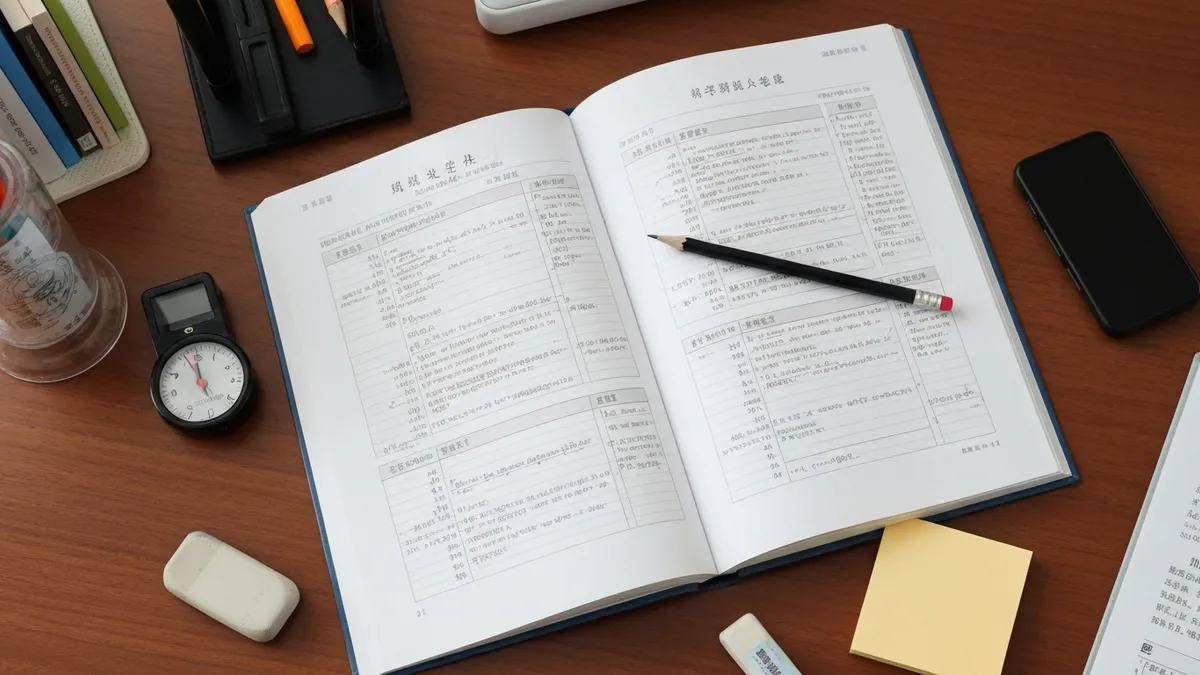
Gaokao Exam Format: Subjects, Time, and Points
| Section | Questions | Time | Weight | Notes |
|---|---|---|---|---|
| Chinese Language | — | 150 min | 150 pts | Essay, reading, classical literature |
| Mathematics | — | 120 min | 150 pts | Separate versions for arts/science tracks in some provinces |
| Foreign Language (English) | — | 120 min | 150 pts | Listening + written sections |
| Elective Subject 1 | — | 90–110 min | 100 pts | Physics, history, or other approved subject |
| Elective Subject 2 | — | 90–110 min | 100 pts | Chemistry, geography, or other approved subject |
| Elective Subject 3 | — | 90–110 min | 100 pts | Biology, politics, or other approved subject |
| Total | — | ~9 hours over 2 days | 100% |
The history of the gaokao is inseparable from the political history of modern China. The examination system traces its philosophical roots to the imperial civil service exams — the keju — which governed official selection in China for more than 1,300 years before their abolition in 1905.
The modern gaokao was introduced in 1952, modeled partly on Soviet educational structures, and operated until 1966 when Mao Zedong's Cultural Revolution suspended it entirely. Universities were shut down or repurposed, and for a decade, academic merit gave way to political loyalty as the primary criterion for advancement. The damage to China's intellectual capital during this period was profound.
When Deng Xiaoping came to power and initiated China's reform era, reinstating the gaokao in December 1977 was among his earliest and most symbolically significant acts. Roughly 5.7 million people sat for that first reinstated exam — many of them adults in their twenties and thirties who had been denied educational opportunity for years. The 1977 gaokao became a landmark moment, signaling that China was returning to meritocracy, scholarship, and outward-looking modernization. The examination has been held annually ever since, growing steadily in scale as China's population and its appetite for higher education expanded.
Throughout the 1980s and 1990s, the gaokao examination operated as a relatively uniform national system. Students sat for the same papers regardless of where they lived, and a single national standard governed scoring and admissions. This uniformity was seen as fair in principle, but it masked significant structural inequalities: students in Beijing and Shanghai benefited from better-funded schools, more experienced teachers, and — crucially — far more generous provincial admission quotas for top universities than students from rural provinces with larger populations and fewer elite schools.
Reforms during the 2000s and 2010s addressed some of these inequalities by introducing province-specific exam versions and adjusting quota allocations, though the fundamental structure remained intact. The most significant recent reform effort began in 2014, when the State Council announced a sweeping overhaul aimed at reducing single-exam pressure and broadening the evaluation of student ability. Under this reform, gradually rolled out across provinces starting with Shanghai and Zhejiang, students can now take certain elective subject exams multiple times and count their best score, reducing the all-or-nothing pressure of a single sitting.
The 2014 reform also introduced the concept of separating the university admission process into two components: the gaokao itself, plus independent assessments conducted by universities that go beyond raw test scores. In theory, this allows elite institutions to consider factors like extracurricular accomplishment, interviews, and portfolios. In practice, the gaokao score still dominates admissions decisions at nearly all Chinese universities, because the volume of applicants makes comprehensive individual review logistically difficult. The reform has nudged the system toward greater holism, but the exam remains central.
Regional disparities remain one of the most debated aspects of the gaokao system. Students from Beijing, Shanghai, and Tianjin have historically enjoyed advantages because top national universities like Peking University and Tsinghua University are located in those cities and reserve a larger share of their spots for local students.
A student from Henan province — China's most populous — may need a score 50 to 100 points higher than a Beijing student to win admission to the same university. Advocacy groups and education researchers have long called for greater equity in quota distribution, with some progress made over the past decade but structural imbalances persisting.
Understanding this history helps contextualize why the gaokao generates such intense national conversation. It is not merely an exam — it is a social institution that encodes beliefs about merit, fairness, opportunity, and the relationship between the state and the individual. For the millions of Chinese families who plan their lives around it, the gaokao is an annual national reckoning, a moment when years of preparation and sacrifice are distilled into a few hours of test-taking. Exploring authentic gaokao test questions and formats is, in this sense, a window into the values and priorities of Chinese society as a whole.
Gaokao Exam Questions: What Each Section Tests
Gaokao math questions are widely regarded as some of the most demanding high school mathematics problems in the world. The exam typically includes multiple-choice items, fill-in-the-blank problems, and extended response questions covering algebra, functions, trigonometry, calculus derivatives and integrals, probability and statistics, solid geometry, and analytic geometry involving conic sections like ellipses and parabolas. Students must demonstrate not only procedural fluency but also the ability to construct multi-step proofs under timed pressure.
Unlike standardized math tests in many Western countries, gaokao math problems rarely have a single obvious pathway to the solution. Students are expected to identify the most efficient method, apply it precisely, and show complete working. A single complex problem may require 20 or more calculation steps. Gaokao math questions from past years show a consistent pattern of increasing complexity in the final few problems — the last open-response question is designed to differentiate the top scorers and is often left partially or entirely blank by most test-takers.

Advantages and Disadvantages of the Gaokao System
- +Provides a single standardized metric that reduces favoritism in admissions decisions
- +Creates strong incentives for academic achievement from an early age
- +Enables students from poor rural families to compete with urban peers on equal academic terms
- +Generates a highly educated workforce with strong fundamentals in math and sciences
- +Transparent scoring system that is publicly understood and widely accepted as legitimate
- +Recent reforms allow multiple exam sittings for elective subjects, reducing all-or-nothing risk
- −Extreme pressure contributes to high rates of anxiety, burnout, and mental health challenges among students
- −Rewards rote memorization and test-taking strategy over creativity and critical thinking
- −Regional quota disparities mean students in populous provinces need significantly higher scores for the same universities
- −Twelve-plus years of study narrowly focused on exam preparation leaves gaps in practical and interpersonal skills
- −Socioeconomic disparities in access to tutoring and quality schools undermine the meritocratic ideal
- −A single bad exam day can derail years of preparation with limited recourse for students
Pros and Cons at a Glance
| Pros | Cons |
|---|---|
| Provides a single standardized metric that reduces favoritism in admissions decisions | Extreme pressure contributes to high rates of anxiety, burnout, and mental health challenges among students |
| Creates strong incentives for academic achievement from an early age | Rewards rote memorization and test-taking strategy over creativity and critical thinking |
| Enables students from poor rural families to compete with urban peers on equal academic terms | Regional quota disparities mean students in populous provinces need significantly higher scores for the same universities |
| Generates a highly educated workforce with strong fundamentals in math and sciences | Twelve-plus years of study narrowly focused on exam preparation leaves gaps in practical and interpersonal skills |
| Transparent scoring system that is publicly understood and widely accepted as legitimate | Socioeconomic disparities in access to tutoring and quality schools undermine the meritocratic ideal |
| Recent reforms allow multiple exam sittings for elective subjects, reducing all-or-nothing risk | A single bad exam day can derail years of preparation with limited recourse for students |
Gaokao Preparation Checklist: 10 Essential Steps
- ✓Download and work through official past gaokao papers from the past five years for each subject.
- ✓Create a structured weekly study schedule that covers all compulsory and elective subjects daily.
- ✓Memorize at least 100 classical Chinese poems and prose passages required for the Chinese language section.
- ✓Practice timed math sessions to build speed and accuracy on multi-step gaokao math questions.
- ✓Take at least three full mock exams under real gaokao time conditions before the actual test date.
- ✓Study provincial-specific exam formats if your province uses a separate version of the gaokao.
- ✓Build English vocabulary with exam-frequency word lists and practice at least one cloze passage daily.
- ✓Review your weakest subject areas each week and track score improvement on practice tests.
- ✓Develop a consistent essay template for the Chinese language section and practice adapting it to new prompts.
- ✓Prioritize sleep and stress management in the final two weeks — cognitive performance degrades under sleep deprivation.

One Point Can Mean Thousands of Rank Positions
Because roughly 13 million students take the gaokao each year, the score distribution near the admission cutoff for top universities is extraordinarily dense. A difference of just one or two points on the 750-point scale can shift a student's ranking by thousands of positions — enough to determine whether they gain admission to their target university. This statistical reality underscores why Chinese students and families treat every exam point as critically important.
The scoring and university admissions process linked to the gaokao system operates through a tiered framework that most Americans find unfamiliar. After students receive their scores — typically within two to three weeks of sitting the exam — they submit voluntary preferences listing the universities and programs they wish to attend.
Each province runs its own admissions process, but the fundamental mechanism is the same: universities receive a fixed number of admission spots allocated by province, and those spots are filled in descending score order. When the spots for a given program run out, all lower-scoring applicants for that program are rejected, regardless of how close their scores are to the cutoff.
China's universities are organized into admissions tiers. The most competitive tier — historically called the First Tier or 985/211 universities — includes institutions like Peking University, Tsinghua University, Fudan University, Shanghai Jiao Tong University, and Zhejiang University. These schools demand scores in approximately the top 0.5 to 2 percent of all provincial test-takers.
The Second Tier encompasses a broader range of solid universities, and the Third Tier includes regional and vocational colleges with lower score requirements. In recent years, China has moved away from using the numerical tier labels officially, but the hierarchical logic persists in practice and in public consciousness.
Gaokao test scores also determine not just which university a student can attend but which specific major or program within that university. In China, students apply to a particular department — say, electrical engineering at Tongji University — rather than to a university as an undeclared student. If a student's score meets the university's threshold but falls below the cutoff for their preferred major, they are typically redirected to another available program or rejected. This system creates an additional layer of strategic complexity: students must choose programs that align with their expected scores, balancing aspiration with realistic probability.
For international observers, one of the most striking aspects of the Chinese gaokao system is how thoroughly it dominates the educational years leading up to it. Chinese high schools are explicitly structured as gaokao preparation institutions. Class time, homework loads, and extracurricular participation are all calibrated around maximizing exam performance.
Many high schools track students into arts or science streams as early as the second year of junior high, based on which subjects show the most promise. By the time a student enters the final year of senior high school — called gaokao year — their entire academic existence may revolve around exam preparation.
The financial ecosystem around the gaokao is enormous. Private tutoring companies, cram schools, online preparation platforms, and printed study materials constitute a multibillion-dollar industry in China. Large tutoring chains like New Oriental Education and TAL Education have built their businesses primarily on gaokao preparation. Individual tutors who specialize in high-difficulty gaokao subjects — particularly advanced math and physics — can command premium fees in major cities. For families with resources, private preparation significantly supplements school instruction; for families without, the gap this creates is a persistent equity concern.
The psychological dimensions of the gaokao also merit attention. Survey research consistently finds high rates of exam anxiety among Chinese high school students in the months before the gaokao, and China's mental health professionals have noted spikes in anxiety-related consultations during gaokao season. Some school systems have attempted to address this by building wellness programs, mindfulness training, and counseling resources into the school calendar. The social pressure is compounded by family expectations: in Chinese culture, a child's exam success is closely tied to family honor and the perceived return on years of parental sacrifice and financial investment in education.
Despite the pressure, the gaokao has demonstrated a genuine capacity to improve students from disadvantaged backgrounds who might otherwise have had no pathway to elite education. Stories of students from remote rural villages who study by kerosene lamp and achieve top scores, winning admission to Tsinghua or Peking University, are a recurring and celebrated feature of Chinese public life. These narratives reinforce the belief in the exam as a meritocratic equalizer — imperfect, but functional — and help explain why calls to abolish or dramatically restructure the gaokao have never gained decisive political traction in China.
The gaokao is administered under some of the most rigorous anti-cheating protocols of any exam in the world. Metal detectors, signal-jamming devices, fingerprint verification, and drone surveillance are deployed at exam centers in many provinces. Cheating carries criminal penalties under Chinese law, including multi-year prison sentences for organized cheating rings. Students must arrive with government-issued ID and are subject to inspection before entering the test hall. Any violation can result in permanent disqualification from the gaokao.
Reform of the gaokao system has been a recurring theme in Chinese educational policy for decades, and the pace of change has accelerated in the 2010s and 2020s. The 2014 State Council directive on gaokao reform set in motion a series of changes that are still being implemented across provinces.
The core goals were to reduce the binary all-or-nothing pressure of a single exam, broaden the range of abilities assessed, and give universities slightly more input in the admissions process. By 2025, most major provinces had adopted or begun adopting the new model, though implementation varies considerably in speed and scope.
One of the most significant changes in the reform era is the introduction of what Chinese educators call the "3+3" or "3+1+2" model for elective subjects. Under the traditional system, students chose either a science track (physics, chemistry, biology) or a humanities track (history, geography, politics), with limited flexibility.
Under the new models, students choose three subjects from a menu of six — physics, chemistry, biology, history, geography, and politics — allowing combinations like history plus chemistry plus biology that would previously have been impossible. This opens the system to more individualized academic profiles, though the compulsory Chinese, math, and English subjects remain fixed.
Technology is also reshaping the gaokao experience. Online preparation platforms have made high-quality tutoring materials accessible to students in provinces that previously had little access to experienced instructors. AI-powered adaptive learning tools now help students identify weak areas and receive targeted practice.
Some provinces have experimented with computer-based testing for portions of the exam, and digitization of the marking process — using machine scoring for objective items and online human marking for essay questions — has improved both speed and consistency. These technological shifts are gradually democratizing access to preparation resources that were once available only to students in major cities.
The question of whether the gaokao should incorporate English oral proficiency is one of the most debated reform topics. Currently, the English section tests only reading, writing, and listening — not speaking. Critics argue that this produces students who can read and write English at a high level but struggle with conversational fluency, limiting their effectiveness in international professional settings. Several provinces have experimented with adding oral English assessments, but the logistical challenge of standardizing and fairly scoring speaking tests at scale for millions of students has slowed progress.
International recognition of gaokao scores is a growing phenomenon. Some universities in the United Kingdom, Australia, and Canada have begun formally accepting strong gaokao results as evidence of academic preparation, much as they would accept A-Level or IB scores. The specific score thresholds and subject requirements vary by institution, but the trend reflects a growing acknowledgment in global higher education that high gaokao scores represent genuine academic achievement. American universities have been slower to adopt formal gaokao recognition policies, but admissions officers at selective institutions are increasingly familiar with the exam's difficulty and the preparation it represents.
For American students curious about their own academic standing relative to Chinese peers, attempting authentic gaokao exam questions is an illuminating exercise. Many U.S. high school students who perform well on the SAT or ACT find gaokao math and science questions significantly more challenging, reflecting the differences between the two countries' educational philosophies and curricular priorities. This is not a failing on either side — it reflects different goals and values in education — but it is a useful reality check for students who want to understand where they stand relative to the world's most competitive academic cohort.
Looking ahead, the gaokao system will continue to evolve as China balances competing priorities: maintaining the meritocratic legitimacy that gives the exam its social authority, reducing the mental health burden on young people, improving equity across regional and socioeconomic lines, and preparing students for an economy that increasingly rewards creativity, collaboration, and adaptive thinking alongside academic mastery. How China navigates these tensions will shape not just its domestic education landscape but the global academic environment, as Chinese universities rise in international rankings and Chinese students take an increasingly prominent role in top institutions worldwide.
For anyone outside China who wants to seriously engage with gaokao content — whether for academic curiosity, competitive preparation, or professional understanding — a few practical strategies make the process far more productive. Start with the compulsory subjects rather than electives, since Chinese, math, and English are the three pillars that every student must master and they represent the core difficulty of the exam. Official past papers are freely available through Chinese educational ministry websites and third-party platforms, and working through them systematically gives a far more accurate sense of the exam's demands than any summary description.
Gaokao math is particularly valuable for high-achieving students anywhere in the world who want rigorous problem-solving practice. The exam's emphasis on multi-step reasoning, elegant solution construction, and geometric proof aligns well with the skills tested in international math olympiads and competitive university entrance exams. Students who can consistently solve the final two or three problems on a gaokao math paper have demonstrated mathematical maturity that will serve them well in STEM university programs at any institution globally. Working through gaokao math questions from the past decade provides a structured and genuinely challenging curriculum in its own right.
For the English section, non-native speakers preparing for international English exams like IELTS or TOEFL will find gaokao English reading passages useful practice material. The passages are carefully selected, the questions are precise, and the cloze format develops the kind of contextual vocabulary knowledge that all English proficiency exams test. However, students should note that the gaokao English essay format differs from Western standardized tests — it is shorter, more formulaic, and rewards a specific organizational style that reflects Chinese writing instruction conventions.
If you are an educator designing curricula or assessments with international comparison in mind, incorporating representative gaokao questions into your practice materials signals to students the level of rigor expected in the world's most competitive academic environments. Many high school mathematics teachers in the U.S. who have reviewed gaokao content have noted that the exam's calculus and probability questions go beyond what Advanced Placement courses require, offering a useful benchmark for students who want to exceed standard expectations.
One common misconception among people encountering the gaokao for the first time is that the exam's difficulty is primarily a matter of breadth — that students are simply required to memorize more content. While content breadth is certainly a factor, the more significant challenge is depth of application. Gaokao questions are designed to present familiar concepts in unfamiliar configurations, requiring students to synthesize and adapt rather than simply recall. This is why students who have only memorized formulas and procedures without developing genuine understanding tend to struggle on the more advanced questions, even after years of preparation.
Stress management during the preparation period is worth addressing practically. Chinese educators and psychologists who work with gaokao students have identified several evidence-based strategies that help: maintaining consistent sleep schedules even during intense study periods, using active recall techniques (testing yourself rather than rereading notes), breaking large content areas into manageable weekly goals, and building in deliberate rest days to allow memory consolidation.
These strategies are not uniquely applicable to the gaokao — they are supported by cognitive science research on effective learning generally — but they are particularly important given the volume of material the gaokao requires students to master.
Finally, approaching the gaokao with genuine intellectual curiosity rather than pure anxiety management tends to produce better outcomes. Students who find authentic interest in the mathematical elegance of a well-constructed geometry problem, or in the literary depth of a classical Chinese poem, tend to develop the deep understanding that the exam's most challenging questions reward.
The gaokao, at its best, is not merely a sorting mechanism — it is a reflection of a civilization's highest academic values, distilled into two days of testing. Engaging with it seriously, whether as a test-taker or as a curious observer, offers a genuinely enriching encounter with one of the world's great educational traditions.
Sample Gaokao Exam Practice Questions
Try these questions from our free Gaokao Exam practice tests. The correct answer and an explanation follow each question.
Which essay genre (文体) is most commonly expected and rewarded in Gaokao Chinese composition prompts?
- A. Narrative essay (记叙文)
- B. Argumentative essay (议论文)
- C. Expository essay (说明文)
- D. Lyrical prose (抒情散文)
Answer: B. Argumentative essay (议论文)
While prompts often allow genre freedom, the argumentative essay (议论文) is by far the most commonly chosen and rewarded format in Gaokao grading because it directly demonstrates logical reasoning, structured '论点-论据-论证' thinking, and clarity of position — all core evaluation targets.
According to China's compulsory politics curriculum, the People's Congress system (人民代表大会制度) is described as China's fundamental political system primarily because it:
- A. Allows citizens to directly elect the President and State Council members
- B. Ensures the ruling party maintains permanent control over all government branches
- C. Embodies the principle that all power belongs to the people through representative organs
- D. Separates executive, legislative, and judicial powers into independent branches
Answer: C. Embodies the principle that all power belongs to the people through representative organs
The compulsory politics textbook defines the People's Congress system as the fundamental political system because it institutionalizes the Marxist principle that state power belongs to the people, exercised through the National People's Congress and local people's congresses at all levels.
In the Gaokao Chinese essay (作文), what does '立意' (lìyì) refer to?
- A. Determining and establishing the central thesis or argument of the essay
- B. The opening paragraph technique
- C. The essay's title selection
- D. The use of literary quotations
Answer: A. Determining and establishing the central thesis or argument of the essay
'立意' means 'establishing the essay's central meaning/thesis' — it is the process of determining what core idea, argument, or value the essay will express. It is considered the most important aspect of Gaokao essay writing.
When Gaokao essay markers assess whether a student has successfully conveyed 'life-changing impact', which element is considered most essential in the body paragraphs?
- A. A before-and-after contrast showing the writer's or character's changed outlook or behaviour
- B. An extensive bibliography of classical Chinese poetry cited verbatim
- C. A rebuttal section arguing against the possibility of personal change
- D. Statistics from government reports on social mobility in China
Answer: A. A before-and-after contrast showing the writer's or character's changed outlook or behaviour
Markers look for a clear before-state and after-state — the evidence that change actually occurred — combined with reflection on why the turning point mattered; without this contrast the essay fails to demonstrate genuine understanding of transformation.
gaokao Questions and Answers

About the Author

Educational Psychologist & Academic Test Preparation Expert
Columbia University Teachers CollegeDr. Lisa Patel holds a Doctorate in Education from Columbia University Teachers College and has spent 17 years researching standardized test design and academic assessment. She has developed preparation programs for SAT, ACT, GRE, LSAT, UCAT, and numerous professional licensing exams, helping students of all backgrounds achieve their target scores.