
Gaokao Exam Questions: Practice Test Guide for 2026 October
Get ready for your Gaokao certification. 📚 Practice questions with step-by-step answer explanations and instant scoring.
Understanding the Gaokao Exam Format
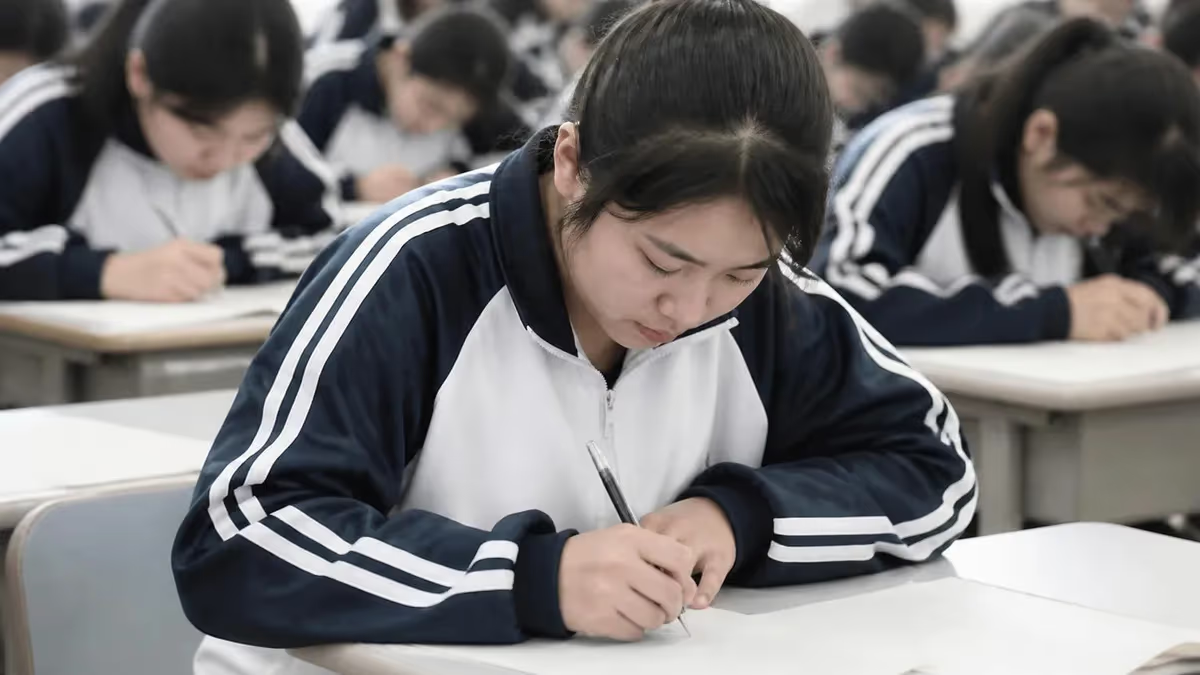
The Gaokao is one of the world's most consequential standardized examinations, determining college placement for millions of Chinese students each year. The exam is administered simultaneously across China over two consecutive days, typically June 7 and 8. All students take Chinese language (yuwen) and Mathematics on the first day. On the second day, students take English (or an approved foreign language) along with their chosen science or humanities combination subjects. The examination is administered in paper-and-pencil format at designated testing centers throughout each province.
The scoring structure of the Gaokao varies slightly by province, but the most common configuration allocates 750 total points across six subjects. The three compulsory subjects — Chinese language, Mathematics, and English — are each worth 150 points, totaling 450 points. The remaining 300 points come from the combined science track (Physics, Chemistry, Biology) or humanities track (History, Geography, Politics). Some provinces have adopted reform models where students select three subjects from a broader menu beyond the traditional science-humanities split.
The Chinese language (yuwen) section is typically the first exam students complete and is considered one of the most challenging components. It includes classical Chinese reading comprehension, modern essay analysis, poetry interpretation, and a composition worth approximately 60 of the 150 available points. The composition topic is not announced in advance and is one of the most closely watched elements of each year's exam — the essay prompt is frequently analyzed in national media as a reflection of cultural and social themes.
The Mathematics section tests students across all mathematics content studied in high school, including algebra, geometry, trigonometry, calculus fundamentals, probability and statistics, and in some provinces, spatial reasoning. Mathematics questions range from multiple-choice and fill-in-the-blank items to open-ended proof and calculation problems worth partial credit. High-scoring students typically complete the full exam within the time limit; many students find the last several questions — which are designed to differentiate top performers — among the most challenging on the entire Gaokao.
The English section tests reading comprehension, listening (in some provinces), grammar, vocabulary, and composition. Reading passages include both shorter texts with multiple-choice comprehension questions and longer passages requiring detailed analysis. English composition topics on the Gaokao are less abstract than Chinese composition prompts, typically asking students to write a letter, describe a situation, or present a reasoned argument in clear, grammatically correct English. The English section has been modified in some provinces in recent years to reduce multiple-choice dependence and increase open-ended writing.
Gaokao scores are used exclusively for university admissions in China and are not officially recognized by foreign universities for admission purposes. However, Gaokao exam content and preparation have attracted growing international interest, particularly among educators comparing Chinese high school curricula to international alternatives and among students who immigrate to China or pursue bilingual education programs.
The difficulty of Gaokao mathematics questions, in particular, has generated global attention as examples circulate on social media and academic forums. Students and teachers worldwide use Gaokao practice materials to benchmark academic standards, understand Chinese educational priorities, and explore one of the most rigorous and consequential high-stakes testing systems in the modern global education landscape.
Gaokao Practice Test Question Types by Subject
Effective Gaokao preparation requires understanding the specific question formats used in each subject area. The exam uses a combination of question types across subjects: multiple-choice questions (单项选择题), fill-in-the-blank items (填空题), and open-ended response questions (解答题 or 应用题). The open-ended questions account for the majority of the total score in Mathematics and Science subjects because they award partial credit and require students to show complete work. Multiple-choice items on the Gaokao do not penalize incorrect answers in most provinces.
For Mathematics practice, Gaokao exam questions typically include 12 multiple-choice items worth 5 points each, 4 fill-in-the-blank items worth 5 points each, and 6 open-ended problems worth 10–12 points each. The multiple-choice section covers standard curriculum topics efficiently; the fill-in-the-blank section tests computational precision without the scaffolding of answer choices; and the open-ended section requires clear, methodical written solutions. Students who want to maximize their Mathematics score must practice showing complete solution steps because partial credit is awarded based on the correctness of each step, not just the final answer.
The Chinese language section's composition component is among the most preparation-intensive parts of the Gaokao. Essay prompts over recent years have addressed themes including traditional culture and modernity, personal integrity, innovation, environmental responsibility, and China's development. Effective essay preparation involves studying exemplary high-scoring Gaokao essays to understand the structural conventions — including a clearly stated thesis, logically organized body paragraphs drawing on historical, literary, and contemporary examples, and a conclusion that reinforces the central argument. Students who memorize general-purpose literary and historical examples can adapt them to a wide range of essay prompts.
The English section's reading comprehension passages are selected for moderate complexity — comparable to mid-difficulty materials from English-language newspapers and academic publications. Vocabulary at the B1–B2 level (Common European Framework of Reference) is most typical, with some B2–C1 vocabulary appearing in longer passages. English composition on the Gaokao rewards clear organization, correct grammar, and on-topic responses over creative vocabulary or complex sentence structures. International students preparing for the English section should practice writing clear, structured responses to functional prompts rather than creative or argumentative essays typical of Western university applications.
Science and humanities subject questions test content knowledge accumulated over three years of high school study. Physics questions on the Gaokao typically include mechanics, electromagnetism, optics, and modern physics. Chemistry questions cover inorganic and organic chemistry, chemical equilibrium, and laboratory procedures. Biology questions address cell biology, genetics, evolution, and ecology.
History, Geography, and Politics questions in the humanities track require both factual recall and analytical skills — students must not only recall historical events but interpret sources, compare perspectives, and apply concepts to novel scenarios. Reviewing past-year exam questions for each subject is essential preparation for the format variety students encounter on the actual exam.
Students preparing for the Gaokao benefit from working through full-length timed practice exams under realistic conditions. Provincial education departments release official past-year Gaokao papers through authorized channels. These authentic materials are the most representative available because they reflect actual exam length, difficulty calibration, and scoring conventions. Third-party practice tests are valuable for content review but may differ in difficulty or question style from the official exam. Using a mix of official past papers and supplementary practice materials, organized by subject and topic, provides the most comprehensive Gaokao preparation coverage.

How to Use Gaokao Practice Tests Effectively
Gaokao practice tests serve multiple purposes in exam preparation: assessing current knowledge, building familiarity with question formats, developing time management skills, and identifying weak areas for targeted review. The most effective preparation strategy treats practice tests as diagnostic tools rather than simply measures of readiness. After completing a practice test, reviewing every incorrect answer — understanding not just the correct answer but why you chose the wrong one — produces more learning than taking additional tests without detailed review.
Time management is a distinctive challenge in the Gaokao because the open-ended sections require extended written work under a fixed time limit. Students who complete practice tests under strict time conditions develop the pacing discipline needed on the actual exam.
In Mathematics, experienced students allocate time based on question weight: spending no more than 8 minutes on each multiple-choice item, 5 minutes on each fill-in-the-blank item, and the majority of remaining time on the high-value open-ended problems. Students who spend excessive time on a single question and fail to reach the high-value problems at the end of the exam lose disproportionate points.
Subject-specific practice is as important as full-exam practice. Students with stronger Chinese language skills than Mathematics skills may find that targeted Mathematics topic review — completing 20 to 30 practice problems per day on their weakest topics — produces more score improvement than repeated full-exam simulations. Gaokao preparation in China typically intensifies significantly in the final year (高三, third year of high school) with students completing dozens of full-length past papers and subject-specific topic drills under teacher supervision. Students studying independently should replicate this structured, high-volume practice approach.
Understanding the scoring distribution helps students prioritize their preparation effort. In Mathematics, the final two to three open-ended problems are typically the most difficult and are designed to differentiate students aiming for top university placement. Students who score near-perfectly on the compulsory and fill-in-the-blank sections but skip the final complex problems will reach a significant score ceiling. Students targeting elite university admission must be able to make partial progress on the most challenging problems — earning partial credit through correct setup, intermediate steps, and logical reasoning even when the final answer is incorrect.
For English section preparation, consistent practice in reading comprehension and grammar is more valuable than last-minute vocabulary memorization. The vocabulary range tested on the Gaokao English section is relatively stable and can be systematically studied using official Gaokao vocabulary lists. Grammar questions typically focus on clause structure, tense consistency, and preposition use — high-frequency error categories in Chinese learners of English. Composition practice should emphasize clear organization and grammatical accuracy rather than sophisticated vocabulary. Students who write grammatically clean, logically organized essays consistently outperform those who attempt complex sentences with numerous errors.
Parents and teachers supporting Gaokao preparation should be aware that the most effective practice schedules balance intense subject preparation with adequate rest, particularly in the weeks immediately before the exam. Research on exam performance consistently shows that well-rested students outperform fatigued students even when the fatigued students have spent more total study hours.
Sleep, nutrition, and reduced anxiety in the final days before the Gaokao are practical preparation factors that complement rigorous academic preparation. Students who have done sustained, organized preparation throughout the school year are better positioned for peak exam performance than those who attempt to compress preparation into the final weeks.
Score: 150 points | Time: 150 minutes
Content: Classical Chinese reading and comprehension, modern literature analysis, poetry interpretation, language knowledge and usage, argumentative essay composition
Key challenge: Essay prompt is unpredictable — students must have flexible command of literary examples and argumentation frameworks
Preparation tip: Study exemplary high-scoring Gaokao essays and practice writing thesis-driven compositions on a variety of thematic prompts

Gaokao Scoring, University Admissions, and Score Interpretation
Gaokao scores are reported as a total point score (out of 750 in most provinces) and are used directly by university admissions offices to rank applicants. Unlike many international university admissions systems, the Gaokao does not incorporate extracurricular activities, teacher recommendations, or personal essays — the score is the primary determinant of admission outcomes. Universities publish minimum admission score thresholds (known as cut lines or 分数线) for different applicant pools, and students whose scores fall above a university's cut line for their intended major are eligible for admission consideration.
The national scoring distribution varies significantly by year based on exam difficulty and the cohort's preparation level. In a typical year, achieving a score in the top 1 percent nationally requires approximately 680 to 720 points out of 750, depending on the province. Admission to China's most selective universities — Peking University and Tsinghua University — historically requires scores near or above this threshold in most provinces.
Score thresholds for 985 universities (China's 39 top-ranked research universities) typically fall in the top 1–5 percent of the national distribution. 211 universities (112 nationally recognized institutions) have lower thresholds, and regular universities accept students from a broader portion of the distribution.
Provincial score distributions and admission processes differ meaningfully across China. Students in high-competition provinces like Henan and Sichuan — which have large test-taking populations relative to their university placement capacity — face structurally harder competition for elite university slots than students in provinces like Beijing and Shanghai, which have higher per-capita allocation of elite university seats. This geographic variation in effective competition is a structural feature of the Gaokao admissions system that has been subject to ongoing policy debate regarding equity.
Students who want to improve their Gaokao score can retake the exam in subsequent years (复读). Repeat test-takers (复读生) are a significant portion of the Gaokao population — some estimates suggest that 10 to 20 percent of annual test-takers are repeat students who did not achieve their admission goals in a prior year. Specialized repeat programs (复读班) in Chinese middle schools provide intensive one-year preparation for students retaking the exam. The decision to retake the Gaokao involves weighing the potential score improvement against the one-year delay in university enrollment and the psychological demands of another full year of Gaokao preparation.
The Gaokao reform movement has introduced changes in some provinces that shift the exam structure toward a "3+3" model — three compulsory subjects (Chinese, Mathematics, English) plus three elective subjects chosen from a menu including Physics, Chemistry, Biology, History, Geography, and Politics. Under this model, some elective subjects may be scored on a grade conversion scale rather than raw points, and students have more flexibility in subject selection. These reforms are intended to reduce the binary science-versus-humanities tracking that the traditional Gaokao enforced and allow students to pursue interdisciplinary academic interests.
For students outside China who are studying Gaokao content — whether for academic comparison purposes, bilingual education programs, or preparation for enrollment in Chinese universities — the most important preparation principle is working from authentic, official exam materials. Chinese government education portals and provincial education departments make past-year papers available, and these authentic materials are the gold standard for understanding the exam's actual difficulty and style. Supplementary practice tests from commercial providers vary significantly in quality and fidelity to the official exam format.
- ✓Obtain official past-year Gaokao papers from your province's education department
- ✓Complete at least one full-length timed practice exam per subject under real exam conditions
- ✓Review every incorrect answer in detail — understand why the wrong choice seemed plausible
- ✓Memorize the Gaokao English vocabulary list systematically using spaced repetition
- ✓Practice Mathematics open-ended problems showing complete solution steps for every question
- ✓Build a library of literary and historical examples adaptable for Chinese essay prompts
- ✓Track performance by topic within each subject to identify weak areas for targeted review
- ✓Prioritize adequate sleep and meals in the week before the exam
- ✓Confirm testing center location, required documents, and arrival time well in advance
- ✓Review China's Gaokao administration rules including prohibited materials and timing protocols

- +Official past-year papers provide the highest-fidelity practice and reflect actual exam difficulty calibration
- +Subject-specific topic drills efficiently target known weak areas without requiring full exam time
- +Practicing with provincial-specific papers prepares students for the scoring conventions of their actual exam
- +Reviewing solution guides (答案解析) from official sources provides expert-level feedback on errors
- +Building composition frameworks and example banks prepares students for the open-ended essay format
- −Relying exclusively on commercial practice tests may create mismatch in difficulty or question style versus the actual Gaokao
- −Last-minute intensive cramming produces diminishing returns and depletes the cognitive stamina needed for a two-day exam
- −Skipping timed practice and studying only untimed does not build the pace management needed for the actual exam
- −Over-specializing in strong subjects while neglecting weak ones creates a score ceiling — all six subjects contribute
- −Attempting to memorize pre-written essay compositions risks producing off-topic responses when the actual prompt differs
Pros and Cons at a Glance
| Pros | Cons |
|---|---|
| Official past-year papers provide the highest-fidelity practice and reflect actual exam difficulty calibration | Relying exclusively on commercial practice tests may create mismatch in difficulty or question style versus the actual Gaokao |
| Subject-specific topic drills efficiently target known weak areas without requiring full exam time | Last-minute intensive cramming produces diminishing returns and depletes the cognitive stamina needed for a two-day exam |
| Practicing with provincial-specific papers prepares students for the scoring conventions of their actual exam | Skipping timed practice and studying only untimed does not build the pace management needed for the actual exam |
| Reviewing solution guides (答案解析) from official sources provides expert-level feedback on errors | Over-specializing in strong subjects while neglecting weak ones creates a score ceiling — all six subjects contribute |
| Building composition frameworks and example banks prepares students for the open-ended essay format | Attempting to memorize pre-written essay compositions risks producing off-topic responses when the actual prompt differs |

Sample Gaokao Exam Practice Questions
Try these questions from our free Gaokao Exam practice tests. The correct answer and an explanation follow each question.
Ba Jin's novel 'Family' (《家》) is frequently cited in Gaokao essays about life-changing impact primarily because it illustrates:
- A. The protagonist Juehui's break from feudal family constraints as a personally transformative act
- B. A rural farmer's journey from poverty to success under modern agricultural reform
- C. The scientific achievements of a Chinese student studying abroad in the 1920s
- D. A love story set during the Song Dynasty that ends in reconciliation
Answer: A. The protagonist Juehui's break from feudal family constraints as a personally transformative act
Juehui's decision to leave the Gao family household represents a decisive break with oppressive tradition — making it a canonical example of an individual life-changing choice driven by ideological awakening, highly relevant to Gaokao transformation themes.
In a Gaokao cloze passage, the blank reads: 'She had always been _____ of her younger brother, often helping him with his homework.' Which word best fits the blank?
- A. protective
- B. jealous
- C. critical
- D. dismissive
Answer: A. protective
'Protective' fits the context: she helped her younger brother with homework, indicating a caring, protective attitude. The other options contradict the helping behavior described.
In a Gaokao cloze passage, the blank reads: 'The government introduced new policies to _____ pollution in major cities across the country.' Which word best fits?
- A. encourage
- B. celebrate
- C. reduce
- D. ignore
Answer: C. reduce
'Reduce' is the only logical choice because pollution is a problem that governments try to decrease. The other options — encourage, celebrate, and ignore — all have negative or neutral connotations that contradict good governance.
In a Gaokao cloze passage about online learning, the blank reads: 'Students can access course materials _____ and study at their own pace.' Which adverb fits best?
- A. anytime
- B. nowhere
- C. seldom
- D. barely
Answer: A. anytime
'Anytime' means at any time of one's choosing, which fits the context of flexible online learning that allows self-paced study.
Gaokao Questions and Answers
About the Author

Educational Psychologist & Academic Test Preparation Expert
Columbia University Teachers CollegeDr. Lisa Patel holds a Doctorate in Education from Columbia University Teachers College and has spent 17 years researching standardized test design and academic assessment. She has developed preparation programs for SAT, ACT, GRE, LSAT, UCAT, and numerous professional licensing exams, helping students of all backgrounds achieve their target scores.