
Gaokao Math Questions: Topics, Difficulty, and Sample Problems 2026 October
✍🏼 Pass your Gaokao Math Questions: Topics, exam on the first attempt. Practice questions with detailed answer explanations, hints, and instant scoring.
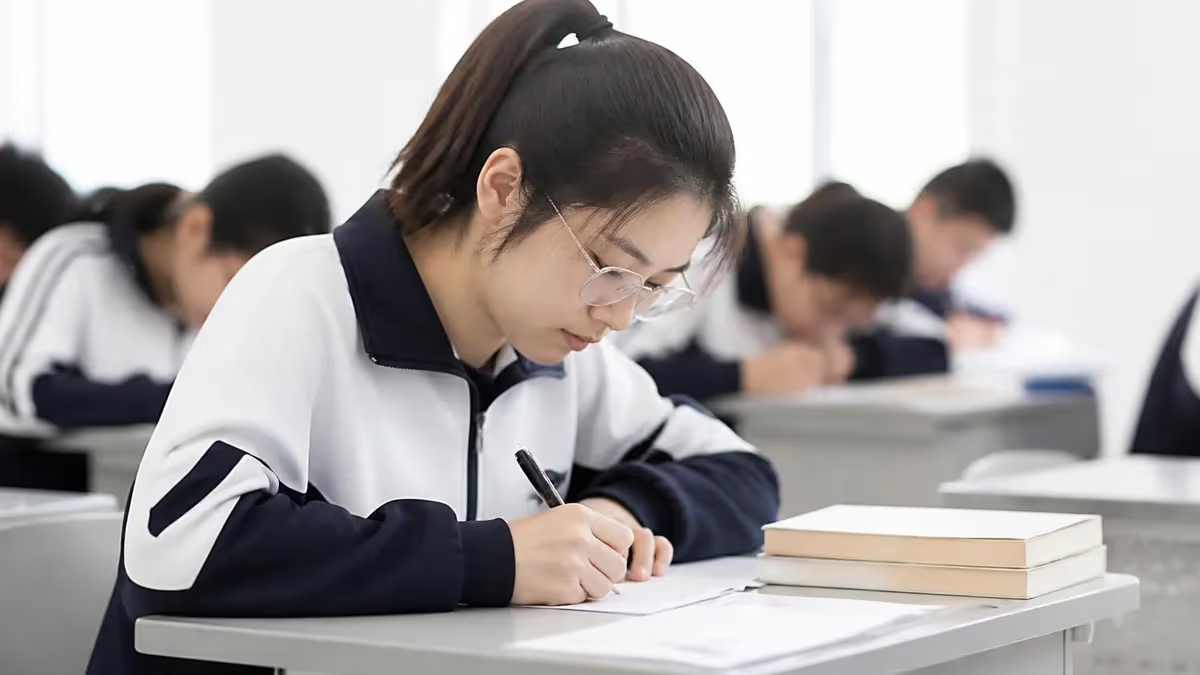
The Gaokao mathematics examination is one of the most demanding components of China's National College Entrance Examination, the high-stakes test taken by approximately 13 million students each year that determines university admission across China. The mathematics section is worth 150 points out of the full 750-point Gaokao score, and the 120-minute time limit is considered tight relative to the complexity of the questions — particularly the final open-response problems, which regularly challenge even well-prepared students. Gaokao math questions are known internationally for their technical rigour and are frequently shared online as examples of high-difficulty secondary school mathematics.
The traditional Gaokao offered two different mathematics papers: a higher-difficulty science track paper (理科数学) and a somewhat less demanding liberal arts track paper (文科数学). Under ongoing curriculum reforms implemented in most provinces since 2021, this split has been eliminated in many regions, and a unified mathematics paper is now administered to all students regardless of their academic track.
The unified paper maintains rigorous coverage of both pure mathematics and applied statistics/probability, and its overall difficulty is broadly comparable to the former science track paper. Students and educators in provinces still using dual papers should confirm which version applies to their specific test year and province.
Gaokao math questions are structured in three major formats. The first section consists of 12 multiple-choice questions, each worth 5 points, covering a broad range of topics and testing conceptual understanding as well as computation. The second section consists of four fill-in-the-blank questions, also worth 5 points each, which require exact numerical or algebraic answers without partial credit — an incorrect or incomplete fill-in-the-blank answer earns zero points regardless of how close the student's work came to the correct answer.
The third and final section consists of six open-response questions (解答题) worth a combined 70 to 74 points, which require students to present full worked solutions with stepwise reasoning — partial credit is awarded based on the correctness and completeness of the method demonstrated.
The open-response section is where the Gaokao mathematics examination becomes most challenging and most consequential. The final two questions in this section — typically involving derivatives or conic sections — are intentionally designed so that only a minority of test-takers complete them fully within the time available.
A student who answers the first four open-response questions completely and correctly and earns partial credit on the fifth can still achieve a highly competitive overall score, and test preparation strategy should account for this by ensuring that full marks are secured on the easier open-response problems before attempting the hardest items. Chinese educators commonly advise students to treat the final open-response question as a bonus target rather than a required completion.
The content scope of Gaokao mathematics corresponds broadly to the Chinese high school mathematics curriculum outlined in the National Curriculum Standards, which spans six semesters of mandatory mathematics education in grades 10 through 12 — equivalent to the final three years of secondary school.
The core content areas include: functions and their properties (including exponential, logarithmic, and trigonometric functions), sequences (arithmetic and geometric), analytic geometry (lines, circles, ellipses, hyperbolas, parabolas), spatial geometry (solid geometry, vectors in three dimensions), derivatives and their applications (including optimisation and inequality proofs), probability and statistics (classical probability, binomial distributions, normal distributions, descriptive statistics), and inequalities. Every Gaokao mathematics paper tests all of these content areas, though the distribution of questions across topics varies from year to year.
The Gaokao mathematics paper tests seven content areas across three question formats. The final open-response questions — particularly conic sections and derivatives — are intentionally designed to challenge the top performers. Understanding the difficulty gradient across the paper is essential for effective time management on test day.
International observers have noted that the level of mathematical sophistication tested by Gaokao math questions significantly exceeds that of most standardised high school tests in English-speaking countries. A typical Gaokao multiple-choice question on trigonometric functions or analytic geometry would be comparable in difficulty to questions on a university entrance examination in many European countries.
The open-response questions — particularly the derivatives application and conic section problems — require multi-step mathematical argument at a level comparable to the first-year university mathematics expected in some countries. This calibration of difficulty is intentional: the Gaokao must differentiate among millions of students, many of whom have received intensive test preparation, and the hardest questions are specifically designed to identify the top academic achievers.
Gaokao mathematics is administered under strict proctoring conditions that remove any possibility of outside reference or assistance. Students enter the examination hall with only pens, pencils, rulers, and an approved compass for geometric constructions; no other materials are permitted. The examination paper is distributed sealed and opened simultaneously by all students at the start time.
Work must be written in pen (ballpoint or gel pen) in the official answer booklet; answers written in the wrong section or outside the designated answer boxes are not graded. These strict administrative protocols are part of what makes the Gaokao one of the most tightly administered large-scale examinations in the world.
The Gaokao examination is held annually on June 7 and 8, with mathematics administered on the afternoon of June 7 for most provinces. For students in provinces using a three-day format (historically including some provinces that tested language subjects on June 9), the mathematics date has remained consistent. The examination date has been changed only once in recent history — to July 2020 due to the COVID-19 pandemic — demonstrating the institutional commitment to maintaining a stable, predictable examination calendar that allows students and families to plan preparation schedules years in advance.
The provincial variation in Gaokao mathematics is an important consideration for students preparing for the examination. While most provinces now use the National Paper (全国卷) — one of three standardised papers produced by the Ministry of Education — a small number of provinces including Beijing, Shanghai, Tianjin, and Zhejiang continue to produce their own locally developed papers.
These local papers may differ in content emphasis, difficulty calibration, and question style from the national papers. Students must prepare specifically for the paper version administered in their province; past papers and official study materials for the correct regional version should always be used rather than relying solely on nationally distributed materials.
Score distribution data published after each Gaokao cycle reveals consistent patterns in mathematics performance that inform preparation strategy. Typically, the average student earns full marks on multiple-choice questions 1 through 8 and partial marks on questions 9 through 12. Fill-in-the-blank completion rates drop significantly for questions three and four.
In the open-response section, national completion rates for the final question (typically a conic section or derivatives problem) are often below 15 percent for full-mark answers, meaning that students who complete this question fully and correctly represent the very top tail of the performance distribution. This data confirms that securing reliable partial credit on harder questions, rather than attempting complete solutions under time pressure, is the strategically correct approach for most students.
The Gaokao scoring process uses a two-reader system for open-response questions, where two independent graders score each answer using a detailed marking scheme. If the two scores differ by more than a specified threshold, a third independent reader adjudicates. The marking schemes for open-response questions allocate partial credit to specific mathematical steps — for example, correctly setting up the problem (2 points), correctly differentiating (3 points), and correctly solving the resulting equation (3 points) might be scored independently within an 8-point sub-question.
Understanding this step-level partial credit structure should influence preparation strategy: showing full method clearly, even when the final numerical answer is uncertain, is essential for maximising partial credit on open-response questions.

Gaokao Math Content Areas
| Section | Questions | Time | Notes |
|---|---|---|---|
| 📈Functions (函数) | — | — | Exponential, logarithmic, power, trigonometric functions; domain, range, monotonicity, extreme values, symmetry |
| 🔄Trigonometry (三角函数) | — | — | Trigonometric identities, sum and difference formulas, double-angle formulas, the sine rule and cosine rule |
| 🔢Sequences (数列) | — | — | Arithmetic and geometric sequences; sum formulas; convergence; sequences defined by recurrence relations |
| 📐Analytic Geometry (解析几何) | — | — | Lines, circles, ellipses, hyperbolas, parabolas in the coordinate plane; standard and general form equations |
| 📦Spatial Geometry and Vectors (空间几何与向量) | — | — | Three-dimensional shapes, line-plane relationships, three-dimensional vectors, dot products |
| 📉Derivatives (导数) | — | — | Differentiation rules, application to monotonicity and extrema, optimisation problems, tangent lines |
| 🎲Probability and Statistics (概率统计) | — | — | Classical probability, conditional probability, binomial distribution, normal distribution, descriptive statistics |
| Total | 22 | 120 minutes |
Preparing effectively for Gaokao math questions requires a multi-year study programme rather than last-minute cramming. The standard approach used by Chinese students is to complete the full high school mathematics curriculum in grades 10 and 11, then spend the entire final year (grade 12) in intensive revision, drilling past examination papers, and working with private tutors (补习班) or attending supplementary mathematics classes at cram schools.
Most competitive students will have completed dozens of full practice examinations under timed conditions before the actual Gaokao date, which is held annually in early June. International students or others preparing outside this system should allocate at least six to twelve months of serious preparation to achieve competitive performance.
Working through past Gaokao mathematics papers is the most direct and effective preparation method available. Official past papers are published by provincial education authorities and are widely available through Chinese academic bookstores, online platforms such as 高考资源网 (Gaokao Resource Network), and test preparation apps widely used in China. International students can access English-translated Gaokao math problems through academic blogs and educational YouTube channels that post and explain problems from recent years. Annotated solutions showing step-by-step working are particularly valuable for open-response preparation, as they model the specific level of mathematical rigour and notation expected by Gaokao graders.
The difficulty distribution across the Gaokao math paper follows a consistent structure. The first eight multiple-choice questions are generally accessible to any well-prepared student; questions 9 through 12 escalate significantly in difficulty and are designed to differentiate top scorers. The fill-in-the-blank questions are typically medium difficulty but unforgiving in their exactness requirement.
Open-response questions 17 and 18 (typically a sequence problem and a probability problem) are achievable for strong students; questions 19 and 20 (typically trigonometry applications and spatial geometry with vectors) are harder; and questions 21 and 22 (typically derivatives and conic sections) are the most demanding. Mastering the approach to each specific problem type within these final two questions is a key differentiator between high-scoring and average students.
Analytic geometry questions — particularly those involving ellipses, hyperbolas, and parabolas — are among the most technically demanding question types on the Gaokao and the ones students find most difficult to complete within the time limit.
A standard Gaokao conic section open-response question typically begins with a computational sub-part (finding the equation of the conic given conditions) followed by an investigation sub-part (proving a geometric property or finding the range of an expression involving a variable parameter on the conic). These investigation sub-parts require sophisticated manipulation of algebraic expressions involving parameters, and students who have not specifically drilled conic section question types under timed conditions often run out of time even when they understand the underlying mathematics.
Derivatives questions on the Gaokao typically test three types of applications: finding the equation of a tangent line to a curve at a given point, determining the intervals of monotonicity and local extrema of a function, and solving inequality-proof problems using derivative techniques.
The inequality-proof sub-type — in which students are asked to prove that f(x) ≥ g(x) on a specified interval using derivative analysis — is considered one of the most challenging formats because it requires constructing a valid mathematical argument rather than simply following an algorithmic procedure. Practising these inequality-proof problems specifically, in addition to the more algorithmic derivative computation questions, is essential for achieving full marks on the derivatives open-response question.

Gaokao mathematics preparation requires sustained multi-year effort rather than short-term cramming. Students who secure reliable marks on multiple-choice questions 1–8 and the open-response probability/sequences questions before targeting harder problems outperform those who attempt difficult questions without mastering the foundational items first.
For international students studying Chinese mathematics at the secondary level, or students preparing for Gaokao-equivalent examinations such as the Chinese University Entrance Exam (CUEE) or the Hong Kong HKDSE Mathematics paper, the conceptual content tested by Gaokao math questions overlaps substantially with A-Level Further Mathematics in the UK, IB Higher Level Mathematics, and Advanced Placement (AP) Calculus BC/Statistics in the US.
However, the computational intensity and time pressure of Gaokao mathematics — combined with the absence of graphing calculators — makes direct skill transfer from Western test preparation materials insufficient. Gaokao-specific practice, using actual past papers and annotated solutions in the expected format, is essential for any serious preparation effort.
The role of cram schools (补习班) in Gaokao mathematics preparation cannot be overstated in the Chinese educational context. An estimated 70 to 80 percent of students attending key high schools participate in private supplementary mathematics tutoring outside of regular school hours, either in small-group classes offered by specialist mathematics tutoring centres or through one-on-one private tuition.
These supplementary programmes focus intensively on Gaokao question formats and frequently work through past exam questions and predicted question types for the upcoming year. Students preparing outside China should research the content used by leading Chinese cram schools — materials from New Oriental (新东方) and Xueersi (学而思) are among the most widely used — to align their preparation with the level and format expected of competitive candidates.
Mental calculation fluency is a prerequisite for competitive Gaokao mathematics performance. Many students underestimate how much computational accuracy and speed contribute to their score, particularly under the 120-minute constraint. Chinese middle school students spend years drilling multiplication tables, fraction operations, and basic algebraic manipulations to the point of automaticity, which frees cognitive capacity for the conceptual and strategic elements of hard questions. International students who have always had access to calculators — and whose mental arithmetic is consequently slower or less reliable — should invest dedicated time in rebuilding computational fluency before attempting timed full-length practice papers.
Vector methods are integrated throughout the Gaokao mathematics curriculum in ways that differ from many international curricula. Vectors in the Gaokao context are used not just in physics-style problems but as a primary tool for proving geometric properties, computing distances and angles in both the plane and three-dimensional space, and relating algebraic expressions to geometric configurations.
Spatial geometry problems on the Gaokao require students to establish three-dimensional coordinate systems, express geometric elements as vectors, and use dot products to find angles or prove perpendicularity. Students unfamiliar with this vector-geometry integration approach should specifically study the Chinese curriculum treatment of vectors rather than assuming their existing knowledge of Cartesian geometry is sufficient.
Practice with the specific notation conventions used in Chinese mathematics education is important for international students and those preparing from non-Chinese sources. The Gaokao uses specific mathematical notation that may differ from conventions taught in other countries — for example, the natural logarithm is denoted ln (consistent with international practice) while the common logarithm is written as lg rather than log₁₀. Set notation, interval notation, and the formatting of piecewise functions follow the conventions used in the Chinese national curriculum textbooks.
Answer booklets evaluated by Gaokao graders are expected to use notation consistent with these conventions; answers written in non-standard notation may not receive full credit even when mathematically correct.
For students who are not enrolled in Chinese high school but wish to understand or benchmark against Gaokao mathematics, the examination serves as a useful reference for the highest level of difficulty achievable in secondary school mathematics without calculus instruction beyond derivatives.
The Gaokao does not test integration, limits in the formal epsilon-delta sense, or complex numbers at the level of A-Level Further Mathematics — it operates within a secondary school curriculum framework that emphasises algebraic and analytical techniques applied to functions, sequences, geometry, and elementary statistics. This scope makes Gaokao mathematics a meaningful and achievable benchmark for academically ambitious secondary students worldwide who want to challenge themselves beyond their national curriculum without moving into university-level mathematics.

No calculator permitted: Calculators are not allowed on the Gaokao mathematics examination. All computations — including trigonometric values, square roots, and multi-step algebraic manipulations — must be performed by hand. Students should practise all arithmetic and algebraic computation without calculator assistance throughout their preparation, including exact values for common trigonometric angles (0°, 30°, 45°, 60°, 90°) and fluency with fraction and radical arithmetic.
Gaokao Math Preparation Plan
- ✓Master the full high school mathematics curriculum across all seven content areas before attempting past Gaokao papers
- ✓Begin past-paper practice with papers from three to five years ago, then progress to the most recent years as your exam date approaches
- ✓Time yourself strictly on full practice papers — 120 minutes; do not extend time even when close to finishing
- ✓Analyse every error after each practice paper — categorise mistakes as conceptual errors, procedural errors, or time-management errors
- ✓Drill conic section (ellipse, hyperbola, parabola) open-response problems specifically — they are the most time-consuming question type
- ✓Memorise and practise all derivative inequality-proof techniques — these appear regularly in the final derivatives open-response question
- ✓Secure full marks on multiple-choice questions 1–8 and the fill-in-the-blank section before attempting to optimise scores on harder questions
- ✓Practise trigonometric identity simplification and sine/cosine rule applications at speed — these appear in both multiple choice and open response
- ✓Work through probability and statistics problems regularly — these are typically among the most accessible open-response questions and should be reliable full-mark targets
- ✓Focus final preparation weeks on the specific question types where partial-credit recovery is most achievable — open-response questions 17–20
Gaokao Pros and Cons
- +Gaokao has a publicly available content blueprint — you know exactly what to prepare for
- +Multiple preparation pathways accommodate different schedules and budgets
- +Clear score reporting shows specific strengths and weaknesses
- +Study communities share current insights from recent test-takers
- +Retake policies allow recovery from a difficult first attempt
- −Tested content scope requires substantial preparation time
- −No single resource covers everything optimally
- −Exam-day performance can differ from practice test performance
- −Registration, prep, and retake costs accumulate significantly
- −Content changes between versions can make older materials less reliable
Pros and Cons at a Glance
| Pros | Cons |
|---|---|
| Gaokao has a publicly available content blueprint — you know exactly what to prepare for | Tested content scope requires substantial preparation time |
| Multiple preparation pathways accommodate different schedules and budgets | No single resource covers everything optimally |
| Clear score reporting shows specific strengths and weaknesses | Exam-day performance can differ from practice test performance |
| Study communities share current insights from recent test-takers | Registration, prep, and retake costs accumulate significantly |
| Retake policies allow recovery from a difficult first attempt | Content changes between versions can make older materials less reliable |
Sample Gaokao Exam Practice Questions
Try these questions from our free Gaokao Exam practice tests. The correct answer and an explanation follow each question.
How do students select their preferred universities and majors based on their Gaokao scores?
- A. They are assigned randomly to universities after the exam.
- B. They rank their choices in an application before knowing their scores.
- C. They can only choose universities within their home province.
- D. They are allowed to select universities and majors after scores are released.
Answer: B. They rank their choices in an application before knowing their scores.
In many Chinese provinces, students must strategically rank their preferred universities and majors in an application *before* their Gaokao scores are officially released. This system requires students to estimate their performance and make crucial decisions under pressure. It adds a layer of complexity to the application process, as choices are made without knowing the exact outcome of the exam.
Which structural pattern is most commonly recommended for Gaokao argumentative essays?
- A. Introduction (引论) → Body with multiple argument points (本论) → Conclusion (结论)
- B. Five-paragraph format identical to English essays
- C. Stream-of-consciousness narrative
- D. Question-answer dialogue format
Answer: A. Introduction (引论) → Body with multiple argument points (本论) → Conclusion (结论)
Chinese argumentative essays (议论文) follow a three-part structure: 引论 (introduction/establishing the thesis), 本论 (body with supporting arguments and evidence), and 结论 (conclusion/restatement). This mirrors Western essay structure but with Chinese-specific conventions.
Which of the following structural techniques is most commonly recommended in Gaokao coaching for essays on life-changing impact where the writer describes a transformation in character?
- A. In medias res opening followed by chronological resolution
- B. A purely argumentative five-paragraph structure with no narrative
- C. Listing unconnected anecdotes from multiple unrelated people
- D. Opening with a dictionary definition of the key concept
Answer: A. In medias res opening followed by chronological resolution
Starting in the midst of the climactic moment (in medias res) creates immediate tension, and then resolving the narrative chronologically shows the reader how the transformation unfolded — a structure widely praised in Gaokao model essays.
In the Gaokao solid geometry proof format, what is the standard first step when asked to prove that a line is perpendicular to a plane?
- A. Show that the line is perpendicular to two distinct lines within the plane that intersect at a point
- B. Show that the line is parallel to another perpendicular line
- C. Measure the angle directly
- D. Show that the line's projection onto the plane is a point
Answer: A. Show that the line is perpendicular to two distinct lines within the plane that intersect at a point
The standard theorem (三垂线定理's basis): a line ⊥ plane iff it is perpendicular to every line in the plane. The practical test: if a line is perpendicular to two intersecting lines in the plane, then it is perpendicular to the plane.
Gaokao Math Questions and Answers
About the Author

Educational Psychologist & Academic Test Preparation Expert
Columbia University Teachers CollegeDr. Lisa Patel holds a Doctorate in Education from Columbia University Teachers College and has spent 17 years researching standardized test design and academic assessment. She has developed preparation programs for SAT, ACT, GRE, LSAT, UCAT, and numerous professional licensing exams, helping students of all backgrounds achieve their target scores.