
Gaokao Math: Topics, Difficulty, and How to Prepare 2026 October
💯 Free Gaokao Math: Topics practice test with instant feedback and detailed answer explanations. Prepare for your exam.

The mathematics section of the Gaokao—China's national college entrance examination—is widely regarded as one of the most demanding math tests in the world at the secondary school level. For Chinese students, the Gaokao math score isn't just a grade; it's a significant determinant of university placement, life trajectory, and access to opportunity. Understanding what the test covers, how it's structured, and how top students approach it offers insight into both the exam itself and the broader landscape of mathematical education at the highest secondary level.
Structure of the Gaokao Math Exam
The Gaokao math exam is three hours long and worth 150 points. Students have two versions to choose from depending on their province and track: the standard national paper (National Unified Exam for Ordinary College Entrance, or Quanguo Juan) and provincial papers, since some provinces like Beijing, Shanghai, and Zhejiang administer their own version. The content and difficulty can differ between these versions, though all are demanding by international standards.
The exam is divided into three parts: multiple choice questions, fill-in-the-blank questions, and open-ended solution questions.
Multiple choice (选择题): Typically 12 questions, each worth 5 points, for 60 points total. Each question has four answer choices. These questions cover a wide range of topics and are often more conceptually tricky than they appear at first glance. Calculations are generally manageable, but the reasoning required to eliminate wrong answers can be subtle.
Fill-in-the-blank (填空题): Typically 4 questions, each worth 5 points, for 20 points total. No work shown—just the answer. These questions require precision; a correct method that produces an incorrect final answer earns zero points.
Solution questions (解答题): Typically 6 questions worth a combined 70 points. These require detailed written solutions. Partial credit is awarded for correct reasoning steps even if the final answer is wrong. The final question in this section is usually the most difficult—often a problem in analytic geometry or sequences that requires sustained multi-step reasoning.
Topics Covered in Gaokao Math
The Gaokao math syllabus is comprehensive. Major topic areas include:
Algebra and functions: Functions (definitions, properties, transformations), exponential and logarithmic functions, polynomial functions, function composition and inverse functions. Understanding function behavior—monotonicity, parity, extrema—is foundational for multiple question types.
Trigonometry: Trigonometric identities, sum and difference formulas, double angle formulas, the law of sines and cosines, solving triangles, and the graphs and properties of trigonometric functions. Trigonometry appears in both pure math problems and applied problems involving triangles and angles.
Sequences: Arithmetic sequences, geometric sequences, convergence concepts, sums of sequences, and problems that combine sequence types or require creative applications of sequence formulas. Sequence problems are common in the solution section and can be among the most challenging.
Analytic geometry: Lines, circles, ellipses, hyperbolas, and parabolas in coordinate form. Properties, intersections, tangent lines, and parameter problems. Analytic geometry is often the source of the most difficult solution questions—problems that require setting up and solving complex systems of equations while tracking geometric constraints.
Solid geometry (立体几何): Three-dimensional shapes, surface area, volume, spatial relationships, angles between lines and planes, and proofs involving spatial reasoning. A dedicated solution problem in this area is standard across most exam versions.
Probability and statistics: Classical probability, conditional probability, independence, expected value, binomial distribution, normal distribution concepts, and basic statistical analysis. This section has expanded in recent years and now typically includes at least one substantial probability problem in the solution section.
Derivatives and integrals: Derivatives of common functions, chain rule, applications of derivatives (monotonicity, extrema, tangent lines), basic definite integrals, and the fundamental theorem of calculus. More advanced integration appears on some provincial papers.
Vectors: Vector operations, dot product, applications of vectors in geometry, and coordinate representation. Vectors appear throughout the exam—in geometry, trigonometry, and analytic contexts.
How Gaokao Math Differs from Western Exams
Compared to exams like the SAT, ACT, or UK A-levels in mathematics, Gaokao math is distinctive in several ways.
Calculation intensity is higher. Problems often require sustained chains of algebraic manipulation—five or six steps of careful algebra to reach a final answer is standard, not exceptional. Calculator use is prohibited on the national exam, which means students must perform complex calculations by hand accurately under time pressure.
Problem depth is greater on the difficult questions. The final solution problem in each section can require integrating multiple mathematical concepts—a geometry problem that becomes an optimization problem that requires trigonometric substitution and algebraic simplification to resolve. The multi-concept nature of hard Gaokao problems is what most international observers find most striking.
Memory of formulas is non-negotiable. While some exams provide formula sheets, the Gaokao does not. Students must have all standard formulas memorized—trigonometric identities, sequence formulas, conic section properties, volume and surface area formulas—and be able to apply them immediately.
Proof writing matters in the solid geometry section, where students must construct logical proofs of spatial relationships. This logical rigor in mathematics is sometimes underemphasized in purely calculation-focused curricula.
You can continue preparing with the gaokao score range, which includes answer explanations for every question.
You can continue preparing with the gaokao practice test, which includes answer explanations for every question.

How Top Students Prepare for Gaokao Math
Chinese high school students typically spend three years preparing for the Gaokao, with the third year (Grade 12) involving intensive review. For math specifically, preparation follows a structured pattern:
Concept mastery first, then application: Students build thorough understanding of each topic area before working on complex problem sets. Weak conceptual foundations produce errors in high-stakes problems that require sustained correct reasoning. Time invested in understanding why formulas work—not just that they work—pays dividends in flexibility on unfamiliar problem types.
Working past papers extensively: Gaokao math past papers from recent years are the most direct preparation material available. Working through these papers under timed exam conditions reveals the actual difficulty distribution, the types of creative twists the examiners use, and the specific sub-areas where you tend to lose points. Past papers from multiple provinces also expose you to variations in problem style.
Categorized problem sets (题型训练): Chinese math education heavily emphasizes organized practice by problem type. Rather than randomly working problems, students systematically work through banks of problems organized by topic, then by difficulty, then by problem variation. This builds pattern recognition for how problems in each area are structured and what the efficient solution approach typically is.
Error analysis: A mistake in Gaokao math preparation is valuable data. Top students don't just check whether answers are right—they analyze wrong answers to understand whether the error was a conceptual misunderstanding, a formula application mistake, a calculation error, or a careless reading error. Different error types require different remediation.
Time management under pressure: Three hours for 22+ questions sounds manageable until you're two hours in, stuck on a multi-step geometry problem, and realize you haven't touched the final question yet. Practicing under strict time constraints is essential. Experienced test-takers develop a feel for how much time to allocate to each section and when to move on from a stuck problem rather than burning time on something unlikely to resolve quickly.
Scoring and Difficulty Trends
The Gaokao math section is scored with partial credit on solution problems. A problem worth 12 points might award 4 points for the correct setup, 4 more for completing a key intermediate step, and 4 for reaching the correct final answer. This means that even on problems you can't fully solve, working out what you can and showing your reasoning clearly is worth the effort.
In recent years, the Gaokao math section has evolved to include more application-oriented problems that present mathematical concepts in real-world contexts. These problems are less purely computational and more interpretive—requiring students to extract the mathematical structure from a contextual description. This shift reflects broader educational goals around mathematical modeling and application rather than pure procedural skill.
Difficulty is calibrated so that a perfect score of 150 is genuinely rare. Most competitive university applicants targeting top schools aim for scores in the 130–145 range. Scores below 100 are competitive for admission to lower-tier programs; scores above 140 place students among the strongest math performers nationally.
Resources for Gaokao Math Preparation
For students inside China, the standard resources are well-established: official textbooks (人教版 and 北师大版 are the two main series), teacher-assigned problem sets, practice exam compilations, and past papers. Tutoring centers and online platforms have expanded the available resources significantly in recent years.
For international students or those studying the Gaokao from abroad—whether for academic interest, preparation for study in China, or comparative purposes—past Gaokao papers are available through various online archives. Bilingual mathematics resources that explain the Chinese high school curriculum in English exist but are limited. Engaging with the actual papers is the most direct approach.
The mathematical content of the Gaokao maps closely to a strong pre-calculus and calculus curriculum augmented by detailed probability and statistics coverage. Students with a strong background in these areas from any country have the conceptual foundation needed—the main gap is typically in problem-solving speed and comfort with the specific problem formats the Gaokao uses.
- +Industry-recognized credential boosts your resume
- +Higher earning potential (10-20% salary increase on average)
- +Demonstrates commitment to professional development
- +Opens doors to advanced career opportunities
- −Exam preparation requires significant time investment (4-8 weeks)
- −Certification fees can be $100-$400+
- −May require continuing education to maintain
- −Some employers may not require certification
Sample Gaokao Exam Practice Questions
Try these questions from our free Gaokao Exam practice tests. The correct answer and an explanation follow each question.
In classic Chinese prose examined in Gaokao reading comprehension, the concept of '顿悟' (sudden enlightenment) most closely parallels which Western literary term?
- A. Anagnorisis
- B. Deus ex machina
- C. Stream of consciousness
- D. Dramatic irony
Answer: A. Anagnorisis
'顿悟' describes the instant a character recognises a profound truth about themselves or the world — the same function served by Aristotle's 'anagnorisis', or recognition, which marks the protagonist's moment of self-discovery.
The Gaokao writing topic '那一刻,我长大了' ('That moment, I grew up') belongs to which category of essay type?
- A. Personal narrative (记叙文) centered on a specific transformative moment
- B. Policy argumentative essay
- C. Descriptive geography writing
- D. Scientific exposition
Answer: A. Personal narrative (记叙文) centered on a specific transformative moment
This is a classic '记叙文' (narrative essay) prompt asking students to recount a specific personal experience that marked a turning point in maturity or self-understanding.
The '高考移民' (Gaokao migration) phenomenon refers to:
- A. Students registering in provinces with lower Gaokao admission thresholds to improve their chances of entering elite universities
- B. International students taking the Gaokao
- C. Rural students moving to cities for better schools
- D. CPC members transferred to different provinces
Answer: A. Students registering in provinces with lower Gaokao admission thresholds to improve their chances of entering elite universities
'Gaokao migration' involves students registering their exam residency (户籍) in provinces with relatively more lenient admission scores (e.g., Inner Mongolia, Tibet, Xinjiang) to gain admission advantage to top universities.
The phrase '蝴蝶效应' (butterfly effect) as used in Chinese essay topics about life-changing impact refers to:
- A. Small initial changes having large, far-reaching consequences
- B. Beautiful but brief experiences
- C. The transformation process from youth to adulthood
- D. Random events with no discernible cause
Answer: A. Small initial changes having large, far-reaching consequences
The butterfly effect (from chaos theory) describes how small initial conditions (a butterfly flapping its wings) can cascade into large effects (a tornado). In essays, it's used metaphorically for how small moments can have life-changing consequences.

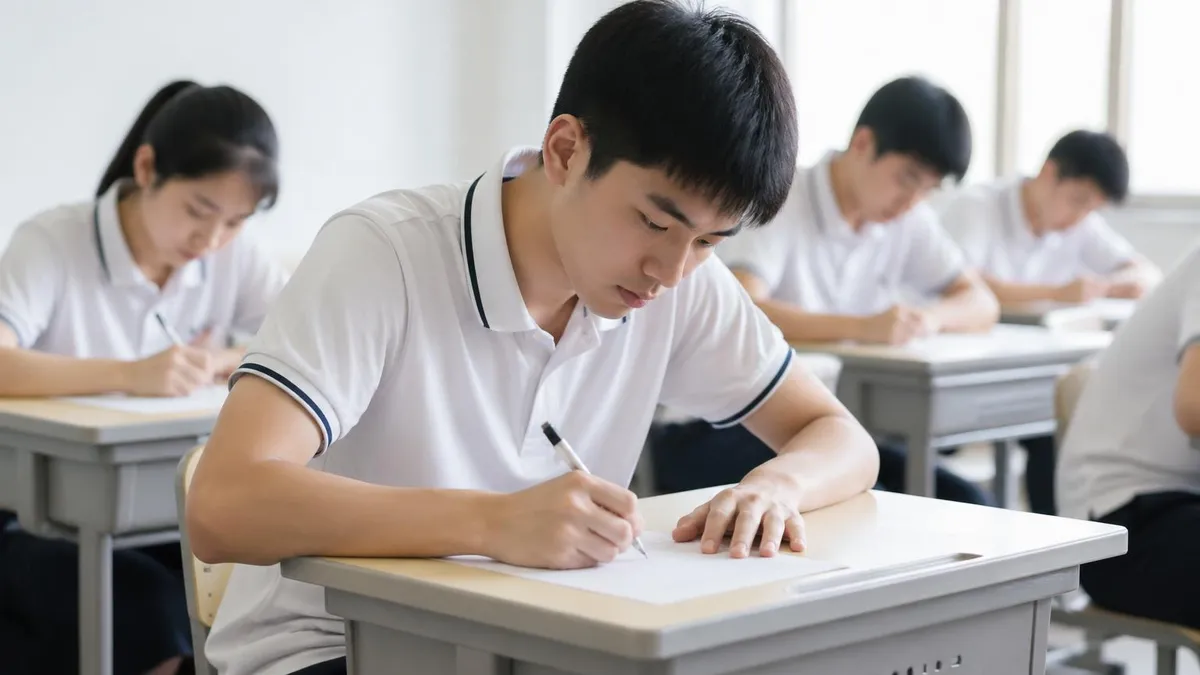


What the Gaokao Math Exam Reveals About Mathematical Education
Studying the Gaokao math exam is instructive for anyone interested in mathematics education, regardless of where they're studying or why. The exam reflects a philosophy that mathematical ability means more than procedural competence—it includes the ability to construct sustained logical arguments, recognize mathematical structure in complex situations, and execute under time pressure without aids.
The emphasis on proof in solid geometry, the multi-concept integration in hard analytic geometry problems, and the prohibition on calculators are all deliberate design choices that reflect educational values. Whether those values are the right ones is a separate debate, but they produce graduates who can perform sustained mathematical reasoning at a high level by hand—a capacity that's genuinely rare and genuinely valuable.
For students currently preparing for the Gaokao or anyone studying at the same mathematical level, the message is straightforward: master the fundamentals deeply, build your problem-solving repertoire through extensive categorized practice, work past papers under real exam conditions, and analyze your mistakes as data rather than just failure. That approach works for the Gaokao, and it works for mathematical development generally.
About the Author

Educational Psychologist & Academic Test Preparation Expert
Columbia University Teachers CollegeDr. Lisa Patel holds a Doctorate in Education from Columbia University Teachers College and has spent 17 years researching standardized test design and academic assessment. She has developed preparation programs for SAT, ACT, GRE, LSAT, UCAT, and numerous professional licensing exams, helping students of all backgrounds achieve their target scores.