
What Is Gaokao: China's College Entrance Exam Explained 2026 October
Prepare for the What Is Gaokao: 📗 China's College Entrance certification. Practice questions with answer explanations covering all exam domains.
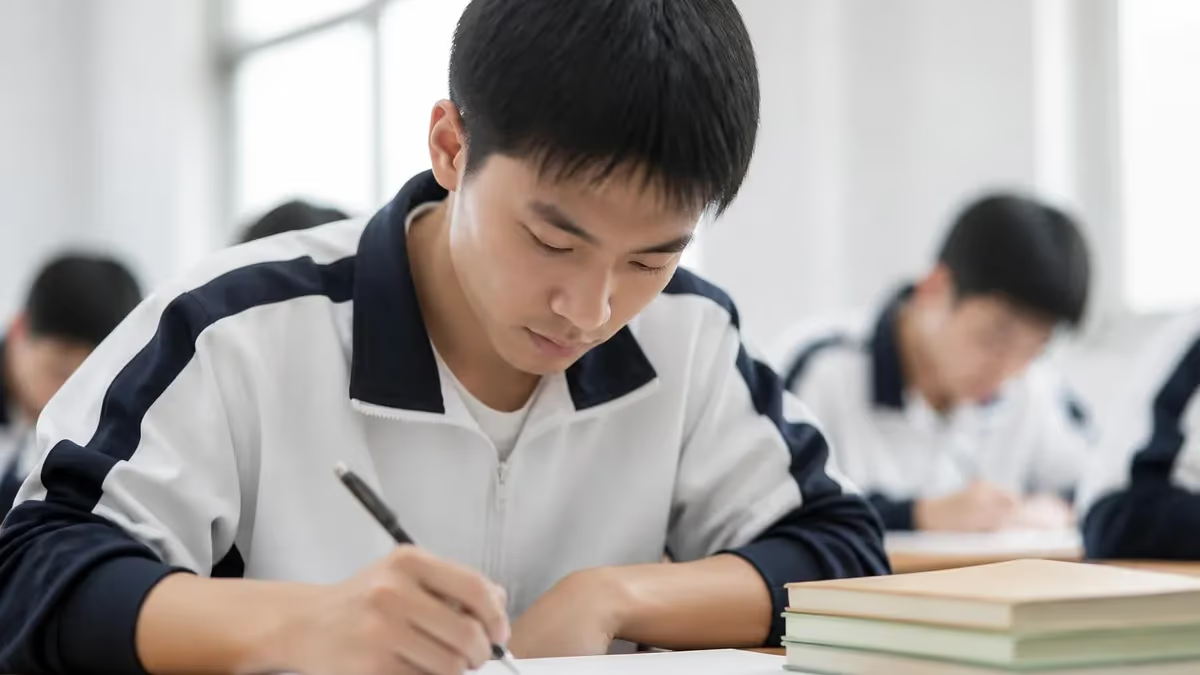
What Is the Gaokao?
The Gaokao (高考) is China's National gaokaoination — the single most consequential academic test in the world by sheer number of participants and stakes involved. Taken by approximately 12 to 13 million Chinese high school students every June, the Gaokao determines which universities — if any — a student can attend.
Unlike university admissions processes in the United States, United Kingdom, or Australia, where holistic factors like extracurriculars, essays, and interviews play a role, admission to Chinese universities is determined almost entirely by a student's Gaokao score. A few points' difference in score can mean the difference between a top-tier university, a regional school, or no university admission at all.
The exam takes its name from the Chinese abbreviation of its full title: 全国普通高等学校招生全国统一考试 (Quánguó Pǔtōng Gāoděng Xuéxiào Zhāoshēng Quánguó Tǒngyī Kǎoshì) — National Ordinary Higher Education Institutions Enrollment Unified Examination. In everyday usage, it is simply called 高考 (gāo kǎo), combining the characters for 'high' (高) and 'examination' (考). The exam was first administered in 1952, suspended during the Cultural Revolution (1966–1976), and reinstated in 1977 under Deng Xiaoping's reforms — a reinstatement widely credited with reopening educational opportunity in China after a decade of disruption.
Gaokao testing typically takes place over two days: June 7 and June 8 across all provinces simultaneously. In provinces with extended subject testing, a third day (June 9 or 10) may be added. The simultaneous nationwide administration is enforced with strict security measures — exam papers are treated as state secrets before distribution, testing centers are monitored by cameras and proctors, and anti-cheating technology including signal jammers and biometric ID verification is deployed at most venues.
The national coordination involved in administering the Gaokao to 12 million candidates on the same day represents one of the largest single logistics operations in global education.
Students who take the Gaokao are typically 18 years old and in their final year of senior high school (高中, gāozhōng), which in China corresponds to Grades 10–12. The Gaokao is not mandatory — students who choose vocational education or who do not plan to pursue university do not take it. But for the vast majority of Chinese students aspiring to attend university, there is no alternative path: the Gaokao is the gate, and passing through it at a high score is the goal that drives years of preparation.
The cultural weight of the Gaokao extends well beyond the exam itself. On the morning of June 7 every year, parents gather outside testing centers across China in the largest display of family support for an academic event anywhere in the world. Traffic in some cities is restricted near testing sites to prevent noise disruptions.
Social media goes quiet as students enter exam halls. Public institutions coordinate around the exam schedule. Understanding the Gaokao means understanding that in China, this two-day event is not merely a test — it is a social institution that organizes the aspirations of an entire generation simultaneously.
The subjects tested on the Gaokao reflect China's educational priorities and have evolved through a series of curriculum reforms. The 2014 reform initiative, now adopted across most provinces, gives students more agency in subject selection while preserving the three fixed core subjects — Chinese, Math, and English.
The reform aims to reduce the binary pressure of choosing between science and humanities tracks in early high school, though subject choice still shapes university eligibility in important ways. Understanding the current structure of the exam in a specific province requires checking that province's implementation timeline, as reform adoption has not been simultaneous nationwide.
Gaokao Scoring and University Admission
The traditional Gaokao scoring system produces a maximum of 750 points: 150 each for Chinese Language, Mathematics, and English, plus 300 points from elective subjects (typically two electives at 150 points each). In the new 3+1+2 reform model used by many provinces, the structure is similar — the fixed three subjects plus three electives — but elective subjects may be scored on a conversion scale rather than raw points, depending on the province. Understanding a Gaokao score requires knowing which provincial scoring system produced it, as raw scores are not directly comparable across regions.
University admission in China operates through a tiered cutoff system. Each province sets annual cutoff lines (分数线, fēn shùxiàn) that determine which tier of university a student's score qualifies them to apply to. At the top are Tier 1 institutions — elite universities including Peking University, Tsinghua University, and other members of China's 985 and 211 university programs.
Below that are Tier 2 and Tier 3 universities, each with progressively lower score requirements. Students whose scores fall below the lowest cutoff line are not eligible for university admission in that cycle and must retake the exam the following year or pursue vocational alternatives.
Cutoff lines vary significantly by province. A student in Beijing may gain admission to a top-tier university with a score that would not clear the cutoff in Henan or Shandong, two provinces with massive populations of Gaokao candidates and proportionally fewer high-tier university seats. This geographic inequality in Gaokao outcomes is a long-running source of social debate in China, with periodic proposals for national score standardization that have faced resistance from provinces with established cutoff advantages.
The pass rates and competitive reality of the Gaokao shift annually based on the total number of candidates, the difficulty of that year's exam, and the number of available university seats. In recent years, the overall university enrollment rate has risen substantially — more than 50% of Gaokao candidates now gain some form of higher education admission — but competition for seats at selective universities remains as intense as ever, concentrated at the top of the score distribution.
Score interpretation also requires understanding what Chinese universities call zhuanyuan (专业), the major or program of study. Students don't simply apply to universities — they apply to specific programs within those universities. A student's score must meet the cutoff for both the university and the desired program, which may have a higher or lower cutoff than the institution's general threshold.
A student who clears the general Tier 1 cutoff might still be assigned to a lower-preference major if their score doesn't meet the specific program requirements they ranked highest, making the preference list submission process itself a strategic calculation that families prepare for with as much care as the exam itself.
Chinese parents typically research cutoff lines for several years of historical data before helping their children build preference lists. Third-party consulting services have emerged specifically to help families navigate university preference strategy — an entire industry built around optimizing the transition from Gaokao score to university placement. This preference list strategy, known informally as 志愿填报 (zhìyuàn tiánbào), has become nearly as stressful as the exam itself for many families in the weeks following score release.

How Students Prepare for the Gaokao
Gaokao preparation is one of the defining features of Chinese adolescent life. The final year of senior high school (高三, gāo sān, Grade 12) is universally understood as the year of Gaokao preparation — extracurricular activities drop off sharply, social commitments shrink, and daily schedules are structured around intensive study. In the months leading up to the June exam date, students in many provinces attend school six or seven days a week, with evening self-study sessions extending until 10 PM or later. This intensity is not unusual or exceptional — it is the expected baseline.
The most common preparation resource is the past exam paper (真题, zhēntí). ETS provides no official preparation materials for the Gaokao the way it does for SAT or GRE; instead, students and teachers use officially released previous years' exam papers as the primary preparation currency. Solving past papers, analyzing mistakes, and identifying question patterns consumes a large portion of Gaokao preparation time. Subject-specific workbooks, practice test compilations, and teacher-made review materials supplement this core activity.
Many Chinese families enroll students in private tutoring (补习班, bǔxí bān) to supplement school instruction. These tutoring programs — ranging from one-on-one private tutors to large cram school operations — generate significant revenue in China's education market. Families view investment in Gaokao preparation as directly linked to their child's life outcomes, making tutoring expenditure a top household priority during the high school years. The gaokao english component in particular receives heavy tutoring focus, as English proficiency varies significantly across China and strong English performance provides a differentiating advantage.
Simulation exams play a major role in preparation. Schools and provinces organize multiple rounds of standardized mock exams (模拟考试, mónǐ kǎoshì) in the months before June — these are high-stakes internal simulations that replicate Gaokao conditions as closely as possible. Students' performance on mock exams shapes teacher feedback, family conversations, and students' own university target lists. A strong mock exam season builds confidence; a weak performance triggers additional preparation intensity in the final weeks.
Chinese Language preparation presents its own demands, including the memorization of classical Chinese poetry and prose that appears as a required section in the exam. Students commit dozens of canonical texts to memory over their high school years, a requirement that reflects China's educational tradition of transmitting classical culture through formal schooling. This section of the Gaokao has no equivalent in most Western national exams.
The week before the exam, most students reduce active study and focus on rest and consolidation — reviewing notes rather than learning new material. Many schools provide specific guidance on this final-week protocol. Sleep and nutrition are taken seriously as performance variables; families coordinate schedules, meal plans, and travel to the test center around optimizing conditions for peak cognitive performance on the exam days themselves.
Gaokao vs Other National Exams
The Gaokao and SAT both serve as university admissions tests, but their roles could not be more different. The SAT is one factor among many in U.S. college admissions — schools also weigh GPA, essays, recommendations, extracurriculars, and demonstrated interest. The Gaokao is effectively the only factor for most Chinese university admissions. The SAT can be taken multiple times with colleges seeing only the best score; the Gaokao is taken once per year, and a single year's score is all that counts. The SAT covers reading, math, and optionally an essay; the Gaokao covers 5–6 subjects across two days. Scale: ~1.7 million SAT takers vs. 12+ million Gaokao candidates annually.

What Gaokao Candidates Typically Do to Prepare
- ✓Complete all past official Gaokao exam papers for the past 5–10 years under timed conditions
- ✓Attend school-organized mock exams (模拟考试) and treat them with the same seriousness as the real exam
- ✓Focus on weak subjects based on mock exam score reports — particularly math, which has the highest variance in outcomes
- ✓Enroll in subject-specific tutoring for high-priority subjects (Math, English, and weakest elective)
- ✓Review teacher answer explanations carefully after each mock exam — understanding wrong answers is more valuable than re-reading correct ones
- ✓Memorize key formulas, vocabulary lists, and classical Chinese texts required for the language arts section
- ✓Practice English listening and writing components, which require different skills from reading-only practice
- ✓Reduce social media and entertainment in the final months before the June exam date
- ✓Maintain regular sleep schedules in the final two weeks — sleep deprivation significantly impairs memory retrieval and problem-solving under pressure
Gaokao: Fairness Debates and Ongoing Reforms
- +Provides a standardized, transparent metric — all students face the same exam content nationally
- +Historically opened university access to students from rural and working-class families who had no alumni networks or social capital
- +Eliminates subjective factors (essays, interviews, legacy admissions) that benefit privileged applicants in other systems
- +Results are released quickly and publicly — no waiting months for opaque admissions decisions
- +Reform process is ongoing — the 2014 curriculum reform attempts to reduce pressure by allowing more subject choice
- −Geographic inequality — cutoff lines disadvantage students in populous provinces with fewer university seats per candidate
- −Extreme pressure concentrates high-stakes outcomes into two days, contributing to documented mental health challenges among high school students
- −Memorization-heavy preparation style may not develop creative thinking, problem-solving, or research skills valued in modern workplaces
- −Single-shot format disadvantages students who test poorly due to illness or circumstances on exam days
- −Private tutoring access creates advantage for affluent urban families, undermining the meritocratic ideal
Pros and Cons at a Glance
| Pros | Cons |
|---|---|
| Provides a standardized, transparent metric — all students face the same exam content nationally | Geographic inequality — cutoff lines disadvantage students in populous provinces with fewer university seats per candidate |
| Historically opened university access to students from rural and working-class families who had no alumni networks or social capital | Extreme pressure concentrates high-stakes outcomes into two days, contributing to documented mental health challenges among high school students |
| Eliminates subjective factors (essays, interviews, legacy admissions) that benefit privileged applicants in other systems | Memorization-heavy preparation style may not develop creative thinking, problem-solving, or research skills valued in modern workplaces |
| Results are released quickly and publicly — no waiting months for opaque admissions decisions | Single-shot format disadvantages students who test poorly due to illness or circumstances on exam days |
Gaokao for International Audiences
For observers outside China, the Gaokao matters in several contexts. International educators and policymakers study the Gaokao as a case study in large-scale standardized testing — how a country of 1.4 billion people designs, secures, and administers a single high-stakes exam to 12 million candidates simultaneously raises operational and pedagogical questions relevant to any country running national assessments. The security infrastructure alone, which treats exam papers as classified materials and deploys signal-blocking technology at test sites, is unmatched in scale.
For international universities, a growing number now accept Gaokao scores as part of admissions materials for Chinese applicants, particularly in the United Kingdom, Australia, and some European countries. These institutions use published conversion tables to map Gaokao scores to equivalent A-Level grades or other national benchmarks. Applicants who performed well on the gaokao examination but wish to study abroad often supplement their score with IELTS or TOEFL results to demonstrate English proficiency at the level required for academic study in English-language programs.
Chinese students who studied internationally and took other university entrance exams (IB, A-Levels, SAT, ACT) generally do not sit the Gaokao. These students apply to Chinese universities — if they choose to return to study in China — through separate international student admission tracks that use their international credentials rather than Gaokao scores. The Gaokao is administered only within China's mainland education system; Chinese citizens who attended school abroad are not required to take it and in most cases are not eligible to sit it in the same cycle.
Understanding the Gaokao is increasingly valuable for anyone working with Chinese education systems, Chinese corporate culture, or Chinese immigration. In China, one of the most common icebreaker questions adults ask — especially upon meeting someone new in a professional context — is where the person studied in university.
The answer carries strong social information, and since university admission follows almost entirely from Gaokao outcomes, the Gaokao effectively shapes professional networks and social identity in ways that persist across an entire career. For people doing business in or with China, cultural literacy about the Gaokao's centrality to Chinese life is genuinely useful context.
Gaokao Questions and Answers
About the Author

Educational Psychologist & Academic Test Preparation Expert
Columbia University Teachers CollegeDr. Lisa Patel holds a Doctorate in Education from Columbia University Teachers College and has spent 17 years researching standardized test design and academic assessment. She has developed preparation programs for SAT, ACT, GRE, LSAT, UCAT, and numerous professional licensing exams, helping students of all backgrounds achieve their target scores.