
Gaokao English: Complete Guide to the English Section of China's National College Entrance Exam
Master the gaokao English section with our complete guide to format, question types, scoring, and proven prep strategies. 🎓 Start practicing free today.
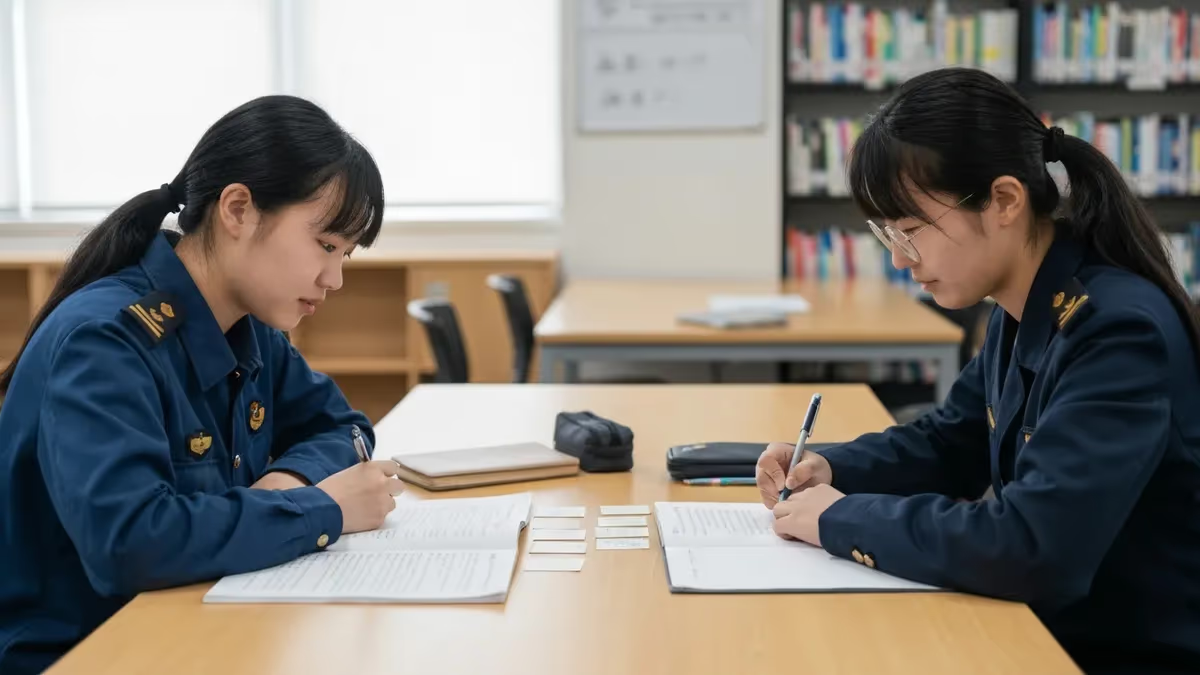
The gaokao English section is one of the most consequential components of China's national college entrance examination, carrying the same 150-point weight as Chinese Language and Mathematics. Every year, millions of Chinese high school students spend years preparing specifically for gaokao English because strong performance can mean the difference between admission to a top-tier university like Peking, Tsinghua, or Fudan and settling for a less competitive institution. Understanding exactly what this exam demands — its structure, question types, scoring logic, and the skills it truly tests — is the essential first step for any serious candidate.
The gaokao examination has evolved significantly over the past two decades. English was once considered a secondary subject, but education reforms have improved its importance substantially. Today, the English section tests a sophisticated blend of reading comprehension, vocabulary in context, grammar application, listening ability, and extended writing skills. American students curious about international education systems, exchange students planning to study in China, or families researching Chinese academic culture will find that gaokao English demands a level of rigor comparable to AP English Language combined with a standardized listening exam.
One of the most misunderstood aspects of gaokao English is that it does not simply test rote memorization of vocabulary lists. Modern gaokao exam questions in English are designed to assess whether students can infer meaning from context, understand nuanced argument structures in reading passages, and produce coherent, well-organized written English under significant time pressure. The exam rewards students who have developed genuine communicative competence alongside test-taking strategy, not those who have merely drilled grammar rules in isolation.
For anyone preparing to tackle gaokao exam questions in English, it is critical to understand regional variation. While a national standard framework exists, provinces like Beijing, Shanghai, Guangdong, and Jiangsu have historically administered their own English exams with distinct formats, scoring rubrics, and even different listening components. Since 2016, China has been gradually moving toward greater standardization through the National College Entrance Examination (NCEE), but as of 2026, meaningful provincial differences remain, particularly in writing prompts and reading text selection.
The listening component deserves special attention because it often surprises students who have focused heavily on reading and writing preparation. Worth 30 points in the national exam (20% of the total English score), listening tests students on their ability to understand natural spoken English across a variety of accents and contexts — conversations between friends, announcements, short lectures, and news-style monologues. Many students underestimate how different real spoken English sounds from the scripted recordings they practice with, and this gap costs them valuable points on exam day.
Reading comprehension is the backbone of gaokao English, typically accounting for 40 points or more of the total score. The passages selected are substantive — drawn from topics in science, culture, society, history, and current events — and are written at a level consistent with upper-secondary English coursework in English-speaking countries. Students are expected to identify main ideas, make logical inferences, understand vocabulary in context, and distinguish between stated facts and authorial opinion. Success in this section requires sustained practice with authentic English texts, not just simplified exam-prep materials.
The writing section, typically worth 25 points for a shorter task and 25 points for a longer composition, demands that students demonstrate organized thinking, appropriate register, and accurate grammar and vocabulary. Topics in recent years have included letters to a foreign friend, notices for school events, argumentative essays on social issues, and narrative compositions. The scoring rubric rewards content relevance, structural coherence, and linguistic accuracy in roughly equal measure, meaning that a technically correct but off-topic essay will score poorly, as will a relevant essay riddled with grammar errors.
Gaokao English by the Numbers

Gaokao English Exam Format
| Section | Questions | Time | Weight | Notes |
|---|---|---|---|---|
| Listening Comprehension | 20 | ~25 min | 20% | Recorded once; 5 short dialogues + 5 longer passages |
| Reading Comprehension | 15 | 40 min | 30% | 3 standard passages + 1 reading task (7 items) |
| Cloze Test (Fill-in-the-Blank) | 15 | 15 min | 15% | Single passage with 15 blanks; vocabulary and grammar |
| Short Writing Task | 1 | 15 min | ~17% | ~80-word functional writing: notice, letter, email |
| Extended Writing Task | 1 | 25 min | ~18% | ~120-150 word essay or narrative composition |
| Total | 55 | 120 minutes | 100% |
Reading comprehension is where gaokao English candidates win or lose the most ground, and understanding the construction of these passages is essential to improving performance. The national exam typically includes three standard multiple-choice reading passages, each between 350 and 500 words, followed by four questions per passage. A fourth section — sometimes called the reading task or information matching section — presents a longer text alongside seven shorter statements or summaries that students must match to specific paragraphs. Together, these account for roughly 40 points, making reading the single highest-value section of the entire English paper.
The topics chosen for reading passages are deliberately varied and global in scope. In recent exam cycles, passages have covered subjects such as wildlife conservation in Africa, technological innovation in Silicon Valley, the psychology of decision-making, cultural heritage tourism in Europe, and medical breakthroughs in cancer treatment. This diversity serves a deliberate pedagogical purpose: students cannot rely on subject-matter familiarity to compensate for weak language skills. A student who reads Chinese science journals but lacks strong English vocabulary will still struggle with a passage on quantum computing written in natural English prose.
Vocabulary breadth and depth are closely intertwined with reading success. The national gaokao English exam assumes a working vocabulary of approximately 3,500 words at the high school level, though reading passages frequently include words beyond this list that students must decode from context. The ability to use morphological clues (prefixes, suffixes, and roots), sentence structure, and passage logic to infer unfamiliar word meanings is a tested skill, not a bonus — several reading questions each year explicitly ask students to determine the meaning of a word or phrase as used in a specific line of the text.
Grammar forms a quieter but persistent thread throughout the gaokao English paper. While the exam no longer includes a dedicated grammar section in the national format (some provinces retain one), grammatical accuracy directly affects scores in the cloze test, the short writing task, and the extended essay.
The most heavily tested grammar areas include complex sentence structures with subordinate clauses, the correct use of articles (a, an, the) in context, subject-verb agreement in long noun phrases, conditional and subjunctive constructions, and the proper use of reported speech. Students who want to explore the full gaokao examination scope beyond English will find that careful grammar study benefits performance across multiple sections.
One underappreciated skill for the reading section is reading speed combined with accuracy. Students have roughly 40 minutes for the reading section, which means they must process 1,500 to 2,000 words of English text, locate relevant information, and answer 15 questions correctly — all without losing focus. Timed practice is non-negotiable. Reading a passage carefully but spending 10 minutes on it leaves insufficient time for the remaining passages, while rushing leads to misreading question stems and selecting plausible but incorrect answers. The ideal reading pace for gaokao English passages is approximately 180 to 220 words per minute with full comprehension.
Inference questions are among the most challenging items in the reading section, and they appear in almost every exam cycle. These questions ask students to go beyond what is explicitly stated to identify what the author implies, what can be logically concluded from specific evidence, or what attitude or tone the author conveys. Common incorrect answer choices are designed to be partially true or to reflect surface-level misreading. The most effective strategy is to locate the specific passage segment relevant to each question before evaluating answer options — rather than answering from memory or general impression of the text.
Skimming and scanning techniques, familiar to anyone who has studied for IELTS or TOEFL, translate well to gaokao English reading preparation. Students should practice identifying topic sentences at the start of each paragraph, recognizing discourse markers (however, therefore, in contrast, as a result) that signal logical relationships between ideas, and using question keywords to locate relevant passage sections efficiently. These are learnable techniques that pay dividends not just on exam day but in the English-medium academic environment that successful gaokao students will enter at university.
Gaokao English: Writing, Listening, and Cloze Strategies
The short writing task (approximately 80 words) requires students to produce functional English — a notice for a school event, an email to a foreign pen pal, or a short announcement. Scoring prioritizes content completeness and format appropriateness above stylistic flair. Students must include all required information points from the prompt, use accurate spelling and punctuation, and maintain appropriate register (formal vs. informal). A common mistake is writing beautifully crafted sentences that omit one or two required content points, which costs more marks than minor grammatical errors would.
The extended writing task (120–150 words) rewards students who have internalized a flexible essay template and practiced adapting it to diverse prompts. Strong responses feature a clear opening statement, two or three well-developed supporting points each illustrated with a brief example, and a logical conclusion that restates the main idea without simply repeating the opening. Examiners note that many student essays score in the middle band because they present ideas without development — stating that learning English is important without explaining why or how reflects thin reasoning that the rubric penalizes. Aim for specificity and concrete illustration in every paragraph.
Studying for Gaokao English: Strengths and Challenges of the Exam
- +Tests practical language skills — reading, writing, and listening — that directly prepare students for English-medium university coursework
- +Clear, published exam framework allows students to target preparation efficiently toward specific section types and point values
- +Reading passage topics are diverse and intellectually engaging, exposing students to authentic global content during preparation
- +Writing rubrics reward organized thinking and content relevance, skills that transfer directly to academic and professional life
- +Strong English scores significantly boost total gaokao points, improving university placement options substantially
- +Consistent exam structure year-over-year means past papers are highly representative preparation materials with proven value
- −Listening audio plays only once, creating high-stakes time pressure that disadvantages students without extensive oral English exposure
- −Provincial exam variations mean preparation materials must be calibrated to the specific regional format, not just the national standard
- −The cloze test rewards deep collocational vocabulary knowledge that is difficult to build quickly, requiring years of sustained reading
- −Extended writing prompts are unpredictable — students cannot rely on a single memorized essay template across all possible topic types
- −Scoring rubrics for writing are only partially transparent, creating uncertainty about exactly how borderline responses are evaluated
- −High-stakes, single-sitting format means test anxiety can significantly impair performance even for well-prepared candidates
Pros and Cons at a Glance
| Pros | Cons |
|---|---|
| Tests practical language skills — reading, writing, and listening — that directly prepare students for English-medium university coursework | Listening audio plays only once, creating high-stakes time pressure that disadvantages students without extensive oral English exposure |
| Clear, published exam framework allows students to target preparation efficiently toward specific section types and point values | Provincial exam variations mean preparation materials must be calibrated to the specific regional format, not just the national standard |
| Reading passage topics are diverse and intellectually engaging, exposing students to authentic global content during preparation | The cloze test rewards deep collocational vocabulary knowledge that is difficult to build quickly, requiring years of sustained reading |
| Writing rubrics reward organized thinking and content relevance, skills that transfer directly to academic and professional life | Extended writing prompts are unpredictable — students cannot rely on a single memorized essay template across all possible topic types |
| Strong English scores significantly boost total gaokao points, improving university placement options substantially | Scoring rubrics for writing are only partially transparent, creating uncertainty about exactly how borderline responses are evaluated |
| Consistent exam structure year-over-year means past papers are highly representative preparation materials with proven value | High-stakes, single-sitting format means test anxiety can significantly impair performance even for well-prepared candidates |
Gaokao English Preparation Checklist
- ✓Download at least five years of official past gaokao English papers and complete each under timed, exam-condition settings.
- ✓Build a daily listening habit of 20–30 minutes using authentic English audio sources such as BBC Learning English or CNN 10.
- ✓Review all 3,500 words on the official Ministry of Education senior high school English vocabulary list systematically.
- ✓Practice the extended writing task weekly, submitting essays for teacher or tutor feedback against the official scoring rubric.
- ✓Master the information-matching reading sub-task by practicing paragraph-to-statement alignment with timed exercises.
- ✓Study the most frequently tested collocations for cloze test preparation, focusing on verb-noun and adjective-noun pairs.
- ✓Learn and apply the five most common discourse marker categories (contrast, cause-effect, addition, sequence, conclusion) in both reading and writing.
- ✓Simulate full listening sections under exam conditions — audio played once only, no pause, no replay, answers marked in real time.
- ✓Analyze every wrong answer from practice tests to identify whether errors stem from vocabulary gaps, inference errors, or time pressure.
- ✓Complete at least one full mock exam per month in the final six months before the gaokao test, reviewing all sections immediately afterward.

Writing Quality Matters More Than Writing Length
Many students write beyond the word limit believing more content earns more points. In practice, gaokao writing scorers deduct marks for content that is off-topic and reward concise, focused responses that directly address every required point in the prompt. A tight, accurate 120-word essay consistently outscores a rambling 200-word attempt with grammar errors and a drifting argument.
Scoring on the gaokao English section follows a relatively transparent point allocation at the section level, but the writing rubric introduces an element of evaluator judgment that students must understand. For multiple-choice sections — listening, reading, and cloze — each correct answer earns a fixed number of points with no penalty for wrong answers in the national format. This means students should always guess on items they cannot confidently answer rather than leaving them blank, a fact that changes test-taking strategy significantly compared to exams that penalize incorrect responses.
The writing section is scored by trained human evaluators using a band-score rubric rather than an automated system. For the short writing task, evaluators typically apply a holistic rubric that considers content completeness (did you include all required information?), language accuracy (are grammar and vocabulary correct?), and format appropriateness (does the response look like the required text type?). For the extended writing, the rubric additionally assesses coherence and cohesion — how logically and smoothly ideas connect across paragraphs. Students aiming for top writing scores must internalize what each band level looks like and practice writing specifically toward the highest-band descriptors.
Provincial scoring variations represent one of the most practically significant but least discussed aspects of gaokao English preparation. Shanghai historically uses a 150-point English exam like the national format but with different listening materials and writing prompts that tend to favor more sophisticated argumentative reasoning. Beijing's exam has periodically included a summary writing task not present in the national format.
Guangdong has integrated more task-based reading items. Students preparing for the gaokao test should identify precisely which exam version their province administers and source practice materials accordingly — using national exam papers when preparing for a provincial variant creates a preparation mismatch that can cost critical points.
The shift toward greater standardization of the gaokao examination has important implications for English preparation. The national standardized exam (全国卷) is now administered in the majority of Chinese provinces, and the trend toward uniformity is expected to continue. This is broadly good news for students because it means more high-quality past papers, more reliable preparation resources, and clearer expectations. Students in provinces that still use local exam variants can also benefit from national-format practice materials as supplementary preparation, particularly for reading and writing skills that transfer across exam versions.
Score improvement trajectories vary widely among gaokao English candidates depending on starting level. Students who begin serious English preparation in their first year of senior high school (Grade 10) with an intermediate-level foundation typically achieve score improvements of 20–30 points over three years of consistent study.
Students who begin intensive preparation in their third and final year (Grade 12) with a below-average foundation face a steeper challenge — vocabulary acquisition and reading fluency do not improve dramatically in a few months — but strategic preparation focusing on listening accuracy, cloze collocations, and writing structure can still yield meaningful gains of 10–15 points within one semester.
One of the most effective differentiated preparation strategies is to take a full diagnostic exam at the start of intensive preparation and score it by section.
This reveals whether a student's weakest areas are in listening (often an exposure problem), reading (often a vocabulary and speed problem), cloze (often a collocation depth problem), or writing (often a planning and organization problem). Each root cause demands a different remediation approach, and treating all English weaknesses as a single unified problem leads to generic studying that improves everything slightly and nothing sufficiently. Targeted, section-specific preparation is consistently more efficient than general English study.
For students who want comprehensive practice beyond their school curriculum, online platforms and supplementary workbooks play an important role. Quality prep materials should include authentic past papers (not just pastiche questions modeled on the exam), annotated answer explanations that teach you why correct answers are correct rather than merely confirming what the right choice was, and listening recordings that accurately replicate the speed and audio quality of the actual exam. Students exploring the gaokao exam practice ecosystem should prioritize resources that offer full-length timed simulations alongside granular performance analytics.
Using national-format (全国卷) practice papers when your province administers a local variant — or vice versa — creates a preparation mismatch that can meaningfully affect your score. Before beginning intensive preparation, confirm exactly which English exam version your province uses for the current exam year, since format changes do occur. Check your school's official gaokao guidance or the provincial education bureau website to verify.
The final stretch of gaokao English preparation — roughly the six to eight weeks before the exam — should shift decisively toward consolidation rather than acquisition. This means moving from learning new vocabulary and grammar rules to reinforcing and applying what has already been studied, reducing error rates on known content, and building the mental stamina required to perform well across a 120-minute exam without losing focus or accuracy. Many students make the mistake of still trying to learn large amounts of new material in the final weeks, which creates cognitive overload and actually increases anxiety rather than reducing it.
Mock exam practice in the final month should be treated with exactly the same seriousness as the real exam. This means starting at the exact same time of day as the actual gaokao (typically morning), sitting in a quiet environment without interruptions, using a physical answer sheet rather than circling answers in the booklet, and scoring the exam immediately afterward with objective self-evaluation.
The psychological benefit of repeated exam-condition practice is significant — students who have experienced the rhythm of a 120-minute English exam dozens of times approach the real exam with far greater composure than those who have only studied individual sections in isolation.
Listening preparation in the final weeks requires daily maintenance rather than intensive burst sessions. A 20-minute listening practice session every single day produces better results than a two-hour session once a week, because listening comprehension is a skill that degrades without regular exercise.
Vary your listening sources to include both exam-format recordings (to maintain familiarity with the question types) and authentic materials (to keep your ear calibrated to natural speech patterns). Students who exclusively listen to exam recordings often find that the slightly more natural speech in real gaokao audio feels surprisingly fast on exam day despite being the same objective speed.
Writing practice in the final weeks should focus intensively on timed production rather than extended revision cycles. Set a 25-minute timer, write your extended essay response to a practice prompt, stop exactly when the timer ends, and then evaluate the response against the rubric before reading model answers. This trains the specific cognitive skill that matters most on exam day: generating a complete, organized, accurate essay under real time pressure. Students who write without time pressure during practice routinely run out of time on the actual exam because they haven't calibrated their pacing for the extended task.
Vocabulary review in the final weeks is most productive when focused on words from authentic gaokao reading passages rather than abstract word lists. When you encounter an unfamiliar word while reading a practice passage, record it with the full sentence it appeared in, an example sentence you write yourself, and two or three common collocations. This contextual encoding makes words far more retrievable under exam conditions than isolated flashcard memorization. Specifically, prioritize reviewing vocabulary from reading passages in official past papers from the last five years, since examiner word selection trends persist across exam cycles.
Test-day preparation begins the evening before, not the morning of. Organize all required materials — admission ticket, valid ID, approved pencils, erasers, and any permitted tools — the night before to avoid morning anxiety. Review your timing plan for each section: approximately 25 minutes for listening (paced by the audio), 40 minutes for reading, 15 minutes for cloze, 15 minutes for short writing, and 25 minutes for extended writing.
Arriving at the testing center early enough to settle your nerves, locate your seat, and arrange your materials without rushing gives you a measurable psychological advantage over candidates who arrive with minutes to spare.
Students who want additional practice resources beyond standard exam papers will find real value in platforms that offer detailed explanations for every question type. Understanding not just what the right answer is but precisely why the other three choices are wrong is one of the highest-use study activities available for multiple-choice sections. The gaokao resources ecosystem has expanded significantly in recent years, and high-quality English-language explanations of gaokao English question types are increasingly accessible to both Chinese students and international observers interested in understanding this landmark examination.
Building a sustainable long-term study routine for gaokao English requires balancing deliberate practice with manageable daily commitments. Students who attempt extreme study schedules — eight or more hours of English per day — invariably experience burnout and diminishing returns within weeks. Research on language learning consistently shows that spaced repetition and consistent daily practice outperform massed practice sessions, even when total study hours are held constant. A routine of 90 minutes of focused gaokao English study per day, sustained over 18 months, produces dramatically better outcomes than 400 hours crammed into the final semester.
Reading authentic English materials outside of exam preparation is one of the highest-return investments a gaokao English candidate can make. English-language science magazines, reputable news websites, short-form essays on educational topics, and well-written young adult novels in English all build the underlying reading fluency and vocabulary breadth that exam preparation alone cannot replicate efficiently. Students who read authentic English regularly for two years before the exam routinely outperform those who studied from exam materials exclusively, even controlling for initial English proficiency level — because authentic reading builds genuine comprehension speed rather than just pattern recognition for exam formats.
Peer study groups with a structured format can significantly enhance gaokao English preparation effectiveness. Rather than reviewing notes passively together, effective study groups should practice essay writing simultaneously and then critique each other's work against the rubric, quiz each other on vocabulary and collocations from recent practice passages, and conduct listening post-analysis sessions where the group identifies exactly which words and phrases were most difficult to catch and why. This active, discussion-based study approach activates deeper processing than individual silent review and surfaces errors and knowledge gaps that students miss when studying alone.
For students whose family backgrounds include little English exposure at home, the path to a strong gaokao English score is more challenging but entirely navigable. The key is creating immersive English micro-environments within daily life: labeling household objects in English, switching phone and social media language settings to English, and finding English-speaking friends or online language exchange partners for regular conversation practice. These low-cost, high-frequency exposures accumulate into meaningful fluency gains over one to two years and complement formal exam preparation without requiring additional study hours.
Parents and teachers supporting gaokao English candidates play an important role in managing expectations and maintaining motivation. The gaokao English score improvement curve is not linear — students often show rapid gains during the first period of intensive preparation, hit a plateau for several months, and then make another leap as their skills consolidate. Understanding this pattern prevents the discouragement that causes many students to abandon effective preparation strategies during the plateau phase, right before they would have broken through to the next performance level.
Technology tools have become valuable supplements to traditional gaokao English preparation without replacing the fundamentals. Vocabulary apps that use spaced repetition algorithms can make vocabulary review more efficient than manual flashcard systems. Text-to-speech tools allow students to hear their own written English read aloud, which is surprisingly effective for catching unnatural phrasings and grammar errors. Online writing feedback platforms can provide rubric-aligned assessments for extended essay practice, especially useful for students without regular access to native-English-speaking teachers. These tools work best when used to enhance a structured preparation plan rather than as the plan's foundation.
Finally, the most important mindset shift for gaokao English candidates is treating English as a living language to be engaged with rather than an obstacle course to be navigated. Students who develop genuine curiosity about English — who read because they find the content interesting, listen because they enjoy the stories, and write because they have something to say — consistently outperform those whose relationship with the language is purely instrumental. The gaokao English exam is demanding precisely because it attempts to measure genuine communicative competence, and the best preparation for demonstrating that competence authentically is developing it authentically.
Sample Gaokao Exam Practice Questions
Try these questions from our free Gaokao Exam practice tests. The correct answer and an explanation follow each question.
Following China's 2015 nationwide cleanup of Gaokao bonus-point (加分) policies, which of the following categories STILL qualifies for national-level 加分 (全国性加分项目)?
- A. Provincial-level academic subject competition winners (省级学科竞赛获奖者)
- B. Students who held the position of class president or student council officer
- C. Children of 烈士 (革命烈士子女, children of revolutionary martyrs)
- D. Graduates of nationally recognized model high schools (全国示范高中毕业生)
Answer: C. Children of 烈士 (革命烈士子女, children of revolutionary martyrs)
The 2015 reforms drastically cut the number of qualifying 加分 categories, eliminating most competition-based and school-honor bonuses. Children of 革命烈士 (revolutionary martyrs) remains one of the very few surviving national-level加分 categories, reflecting the government's policy to honor families of those who died serving the state. Provincial-level competition awards were specifically removed from the national list.
What is the significance of Tier 1 and Tier 2 universities in the Gaokao system?
- A. Tier 1 universities have higher cut-off scores and more prestigious programs.
- B. Tier 2 universities are only for international students.
- C. Scoring above the Tier 1 threshold guarantees admission to a university.
- D. Tier 2 universities offer vocational training rather than academic degrees.
Answer: A. Tier 1 universities have higher cut-off scores and more prestigious programs.
Tier 1 universities in China represent the most elite and competitive institutions, demanding significantly higher Gaokao scores for admission. They are recognized for their academic prestige, comprehensive research programs, and often receive more government funding. This distinction guides students in setting their academic aspirations and application strategies based on their expected performance.
In the Gaokao admissions process, how does the '投档线' (tóudàng xiàn, filing threshold) relate to the '录取线' (lùqǔ xiàn, final admission cutoff)?
- A. They are always identical, both set in advance by provincial education authorities
- B. The 投档线 is typically higher because universities pre-screen applicants before filing
- C. Universities request files at roughly 100–105% of planned enrollment, so the 投档线 may be slightly lower than the final 录取线
- D. The 投档线 applies only to out-of-province applicants while 录取线 applies to all students
Answer: C. Universities request files at roughly 100–105% of planned enrollment, so the 投档线 may be slightly lower than the final 录取线
Universities instruct the provincial admissions office to send files for approximately 100–105% of their planned intake. This means students at the margin of the 投档线 (where files are forwarded) may still be rejected after the university reviews their specific major preferences, and the lowest score among actually admitted students — the 录取线 — often ends up slightly higher than the 投档线.
In China's compulsory geography curriculum, the Huangtu (Loess) Plateau is most associated with which of the following environmental challenges?
- A. Desertification caused by advancing sand dunes from the Gobi Desert
- B. Severe soil erosion resulting from wind and water action on fragile loess deposits
- C. Flooding from the annual overflow of the Pearl River tributaries
- D. Salinization of agricultural land due to excessive irrigation from underground aquifers
Answer: B. Severe soil erosion resulting from wind and water action on fragile loess deposits
The Loess Plateau is a central case study in China's compulsory geography curriculum for soil erosion — the fine-grained loess is highly susceptible to gully erosion from rainfall and wind, making it one of the most severely eroded regions in the world and a key focus of ecological restoration policy.
gaokao Questions and Answers



About the Author

Educational Psychologist & Academic Test Preparation Expert
Columbia University Teachers CollegeDr. Lisa Patel holds a Doctorate in Education from Columbia University Teachers College and has spent 17 years researching standardized test design and academic assessment. She has developed preparation programs for SAT, ACT, GRE, LSAT, UCAT, and numerous professional licensing exams, helping students of all backgrounds achieve their target scores.