
Forklift Safety Questions — Complete Guide (2026 October)
Forklift safety questions answered: ✅ OSHA hand signals, unattended rules, fire extinguishers, horn checks, stability triangle, and pre-shift inspection.
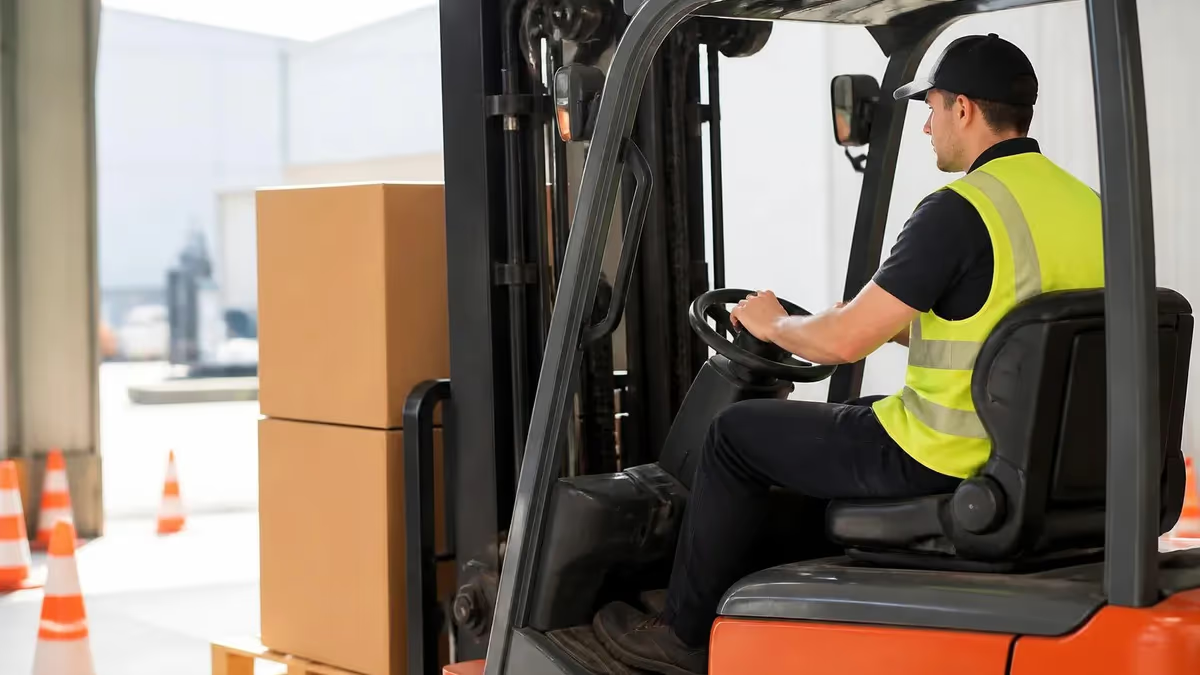
Forklift Safety By the Numbers

Forklift Safety Questions — Complete Guide (2026)
Short answer first. The hand signal to stop a forklift is a closed fist held up in the air. A forklift is considered unattended when the operator is 25 feet or more away, or out of sight of the truck — even if the engine's still running. Fire extinguishers aren't required by OSHA on the truck itself, but most workplaces require them anyway. And if the horn doesn't work, the lift is unsafe and must be tagged out. That's the spine of every OSHA safety quiz you'll ever see.
This guide walks through the questions that show up over and over on forklift training tests, certification exams, and real workplace assessments. Some are gotchas. Some are simple. All of them matter because operators who can't answer them get hurt — or get someone else hurt. OSHA's powered industrial truck standard (1910.178) is dense, but the high-frequency exam questions cluster around maybe eight topics.
Quick caveat. The answers here reflect the federal OSHA standard. State plans like Cal/OSHA layer on extras — California requires written authorization cards, Washington bumps recertification to every two years no matter what, and a few states have warehouse-specific rules. Always check your local OSHA office before assuming federal rules cover you completely.
Here's the thing about safety questions on the actual test. Examiners write them to trip you up on the small print. The horn question isn't "is the horn important" — it's "the forklift is unsafe if which of these fails." The unattended question isn't "can you leave the truck running" — it's a multi-step scenario asking when you must lower forks and set the brake. Read every word twice.
Why does any of this matter beyond passing a test? Because forklifts kill roughly 85 American workers a year and injure another 35,000. Tip-overs account for the largest share. Pedestrian strikes are next. Falling loads and operator falls round out the top four. Every single one of those death modes maps to a question on the OSHA written exam — and to a workplace failure that someone should have caught.
One more thing about how to use this guide. The questions below aren't ranked by difficulty. They're ranked by how often they appear on real forklift certified assessments and the OSHA-aligned written tests used by employer programs. If you only have an hour to study, start at the top and work down. The first six questions cover about 70% of the safety section on most certification exams.
One question we get a lot: how strict are the answers, really? Very. OSHA exam answers come from regulatory text. They're not opinion. "Closed fist held up" isn't one of several acceptable answers — it's the answer. The 25-foot rule isn't "approximately 25 feet." It's 25. The fork adjustment rule isn't "when convenient" — it's empty, parked, ignition off. If your trainer is improvising on these answers, get a second opinion. Federal law is precise here.
"The forklift is fine to use if the horn just doesn't work."
Wrong. OSHA 1910.178(q)(7) says any powered industrial truck found to be in unsafe condition shall be removed from service. The horn is the operator's primary warning device at blind corners, doorways, and pedestrian aisles. No horn = no truck. Tag it out, fill in a defect report, and grab another lift. This is one of the most-missed questions on the OSHA written exam.
Forklift Hand Signals — What Each One Means
Closed fist held up in the air. Used by spotters, pedestrians, and supervisors. Operator must stop immediately — no exceptions.
- Hand position: Closed fist, arm raised
- Operator response: Stop and hold position
Index finger pointed up, rotating in a small circle. Used during loading and dock operations to signal forks should go up.
- Hand position: Index finger up, circling
- Operator response: Raise forks smoothly
Index finger pointed down, rotating. Signals operator to lower the load or empty forks toward the ground.
- Hand position: Index finger down, circling
- Operator response: Lower forks under control
Flat hand pointed in the direction of travel. Spotter guides the truck through tight aisles or around blind corners.
- Hand position: Flat hand, finger-pointed
- Operator response: Move slowly in indicated direction
Both hands open, palms facing operator, beckoning motion. Used when bringing forklift into a dock or staging zone.
- Hand position: Both palms in, beckoning
- Operator response: Inch forward, watch spotter
Both arms crossed overhead in an X shape. Cease all movement immediately — there is a person, hazard, or equipment failure in the path.
- Hand position: Both arms crossed overhead
- Operator response: Stop, lower load, investigate
When Is a Forklift Considered Unattended?
OSHA's exact wording matters here because the test loves to quote it. A powered industrial truck is unattended when the operator is 25 feet or more from the vehicle which remains in his view, OR when the operator leaves the vehicle and it is not in his view. Distance OR sight — either one triggers the rule. You don't need both.
If the truck is unattended, three things must happen. Load-engaging means must be fully lowered, controls must be neutralized, and the power must be shut off. Brakes set. If parked on an incline, wheels block. The exam version of this question usually drops one of those four steps and asks you to spot what's missing.
The Closer Rule (Within 25 Feet)
If you're within 25 feet AND the truck is in your view, OSHA calls this "attended" — but you still have requirements. Load-engaging means must be fully lowered. Controls neutralized. You don't have to kill the engine, but you can't just walk away with the forks improved. A lot of operators get this wrong because they think "I'm right here" exempts them. It doesn't.
Why the Rule Exists
Runaway forklifts crush people. A truck on idle with the parking brake off can roll on a 1% grade. Forks raised at chest height become a guillotine for the next person who walks past. The 25-foot rule isn't arbitrary — it's the distance OSHA decided gives an operator time to react if something starts moving. Treat it as a hard line.
Common Exam Trap on This Question
Test writers love this format: "An operator dismounts to grab a clipboard from a desk 18 feet away. The forklift is in plain sight. Which of the following is required before dismount?" The trap answer says "shut off the engine." The correct answer is "lower forks fully and neutralize controls." Within 25 feet and in sight, you don't have to kill the engine — but you must lower forks and neutralize. Distance + sight = the deciding factors.
Fire Extinguishers and Horn Requirements
Are fire extinguishers required on forklifts? OSHA does not require an extinguisher mounted on the truck itself under 1910.178. But — and this is where test answers get tricky — the National Fire Protection Association (NFPA 505) recommends one, and many employers, insurance carriers, and state plans mandate it. The right exam answer is usually "check your workplace policy." Federal law: no. Practical reality: almost always yes.
The horn is a different story. OSHA 1910.178(q) lists daily inspection items, and the horn is one of them. If the horn is inoperable, the truck cannot be operated until repaired. This connects to forklift certification requirements because certified operators are trained to refuse an unsafe truck. Refusing to operate a defective forklift is protected under OSHA's anti-retaliation rules.
Other Defects That Make a Forklift Unsafe
The horn is just one item on a longer list. A truck is also unsafe if the brakes are spongy, the steering has slack, the seatbelt won't latch, the overhead guard is cracked, the data plate is missing, the forks are bent, the mast chains are stretched, the hydraulic system leaks, the backup alarm doesn't sound, or the tires have chunks missing. Any of these failures means the truck comes out of service. Don't argue with the supervisor about "just one more load." Tag it, log it, walk away.
What Happens After Tag-Out
The truck stays out of service until a qualified mechanic inspects, repairs, and signs off. Operators are not authorized to repair the truck themselves unless they're also certified mechanics. After repair, run another pre-shift inspection before driving. Document the defect, the repair, and the post-repair inspection. This paperwork is what OSHA inspectors ask for when they visit — and what protects you if there's later an incident.

Quick Answers to the Top OSHA Forklift Quiz Questions
Q: What is the hand signal to stop a forklift?
A: A closed fist held up in the air. The signal works whether you're a spotter, a pedestrian crossing an aisle, or a supervisor in the warehouse. The operator must stop immediately and wait for further direction before moving again.
Some workplaces add a secondary signal — both arms crossed overhead — for emergency stops. The single closed fist is standard. Memorize it for the test.
The Stability Triangle and Load Center
The stability triangle is the invisible boundary that decides whether your forklift tips over or stays upright. It runs between the two front wheels and the pivot point of the rear axle — three points, forming a triangle. If the combined center of gravity of the truck and load stays inside that triangle, you're stable. If it moves outside, the truck tips.
Counterbalanced forklifts pivot on the rear axle, which is why backing turns feel sharp and the rear end swings wide. Most tip-overs happen during turns with raised loads — the center of gravity moves up and sideways at the same time, and the triangle's tolerance shrinks fast. Slow turns, lowered loads, and gradual stops keep you inside the safe zone.
What Is the Load Center?
Load center is the horizontal distance from the fork face to the center of gravity of the load. Standard forklift capacity ratings assume a 24-inch load center for loads up to 48 inches square. If your pallet is longer — say 60 inches — the center of gravity sits farther out, the use increases, and your effective capacity drops sharply.
This is the answer to one of the highest-volume forklift license exam questions. A truck rated at 5,000 pounds at a 24-inch load center might only safely lift 3,500 pounds at a 36-inch load center. Read the capacity plate (also called the data plate). It lists ratings at different load centers and attachment configurations. Never lift beyond what the plate allows.
What Causes a Forklift to Tip Forward vs Sideways
Forward tips happen on hard stops with a load high in the air. Momentum carries the load forward, the center of gravity crosses the front wheel line, and the rear end lifts. Sideways tips happen on turns — usually fast turns with raised loads. The centrifugal force pushes the load outboard of the steer wheels and the truck rolls. Slow your turns. Lower the load to travel height. Both tip modes shrink to almost zero risk if you treat the truck like it wants to fall over, because it does.
Pre-Shift Inspection — What to Check
OSHA requires a pre-shift inspection at the start of every shift. The list is long but most of it is common sense. Tires, forks, mast, chains, hydraulic lines, horn, brakes, steering, lights, backup alarm, seatbelt, data plate, leaks. If anything fails, the truck is out of service until repaired.
Print a checklist and use it. Don't rely on memory. Most warehouses keep the checklist on a clipboard mounted to each forklift, and the operator signs and dates it before driving. A skipped inspection is one of the top three OSHA forklift citations every year, right alongside untrained operators and missing osha forklift certification.
The Walk-Around (Engine Off)
Start with the truck off. Walk around it. Check tire pressure visually — bulges, cuts, low spots. Look under the truck for hydraulic puddles. Inspect forks for cracks, bends, or worn heels. Make sure the data plate is legible. Check the load backrest is solid. Examine the overhead guard for damage. Verify the seatbelt latches and retracts.
The Operational Check (Engine On)
Now start it. Test horn, brakes (service and parking), steering in both directions, hoist (raise and lower forks), tilt (forward and back), and the backup alarm. Lights work. Gauges read normal. No warning lamps. If anything is off, shut it down and tag it out.
Inspection on Electric vs LPG Trucks
Electric forklifts add battery checks. Verify the battery is properly secured in its compartment, terminals are clean and corrosion-free, electrolyte levels look right (for lead-acid batteries — not sealed types), and the charging cable is undamaged. LPG trucks add tank checks. The propane tank must be properly mounted, the gauge readable, hoses crack-free, and the relief valve unobstructed. Diesel trucks add exhaust scrubber and fluid checks. Know which type you're inspecting before you start.
Pre-Shift Inspection Checklist (OSHA-Aligned)
- ✓Tires — proper inflation, no cuts, no chunks missing
- ✓Forks — straight, no cracks, heels not worn beyond 10%
- ✓Mast and chains — no kinks, no broken links, lubricated
- ✓Hydraulic lines — no leaks, fittings tight, no rubbing
- ✓Horn — loud, works on first press
- ✓Brakes — service brake firm, parking brake holds on grade
- ✓Steering — full lock both directions, no slack
- ✓Lights — headlights, tail lights, strobe if equipped
- ✓Backup alarm — audible at minimum 5 feet behind truck
- ✓Seatbelt — latches, retracts, no fraying
- ✓Data plate (capacity plate) — legible and present
- ✓Load backrest extension — secure, no cracks
- ✓Overhead guard — no bent or cracked supports
- ✓Fluid levels — hydraulic, engine oil, coolant, fuel
- ✓Battery (electric) or LPG tank — secured, no leaks

Capacity Plate and Travel Rules
Every forklift carries a capacity plate (sometimes called the data plate or nameplate) bolted to the dashboard or cowl. Federal law requires it. The plate lists the truck's make, model, serial number, weight, fuel type, capacity at standard load center, and ratings for any attachments. If the plate is missing, illegible, or has been modified — the truck cannot be operated. That's an OSHA violation and a frequent inspection finding.
Reading the plate is a tested skill. The capacity number isn't always what you think. A 5,000-pound truck rated at a 24-inch load center may only handle 3,200 pounds with a 48-inch paper roll clamp attached. The attachment derates the truck. Many types of forklifts have multiple plates — one for the base truck and one for each attachment.
Travel Rules — Forks and Speed
Travel with forks low. OSHA doesn't pick an exact height, but industry standard is 4 to 6 inches off the ground, tilted slightly back. Low forks lower your center of gravity and stop the tips from catching on uneven surfaces. Never travel with raised forks — even unloaded. Wind gusts, uneven pavement, or a sudden stop can flip a high-mast truck.
Maximum travel speed depends on the worksite, but the universal rule is: slow enough that you can stop within the distance you can see. Indoor warehouse speeds typically cap at 5 mph in aisles. Loading docks and tight quarters drop to walking pace. Some forklift operator employers post speed limits on aisles — follow them.
Grades and Ramps
When traveling on a grade with a load, the load goes upgrade. Forks pointed up the slope. Drive forward up the ramp, back down. Without a load, reverse this: forks downgrade, drive in reverse up the ramp, forward down. Never turn on a grade. Never cross a slope diagonally with a load — that's a tip-over invitation.
The maximum recommended grade for most counterbalanced trucks is around 15%, but this varies by manufacturer. The capacity plate or operator manual will list the max grade. Ramps inside facilities are usually built well within that limit.
Pedestrian Right of Way
Pedestrians always have the right of way. Always. Even if you're loaded, even if you're behind schedule, even if the pedestrian is walking somewhere they probably shouldn't be. Sound the horn at blind corners and doorways. Make eye contact at intersections. If a pedestrian doesn't see you, stop until they do.
One Last Thing About the Written Test
Memorize the four conditions for unattended status. Memorize the closed-fist stop signal. Memorize the 24-inch standard load center. Memorize that the horn failure rule comes from 1910.178(q)(7). These four facts alone show up on roughly half of all OSHA-aligned written exams. Everything else builds on them. Pass the written test, ace the practical, and you'll be fully cleared to operate in just about any OSHA-compliant warehouse in the country.
Test Prep Strategy — Memorization vs Understanding
- +Learn the WHY behind each rule — examiners write questions that test reasoning
- +Memorize exact OSHA numbers — 25 feet, 24-inch load center, etc.
- +Practice with real OSHA quiz questions from multiple sources
- +Read the question twice — gotchas hide in single words
- +Walk through a real pre-shift inspection at your workplace
- +Review the capacity plate on your assigned truck
- −Skimming the operator manual once without practice questions
- −Assuming common sense will cover all answers — it won't
- −Memorizing one practice test verbatim instead of learning concepts
- −Skipping the inspection section because it "seems obvious"
- −Ignoring state plan differences if you work in CA, WA, MI, OR
- −Trusting old PDFs — OSHA updates 1910.178 periodically
Forklift Certification Investment
Forklift Questions and Answers
More Forklift Safety Guides
Forklift Certification: OSHA Requirements, Training & How to Get Certified
Forklift Training — Requirements, Cost, and Certification Steps
OSHA Forklift Certification: 29 CFR 1910.178 Training, Evaluation & Recertification Guide
Forklift License vs Certification: OSHA Requirements, Cost, and Training
How to Get Forklift Certified: Complete Step-by-Step Guide
About the Author

Certified Crane Operator & Skilled Trades Exam Specialist
Ferris State UniversityRobert Martinez is a Journeyman Ironworker, NCCCO-certified crane operator, and forklift trainer with a Bachelor of Science in Construction Technology from Ferris State University. He has 21 years of ironworking, rigging, and heavy equipment operation experience across high-rise and industrial construction sites. Robert prepares candidates for crane operator, rigger, forklift, and skilled trades certification examinations.