
Forklift Classes — Complete Guide (2026)
✏️ Forklift classes I–VII explained: OSHA 29 CFR 1910.178 categories, fuel type, capacity, applications, OEM examples, and class-specific training rules.
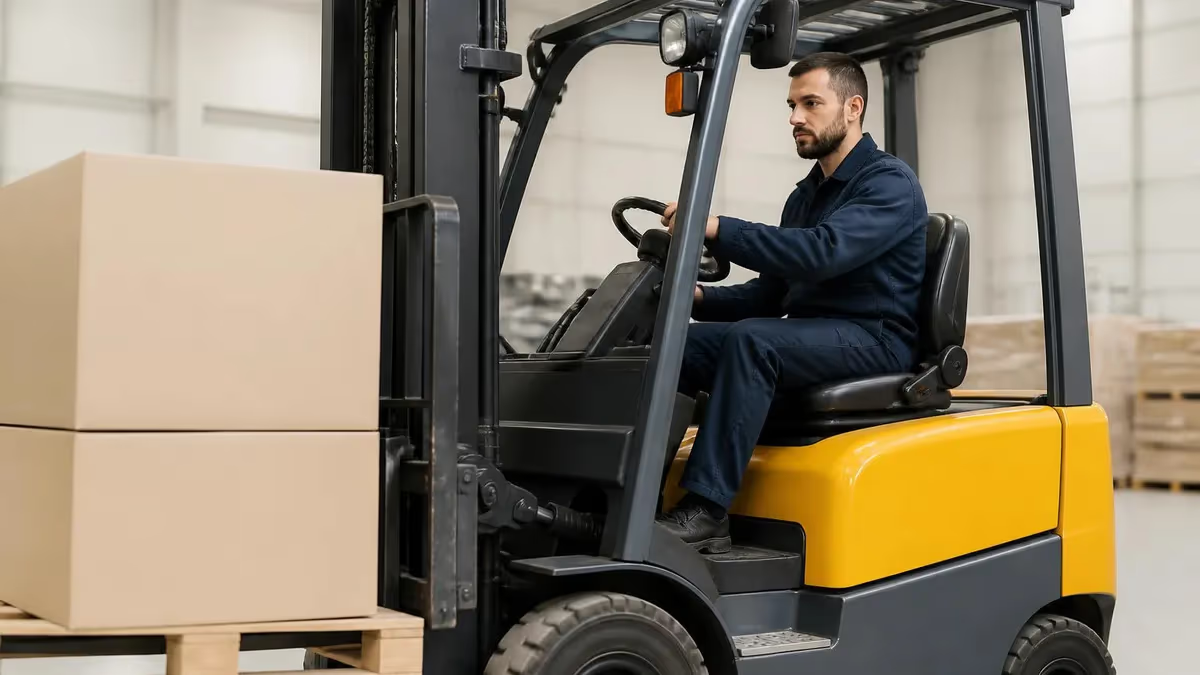
- OSHA requires forklift operators to undergo a performance evaluation at least once every three years. (Occupational Safety and Health Administration (OSHA), U.S. Department of Labor; employers certify operators)
- Forklift operator certification under OSHA requires formal and practical training and an employer evaluation of the operator's workplace performance. (Occupational Safety and Health Administration (OSHA), U.S. Department of Labor; employers certify operators)
- For forklift operator certification, the employer must evaluate the operator's performance and determine that the operator can operate safely before workplace operation. (Occupational Safety and Health Administration (OSHA), U.S. Department of Labor; employers certify operators)
Facts verified Oct 15, 2026 against Occupational Safety and Health Administration (OSHA), U.S. Department of Labor; employers certify operators. Dates that have passed are removed automatically.
Forklift certification Certification Exam at a Glance
| Item | Detail | Official source |
|---|---|---|
| Renewal | Performance evaluation at least every three years | Occupational Safety and Health Administration (OSHA), U.S. Department of Labor; employers certify operators |
| Delivery | Formal instruction, practical training and workplace evaluation | Occupational Safety and Health Administration (OSHA), U.S. Department of Labor; employers certify operators |
| Eligibility | Training and demonstrated competence before workplace operation | Occupational Safety and Health Administration (OSHA), U.S. Department of Labor; employers certify operators |
Facts verified Oct 15, 2026 against Occupational Safety and Health Administration (OSHA), U.S. Department of Labor; employers certify operators. Dates that have passed are removed automatically.
OSHA Forklift Classes At a Glance

Forklift Classes: What OSHA Means By Class I Through Class VII
Here's the part most operators learn the hard way: getting certified on a sit-down electric forklift doesn't make you legal to drive a rough-terrain machine on a job site. OSHA splits powered industrial trucks into seven classes under 29 CFR 1910.178, and each class is its own training universe. Different controls. Different stability physics. Different hazards. Practice with the free Forklift certification practice test on PracticeTestGeeks (7 questions with answer explanations).
The class system is older than most operators realize. ANSI/ITSDF B56.1 wrote it. OSHA adopted it. Manufacturers, insurers, rental companies, training schools, and inspectors all use the same numbering. Class I through VII isn't marketing — it's the language of compliance.
Why care? Two reasons. First, if you run the wrong class for the work, you'll either kill the equipment (running an electric Class I outdoors in the rain), fail an audit (no class-specific training records on file), or kill a worker (cushion-tire Class IV on broken asphalt rolling and tipping). Second, the buying decision. A new Class I costs $20K–$45K. A new Class V costs $35K–$80K. A Class VII rough-terrain pushes $90K and up. Pick the wrong class and the budget bleeds.
This guide walks through every class — Class I sit-down electric counterbalance through Class VII rough terrain. For each one, you'll see the power source, capacity range, where they belong, where they don't, and the brand-name models that dominate that class. By the end you'll know which class fits which job and what the forklift operator training rules look like for each one.
What 29 CFR 1910.178 Actually Says
The OSHA rule is short on the class definitions themselves — those live in ANSI B56.1, incorporated by reference. The rule is long on training. 1910.178(l) is the operator training section. It requires formal instruction (lecture, video, written materials), practical training (hands-on demonstration plus exercises), and evaluation in the workplace on the specific type of truck. The phrase "specific type" is what creates the class barrier.
Train an operator on a Class I sit-down rider. They are certified for Class I sit-down riders only. Move them to Class III walkie pallet jack? New training event. New evaluation. New certificate. The rule explicitly calls out class differences as triggers for retraining whenever the operator switches equipment.
Free Forklift certification Study Tools
Interactive Forklift certification resources on PracticeTestGeeks, free to start:
- Forklift certification flashcards — review key terms and concepts card by card
- Forklift certification study guide — topic-by-topic overview of what the exam covers
- Forklift certification cheat sheet — one-page printable summary for last-minute review
Train Per Class, Per Equipment Type
OSHA 1910.178(l)(4)(ii) requires re-evaluation when the operator changes truck type. Class I to Class IV? New training. Class V to Class VII? New training. Even within the same class, switching from cushion-tire to pneumatic-tire triggers it. Single "forklift card" certificates that claim to cover all seven classes are not compliant — auditors look for class-specific evaluation records.
OSHA Forklift Classes — Quick Comparison
Electric Motor Rider Trucks. Sit-down counterbalance design. Cushion or pneumatic tires. Capacity 3,000–12,000 lb (some heavy-duty 15,000 lb). Indoor warehouses. Quiet, zero-emission, smooth floors. Toyota 8FBC, Hyster J50XN, Crown FC 5200.
Class I — Electric Motor Rider Trucks (Sit-Down Counterbalance)
The most common forklift in U.S. warehouses. Battery-powered. Operator sits down. Counterbalance design — meaning the weight of the truck behind the front wheels offsets the load on the forks. No outrigger legs, no straddle arms. Just a chunk of steel and lead-acid (or now, increasingly lithium-ion) battery behind the driver's seat.
Why warehouses love them: zero exhaust emissions, low noise, smooth operation. A Class I runs an 8-hour shift on a single battery charge. Swap or opportunity-charge during breaks. No fuel storage. No CO monitors. Fits into facilities where indoor air quality matters — food, pharma, electronics, anywhere a forklift can't share air with people for long.
Capacity Range
Standard 3,000-lb to 6,000-lb capacity covers about 80% of warehouse work. Heavy-duty Class I models reach 12,000 lb (Toyota 8FBCU60 for example). Anything beyond that crosses into IC engine territory because the battery weight gets prohibitive. The math is unforgiving — every extra 1,000 lb of load capacity needs another 600–900 lb of counterweight battery.
Cushion vs. Pneumatic Tires Within Class I
Most Class I trucks run cushion tires — solid rubber bonded to a metal hub. Indoor-only because cushion tires don't handle gravel, potholes, or wet pavement. Pneumatic-tire Class I exists (Toyota 8FBN, Hyster J60XN) for transitional indoor/outdoor work — loading docks, covered yards. Solid pneumatics last longer than air-filled; air-filled give better ride on rough surfaces.
License Requirements
OSHA-compliant training plus practical evaluation per 1910.178(l). Most employers issue a class-specific certificate valid for 3 years. Some states (California, Washington) layer additional record-keeping on top. There's no federal forklift license — only employer-issued certification documenting that operator training was completed. See the forklift license guide for state-by-state details.
Class II — Electric Motor Narrow Aisle Trucks
Narrow aisle. The whole point. Class II machines are built for warehouses where every cubic foot of vertical storage matters. Reach trucks extend the forks forward into racking. Order pickers lift the operator up to the load. Turret trucks swivel the mast 180 degrees inside the aisle. Aisle widths drop to 5 or 6 feet — half what a Class I needs.
The Crown RR series is the gold standard for reach trucks. Raymond's 7400 dominates double-deep racking. Order pickers — Crown SP 4500, Raymond 5500, Yale OS — let pickers grab individual cases from 30-foot heights. Different machine for a different problem than a Class I, even though both run on batteries.
Why You Can't Substitute
A Class I sit-down can't enter a Class II aisle. The reach mechanism doesn't exist. The footprint is wrong. The operator's seating angle doesn't see the upper racking. Substituting a Class I where a Class II is needed means either widening aisles (loses 30% of storage cube) or accepting that the warehouse never reaches its design density. That's why high-bay warehouses spec both fleets in parallel.
Class III — Electric Motor Hand/Hand-Rider Trucks
Walkie pallet jacks. The most-sold powered industrial truck in North America, by far. Operator walks behind (or rides on a small platform). Capacity 2,000–4,500 lb. Battery-powered tiller arm with thumb-control speed. Used everywhere — receiving docks, store backrooms, light manufacturing, last-mile delivery trucks.
Crown WP 3000 series and Raymond 8210 dominate U.S. walkie sales. Walkie stackers (raised forks, no rider) like the Toyota 7BWS add vertical capability — store goods 8 feet up on racks. Rider pallet trucks (small platform under the tiller, operator stands) handle long-distance horizontal moves in big DCs.
Training Distinction
Most operators assume "it's just a pallet jack — no training needed." Wrong. OSHA 1910.178 covers Class III as much as Class I. Crush injuries from walkie pallet trucks are the third-leading cause of forklift fatalities (behind tip-overs and falls). Specific training: tiller pinch points, runaway controls, dock-edge awareness.
If you want the full picture, the forklift classes guide walks through it step by step.
Class-by-Class OEM Examples
- Top Models: Toyota 8FBC, Hyster J50XN, Crown FC 5200
- Capacity: 3,000–12,000 lb
- Best For: Indoor warehouses, food/pharma, smooth floors
- Top Models: Crown RR 5700, Raymond 7400, Yale NR
- Capacity: 3,000–5,500 lb
- Best For: High-bay racking, 5-ft aisles, order picking
- Top Models: Crown WP 3000, Raymond 8210, Toyota 8HBW
- Capacity: 2,000–4,500 lb
- Best For: Dock work, pick-and-carry, retail backrooms
- Top Models: Hyster H50FT, Toyota 8FGCU25, Cat 2C5000
- Capacity: 4,000–12,000 lb
- Best For: Indoor manufacturing, LPG only, smooth floors
- Top Models: Toyota 8FDU25, Hyster H80FT, Cat DP70
- Capacity: 3,000–35,000+ lb
- Best For: Outdoor yards, lumber, container handling
- Top Models: Taylor-Dunn TT-316, Toyota TT 1500, Cushman Titan
- Capacity: Drawbar 3,000–15,000 lb
- Best For: Airport baggage, factory trains, assembly lines
- Top Models: JCB 940, Cat TL642, Skytrak 6042, JLG G10-55A
- Capacity: 6,000–20,000 lb
- Best For: Construction sites, lumber yards, agriculture

Class IV — Internal Combustion Engine Cushion Tire Trucks
The misunderstood class. Class IV is IC engine — meaning LPG, diesel, or gasoline. But cushion tires. Which sounds contradictory until you see the math: indoor manufacturing facilities want the lifting power of an engine but the smooth-floor performance of cushion tires. Solid rubber. Hard hubs. Designed for concrete and asphalt that's smooth as glass.
Almost all Class IV trucks run LPG (propane). Diesel Class IV is rare in modern facilities because of emissions — indoor diesel exhaust requires expensive ventilation. LPG burns cleaner, the bottle swaps in two minutes, and a single bottle runs about 8 hours of moderate-duty work.
Capacity and Use Cases
Standard Class IV: 4,000–8,000 lb. Heavy-duty: 10,000–12,000 lb. Goes where Class I batteries can't keep up — high-cycle paper mills, automotive assembly, anywhere a 16-hour day means a bottle swap beats a battery swap. Hyster H50FT and Toyota 8FGCU25 dominate this segment.
The Floor Surface Rule
Cushion tires give zero. Run a Class IV outside on broken asphalt or gravel and the bouncing fatigue cracks the frame within a year. Manufacturers void warranty for non-paved use. Operators learn this the hard way when the mast collapses three years in. If you need outdoor capability, that's Class V territory.
Class V — Internal Combustion Engine Pneumatic Tire Trucks
The workhorse. If you imagine a stereotypical forklift — yellow paint, diesel growl, big rubber tires — that's a Class V. They run everywhere outdoors and on rough indoor surfaces. Capacity tops out at 35,000 lb and up for the giants. Toyota 8FDU25, Hyster H80FT, Cat DP70, Komatsu FD25, Mitsubishi FG35N — the big OEMs all play here.
Pneumatic tires absorb shock. Big sidewalls flex over potholes, gravel, broken pavement. Available as air-filled (cheaper, better ride) or solid pneumatic (puncture-proof, heavier, more expensive). Lumber yards, scrapyards, container terminals, and concrete plants pick solid pneumatic almost without exception — the cost of a downed truck because of a nail in a tire dwarfs the upcharge.
Fuel Trade-Offs
LPG: cleanest, mid-range cost per hour, bottle swaps. Diesel: most torque, lowest cost per hour for heavy work, but emissions limit indoor use. Gasoline: simplest engine, lowest acquisition cost, but fuel cost per hour is highest. Most fleets standardize on LPG for mixed indoor/outdoor and diesel for outdoor-only.
Specialty Class V Variants
Container handlers, top picks, side loaders — all sit within Class V. Hyster H40-50XM-12 lifts a 50,000-lb container three high. Taylor TX-450L handles 40-foot intermodal containers at port operations. These aren't "forklifts" in the warehouse sense, but they share the Class V designation and the same training framework.
Class VI — Electric and IC Engine Tractors
Not technically forklifts. They don't lift. They tow. Tow tractors, baggage tractors, factory train tugs, burden carriers. Capacity is measured by drawbar pull (how many pounds the truck can pull horizontally), not lift capacity. Most Class VI machines pull 3,000–15,000 lb.
Where you see them: airports (Cushman Titan, Toyota TT 1500 pulling baggage trains), automotive plants (Taylor-Dunn TT-316 pulling subassembly carts to the line), warehouses with order-picking trains. Some are battery-electric. Some are LPG. Some are diesel. All fall under 1910.178 because OSHA defines them as powered industrial trucks.
Why a Separate Class
Different hazards. No mast, no overhead protective guard requirement on most. Steering geometry is articulated on some models. Operators face train-handling rules (jackknife prevention, max train length, cornering speed) that don't exist in lifting trucks. Specific training matters more than in any other class because the failure modes are completely different.
Class VII — Rough Terrain Forklift Trucks
Construction-site machines. 4-wheel drive diesel. Massive pneumatic tires built for mud, gravel, and uneven ground. Capacity 6,000–20,000 lb. The look is closer to a tractor than a warehouse forklift — high ground clearance, articulating frame on some models, telescoping boom on most.
Three sub-types within Class VII matter for buyers. Vertical-mast rough terrain (closest to a normal forklift, taller wheels) — Cat TL642, Mitsubishi FD50N. Telehandlers (boom that extends and lifts) — JCB 940, Skytrak 6042, JLG G10-55A. Variable-reach models that pivot the boom side-to-side — Manitou MT-X 1840.
Where They Belong
Lumber yards. Concrete sites. Steel erection. Roofing supply yards. Agriculture (loading hay bales, moving feed). Anywhere a warehouse forklift would sink, slip, or tip. The 4WD plus oversized tires deliver traction that pneumatic-tire Class V can't match on dirt.
Where They Don't
Indoors. Almost never. Class VII diesel exhaust plus the sheer size — 9-foot width on a Skytrak 10K — makes indoor operation impractical. Also smooth floors: those big tires scrub badly on concrete and shorten tire life dramatically.
Telehandler vs. Vertical-Mast Decision
Telehandlers reach forward and up — perfect for placing trusses on a second-floor framing or lifting roofing materials to the eaves. Vertical-mast rough terrain is faster for repetitive lumber-yard work where the load travels straight up. Most contractors run both; the rental fleet decides which one shows up by job description.
Class-Specific Training: What 1910.178(l) Actually Requires
The training rule has three legs. Formal instruction — lectures, video, written tests. Practical training — hands-on demonstration plus exercises. Evaluation in the workplace — supervised operation of the specific truck on the specific surface in the specific work environment. All three must happen. All three must be documented. All three must be class-specific.
Refresher training every 3 years. Plus immediate refresher if the operator is observed operating unsafely, is involved in an incident or near-miss, gets a poor evaluation, changes truck class, or the workplace conditions change. Documentation requirements live in 1910.178(l)(6) — name of operator, date of training, date of evaluation, identity of trainer.
Common Training Mistakes
Single "general forklift card." Not legal. Online-only certification with no in-person evaluation. Not legal — practical training and workplace evaluation must be in person. Training on one truck class then assuming it covers others. Not legal. Each of these is a citation waiting to happen and most rental companies and insurance carriers now ask for class-specific records before they release equipment.
For the full breakdown of what proper OSHA forklift training looks like — written test, practical evaluation, refresher cycle — see the dedicated training guide.
Class Selection Checklist (Before Buying or Renting)
- ✓Indoor only? Class I or Class IV. Outdoor only? Class V or VII. Mixed? Lean Class V with pneumatic tires.
- ✓Aisle width below 8 ft? You need Class II — Class I won't fit.
- ✓Load capacity needed in pounds? Compare to class capacity range before ruling out classes.
- ✓Maximum lift height? Match to class typical mast height (Class I: 18 ft; Class II: 40+ ft; Class VII: 55 ft on telehandlers).
- ✓Floor surface? Smooth concrete = cushion tire OK. Gravel/dirt = pneumatic required.
- ✓Indoor air quality concerns? Electric (Class I/II/III) — not LPG/diesel.
- ✓Daily run-hours over 12? IC engine (Class IV/V) — battery swap logistics get unwieldy.
- ✓Towing or lifting? Towing = Class VI. Lifting = anything else.
- ✓Operator training records — do you have class-specific evaluation slots for this truck?
- ✓Service network — does your local dealer support this class? Crown for I/II/III, Hyster/Toyota for IV/V, JCB/Cat for VII.
Cost Differences Between Classes (2026 Market)
The acquisition gap between classes is real and worth planning for. Used Class I 5,000-lb electric sit-downs run $8,000–$18,000 depending on hours and battery condition. Brand-new same spec: $25,000–$45,000 with battery and charger. Lithium-ion adds $8,000–$12,000 to the new price but cuts charging time and extends battery life.
Class II reach trucks: new $35,000–$60,000. Used $15,000–$30,000. The narrower the aisle the trucks are built for, the higher the price — turret trucks push past $80K new. Class III walkie pallet jacks are the cheapest powered industrial trucks: $4,000–$9,000 new, $1,500–$4,000 used.
Class IV LPG cushion-tire: new $30,000–$55,000. Class V LPG pneumatic-tire: new $35,000–$80,000 depending on capacity. Heavy-capacity Class V (15,000-lb-plus): $100,000 and climbing. Container handlers and top picks reach $250,000–$400,000.
Class VI tow tractors: $15,000–$60,000 new depending on drawbar capacity and electric vs. IC. Class VII telehandlers: $65,000–$140,000 new. Vertical-mast rough terrain: $50,000–$120,000.
Hourly Operating Cost
Electric trucks (I, II, III) win on operating cost — about $1.50–$3.00 per hour all-in (electricity, battery amortization, maintenance). LPG Class IV/V runs $4.00–$7.00 per hour with fuel and oil. Diesel Class V/VII pushes $6.00–$10.00 per hour, but heavy work justifies the extra. Over a 5-year equipment life, the operating cost gap can equal or exceed the original purchase price difference.
Picking the Right Class — Three Real-World Examples
Pharma warehouse, 40,000 sq ft, all indoor, smooth epoxy floors, 5-ft aisles in the racking sections, 12-ft general traffic aisles, lifting up to 18 ft. Right answer: mix of Class I sit-down for case picking and dock work plus Class II reach trucks for the narrow racking aisles. Class III walkie pallet jacks for receiving. No combustion equipment because clean-room adjacency.
Lumber yard, 8-acre site, outdoor stacks, occasional shed work. Right answer: Class V pneumatic-tire LPG forklift for shed and yard. Class VII telehandler for high stacks and second-story delivery. No Class I or II — outdoor surfaces would eat the cushion tires and reach mechanisms.
Auto parts distribution center, 250,000 sq ft, 9-ft aisles, mostly pallet moves under 6,000 lb, indoor, 24-hour operation. Right answer: Class I battery sit-down trucks running on 3 shifts with hot-swap or opportunity-charge lithium-ion batteries. Class III walkie pallet jacks at the dock. No Class IV — battery wins on operating cost over a million annual hours of operation across the fleet.
The mistake to avoid: trying to standardize on one class for everything. The classes exist because the work doesn't fit one machine. Mixed fleets are normal, deliberate, and required by the diversity of real warehouse operations. For deeper coverage of fleet planning by use case, the forklift reference walks through the buyer-side decisions in detail.
The Future of the Class System
ANSI B56.1 hasn't been revised since 2020, and the next update is in committee for 2027. Expected changes: a new sub-classification for autonomous mobile robot (AMR) forklifts that span Class I/III hybrid functions. Tighter telematics requirements — black-box operating logs for every powered industrial truck. Lithium-ion-specific safety requirements that currently sit in NFPA 855 rather than B56.1.
OSHA is studying whether to add a Class VIII for very-narrow-aisle automated trucks (Crown's TSP series and similar). Industry pushback wants them under Class II. Likely outcome: Class II expanded with a sub-category rather than a brand-new class — keeps existing certifications intact.
What stays the same: the seven-class framework, the per-class training rule, and the principle that operating a powered industrial truck is a skilled, certified activity governed by federal regulation. Operators who know their class — and their employer's training records — work safer and pass audits cleaner.

Class-Based Fleet Strategy: Pros & Cons
- +Class-specific training matches operator skills to actual equipment
- +Targeted purchasing — buy exactly what the work needs, not one-size-fits-all
- +Easier OSHA audits — class records align cleanly with CFR sections
- +Insurance carriers prefer documented per-class certification
- +Maintenance costs lower when each class runs on appropriate surfaces
- −Multiple classes = more training cycles per operator
- −Higher fleet complexity — parts, chargers, fuel logistics for each class
- −Cross-training takes time — new operators need 4–8 hours per class
- −Mixed-class facilities need clear signage and operator awareness
- −Substitutes during equipment downtime require class-matched rentals
Pros and Cons at a Glance
| Pros | Cons |
|---|---|
| Class-specific training matches operator skills to actual equipment | Multiple classes = more training cycles per operator |
| Targeted purchasing — buy exactly what the work needs, not one-size-fits-all | Higher fleet complexity — parts, chargers, fuel logistics for each class |
| Easier OSHA audits — class records align cleanly with CFR sections | Mixed-class facilities need clear signage and operator awareness |
| Insurance carriers prefer documented per-class certification | Substitutes during equipment downtime require class-matched rentals |
Typical New Forklift Acquisition by Class (2026)
How to Build a Class-Aware Fleet Plan
Step 1: Map the Work
Step 2: Surface Audit
Step 3: Match Class to Move
Step 4: Cost Model
Step 5: Training Plan
Step 6: Maintenance Contract
Sample Forklift certification Practice Questions
Try these questions from our free Forklift certification practice tests. The correct answer and an explanation follow each question.
Adding a heavier attachment to a forklift generally does what to its rated capacity?
- A. Increases the capacity
- B. Reduces the rated capacity
- C. Has no effect on capacity
- D. Doubles the capacity
Answer: B. Reduces the rated capacity
Attachments add weight and can move the load center, which lowers the truck's effective load capacity.
If the forklift's counterweight approaches any structure closer than a predetermined distance, extra safety precautions need to be taken. How far away is that?
- A. 750 mm
- B. 1000 mm
- C. 300 mm
- D. 600 mm
Answer: D. 600 mm
If a forklift's counterweight approaches any structure closer than 600 mm (approximately 2 feet), extra safety precautions are required. This predetermined distance is a safety standard to prevent crushing hazards for personnel or damage to structures. Operating within this zone necessitates heightened awareness, clear communication, and often the implementation of exclusion zones or spotters to ensure safety.
What is the minimum age OSHA sets for operating a forklift in a non-agricultural workplace?
- A. 16 years
- B. 18 years
- C. 21 years
- D. No minimum
Answer: B. 18 years
OSHA prohibits anyone under 18 from operating a forklift in non-agricultural employment.
What is a counterweight on a forklift designed to do?
- A. Add speed
- B. Balance the weight of the load on the forks
- C. Protect the operator's head
- D. Cool the engine
Answer: B. Balance the weight of the load on the forks
The counterweight at the rear offsets the load on the forks to keep the truck balanced.
Take the full Forklift certification practice test
Forklift Questions and Answers
Related Forklift Guides
Forklift Driver: Complete Career Guide
Forklift Certification Practice Test PDF (Free Printable 2026)
Forklift Operator: Job Duties, Pay & Certification Requirements
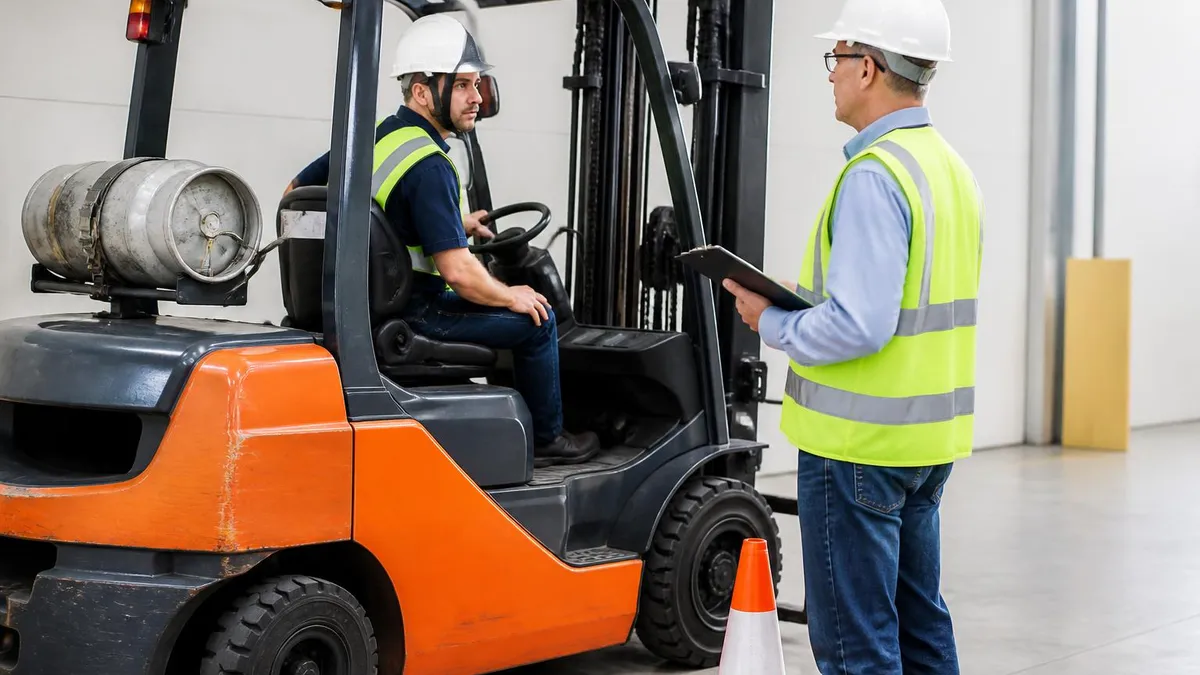
How to Get Forklift Certified: Complete Certification Guide
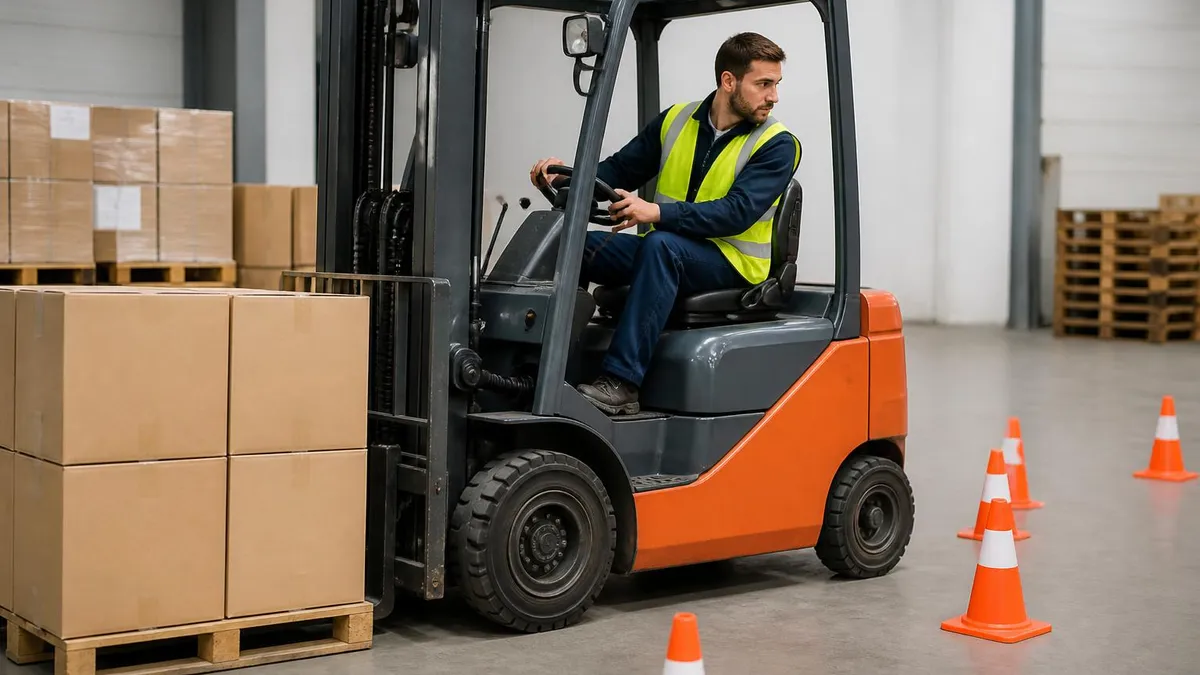
OSHA Forklift Certification: 29 CFR 1910.178 Training, Evaluation & Recertification Guide
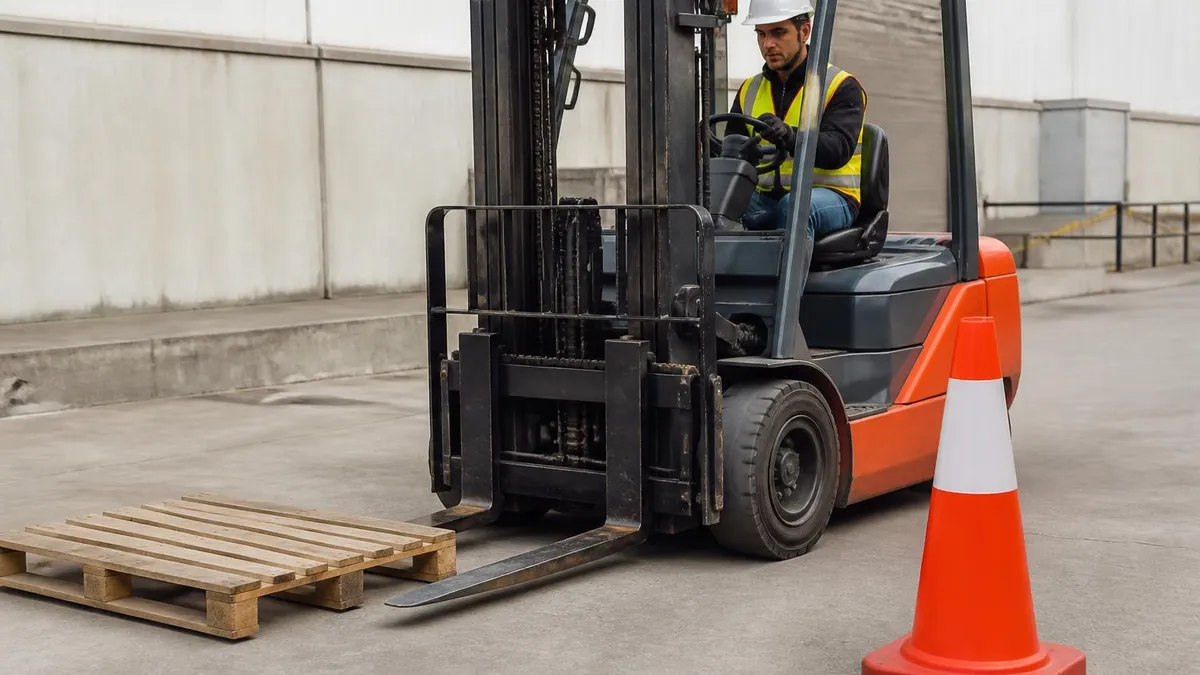
Forklift Types: Complete Guide to Classes, Uses, and Certification
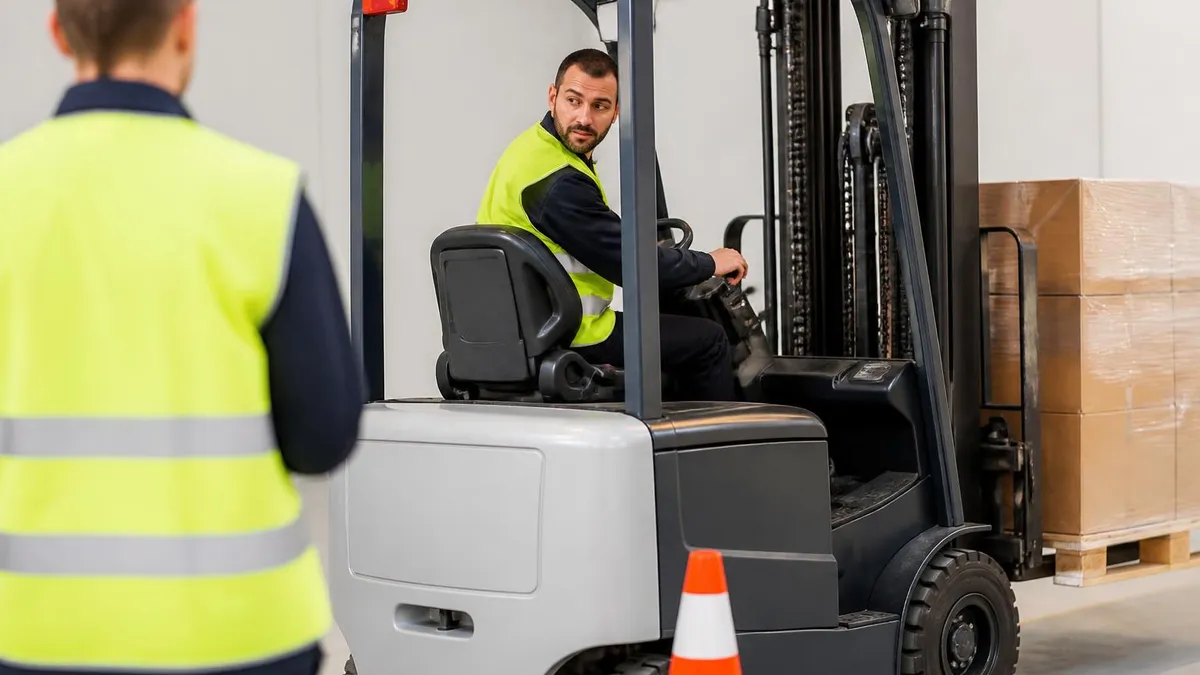
Forklift License vs Certification: OSHA Requirements, Cost, and Training
How this page was made: written with AI tools and published by Nathan Beja, founder of Practice Test Geeks, who is responsible for its content. Exam facts are checked against the official sources listed below. Not reviewed by a subject-matter expert. Editorial policy
Sources & references
Exam facts on this page (fees, format, dates, passing scores) are checked against these official sources; the date is our last check. Editorial policy
- osha.gov — Test delivery, eligibility, renewal · verified Oct 2026