
FCLE Questions and Answers: Florida Civic Literacy Exam Practice Test 2026 September
Master the Florida Civic Literacy Exam with real practice questions & answers. Free FCLE prep, topic breakdowns, and study tips. 🎯 Start today!
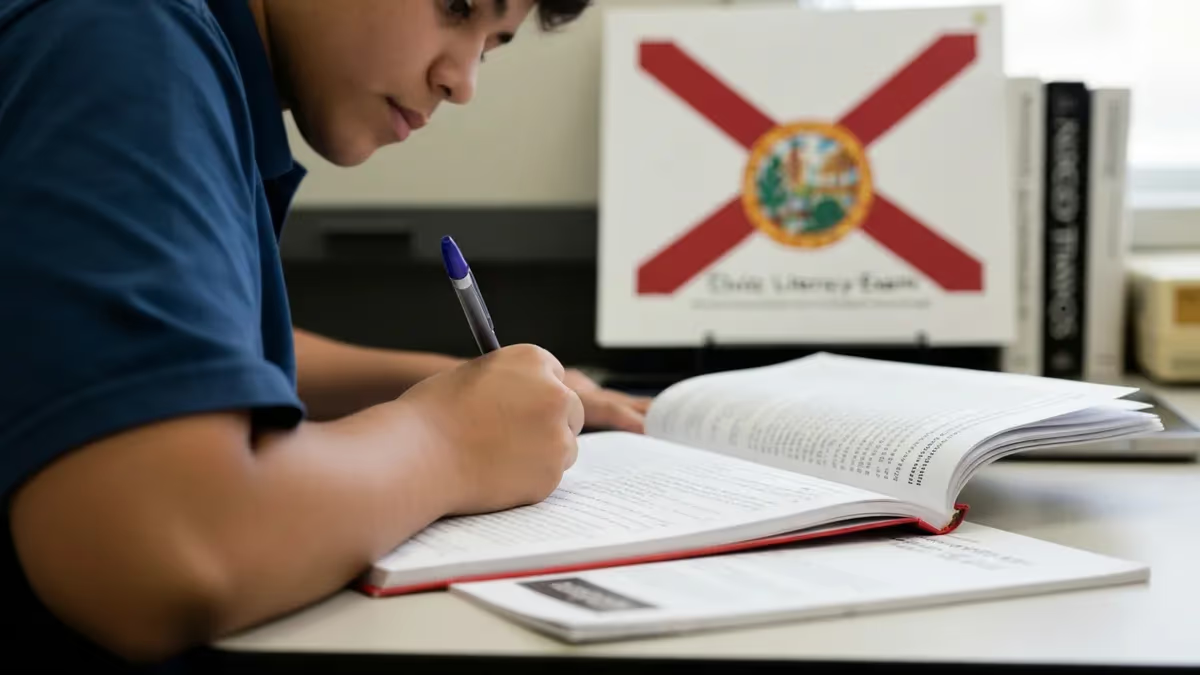
If you are preparing for the Florida Civic Literacy Exam, working through a comprehensive set of florida civic literacy test questions is the single most effective study strategy available. The FCLE is a mandatory graduation requirement for all Florida public university students, and understanding exactly what kinds of questions appear on the exam — and why specific answers are correct — gives you a decisive advantage on test day. This article walks you through the full landscape of FCLE questions and answers, covering every major content domain tested on the official assessment.
The fcle covers a wide range of American civics topics, from the founding documents and constitutional principles to the structure of the federal government, individual rights, and the responsibilities of citizenship. Each of these content areas appears in roughly equal proportion on the exam, so a thorough review of all domains is essential. Students who focus only on memorizing dates and names without understanding the underlying concepts tend to struggle with the application-style questions that make up a significant portion of the test.
One important distinction that many students miss is the difference between recalling facts and applying civic knowledge in context. A question may describe a hypothetical scenario — for example, a citizen being denied the right to vote — and ask you to identify which constitutional amendment or legal protection was violated. These scenario-based items require not just memorization but genuine comprehension of how civic principles operate in practice. Building that deeper understanding through repeated practice is the goal of every section in this guide.
The exam was developed by the Florida Department of Education as part of House Bill 7 and went into effect for all Florida College System and State University System students. The requirement reflects Florida's commitment to ensuring that graduates can identify the foundations of American democracy, explain the role of each branch of government, and articulate what active citizenship looks like in a democratic society. Knowing the legislative background helps you appreciate why certain topics receive heavier emphasis on the test.
Throughout this guide you will find detailed explanations for every major topic category, tips for approaching tricky multiple-choice questions, and a structured study framework you can follow in the weeks before your exam date. We also provide links to our free interactive practice tests so you can apply what you read immediately. Research consistently shows that active recall — testing yourself rather than simply rereading notes — produces stronger long-term retention, which translates directly into better performance on your actual FCLE.
Students who use structured practice resources alongside content review routinely outperform those who rely solely on classroom notes or textbook readings. Our free fcle quizlet-style interactive quizzes replicate the difficulty level and question style of the real exam, giving you an accurate benchmark of your readiness. The combination of understanding the content, practicing the question format, and reviewing your mistakes is the proven path to passing the Florida Civic Literacy Exam on your first attempt.
Whether you are taking the FCLE for the first time or retaking it after an unsuccessful attempt, this guide is designed to meet you where you are. We cover foundational concepts for beginners, offer deeper analysis for students who want to ensure mastery, and provide time-saving tips for anyone who needs to prepare efficiently. By the time you finish reading and working through the linked practice questions, you will have everything you need to approach the Florida Civic Literacy Exam with confidence and clarity.
Florida Civic Literacy Exam by the Numbers
FCLE Exam Format Overview
| Section | Questions | Time | Weight | Notes |
|---|---|---|---|---|
| American Government & Political Institutions | 25 | ~30 min | 25% | Branches of government, federalism, constitutional structure |
| Citizenship Rights & Responsibilities | 25 | ~30 min | 25% | Bill of Rights, voting, civic participation |
| History of the United States | 20 | ~24 min | 20% | Founding era, Civil War, 20th century milestones |
| Civic Literacy & Democratic Principles | 15 | ~18 min | 15% | Rule of law, free press, separation of powers |
| Florida Civics | 15 | ~18 min | 15% | Florida Constitution, state government, local governance |
| Total | 100 | 2 hours | 100% |
Understanding the content domains of the FCLE is the essential first step in building an effective study plan. The exam tests five broad areas of civic knowledge, and each domain requires a somewhat different approach. The American Government and Political Institutions domain, which accounts for roughly a quarter of the exam, focuses heavily on the three branches of the federal government, the system of checks and balances, the role of federalism in dividing power between state and national governments, and the process by which laws are created, signed, and challenged in court.
The Citizenship Rights and Responsibilities domain is equally important and covers the protections enumerated in the Bill of Rights, the expansion of civil rights through subsequent constitutional amendments, the rights and duties of citizens in a democratic society, and the mechanisms through which citizens can participate in government — including voting, running for office, serving on juries, and engaging in peaceful protest. Many students underestimate this domain because the topics feel familiar from high school, but the FCLE asks nuanced questions that go beyond surface-level recognition.
The History of the United States domain tests knowledge of the founding era, including the ideological roots of American democracy in Enlightenment philosophy, the events leading to the Declaration of Independence, and the debates that shaped the Constitutional Convention of 1787. It also covers major subsequent periods including the Civil War and Reconstruction, the Progressive Era, the New Deal, and the civil rights movement of the 1950s and 1960s. Understanding historical context helps you answer questions that connect past events to enduring constitutional principles.
The Civic Literacy and Democratic Principles domain explores the philosophical underpinnings of American democracy — concepts like popular sovereignty, the rule of law, the protection of minority rights within a majoritarian system, freedom of the press as a democratic safeguard, and the importance of civic education itself. Questions in this domain often present scenarios or short passages and ask you to identify which democratic principle is being illustrated or threatened. Strong reading comprehension skills are especially useful here.
Florida Civics rounds out the five domains with questions specifically about the state's governmental structure, the Florida Constitution, the roles of the governor and state legislature, the judicial system at the state level, and the organization of local governments including counties, municipalities, and special districts. Florida students sometimes neglect this domain assuming it will be easier, but the state-specific details — such as the Cabinet structure unique to Florida or the process of constitutional amendments through citizen initiatives — can trip up underprepared test-takers.
For each of these domains, the most effective study strategy combines reading authoritative content with answering practice questions and carefully reviewing every wrong answer. When you miss a question, do not simply note the correct answer — investigate why that answer is correct and why the options you considered were wrong. This deeper analysis builds the conceptual framework that helps you answer novel variations of the same topic. Reviewing the fcle practice test tsc schedule can also help you plan backward from your exam date so each content domain gets adequate attention before test day.
A useful rule of thumb for FCLE preparation is to spend proportional study time on each domain based on its exam weight, but to give extra attention to any domain where your practice test scores are consistently below 70 percent. Targeted weakness remediation is more efficient than studying your strengths. Once you feel confident in a domain, shift your energy toward the areas where additional review will have the greatest impact on your overall score and your chances of passing on the first attempt.
FCLE Practice Test Strategies by Question Type
Fact-recall questions ask you to identify a specific piece of information — a date, a name, a constitutional provision, or a historical event. These are typically the most straightforward items on the florida civic literacy exam practice test, but they reward students who have done systematic content review rather than casual reading. The most reliable strategy is to create flashcards for key facts across all five content domains and review them with spaced repetition in the two to three weeks before your exam.
Common fact-recall topics on the FCLE include the number of senators and representatives in Congress, the age requirements for federal office, the year specific amendments were ratified, the names and roles of Florida's constitutional officers, and the steps in the federal legislative process. Students who consistently miss these questions usually have not reviewed the core content thoroughly enough. Dedicate at least one full study session to memorizing the most commonly tested facts before moving on to application-style questions.
FCLE Practice Tests vs. Textbook-Only Study: Which Works Better?
- +Practice tests replicate real exam conditions, reducing test-day anxiety significantly
- +Immediate feedback on wrong answers accelerates learning and closes knowledge gaps faster
- +Timed practice builds the pacing skills needed to finish 100 questions in 2 hours
- +Repeated exposure to question formats makes you faster and more accurate over time
- +Diagnostic score reports reveal specific weak domains so you can target study sessions
- +Active recall during practice testing produces deeper long-term retention than passive reading
- −Practice tests alone won't teach you content you have never encountered before
- −Low-quality practice questions can mislead you about actual exam difficulty and scope
- −Overconfidence after high practice scores can lead to reduced effort before the real exam
- −Without reviewing wrong answers in depth, repeated testing yields diminishing returns
- −Some students become anxious when practice scores are low, harming motivation to continue
- −Textbooks provide historical narrative and context that multiple-choice questions cannot fully convey
FCLE Study Checklist: 10 Steps to Exam-Ready
- ✓Download and read the official FCLE Blueprint from the Florida Department of Education website
- ✓Take a full-length diagnostic practice test before studying to identify your weakest content domains
- ✓Create a study calendar that allocates proportional time to each of the five FCLE content domains
- ✓Memorize all 27 constitutional amendments with their year of ratification and primary effect
- ✓Review the structure and powers of all three branches of the federal government in detail
- ✓Study the Florida Constitution and identify how it differs structurally from the U.S. Constitution
- ✓Practice at least three full-length timed mock exams under real testing conditions before exam day
- ✓Review every incorrect answer by researching why the correct option is right, not just what it is
- ✓Use flashcards or spaced-repetition apps to reinforce key facts, dates, names, and legal terms
- ✓On the day before the exam, do a light review only — avoid intensive cramming and get adequate sleep
The 60% Passing Threshold Is More Achievable Than It Sounds
You need to answer 60 out of 100 questions correctly to pass the FCLE — that means you can miss up to 40 questions and still pass. Students who know this going in tend to manage their time and anxiety much better during the exam. Focus your energy on the three domains you find easiest, lock in those points, and use the time remaining to work carefully through the harder items.
One of the most common mistakes students make when preparing for the FCLE is treating all five content domains as equally challenging and spending equal time on each regardless of their individual strengths and weaknesses.
A more efficient approach is to use your diagnostic practice test scores to identify the two or three domains where your accuracy is below 65 percent, then front-load your study time on those specific areas. Once you have brought your weakest domains up to a passing threshold, you can return to your strongest areas for a final review rather than continuing to invest disproportionate time there.
Another frequent error is confusing the roles of similar governmental institutions — for instance, mixing up the functions of the Senate and the House of Representatives, or conflating the roles of the Supreme Court, federal appellate courts, and trial courts. The FCLE regularly tests these distinctions because they are foundational to understanding how American government operates.
Make sure you can explain, in your own words, what makes each institution unique and why the Founders designed the system this way. Understanding the intent behind the structure, not just the structure itself, helps you answer nuanced questions that test conceptual understanding rather than rote memorization.
Students also commonly misunderstand the Bill of Rights as a list of rights that the government grants to citizens. In fact, the Bill of Rights enumerates rights that pre-exist government and that the government is prohibited from infringing upon. This distinction is philosophically significant and appears in FCLE questions that ask about the source or nature of constitutional rights.
Similarly, many students confuse the First Amendment's five specific protections — freedom of religion, speech, press, assembly, and petition — with broader but legally distinct concepts like the right to privacy, which is not explicitly mentioned in the Constitution but has been recognized by the Supreme Court through case law.
The Federalist Papers are a surprisingly important source of FCLE questions.
Although the exam does not require deep literary analysis, you should know the three primary authors (Alexander Hamilton, James Madison, and John Jay), the purpose of the collection (to advocate for ratification of the Constitution in New York), and the key arguments made in the most influential essays — particularly Federalist No. 10, which argues that a large republic provides the best protection against the tyranny of factions, and Federalist No. 51, which explains how the system of separation of powers and checks and balances prevents any single branch from accumulating too much power.
Constitutional amendments beyond the Bill of Rights are also tested with some regularity. The Reconstruction Amendments — the 13th, 14th, and 15th — are especially important because they fundamentally transformed the relationship between the federal government and the states, and between the government and individual citizens.
The 14th Amendment in particular is one of the most litigated provisions in constitutional history, and its Equal Protection and Due Process clauses underpin a vast range of civil rights protections that have been recognized over the subsequent century and a half. Know what each Reconstruction Amendment did and why it was necessary in the post-Civil War context.
Florida-specific content trips up many students who were educated outside the state or who focused heavily on federal government in their prior civics coursework. The Florida Constitution is the state's foundational law and has been significantly revised several times, most recently with major revisions in 1968.
Unlike the U.S. Constitution, the Florida Constitution contains a Declaration of Rights that in some areas goes further than the federal Bill of Rights. Florida also has a unique Cabinet structure in which several executive officers are independently elected rather than appointed by the governor, which is a direct contrast to the federal model and a frequent subject of FCLE questions about state-level governance.
Developing strong process of elimination skills will significantly boost your FCLE score even when you are uncertain about the correct answer. On most questions, at least one or two answer choices are clearly implausible — they reference the wrong branch of government, the wrong amendment, or a principle that does not apply to the described situation.
Eliminating these options immediately raises your odds of selecting the correct answer from the remaining choices. Practice this technique on every question during your mock exams so it becomes automatic on test day, when time pressure and stress can cloud your judgment if you have not built these habits in advance.
Florida university students who do not pass the FCLE on their first attempt must wait a specified period before retaking the exam, and some institutions limit the number of attempts available before additional remediation is required. Check your specific institution's retake policy well in advance of your exam date. Failing to pass the FCLE can delay graduation, so treat your first attempt as your best opportunity by preparing thoroughly rather than testing without adequate preparation.
Effective test-day preparation begins well before you sit down in the testing center. In the final week before your FCLE, shift from intensive content learning to consolidation and review. Go back over your flashcards, revisit any topic areas where you still feel uncertain, and take one final full-length practice test no later than three days before the real exam.
This final practice run serves two purposes: it gives you an up-to-date snapshot of your readiness, and it familiarizes you with the physical and mental experience of working through 100 questions in two hours so that the real exam feels familiar rather than daunting.
Time management during the actual exam is one of the factors students most consistently underestimate. Two hours for 100 questions gives you an average of 72 seconds per question — which sounds comfortable until you encounter a passage-based question with a lengthy excerpt or a complex scenario that requires careful analysis.
The safest strategy is to move at a steady pace through the entire exam on your first pass, answering every question you can confidently address and flagging any question that requires more thought. Once you have worked through all 100 items, return to the flagged questions with whatever time remains and give them your full attention.
Do not leave any question blank. The FCLE does not penalize wrong answers, so a guess is always better than an empty response. If you are completely uncertain, use process of elimination to narrow your options and then commit to your best guess.
Students often leave questions blank because they plan to return to them but then run out of time — by answering every question on your first pass, even if only with a tentative guess, you ensure that every item has at least a chance of being scored correctly. You can always change your answer when you return if additional reflection leads you to a different conclusion.
The night before your exam, review only light material — a quick scan of your flashcards or a brief review of key constitutional provisions is appropriate, but avoid attempting a full practice test or trying to cram new content. Sleep is essential for cognitive performance, memory consolidation, and emotional regulation under stress.
Students who sacrifice sleep for last-minute studying consistently perform below their practice test levels on the actual exam. Treat the night before your FCLE as a recovery and preparation night: get to bed at a reasonable hour, set a reliable alarm, and lay out everything you need for the morning so that logistical stress does not compound the natural anxiety of test day.
On the morning of the exam, eat a balanced meal that includes protein and complex carbohydrates — these provide sustained mental energy without the blood sugar crash that can follow a high-sugar breakfast. Arrive at the testing center early enough to check in without rushing. Bring any required identification documents as specified by your institution or the testing provider. If you are taking the exam through the Testing Services Center at a Florida State University System school, review the florida civic literacy exam quizlet resources one final time as a warm-up during the waiting period before you are seated.
During the exam, manage your anxiety by focusing on one question at a time rather than thinking about your overall score or how many questions remain. Read each question stem carefully before looking at the answer choices — many errors occur because students misread a key word like "not" or "except" that reverses what the question is actually asking.
When you have identified the correct answer, commit to it and move forward rather than second-guessing yourself repeatedly. Research on multiple-choice testing shows that first instincts are correct more often than not, and excessive deliberation frequently leads to changing a correct answer to an incorrect one.
After your exam, whether you passed or are planning a retake, take time to reflect on your preparation process. If you passed, note which study strategies were most effective so you can apply them to future academic challenges. If you need to retake the exam, request your score report if available and use it to identify the specific domains where you lost the most points.
A targeted retake preparation plan focused on your weakest areas is far more efficient than starting over with a general review of all content. Every attempt at the Florida Civic Literacy Exam is an opportunity to deepen your understanding of the democratic principles that the exam is designed to assess.
Building a sustainable daily study routine in the weeks leading up to your FCLE will produce far better results than irregular marathon sessions. Research in cognitive science consistently shows that distributed practice — studying for shorter periods across many days — produces stronger and more durable memory than massed practice compressed into a few intense sessions.
A practical schedule for most students is 45 to 60 minutes of focused FCLE study per day, six days per week, for four to six weeks before the exam. This totals between 18 and 36 hours of preparation, which is sufficient for most students to achieve a comfortable passing score.
Within each daily study session, vary your activities to maintain engagement and maximize learning. A productive 45-minute session might begin with 10 minutes of flashcard review for key facts and vocabulary, followed by 20 minutes of content reading or video watching on a specific topic, and conclude with 15 minutes of answering practice questions on that same topic and reviewing the explanations for any items you missed. This interleaving of encoding and retrieval within a single session is one of the most effective learning strategies supported by educational research.
Group study can be a valuable supplement to individual preparation if conducted effectively. Rather than simply talking about the material, productive group sessions involve quizzing each other, explaining concepts aloud, debating answer choices on difficult practice questions, and collectively resolving points of confusion. Teaching a concept to a peer is one of the strongest indicators that you truly understand it — if you cannot explain the difference between the enumerated and implied powers of Congress in plain language, that is a signal to review the topic more carefully before your exam.
Online resources for FCLE preparation vary widely in quality. Official resources from the Florida Department of Education, including the official exam blueprint, provide the most authoritative guidance on what content is tested and in what proportion. High-quality practice test platforms like PracticeTestGeeks offer questions that closely match the actual exam in both content and difficulty, with detailed explanations that help you understand not just what the right answer is but why it is right. Be cautious with resources that do not cite official sources for their content, as inaccurate or outdated information can lead you to study incorrect material.
Vocabulary is a surprisingly important preparation area that many students overlook. The FCLE uses precise constitutional and political science terminology throughout its questions, and misunderstanding a key term can cause you to miss questions you otherwise would have answered correctly. Make sure you can define and distinguish terms like sovereignty, federalism, bicameralism, judicial review, due process, equal protection, civil liberties, civil rights, enumerated powers, reserved powers, concurrent powers, and the various types of jurisdiction exercised by federal and state courts. These terms appear throughout the exam and serve as anchors for understanding more complex questions.
Primary source documents are another area of emphasis worth deliberate preparation. The exam draws on language and concepts from the Declaration of Independence, the Preamble and key articles of the U.S. Constitution, the Bill of Rights, and selected constitutional amendments. Reading these documents in their original language — not just summaries of them — gives you direct familiarity with the vocabulary and reasoning that the exam references. The Florida Civic Literacy Exam is ultimately an assessment of whether you can engage with the actual texts of American democracy, not just the secondhand descriptions of them found in textbooks.
Finally, remember that the FCLE is not designed to trick you or to test arcane knowledge available only to professional political scientists. It is an assessment of civic literacy — the kind of foundational knowledge that every college graduate should have about the government under which they live.
Approach the exam with that perspective: you are not trying to master constitutional law at the level of a law school student, but rather to demonstrate that you understand the basic structure of American democracy, the rights you hold as a citizen, and the responsibilities that come with living in a self-governing society. That framing can help reduce anxiety and give you confidence as you complete your preparation.
FCLE Questions and Answers
FCLE Practice Test PDF (Free Printable 2026)

When Is the Florida Civic Literacy Exam? Complete FCLE Guide 2026
FCLE Practice Test TSC: Free Florida Civic Literacy Exam Questions
FCLE Practice Test: Florida Civic Literacy Exam Free Prep 2026

How Long Is the FCLE? Complete Florida Civic Literacy Exam Guide 2026
About the Author

Educational Psychologist & Academic Test Preparation Expert
Columbia University Teachers CollegeDr. Lisa Patel holds a Doctorate in Education from Columbia University Teachers College and has spent 17 years researching standardized test design and academic assessment. She has developed preparation programs for SAT, ACT, GRE, LSAT, UCAT, and numerous professional licensing exams, helping students of all backgrounds achieve their target scores.
Join the Discussion
Connect with other students preparing for this exam. Share tips, ask questions, and get advice from people who have been there.
View discussion (7 replies)