
How Long Is the FCLE? Complete Florida Civic Literacy Exam Guide 2026 September
How long is the FCLE? 🎓 Learn the exam length, format, time limits & top study tips for the Florida Civic Literacy Exam in 2026 September.
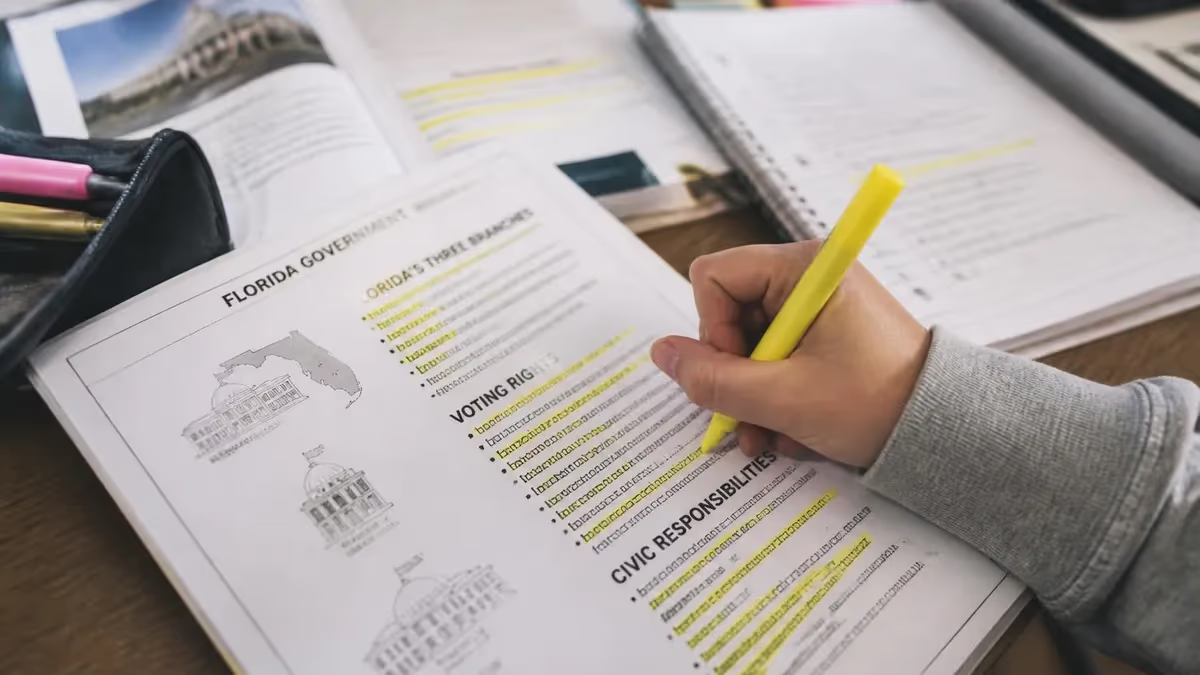
If you are preparing for the fcle, one of the first questions on your mind is almost certainly: how long is the FCLE? The Florida Civic Literacy Exam consists of 60 multiple-choice questions, and test-takers are given 60 minutes to complete the entire exam. That works out to an average of exactly one minute per question, which sounds manageable but can feel intense once you factor in careful reading of answer choices and reviewing flagged items. Knowing this upfront lets you build a realistic pacing strategy from day one of your preparation.
The FCLE — formally known as the Florida Civic Literacy Exam — was introduced by the Florida Legislature under Senate Bill 1108 to ensure that college students demonstrate a baseline understanding of American government, history, and civic principles before graduating. All students enrolled in Florida public colleges and universities are required to pass the exam or complete an approved civic literacy course. Because the exam directly affects graduation eligibility, treating it seriously from the start is essential rather than optional.
Many students underestimate the exam because 60 questions in 60 minutes sounds straightforward. However, the content spans a remarkably broad range of topics — from the foundational documents of American democracy like the Declaration of Independence and the U.S. Constitution, to the structure of federal, state, and local government, to the rights and responsibilities of citizens. Answering questions accurately within the time limit requires both content knowledge and strong test-taking discipline, especially under the pressure of knowing a passing score is required for graduation.
One of the most effective ways to build confidence about the exam format and timing is to take an fcle practice test under realistic conditions. Timed practice sessions help you identify whether you naturally work too slowly, too quickly, or right on pace. They also surface which content domains — American government, citizenship rights, civic principles — need extra attention before test day. Students who practice with real timing constraints consistently perform better than those who review content alone without simulating the actual test experience.
The FCLE is administered through the college or university's testing center, and most institutions follow guidelines issued by the Florida Department of Education. It is a computer-based exam, meaning you will be reading passages and selecting answers on screen rather than bubbling a paper answer sheet. Familiarity with digital test-taking — scrolling through questions, flagging items for review, navigating the exam interface — can save precious seconds on test day and reduce anxiety caused by unfamiliar software.
Understanding the exam's time structure also helps you plan your study schedule more precisely. With 60 questions covering multiple content areas, you need to allocate study time proportionately to each domain's representation on the exam. Domains that carry more questions deserve more preparation hours. This article breaks down every important detail about the FCLE — its format, content areas, timing, difficulty, preparation strategies, and the most effective resources — so you walk into the testing center fully informed and genuinely ready to succeed.
Whether you are a first-generation college student, a transfer student navigating a new institution's requirements, or a non-traditional learner returning to complete your degree, this comprehensive guide gives you the exact framework you need. Read every section carefully, use the study tools provided, and commit to consistent practice over several weeks. Students who approach the FCLE with a structured preparation plan pass at significantly higher rates than those who cram the night before — and passing on your first attempt saves both time and stress.
FCLE by the Numbers
FCLE Exam Format & Structure
| Section | Questions | Time | Weight | Notes |
|---|---|---|---|---|
| American History & Founding Documents | 20 | ~20 min | 33% | Constitution, Declaration, Federalist Papers |
| American Government & Political Institutions | 22 | ~22 min | 37% | Branches, checks & balances, elections |
| Citizenship Rights & Responsibilities | 18 | ~18 min | 30% | Civil rights, civic participation, amendments |
| Total | 60 | 60 minutes | 100% |
The content covered on the Florida Civic Literacy Exam spans three broad domains, each requiring distinct knowledge and analytical skills. The first domain — American History and Founding Documents — tests your understanding of the historical context that shaped the United States government. You will encounter questions about the Declaration of Independence, the Articles of Confederation, the U.S. Constitution, and landmark documents like the Federalist Papers. Understanding why these documents were created, what problems they solved, and how they continue to influence American law is essential for this section.
The second domain — American Government and Political Institutions — is the largest section of the exam, accounting for roughly 37 percent of the total questions. This area tests knowledge of all three branches of the federal government: the legislative branch (Congress, its structure, and how laws are made), the executive branch (the presidency, Cabinet, and federal agencies), and the judicial branch (the Supreme Court, judicial review, and landmark court decisions). You also need to understand how these branches check and balance one another and how the federal system relates to state and local governments.
The third domain — Citizenship Rights and Responsibilities — covers the rights guaranteed to American citizens by the Constitution and its amendments, as well as the civic duties that come with citizenship. Key topics include the Bill of Rights, subsequent constitutional amendments, voting rights, due process, equal protection under the law, and the processes through which citizens can participate in government. This section often surprises students because it goes beyond mere memorization of rights and asks analytical questions about how those rights apply in specific real-world scenarios.
Across all three domains, the exam uses application-level questions alongside recall questions. You cannot simply memorize a list of facts; you must also be able to apply concepts. For example, a question might describe a hypothetical government action and ask which constitutional principle it violates. These scenario-based questions reward students who truly understand the underlying concepts rather than those who have only memorized surface-level information. This is why using a fcle practice test tsc that mirrors the real exam's question style is so valuable during preparation.
Time management across the three domains is critical. With an average of one minute per question, you do not have room to spend three or four minutes on a single difficult item. A practical approach is to read each question carefully, eliminate obviously wrong answers immediately, and then select from the remaining choices. If you are genuinely uncertain, flag the question and move on. The computer-based interface typically allows you to return to flagged questions before submitting, so you can spend any remaining time revisiting the ones you skipped rather than getting stuck mid-exam.
Students who struggle most often report that the government and institutions section — particularly questions about congressional procedures, the amendment process, and Supreme Court powers — requires the deepest study. The history section tends to feel more accessible because many students have some prior exposure to American history from high school. The citizenship rights section falls in the middle in terms of difficulty, but its scenario-based questions can be deceptive if you only memorized rights without understanding their practical application. Prioritize your weakest domain during study sessions and use timed practice quizzes to confirm your improvement before test day.
It is also worth noting that the FCLE does not penalize for wrong answers — there is no negative marking. This means that if you are running out of time with questions remaining, you should always make a reasonable guess rather than leaving items blank. Process of elimination is your best friend in that situation: even removing one or two clearly wrong answer choices significantly improves your odds of selecting the correct response. Never submit the exam with unanswered questions, as a blank response is always worth zero points while an educated guess gives you a real chance at credit.
FCLE Practice Test Study Strategies
Taking a full timed florida civic literacy exam practice test is one of the single most effective preparation methods available. Set a timer for exactly 60 minutes, attempt all 60 questions without pausing, and then review every answer — both correct and incorrect — afterward. This dual process builds pacing instinct and reveals content gaps simultaneously, giving you actionable data about where to focus your next study session rather than just a vague sense of how prepared you feel.
After each timed session, calculate your per-domain accuracy: how many history questions did you get right versus government versus citizenship? If your government accuracy is 60% but history is 85%, your next study block should be heavily government-focused. Repeating this diagnostic loop every week means your study time is always targeted at your weakest areas, which is far more efficient than reviewing material you already know well. Aim for at least three full timed practice tests before your scheduled exam date.

Is the FCLE Hard to Pass? Pros and Cons of the Exam Design
- +Only 60 questions with a 60-minute time limit — straightforward pacing at one minute per question
- +No penalty for wrong answers — always guess rather than leave blank
- +Multiple free practice resources available from Florida colleges and test prep sites
- +Focused content scope — three clearly defined domains make targeted studying highly effective
- +Computer-based format allows flagging questions for later review within the session
- +Passing score of approximately 60% is achievable with structured four-to-six week preparation
- −Required for graduation at Florida public colleges — high stakes add real pressure
- −Application-level questions test understanding, not just memorization, requiring deeper study
- −60 minutes is tight for students who read slowly or second-guess answers frequently
- −Content spans centuries of American history requiring broad background knowledge
- −Students unfamiliar with computer-based testing may lose time navigating the interface
- −Retake waiting periods vary by institution, so failing delays graduation plans significantly
FCLE Exam Day Readiness Checklist
- ✓Confirm your exam date, time, and testing center location with your institution's registrar at least one week in advance
- ✓Bring a valid government-issued photo ID — most testing centers will not admit you without acceptable identification
- ✓Arrive at the testing center at least 15 minutes early to complete check-in without rushing
- ✓Review the three content domains — American History, Government, and Citizenship — the evening before your exam
- ✓Avoid cramming new material the morning of your exam; use that time for light review of your outline notes only
- ✓Practice the exact pacing strategy: spend no more than 60 seconds per question; flag uncertain items and move on
- ✓Complete at least one full timed practice test under realistic conditions within three days of your exam
- ✓Familiarize yourself with the computer-based testing interface so navigation does not slow you down on test day
- ✓Answer every question before submitting — never leave blanks since wrong answers and blanks both score zero
- ✓Get a full night of sleep before the exam — cognitive performance drops measurably with sleep deprivation
Students Who Take 3+ Practice Tests Pass at a Much Higher Rate
Research on standardized exam preparation consistently shows that students who complete three or more full-length timed practice tests before their actual exam outperform those who only review content. Practice testing builds pacing instinct, reduces test anxiety through familiarity, and provides actionable diagnostic data. Commit to at least three timed sessions spread across your preparation period — not crammed into the final 48 hours — for the best outcome on the Florida Civic Literacy Exam.
Understanding how the FCLE is scored and what constitutes a passing result is just as important as understanding what it covers. The exam uses a scaled scoring system, and the Florida Department of Education has set the passing standard at a score of 60 out of 100 on the scaled score, which corresponds roughly to answering 36 or more of the 60 questions correctly. This means you have a margin of about 24 wrong answers — but relying on that margin as a safety net rather than a performance floor is a risky strategy that many students regret.
The scaling process means that the number of raw correct answers needed to achieve a scaled score of 60 can vary slightly from one exam form to another, depending on the difficulty calibration of that particular version. Exam forms are equated so that a scaled score of 60 on one version represents the same level of knowledge as a scaled score of 60 on another.
In practice, this means you should target a raw score of at least 40 correct out of 60 during your practice tests to give yourself a comfortable buffer, accounting for the possibility that your actual exam version might be slightly harder than the practice materials you used.
Results are typically reported to your institution within a few business days of completing the exam. Your score report will indicate whether you passed or did not meet the standard, and many institutions also provide domain-level feedback showing how you performed in each of the three content areas. If you did not pass, this domain breakdown is invaluable for planning your retake preparation — it tells you precisely where your knowledge gaps are so you can study more efficiently the second time rather than reviewing everything equally.
Students who do not pass the FCLE on their first attempt are not automatically barred from graduation, but they do face additional requirements. Most Florida institutions require students who fail to either retake and pass the exam or complete an approved civic literacy course before their degree is conferred. The waiting period between retakes varies by institution — some allow an immediate retake, while others require a minimum waiting period of 30 days or one academic semester. Check with your specific institution's testing office for the exact retake policy that applies to you.
The first-time pass rate for the FCLE has varied since the exam was introduced, with some reporting suggesting pass rates in the range of 55 to 65 percent depending on the institution and the preparation support provided to students. This means that roughly one in three to one in two first-time test-takers does not pass — a much higher failure rate than many students expect going in. Treating this exam as a significant academic challenge requiring genuine preparation is not an overreaction; the statistics clearly support taking it seriously.
Some students wonder whether taking the civic literacy course as an alternative is a better strategy than attempting the exam. The course option is valid and can fulfill the graduation requirement, but it typically requires a full semester of enrollment, attendance, assignments, and a passing grade — a much larger time commitment than preparing for and passing a 60-question, 60-minute exam. For students who are close to graduation and want the fastest path to fulfilling the requirement, a focused four-to-six week exam preparation plan is almost always more efficient than adding a full course to an already packed schedule.
Your institution may also offer institutional support resources such as tutoring, study groups, or prep workshops specifically designed to help students pass the FCLE. These resources are often underutilized because students are unaware they exist or underestimate the challenge until it is too late to use them effectively. Contact your college's academic success center, tutoring center, or library resource office early in your preparation to learn what institutional support is available. Combining institutional resources with self-directed practice using quality online materials creates the most comprehensive preparation approach available to you.
Each Florida public college and university sets its own FCLE retake waiting period and procedure. Some institutions allow immediate retakes while others require 30 days or a full semester between attempts. Do not assume you can retake the exam on short notice — contact your institution's testing center as soon as possible if you are concerned about your timeline. Failing to plan for retake logistics has delayed graduation for students who were otherwise academically ready to finish their degree.
Among the most common mistakes students make when preparing for the Florida Civic Literacy Exam is focusing almost exclusively on content review while neglecting timed practice. Content knowledge is necessary but not sufficient — you also need to demonstrate that knowledge within the 60-minute time constraint. Students who have a thorough understanding of American government but have never practiced under exam-like time pressure frequently run out of time or rush through the final questions carelessly. The exam rewards prepared pacing as much as it rewards content knowledge.
A related mistake is studying only from secondary summaries — textbooks, Wikipedia articles, or condensed review sheets — without ever engaging with primary source documents. The FCLE frequently quotes language directly from the Constitution, the Declaration of Independence, the Federalist Papers, and landmark Supreme Court decisions. Students who have read these documents in their original language are better equipped to answer passage-based questions accurately. If a question quotes Article II of the Constitution and asks what power it grants, recognizing that language from prior reading is much faster than trying to reason it out from scratch under time pressure.
Another common pitfall is treating all three content domains as equally familiar. Most students overestimate their knowledge of the government and institutions domain because they feel generally familiar with concepts like Congress and the President. However, the exam tests specific procedural knowledge — how a conference committee works, what it means for a bill to be pocket vetoed, how electoral votes are distributed — that most students have not reviewed since a high school civics class. Honest self-assessment through diagnostic practice tests is the only reliable way to identify where your actual knowledge gaps are.
Students sometimes also make the mistake of using only one preparation resource. Relying solely on flashcard decks or solely on a single practice test bank limits your exposure to the variety of question formats and content angles the real exam may use. Combining timed full-length practice tests with targeted content review, primary source reading, and short flashcard sessions creates a multi-modal preparation approach that builds both breadth of knowledge and depth of understanding. Variety in study methods also reduces the fatigue and boredom that come from doing the same activity every single day.
Procrastination is perhaps the single largest factor in FCLE failure. Students who begin preparation two or three weeks before their exam date consistently perform worse than those who start five to eight weeks out. Spaced learning — distributing study sessions over a longer period — is dramatically more effective for retention than massed practice crammed into a short window.
If you have a scheduled exam date on your calendar, count backward at least five weeks and mark that as your preparation start date. Use the first week for assessment and planning, the middle weeks for intensive content and practice, and the final week for review and rest.
Managing test anxiety is also a practical preparation skill that many students overlook. The FCLE carries real stakes — your graduation depends on passing — and that pressure can cause anxiety that impairs performance even in well-prepared students.
Strategies like completing multiple timed practice tests to build familiarity with the exam environment, practicing slow breathing techniques before and during the exam, and reframing difficult questions as puzzles to solve rather than threats to your status all reduce anxiety's impact on performance. Arrive at the testing center early so you are not rushed, and give yourself a few minutes of calm before the exam begins.
Finally, remember that seeking help is a strength, not a weakness. If after several weeks of self-directed preparation you are still not consistently scoring at or above passing on practice tests, reach out to your institution's academic support services, a private tutor, or a structured prep course.
Many students who struggled with the material on their own passed comfortably after getting targeted help from an experienced instructor. The FCLE is a passable exam with the right preparation and support — the goal is simply to make sure you walk in on test day with the knowledge, the pacing, and the confidence you have genuinely earned through consistent, structured work.
Building an effective study schedule for the FCLE does not require massive daily time investments — it requires consistency and smart prioritization. A realistic and proven approach is to dedicate 45 to 60 minutes of focused study per day for five to six weeks before your exam date. This totals roughly 20 to 25 hours of preparation, which is sufficient for most students to move from uncertain to confident, provided those hours are spent on the right activities in the right sequence. The schedule below outlines how to distribute those hours across your preparation period.
In weeks one and two, focus on diagnostic assessment and foundational content review. Take a full untimed practice test to establish your baseline, then score it by domain. Read the primary source documents — Declaration, Constitution, Bill of Rights — at least once each. Create a simple outline of the three branches of government and their key powers. Your goal in this phase is not mastery but orientation: understanding the landscape of the exam and identifying where your biggest gaps are so you can allocate the remaining weeks intelligently.
In weeks three and four, shift to intensive targeted study on your weakest domains. If government and institutions is your lowest-scoring area, spend the majority of your daily study time there — reading about congressional procedures, the amendment process, the electoral college, and landmark Supreme Court cases. Use flashcard review for specific facts and dates. Take one or two additional timed practice tests during this phase, scoring yourself by domain each time to track your improvement. This feedback loop keeps your effort pointed at what matters most.
In week five, transition to consolidation and confidence-building. Take at least two full timed practice tests under realistic conditions — no pausing, no checking notes, strict 60-minute limit. Review every wrong answer in detail, not just to learn the correct answer but to understand why your chosen answer was wrong. This distinction between understanding correct answers and understanding your errors is crucial. Common errors often reveal a misunderstanding of a broader concept, and fixing the concept is far more valuable than memorizing the single correct answer for that one question.
In the final week before your exam, reduce the intensity of new learning and shift toward active review and rest. Revisit your outline notes, flip through your flashcard decks focusing on the difficult cards, and read through your wrong-answer notes from prior practice tests. Do not attempt to learn large amounts of new material in the final 72 hours — at this stage, consolidating what you already know is more valuable than adding new information that may not be retained under exam pressure. Get adequate sleep every night, especially the two nights before your exam.
On the day of your exam, eat a nutritious meal beforehand, arrive early, and bring your ID. When the exam begins, read each question fully before reading the answer choices — many students misread questions by rushing to the answers before they have absorbed what is being asked.
Use process of elimination aggressively: for any question you are unsure about, cross out answers that are obviously wrong first, then choose the best remaining option. If you have flagged questions and finish with time remaining, return to them calmly rather than second-guessing correct answers — research consistently shows that first instincts on multiple-choice exams are correct more often than changes made under uncertainty.
After your exam, regardless of how you feel about your performance in the moment, give yourself credit for doing the preparation. Exam stress often makes students feel they performed worse than they actually did — the questions you remember struggling with stand out more vividly than the many you answered confidently. Wait for your official score report before drawing conclusions, and if you need to retake, treat it as additional data rather than a failure: you now know exactly what the exam experience feels like and exactly which content areas to strengthen before attempt two.
FCLE Questions and Answers

About the Author

Educational Psychologist & Academic Test Preparation Expert
Columbia University Teachers CollegeDr. Lisa Patel holds a Doctorate in Education from Columbia University Teachers College and has spent 17 years researching standardized test design and academic assessment. She has developed preparation programs for SAT, ACT, GRE, LSAT, UCAT, and numerous professional licensing exams, helping students of all backgrounds achieve their target scores.
Join the Discussion
Connect with other students preparing for this exam. Share tips, ask questions, and get advice from people who have been there.
View discussion (7 replies)