
FCLE Court Cases: Key Landmark Decisions You Must Know for the Florida Civic Literacy Exam
Master FCLE court cases with our study guide. Learn landmark Supreme Court decisions tested on the Florida Civic Literacy Exam. 🏆 Free practice included.
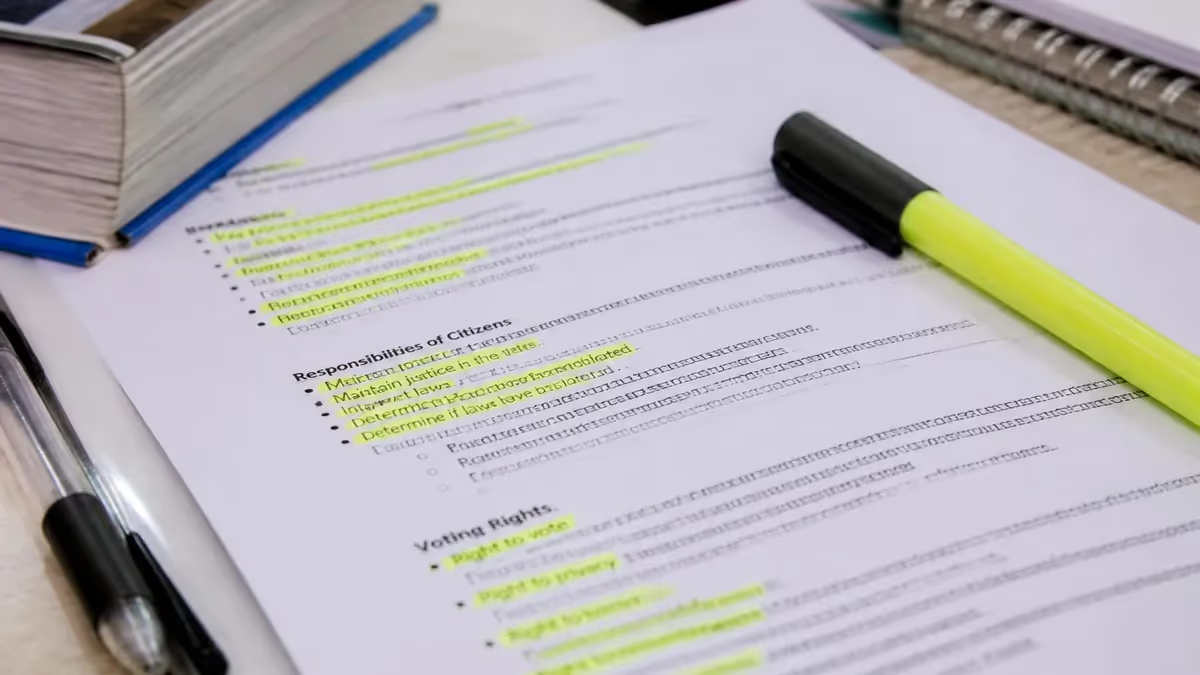
If you are preparing for the fcle practice test, understanding landmark court cases is one of the most rewarding investments you can make. The Florida Civic Literacy Exam (FCLE) consistently tests students on Supreme Court decisions that shaped American democracy, civil rights, and the balance of governmental power. These cases are not obscure legal trivia — they are the foundational rulings that define how the Constitution functions in everyday life, from free speech in public schools to the rights of the accused in criminal proceedings.
The FCLE court cases portion of the exam covers decisions spanning nearly two centuries of American jurisprudence. Students frequently underestimate how many questions touch on judicial interpretation, constitutional amendments, and the evolving relationship between federal and state authority. On any given exam administration, you can expect between 15 and 25 questions that directly reference or implicitly require knowledge of major Supreme Court rulings. That means court cases alone can account for up to 15 percent of your total score on the florida civic literacy exam.
Many students preparing for the FCLE make the mistake of memorizing case names without understanding the underlying constitutional principles. For example, simply knowing that Marbury v. Madison established judicial review is not enough — you need to understand why Chief Justice John Marshall's 1803 ruling fundamentally altered the relationship between the three branches of government, and why that principle remains the cornerstone of American constitutional law more than two centuries later. Depth of understanding translates directly into higher scores on the actual exam.
The good news is that the FCLE tests a manageable list of landmark decisions. Unlike a law school entrance exam or a bar review course, the florida civic literacy exam focuses on approximately 20 to 30 cases that every civically literate American should know. These cases cluster around themes: judicial review and federal supremacy, civil liberties and the Bill of Rights, civil rights and equal protection, and the separation of powers. Organizing your study around these themes — rather than memorizing cases in chronological order — dramatically improves both retention and test performance.
This guide walks you through every major FCLE court case category, explains the constitutional principles at stake, provides the context you need to answer tricky multiple-choice questions, and offers practical strategies for remembering which case stands for which principle. Whether you are taking the FCLE as a Florida public university student or as part of a teacher certification requirement, mastering these court cases will give you a measurable advantage on exam day. The practice questions and study techniques outlined below are drawn directly from the official FCLE content specifications published by the Florida Department of Education.
One important note before diving in: the FCLE is not merely a test of factual recall. Questions are often written to test your ability to apply constitutional principles to new scenarios. You might be shown a hypothetical situation — a school principal banning political armbands, or a state legislature passing a law that conflicts with a federal statute — and asked which landmark case most directly governs the outcome.
This application-level reasoning is exactly what separates students who score in the 80s from those who barely pass. The court cases in this guide are explained with that application focus in mind.
Finally, remember that consistent practice is the key to FCLE success. Reading through this guide once is a strong start, but pairing your content review with timed practice questions will lock in the material far more effectively than passive reading alone. By the time you finish this article, you will have a clear roadmap for every major court case on the FCLE, a study schedule to follow, and direct links to free practice resources that mirror the actual exam format.
FCLE Court Cases by the Numbers
FCLE Exam Format & Court Case Coverage
| Section | Questions | Time | Weight | Notes |
|---|---|---|---|---|
| American History & Constitutional Foundations | 30 | Open | 30% | Includes founding-era court decisions |
| American Government & Political Institutions | 35 | Open | 35% | Heavy court case content — separation of powers, judicial review |
| Civic Literacy & Citizenship Rights | 35 | Open | 35% | Civil liberties, civil rights, landmark SCOTUS rulings |
| Total | 100 | Not timed (untimed exam) | 100% |
The foundation of FCLE court case knowledge begins with judicial review and federal supremacy — the twin doctrines that define how American constitutional law actually works. Marbury v. Madison (1803) is the single most important case on the entire exam.
When outgoing President John Adams appointed William Marbury as a justice of the peace but Secretary of State James Madison refused to deliver the commission, Marbury sued. Chief Justice John Marshall's opinion established that the Supreme Court has the authority to strike down laws that violate the Constitution — a power not explicitly granted by the document itself, but logically derived from it.
McCulloch v. Maryland (1819) extended federal supremacy in a different direction. When Maryland attempted to tax the federally chartered Bank of the United States, Chief Justice Marshall ruled that states cannot tax federal institutions. More importantly, the case established the doctrine of implied powers — the idea that Congress can exercise powers not explicitly listed in the Constitution as long as those powers are reasonably connected to its enumerated duties. The phrase "necessary and proper" took on enormous constitutional significance after this ruling, expanding the scope of federal legislative authority in ways the Framers may not have fully anticipated.
Gibbons v. Ogden (1824) settled a dispute over steamboat navigation rights between New York and New Jersey by ruling that Congress has broad authority to regulate interstate commerce. This case planted the seed for what would eventually become the Commerce Clause's enormous reach in the twentieth century, justifying federal regulation of everything from labor standards to civil rights. For the FCLE, the key takeaway is that Gibbons established Congress as the primary regulator of economic activity crossing state lines, defeating state attempts to create local monopolies that interfered with interstate trade.
The Supremacy Clause cases are closely related to federal preemption doctrine, which the FCLE also tests. When a valid federal law conflicts with a state law, the federal law wins — period. This principle, rooted in Article VI of the Constitution, was reinforced in case after case throughout the nineteenth and twentieth centuries. Students often confuse federal supremacy with the complete elimination of state authority, but that is not the rule. States retain broad police powers to regulate health, safety, and morals, as long as those regulations do not conflict with valid federal statutes or constitutional provisions.
Dred Scott v. Sandford (1857) represents a cautionary landmark — a case where the Supreme Court got it catastrophically wrong. Chief Justice Roger Taney's ruling that enslaved people were property and not citizens, and that Congress lacked authority to prohibit slavery in the territories, inflamed sectional tensions and contributed directly to the outbreak of the Civil War. The decision was effectively overturned by the Thirteenth and Fourteenth Amendments. For the FCLE, Dred Scott is important as an example of how judicial decisions can have profound historical consequences and how constitutional amendments can correct judicial errors.
For students using an fcle study guide, the judicial review and federal supremacy cases deserve at least two full study sessions. Practice explaining each case in your own words without looking at your notes — if you cannot articulate the constitutional principle in one or two sentences, you have not yet internalized it. The FCLE frequently uses answer choices that are almost correct, distinguishing between cases that established similar but distinct principles. Knowing the precise holding of each case — not just the general theme — is what will protect you from those tricky distractors.
One effective technique is to create a simple two-column chart: on the left, write the case name and year; on the right, write the single constitutional principle it established. Keep the principle statement to one sentence. Then practice covering the right column and stating the principle from memory. This flashcard-style approach works particularly well for the judicial review cases because the holdings are clear, precise, and frequently tested in almost exactly the same language used in the official FCLE content specifications.
Florida Civic Literacy Exam: Civil Liberties Cases by Category
The First Amendment generates more FCLE questions than any other constitutional provision. Schenck v. United States (1919) introduced the "clear and present danger" test for speech that could be restricted during wartime. Tinker v. Des Moines (1969) established that students do not shed their constitutional rights at the schoolhouse gate, protecting symbolic political speech like anti-war armbands. New York Times v. Sullivan (1964) set a high bar for public officials to win defamation suits, protecting robust debate about government conduct. Each of these cases illustrates the tension between free expression and legitimate government interests in order and reputation.
Brandenburg v. Ohio (1969) replaced the clear and present danger test with a stricter standard: speech can only be restricted if it is directed to inciting imminent lawless action and is likely to produce such action. Engel v. Vitale (1962) struck down school-sponsored prayer, applying the Establishment Clause to public education for the first time. West Virginia v. Barnette (1943) ruled that students cannot be compelled to salute the flag, protecting free expression rights against mandatory patriotic exercises. Understanding the distinction between government-sponsored religious activity (unconstitutional) and private religious expression (protected) is essential for the FCLE.
Studying FCLE Court Cases: Thematic vs. Chronological Approach
- +Grouping cases by constitutional theme mirrors the FCLE question structure
- +Understanding principles helps you answer application questions, not just recall questions
- +Thematic study reveals connections between cases that share constitutional roots
- +Easier to remember 5-6 themes than 30 individual case facts in isolation
- +Mirrors how attorneys and law students actually learn constitutional law
- +Prepares you for trick questions that test whether you know which case is which
- −Chronological study helps you understand how constitutional interpretation evolved over time
- −Some FCLE questions ask about historical context, which thematic study can miss
- −Risk of conflating cases within the same theme if distinctions are not carefully studied
- −Thematic groupings can obscure the fact that some cases span multiple constitutional provisions
- −Less effective for students who are strong visual or timeline-based learners
- −May require additional review to master the specific dates and historical context of each ruling
FCLE Court Cases Study Checklist: 10 Steps to Exam Readiness
- ✓Memorize the constitutional principle established by Marbury v. Madison (1803) — judicial review.
- ✓Explain in your own words why McCulloch v. Maryland expanded federal implied powers.
- ✓Know the difference between the Schenck 'clear and present danger' test and the Brandenburg standard.
- ✓Identify which amendment each major civil liberties case interprets: Mapp (4th), Miranda (5th), Gideon (6th).
- ✓Understand why Plessy v. Ferguson was wrong and exactly how Brown v. Board corrected it.
- ✓Practice applying Tinker v. Des Moines to hypothetical school speech scenarios.
- ✓Review the incorporation doctrine — how does the 14th Amendment apply the Bill of Rights to states?
- ✓Create flashcards for all 30 FCLE landmark cases with name, year, and one-sentence holding.
- ✓Complete at least three timed practice tests focusing specifically on court case questions.
- ✓Review any missed questions by reading the full constitutional text of the relevant amendment.

The Incorporation Doctrine Is the Hidden Key to FCLE Court Cases
Many FCLE court case questions hinge on the incorporation doctrine — the legal process by which the 14th Amendment's Due Process Clause applies Bill of Rights protections to state governments. Before incorporation, states could theoretically ignore free speech, search-and-seizure rules, and other federal protections. Cases like Mapp v. Ohio (1961) and Gideon v. Wainwright (1963) are incorporation cases as much as they are Fourth and Sixth Amendment cases. Recognizing this pattern will help you answer a whole category of FCLE questions that other students find confusing.
Civil rights cases represent the moral heart of American constitutional history, and the FCLE tests them with both factual recall questions and application scenarios. The Civil Rights Cases of 1883 are a crucial but often overlooked example of how the Supreme Court initially limited civil rights protections.
In that decision, the Court ruled that the Civil Rights Act of 1875 — which banned racial discrimination in public accommodations — was unconstitutional because the Fourteenth Amendment only prohibited state discrimination, not private discrimination. This ruling left millions of Black Americans vulnerable to private discrimination for nearly eighty years until the Civil Rights Act of 1964.
Heart of Atlanta Motel v. United States (1964) shows how Congress eventually solved the problem the 1883 Civil Rights Cases created. Instead of relying on the Fourteenth Amendment's equal protection guarantee, Congress used its Commerce Clause authority to pass the Civil Rights Act of 1964 — including the public accommodations provisions. The Supreme Court unanimously upheld the law because racial discrimination in hotels and restaurants demonstrably affected interstate commerce. For the FCLE, this case illustrates the creative constitutional strategy of using one constitutional power to achieve an objective that another constitutional provision could not directly reach.
Shelley v. Kraemer (1948) addressed racially restrictive covenants — private contracts that prohibited homeowners from selling their property to Black buyers. While the covenants themselves were private agreements and not directly reachable under the Fourteenth Amendment, the Court ruled that judicial enforcement of those covenants constituted state action. When a state court enforces a racially discriminatory private contract, the state itself becomes complicit in the discrimination, violating the Equal Protection Clause. This case expanded the concept of state action in ways that continue to influence civil rights litigation today.
The Voting Rights Act cases are also important FCLE territory. Harper v. Virginia State Board of Elections (1966) struck down poll taxes in state elections as a violation of the Equal Protection Clause, building on the Twenty-Fourth Amendment's earlier prohibition of poll taxes in federal elections. South Carolina v. Katzenbach (1966) upheld the constitutionality of the Voting Rights Act of 1965, including its preclearance requirement that required certain states with histories of discrimination to get federal approval before changing voting laws. Understanding the constitutional tools used to protect voting rights is a recurring FCLE theme.
Regents of the University of California v. Bakke (1978) introduced the FCLE to affirmative action jurisprudence. Allan Bakke, a white applicant, sued UC Davis Medical School after being rejected despite having higher test scores than some minority applicants admitted under a special program reserving 16 of 100 seats. Justice Powell's controlling opinion struck down the rigid quota but permitted race to be considered as one factor among many in holistic admissions review. The FCLE typically tests this case to distinguish constitutionally permissible from impermissible uses of race in government programs — a distinction that remained contested in subsequent decades.
United States v. Windsor (2013) and Obergefell v. Hodges (2015) represent the most recent landmark civil rights rulings that appear on the FCLE. Windsor struck down the federal Defense of Marriage Act's definition of marriage as between a man and woman, holding that it violated the Fifth Amendment's equal protection principles as applied to the federal government.
Obergefell went further, ruling that same-sex couples have a fundamental constitutional right to marry under both the Due Process and Equal Protection Clauses of the Fourteenth Amendment, requiring all fifty states to recognize same-sex marriages. These cases demonstrate that constitutional interpretation evolves over time as the Court's understanding of liberty and equality deepens.
For comprehensive FCLE preparation, students should understand that civil rights cases often involve overlapping constitutional provisions — equal protection, due process, and specific amendments all interact in complex ways. The key exam skill is identifying which constitutional provision is the primary basis for a ruling, even when multiple provisions are discussed in the opinion. Practice questions that ask you to identify the constitutional basis for a fictional government action are testing exactly this skill, and mastering it requires more than surface-level familiarity with case names and outcomes.
Florida public university students must pass the FCLE before graduation — there is no grace period after your final semester begins. Check with your institution's testing center at least 60 days before your intended graduation date to confirm registration deadlines, available testing windows, and any accommodation request timelines. Failing to register in time may delay your graduation, so treat this exam with the same urgency as any major final exam.
The separation of powers cases tested on the FCLE explore the constitutional boundaries between the three branches of the federal government and between the federal government and the states. Youngstown Sheet and Tube Co. v. Sawyer (1952) — often called the Steel Seizure Case — is one of the most important executive power precedents in American history.
During the Korean War, President Truman ordered the seizure of steel mills to prevent a strike that he believed would harm the war effort. The Supreme Court ruled 6-3 that the President lacked constitutional authority for the seizure because Congress had not authorized it and he was not acting as commander in chief in the traditional sense.
Justice Robert Jackson's concurring opinion in Youngstown established the famous three-tier framework for presidential power that courts still use today. When the President acts with express or implied congressional authorization, his power is at its maximum. When Congress is silent, the President acts in a twilight zone where his power is uncertain. When the President acts contrary to the will of Congress, his power is at its lowest ebb and he can only act if the power is exclusively his under the Constitution. This framework appears in FCLE questions testing whether students can identify when executive action is constitutionally valid.
United States v. Nixon (1974) tested the limits of executive privilege — the President's claimed right to keep confidential communications secret from the other branches. When Special Prosecutor Leon Jaworski subpoenaed the White House tapes related to the Watergate scandal, President Nixon claimed executive privilege. A unanimous Supreme Court ruled that while executive privilege exists as a constitutional principle, it is not absolute and cannot override a demonstrated specific need for evidence in a criminal trial. Nixon turned over the tapes and resigned sixteen days later. The case remains the definitive statement on the limits of presidential confidentiality claims.
INS v. Chadha (1983) struck down the legislative veto — a common congressional mechanism that allowed one or both houses of Congress to override executive branch actions without presenting the measure to the President for signature. The Supreme Court ruled this violated the Presentment Clause, which requires all legislation to be presented to the President for his signature or veto.
The decision invalidated hundreds of statutory provisions across dozens of federal laws, making it one of the most consequential structural rulings of the twentieth century. For the FCLE, this case illustrates how the Constitution's procedural requirements for lawmaking cannot be circumvented by legislative convenience.
Clinton v. City of New York (1998) struck down the Line Item Veto Act, which had given the President the power to cancel individual spending items in legislation without vetoing the entire bill. The Supreme Court ruled this violated the Presentment Clause for the same reasons as the legislative veto — changing an enrolled bill after Congress has passed it and the President has signed it does not comport with the constitutional process for making law.
Students preparing with an fcle practice test tsc resource should note that separation of powers questions often ask which branch is acting improperly and why the specific constitutional provision is violated.
Hamdan v. Rumsfeld (2006) addressed the constitutional limits of executive power in the context of military commissions established to try terrorism suspects at Guantanamo Bay. The Supreme Court ruled that the commissions violated both the Uniform Code of Military Justice and Common Article 3 of the Geneva Conventions. More broadly, the case reaffirmed that even in times of national security emergency, the executive branch must operate within the constraints imposed by Congress and applicable law. For the FCLE, Hamdan illustrates that the War on Terror did not create a constitutional exception to the separation of powers.
The key skill for separation of powers FCLE questions is identifying which branch is acting, what power it is claiming, and whether that power has been expressly granted, implied, or is being usurped from another branch.
Many FCLE questions present hypothetical scenarios — a President issuing an executive order on a matter Congress has legislated, a court attempting to direct military operations, or Congress passing a law that removes an official the President wants to keep. Applying the Youngstown framework and the specific holdings from these cases will give you the analytical tools to answer correctly even when you have not seen the exact question before.
Effective FCLE court case preparation requires more than reading — it requires active recall, spaced repetition, and deliberate practice with application-style questions. The most successful test-takers treat court cases the way medical students treat anatomy: they do not just read about the heart, they draw it from memory, label its parts, and explain how it connects to surrounding systems.
Similarly, for the FCLE, you should not just read about Marbury v. Madison — you should close your notes, write out the constitutional principle from scratch, connect it to McCulloch v. Maryland and the broader doctrine of federal supremacy, and then answer a practice question applying those principles to a new scenario.
Spaced repetition is especially important for court cases because there are approximately 30 cases to master, and the human memory naturally decays without periodic reinforcement. Use a flashcard app or physical cards to review your case principles on a schedule: new cards every day, older cards reviewed every three days, then once a week.
Research on spaced repetition consistently shows it is two to three times more effective for long-term retention than massed studying sessions. Given that the FCLE can be taken multiple times but most students want to pass on the first attempt, investing in a spaced repetition system pays dividends.
Practice test timing matters even though the FCLE itself is untimed. The reason is that timed practice builds the habit of reading questions carefully and eliminating wrong answers systematically, rather than staring at a question indecisively. Set a personal goal of spending no more than 90 seconds per question during practice. If you cannot identify the answer within that window, mark the question, move on, and return at the end. This pacing strategy prevents the anxiety spiral that derails many test-takers who get stuck on a hard question early and then rush through the remainder.
When reviewing practice questions you answered incorrectly, resist the temptation to simply note the right answer and move on. Instead, ask yourself four questions: What did I think the question was asking? What did the question actually ask? Which case or principle does the correct answer draw on? What would I need to understand to answer this correctly without hesitation next time? This metacognitive review process turns each missed question into a targeted learning opportunity rather than a source of discouragement.
Group study can be particularly effective for court cases because explaining a principle to a peer is one of the strongest ways to consolidate your own understanding. Try a format where one student names a case and another must state the constitutional principle, the year, and one application scenario — all from memory.
Then switch roles. This mutual teaching approach not only reinforces your own knowledge but also exposes gaps in your understanding that passive review would miss. If you cannot explain Miranda v. Arizona to a classmate in 30 seconds, you are not ready to answer a tricky FCLE question about it under exam conditions.
In the final week before your FCLE, shift from deep learning mode to consolidation mode. Stop introducing new material and focus exclusively on reviewing your flashcards, completing practice tests, and re-reading the summaries of any cases you still find confusing. Your goal in the final week is to reduce the cognitive load on exam day — everything should feel automatic, not effortful.
Get adequate sleep the night before; memory consolidation happens during sleep, and a well-rested brain recalls material significantly more accurately than a fatigued one. Eat a solid breakfast and arrive at the testing center with time to spare so you begin in a calm, focused state.
After the exam, regardless of the outcome, take time to reflect on which court case categories felt most and least secure. If you pass, that reflection will help you if you ever need to take a similar civics assessment in the future. If you need to retake the exam, that reflection gives you a precise roadmap for your next study session.
The fcle quizlet and other free online resources can supplement your next round of preparation. Most importantly, remember that the FCLE is not just a graduation requirement — it is a genuine measure of the civic knowledge that makes democratic participation meaningful.
FCLE Questions and Answers

FCLE Practice Test: Florida Civic Literacy Exam Free Prep & Real Questions (2026)
FCLE Practice Test PDF (Free Printable 2026)
FCLE Practice Test: Florida Civic Literacy Exam Free Prep 2026

FCLE Practice Test TSC: Free Florida Civic Literacy Exam Questions

How Long Is the FCLE? Complete Florida Civic Literacy Exam Guide 2026
About the Author

Educational Psychologist & Academic Test Preparation Expert
Columbia University Teachers CollegeDr. Lisa Patel holds a Doctorate in Education from Columbia University Teachers College and has spent 17 years researching standardized test design and academic assessment. She has developed preparation programs for SAT, ACT, GRE, LSAT, UCAT, and numerous professional licensing exams, helping students of all backgrounds achieve their target scores.
Join the Discussion
Connect with other students preparing for this exam. Share tips, ask questions, and get advice from people who have been there.
View discussion (7 replies)