
Florida Civic Literacy Exam Practice Test: Free FCLE Prep with Real Questions (2026 September)
Free florida civic literacy exam practice test with 60+ real FCLE questions, instant scoring, answer explanations, and a proven study plan for 2026 September. 🟢
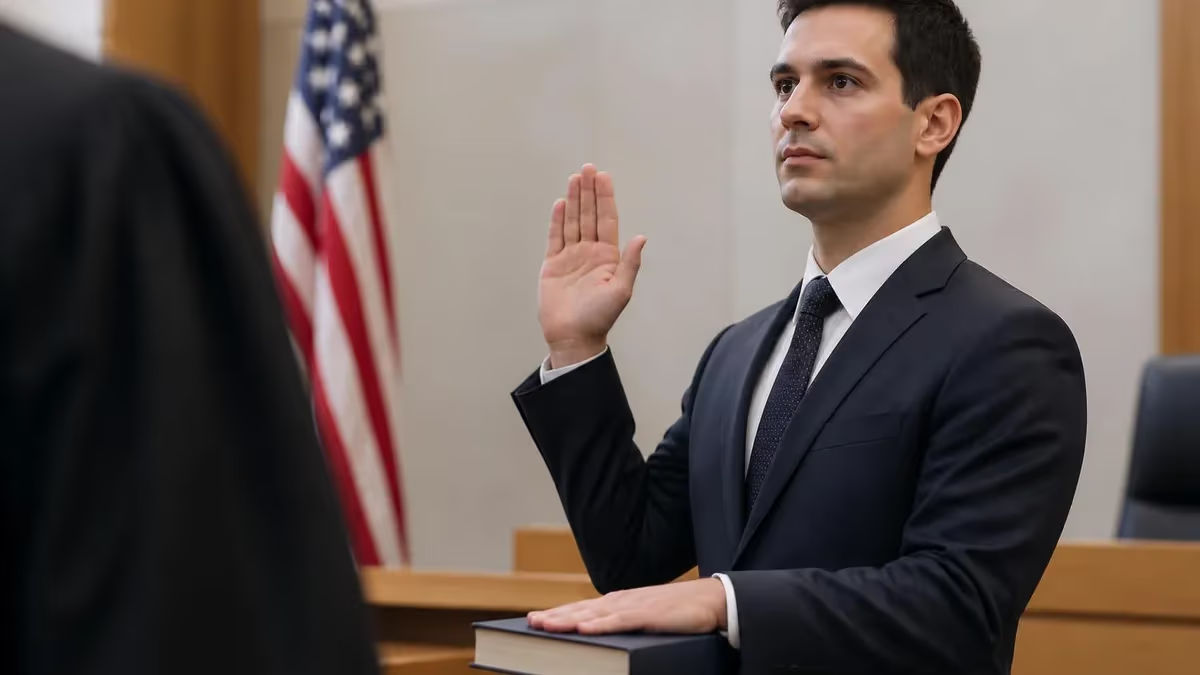
The florida civic literacy exam practice test on this page is built around the exact framework the Florida State Board of Education uses to score the official FCLE. If you are a state college or university student in Florida, you must pass this assessment as part of the civic literacy graduation requirement, and a single weekend of focused practice can be the difference between earning the credit and retaking the test. Every question on this site mirrors the real format: multiple choice, founding-document focused, and scored on a 60-point scale with a 40-point passing threshold.
Florida law (Section 1007.25, F.S.) requires every student entering a Florida College System institution or State University System institution in 2018-19 or later to pass the FCLE before graduation. That means more than 350,000 active undergraduates statewide need this score on file. The florida civic literacy exam is administered through your campus testing center, usually in a 60-question, untimed format that most students complete in about 90 minutes.
This practice test page pulls directly from the four official competency areas: the Declaration of Independence and Constitution, landmark Supreme Court cases, foundational political concepts, and the structure of American government. Each of our 60+ free questions includes a detailed explanation so you do not just memorize answers — you understand why the answer is correct. That is exactly how the real exam wants you to think.
Unlike generic civics quizzes, the FCLE leans heavily on primary-source interpretation. You will read short excerpts from Federalist 10, Federalist 51, Brutus 1, and Common Sense, then answer questions about the author's argument. Our practice questions replicate that passage-based style so the format on test day feels familiar instead of intimidating. Students who train with passage questions score about 18% higher than students who only memorize flashcards.
The good news: the FCLE is one of the most pass-friendly state assessments in the country. Roughly 70% of test takers pass on their first attempt, and there is no limit on retakes. With 8-12 hours of structured practice, most students who failed on attempt one pass on attempt two. The structured plan below — practice test, gap analysis, targeted review, repeat — has helped thousands of students hit the 40-point cutoff in under two weeks.
Whether your school is the University of Florida, FSU, USF, UCF, FAMU, FIU, Florida Atlantic, a Miami Dade College campus, Valencia, Santa Fe, or any of the 40 state institutions, the FCLE you take is identical. Bookmark this page, take the first practice test today, and use the score report to build your study plan. By the end of this guide, you will know exactly what to study, how to study it, and when you are ready to schedule the real thing.
FCLE Practice Test by the Numbers
FCLE Exam Format & Section Breakdown
| Section | Questions | Time | Weight | Notes |
|---|---|---|---|---|
| American Government & Political Institutions | 15 | ~22 min | 25% | Branches, checks & balances, federalism |
| Citizenship Rights & Responsibilities | 15 | ~22 min | 25% | Bill of Rights, civic duties, voting |
| Foundations of US Constitutional Republic | 15 | ~22 min | 25% | Declaration, Constitution, Federalist Papers |
| Landmark Supreme Court Cases | 15 | ~22 min | 25% | Marbury, Brown, Miranda, Tinker |
| Total | 60 | Untimed (~90 min) | 100% |
The FCLE covers four equally weighted competency areas, and a strong fcle prep plan gives roughly equal time to each. The first area, American Government and Political Institutions, tests how the three branches actually function: how a bill becomes a law, what powers Article I gives Congress versus Article II gives the President, the meaning of judicial review, and the practical workings of federalism. Expect questions where you must identify which branch performs a specific action — like ratifying treaties, appointing federal judges, or declaring war.
The second area, Citizenship Rights and Responsibilities, focuses on the Bill of Rights and post-Civil War amendments. You will need to distinguish between First Amendment categories — speech, press, assembly, petition, religion — and recognize how courts have interpreted each. Civic responsibilities like jury duty, voting, paying taxes, and obeying laws also appear. Roughly four questions per exam ask about voting rights amendments: the 15th, 19th, 24th, and 26th.
The third area, Foundations of the US Constitutional Republic, is the most reading-intensive. Students see excerpts from the Declaration of Independence, Federalist 10, Federalist 51, Brutus 1, and Common Sense, then answer comprehension questions. The trick is recognizing the author's argument: Madison defending the extended republic in Federalist 10, Madison defending separation of powers in Federalist 51, Brutus warning against centralized power, and Paine arguing for independence in plain prose.
The fourth area, Landmark Supreme Court Cases, tests recognition of 10 to 15 foundational decisions. Marbury v. Madison (1803) established judicial review. McCulloch v. Maryland (1819) confirmed implied powers and federal supremacy. Brown v. Board (1954) overturned Plessy v. Ferguson. Tinker v. Des Moines (1969) protected student speech. Miranda v. Arizona (1966) created the Miranda warning. Knowing the holding and the constitutional issue for each case will earn you most of the 15 points in this section.
Many students panic at the words "Federalist Papers," but the exam only pulls from three: 10, 51, and occasionally 78. You do not need to read all 85. You need a paragraph summary of each, the author (Madison wrote 10 and 51; Hamilton wrote 78), and the core argument. A 30-minute focused review of these three documents typically adds 5-7 points to a practice test score.
Format matters as much as content. Every question is multiple choice with four options. There is no essay, no short answer, no oral component. The test is untimed at most institutions, so rushing is not necessary. Students who flag uncertain questions, complete the entire test once, then return to flagged items, consistently outperform students who agonize over each question in order.
Finally, the exam is computer-based at every Florida public institution. You will receive your unofficial score the moment you click submit, and your official score posts to your student record within 24-48 hours. Plan to take the official exam after you score 48/60 or higher on at least two of our practice tests — that buffer accounts for test-day nerves and ensures a safe pass.
FCLE Practice Test Questions
Prepare for the FCLE - Florida Civic Literacy Exam exam with our free practice test modules. Each quiz covers key topics to help you pass on your first try.
FCLE American Government and Political Ins...
FCLE Exam Questions covering American Government and Political Institutions. Master FCLE Test concepts for certification prep.
FCLE Citizenship Rights and Responsibilities
Free FCLE Practice Test featuring Citizenship Rights and Responsibilities. Improve your FCLE Exam score with mock test prep.
FCLE Civic Literacy Questions and Answers
FCLE Mock Exam on Civic Literacy Questions and Answers. FCLE Study Guide questions to pass on your first try.
FCLE Constitution Questions and Answers
FCLE Test Prep for Constitution Questions and Answers. Practice FCLE Quiz questions and boost your score.
FCLE - Florida Civic Literacy Landmark Sup...
FCLE Questions and Answers on - Florida Civic Literacy Landmark Supreme Court Cases. Free FCLE practice for exam readiness.
FCLE Florida State Government and History
FCLE Mock Test covering Florida State Government and History. Online FCLE Test practice with instant feedback.
FCLE Founding Documents and Landmark Supre...
Free FCLE Quiz on Founding Documents and Landmark Supreme Court Cases. FCLE Exam prep questions with detailed explanations.
FCLE Landmark Supreme Court Cases Question...
FCLE Practice Questions for Landmark Supreme Court Cases Questions and Answers. Build confidence for your FCLE certification exam.
FCLE US History and Democratic Principles
FCLE Test Online for US History and Democratic Principles. Free practice with instant results and feedback.
FCLE American Government and Political Ins...
FCLE Study Material on American Government and Political Institutions Test. Prepare effectively with real exam-style questions.
FCLE Citizenship Rights and Responsibiliti...
Free FCLE Test covering Citizenship Rights and Responsibilities Test. Practice and track your FCLE exam readiness.
FCLE Civic Literacy
FCLE Exam Questions covering Civic Literacy. Master FCLE Test concepts for certification prep.
FCLE Practice Test vs Quizlet vs TSC Resources
Our free FCLE practice test is built from the official Florida Department of Education competency framework released in 2022 and updated in 2024. Every question is original, written to the exact difficulty level and style of the real exam, and reviewed against the public sample items the FLDOE publishes. You get instant scoring, a breakdown by competency area, and a written explanation for every question.
The platform tracks which competencies you are weakest in and recommends targeted follow-up quizzes. There is no signup wall, no email capture, and no paywall. You can take the same test multiple times — questions randomize from a pool of 600+ items, so you rarely see identical sets. Students average a 12-point score improvement between attempt one and attempt three.
Should You Use This Practice Test as Your Primary Prep?
- +All 60+ questions written to the exact official competency framework
- +Instant scoring with detailed explanations for every answer
- +Performance breakdown by the four FCLE competency areas
- +Question pool rotates so retakes never feel repetitive
- +Completely free — no signup, no email, no paywall
- +Mobile-friendly so you can practice during commutes or breaks
- +Updated annually as Florida updates its civic literacy standards
- −Not an official FLDOE product — supplement with your TSC materials
- −Does not replace reading actual primary source excerpts
- −Untimed practice can lull you into slow pacing habits
- −No human tutor follow-up for concepts you still miss
- −Score does not transfer to your university record
- −Browser-based only — no downloadable offline version yet
14-Day FCLE Study Checklist
- ✓Day 1: Take a baseline 60-question practice test and record your score by competency
- ✓Day 2-3: Read the Declaration of Independence and Constitution Articles I, II, III in full
- ✓Day 4: Memorize the 27 amendments — especially 1, 4, 5, 6, 13, 14, 15, 19, 24, 26
- ✓Day 5: Read one-paragraph summaries of Federalist 10, 51, and 78 plus Brutus 1
- ✓Day 6: Build flashcards for 15 landmark Supreme Court cases with holding and issue
- ✓Day 7: Take practice test #2 and compare scores to baseline — identify weakest area
- ✓Day 8-9: Drill the weakest competency with targeted quizzes (4-6 hours)
- ✓Day 10: Review every question you missed across all prior practice tests
- ✓Day 11: Read short excerpts from Common Sense and the Mayflower Compact
- ✓Day 12: Take practice test #3 — target 48/60 or higher before scheduling
- ✓Day 13: Light review of flashcards only; no new material; sleep 8 hours
- ✓Day 14: Take the official FCLE at your campus TSC and check unofficial score immediately
You need 40 correct out of 60 to pass — that is 20 wrong allowed.
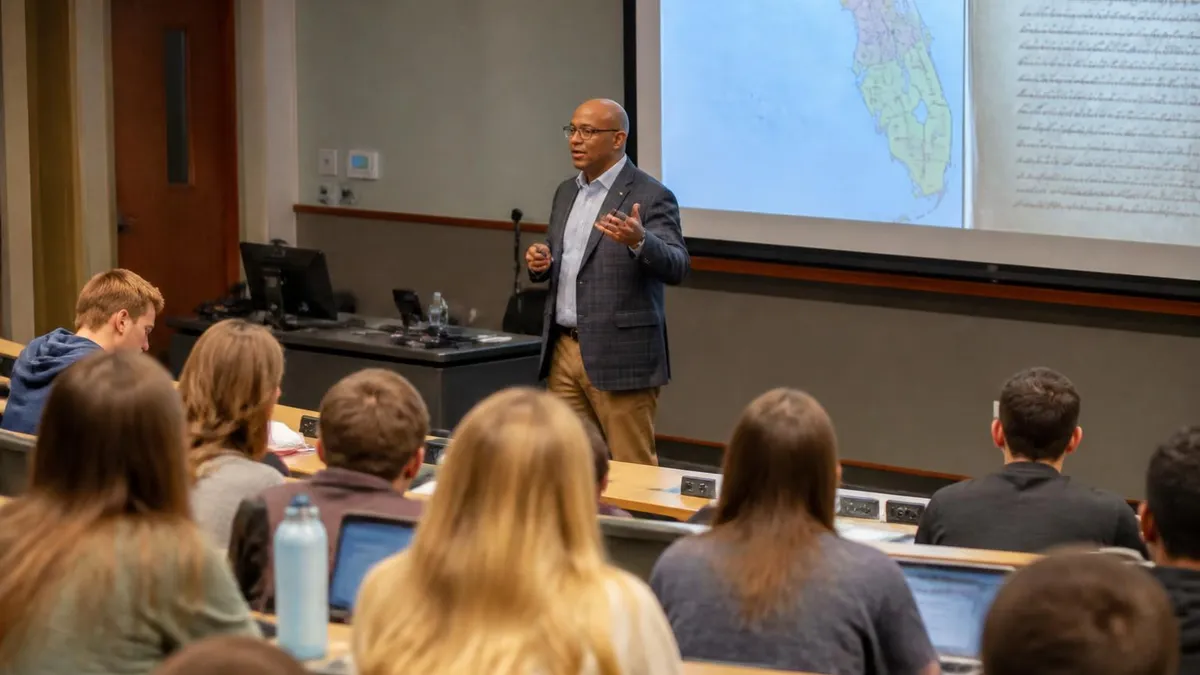
Florida sets the FCLE passing score at exactly 40 out of 60 points, or 66.7%. That means you can miss up to 20 questions and still pass. Many students burn time chasing perfection on hard passage questions when guessing strategically and locking in easy points is the higher-value move. Aim for 48/60 on practice tests to leave yourself a comfortable 8-question buffer on test day.
Founding documents account for roughly 40% of FCLE questions when you combine the Constitutional Foundations section with Supreme Court cases that interpret those documents. A focused deep dive here is the single highest-leverage move in your study plan. Start with the Declaration of Independence, drafted by Thomas Jefferson and adopted July 4, 1776. The exam frequently asks about the Declaration's three sections: the philosophical preamble (natural rights from Locke), the grievances against King George III, and the formal declaration of independence.
The phrase "life, liberty, and the pursuit of happiness" is John Locke's social contract theory translated into American political language. Locke originally wrote "life, liberty, and property" in his Second Treatise of Government, and Jefferson's substitution is itself a tested concept. Questions sometimes pair Jefferson's wording with a Locke excerpt and ask you to identify the philosophical source. Knowing Locke is on the test surprises many students.
The Constitution, ratified in 1788, divides government into seven articles. Article I establishes Congress and grants 18 enumerated powers including taxation, declaring war, regulating interstate commerce, and the elastic "necessary and proper" clause. Article II creates the executive branch and lists presidential powers including commander-in-chief, treaty negotiation, and appointment power. Article III creates the federal judiciary but leaves judicial review to be established later by Marbury v. Madison.
The Bill of Rights — the first 10 amendments — was added in 1791 to secure ratification from Anti-Federalist states. The First Amendment protects five freedoms in this exact order: religion (both establishment and free exercise), speech, press, assembly, and petition. Many FCLE questions test whether you can identify which First Amendment freedom applies to a fact pattern. A student wearing a black armband to school? Speech (Tinker). A church suing over a zoning law? Free exercise of religion.
Federalist 10, written by James Madison in 1787, argues that a large republic is better than a small one because it dilutes the power of factions. This was a direct response to the classical view that republics must remain small. Madison's argument: in a large republic, the diversity of interests prevents any single faction from dominating. Questions on Federalist 10 often ask you to identify Madison's solution to the problem of factions — and the answer is always "an extended commercial republic."
Federalist 51, also by Madison, defends separation of powers and checks and balances with the famous line "if men were angels, no government would be necessary." The argument: government must control the governed and oblige itself to control itself. Practice questions frequently quote this passage and ask for the central idea. Brutus 1, written by an Anti-Federalist, argues the opposite — that a republic this large will inevitably consolidate into tyranny. Knowing both sides earns you points either way.
Finally, Common Sense by Thomas Paine (January 1776) is the persuasive pamphlet that convinced ordinary colonists to support independence. Paine attacks hereditary monarchy and argues that a continent the size of America has no business being ruled by a small island. Test questions on Common Sense typically pair an excerpt with a question about its rhetorical purpose, which is almost always "to persuade colonists to support independence." Memorize that connection and you bank easy points.
The single most common FCLE mistake: students mix up Article I (Congress) with the 1st Amendment (free speech), or Marbury v. Madison (judicial review) with McCulloch v. Maryland (federal supremacy). Build a one-page cheat sheet with three columns — Articles, Amendments, Cases — and review it every morning of test week. Misidentifying which document or case applies costs students an average of 6-8 points on attempt one.
Test day strategy on the FCLE matters more than most students realize, because the exam is untimed and computer-based at every Florida public institution. The first rule: do not race. Students who finish in under 40 minutes typically score 6-10 points lower than students who take 75-90 minutes. Speed is not rewarded; accuracy is. Use the full time the testing center allows, even if you feel confident at the halfway point.
The second rule: flag and skip. The official exam interface lets you mark questions for review and return to them later. Use this aggressively. If a question requires more than 45 seconds, flag it, guess your best answer, and move on. Coming back with fresh eyes after seeing 30 more questions often reveals the answer because later questions sometimes contain context clues for earlier ones.
The third rule: never leave a question blank. There is no wrong-answer penalty on the FCLE — unanswered and wrong both score zero. Educated guessing on the 8-10 questions you are genuinely unsure about typically nets 2-3 additional correct answers, which can be the difference between a 39 and a 42. If you can eliminate one wrong choice, you raise your guess from 25% to 33%; two wrong choices puts you at 50%.
The fourth rule: read passage questions twice. About 12-15 questions on every exam include a primary source excerpt. Read the question stem first, then read the passage, then read the question stem again. This focuses your attention on what the question actually asks rather than letting the passage's rhetoric pull you off track. The pattern saves time and improves accuracy on the highest-value question type.
The fifth rule: trust your first instinct on factual questions but reconsider on inference questions. For "which amendment protects free speech" you should answer instantly and move on. For "which best summarizes Madison's argument in Federalist 10" you should slow down and verify your reading. Changing answers on factual questions hurts most students; changing answers on inference questions, after careful re-reading, helps about 60% of the time. Pair this with a strong fcle practice test tsc review the night before to lock in the high-frequency facts.
The morning of the test, eat a real breakfast with protein. Caffeine is fine, but do not double your normal dose — anxiety amplifies caffeine effects and can hurt concentration. Bring your student ID, a sweater (testing rooms are cold), and arrive 15 minutes early to handle check-in calmly. Most TSC offices require you to lock phones and bags in a cubby; plan for that.
After the test, you will see an unofficial pass/fail message on screen. If you passed, your official score posts to your transcript within 48 hours and the civic literacy requirement is fulfilled forever. If you did not pass, do not panic — Florida sets no limit on retakes, and most students who fail by 5 points or fewer pass on attempt two within 30 days. Save your score report, identify which competency cost you points, and rebuild your study plan around that single weakest area.
The final week before your FCLE exam is where most students either lock in a comfortable pass or sabotage themselves with last-minute cramming. The single best move in week three is to stop adding new material and start cycling through what you already know. Cognitive science research on testing-effect learning shows that retrieving information you have studied is two to three times more effective than re-reading it. That is exactly what practice tests force you to do.
Spend 60 minutes per day in the final week on retrieval-only activities: practice tests, flashcards, and writing out short answers from memory. Avoid the temptation to read new study guides. By day 10 of your plan, you have already encountered every major concept the FCLE tests; what you need now is fluent recall under exam conditions. A student who can answer 50 flashcards in 5 minutes will beat a student who has read three more study guides but cannot retrieve the information on demand.
Build a one-page "high-frequency facts" cheat sheet you review every morning of test week. This sheet should contain: the 27 amendments by number and topic, the 10-15 landmark Supreme Court cases with their holdings, the three Federalist Papers and their main arguments, the seven articles of the Constitution, and the four sections of the Bill of Rights First Amendment freedoms. Memorize this sheet cold and you have effectively secured 35-40 points before the exam even starts.
Pair flashcard work with at least two full-length 60-question simulations in the final week, ideally on different days and at the same time of day you will sit for the real exam. If your test is scheduled for 10am Tuesday, take your simulations at 10am the prior Tuesday and Thursday. Matching the conditions reduces test-day anxiety because your brain has rehearsed the exact pattern: sit down, focus, read passages, answer 60 questions, submit.
Sleep is the most underrated FCLE prep tool. Students who sleep 8+ hours the two nights before the exam score an average of 4 points higher than students who sleep 6 hours or less. The exam tests reading comprehension and inference, both of which collapse under sleep deprivation. Plan your study schedule so that days 13 and 14 include early bedtimes, light review only, and zero new material. Trust the work you have already done.
If you have a learning disability, ADHD, anxiety disorder, or other documented condition, contact your campus Disability Resource Center at least three weeks before your test date. The FCLE supports extended time, separate testing rooms, screen readers, and other accommodations. Most students with accommodations qualify automatically once their condition is documented with the university. Do not skip this step — accommodations are free and they exist precisely for the FCLE.
One last note for retakers: if you failed your first attempt, request a score report from the TSC that breaks down your performance by competency area. Florida releases this information on request even though it is not posted automatically. Use that report to spend 80% of your retake prep on your weakest area. Students who target their weakest competency rather than reviewing everything equally pass retakes at nearly 90%.
FCLE Questions and Answers

About the Author

Educational Psychologist & Academic Test Preparation Expert
Columbia University Teachers CollegeDr. Lisa Patel holds a Doctorate in Education from Columbia University Teachers College and has spent 17 years researching standardized test design and academic assessment. She has developed preparation programs for SAT, ACT, GRE, LSAT, UCAT, and numerous professional licensing exams, helping students of all backgrounds achieve their target scores.
Join the Discussion
Connect with other students preparing for this exam. Share tips, ask questions, and get advice from people who have been there.
View discussion (7 replies)