
What Is the Florida Civic Literacy Exam? Complete FCLE Guide 2026 September
What is the Florida Civic Literacy Exam? Learn format, topics, pass rates & prep tips. 🎓 Free FCLE practice test questions included.
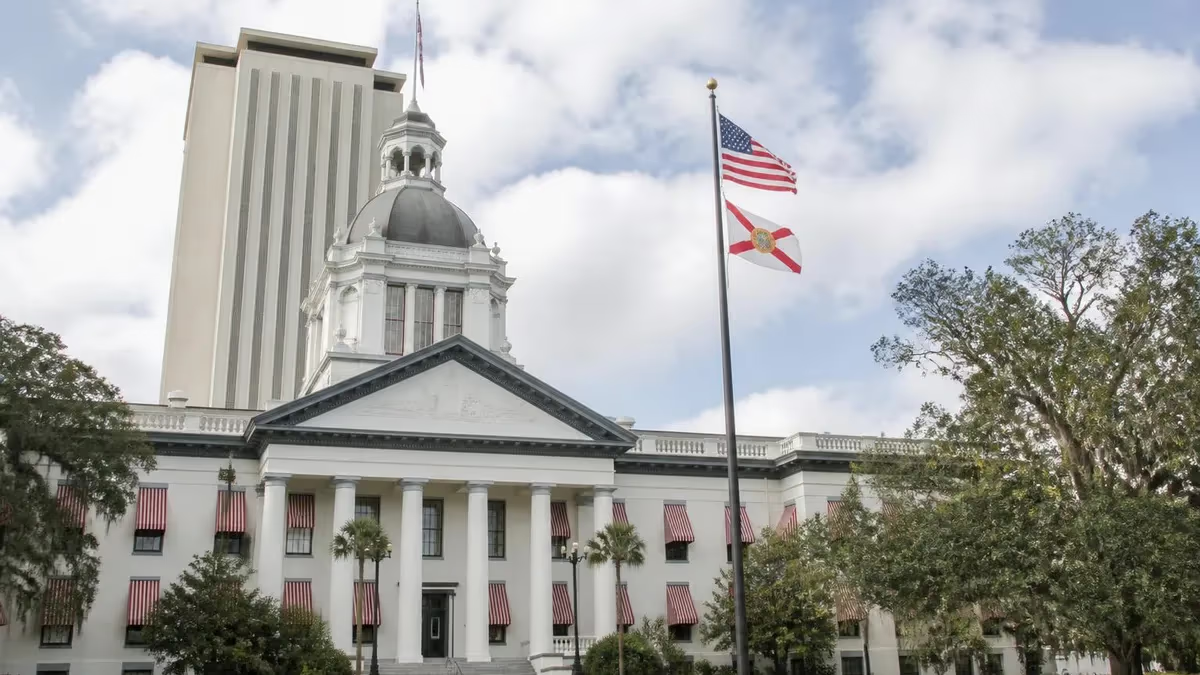
The Florida Civic Literacy Exam, widely known as the FCLE, is a standardized assessment required for graduation at Florida public colleges and universities. Established under Florida Statute 1007.25, the exam tests whether students possess a foundational understanding of American government, the U.S. Constitution, and the rights and responsibilities of citizenship.
If you are enrolled at a Florida State University System or Florida College System institution, passing the florida civic literacy exam is a requirement you cannot skip — and understanding exactly what it covers is the first step toward success. Try a florida civics literacy exam practice set today to see where you stand.
The FCLE was introduced as part of Florida's broader effort to strengthen civics education at the postsecondary level. Florida House Bill 7 (2021) mandated the exam, making Florida one of the first states in the nation to require a civic literacy assessment for all bachelor's degree candidates. The law reflects a national conversation about whether college graduates understand how their government works, what their constitutional rights are, and how democratic institutions function. The exam is not optional; it is a degree requirement, which means failing it — or never attempting it — can block you from graduating.
Many students are surprised to discover that the FCLE is not a brand-new type of test. Florida actually offers two pathways: students can pass the standardized FCLE exam administered by their institution, or they can demonstrate civic literacy through approved coursework. The direct exam pathway is the more common route, and it is what most students mean when they search for an fcle practice test or study materials online. Knowing which pathway applies to you is essential before you begin preparing.
The exam itself draws from a well-defined set of content domains. These include the historical foundations of American democracy, the structure and function of all three branches of the federal government, the Bill of Rights and subsequent constitutional amendments, and the civic responsibilities of American citizens. Understanding these domains helps you prioritize your study time instead of reviewing material that won't appear on the test. Each domain carries its own weight on the exam, and some topics — like the separation of powers and the amendment process — appear in multiple question formats.
One of the most frequently asked questions about the FCLE is how difficult it actually is. The exam is considered moderately challenging for students who have not recently studied U.S. civics or history. Students who took a rigorous high school government course within the past few years often find the content familiar, but the specific framing of questions — and the level of detail expected — can still trip up unprepared test-takers.
The good news is that the exam has a clearly defined scope, which means targeted preparation is highly effective. Using an fcle practice test before your exam date gives you the best possible preview of real question types.
Florida's public institutions administer the FCLE through the Testing Services Center (TSC) at most campuses. You may also see the exam referred to as the FCLE practice test TSC in search results, which simply means the TSC-administered version of the exam or the practice materials tied to it. The TSC handles scheduling, accommodations for students with disabilities, and score reporting. Understanding the administrative process — who runs the exam, how you register, and how scores are reported to your institution — removes unnecessary anxiety on test day.
This article walks you through everything you need to know about the florida civic literacy exam: what it covers, how it is structured, how to study effectively, and what happens if you do not pass on your first attempt. Whether you are just beginning your college career or approaching graduation, the information here will help you prepare with confidence and pass the FCLE on schedule.
Florida Civic Literacy Exam by the Numbers
FCLE Exam Format & Structure
| Section | Questions | Time | Weight | Notes |
|---|---|---|---|---|
| American History & Founding Documents | 30 | ~18 min | 30% | Declaration of Independence, Constitution, Federalist Papers |
| American Government & Political Institutions | 35 | ~21 min | 35% | Three branches, checks and balances, elections |
| Citizenship Rights & Responsibilities | 20 | ~12 min | 20% | Bill of Rights, amendments, civic participation |
| Florida Government & Civic Literacy | 15 | ~9 min | 15% | State government, local government, Florida Constitution |
| Total | 100 | 60 minutes | 100% |
The FCLE tests knowledge across four major content domains, each of which maps to a distinct era and branch of American civic life. The first and foundational domain covers American history and the founding documents that shaped the nation. This includes the Declaration of Independence, the Articles of Confederation, the U.S. Constitution, and key Federalist Papers like No. 10 and No. 51.
Questions in this domain often ask about the philosophical underpinnings of American democracy — concepts like natural rights, popular sovereignty, and the social contract — as well as specific historical events that led to the Constitutional Convention. Students who want a comprehensive review of these foundational documents should explore a florida civic literacy exam practice test in PDF format to drill these concepts offline.
The second and largest content domain focuses on American government and political institutions. This section makes up approximately 35 percent of the exam and tests your understanding of how the three branches of government — legislative, executive, and judicial — function individually and in relation to one another.
Expect questions about how a bill becomes a law, how the president vetoes legislation, how the Supreme Court exercises judicial review, and how the federal system divides power between the national government and the states. The concept of checks and balances is central to this domain, and it appears in multiple question types throughout the exam.
The third domain covers citizenship rights and responsibilities. This section draws heavily from the Bill of Rights — the first ten amendments — and from subsequent amendments that expanded civil rights and suffrage throughout American history. You should be comfortable explaining the protections guaranteed by each amendment in the Bill of Rights, as well as the significance of landmark amendments like the 13th, 14th, 15th, 19th, and 26th. Questions may ask you to apply these rights to real-world scenarios, such as whether a government action constitutes a First Amendment violation or how due process protections apply to criminal defendants.
The fourth domain addresses Florida-specific government and civic literacy. While this section is smaller — roughly 15 percent of the exam — it is frequently overlooked by students who focus exclusively on federal-level content. This domain tests your knowledge of Florida's state government structure, including the Florida Legislature, the Governor's office, and the Florida Supreme Court.
You should also understand how county and municipal governments function, how Florida's Constitution differs from the U.S. Constitution, and what rights are guaranteed specifically to Florida residents. Studying this section carefully can give you an edge, since fewer commercially available study materials address Florida-specific content in depth.
One important aspect of FCLE content that many students underestimate is the level of specificity required. The exam does not simply ask you to recognize famous documents or general concepts — it asks you to recall specific details, apply principles to new scenarios, and distinguish between similar-sounding concepts.
For example, you might be asked to identify the difference between a concurrent power and an exclusive federal power, or to explain why the Great Compromise during the Constitutional Convention matters for how Congress is structured today. This level of detail is precisely why passive reading of a textbook is less effective than active practice with realistic exam questions.
Vocabulary is another hidden challenge on the FCLE. Civic and legal terminology — terms like habeas corpus, bicameral, federalism, enumerated powers, judicial review, and due process — appears throughout the exam, and you must understand not just the definition but how each term functions in context. Building a strong civic vocabulary early in your study process will help you interpret questions more quickly and avoid being tripped up by unfamiliar phrasing. Flashcard tools and civic vocabulary lists are useful supplements to full practice exams, especially for students who did not take a rigorous government course in high school.
Finally, it is worth noting that the FCLE is not a trick exam. The questions are designed to test genuine civic knowledge, not to confuse students with misleading wording or obscure trivia. Most questions have a clearly correct answer when you know the content. This means that consistent, focused preparation — working through an fcle quizlet deck, completing full practice exams, and reviewing your mistakes — is the most reliable path to a passing score. The exam rewards students who put in deliberate practice, not just those who happen to remember a few facts from high school.
FCLE Study Strategies by Topic Area
The founding documents domain rewards students who read primary sources rather than just summaries. Download a clean copy of the U.S. Constitution and read it section by section, pausing to note what each article and amendment actually says. Pay particular attention to the Preamble, Article I (Congress), Article II (President), and Article III (Supreme Court). The Federalist Papers No. 10 and No. 51 are also high-yield: No. 10 argues that a large republic controls factionalism, while No. 51 explains the logic of separated powers. Understanding the argument — not just the title — is what the FCLE tests.
When studying the Declaration of Independence, focus on the philosophical claims Jefferson makes about natural rights, the purpose of government, and the right of revolution. The FCLE frequently asks why the Declaration matters as a founding document rather than as a legal one — it does not create law but it establishes the moral framework that the Constitution later codified. Practice explaining the difference between the Articles of Confederation and the Constitution, including why the Articles failed and what specific problems the Constitutional Convention was convened to fix. These comparisons appear on the exam regularly.

FCLE Requirement: Benefits and Drawbacks for Students
- +Ensures all Florida graduates understand their constitutional rights and civic responsibilities
- +Provides a clear, defined scope of content so preparation is highly focused
- +Passing demonstrates civic competency that employers increasingly value
- +Unlimited retakes available so students are never permanently blocked from graduating
- +Strong study materials — including free practice tests — are widely available online
- +Passing the FCLE through coursework is an alternative pathway for students who prefer classroom learning
- −Adds a graduation requirement that students may not learn about until late in their academic careers
- −Students who attended weak civics programs in high school may face a significant knowledge gap
- −The 60-minute time limit can feel tight for students who need extra time to process multiple-choice questions
- −Florida-specific government content is underrepresented in most commercial study guides
- −Students with test anxiety may find the standardized exam format stressful even when they know the material
- −There is currently no official state-issued practice exam, so students must rely on third-party resources
FCLE Prep Checklist: 10 Steps Before Exam Day
- ✓Confirm your institution's FCLE registration process and schedule your exam date at least 30 days in advance.
- ✓Download and read the U.S. Constitution, Bill of Rights, and at least two Federalist Papers (No. 10 and No. 51).
- ✓Take a full-length FCLE practice test under timed conditions to establish your baseline score.
- ✓Review every incorrect answer and identify which content domain each mistake belongs to.
- ✓Build a vocabulary list of civic and legal terms: federalism, judicial review, due process, habeas corpus, bicameral, and at least 20 others.
- ✓Study the three branches of government in detail, including how each checks the power of the other two.
- ✓Review all 27 constitutional amendments, with special focus on the first ten and the Civil War and voting-rights amendments.
- ✓Study Florida-specific government content: the Florida Legislature, the Governor's constitutional powers, and Florida's court system.
- ✓Complete at least three full practice exams in the final two weeks before your test date.
- ✓Request testing accommodations from your institution's Testing Services Center if you qualify under ADA guidelines.
The 60% Rule: What It Really Means
To pass the FCLE, you need to answer at least 60 out of 100 questions correctly — a 60% passing threshold. This means you can miss up to 40 questions and still pass. While that may sound lenient, students who rely on guessing rather than genuine knowledge tend to cluster just below that threshold. Targeted preparation on your weakest domains is far more efficient than memorizing random facts. Focus on government structure and founding documents first — together they represent 65% of exam content.
Understanding the FCLE scoring system helps you develop a realistic and strategic study plan. The exam consists of 100 multiple-choice questions, and a score of 60 — meaning 60 correct answers — is required to pass. There is no partial credit; each question is either right or wrong.
The exam does not penalize you for incorrect answers, which means you should always attempt every question rather than leaving any blank. If you are unsure about a question, eliminate the obviously wrong choices, make your best guess, and move on. Running out of time with unanswered questions is one of the most common and preventable reasons students fail.
Your raw score of 60 or higher is reported to your institution as a passing score, and the institution then records the requirement as fulfilled in your academic file. You do not receive a letter grade on the FCLE — it is simply pass or fail. If you pass, the requirement is marked complete and you move forward toward graduation.
If you do not pass, you are typically allowed to retake the exam after a waiting period determined by your institution. Most Florida institutions allow students to retake the FCLE as many times as needed, though some campuses charge a small retest fee after the first free attempt.
First-time pass rates for the FCLE vary by institution, but statewide data suggest that roughly 50 to 60 percent of students pass on their first attempt without any formal preparation. Students who use structured study materials — including an florida civic literacy exam quizlet deck or full practice exams — report significantly higher first-attempt pass rates. This gap between prepared and unprepared students is one of the strongest arguments for starting your FCLE prep early rather than walking in cold.
If you do not pass on your first attempt, do not panic. The most effective approach after a failed attempt is to review your score report carefully. Most institutions provide some form of score breakdown showing which content domains you struggled with. Use this information to direct your subsequent study sessions toward your weakest areas rather than re-studying everything from scratch. Students who fail the FCLE often do so because they were underprepared in one or two specific domains — usually Florida government or the founding documents — not because they lack general civic knowledge.
The FCLE also intersects with an alternative compliance pathway that some students may qualify for. If you have completed a state-approved civic literacy course at your institution with a passing grade of C or higher, that course completion may satisfy the FCLE requirement without you ever taking the standardized exam. Common qualifying courses include Introduction to American Government, Florida Government, and similar civics-focused electives offered through political science or social science departments. Check with your academic advisor and your institution's registrar to confirm whether a course you have already taken — or plan to take — fulfills the requirement.
Timing your FCLE attempt strategically is another factor worth considering. Many students choose to take the exam during their freshman or sophomore year, when foundational civics knowledge from high school is still relatively fresh. Waiting until the semester before graduation is risky because a failed attempt can delay graduation if there is not enough time to retake the exam before your degree conferral date. Talk to your academic advisor about the best semester to schedule your FCLE based on your degree timeline and current course load.
Finally, students with documented disabilities have the right to request testing accommodations through their institution's disability services office. Accommodations may include extended time, a separate testing room, assistive technology, or other modifications appropriate to the student's documented needs. These accommodations must be requested in advance — typically at least two weeks before your scheduled exam date — so plan ahead if you believe you qualify. The Testing Services Center at your campus can walk you through the accommodation request process and timeline.
Florida public institutions require the FCLE to be passed before a bachelor's degree can be conferred. If you fail the exam in your final semester, your graduation may be delayed even if all other degree requirements are complete. Schedule your FCLE no later than the semester before your intended graduation date. This gives you at least one full semester to retake the exam if needed — and prevents a single exam from standing between you and your diploma.
Test day preparation begins long before you walk into the Testing Services Center. The night before your FCLE, resist the temptation to cram. Research consistently shows that last-minute cramming increases anxiety and impairs recall during the actual exam. Instead, spend the evening doing a light review of your vocabulary list and a few practice questions — just enough to keep your mind engaged without overwhelming it.
Get at least seven to eight hours of sleep, because cognitive performance on multiple-choice exams drops measurably with sleep deprivation. Eat a balanced breakfast before heading to the test center, and arrive at least 15 minutes early to allow time for check-in procedures.
When you sit down to take the exam, use the first two minutes to scan the question format and mentally allocate your time. With 100 questions and 60 minutes, you have an average of 36 seconds per question. That pace is achievable for most students who have prepared, but it requires staying disciplined throughout the exam. If a question is taking more than 60 seconds, make your best guess, mark it if your testing platform allows, and move on. Return to flagged questions only if you have time remaining after completing the rest of the exam.
Read every question and all four answer choices carefully before selecting your answer. FCLE questions are often written to test whether you understand a concept precisely, and two answer choices may sound very similar at first glance.
The difference between them is usually one specific word or phrase that changes the meaning — for example, the difference between a right that is absolute and one that is subject to reasonable restrictions, or between a power that is enumerated and one that is implied. Slow down slightly on questions that feel tricky, and trust the preparation you have done rather than second-guessing yourself repeatedly.
Process of elimination is your most powerful test-taking tool on the FCLE. Even when you are not certain of the correct answer, you can often rule out one or two choices immediately because they contradict something you know to be true. Narrowing a four-choice question down to two options improves your odds from 25 percent to 50 percent — a significant advantage over random guessing.
Practice using process of elimination during your preparation sessions so that it becomes automatic by exam day. When you review practice tests, note not just why the correct answer is right but also why each wrong answer is wrong.
Managing exam anxiety is a skill that improves with practice. The more full-length practice exams you complete under realistic timed conditions, the more comfortable you will feel on exam day. Familiarity reduces anxiety because your brain recognizes the format, the pacing, and the types of questions as things it has handled successfully before.
If you notice yourself feeling anxious during the exam, take three slow, deep breaths before reading the next question. This brief pause resets your nervous system and improves focus without costing significant time. To explore how long you have for the full exam, check out the fcle exam duration guide for detailed timing breakdowns.
After you finish the exam, your score is typically available immediately or within a few business days, depending on your institution's reporting process. If you pass, celebrate — you have fulfilled a meaningful graduation requirement and demonstrated genuine civic knowledge. If you do not pass on your first attempt, request feedback from your institution about which content areas were weakest, and use that information to build a more targeted study plan before your next attempt. Many students pass the FCLE on their second attempt after addressing specific knowledge gaps identified in their first score report.
The FCLE is ultimately not just a graduation hurdle — it is an opportunity to develop a working knowledge of the institutions, rights, and responsibilities that define American citizenship. Students who take the preparation process seriously often report that the exam changed how they think about current events, political decisions, and their own role as citizens. That broader perspective is precisely what Florida's civic literacy mandate was designed to cultivate, and it is a benefit that extends well beyond graduation day.
Building an effective FCLE study schedule requires matching the amount of preparation time you have to your current knowledge level. Students who have recently completed a high school AP Government course or a college-level political science class may need only two to three weeks of focused review.
Students who have not studied civics in several years — or who feel unfamiliar with constitutional law and government structure — should plan for four to six weeks of consistent preparation. Either way, the key is to study actively rather than passively, using practice questions and self-testing rather than simply reading or highlighting notes.
Week one of any solid FCLE study plan should focus on assessment and foundation-building. Take a full-length diagnostic practice exam to identify your current score and your weakest content domains. Use that score report to prioritize your study topics: spend the most time on the domains where you missed the most questions, not on the ones where you already feel confident. Build your civic vocabulary list during week one, since strong vocabulary knowledge pays dividends across all content domains throughout your preparation.
Weeks two and three should be devoted to deep content review in your priority areas. For most students, this means focusing on American government structure and the founding documents. Work through the U.S. Constitution article by article, pausing to answer practice questions on each section before moving to the next.
Review the Federalist Papers and be able to summarize the main argument of each key paper in two or three sentences. Study the amendment timeline chronologically — from the Bill of Rights through the most recent amendments — so that you understand not just what each amendment says but why it was added at that particular point in history.
Week four should shift toward integration and practice testing. At this stage, you should be completing full-length FCLE practice exams under timed conditions at least three times per week. After each exam, spend as much time reviewing your wrong answers as you spent taking the exam itself. This review process — understanding exactly why each incorrect answer was wrong and each correct answer was right — is where the deepest learning happens. Keep a running log of the topics that continue to generate mistakes, and revisit those topics with targeted flashcards or additional reading.
If you have a fifth or sixth week available, use it to sharpen your Florida-specific government knowledge and to do final polish on vocabulary and amendment details. The Florida government domain is small but frequently underestimated, and a few focused hours on Florida's constitutional structure, legislative process, and court system can meaningfully improve your score in that section. Also use the final week to simulate real exam conditions as closely as possible: sit in a quiet room, use a timer, avoid pausing or looking things up, and practice the pacing strategies described earlier in this guide.
One resource category that many students overlook is civic media — news articles, podcasts, and documentaries that contextualize the information you are studying. When you read a news story about a Supreme Court decision, a congressional override attempt, or a First Amendment case, you are reinforcing exactly the kinds of content-domain knowledge the FCLE tests. This type of real-world application makes abstract concepts stick far better than re-reading definitions. Look for podcasts focused on constitutional law, American history, or government function — even 20 minutes of engaging audio during a commute can reinforce your preparation in meaningful ways.
Finally, consider forming a small study group with other students who are preparing for the FCLE. Teaching concepts to a peer is one of the most powerful learning strategies known to cognitive science — when you explain the separation of powers or the significance of the 14th Amendment to someone else, you are forced to organize your knowledge clearly and fill in any gaps you did not realize existed. Even two or three study sessions with a partner can dramatically improve both your comprehension and your confidence before exam day.
FCLE Questions and Answers
FCLE Practice Test PDF (Free Printable 2026)

FCLE Practice Test TSC: Free Florida Civic Literacy Exam Questions
FCLE Practice Test: Florida Civic Literacy Exam Free Prep 2026

How Long Is the FCLE? Complete Florida Civic Literacy Exam Guide 2026

FCLE Supreme Court Cases: What You Need to Know for the Florida Civic Literacy Exam
About the Author

Educational Psychologist & Academic Test Preparation Expert
Columbia University Teachers CollegeDr. Lisa Patel holds a Doctorate in Education from Columbia University Teachers College and has spent 17 years researching standardized test design and academic assessment. She has developed preparation programs for SAT, ACT, GRE, LSAT, UCAT, and numerous professional licensing exams, helping students of all backgrounds achieve their target scores.
Join the Discussion
Connect with other students preparing for this exam. Share tips, ask questions, and get advice from people who have been there.
View discussion (7 replies)