
Medical Esthetician Salary 2026 October: Pay by State, Experience, and Specialty
Medical esthetician salary guide: average pay, top-paying states, dermatology vs spa earnings, tips and commission, and how to boost income fast. 📗
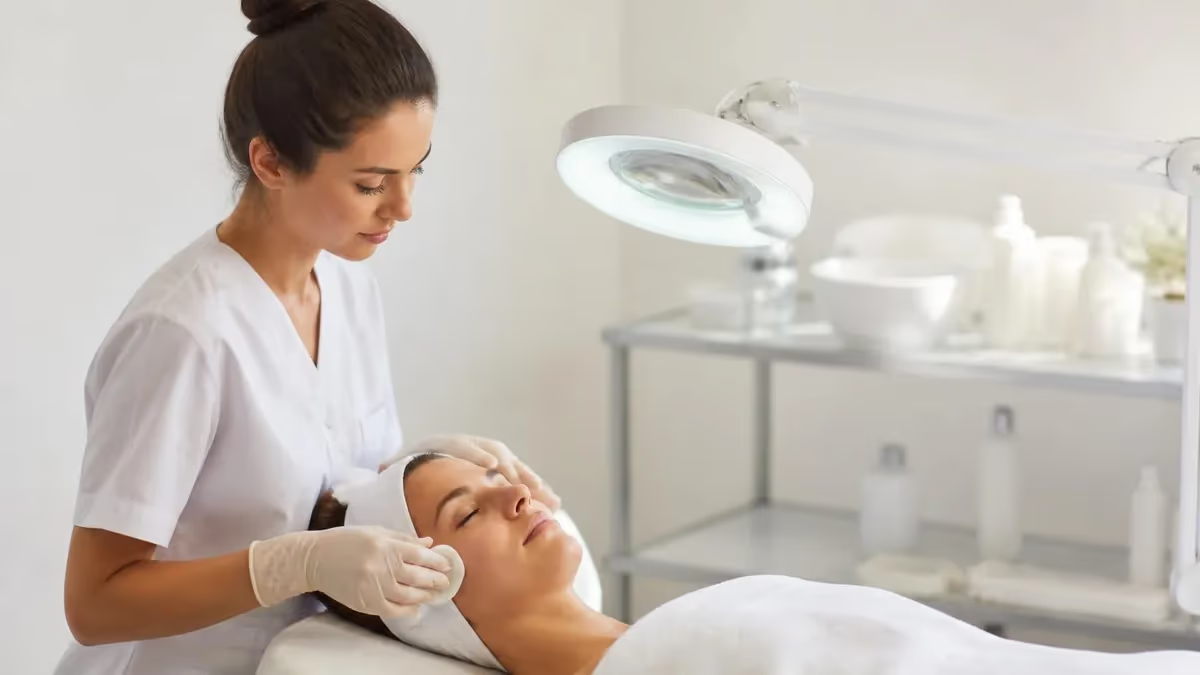
The medical esthetician salary in 2026 averages roughly $58,000 to $72,000 per year in the United States, with experienced clinical estheticians in dermatology, plastic surgery, and medical spa settings often earning $85,000 to $110,000 once commissions, retail bonuses, and tips are included. Pay varies sharply by state, employer type, license tier, and which advanced modalities you can legally perform. Understanding those drivers is the difference between a $42,000 entry-level offer and a six-figure clinical role two years later.
A medical esthetician is a licensed skin specialist who works under the supervision of a physician, nurse practitioner, or physician assistant, typically inside a dermatology clinic, plastic surgery practice, or medical spa. The role goes far beyond a relaxation facial. Daily duties include chemical peels, dermaplaning, microneedling, LED therapy, laser-assist work, post-procedure care, scar revision, acne management, and detailed skin analysis for clients preparing for or recovering from clinical treatments.
If you are still weighing the career, start with a clear picture of the job itself. Read what is an esthetician to understand the licensing scope, then layer the medical specialization on top. The base esthetics license is the foundation; medical estheticians add on-the-job training, manufacturer certifications, and often a 600-hour master esthetician credential in states that recognize the tier.
The compensation upside in medical esthetics comes from three stackable income streams: an hourly or salaried base, treatment commission ranging from 10% to 25%, and retail commission on physician-grade skincare from brands like SkinMedica, ZO Skin Health, Obagi, and Skinbetter Science. A skilled provider who books 28 to 32 clinical hours per week and sells $4,000 to $7,000 in retail monthly will routinely clear $90,000 even in mid-priced markets.
Geography matters more than most new graduates realize. California, New York, Massachusetts, Washington, and Colorado consistently produce the highest medical esthetician salaries because they combine high cosmetic demand, strong disposable income, and price points of $250 to $450 per advanced facial. Texas, Florida, Arizona, and North Carolina pay slightly less per service but offer lower cost of living and faster client volume, which can produce equivalent take-home income.
Employer type is the next big lever. Dermatology offices tend to pay the highest base salary because the schedule is dense and the physician handles marketing. Plastic surgery practices pay strong commissions tied to surgical revenue. Independent medical spas offer the highest commission percentages but expect estheticians to build their own book. Hospital outpatient cosmetic departments pay benefits-heavy packages that look modest on paper but include retirement matching, paid CE, and parental leave.
This guide walks through every variable that moves the number on your paycheck: state averages, experience tiers, specialty premiums, tip culture, commission math, benefits, and the fastest legitimate paths to raise your earnings within 12 to 24 months of getting licensed.
Medical Esthetician Salary by the Numbers

Medical Esthetician Salary by State and Metro
California ($78K avg), Washington ($74K), Massachusetts ($73K), New York ($72K), and Colorado ($69K) lead the country. High cosmetic demand, premium pricing, and strong med-spa density push averages 20-30% above national median.
Texas, Florida, Arizona, North Carolina, Georgia, and Illinois average $58K-$64K. Lower service prices are offset by faster client volume, lower cost of living, and aggressive med-spa expansion in Sun Belt metros.
Mississippi, Alabama, West Virginia, Oklahoma, and Arkansas average $42K-$50K. Limited med-spa infrastructure means most jobs are spa-based facials rather than true clinical work with injectables-team support.
San Francisco, Seattle, Boston, NYC, LA, San Diego, and DC consistently post listings at $30-$42/hour base plus commission. Beverly Hills and Manhattan dermatology offices regularly pay senior estheticians $120K-$150K.
Towns under 50,000 people pay $18-$24 per hour with minimal commission infrastructure. The trade-off is loyalty, retention, and the chance to become the only clinical skin expert within a 40-mile radius.
Experience compounds faster in medical esthetics than in nearly any other beauty-industry career. A new graduate who finishes the standard 600 to 1,200 training hours and passes the written and practical state board exam typically starts at $18 to $24 per hour in a dermatology office, often as an esthetician assistant or junior provider. Within six to twelve months, after completing in-house chemical peel, dermaplaning, and microneedling certifications, most providers move to a full clinical schedule with commission, pushing total compensation past $50,000.
Year two is where the curve steepens. Estheticians who master skin analysis, contraindication screening, and post-procedure care become indispensable to the physician's workflow. They start handling pre-op skin prep for facelift and rhinoplasty patients, post-laser recovery, and the high-margin add-on services that dermatologists do not want to perform themselves. Base pay typically climbs to $26-$32 per hour and treatment commission begins compounding to $65,000-$78,000 in total annual earnings.
By year three, the differentiation between average and top-tier providers is dramatic. A medical esthetician with a strong retention rate of 70%+ and a personal client base of 250-400 active patients can negotiate either a higher commission split (35-50% on services) or a salaried lead-esthetician role at $75,000-$95,000 plus retail bonuses. Some practices offer profit-sharing or signing bonuses to keep these providers from opening competing medspas.
Senior medical estheticians with five to ten years of experience and specialty certifications in laser, body contouring, or oncology esthetics regularly earn $95,000 to $135,000 in major metros. The ceiling is set by your skill stack and your book. Providers who can also perform RF microneedling, hydrafacial, IPL assistance, and full body chemical peels are scheduled solid and command top dollar because they generate revenue across every patient demographic the practice serves.
The path to the highest tier of pay almost always involves becoming a lead esthetician, clinical educator, or practice manager. Lead estheticians at multi-location medspas earn $85,000-$120,000 in base salary plus override commission on the team they supervise. Manufacturer educators for brands like SkinPen, Aerolase, Lutronic, or AviClear can earn $110,000-$160,000 traveling to train other providers. Several roads exist, but they all require building clinical depth first.
For readers still mapping the entry path, the cost-and-time math is worth reviewing alongside the income math. The full breakdown of the esthetician salary trajectory by training hours invested gives a clear ROI lens. Most medical estheticians recoup their tuition within 14 months of licensure, and within three years total lifetime earnings outpace the typical four-year degree in adjacent health fields.
One often-overlooked accelerator: take every free certification a brand-rep offers. SkinMedica, Galderma, Allergan, and Merz Aesthetics run no-cost product training that adds credentials to your résumé and unlocks the specific services your employer bills at premium rates. Estheticians who collect 8-10 brand certifications in their first two years consistently out-earn peers who rely only on what their state board required.
Esthetician Practice Practice Test Questions
Prepare for the Esthetician Practice Exam exam with our free practice test modules. Each quiz covers key topics to help you pass on your first try.
Esthetician Practice Advanced Facial Treat...
Esthetician Practice Exam Questions covering Advanced Facial Treatments. Master Esthetician Practice Test concepts for certification prep.
Esthetician Practice Anatomy and Physiology
Free Esthetician Practice Practice Test featuring Anatomy and Physiology. Improve your Esthetician Practice Exam score with mock test prep.
Esthetician Practice Chemistry and Product...
Esthetician Practice Mock Exam on Chemistry and Product Ingredients. Esthetician Practice Study Guide questions to pass on your first try.
Esthetician Practice Client Consultation a...
Esthetician Practice Test Prep for Client Consultation and Analysis. Practice Esthetician Practice Quiz questions and boost your score.
Esthetician Practice Esthetics Chemistry a...
Esthetician Practice Questions and Answers on Esthetics Chemistry and Ingredients. Free Esthetician Practice practice for exam readiness.
Esthetician Practice Exam Esthetician Prac...
Esthetician Practice Mock Test covering Exam Esthetician Practice Advanced Facial Treatments Questions and Answers. Online Esthetician Practice Test practice with instant feedback.
Esthetician Practice Exam Esthetician Prac...
Free Esthetician Practice Quiz on Exam Esthetician Practice Anatomy and Physiology Questions and Answers. Esthetician Practice Exam prep questions with detailed explanations.
Esthetician Practice Exam Esthetician Prac...
Esthetician Practice Practice Questions for Exam Esthetician Practice Chemistry and Product Ingredients Questions and Answers. Build confidence for your Esthetician Practice certification exam.
Esthetician Practice Exam Esthetician Prac...
Esthetician Practice Test Online for Exam Esthetician Practice Client Consultation and Analysis Questions and Answers. Free practice with instant results and feedback.
Esthetician Practice Exam Esthetician Prac...
Esthetician Practice Study Material on Exam Esthetician Practice Esthetics Chemistry and Ingredients Questions and Answers. Prepare effectively with real exam-style questions.
Esthetician Practice Exam Esthetician Prac...
Free Esthetician Practice Test covering Exam Esthetician Practice Facial Treatments and Massage Questions and Answers. Practice and track your Esthetician Practice exam readiness.
Esthetician Practice Exam Esthetician Prac...
Esthetician Practice Exam Questions covering Exam Esthetician Practice Hair Removal Methods Questions and Answers. Master Esthetician Practice Test concepts for certification prep.
Esthetician Practice Exam Esthetician Prac...
Free Esthetician Practice Practice Test featuring Exam Esthetician Practice Infection Control and Safety Questions and Answers. Improve your Esthetician Practice Exam score with mock test prep.
Esthetician Practice Exam Esthetician Prac...
Esthetician Practice Mock Exam on Exam Esthetician Practice Skin Analysis and Conditions Questions and Answers. Esthetician Practice Study Guide questions to pass on your first try.
Esthetician Practice Exam Esthetician Prac...
Esthetician Practice Test Prep for Exam Esthetician Practice Skin Histology and Disorders Questions and Answers. Practice Esthetician Practice Quiz questions and boost your score.
Esthetician Practice Exam FREE Esthetician...
Esthetician Practice Questions and Answers on Exam FREE Esthetician Knowledge Questions and Answers. Free Esthetician Practice practice for exam readiness.
Esthetician Practice Exam FREE Esthetician...
Esthetician Practice Mock Test covering Exam FREE Esthetician MCQ Questions and Answers. Online Esthetician Practice Test practice with instant feedback.
Esthetician Practice Exam FREE Esthetician...
Free Esthetician Practice Quiz on Exam FREE Esthetician Practice Anatomy and Physiology Questions and Answers. Esthetician Practice Exam prep questions with detailed explanations.
Esthetician Practice Exam FREE Esthetician...
Esthetician Practice Practice Questions for Exam FREE Esthetician Practice Cosmetic Chemistry and Ingredients Questions and Answers. Build confidence for your Esthetician Practice certification exam.
Esthetician Practice Exam FREE Esthetician...
Esthetician Practice Test Online for Exam FREE Esthetician Practice Facial Treatments and Devices Questions and Answers. Free practice with instant results and feedback.
Esthetician Practice Exam FREE Esthetician...
Esthetician Practice Study Material on Exam FREE Esthetician Practice Hair Removal Procedures Questions and Answers. Prepare effectively with real exam-style questions.
Esthetician Practice Exam FREE Esthetician...
Free Esthetician Practice Test covering Exam FREE Esthetician Practice Infection Control and Safety Questions and Answers. Practice and track your Esthetician Practice exam readiness.
Esthetician Practice Exam FREE Esthetician...
Esthetician Practice Exam Questions covering Exam FREE Esthetician Practice Skin Analysis and Conditions Questions and Answers. Master Esthetician Practice Test concepts for certification prep.
Esthetician Practice Exam FREE Esthetician...
Free Esthetician Practice Practice Test featuring Exam FREE Esthetician (Reading) Questions and Answers. Improve your Esthetician Practice Exam score with mock test prep.
Esthetician Practice Facial Treatments and...
Esthetician Practice Mock Exam on Facial Treatments and Massage. Esthetician Practice Study Guide questions to pass on your first try.
Esthetician Practice Hair Removal Methods
Esthetician Practice Test Prep for Hair Removal Methods. Practice Esthetician Practice Quiz questions and boost your score.
Esthetician Practice Infection Control and...
Esthetician Practice Questions and Answers on Infection Control and Safety. Free Esthetician Practice practice for exam readiness.
Esthetician Practice Skin Analysis and Con...
Esthetician Practice Mock Test covering Skin Analysis and Conditions. Online Esthetician Practice Test practice with instant feedback.
Esthetician Practice Skin Histology and Di...
Free Esthetician Practice Quiz on Skin Histology and Disorders. Esthetician Practice Exam prep questions with detailed explanations.
Esthetician Practice Esthetician Knowledge
Esthetician Practice Practice Questions for Esthetician Knowledge. Build confidence for your Esthetician Practice certification exam.
Esthetician Practice Esthetician MCQ
Esthetician Practice Test Online for Esthetician MCQ. Free practice with instant results and feedback.
Esthetician Practice Cosmetic Chemistry an...
Esthetician Practice Study Material on Cosmetic Chemistry and Ingredients. Prepare effectively with real exam-style questions.
Esthetician Practice Facial Treatments and...
Free Esthetician Practice Test covering Facial Treatments and Devices. Practice and track your Esthetician Practice exam readiness.
Medical Esthetician Pay by Workplace Type
Dermatology clinics provide the most consistent and highest base salary for medical estheticians. Hourly pay typically ranges from $26 to $42 depending on metro, with annual totals of $62,000 to $95,000 once retail commission and modest service commission are factored in. The schedule is dense because patients arrive pre-booked by the dermatologist, removing the marketing burden from the esthetician.
The trade-off is volume over creativity. You may perform 12-18 chemical peels, microneedling sessions, and post-procedure facials per day with little room for personalized signature treatments. Many providers consider dermatology the best two-to-three year springboard: you build clinical skill, master contraindications, and earn certifications the practice pays for, then move to a medspa for higher commission splits once your book and confidence are established.

Is a Medical Esthetician Career Worth the Investment?
- +Six-figure earnings achievable within 3-5 years in major metros
- +Stackable income from base pay, service commission, retail commission, and tips
- +Clear career ladder from junior provider to lead, educator, or practice owner
- +Health benefits, paid time off, and CE budgets in dermatology and hospital settings
- +Recession-resistant demand — cosmetic dermatology has grown every year since 2009
- +Skills transfer across all 50 states once you complete reciprocity paperwork
- +Free brand certifications add credentials without tuition cost
- −Entry-level pay of $18-$24/hour can feel low for the first 6-12 months
- −Physical demands of standing and detailed hand work cause early career burnout for some
- −Income highly dependent on rebooking, retail sales, and personal book-building
- −Tuition of $6,000-$20,000 must be paid before earning begins
- −Scope of practice varies by state — what you can perform in one state may be illegal in another
- −Commission-only positions create income volatility and inconsistent paychecks
Pros and Cons at a Glance
| Pros | Cons |
|---|---|
| Stackable income from base pay, service commission, retail commission, and tips | Physical demands of standing and detailed hand work cause early career burnout for some |
| Clear career ladder from junior provider to lead, educator, or practice owner | Income highly dependent on rebooking, retail sales, and personal book-building |
| Health benefits, paid time off, and CE budgets in dermatology and hospital settings | Scope of practice varies by state — what you can perform in one state may be illegal in another |
| Free brand certifications add credentials without tuition cost | Commission-only positions create income volatility and inconsistent paychecks |
How to Increase Your Medical Esthetician Salary in 12 Months
- ✓Complete free certifications from SkinMedica, ZO Skin Health, Obagi, and Skinbetter within the first 90 days of employment
- ✓Earn manufacturer certifications for SkinPen microneedling and at least one chemical peel system
- ✓Track your rebooking rate weekly and aim for 70% before negotiating any raise
- ✓Build a retail attachment rate of $80+ per service ticket through structured home-care recommendations
- ✓Add a high-margin modality like dermaplaning, LED, or hydrafacial within your first six months
- ✓Document every clinical photo with consent and use them as a portfolio when negotiating commission splits
- ✓Move to a 600-hour master esthetician program if your state offers a higher license tier
- ✓Switch employer at the 18-month mark if base pay has not increased at least 15%
- ✓Build a personal Instagram or TikTok presence showcasing real client results with consent
- ✓Get cross-trained in laser-assist or RF microneedling to qualify for the highest commission services
Rebooking rate beats hourly rate every time
A medical esthetician with a 75% rebooking rate at $22/hour earns more annually than one with a 40% rebooking rate at $32/hour. Commission compounds when clients return on six-week cycles. Master your post-treatment rebooking conversation in the first 90 days — it is the single highest-ROI skill in clinical esthetics.
Specialty certifications are the fastest legitimate way to raise a medical esthetician salary above the median. The industry has shifted from generalist providers to credentialed specialists, and clinics now pay premiums for estheticians who can perform specific high-margin services. Five certifications consistently produce the largest pay bumps: advanced chemical peels, microneedling with PRP-assist, dermaplaning, LED light therapy, and laser-and-IPL safety. Each adds $5,000 to $15,000 in annual earning potential once you are competent enough to be scheduled solo.
Chemical peel mastery is the foundation. Most medical estheticians start with superficial alpha-hydroxy and beta-hydroxy peels, but the income jump comes from earning Jessner, TCA, and modified phenol training. Brands like PCA Skin, SkinCeuticals, and ZO Skin Health offer multi-day certification courses that cost $300 to $1,200 and immediately qualify you to perform services priced at $250 to $600 per session. A provider who performs ten peels per week at 30% commission adds roughly $35,000 to annual income.
Microneedling certifications, especially through SkinPen and Dermapen, are essential for any medical esthetician serious about earnings. The treatment generates strong revenue, has a high rebooking rate, and stacks well with PRP for clinics that offer it. Most states allow estheticians to perform microneedling at 0.5mm to 1.0mm depths; deeper protocols require RN, NP, or PA involvement. Knowing exactly where the legal line sits in your state protects your license while maximizing what you can bill.
Laser-and-IPL assist roles are a quiet income accelerator. Estheticians cannot fire most lasers in most states, but they can prep the patient, position the device, manage post-treatment skincare, and handle the consultation. Practices pay $8-$15 per hour premium for laser-trained estheticians because the physician or NP can move faster between rooms. Within 18 months, many laser-trained estheticians transition into device sales or clinical education roles paying $110,000 and up.
Oncology esthetics is the highest-margin niche most providers ignore. Cancer patients undergoing chemotherapy, radiation, and surgical recovery need highly specialized skincare from providers who understand contraindications, port placement, lymphedema risk, and emotional sensitivity. Society for Oncology Esthetics certification costs about $700 and qualifies you to work with major cancer centers and hospital outpatient clinics. The work pays $35-$55 per hour with predictable benefits and minimal cosmetic-sales pressure.
Aesthetician vs esthetician is a question that comes up constantly in salary discussions. In the United States, the two terms are largely interchangeable as a job title, but medical esthetician carries a clinical connotation, while esthetician suggests spa or salon work. Your license title is set by your state — most states use "esthetician" — and your earning power comes from the certifications you stack on top of that base license, not the spelling.
Continuing education spending is the single best ROI investment a working medical esthetician can make. Budget $1,500 to $3,000 annually for certifications, conferences like AmSpa Medical Spa Show and IECSC, and advanced hands-on training. The providers who spend nothing on CE plateau at $50,000-$60,000 forever. The providers who reinvest 3-5% of their income into skill-building consistently reach $90,000 and up by year four.

Microneedling, dermaplaning, and certain peel depths are legal for estheticians in some states and explicitly prohibited in others. Performing a service outside your state's scope can void your license, result in fines of $1,000-$5,000, and create personal liability exposure. Always verify your state board's current scope before adding a new modality, even if your employer claims it's allowed.
Benefits and hidden compensation often add 15-25% to a medical esthetician's effective salary, yet most providers fail to negotiate them. Health insurance through a dermatology or plastic surgery employer typically saves $400-$800 per month compared to marketplace plans. Add dental, vision, disability, and a 401(k) with even a modest 3% match, and the total benefits package can be worth $12,000-$18,000 annually on top of base and commission. When comparing two job offers, always calculate the loaded compensation rather than just the hourly rate.
Tips remain a significant and underappreciated income stream. Even in clinical settings where tipping is not expected, patients tip an average of 12-18% on service totals when the provider builds genuine rapport. A medical esthetician performing eight services per day at $180 average ticket and 15% tip rate earns an extra $216 per day, or roughly $44,000 annually in tips alone. Plastic surgery and high-end dermatology environments tip more generously than budget medspas, especially around major procedures and recovery.
Retail commission is the single most overlooked income stream in medical esthetics. Physician-grade skincare margins are massive, and most practices offer 10-20% commission on retail sales. An esthetician with strong consultation skills who sells $5,000 per month in retail at 15% commission adds $9,000 annually with zero additional hours worked. The skill is structured prescription, not pushy selling. Every patient leaves with three to five recommended products tied to their treatment plan.
Signing bonuses, retention bonuses, and non-compete buyouts have become standard in competitive markets. Major dermatology groups in Texas, Florida, and the Northeast now offer $3,000-$10,000 signing bonuses for experienced medical estheticians, often paid out over 12-24 months. Retention bonuses of $5,000-$15,000 are common at year three to keep top providers from opening competing medspas. Negotiate these explicitly during the offer stage rather than accepting the first written number.
Paid continuing education is one of the most valuable non-cash benefits. The best dermatology and plastic surgery practices pay for two to four certifications per year, plus travel and lodging for one major conference. A typical certification costs $400-$1,200 and a conference runs $1,500-$3,000 with travel. An employer who covers this is effectively raising your salary by $4,000-$8,000 annually while making you more valuable on the open market.
For estheticians who want to validate clinical readiness before negotiating any of these benefits, building familiarity with real exam-style questions matters. The downloadable esthetician employment opportunities resource pulls together hundreds of practice questions covering the exact clinical scenarios medical estheticians face in interview hands-on practicals. Walking into a working interview with confident answers about contraindications, skin analysis, and treatment selection routinely converts to higher starting offers.
One final hidden lever: equity and ownership. Several mid-size medspa groups now offer small equity stakes to lead estheticians who stay three to five years. Even a 1-2% equity slice in a single-location medspa generating $1.5M-$3M in annual revenue can be worth $20,000-$70,000 if the business sells. Ask directly about partnership tracks, profit-sharing, or phantom equity during your year-three negotiation — most owners would rather give equity than lose a top provider.
Putting the full picture together: a medical esthetician who completes 600 hours of training, passes the state board, takes a dermatology entry job at $22/hour, earns five certifications in the first 18 months, and switches to a higher-commission medspa at the two-year mark will realistically reach $85,000-$95,000 in total compensation by year three. That is the standard high-performer trajectory, and it is repeatable in nearly every US metro with a population above 250,000.
The biggest mistakes new medical estheticians make are accepting the first job offered without comparing three options, failing to track rebooking and retail attachment rates, and neglecting to ask for written commission structures. Always ask for the commission schedule in writing before accepting a role. "15% commission" can mean 15% of gross, 15% after product cost, or 15% only after a weekly revenue threshold. The difference can be $15,000-$25,000 annually.
Document everything from day one. Build a digital folder containing your license, all certifications, before-and-after photos with consent, client testimonials, retention metrics, and retail sales data. This becomes your portfolio. When you negotiate a raise or apply to a new practice, walking in with verified performance data converts to higher offers more reliably than any résumé bullet.
Network actively with reps from skincare and device brands. Sales representatives from Galderma, Allergan, Merz, Hologic, Solta, and Cynosure know about job openings, signing bonuses, and educator positions weeks before they hit job boards. Treat your brand reps as career allies — schedule lunches, attend their dinners, and follow them on LinkedIn. Many of the highest-paying medical esthetician roles never get publicly posted.
Take care of your body. Medical esthetics is physically demanding: standing for eight hours, leaning forward over treatment tables, performing fine motor work for hours at a time. The providers who maintain ergonomics, take real breaks, invest in proper saddle chairs, and stretch daily extend their careers by ten to fifteen years. Burnout is the biggest career-shortener in this field. Protecting your body protects your earning power.
Finally, watch the regulatory landscape. State boards regularly update what medical estheticians can perform, especially around microneedling, RF devices, and laser-assist. Subscribe to your state board newsletter, join AmSpa or ASCP, and attend at least one industry conference per year. The estheticians who get hurt financially are the ones surprised by a new regulation. The estheticians who thrive are the ones ahead of it, ready to add the next legal high-margin modality the moment it opens up.
The medical esthetician path remains one of the highest-ROI careers available without a four-year degree. Tuition is modest, time to licensure is short, demand is growing, and the income ceiling is genuinely six figures for skilled providers willing to invest in continuing education and build a real book. Start with a strong clinical foundation, layer specialty certifications strategically, and negotiate every offer with the loaded-compensation framework above — and the salary numbers in this article become not a ceiling but a baseline.
Sample Esthetician Practice Questions
Try these questions from our free Esthetician practice tests. The correct answer and an explanation follow each question.
What is an esthetician’s main goal during a skin analysis?
- A. To remove blackheads.
- B. To diagnose skin diseases.
- C. To select makeup shades.
- D. To assess skin type and condition
Answer: D. To assess skin type and condition
During a skin analysis, an esthetician's main goal is to thoroughly evaluate the client's skin to determine its type (e.g., oily, dry, combination, normal) and current condition (e.g., dehydrated, sensitive, acne-prone, aging). This comprehensive assessment is crucial for developing a personalized and effective treatment plan and recommending appropriate products. It is not for diagnosing medical conditions.
What is the minimum concentration of isopropyl alcohol recommended for disinfecting non-porous surfaces in an esthetician setting?
- A. 50%
- B. 60%
- C. 70%
- D. 90%
Answer: C. 70%
A 70% isopropyl alcohol solution is the standard minimum concentration effective for disinfecting non-porous surfaces in salon and spa environments.
During a facial treatment, an esthetician uses an ultrasonic skin scrubber (spatula). What is the primary principle behind how this device exfoliates the skin?
- A. It uses a direct electrical current to dissolve sebum in the pores.
- B. It emits thermal energy to melt away the stratum corneum.
- C. It uses high-frequency sound waves to create vibrations that loosen dead skin cells.
- D. It projects fine crystals onto the skin to abrade the surface.
Answer: C. It uses high-frequency sound waves to create vibrations that loosen dead skin cells.
An ultrasonic skin scrubber, or spatula, works through a process called cavitation. It uses high-frequency sound waves (typically 28,000 to 30,000 vibrations per second) that, when applied to wet skin, create vibrations that loosen and 'jiggle' out dead skin cells, oil, and debris from the pores for effective exfoliation.
Which method of sterilization uses pressurized steam and is considered the gold standard for reusable esthetician implements?
- A. UV light cabinet
- B. Dry heat oven
- C. Autoclave
- D. Chemical immersion
Answer: C. Autoclave
An autoclave uses pressurized steam at high temperatures to achieve complete sterilization of reusable implements.
Esthetician Questions and Answers

Esthetician Practice Exam 2026

How to Become an Esthetician: Requirements, Training Hours, Costs, and Career Paths
Esthetician Practice Test PDF (Free Printable 2026)

Esthetician State Board Exam Guide: Written and Practical Test Format, Study Tips
How Long Is Esthetician School: State Hours and Real Timelines
About the Author
Licensed Cosmetologist & Beauty Licensing Exam Specialist
Paul Mitchell SchoolsMichelle Santos is a licensed cosmetologist with a Bachelor of Science in Esthetics and Salon Management from Paul Mitchell School. She has 16 years of salon industry experience and 8 years preparing students for state cosmetology board exams in theory, practical skills, and sanitation. She specializes in licensure preparation for cosmetologists, estheticians, and nail technicians.
Join the Discussion
Connect with other students preparing for this exam. Share tips, ask questions, and get advice from people who have been there.
View discussion (4 replies)