
How Much Does an EEG Test Cost? Prices, Insurance, and What to Expect 2026
🧠 How much are EEG tests? Routine EEGs cost $200–$3,000. See EEG test price by type, insurance coverage, how long an EEG test takes, and ways to save.
If you are wondering how much are EEG tests, the short answer is that a routine EEG test in the United States carries a billed price between $200 and $3,000, and most insured patients pay far less than the sticker price. The range surprises almost everyone. An EEG test records electrical activity in the brain through small sensors on the scalp, yet the final bill depends on where you go, how long the recording runs, and who interprets it.
Understanding what is an EEG test helps explain the pricing. An electroencephalogram is a painless EEG medical test that measures brain waves, usually to investigate seizures, unexplained fainting, sleep disorders, confusion, or sudden changes in consciousness. A trained technologist places 16 to 25 electrodes on the scalp with paste or gel, and the machine traces voltage fluctuations on a screen. A neurologist reviews the tracing later. That two-part process, technical recording plus professional interpretation, sits behind nearly every EEG charge.
Most patients see three separate charges. The facility or technical fee covers the room, equipment, supplies, and the technologist's time. The professional fee pays the neurologist or epileptologist who reads the recording, often 30 to 60 minutes of expert review. Sometimes a third charge appears for the visit that ordered the study. Hospital outpatient departments usually bill all of these at higher rates than independent neurology offices, which is why identical recordings can differ by several hundred dollars across town.
Searching for an EEG test price online rarely produces a single number, because prices follow the billing code. Routine awake-and-drowsy studies use CPT code 95816, sleep-deprived recordings use 95819, and ambulatory or video monitoring use newer code families. Each code carries its own reimbursement rate. Medicare's allowed amount for a routine study generally lands in the low hundreds of dollars, while commercial insurers and hospitals negotiate separate rates that can run two to four times higher.
This guide walks through every cost layer: routine, sleep-deprived, ambulatory, and inpatient video EEG pricing, plus what insurance usually covers and how to lower a bill. You will also learn how long an EEG test takes, what happens during the appointment, and whether an eeg test for brain activity carries side effects worth worrying about. Because technologists shape the patient experience, we also outline the daily duties of the professionals who run these studies.
Cost anxiety keeps some people from getting tested, which can delay a diagnosis. Epilepsy affects roughly 3.4 million Americans, and the EEG remains the most widely used tool for confirming epilepsy and classifying seizure type. Spending a few hundred dollars on an accurate recording is often far cheaper than months of misdirected treatment, repeated emergency visits, or an unnecessary hospital admission. Knowing the price structure in advance gives you leverage to ask the right questions before you schedule.
Throughout the article you will find real dollar ranges, step-by-step instructions for checking your coverage, and practice resources for students preparing for neurodiagnostic credentials. Prices change by region and by year, so treat every figure as a planning estimate rather than a quote. Always request a written estimate from the scheduling office, and ask for the facility and professional charges separately so nothing surprises you after the recording is finished and the report reaches your chart.
EEG Test Cost by the Numbers
EEG Test Cost by Type: What You Can Expect to Pay
What Is an EEG Test and Why Does the Price Vary So Much?
So what is EEG test pricing really built on? When people ask what is a EEG test, they usually want to know both the purpose and the expense. An EEG, short for electroencephalogram, places flat metal discs on the scalp to detect tiny voltage changes produced by neurons. Because the machine only listens and never sends current into the body, the procedure is noninvasive. The price reflects staff skill, equipment, and expert interpretation rather than any risky intervention.
Location creates the biggest swing. A hospital outpatient department may charge a facility fee of $600 to $2,500 for a routine study, while a freestanding neurology practice might bill $250 to $800 for the same recording. Academic medical centers sit at the top because their overhead includes round-the-clock monitoring units and research programs. Rural clinics sometimes charge less but offer fewer appointment slots, so patients occasionally travel to a city hospital and pay more for convenience.
Study type is the second driver. A routine EEG captures about 20 to 40 minutes of data, while a sleep-deprived study may last 60 to 90 minutes because the technologist waits for the patient to doze. Ambulatory systems send the patient home wearing electrodes for one to three days. Each extra hour of technologist attention, data storage, and physician review adds cost. That is why the same eeg brain test can land in very different price tiers.
Billing practices add another layer. Hospitals publish chargemaster prices, which are inflated starting points that insurers rarely pay in full. Under federal price transparency rules, hospitals must post negotiated rates, so you can search a facility's website for CPT 95816 and compare plans side by side. Many patients discover that their insurer's negotiated rate is 30 to 70 percent below the chargemaster figure, and that cash discounts can beat insurance for people with high deductibles.
Interpretation fees deserve a closer look. A board-certified neurologist or clinical neurophysiologist reviews the entire recording, marking spikes, sharp waves, slowing, and artifact from muscle or eye movement. For a routine study this takes 20 to 45 minutes, and the professional fee commonly runs $100 to $400. In ambulatory and video monitoring, review can take several hours because there are 24 to 72 hours or more of data, which explains the steep price jump.
Duration questions come up constantly, so here is the realistic answer to how long is an EEG test. Plan on 60 to 90 minutes at the clinic for a routine study, including electrode placement, a 20 to 40 minute recording, and cleanup. Sleep-deprived recordings can stretch to two hours. Ambulatory studies last 24 to 72 hours at home, and inpatient video EEG can continue for three to seven days until the care team captures enough events.
Finally, remember that an EEG medical test is only one piece of an evaluation. Patients with new seizures often also need MRI, blood work, and a neurology visit, and those charges stack. When someone asks what is an EEG medical test worth, the clinical answer is that it can shorten diagnostic delays and guide medication choices. Ask your clinician which components are truly necessary, then price them individually before scheduling anything, so you avoid duplicated testing.
EEG Test Price: Routine, Sleep-Deprived, and Ambulatory Compared
A routine EEG is the standard first-line study and the one most people mean when they search for an eeg test price. It records 20 to 40 minutes of brain activity while you rest with eyes open and closed, then may include hyperventilation and flashing lights. Billed totals run from $200 at independent clinics to $3,000 at large hospitals, with insured out-of-pocket costs often between $0 and $400.
Appointments take about an hour to an hour and a half because electrode placement consumes the first 20 to 30 minutes. Results typically reach your ordering doctor within one to seven days. Routine studies catch abnormalities in roughly half of people with epilepsy on the first try, so a normal result does not always end the workup, and a repeat or longer study may follow.
Is an EEG Test Worth the Cost?
- +Noninvasive and painless, with no radiation exposure
- +Often the fastest way to confirm or rule out seizure activity
- +Routine studies are among the least expensive neurodiagnostic tests
- +Most insurance plans cover medically necessary EEGs
- +Results can steer medication choices and prevent costly misdiagnosis
- +Appointments are short, usually under 90 minutes for a routine study
- −Billed prices vary by thousands of dollars across facilities
- −A single routine EEG can miss abnormalities that appear only occasionally
- −Separate facility and professional bills can arrive weeks apart
- −Ambulatory and video monitoring may require prior authorization
- −Sleep-deprived studies demand an inconvenient night of limited sleep
- −Paste or glue in the hair can be messy and take time to wash out
How to Lower Your EEG Test Cost: 10 Practical Steps
- ✓Call your insurer and confirm the EEG is covered under your plan.
- ✓Ask whether prior authorization is required before you schedule.
- ✓Request the CPT code from your doctor's office, usually 95816 or 95819.
- ✓Compare in-network hospital and independent clinic prices for that code.
- ✓Search the hospital's posted price transparency file for negotiated rates.
- ✓Ask for a written estimate that separates facility and professional fees.
- ✓Inquire about a self-pay discount if your deductible is high.
- ✓Confirm the neurologist who reads the study is in your network.
- ✓Ask about financial assistance or a payment plan before the visit.
- ✓Review your explanation of benefits and dispute any duplicate charges.
Network Status Applies to Two Different Bills
An in-network facility does not guarantee an in-network reader. Ask whether the neurologist who interprets your EEG participates in your plan, because an out-of-network professional fee can add $100 to $400 even when the technical fee is fully covered.
What Happens During an EEG Medical Test Appointment
Knowing the steps makes the cost feel more concrete, because every stage involves paid staff time. When you arrive, a registration clerk verifies insurance and collects any copay. A technologist then reviews your history, asks about medications, recent sleep, and prior seizures, and measures your head to place electrodes accurately. This intake usually takes 10 to 15 minutes and is the first place the technologist's clinical judgment shapes the quality of the final recording.
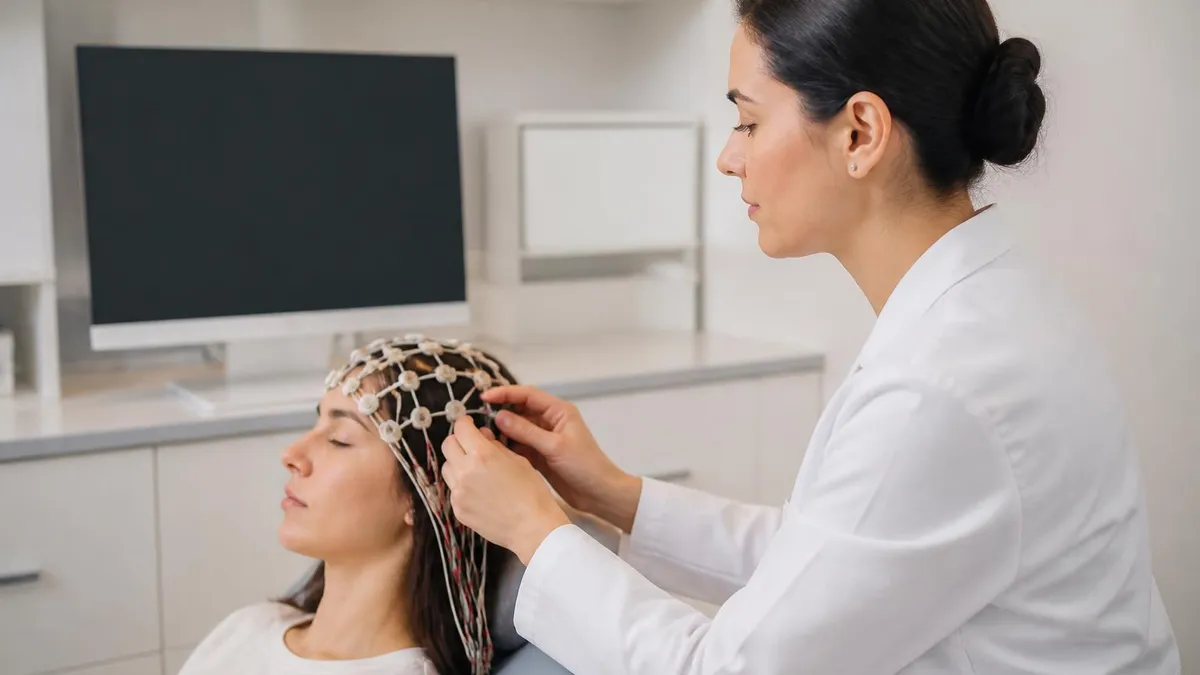
Next comes electrode placement using the international 10-20 system, a standardized map that spaces sensors at 10 or 20 percent intervals across the skull. The technologist lightly scrubs each site, applies conductive paste, and secures every disc, checking impedance so signals stay clean. Placing 21 or more electrodes carefully takes 20 to 30 minutes. Poor contact creates artifact, which is why experienced technologists are the hidden value inside every EEG bill.
You then rest in a reclined chair or bed, eyes closed for much of the recording, while the technologist watches the screen and annotates events such as blinking, swallowing, or movement. The room is usually dim and quiet. Most people feel nothing at all, and some doze off. This phase runs 20 to 40 minutes for a routine EEG test, though sleep-deprived protocols deliberately allow additional time for natural sleep to occur.
Activation procedures follow, designed to provoke abnormal activity that might not appear at rest. Hyperventilation asks you to breathe deeply and steadily for about three minutes, and photic stimulation flashes a strobe light at different frequencies. Both techniques can reveal absence seizures or photosensitivity. The technologist watches for any change in awareness and stops immediately if needed. These maneuvers add only minutes to the visit but meaningfully increase the diagnostic value of the study.
After the recording, the technologist removes the electrodes and cleans most of the paste with a damp cloth or acetone-free remover. A bit of residue usually remains, so many people wash their hair at home. Then the data file goes to a neurologist, who reads the full tracing and writes a report. Turnaround ranges from same-day in hospital settings to a week in busy outpatient practices, and this is when the professional fee is generated.
Preparation affects both the quality and the cost of the visit. Arrive with clean, dry hair free of oils, gels, sprays, and extensions, since these interfere with electrode contact. Eat normally and take prescribed medications unless your doctor says otherwise, but avoid caffeine on the day of the study. Bring a medication list and a short description of your events. A rejected recording due to poor preparation can force a repeat appointment and a second bill.
Finally, ask how the results will reach you. Some clinics release reports through a patient portal within days, while others require a follow-up visit with the ordering physician. The report might read normal, mildly abnormal, or show epileptiform discharges, and none of those labels is a diagnosis alone. Context matters, and your doctor will connect the findings to symptoms, imaging, and history before recommending treatment, repeat testing, or no further action at all.
Under the No Surprises Act, uninsured and self-pay patients can request a good faith estimate before scheduling. Ask for it in writing for the EEG, the interpretation, and any follow-up visit, and compare it against your final bill.
EEG Test Side Effects, Risks, and Hidden Costs
Safety questions often travel with cost questions, and the reassuring answer is that an EEG is one of the safest tests in medicine. Reviewing eeg test side effects shows that most people experience none beyond mild skin redness or tackiness from paste where electrodes sat. The machine does not deliver electricity or radiation. It simply amplifies the faint signals your brain already produces, so there is no recovery period and no restriction on driving afterward.
Rare risks do exist. Hyperventilation can cause lightheadedness, tingling in the fingers, or a brief feeling of anxiety, and these sensations fade within a minute or two of normal breathing. Flashing lights can trigger a seizure in a small number of people with photosensitive epilepsy, which is exactly why the study is done in a monitored room with trained staff ready to respond. The chance of a seizure is low, and technologists are certified in basic life support.
Skin sensitivity is the most common complaint. People with eczema, very sensitive scalps, or allergies to adhesives such as collodion may develop irritation under electrodes. Tell the technologist before placement so they can choose a gentler paste or adjust the glue. In ambulatory studies, electrodes stay in place for days, so itching and mild breakouts occur more often. Dermatologic problems rarely last beyond a week, and they almost never require medical treatment.
Sleep-deprived protocols add temporary effects. Staying awake overnight can leave you tired, irritable, or unsteady, and a few patients feel headachy afterward. Because sleep loss itself can lower the seizure threshold, clinics screen people carefully and give clear instructions about how many hours to sleep beforehand. You should not drive home if you feel drowsy. Arrange a ride in advance, since a rushed taxi fee is one more small cost of the visit.
Hidden costs deserve equal attention. Common examples include a separate bill from the interpreting neurologist, a fee for the follow-up appointment, charges for a repeat study when artifact ruins the first, and parking or lost wages for a half day off work. Ambulatory patients may owe supply fees if equipment is not returned. Adding these items to your estimate can raise the true cost of an EEG test by 20 to 50 percent.
Cost also interacts with accuracy. A single normal routine EEG does not rule out epilepsy, because abnormalities can come and go. Studies show a first routine recording catches epileptiform activity in about 30 to 50 percent of people with epilepsy, and repeating it raises that figure toward 80 to 90 percent. A sleep-deprived or ambulatory follow-up is therefore a legitimate expense, not an upsell, when symptoms persist after an unrevealing first study.
If you are a student or new technologist reading this, the same safety awareness applies to your daily practice. Verifying identity, monitoring the patient throughout activation, documenting every event, and keeping electrode impedances low are core duties that protect patients and preserve data quality. Careful technique reduces repeated recordings, which saves patients money and time. Strong safety habits and accurate documentation are the quiet reasons many neurology offices keep their per-study costs low.
Practical Tips for Finding an Affordable EEG and Understanding the Technologist's Role
Start your search with your ordering physician rather than a search engine. Doctors know which local labs deliver fast, readable studies, and some neurology groups own in-office EEG suites with lower overhead than hospitals. If you type eeg test near me into a search bar, you will see dozens of locations, but only your insurer's directory confirms network status. Call two or three in-network sites, quote the CPT code, and compare estimates before booking.
Use your insurance benefits wisely. If you have not met your deductible, the full negotiated rate falls on you, so schedule before year-end resets only when it helps your accumulated costs. Health savings accounts and flexible spending accounts let you pay with pre-tax dollars, effectively reducing the price by your marginal tax rate. Keep every explanation of benefits, because errors such as duplicate professional fees are common and often reversed after a polite phone call.
Negotiate when you pay out of pocket. Independent clinics frequently offer prompt-pay discounts of 20 to 40 percent off the listed price, and hospitals have financial assistance policies, particularly nonprofit systems required to maintain charity care. Ask about income-based reductions and interest-free payment plans. Many billing departments will accept a lower lump sum rather than chase a balance for months. Written agreements protect you, so confirm the final amount in an email before you pay.
Prepare thoroughly to avoid a repeat study. Wash your hair the night before without conditioner, skip hair products, and wear a loose top that buttons or zips so you do not pull anything over the electrodes. Follow sleep instructions exactly if you were told to cut back. Write down your symptoms, medications, and any triggers you have noticed. Clean signals and complete histories help the neurologist make a firm interpretation the first time.
It also helps to know who is doing the work. An EEG technologist places electrodes, runs the recording, applies activation procedures, annotates the tracing, and keeps the patient safe and comfortable. Many hold the R. EEG T. credential from the American Board of Registration of Electroencephalographic and Evoked Potential Technologists, and typical salaries for neurodiagnostic technologists often fall around $50,000 to $75,000 depending on region and experience. Their skill directly affects whether a study is usable.
Students aiming for this career should practice pattern recognition early. Learning to separate true epileptiform discharges from eye blinks, muscle activity, and electrode pops builds the judgment that employers value. Understanding what follows a finding is also useful, and our overview of abnormal EEG results explains next steps. Free practice questions on epileptiform patterns and activation procedures let you test yourself in short sessions before certification exams or clinical rotations.
Last, keep perspective on value. The right EEG at the right time can prevent months of uncertainty, unnecessary medications, or missed diagnoses, and it often costs less than a single emergency department copay. Do your homework, ask for estimates, document every conversation, and follow preparation instructions carefully. With those steps you can usually secure a high-quality study at a fair price and walk out with answers that guide the next phase of care.
EEG Questions and Answers

Sleep Deprivation EEG: What It Is, How It Works, and What to Expect

How to Read an EEG Test: A Complete Guide to Brain Wave Patterns and Results

What Does an EEG Do? Everything You Need to Know About the EEG Test
Abnormal EEG Results: What They Mean, Common Patterns, and Next Steps

EEG Sleep Stages: How Brain Waves Change During Sleep and What the Test Reveals
How this page was made: written with AI tools and published by Nathan Beja, founder of Practice Test Geeks, who is responsible for its content. Exam facts are checked against the official sources listed below. Not reviewed by a subject-matter expert. Editorial policy
Sources & references
Exam facts on this page (fees, format, dates, passing scores) are checked against these official sources; the date is our last check. Editorial policy
- abret.org — Late registration, score validity, test delivery, fees, exam format, passing score, retake policy, score release, test dates · verified Oct 2026