
EEG Test Cost in 2026 October: Prices, Insurance Coverage, and How to Save
EEG test cost in 2026 October ranges $200-$3,000+. ❓ See real prices by type, insurance coverage rules, and proven ways to lower your bill.
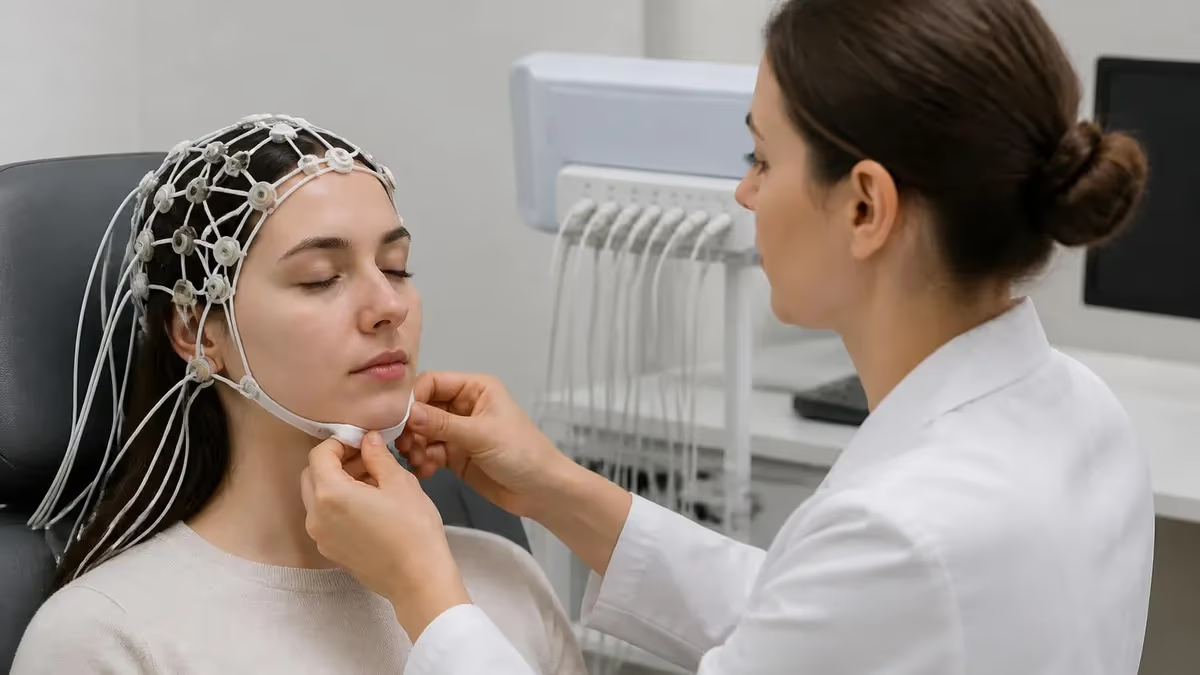
The eeg test cost in the United States varies more than most patients expect, with prices ranging from roughly $200 for a basic outpatient study to over $3,000 for an ambulatory or video-monitored recording. An electroencephalogram measures the electrical activity of your brain through small electrodes placed on the scalp, and it is the gold standard for evaluating seizures, unexplained loss of consciousness, sleep disorders, and certain types of headaches. Understanding what drives the price helps you plan, budget, and avoid surprise bills.
Three major factors shape your final bill: the type of EEG ordered, the facility performing it, and your insurance plan's negotiated rate. A routine 20 to 40 minute scalp recording at an outpatient neurology clinic is far cheaper than a 72 hour ambulatory study or a multi day inpatient video EEG. Hospital-based studies often cost two to three times more than the same procedure performed at an independent neurodiagnostic center, even when the technology and interpretation are identical.
Insurance coverage is generally favorable when the eeg test is medically necessary and pre-authorized, but cost-sharing varies widely. High-deductible health plans can leave you responsible for the full negotiated rate until your deductible is met, while traditional plans typically apply a copay or coinsurance percentage. Medicare reimburses EEG under specific CPT codes with a standard fee schedule, and Medicaid coverage rules differ by state, particularly for ambulatory and long-term monitoring studies.
If you are paying cash or have not yet met your deductible, the spread between providers can be dramatic. The same routine EEG may be billed at $1,200 by a large hospital system and $325 by an independent clinic across town. Many imaging and neurodiagnostic centers publish self-pay rates online and will quote a bundled price that includes both the technical recording and the neurologist's interpretation, two charges that hospitals often split into separate, more expensive bills.
This guide breaks down EEG pricing for routine, ambulatory, sleep-deprived, and video EEG studies, explains what insurance typically covers, walks through the billing codes you will see, and shares practical strategies to negotiate or reduce your costs. Whether you are a patient preparing for your first study, a parent navigating pediatric neurology, or a caregiver coordinating long-term monitoring, the numbers and tactics below will help you make informed choices.
We also clarify what is and is not included in a quoted price, because that single detail accounts for most billing disputes. A facility fee, electrode setup, technologist time, neurologist read, and any sedation or activation procedure can all appear as separate line items. Asking the right questions before scheduling can keep your out-of-pocket spend hundreds of dollars lower without sacrificing the quality of the study or the accuracy of the diagnosis.
EEG Test Cost by the Numbers

EEG Test Price by Study Type
Patients commonly ask what is an eeg test going to cost in real terms, and the honest answer is that two people with identical orders can pay wildly different amounts. The single largest driver is the place of service. Hospital outpatient departments charge a facility fee on top of the professional and technical components, while freestanding neurology clinics and independent diagnostic testing facilities (IDTFs) usually bill a single bundled rate. That facility fee alone can add $400 to $1,500 to a routine EEG.
The second driver is geography. Studies from healthcare price transparency datasets show that EEG prices in major metro areas like New York, San Francisco, and Boston routinely run 40 to 70 percent higher than the same study in mid-sized markets such as Indianapolis, Birmingham, or Tucson. Rural areas can be cheaper still, although limited provider availability sometimes forces patients into a regional hospital system with hospital-level pricing.
Insurance status matters enormously. If you are in-network, your plan has a pre-negotiated rate that may be 40 to 80 percent lower than the facility's chargemaster price. Out-of-network patients can be billed the full chargemaster amount, which is essentially a sticker price designed for negotiation rather than payment. Self-pay patients who proactively ask for the cash rate often get a discount of 30 to 60 percent off the chargemaster, sometimes matching or beating the insurance rate.
The third driver is study complexity. A routine 30 minute EEG involves about 20 electrodes, a single technologist, and a single read by a neurologist. A long-term video EEG requires a dedicated hospital room, continuous technologist monitoring, video equipment, and daily neurologist reads, often with an epileptologist on the team. The labor and equipment costs scale accordingly, which is why a five-day video EEG can exceed $30,000 in total billed charges.
Add-on services can quietly inflate the bill. Activation procedures such as hyperventilation and photic stimulation are usually included, but sedation for pediatric or anxious patients is billed separately. If sedation requires an anesthesiologist or anesthesia nurse, expect an additional $400 to $1,500 charge. Sleep deprivation protocols that require an extended stay or overnight observation may also include accommodation fees if performed in a sleep lab setting.
Finally, the neurologist's reading fee is a separate professional charge in many billing models. A typical interpretation runs $100 to $300 for a routine study and $300 to $800 for a long-term study. Subspecialty reads by an epileptologist or pediatric neurologist may carry a premium. Always confirm whether the price you have been quoted includes the professional read or only the technical recording, because billing surprises in this gap are extremely common.
Knowing these levers gives you control. Ask the scheduler for an itemized estimate, request the CPT codes that will be billed, and call your insurance plan to confirm the patient responsibility for each code. The 15 minutes you spend on these calls before the appointment can save you hundreds or even thousands of dollars after the study is complete.

EEG Practice Test Questions
Prepare for the EEG - Electroencephalography exam with our free practice test modules. Each quiz covers key topics to help you pass on your first try.
EEG Abnormal Epileptiform Patterns
EEG Exam Questions covering Abnormal Epileptiform Patterns. Master EEG Test concepts for certification prep.
EEG Activation Procedures
Free EEG Practice Test featuring Activation Procedures. Improve your EEG Exam score with mock test prep.
EEG Artifact Identification
EEG Test Prep for Artifact Identification. Practice EEG Quiz questions and boost your score.
EEG Electrode Placement and Montages
EEG Questions and Answers on Electrode Placement and Montages. Free EEG practice for exam readiness.
EEG - Electroencephalography Abnormal Epil...
EEG Mock Test covering - Electroencephalography Abnormal Epileptiform Patterns. Online EEG Test practice with instant feedback.
EEG - Electroencephalography Activation Pr...
Free EEG Quiz on - Electroencephalography Activation Procedures. EEG Exam prep questions with detailed explanations.
EEG - Electroencephalography Artifact Iden...
EEG Practice Questions for - Electroencephalography Artifact Identification. Build confidence for your EEG certification exam.
EEG - Electroencephalography Electrode Pla...
EEG Test Online for - Electroencephalography Electrode Placement and Montages. Free practice with instant results and feedback.
EEG - Electroencephalography Instrumentati...
EEG Study Material on - Electroencephalography Instrumentation and Calibration. Prepare effectively with real exam-style questions.
EEG - Electroencephalography Neuroanatomy ...
Free EEG Test covering - Electroencephalography Neuroanatomy and Physiology. Practice and track your EEG exam readiness.
EEG - Electroencephalography Non-Epileptif...
EEG Exam Questions covering - Electroencephalography Non-Epileptiform Abnormalities. Master EEG Test concepts for certification prep.
EEG - Electroencephalography Normal EEG Wa...
Free EEG Practice Test featuring - Electroencephalography Normal EEG Waveforms. Improve your EEG Exam score with mock test prep.
EEG - Electroencephalography Patient Safet...
EEG Mock Exam on - Electroencephalography Patient Safety and Ethics. EEG Study Guide questions to pass on your first try.
EEG - Electroencephalography Pediatric and...
EEG Test Prep for - Electroencephalography Pediatric and Neonatal EEG. Practice EEG Quiz questions and boost your score.
EEG ICU and Continuous EEG Monitoring
EEG Questions and Answers on ICU and Continuous EEG Monitoring. Free EEG practice for exam readiness.
EEG Instrumentation and Calibration
EEG Mock Test covering Instrumentation and Calibration. Online EEG Test practice with instant feedback.
EEG Neuroanatomy and Physiology
Free EEG Quiz on Neuroanatomy and Physiology. EEG Exam prep questions with detailed explanations.
EEG Non-Epileptiform Abnormalities
EEG Practice Questions for Non-Epileptiform Abnormalities. Build confidence for your EEG certification exam.
EEG Normal EEG Waveforms
EEG Test Online for Normal EEG Waveforms. Free practice with instant results and feedback.
EEG Patient Safety and Ethics
EEG Study Material on Patient Safety and Ethics. Prepare effectively with real exam-style questions.
How Long Is an EEG Test and What Affects Price
A routine EEG records 20 to 40 minutes of brain activity while you rest, breathe deeply, and watch a flashing light. Including setup, electrode placement, and removal, plan on 60 to 90 minutes total in the clinic. Because the procedure is short and uses standard equipment, it is the least expensive option.
Insurance plans almost always cover routine EEG when ordered for seizures, syncope, head injury, or unexplained altered mental status. Expect total billed charges of $200 to $700 at independent clinics and $700 to $1,800 at hospital outpatient departments, with patient responsibility typically running $50 to $400 after insurance.
Hospital EEG vs. Independent Clinic: Which Saves You More?
- +Independent clinics often bill 40-70% less than hospital outpatient departments
- +Bundled pricing avoids surprise separate facility, technical, and professional fees
- +Self-pay cash rates at clinics are typically published and easy to compare
- +Shorter wait times for scheduling routine EEG studies
- +Direct communication with the reading neurologist is often easier
- +Less paperwork and lower copay structure for most commercial plans
- −Limited availability for ambulatory and video EEG outside hospital systems
- −May not be in-network for some narrow-network HMO plans
- −Emergency or inpatient EEG cannot be performed at outpatient clinics
- −Sedation services for pediatric patients may require hospital referral
- −Some neurologists only read studies done within their hospital system
- −Specialty epilepsy monitoring units exist primarily in academic medical centers
Pros and Cons at a Glance
| Pros | Cons |
|---|---|
| Bundled pricing avoids surprise separate facility, technical, and professional fees | Limited availability for ambulatory and video EEG outside hospital systems |
| Self-pay cash rates at clinics are typically published and easy to compare | May not be in-network for some narrow-network HMO plans |
| Shorter wait times for scheduling routine EEG studies | Emergency or inpatient EEG cannot be performed at outpatient clinics |
| Direct communication with the reading neurologist is often easier | Sedation services for pediatric patients may require hospital referral |
| Less paperwork and lower copay structure for most commercial plans | Some neurologists only read studies done within their hospital system |

Questions to Ask Before Scheduling Your EEG Test
- ✓Which CPT code will be used for billing this EEG study?
- ✓Is the facility in-network with my insurance plan for this CPT code?
- ✓Does the quoted price include both the technical recording and the professional read?
- ✓Are activation procedures or sedation billed as separate line items?
- ✓Will a facility fee be added on top of the technical and professional charges?
- ✓What is the cash or self-pay rate if I choose not to bill insurance?
- ✓Has prior authorization been obtained and confirmed in writing?
- ✓What is my estimated out-of-pocket cost based on my current deductible status?
- ✓Can the study be performed at an independent clinic instead of the hospital?
- ✓Will an itemized statement be available within 30 days of the procedure?
Always Ask for the Cash Price
Even with insurance, request the self-pay cash rate before scheduling. Many neurodiagnostic clinics offer cash discounts of 30 to 60 percent, which can be lower than your insurance coinsurance after factoring in deductibles. If the cash price beats your insurance estimate, you may save money by paying directly and skipping the claim.
To understand your bill, it helps to know the actual CPT codes neurologists and hospitals use. A routine EEG is typically billed under CPT 95816 (awake and drowsy, less than 41 minutes) or 95819 (awake and asleep). Sleep-deprived EEG often uses 95822. Extended EEG monitoring up to 24 hours falls under 95812, while long-term monitoring uses the 95717 through 95726 series introduced in recent code updates. Each code carries a specific Medicare fee schedule amount that anchors what other payers will reimburse.
Medicare 2026 national average reimbursement for a routine EEG (95816) is roughly $130 to $170 for the global fee, split between a technical component paid to the facility and a professional component paid to the reading neurologist. Commercial insurance plans typically reimburse 110 to 180 percent of Medicare rates, which is why your insured allowable amount may be $180 to $400 even though the hospital chargemaster lists $1,200 or more.
Long-term video EEG codes (95720 through 95726) are reimbursed by Medicare at $120 to $250 per 24 hour interpretation, on top of the technical recording. Multi-day studies stack these codes daily, which is why total reimbursement for a five day epilepsy monitoring unit stay can reach $5,000 in professional fees alone, plus thousands more in technical and facility charges.
Sedation, when required, is billed separately under anesthesia CPT codes such as 00170 or 00752, depending on the location and type. Anesthesia billing uses time units that multiply quickly, often adding $400 to $1,500 to a pediatric EEG. If you can avoid sedation with a child life specialist or by scheduling during natural sleep, you can sometimes skip this charge entirely.
The professional fee modifier 26 indicates the physician's interpretation only, while modifier TC indicates the technical component only. When you see both on your explanation of benefits, you are looking at a split bill from two different entities. Confirm that the same physician or group reading the study is in-network, because the technical facility and the reading physician are sometimes contracted separately, creating a hidden out-of-network exposure.
You can pull these codes from your scheduling confirmation, your insurance pre-authorization letter, or by asking the facility's billing office. Once you have them, the Centers for Medicare and Medicaid Services maintains a public fee schedule lookup that lets you see the Medicare allowable. Multiplying that number by 1.2 to 1.8 gives you a realistic ballpark of what your commercial insurance will pay, which is the number that should drive your out-of-pocket estimate.
Knowing the codes also helps if you need to appeal a denied claim. EEG denials often hinge on missing documentation of medical necessity, incorrect ICD-10 diagnosis codes, or use of a code that requires prior authorization. With the exact CPT code in hand, you can call your insurance, identify the specific reason for denial, and ask the ordering neurologist to submit the corrected documentation.
Even at an in-network hospital, the neurologist who reads your EEG may bill separately and could be out-of-network. The federal No Surprises Act protects you in most emergencies and at in-network facilities, but you must dispute the bill in writing within the required window. Always confirm both the facility and the interpreting physician are in your network before the study.
Reducing your EEG bill starts with location. If your neurologist offers a choice between a hospital outpatient department and an independent neurodiagnostic clinic, the clinic will almost always be cheaper. Ask the scheduler directly: "Is there a non-hospital location where I can have this same study done?" Many academic medical centers operate satellite clinics for outpatient testing that bill at a lower rate while using the same physicians and equipment. The savings can be 50 percent or more for a routine EEG.
For self-pay or high-deductible patients, get three written quotes. Call independent clinics, university health systems, and hospital outpatient departments within a reasonable driving distance. Ask each one for the all-inclusive cash price including the read, and write it down with the date and the staff member's name. Bring the lowest quote to your preferred provider and ask if they will match it, a tactic that succeeds more often than patients realize.
Compare your insurance estimate to the cash price. Use your plan's online cost estimator or call member services for the patient responsibility on each CPT code. If you have not met your deductible and the cash price is lower than the insurance allowable amount, paying cash may save money. Be aware that paying cash means the charge will not count toward your deductible or out-of-pocket maximum, so factor in whether you expect more medical spending this year.
Use a Health Savings Account or Flexible Spending Account if you have one. EEG studies are qualified medical expenses, and paying with pre-tax dollars effectively discounts the bill by your marginal tax rate, often 22 to 32 percent. If you have an HSA-eligible high-deductible plan, this can be one of the most efficient ways to absorb the cost while building tax-advantaged savings.
Negotiate after the fact if you receive a surprise bill. Hospital billing departments routinely offer prompt-pay discounts of 10 to 30 percent for patients who pay the full balance within 30 days. If the bill is unmanageable, ask about financial assistance or charity care policies; nonprofit hospitals are required to publish them, and many patients with household incomes up to 400 percent of the federal poverty level qualify for partial or full forgiveness.
Check the what is eeg test documentation against your explanation of benefits line by line. Billing errors are common, including duplicate charges, incorrect CPT codes, and unbundling of services that should be billed together. Ask for an itemized statement (not a summary), compare it to your EOB, and dispute any discrepancies in writing. Even legitimate-looking bills can contain errors that, once corrected, lower your balance by hundreds of dollars.
Finally, plan timing strategically. If you have already met your deductible for the year, scheduling additional testing before December 31 lets you pay only coinsurance rather than restart the deductible in January. Conversely, if you have a major surgery or treatment planned, bundling tests into the same calendar year as that procedure may push you past your out-of-pocket maximum, after which the EEG becomes essentially free.
A few practical preparation tips will keep your study efficient and reduce the chance of needing a costly repeat. Wash your hair the night before with regular shampoo only; skip conditioner, gel, hairspray, oils, and dry shampoo, all of which interfere with electrode contact and can force technologists to spend extra time prepping the scalp. Some clinics will reschedule patients whose hair is heavily product-laden, which means another round of scheduling and another copay.
Do not stop seizure medications unless your neurologist specifically instructs you to. Discontinuing antiseizure drugs without medical supervision can trigger breakthrough seizures and skew study results. If your neurologist orders a medication taper for a video EEG, follow it precisely, document each dose, and bring the list to your admission. A study that fails to capture a seizure because of medication confusion may need to be repeated, doubling the cost.
For sleep-deprived EEG, follow the sleep restriction protocol exactly. Most labs ask you to stay awake for the four to eight hours preceding the appointment, and some require complete overnight sleep deprivation. Arrange transportation, because driving drowsy is dangerous and many clinics will not perform the study if you arrived behind the wheel alone. Caffeine restriction varies by lab, so call ahead and confirm.
If you are bringing a child, plan around their nap or bedtime when possible. A natural sleep recording avoids sedation and the associated $400 to $1,500 anesthesia bill. Many pediatric labs schedule late-morning appointments for toddlers and offer comfortable rooms with parents present. Bring familiar comfort items, a favorite blanket, and a tablet with downloaded content for the awake portion of the study.
After the study, follow up on the report. Most neurologists deliver results within three to seven business days, with urgent cases read same-day. If you have not received results within two weeks, call the office. A study that sits unread is a study you paid for but cannot act on, and persistent symptoms may warrant repeat testing or specialist referral that adds further cost if the original report is lost in the workflow.
Compare the eeg test price you were quoted with the actual explanation of benefits when it arrives. Ask the billing office to walk you through any difference. Hospitals will sometimes adjust a bill simply because you noticed an inconsistency between the verbal quote and the final charge. Keep a written log of every conversation, including the date, the representative's name, and the substance of the discussion, in case you need to escalate.
Finally, if cost is a barrier to getting an EEG you need, do not delay care. Speak with your neurologist's social worker or the hospital's financial counselor about payment plans, charity care, and clinical trials that include free testing. Untreated seizures and undiagnosed neurological symptoms can lead to far more expensive emergency care, lost work, and safety risks. The cheapest EEG is the one that delivers a diagnosis before a crisis.
Sample EEG - Electroencephalography Practice Questions
Try these questions from our free EEG - Electroencephalography practice tests. The correct answer and an explanation follow each question.
Which of the following actions by an EEG technologist is a direct violation of the Health Insurance Portability and Accountability Act (HIPAA)?
- A. Discussing a complex EEG record with the interpreting neurologist in a private reading room.
- B. Using a hospital-provided, encrypted tablet to review a patient's prior EEG report.
- C. Looking up the medical records of a celebrity who is a patient in another part of the hospital out of curiosity.
- D. Calling the patient's nurse to confirm their current list of medications.
Answer: C. Looking up the medical records of a celebrity who is a patient in another part of the hospital out of curiosity.
Accessing a patient's protected health information (PHI) without a legitimate, job-related reason is a serious HIPAA violation. Curiosity is not a valid reason for accessing records. The other options describe appropriate actions: consulting with the care team, using secure devices, and gathering necessary clinical information are all permissible uses of PHI for patient care.
A technologist notices intermittent square-wave transients isolated to a single electrode that disappear when the electrode impedance is rechecked and re-gelled. This is most consistent with:
- A. Muscle artifact
- B. Electrode pop
- C. Sweat artifact
- D. EKG artifact
Answer: B. Electrode pop
Electrode pops are caused by intermittent loss of contact or impedance instability at a single electrode and typically resolve with re-application.
In the setting of acute liver failure, which EEG pattern is characteristic and reflects hepatic encephalopathy grade III-IV?
- A. Frontal dominant triphasic waves with anterior-to-posterior lag
- B. Generalized high-amplitude rhythmic theta activity
- C. Occipital dominant spike-wave complexes at 3 Hz
- D. Bilateral independent periodic lateralized discharges
Answer: A. Frontal dominant triphasic waves with anterior-to-posterior lag
Triphasic waves with a characteristic anterior-to-posterior phase lag are the classic EEG signature of moderate-to-severe hepatic encephalopathy, reflecting diffuse metabolic cortical dysfunction.
Which of the following non-epileptiform patterns is characterized by its location over the sensorimotor cortex, a frequency of 8-10 Hz, an arciform or comb-like morphology, and its attenuation with contralateral limb movement or the thought of movement?
- A. Posterior Dominant Rhythm (Alpha)
- B. Mu Rhythm
- C. Rhythmic Mid-Temporal Theta of Drowsiness (RMTD)
- D. Lambda Waves
Answer: B. Mu Rhythm
The Mu rhythm is the idling rhythm of the sensorimotor cortex. It is defined by its central location (C3, Cz, C4), alpha-range frequency (typically 8-10 Hz), arc-like shape, and its unique reactivity—it blocks or attenuates with contralateral motor activity, imagined motor activity, or tactile stimulation, but not with eye-opening. [21, 29, 39]
EEG Questions and Answers
EEG Tech Salary 2026: Pay by State, Experience, and Certification
EEG Tech Jobs in 2026: Career Paths, Salaries, and How to Get Hired
Reading EEG Patterns: A Practical Reference for Techs and Trainees
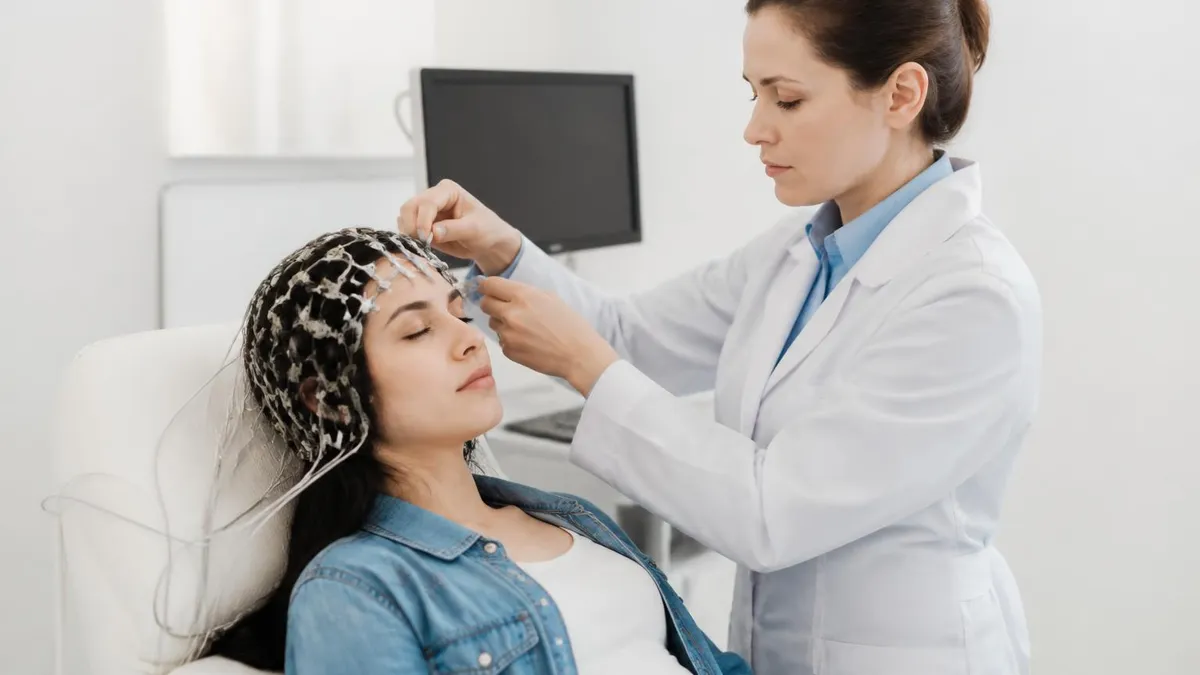
EEG Waves Explained: Delta, Theta, Alpha, Beta, and Gamma Brain Rhythms
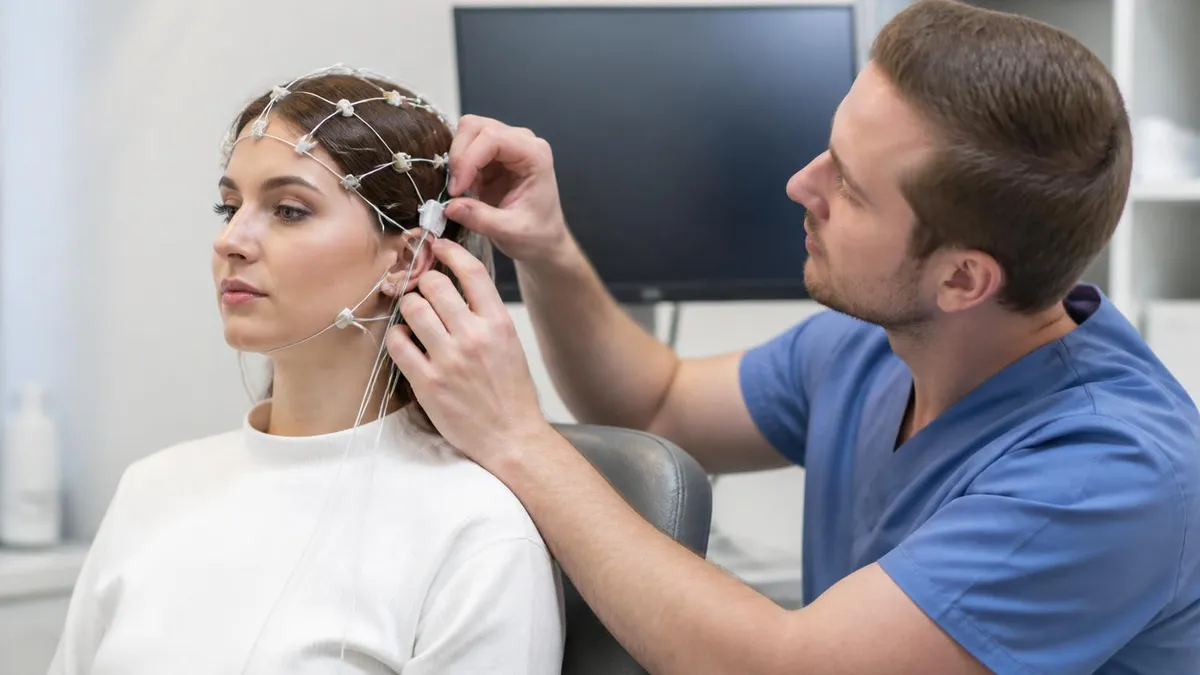
EEG Equipment Guide: Machines, Electrodes, Costs, and What Patients Should Know
About the Author

Educational Psychologist & Academic Test Preparation Expert
Columbia University Teachers CollegeDr. Lisa Patel holds a Doctorate in Education from Columbia University Teachers College and has spent 17 years researching standardized test design and academic assessment. She has developed preparation programs for SAT, ACT, GRE, LSAT, UCAT, and numerous professional licensing exams, helping students of all backgrounds achieve their target scores.