
EEG Test Price: How Much Does an EEG Cost in 2026 October?
EEG test price ranges from $200-$15,000+ depending on type. 🏆 Compare routine, ambulatory, and video EEG costs with and without insurance.
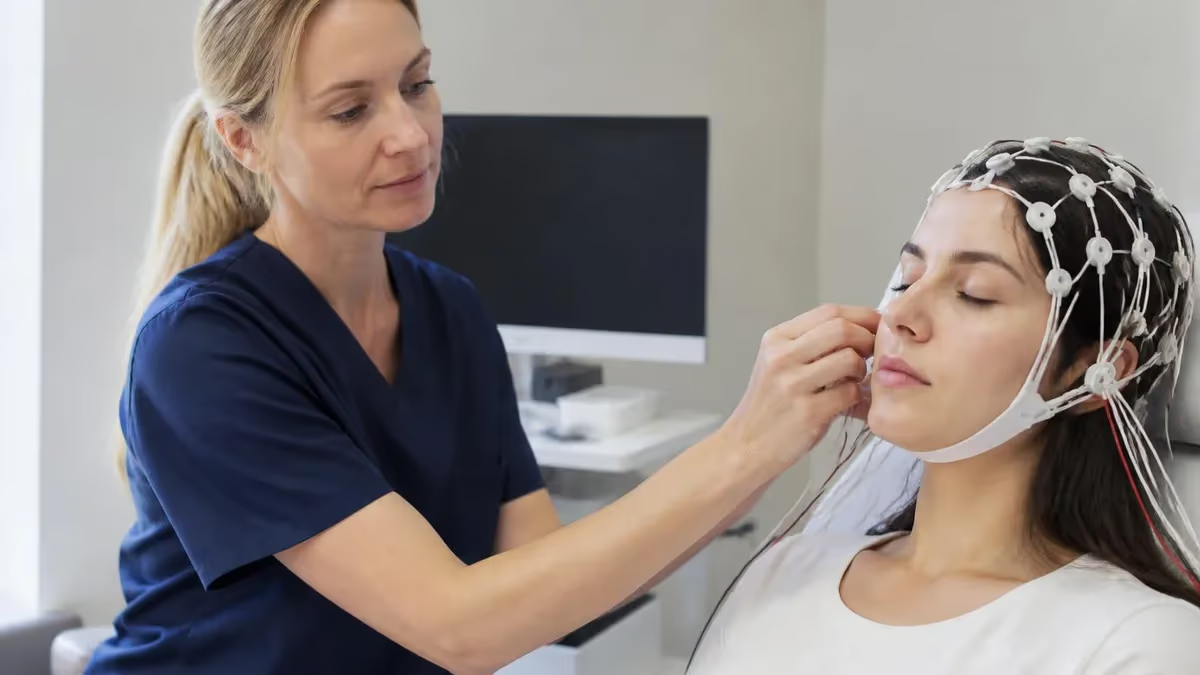
So you've got an EEG test scheduled, and the first thing on your mind probably isn't the squirty gel they'll smear in your hair — it's the bill. Fair. Medical pricing in the United States is notoriously opaque, and EEG costs swing wildly. A quick routine recording at a community outpatient clinic might run you $200 out of pocket. A multi-day inpatient video EEG with continuous monitoring in an epilepsy unit can land somewhere north of $50,000 before insurance touches it.
This guide breaks down what an EEG actually costs in 2026 — by type of recording, by setting, and by whether you've got insurance covering you. We'll also cover the sneaky charges that get billed separately (hint: the doctor reading your results and the machine making them are two different invoices), what Medicare and Medicaid will and won't pay for, how to ask for an itemized bill, and whether flying to Mexico or India for the test is actually saving anyone money.
Quick heads up: the price you pay is rarely the price the hospital charges. The "sticker" price (what's called the chargemaster rate) is often three or four times what insurance companies actually pay, and cash-pay patients can usually negotiate down to that lower number too. We'll show you how.
The median out-of-pocket cost for a routine outpatient EEG in the US sits around $400-$500 without insurance and $50-$150 with most commercial plans after deductible. Hospital-based tests typically cost 2-3× more than freestanding imaging centers for identical recordings.
What Actually Drives EEG Pricing
Before we get into specific dollar amounts, it helps to understand why the same test can cost $200 in one place and $2,000 in another. A handful of variables push the price up or down, and almost none of them have to do with the quality of the recording itself.
Length of the recording. A standard routine EEG runs 20-40 minutes. A sleep-deprived study takes longer because they need to capture both awake and drowsy states. Ambulatory EEGs — the take-home kind — record continuously for 24, 48, or 72 hours. Continuous video EEG in an epilepsy monitoring unit (EMU) runs for days, sometimes a full week, and every hour costs money in tech time, bed space, and storage.
Where the test happens. A freestanding outpatient neurology clinic charges far less than a hospital outpatient department, and a hospital outpatient department charges less than the inpatient ward. This isn't because the equipment is different — it's the facility fee. Hospitals tack on overhead, and that overhead can double or triple the bill.
Whether you need sedation. Pediatric patients, claustrophobic adults, and people with movement disorders sometimes need a mild sedative to get a clean recording. Sedation means an anesthesiologist or sedation nurse is involved, plus monitoring equipment, plus extra recovery time. That can add $300-$1,500 to the bottom line.
Technologist time. A board-certified EEG technologist (often called an REEGT — Registered EEG Technologist) places the electrodes, monitors the recording, and flags artifacts in real time. Their hourly cost goes into your bill, and longer recordings mean more tech hours. EEG tech labor is one of the biggest line items on any inpatient study.
Interpretation by a neurologist. The recording is just data. A board-certified neurologist — usually an epileptologist for complex cases — has to read it, mark seizures or abnormal patterns, and write a formal report. That's the "professional fee," and it's almost always billed separately from the test itself. Expect $150-$600 just for the read on a routine study, more for ambulatory and video recordings.

EEG Test Cost Ranges (2026 US Averages)
Out-of-pocket ranges for the most common EEG types when paying without insurance. Insurance with copay usually drops these by 60-80%.
Routine Outpatient EEG: The Baseline Test
The routine EEG is what most people get the first time a neurologist suspects something's off — recurring headaches, a single seizure, fainting spells, suspected sleep issues. You show up, get wired up with about 21 scalp electrodes following the international 10-20 placement system, lie still for 20-40 minutes, and go home. The whole appointment usually takes about an hour including prep.
Cash price without insurance typically lands between $200 and $700 at a freestanding outpatient clinic. The same test at a hospital outpatient department can run $500-$1,500 thanks to facility fees. Some imaging chains — Smart Choice MRI, RadNet, SimonMed — bundle EEG into their flat-rate offerings and quote $250-$400 all-in (test + read).
With insurance, you're looking at your standard diagnostic test treatment. Most commercial plans classify outpatient EEG as a specialist visit or outpatient procedure. After your deductible, expect a copay of $50-$250 if you're in-network, more if you've gone out of network. HMO plans usually require a referral from your primary care doc; PPO plans don't but might charge more without one.
The professional fee — the neurologist's read — is billed separately. It might come from the same hospital, a contracted reading group, or even a different state entirely (some hospitals outsource overnight reads to teleneurology services). On a routine EEG, the professional component runs $150-$400.
Sleep-Deprived EEG
This is the same setup as a routine EEG, but you've been awake all night or only slept a few hours. Sleep deprivation lowers the seizure threshold and makes abnormal patterns easier to catch — useful if a standard EEG came back clean but the clinical suspicion is still high. The recording itself often runs longer, 1-2 hours, to capture both wake and drowsy/sleep states.
Expect $300-$900 cash, or roughly 1.5× a routine EEG with insurance. The added cost reflects the longer technologist time and the higher technical complexity of interpreting sleep-related changes.
Heads up — there are usually two invoices
Almost every EEG generates two separate bills: a technical fee (the test, the equipment, the tech) and a professional fee (the neurologist reading your tracing). Patients are routinely caught off guard when a second invoice shows up weeks after the first. Always ask in advance: 'Will the reading physician bill me separately, and is that reader in-network with my insurance?' An out-of-network read on an in-network EEG is the most common reason patients get balance-billed for hundreds of dollars they didn't expect.
Ambulatory EEG: 24-72 Hours at Home
An ambulatory EEG moves the recording out of the clinic and into your normal life. The tech places electrodes, hooks you up to a portable battery-powered recorder (about the size of a paperback novel), and sends you home with instructions to push a button when you feel anything unusual. The device records continuously for 24, 48, or 72 hours, and you bring it back when the study window ends.
The cash price is steeper than a routine EEG because the equipment is occupied for days, not minutes. You're looking at $1,500-$3,500 for a typical 24-72 hour study. Hospital-based ambulatory studies cost more — often $4,000-$6,000 — because the device is tied up and the institution charges accordingly.
With insurance, ambulatory EEG is usually covered when there's medical necessity (suspected seizures not captured on routine EEG, episodes that happen mainly during sleep, suspected non-epileptic events). Prior authorization is common. Your share might be $200-$800 after deductible, depending on plan structure.
Why does this test cost so much more? Three reasons: longer recording means much more data to interpret (and the neurologist gets paid for that interpretation), the device itself is dedicated to you for days, and the technical setup is more demanding. The tech often has to reinforce electrode bonds to survive showers and sleep, which means specialized adhesives and sometimes a second visit.
Where You Get the EEG Changes the Price (A Lot)
Standalone neurology practices and independent imaging centers usually have the lowest cash prices. No hospital overhead, no facility fee. Often quote bundled rates.
- Routine EEG range: $200-$500
- Negotiation room: Often 20-40% discount for upfront cash
Same test, but the hospital adds a facility fee that can double or triple the bill. Convenient if you need other tests bundled (MRI, labs), but expensive if it's just an EEG.
- Routine EEG range: $500-$1,500
- Markup vs clinic: Typically 2-3×
If you're already admitted and they bring the EEG to your bedside, you'll get a portable bedside study. The technical fee is rolled into your hospital stay, but the professional read is still separately billed.
- Typical bedside EEG: $1,500-$4,000 of stay charge
- Coverage: Part of admission, usually well-covered
Dedicated inpatient unit with continuous video plus EEG, often for several days to capture seizures while medications are tapered. The most expensive setting by a wide margin.
- Daily rate: $5,000-$15,000
- Typical stay total: $25,000-$75,000+ for 3-7 days

Video EEG and the Epilepsy Monitoring Unit
Continuous video EEG in an epilepsy monitoring unit (EMU) is the gold standard for diagnosing drug-resistant epilepsy, locating seizure foci before surgery, and distinguishing epileptic seizures from non-epileptic events. It's also the most expensive form of EEG anywhere in medicine.
You're admitted to a specialized inpatient unit for anywhere from 2 to 10 days. Electrodes stay on the whole time. A camera records you continuously. Trained neuro-techs and nurses watch the live feed in shifts, ready to push the event button and capture detailed clinical descriptions when a seizure starts. Sometimes your anti-seizure medications are gradually reduced (under close supervision) to provoke events.
The cost: daily rates run $5,000 to $15,000+ depending on the institution. A 3-day stay can total $25,000-$45,000. A full week-long monitoring stay before epilepsy surgery can break $75,000. That's the chargemaster price — the actual amount paid by insurance is usually a fraction of that, but cash-pay patients without insurance protections see the full sticker shock.
Almost every video EEG requires prior authorization from your insurance. Without it, the entire stay can be denied retroactively. Make sure your neurologist's office has confirmed prior auth in writing before admission. Get the authorization number. Keep a copy.
Insurance Coverage for EEG by Plan Type
Coverage: Routine EEG is almost always covered as a diagnostic test when ordered for a medically necessary reason — recurring seizures, suspected epilepsy, syncope workup, headache evaluation, sleep disorder assessment.
Your share: After deductible, expect a specialist copay ($30-$80) or coinsurance (10-30%) up to your out-of-pocket maximum. PPO plans typically allow self-referral; HMO plans require a referral from your primary care physician.
Prior auth: Usually not required for routine outpatient EEG. Required for video EEG, ambulatory EEG, and any EMU stay. Skipping prior auth on these is a fast way to get a $25,000 surprise bill.
With Insurance vs. Without: Real-World Numbers
Let's run some honest scenarios. These are pulled from actual EOB statements and hospital cash-price disclosures (which, since 2021, US hospitals are legally required to publish online — though most bury them in unreadable spreadsheets).
Scenario 1: Adult routine outpatient EEG, suburban Texas. Hospital chargemaster: $1,840. Cash-pay rate after negotiation: $385. Commercial PPO covered rate: $312, of which the patient paid $94 copay. Medicare paid: $186, patient paid $46. Same test, three completely different prices.
Scenario 2: 48-hour ambulatory EEG, Massachusetts. Charge: $4,250. Self-pay quoted price: $1,950. BCBS PPO covered $1,820, patient paid $545 coinsurance after deductible. Medicare paid $1,108, patient paid $277.
Scenario 3: 4-day EMU stay with video EEG, Ohio academic medical center. Charged: $63,400. Self-pay negotiated rate: $18,900 (still steep). Commercial PPO paid $19,200 after a heavy contracted discount, patient owed $3,400 in coinsurance/copays. Medicare covered everything but the $1,632 inpatient deductible.
The pattern is consistent: the headline "price" of an EEG bears almost no relationship to what anyone actually pays. The cash-pay rate is the price you negotiate, the insurance rate is the price your plan negotiated, and the chargemaster rate is the price nobody pays except the rare uninsured patient who doesn't know to ask for a discount.
What's Billed Separately — and How to Ask for an Itemized Bill
An EEG bill is almost never one number. It's a stack of charges that come from different entities, and each line is negotiable on its own. Here's the typical breakdown for a routine outpatient EEG:
Technical fee (CPT 95816, 95819, or 95822). This is the test itself — equipment, electrodes, tech time, recording. It's billed by the facility where the test happened. On a routine EEG, this is usually $200-$1,200 depending on setting.
Professional fee (CPT 95957 or similar interpretation codes). This is the neurologist's read — opening the file, scrolling through the tracing, marking abnormalities, writing the report. It's billed by the reading physician's practice, which may or may not be the same as the facility. Typical range: $150-$600.
Facility fee (hospital outpatient only). An overhead charge that hospitals add when the test happens in an outpatient hospital department instead of a freestanding clinic. Can range from $100 to $800+.
Anesthesia or sedation fee (if applicable). Pediatric and complex cases sometimes need sedation. This is billed by the anesthesiologist or sedation team — another separate invoice, typically $300-$1,500.
Pharmacy charges (inpatient EMU only). Any medications administered during a video EEG stay get itemized separately. This can be substantial if you're being weaned off anti-seizure drugs.
Always ask for an itemized bill. Federal law requires hospitals to provide one within 30 days of request. Once you have it, you can spot duplicate charges, supplies that weren't actually used, and inflated rates. Patient advocacy groups routinely find 30-50% overcharges on inpatient EEG bills when patients ask for detail.
The CPT Code Cheat Sheet
Knowing the exact CPT code for your study lets you call insurance and confirm coverage before you walk in. The main EEG codes:
- 95812 — EEG over 1 hour
- 95816 — Routine EEG, awake and drowsy
- 95819 — Routine EEG, awake and asleep
- 95822 — EEG during sleep only
- 95951 — Continuous video EEG, 24-hour monitoring (per day)
- 95953 — Ambulatory EEG (per 24-hour period)
- 95957 — Digital EEG analysis/quantitative interpretation
Get the code in writing from your ordering physician. Then call the 800 number on the back of your insurance card and ask: "What's my expected out-of-pocket cost for CPT 95816 at [facility name] with [neurologist name] reading?" Write down the rep's name and the reference number for the call.

How to Cut Your EEG Bill — 10 Steps Before You Schedule
- ✓Ask the ordering physician for the exact CPT code(s) for your study
- ✓Call your insurance and request the in-network negotiated rate for that code
- ✓Ask whether prior authorization is needed (always for video EEG and EMU)
- ✓Compare prices: hospital outpatient vs freestanding neurology clinic vs imaging center
- ✓Confirm the reading neurologist is also in-network (separate billing entity)
- ✓If self-pay, request the cash-pay discount and ask about the Medicare rate for benchmark
- ✓Check the hospital's public price disclosure file for the procedure code
- ✓Ask if the facility offers payment plans (most do, interest-free, 6-12 months)
- ✓If income-qualified, apply for charity care or financial assistance before the test
- ✓Request an itemized bill within 30 days and review every line item for duplicates
Medical Tourism, Telehealth, and Special Cases
For uninsured Americans facing $30,000+ EMU bills, medical tourism becomes a serious calculation. Routine EEG at top-tier private hospitals in India costs $18-$60. The big chains — Apollo, Fortis, Max Healthcare — operate at international quality standards with English-speaking staff. A 4-day video EEG monitoring stay in India can be done for $2,000-$4,500.
Mexican border-town clinics (Tijuana, Mexicali, Guadalajara) charge $80-$200 for routine EEG and $1,500-$3,000 for video EEG stays. Drive-in convenience makes this practical for residents of California, Arizona, Texas, and New Mexico. Pakistan, Philippines, Bangladesh, and UAE private hospitals offer routine EEG for $30-$120.
Is medical tourism worth it? For routine diagnostic EEG, probably not — savings get eaten by travel costs. For multi-day video EEG, where you're saving $25,000-$60,000 against US cash prices, the math starts to work. Make sure the reading neurologist holds board certification in clinical neurophysiology and that the report releases in a format your US doctor can use.
Telehealth EEG: a concept, mostly
Remote EEG reading has been possible for over a decade. Teleneurology services handle overnight reads for many US hospitals — the technologist places electrodes locally, the recording streams to a board-certified neurologist elsewhere. This shifts cost slightly but doesn't dramatically change patient prices. Home-based consumer EEG headsets exist for sleep tracking and meditation feedback, but they're not clinical-grade. Full diagnostic EEG remains a clinic or hospital procedure.
Pediatric, neonatal, and ICU EEG
Pediatric EEG costs $400-$1,200 and neonatal EEG runs $800-$2,500 in the NICU. The difference comes from specialized tech skill, shorter recording windows that often repeat, and frequent sedation. Continuous ICU EEG monitoring for critically ill patients rolls into daily critical care charges — typically adding $1,500-$4,000 per day on top of standard ICU rates.
NIH-funded research and free EEG
Academic centers running NIH-funded epilepsy and sleep studies frequently offer free EEG to qualifying participants. ClinicalTrials.gov lists active studies — search "EEG" plus your condition. Compensation often includes the test, the workup, and a stipend. This route works especially well for people with confirmed or suspected epilepsy who would otherwise face tens of thousands in EMU costs. Major epilepsy centers (NIH, Mayo, Cleveland Clinic, Johns Hopkins, UCSF) run rolling protocols.
EEG costs around the world
If you're reading from outside the US, the financial picture looks different. UK (NHS): free at point of care; private NHS-adjacent clinics offer same-week scheduling at £200-£500 for routine, £2,500-£6,000 for inpatient video EEG. Canada: provincial health insurance covers all medically necessary EEG with zero patient cost; private clinics charge CA$300-$600 if you want to skip the queue. European Union: Germany, France, Netherlands, and the Nordics cover EEG through statutory insurance with €10-€50 copays.
Australia: Medicare Australia rebates AU$130-$180 with patient gap; bulk-billing clinics charge nothing. UAE / Dubai: routine EEG runs AED 250-600 (~$70-$165) at private clinics. Philippines: public hospitals charge ₱500-₱2,000 ($9-$36); private hospitals ₱3,000-₱8,000 ($55-$145). Pakistan / Bangladesh: routine EEG at major private hospitals runs $11-$30 and $23-$64 respectively. Government hospitals charge significantly less.
Hospital EEG vs Freestanding Clinic — Which Is Worth Paying For?
- +Direct access to inpatient resources if results show emergency findings
- +Easier to bundle with other diagnostics like MRI, CT, or labs
- +Familiar billing structure if you're already a hospital system patient
- +On-site epileptologists at academic centers for complex cases
- +Better fit for pediatric cases requiring sedation backup
- +EMU and video EEG only available in hospital setting
- −Lower cash prices, often 50-70% less for identical test
- −Faster scheduling — often next-day or same-week
- −Less paperwork and shorter check-in
- −No facility fee on the bill
- −Often better customer service and patient experience
- −Cash-pay discounts more readily negotiated
Pros and Cons at a Glance
| Pros | Cons |
|---|---|
| Direct access to inpatient resources if results show emergency findings | Faster scheduling — often next-day or same-week |
| Easier to bundle with other diagnostics like MRI, CT, or labs | Less paperwork and shorter check-in |
| Familiar billing structure if you're already a hospital system patient | No facility fee on the bill |
| On-site epileptologists at academic centers for complex cases | Often better customer service and patient experience |
| Better fit for pediatric cases requiring sedation backup | Cash-pay discounts more readily negotiated |
The Bottom Line on EEG Pricing
EEG cost in the US is a moving target. The same test can cost $200 or $30,000 depending on type, setting, and how you pay. The good news: most of those high prices are negotiable, most are covered by insurance with proper authorization, and there are clear strategies to bring your out-of-pocket cost down regardless of your insurance status.
Three things to remember. First, always get the CPT code and call insurance before scheduling — don't walk in blind. Second, ask whether the reading neurologist is in-network separately from the facility, because that's where balance bills come from. Third, request an itemized bill and review it; overcharges are the rule, not the exception, especially on multi-day video EEG stays.
If you're studying to become an EEG technologist yourself, brushing up on the test workflow and patient-facing aspects of pricing is increasingly part of the modern curriculum. Tech programs covering EEG tech jobs now include billing and insurance basics because patients ask techs about cost more than they ask doctors.
Sample EEG - Electroencephalography Practice Questions
Try these questions from our free EEG - Electroencephalography practice tests. The correct answer and an explanation follow each question.
What does a referential montage compare each electrode to?
- A. A common reference electrode
- B. The adjacent electrode
- C. The opposite hemisphere electrode
- D. The ground electrode
Answer: A. A common reference electrode
In a referential montage, each active electrode is compared to a single common reference electrode, often placed at the ear or linked mastoids.
An EEG recording shows a sudden, very high-amplitude, brief transient that is strictly confined to a single channel. The transient does not have a physiological field and is not time-locked to any other event. What is the most likely cause?
- A. An EKG artifact
- B. An epileptiform spike
- C. An electrode artifact ('pop')
- D. A photic driving response
Answer: C. An electrode artifact ('pop')
The key features are its confinement to a single electrode and the lack of a physiological field (i.e., it doesn't appear in adjacent channels). This is the classic presentation of an electrode artifact, often called an 'electrode pop,' which is caused by a sudden, unstable change in impedance at that one site.
During cEEG monitoring in a TBI patient, what does the appearance of 'breach rhythm' indicate?
- A. Subcortical seizure activity
- B. Skull defect causing amplitude enhancement and frequency changes
- C. Pharmacologically induced EEG change
- D. Cortical spreading depolarization
Answer: B. Skull defect causing amplitude enhancement and frequency changes
Breach rhythm occurs over skull defects (craniectomy or fracture) where the missing bone allows higher amplitude and sharper-appearing waveforms due to reduced electrical filtering.
At what age does the posterior dominant rhythm typically reach the adult alpha frequency range of 8 Hz?
- A. 6 months
- B. 1 year
- C. 3 years
- D. 8 years
Answer: C. 3 years
The posterior dominant rhythm gradually increases from approximately 3-4 Hz in infancy to 8 Hz by around age 3 years, continuing to increase to the full adult range of 8-13 Hz by approximately age 8-10 years.
EEG Questions and Answers
About the Author

Educational Psychologist & Academic Test Preparation Expert
Columbia University Teachers CollegeDr. Lisa Patel holds a Doctorate in Education from Columbia University Teachers College and has spent 17 years researching standardized test design and academic assessment. She has developed preparation programs for SAT, ACT, GRE, LSAT, UCAT, and numerous professional licensing exams, helping students of all backgrounds achieve their target scores.