
Ambulatory EEG: 24-72 Hour Home Recording for Suspected Seizures 2026 October
Ambulatory EEG — 24 to 72 hour home brain wave recording, when neurologists order it, what to expect, costs, accuracy and modern wireless options. ✅
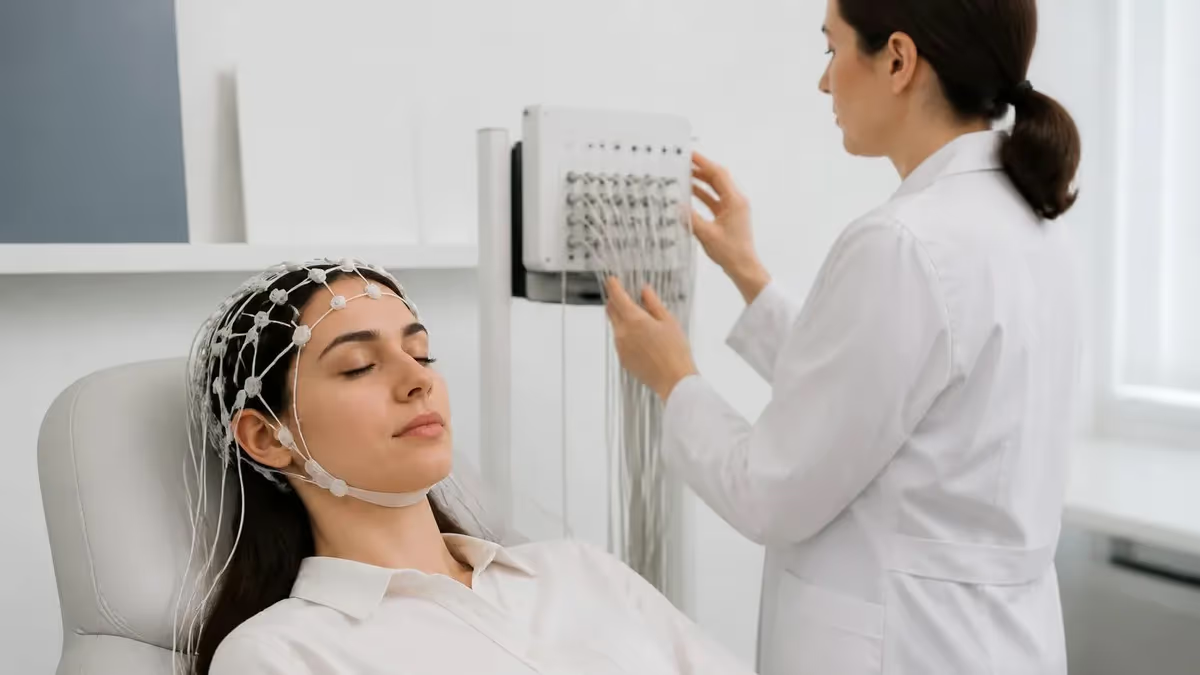
Ambulatory EEG: What It Is and Why It Matters
Ambulatory EEG is a brain-wave recording performed over 24 to 72 hours while the patient goes about ordinary daily activities at home. Unlike a routine in-lab EEG that captures 30 to 60 minutes of brain activity in a controlled clinical setting, ambulatory EEG samples a much longer window during real-life conditions — sleeping, eating, working, watching television, exercising lightly.
The longer recording window dramatically increases the probability of capturing the kind of episodic event that prompted the test in the first place. Brief paroxysmal events that happen once or twice per day rarely show up during a 30-minute lab recording. They show up regularly during a 48-hour ambulatory recording.
This guide walks through what ambulatory EEG actually involves, why neurologists order it, the procedure for setup and patient self-care during the recording window, the cost and insurance picture, the comparison with routine in-lab EEG and video EEG monitoring, and the modern wireless systems that have made ambulatory recording dramatically more comfortable than the older wired versions. The aim is to give patients and family members a clear picture of what to expect when ambulatory EEG is on the table, so the test produces useful diagnostic information rather than a frustrating multi-day experience without a clear result.
The technology has improved substantially over the past decade. Early ambulatory EEG systems were uncomfortable, prone to artifact and limited to 24 hours of recording. Modern systems handle 72 hours routinely and some go beyond a week. The wireless versions look almost normal under a hat or scarf. The diagnostic yield has improved alongside the patient experience, with detection sensitivity for epileptic seizures climbing from around 30 percent on routine EEG to over 70 percent across multi-day ambulatory recordings in published series. Better tools have made the test meaningfully more useful.
Ambulatory EEG at a glance
Recording length: 24 to 72 hours typical, up to 7 days with modern wireless systems. Setup time: 60–90 minutes for electrode application. Activities allowed: sleeping, eating, working, light activity, sleeping. Restrictions: no swimming or showering, avoid hair products, keep electrodes in place. Cost: $1,000–$3,000 typical, insurance usually covers when medically indicated. Read by: a neurologist or epileptologist after the recording ends.
Why Neurologists Order Ambulatory EEG
The most common reason for ordering ambulatory EEG is evaluation of suspected seizures or other paroxysmal events that did not show up on a routine in-lab EEG. Many seizures are infrequent enough that a one-hour clinical recording catches none of them. Stretching the recording window to 24, 48 or 72 hours dramatically increases capture probability without committing the patient to inpatient hospitalisation. The neurologist reads the longer recording for epileptiform discharges, captured events, sleep architecture and other findings that inform the diagnostic workup.
Ambulatory EEG is also commonly ordered to distinguish epileptic seizures from non-epileptic events that look similar. Patients sometimes have spells that could be seizures, syncope (fainting), psychogenic non-epileptic seizures, parasomnias, transient ischaemic attacks or cardiac arrhythmias. The captured event during ambulatory recording, combined with the patient's diary of timing and symptoms, often clarifies which type of event is occurring. Other indications include evaluation of nocturnal events that the patient or sleeping partner cannot describe clearly, follow-up after a normal routine EEG when clinical suspicion remains high, and pre-surgical evaluation in selected epilepsy cases.
Patients are sometimes surprised to learn that their neurologist orders ambulatory EEG without expecting to capture an event. The interictal recording — the brain wave activity between obvious clinical events — often shows abnormal patterns even when no seizure happens during the recording. Frequent epileptiform discharges between events strongly suggest underlying epilepsy, even if no seizure occurs during the recording window. The diagnostic information from interictal patterns alone is often enough to support a confident epilepsy diagnosis and guide treatment.

Common Reasons for Ambulatory EEG
Patients reporting episodic confusion, brief unresponsiveness, automatic movements or loss of awareness whose routine EEG was inconclusive. The longer recording window catches infrequent seizures missed by 30-minute clinical recordings.
Distinguishing epileptic seizures from syncope, psychogenic non-epileptic seizures, parasomnias and transient ischaemic attacks. The captured event correlated with patient diary timing usually clarifies which category applies.
Sleep-related events that the patient cannot describe and that no witness has observed in detail. Examples include suspected nocturnal seizures, REM behaviour disorder and complex parasomnias. Recording during sleep captures the activity at the time it actually occurs.
Patients whose 30-minute lab EEG was normal or non-diagnostic but whose clinical history strongly suggests epilepsy. Extending recording to 24 to 72 hours uncovers epileptiform discharges that brief recordings miss.
Patients on antiepileptic medication where the neurologist wants to assess whether breakthrough seizures or subclinical activity are still occurring. Quantifying seizure burden during normal activity informs treatment adjustments.
Selected epilepsy patients being considered for resective surgery. Ambulatory recording can capture seizures and inform localisation before more invasive monitoring like inpatient video EEG with intracranial electrodes.
The Setup: What Happens at the Clinic Visit
The ambulatory EEG setup is performed by an EEG technologist at the neurology clinic or hospital outpatient EEG lab. The patient arrives for a 60 to 90 minute appointment. The technologist measures the patient's head using the international 10-20 system landmarks and marks 21 to 25 electrode positions.
Each scalp position is gently abraded to reduce skin impedance, then a small amount of conductive paste is applied. Electrodes are pressed onto the paste, secured with collodion glue or strong adhesive tape, and connected by wires to a small recording amplifier worn in a pouch around the waist or in a small backpack.
Once the electrodes and amplifier are in place, the technologist tests the impedance of each connection to confirm signal quality before sending the patient home. The patient is given written instructions, an event button to press whenever a noticeable event occurs, and a paper or app-based diary for recording activities, symptoms, sleep times and any noticed events. The amplifier records continuously to internal memory or, in newer systems, streams wirelessly to a cloud platform that the neurologist can monitor remotely. After the recording window ends, the patient returns to the clinic for electrode removal and amplifier handover.
Some patients ask whether they can sleep on their stomach during ambulatory EEG. The honest answer is that side-sleeping or back-sleeping works better for keeping electrodes in good contact, but stomach-sleepers can usually adapt for a few nights. Pillow choice matters — a flatter pillow that does not push the head into the mattress reduces electrode pressure. Patients who normally sleep with multiple pillows may need to adjust the arrangement during the recording. The technologist's preparation includes some discussion of typical sleep position and how to manage it during the recording window.
Patient Experience During Recording
Sleep normally — most home recordings include at least one full sleep cycle. Eat your usual diet. Work from home or at a desk-based job if comfortable. Watch television, use a computer, read, exercise lightly. Move around the house and yard. Drive only if your neurologist explicitly clears it (most do not because of the underlying seizure-risk concern).
Modern Wireless Systems
Older ambulatory EEG required wired electrodes connected to a recording amplifier worn at the waist, with all the discomfort and visual obviousness that implies. Modern wireless systems have made the experience dramatically more comfortable. Stratus EEG, Natus, Persyst, BioSerenity and several other manufacturers now offer wireless ambulatory recording where each electrode communicates with a small bedside or worn receiver via low-power wireless.
The patient still has electrodes attached to the scalp but no wires running down the body to a backpack amplifier. Some systems integrate with a wristband or pendant for the event button rather than requiring the patient to find a tethered button.
The wireless format also allows longer recordings — up to 7 days in some configurations — without the battery and storage limitations of wired systems. Cloud-based monitoring lets the neurologist review accumulated data while the recording is still in progress, occasionally extending or terminating the recording based on captured events. The wireless approach is particularly useful for paediatric patients and elderly patients who tolerate wired setups poorly. Insurance coverage for the wireless systems has caught up with the older wired versions in most regions, although costs vary somewhat between manufacturers and recording centres.
One often-overlooked feature of modern wireless ambulatory EEG is integrated motion sensing. Accelerometers built into the recording amplifier track patient movement, providing context for the brain wave data. A pattern that looks like seizure activity but coincides with a documented head movement is more likely to be artifact. The motion data is automatically aligned with the EEG signal during reading, which helps neurologists distinguish artifact from genuine cerebral events more efficiently than the older recordings without movement context.

Most patients undergoing ambulatory EEG for suspected seizures are advised not to drive during the recording. The underlying clinical concern — possible undiagnosed epilepsy — is also the reason many state DMVs require a seizure-free interval before allowing driving. If you are unsure about driving rules during your specific situation, ask your neurologist for explicit guidance before the test. Resuming driving usually depends on test results and any subsequent diagnosis rather than just completion of the recording.
Cost, Insurance and Billing
Ambulatory EEG typically costs $1,000 to $3,000 in the United States depending on recording duration, facility type and whether the recording includes simultaneous home video. Hospital-based EEG labs usually cost more than freestanding outpatient neurology centres for the same study. Insurance generally covers ambulatory EEG when there is documented medical indication — suspected seizures, evaluation of paroxysmal events, follow-up after inconclusive routine EEG. Prior authorisation is often required, with the neurologist's office submitting documentation to the insurance company before the test is scheduled.
Patient out-of-pocket cost depends on the specific insurance plan, deductible status and the imaging facility's contracted rates. High-deductible plan members who have not yet met their annual deductible often face the full negotiated rate. Patients with met deductibles typically pay only the standard coinsurance percentage. Cash-pay rates at independent EEG centres can sometimes be lower than the negotiated rate when the deductible is large. Always confirm pricing and prior authorisation status before scheduling — surprise bills from out-of-network facility components are unfortunately common in US healthcare and ambulatory EEG is no exception.
Some insurance plans require step therapy — completing routine EEG before approving ambulatory EEG. The neurologist's office typically navigates this paperwork on the patient's behalf, but understanding the requirement helps patients plan their own timeline. Going directly from clinical suspicion to ambulatory recording is rare unless the patient has already had inconclusive routine EEG or has clear documented spell history that justifies skipping the screening step. Ask the neurologist's office about prior authorisation status before committing to a date.
Preparing for Your Ambulatory EEG
- ✓Confirm the date, time and duration of the recording with the EEG lab
- ✓Wash and dry your hair the morning of the appointment — no products afterward
- ✓Bring loose-fitting button-up clothing for easy removal during electrode placement
- ✓Plan for no shower or swimming during the entire recording period
- ✓Schedule the test for a window when you can stay home or work from home if needed
- ✓Verify insurance prior authorisation has been completed before the appointment
- ✓Bring a list of current medications including supplements and over-the-counter drugs
- ✓Plan to keep an event diary throughout the recording — paper or app
- ✓Clear non-essential plans for the recording window — focus on detecting events
- ✓Confirm transportation home after electrode placement and after removal
What the Neurologist Looks For When Reading
After the recording ends, a neurologist or epileptologist reviews the entire record using specialised reading software. The reader scans for specific patterns: epileptiform discharges (spikes, sharp waves, polyspikes), captured seizures (electrographic seizure patterns with associated clinical events), sleep architecture changes, focal slowing suggesting localised brain dysfunction, and any artifact patterns that need to be distinguished from real brain activity. Modern reading software accelerates the review with computer-assisted detection of epileptiform discharges, but the neurologist makes the final interpretation because automated detection produces false positives that need clinical context.
The reader correlates findings with the patient's event diary and event-button presses. A patient who reported a confused spell at 3:42 PM gets the corresponding portion of the recording reviewed in detail to see whether electrographic abnormality coincided with the reported event. A clean recording during a reported event suggests non-epileptic origin; a clear seizure pattern coinciding with the event confirms epileptic origin.
Even a normal recording during the patient's typical event window provides useful diagnostic information, narrowing the differential and shaping next steps in the workup. The final report typically arrives within a few business days of the recording's end and is shared with the ordering physician for clinical follow-up.
The reading process for a multi-day ambulatory recording is genuinely time-consuming. A typical 48-hour recording requires the neurologist to review the entire signal, with computer-assisted detection algorithms flagging suspicious portions for closer inspection. Quality reads take several hours of focused review. Patients sometimes wonder why the report does not arrive immediately after the recording ends — the answer is that careful review of long-duration recordings cannot be rushed. The 3 to 5 business day turnaround reflects realistic professional time investment in the interpretation.
Comparison With Other EEG Modalities
Routine in-lab EEG is the basic 30 to 60 minute scalp recording in a clinic or hospital EEG lab. It works well as a first-line evaluation when the clinical question is whether interictal epileptiform discharges exist. Routine EEG is faster, cheaper and less disruptive than ambulatory recording, but it captures only a brief window. Patients whose events are infrequent often have normal routine EEGs, prompting follow-up with ambulatory recording. The two studies complement each other — routine EEG screens; ambulatory EEG dives deeper when screening was inconclusive.
Continuous video EEG monitoring (cVEEG) is the most rigorous EEG modality, conducted in a hospital epilepsy monitoring unit (EMU) over several days with simultaneous video recording. cVEEG provides the gold-standard combination of brain wave data and synchronised video to correlate electrographic findings with observed clinical activity.
The trade-off is hospitalisation, higher cost ($10,000 to $30,000 typical) and inpatient logistics. Many epilepsy centres now offer hybrid approaches — ambulatory EEG with home video recording — that bridge between the convenience of ambulatory and the diagnostic depth of cVEEG. The right modality depends on the clinical question and what previous testing has already shown.

Ambulatory EEG Numbers
Key Facts at a Glance
| Item | Value | Details |
|---|---|---|
| Typical recording duration | 24–72 hr | |
| Setup time at clinic | 60–90 min | |
| Typical cost in the US | $1k–$3k |
Modern Ambulatory EEG Manufacturers
Cloud-based ambulatory EEG service with at-home setup option in some regions. Wireless electrode systems and cloud-based reading workflow. Strong fit for patients who prefer minimal clinic visits and remote setup options where available.
Long-running EEG manufacturer with wired and wireless ambulatory products. Strong hardware and well-established interpretation software. Common at academic medical centres and major epilepsy programs across the United States.
Software platform that overlays on multiple manufacturers' hardware. Strong automated detection algorithms for epileptiform discharges and seizures. Reduces neurologist review time on long recordings while maintaining diagnostic accuracy.
Wireless ambulatory headset system originally developed in France. Compact electrode array integrated into a removable cap. Strong fit for paediatric and elderly patients who tolerate traditional electrode setups poorly.
Long-running ambulatory and research EEG manufacturer. Wired and wireless options. Strong reputation in research environments and at academic neurology departments. Less consumer-facing than some newer entrants.
Devices like Muse and Emotiv are wearable EEG products marketed for consumer use, not for medical diagnosis. They lack the spatial resolution and signal quality required for clinical seizure detection. Useful for meditation tracking but not for the clinical questions ambulatory EEG addresses.
Limitations and Common Issues
Ambulatory EEG is not perfect. Movement artifact is the most common issue — chewing, walking, head movement and electrode shifts produce signal patterns that need to be distinguished from genuine brain activity. Skilled neurologists handle these artifacts routinely, but heavy artifact in a recording can degrade diagnostic value. Patients are asked to minimise vigorous movement and to keep their hands away from electrodes during the recording, but real-life activities inevitably produce some artifact regardless of patient compliance.
Technical failures also occur. Electrodes can come loose, particularly during sleep when the head moves against the pillow. Wireless connections can drop temporarily, leaving short gaps in the recording. Battery failures in older systems sometimes cut recordings short. Patient compliance with the diary and event button is also variable — some patients diligently record every event while others forget the button entirely, producing recordings that capture activity without the clinical correlation needed to interpret it. The combination of these limitations means ambulatory EEG produces inconclusive results in some cases, occasionally requiring a follow-up study with different methods.
Privacy considerations also factor into ambulatory recording for some patients. The amplifier records continuously while electrodes are attached, which means data is collected during all home activities. Most patients are not concerned because the data is just brain wave signals, not video or audio. But patients who add home video to their recording or who use cloud-based wireless systems may want to confirm with the neurology office how their data is stored, who has access and how long it is retained. Reputable centres have clear policies that comply with HIPAA, but it is worth asking explicitly.
Asking those questions early in the process produces clear answers, and any reputable centre handles them as a routine part of patient onboarding rather than as an unusual request. Transparent discussion of data handling builds trust between patient and centre.
That trust supports better diagnostic outcomes overall.
Ambulatory EEG vs Routine and Inpatient EEG
- +Long recording window catches infrequent events better than 30-minute routine EEG
- +Records during real-life conditions including sleep and ordinary activities
- +Cheaper than inpatient continuous video EEG monitoring
- +Patient stays at home rather than admitted to a hospital epilepsy monitoring unit
- +Modern wireless systems are far more comfortable than older wired versions
- −No video correlation in standard ambulatory recordings
- −Movement artifact during real-life activities reduces signal quality
- −Patient compliance with diary and event button is variable
- −Cannot capture events that occur outside the recording window
- −Hygiene restrictions during multi-day recordings inconvenience patients
Sample EEG - Electroencephalography Practice Questions
Try these questions from our free EEG - Electroencephalography practice tests. The correct answer and an explanation follow each question.
When a patient on ambulatory EEG reports a suspected seizure event via the event button but the recording shows no ictal activity, the MOST likely explanation is:
- A. Equipment malfunction caused signal dropout
- B. The event was a non-epileptic psychogenic episode
- C. The button was pressed too late after the event ended
- D. Electrode impedance was too high during the event
Answer: B. The event was a non-epileptic psychogenic episode
Non-epileptic psychogenic events (PNES) are a common finding when patient-reported events lack EEG correlate during ambulatory monitoring.
What electrode application method is preferred for ambulatory EEG to ensure electrodes remain in place during extended recording?
- A. Paste with gauze
- B. Collodion adhesive
- C. Conductive gel alone
- D. Saline-soaked sponges
Answer: B. Collodion adhesive
Collodion is the preferred adhesive for ambulatory EEG because it provides secure, long-lasting electrode fixation that withstands the physical activity of daily living during multi-day recordings.
During ambulatory EEG review, runs of rhythmic 4–7 Hz theta activity appearing symmetrically during an afternoon recording segment are MOST consistent with:
- A. Absence seizures
- B. Normal drowsiness
- C. Temporal lobe epilepsy
- D. Electrode pop artifact
Answer: B. Normal drowsiness
Symmetric theta slowing during daytime hours is a normal finding associated with drowsiness or light sleep stage N1.
What is the typical recording duration for an ambulatory EEG study?
- A. 1-2 hours
- B. 4-6 hours
- C. 24-72 hours
- D. 1 week minimum
Answer: C. 24-72 hours
Ambulatory EEG studies typically record for 24-72 hours, allowing capture of events that may not occur during a brief routine recording, including sleep-wake cycles.
EEG Questions and Answers
About the Author

Educational Psychologist & Academic Test Preparation Expert
Columbia University Teachers CollegeDr. Lisa Patel holds a Doctorate in Education from Columbia University Teachers College and has spent 17 years researching standardized test design and academic assessment. She has developed preparation programs for SAT, ACT, GRE, LSAT, UCAT, and numerous professional licensing exams, helping students of all backgrounds achieve their target scores.