
How to Schedule a DMV Permit Test: Complete Guide for DMV Customer Service Representative Careers
Learn how to schedule a DMV permit test & start a DMV customer service representative career. Step-by-step guide with tips. ✅
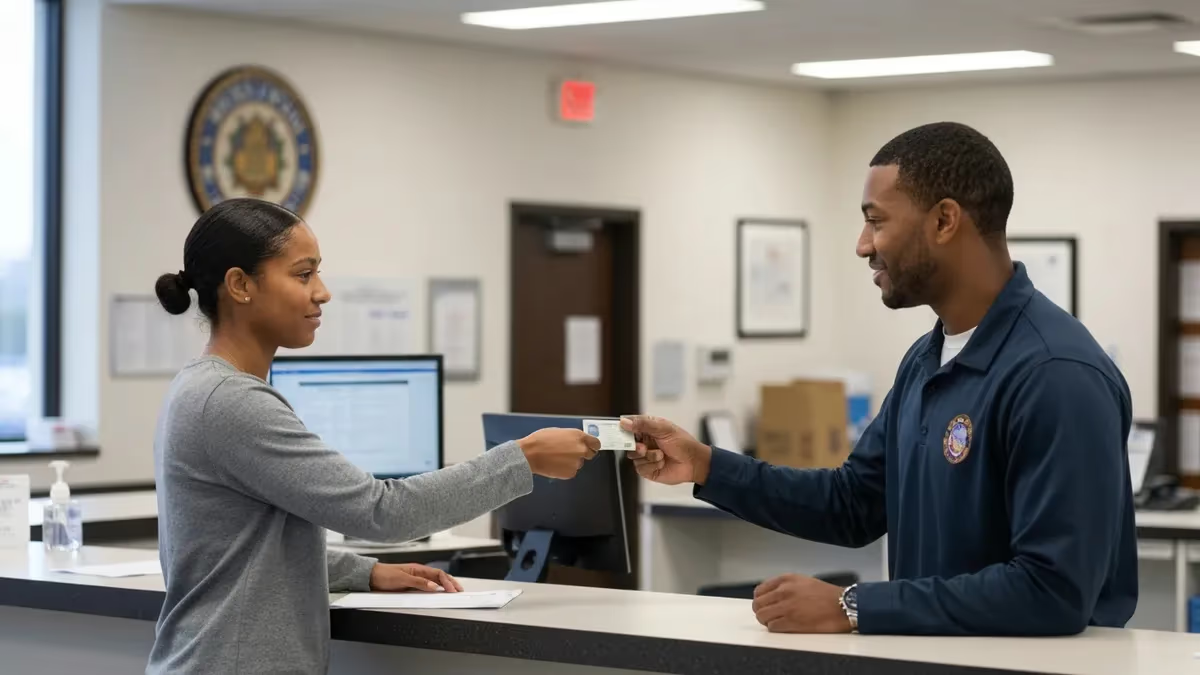
Understanding how to schedule a DMV permit test is one of the first steps on your path toward working as a DMV customer service representative — a role that sits at the intersection of public service, regulatory compliance, and everyday driver education.
Across the United States, DMV offices process millions of permit applications each year, and the representatives who guide applicants through that process must have a thorough working knowledge of every stage: from appointment booking to road-test readiness. Whether you are preparing for your own permit exam or training to assist others, knowing the scheduling process inside and out is essential.
A DMV customer service representative handles far more than handing out forms. On any given shift, they verify identity documents, explain eligibility rules, collect fees, schedule appointments, and answer detailed questions about vehicle registrations, license classes, and safety standards. Because their work directly affects public safety on the roads, DMV agencies hold their staff to high standards of accuracy and professionalism. Many states require representatives to pass a written civil-service or agency-specific exam before being hired, and ongoing training is a regular part of the job.
The demand for knowledgeable DMV staff continues to grow as populations expand and vehicle ownership increases. The Bureau of Labor Statistics classifies most DMV customer service roles under the broader category of license clerks and examiners, a field that employs tens of thousands of workers nationwide. States such as California, Texas, New York, and Florida alone employ thousands of DMV representatives, making this one of the more stable career tracks in state government. Understanding how permit tests are scheduled — and what happens on test day — gives aspiring representatives a concrete foundation to build upon.
For applicants coming in to take a permit exam, the scheduling process varies by state but follows a consistent pattern: gather required documents, pay the applicable fee, and reserve a time slot either online, by phone, or in person. DMV customer service representatives must be able to walk applicants through each of those steps without hesitation, answer follow-up questions about what to bring, and troubleshoot common problems like missing documents or expired identification. Practicing this knowledge through realistic scenario-based questions is one of the most effective ways to prepare.
If you are studying for a DMV representative exam, you will quickly discover that permit test scheduling is only one slice of a much broader knowledge base. Representatives must also understand vehicle inspection protocols, consumer protection regulations, dispute resolution procedures, and accessibility requirements for applicants with disabilities. The practice quizzes available on PracticeTestGeeks are organized by these exact content domains, so you can target your weak areas efficiently. Before you dive into the components of the job, consider reviewing a solid dmv permit test schedule resource to ground your study plan in real exam content.
This article is organized as a comprehensive career-and-process guide. You will find sections covering the specific duties of a DMV representative, the step-by-step scheduling workflow for permit tests, the pros and cons of working in this field, a practical checklist for exam day, and a detailed FAQ covering the questions applicants ask most often. Each section is designed both for job seekers who want to enter the field and for current representatives who want to sharpen their customer-facing knowledge. Read through from start to finish for the fullest picture, or jump to the section most relevant to your immediate goal.
No matter where you are in your career journey — considering a DMV representative role, actively studying for the civil-service exam, or already on the job and wanting to better serve permit applicants — this guide provides actionable, accurate information. The scheduling systems, fee structures, and document requirements described here reflect current best practices across major U.S. states. Where specific states differ significantly, those differences are noted so you can adapt the general framework to your local context.
DMV Customer Service Representative by the Numbers

How to Schedule a DMV Permit Test: Step-by-Step
Gather Required Documents
Pay the Application Fee
Choose a Scheduling Method
Select Date, Time & Location
Confirm & Prepare for Test Day
Arrive & Complete the Test
A skilled DMV customer service representative must possess a wide and surprisingly deep knowledge base. On the surface, the job appears to be about processing paperwork, but the reality is that representatives serve as the primary point of contact for the public on some of the most consequential administrative decisions in a person's life — getting a first driver's license, registering a new vehicle, or resolving a suspended license. Each of these interactions requires not just procedural knowledge but also the ability to communicate clearly, empathize with frustrated customers, and apply judgment when situations fall outside the standard script.
Knowledge of consumer protection is particularly important. DMV representatives must understand what rights applicants have when they disagree with an agency decision, how to file a formal complaint, and what the agency's obligations are under state administrative law. In many states, a representative who mishandles a dispute can trigger an administrative appeal, a formal hearing, or even litigation. Training in dispute resolution — including de-escalation techniques and proper documentation practices — is therefore a core competency for anyone working at a DMV counter.
Vehicle inspection and safety standards represent another major content area. Representatives frequently answer questions about what vehicles must pass a state inspection to be registered, what emissions standards apply in their county or region, and what exemptions exist for antique or out-of-state vehicles. In states with stringent emissions programs such as California, New York, and Colorado, representatives must be familiar with the OBD-II diagnostic requirements and know how to advise customers whose vehicles have failed inspection on the available remediation paths.
License classification is a topic that trips up many new representatives. The difference between a Class A, B, and C commercial driver's license (CDL), the endorsements required for passenger transport or hazardous materials, and the restrictions that apply to learner's permits versus full licenses are all questions that come across the counter daily. Representatives who can answer these questions confidently and correctly reduce the need for supervisory escalations and create a much smoother experience for applicants who are often anxious or confused about the process.
Accessibility and accommodation rules are increasingly important as well. The Americans with Disabilities Act (ADA) requires DMV offices to provide reasonable accommodations for applicants with disabilities, including accessible testing formats, sign language interpretation, and alternative scheduling options. Representatives must know the accommodation request process, understand what documentation is required, and be able to explain options without making applicants feel singled out or burdened. This is both a legal requirement and a core element of quality public service.
Technology fluency is a growing expectation for DMV representatives. Most modern DMV offices use integrated computer systems that pull together motor vehicle records, identity verification databases, and payment processing in a single interface. Learning to navigate these systems quickly and accurately — while also maintaining eye contact and a professional demeanor with the customer standing at the counter — is a skill that takes weeks to develop and months to master. New hires typically receive structured onboarding training, but self-study and practice are what separate good representatives from great ones.
For those preparing for the DMV representative civil-service exam, the breadth of this knowledge base can feel overwhelming. The most effective strategy is to break the material into focused topic areas and practice each one systematically. Consumer protection, vehicle safety standards, license classifications, ADA accommodations, and scheduling procedures should each get dedicated study time. Using targeted practice quizzes — organized exactly the way the real exam is structured — accelerates retention and helps you identify gaps before test day.
How Do I Speak to a DMV Representative in NY and Other States?
In New York, the primary way to speak to a DMV customer service representative is through the NY DMV Contact Center, reachable at 1-518-486-9786 during business hours, Monday through Friday. The automated phone system routes callers based on their inquiry type — license, registration, permits, or tickets — before connecting them to a live representative. Wait times vary significantly by time of day; calling early in the morning or on Wednesdays typically yields shorter holds than peak Monday-morning traffic.
New York also allows in-person service at any of its regional DMV offices, which are located in every county across the state. Appointments are strongly recommended and can be booked at dmv.ny.gov. Walk-ins are accepted at some offices for limited transaction types, but permit test appointments almost always require advance scheduling. Applicants who need language assistance can request an interpreter at the time of booking; NY DMV supports more than 30 languages through its telephonic interpretation service.
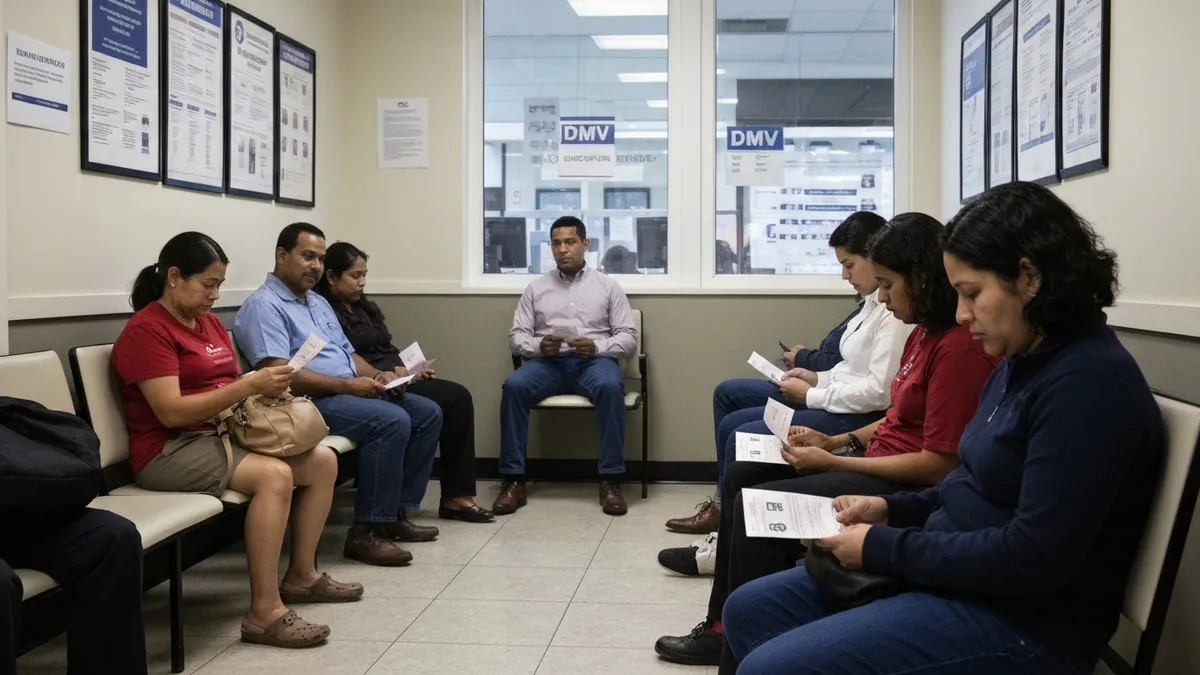
Pros and Cons of Working as a DMV Customer Service Representative
- +Stable government employment with strong job security and recession resistance
- +Comprehensive benefits packages including health insurance, pension, and paid leave
- +Regular weekday hours with no evenings or weekends required in most offices
- +Clear career advancement pathways through civil-service promotion tracks
- +Meaningful public service role that directly helps community members navigate important life tasks
- +Structured onboarding and ongoing training provided by the agency at no personal cost
- −Dealing with frustrated or hostile customers is a daily reality that requires consistent emotional resilience
- −Salary growth can be slow due to union pay scales and budget constraints in many states
- −Repetitive tasks and high transaction volumes can contribute to burnout over time
- −Strict procedural requirements leave limited room for personal judgment or creativity
- −Some offices are understaffed, increasing workload and pressure on existing representatives
- −Technology systems at many DMV offices are outdated, making certain tasks slower and more cumbersome than necessary
Pros and Cons at a Glance
| Pros | Cons |
|---|---|
| Stable government employment with strong job security and recession resistance | Dealing with frustrated or hostile customers is a daily reality that requires consistent emotional resilience |
| Comprehensive benefits packages including health insurance, pension, and paid leave | Salary growth can be slow due to union pay scales and budget constraints in many states |
| Regular weekday hours with no evenings or weekends required in most offices | Repetitive tasks and high transaction volumes can contribute to burnout over time |
| Clear career advancement pathways through civil-service promotion tracks | Strict procedural requirements leave limited room for personal judgment or creativity |
| Meaningful public service role that directly helps community members navigate important life tasks | Some offices are understaffed, increasing workload and pressure on existing representatives |
| Structured onboarding and ongoing training provided by the agency at no personal cost | Technology systems at many DMV offices are outdated, making certain tasks slower and more cumbersome than necessary |
DMV Permit Test Day Checklist for Representatives and Applicants
- ✓Confirm your appointment online or by phone the day before and bring your confirmation number.
- ✓Bring a valid primary identity document such as a U.S. birth certificate, passport, or permanent resident card.
- ✓Include your Social Security card or a document showing your full Social Security number.
- ✓Carry two separate proofs of current state residency such as utility bills or bank statements dated within 60 days.
- ✓Bring the required permit application fee in cash, check, or debit/credit card — verify accepted payment methods in advance.
- ✓If under 18, carry a signed and notarized parental or guardian consent form.
- ✓Arrive at least 10–15 minutes early to allow time for document verification at the counter.
- ✓Review the state driver handbook the night before, focusing on road signs, right-of-way rules, and speed limits.
- ✓Avoid peak hours (Monday mornings, lunch hours, end of month) if scheduling a walk-in visit.
- ✓Know the passing score threshold for your state — most require 70–80% correct answers on the knowledge test.
Consumer Protection Is the Highest-Weighted Topic on Most DMV Rep Exams
Across states that publish civil-service exam blueprints, consumer protection and dispute resolution typically accounts for 25–35% of the total question pool. Applicants who focus their early study time on understanding applicant rights, agency complaint procedures, and formal appeal processes tend to outperform those who concentrate only on vehicle codes and license classifications. Use the PracticeTestGeeks consumer protection quizzes to build this foundation early.
Preparing for the DMV customer service representative exam requires a structured, multi-week study plan rather than a last-minute cramming session. The exam typically covers five to seven distinct content domains, each weighted differently in the total score. Consumer protection and dispute resolution usually carries the heaviest weight, followed by vehicle inspection and safety standards, license classification and issuance, records management, and customer service best practices. Understanding this weighting helps you allocate your study time proportionally rather than spending equal hours on every topic regardless of its exam impact.
Practice testing is the single most evidence-backed study strategy for standardized exams. Research in cognitive psychology consistently shows that retrieving information from memory — as you do when answering practice questions — produces stronger long-term retention than rereading notes or highlighting text. This phenomenon, known as the testing effect or retrieval practice, means that spending 60% of your study time on practice questions and 40% on content review will produce better results than the reverse. The PracticeTestGeeks quiz sets are designed with this in mind, presenting questions in the same format and difficulty level as the real civil-service exam.
Spaced repetition is the second major pillar of an effective study plan. Rather than studying a topic intensively for one long session and then not returning to it for weeks, spaced repetition has you revisit material at gradually increasing intervals — for example, reviewing consumer protection rules on day 1, day 3, day 7, and day 14.
This approach takes advantage of how the brain consolidates memories during sleep and rest periods, making each review session more efficient than the last. Many commercial flashcard apps support spaced repetition scheduling automatically, and you can supplement them with the timed practice tests on PracticeTestGeeks for realistic exam simulation.
Time management during the actual exam is a skill that many candidates underestimate. Civil-service exams for DMV representatives typically allow between 90 minutes and three hours for 80 to 150 questions, depending on the state. That gives you roughly 60 to 90 seconds per question, which feels generous until you encounter a scenario-based question that requires you to reason through a three-step customer interaction before selecting an answer.
Practicing under timed conditions — setting a stopwatch and committing to moving on from any question after 90 seconds — trains you to pace yourself and avoid the trap of spending five minutes on a single hard question while easier ones wait unanswered.
Reading the driver handbook for your state is non-negotiable preparation even if you have years of driving experience. The handbook contains the exact content that both the permit test and the representative exam draw from, and it is updated annually to reflect legislative changes in traffic law. Pay particular attention to sections on graduated driver licensing (GDL) restrictions for teen drivers, the rules governing learner's permits vs. probationary licenses, and any recently enacted laws around distracted driving or autonomous vehicle regulations. These are exactly the areas where exam questions tend to cluster because they reflect current policy priorities.
Group study can accelerate preparation significantly when done well. Pairing with one or two other candidates preparing for the same exam allows you to quiz each other on weak areas, share mnemonic devices for remembering complex rules, and stay accountable to a study schedule.
The key is ensuring that group sessions remain focused on active recall rather than passive discussion — the goal is to be tested by your partners, not simply to talk through material together. Set a timer, rotate who plays examiner, and debrief incorrect answers as a group to understand why the right answer is correct rather than just which answer is correct.
Finally, physical and mental preparation on the days leading up to the exam matters more than most candidates realize. Sleep deprivation reduces working memory capacity, slows processing speed, and increases error rates — all of which compound on a timed multiple-choice exam. Aim for seven to nine hours of sleep the two nights before test day.
Eat a balanced breakfast on exam morning, avoid excessive caffeine that could heighten anxiety, and arrive at the testing location with time to spare. Walking into the exam calm and well-rested, with weeks of structured practice behind you, is the combination that produces passing scores consistently.
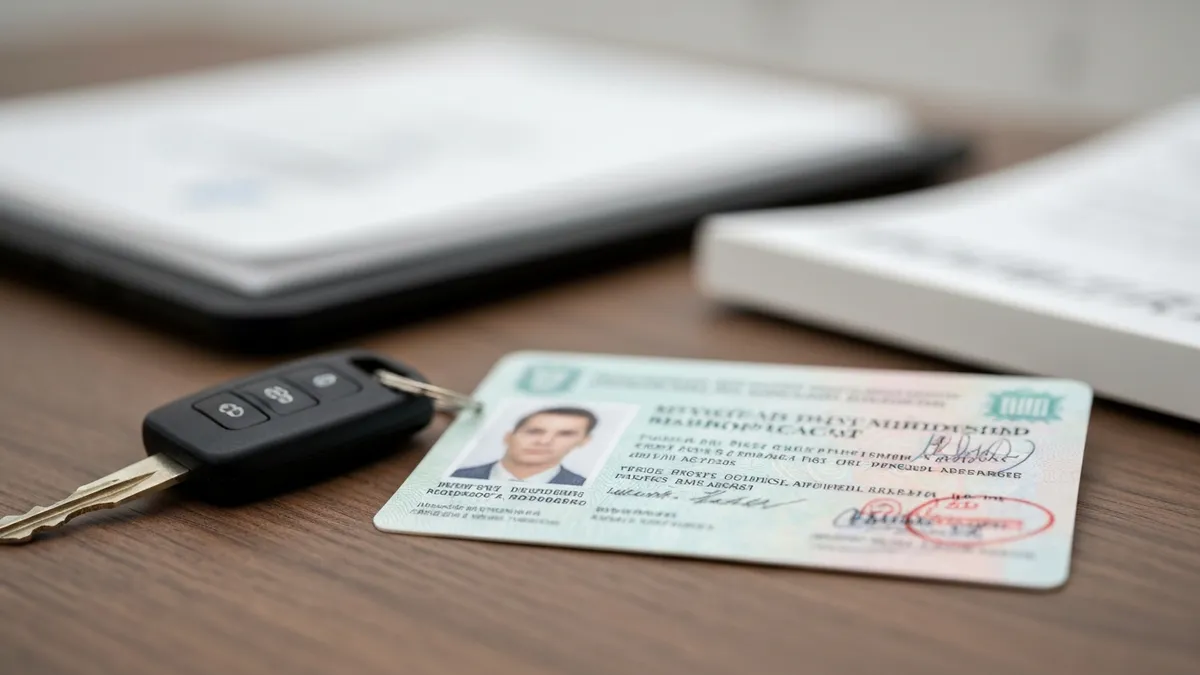
The minimum age to apply for a learner's permit ranges from 14 years old in states like Alaska, Arkansas, Iowa, Kansas, and North Dakota to 16 years old in states including California, New York, and New Jersey. DMV customer service representatives must know their state's specific age threshold, parental consent rules, and any pre-permit requirements such as mandatory driver education enrollment. Providing incorrect eligibility information to an applicant can result in a wasted trip and a formal complaint against the representative.
Career growth for a DMV customer service representative follows a well-defined civil-service ladder in most states, with promotions tied to a combination of tenure, performance evaluations, and competitive exams. Entry-level representatives typically start as DMV Technician I or License Examiner I positions, depending on the state's classification system. After one to three years of satisfactory performance reviews, they become eligible to take the promotional exam for Technician II or Senior Examiner, which brings a pay increase of roughly 10 to 15 percent and expanded responsibilities such as training new hires and handling escalated customer issues.
Supervisory roles such as DMV Office Supervisor or Branch Manager open up after five to eight years of service and represent a significant jump in both compensation and responsibility. Supervisors oversee a team of five to twenty representatives, manage daily workflow and staffing allocations, handle complex customer complaints, conduct performance reviews, and liaise with the regional or district manager on policy implementation. In many states, the supervisory exam covers personnel management, labor law basics, budgeting fundamentals, and advanced knowledge of motor vehicle regulations — a notably broader scope than the frontline representative exam.
Specialization is another avenue for career advancement within the DMV system. Some representatives transition into investigative roles, working on license fraud detection, title fraud, and odometer rollback cases. Others move into driver safety programs, conducting behind-the-wheel road tests and administering skills assessments rather than knowledge tests. A growing number of DMV agencies also have dedicated accessibility coordinators who ensure that all services comply with ADA requirements — a role that combines regulatory knowledge with advocacy and communication skills.
For those interested in moving beyond the DMV itself, the skills developed as a customer service representative transfer well into broader state government careers. Experience in document verification, identity management, public-facing service delivery, and regulatory compliance is valued by agencies such as the Department of Revenue, Social Services, and State Police. Many DMV employees use their civil-service status as a springboard into roles with higher salaries and greater specialization by transferring laterally to another agency rather than waiting for a promotion within the DMV structure.
Salary increases tied to geographic location are worth understanding if you have flexibility in where you work. DMV representatives in high cost-of-living metro areas such as San Francisco, New York City, Seattle, and Washington D.C. typically earn 20 to 40 percent more than their counterparts in rural areas of the same state, reflecting both the higher local cost of living and the greater complexity of urban office operations where transaction volumes are higher and cases are more varied.
If salary is a priority in your career plan, researching the pay scales for specific counties or regional offices before applying can make a meaningful difference in your total compensation.
Professional development resources are more abundant now than at any prior point in the history of public motor vehicle administration. The American Association of Motor Vehicle Administrators (AAMVA) offers training courses, webinars, and certification programs for DMV professionals at all career levels. These programs cover emerging topics such as digital identity verification, REAL ID compliance, connected and autonomous vehicles, and cybersecurity for motor vehicle data systems. Representatives who pursue AAMVA credentials signal to their supervisors a commitment to the profession that stands out during promotion cycles and performance reviews.
The long-term outlook for DMV employment is positive despite ongoing investments in online service delivery. While routine transactions like renewals and address changes increasingly migrate to self-service portals, complex, exception-heavy cases — fraudulent documents, suspended licenses, accessibility accommodations, and commercial licensing — continue to require human judgment and will keep skilled representatives employed for the foreseeable future. States are also investing in modernizing their DMV offices, which means representatives who embrace new technology and adapt quickly to updated systems will be most competitive for supervisory and specialist roles in the years ahead.
Practical preparation for the DMV customer service representative exam goes beyond simply reading the right materials. The candidates who consistently pass on their first attempt share a common set of habits: they start studying at least six weeks before the exam date, they use practice questions from day one rather than saving them for the final week, and they track their performance by topic area so they can identify and address weaknesses systematically.
If your practice scores on consumer protection questions are hovering around 65 percent while your vehicle safety scores are above 85 percent, that data tells you exactly where your next study session should focus.
Understanding the test format before you sit for the actual exam reduces anxiety and improves performance. Most DMV representative civil-service exams are administered either at a state testing center or online through a proctored remote platform. Questions are multiple-choice with four options, and there is no penalty for guessing — meaning you should always mark an answer even when uncertain. Some exams include scenario-based questions that present a realistic customer service situation and ask you to choose the best response, which requires not just factual recall but also judgment about professional conduct and regulatory compliance.
Reading answer choices carefully is one of the most consistently useful test-taking strategies. Civil-service exams frequently include distractors — incorrect answers that are partially true or that apply in a slightly different context than the one described in the question.
Training yourself to read all four options before selecting one, even when the first option looks obviously correct, prevents the common mistake of choosing a partially true answer over a fully correct one. This habit is especially important on scenario-based questions where two or three of the options may describe acceptable actions but only one represents the best practice under the agency's written policy.
Physical test center logistics deserve attention in your preparation plan. Know exactly where the testing location is and how long it takes to get there during the time of day your exam is scheduled. Arrive with a government-issued photo ID, your exam confirmation number, and any materials explicitly permitted by the exam administrator.
Most civil-service exams are closed-book with no notes, calculators, or electronic devices allowed. Personal items are typically stored in a locker outside the testing room. Understanding these logistics in advance means you can focus your mental energy on the exam itself rather than on navigating an unfamiliar environment.
After passing the representative exam, the real learning begins on the job. Experienced colleagues are your most valuable resource in the first three to six months. Do not hesitate to shadow a senior representative when a complex situation arises, ask supervisors to review your document verification decisions on ambiguous cases, and debrief any customer complaint or escalation to understand what went wrong and how the situation could have been handled better. The DMV environment moves fast, but agencies generally support new hires with a learning curve period during which mistakes are treated as training opportunities rather than disciplinary events.
For applicants coming to the DMV to take a permit test, the advice is similar in spirit: preparation beats last-minute cramming, practice tests beat passive reading, and understanding the process reduces the anxiety that causes avoidable errors on test day. A well-prepared applicant who arrives with correct documents, adequate fees, and solid knowledge of road rules will complete the permit process in under an hour. A representative who guided hundreds of applicants through this same process knows exactly what to expect and can make the experience smooth and efficient for everyone involved.
The connection between understanding the permit scheduling process and succeeding as a DMV representative runs deeper than it might first appear. Representatives who have personally navigated the permit test experience — or who have studied it exhaustively — develop a genuine empathy for the applicants they serve.
They remember what it felt like to be uncertain about which documents to bring, anxious about the test questions, or confused about what happens if you fail. That empathy translates into clearer explanations, more patient interactions, and ultimately a better experience for the public. It is one of the qualities that distinguishes an average representative from an exceptional one.
Sample DMV - Representative Exam Practice Questions
Try these questions from our free DMV - Representative Exam practice tests. The correct answer and an explanation follow each question.
A customer is purchasing a used vehicle from a licensed California dealer and asks about the optional 2-day contract cancellation agreement. In which of the following scenarios is the dealer prohibited from offering this option?
- A. The customer is buying a 3-year-old sedan with a purchase price of $25,000.
- B. The customer is financing the entire purchase through a credit union.
- C. The customer is purchasing a used sports car with a negotiated price of $45,000.
- D. The customer is trading in a vehicle as part of the transaction.
Answer: C. The customer is purchasing a used sports car with a negotiated price of $45,000.
Under the California Car Buyer's Bill of Rights, the optional contract cancellation agreement can only be offered on used vehicles with a purchase price of less than $40,000. Since the sports car's price is $45,000, it is not eligible for the option.
When a customer trades in a vehicle with negative equity (owing more than it's worth), how must this be handled on the retail installment sale contract in California?
- A. It should be added to the cash price of the new vehicle without separate disclosure.
- B. It must be clearly and conspicuously disclosed as a separate line item.
- C. The dealer can absorb the cost into the overall financing without itemizing it.
- D. It is illegal to proceed with a sale if the trade-in has negative equity.
Answer: B. It must be clearly and conspicuously disclosed as a separate line item.
California law requires that any negative equity on a trade-in vehicle be disclosed separately and transparently on the sales contract. It cannot be concealed by adjusting the vehicle's price or the trade-in allowance. This ensures the buyer understands the total amount being financed.
A customer complains to the DMV that a dealer refused to sell them a vehicle at the advertised price. Which of the following scenarios represents an unlawful act by the dealer?
- A. The advertisement clearly stated the price was valid only for a 24-hour sale that ended the previous day.
- B. The dealer refused to sell at the advertised price because the customer had poor credit and could not secure financing.
- C. The dealer refused to sell at the advertised price unless the customer also purchased an extended service contract.
- D. The advertisement for a specific vehicle included its VIN, and the vehicle was sold just before the customer arrived.
Answer: C. The dealer refused to sell at the advertised price unless the customer also purchased an extended service contract.
It is unlawful to fail to sell a vehicle at the advertised total price while the vehicle remains unsold. Tying the sale to the purchase of an additional, optional product like an extended service contract is a prohibited practice. A dealer must sell the vehicle at the advertised price to any willing buyer, exclusive of specified taxes and fees, without requiring the purchase of other goods or services.
A vehicle owner's registration expired 25 days ago. According to California DMV penalty schedules, what percentage of the vehicle license fee and weight fee will be added as a penalty?
- A. 10%
- B. 20%
- C. 40%
- D. 60%
Answer: B. 20%
If registration renewal fees are paid between 11 and 30 days after the expiration date, the penalty includes 20% of the annual vehicle license fee and 20% of the weight fee, if applicable.
DMV Questions and Answers

DMV Customer Service Representative: Complete Career Guide & Permit Test Practice

DMV Drivers License: Application, Tests, REAL ID and Renewals

Colorado DMV Walk-In Locations: How to Talk to a DMV Customer Service Representative

What Are 6 Points of ID for NJ DMV: Complete Guide to New Jersey ID Requirements

DMV License Plate Renewal: Complete Guide to Renewing Your Tabs, Stickers and Registration (2026)
About the Author
Licensed Driving Instructor & DMV Test Specialist
Penn State UniversityRobert J. Williams graduated from Penn State University with a degree in Transportation Management and has spent 20 years as a certified driving instructor and DMV examiner consultant. He has personally coached thousands of applicants through written knowledge tests, skills assessments, and commercial driver licensing programs across more than 30 states.
Join the Discussion
Connect with other students preparing for this exam. Share tips, ask questions, and get advice from people who have been there.
View discussion (8 replies)